The sound of thick cardstock folding in half was louder than Marcus Bennett expected. It cracked across the marble reception hall just as fourteen high school students behind him went silent. For nearly two years, Marcus had helped those teenagers fill out forms, collect birth certificates, practice interviews, raise travel money, and survive the endless small disappointments that came with competing for an international youth exchange. Now the blue diplomatic folder containing their final visa confirmations was bent between the hands of an embassy intake clerk who looked at Marcus as though he had carried garbage into a formal reception. “These seats were not meant for people who need sponsors,” the clerk said, pressing another crease into the folder. “You people keep thinking a scholarship means you can walk in here and demand the same treatment as everyone else.”
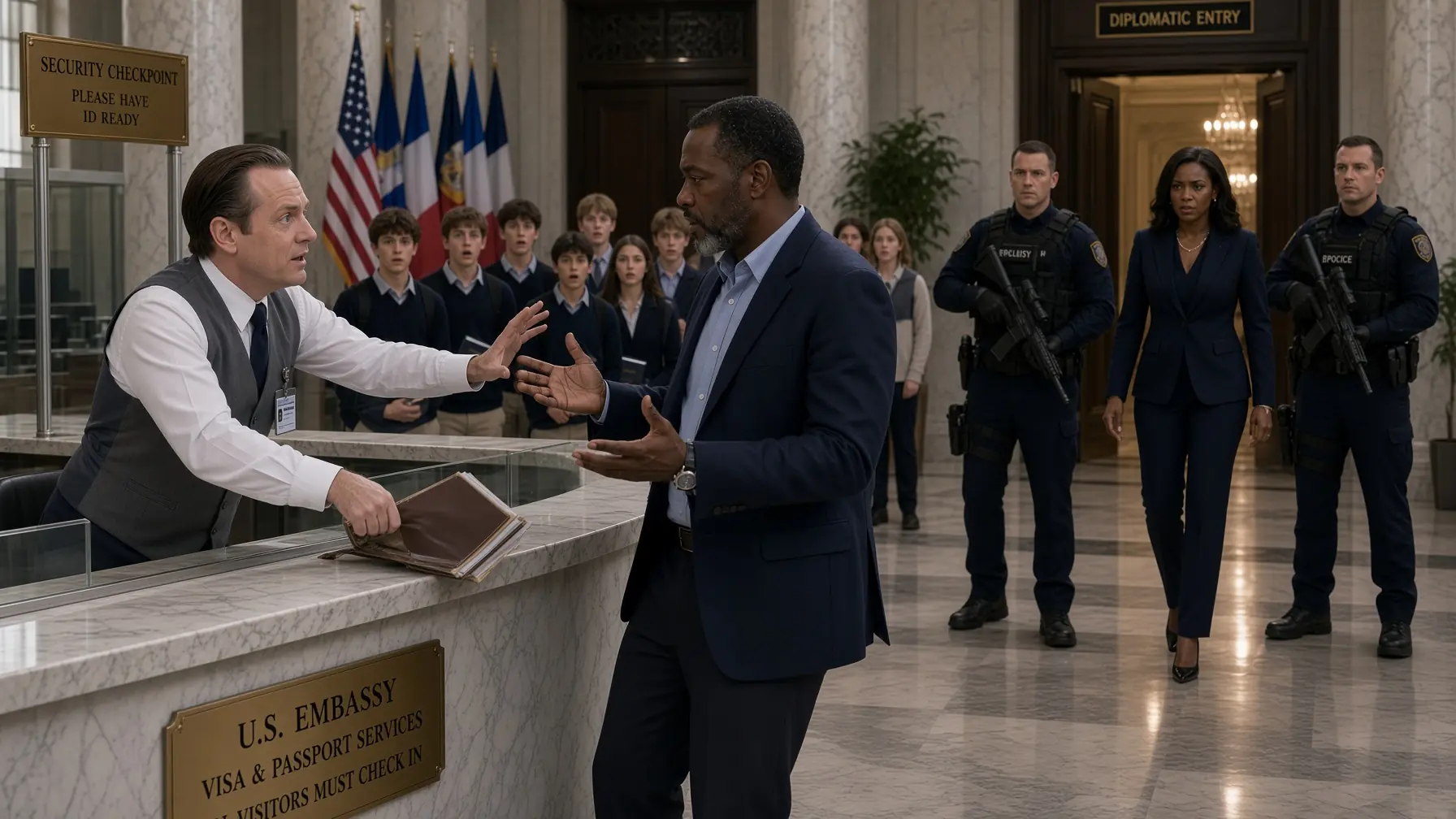
Marcus did not shout. He did not reach across the counter. He had learned long ago that when someone wanted an excuse to call you aggressive, anger could become a gift you handed them. At fifty-six, he was a broad-shouldered Black man with graying hair at his temples, a navy blazer polished shiny at the elbows, and a calm voice his students jokingly called his principal voice even though he had never been a principal. He raised both palms and said, “Sir, the visas have already been approved. We are here for the Youth Bridges orientation at ten. The appointment confirmation is inside that folder.” The clerk, Gregory Hale, leaned forward with a cold smile. “I know what you think is inside it.”
Marcus stared at him. “You opened it.”
“I reviewed what you brought.”
“Then you saw the appointment letter.”
“I saw a sponsorship packet.”
“It is an embassy-funded exchange.”
Gregory shrugged. “That does not mean this desk has to process you.”
Behind Marcus, sixteen-year-old Isaiah Grant tightened both hands around his passport. Beside him, Tiana Lewis stared at the floor, the excitement she had carried into the embassy thirty minutes earlier almost completely gone. The students had dressed as if attending graduation. Boys wore borrowed jackets and ties. Girls wore carefully pressed dresses, skirts, or suits. One student had shoes half a size too large because his uncle had lent them for the day. They had taken photographs outside the embassy gates before security screening, all of them holding the small program badges Marcus had printed the night before. Now those badges seemed childish under Gregory’s stare.
A security guard near the outer checkpoint glanced over but did not move. What was happening did not yet look like an emergency. No one was screaming. No weapon had appeared. From thirty feet away it could have passed for an administrative disagreement between a clerk and a visitor. That was part of what gave Gregory confidence. He had worked the public-registration desk for six years as a locally hired administrative employee under a government services contract, and he understood exactly how much authority people imagined the glass counter gave him. He could not approve or deny a visa. He could not cancel the Youth Bridges program. He could not change a consular adjudication. What he could do was control who received a visitor badge, whose documents moved to the next desk, and how long a nervous family stood beneath the fluorescent lights wondering whether one wrong word might destroy months of preparation.
Marcus had encountered men like him before. People who possessed a narrow piece of power and expanded it in their imagination until everyone standing on the other side of a counter seemed dependent on their mood. He tried once more. “Please call Public Diplomacy. Ask for Ms. Patel or Mr. Hernandez. Our group is listed as East Harbor Youth Initiative, fourteen students, two adult coordinators. We were instructed to arrive at nine-thirty for a ten o’clock orientation.”
Gregory tapped the bent folder against the counter. “You’re late.”
Marcus looked at the clock above the security station.
9:34.
“Our appointment is at ten.”
“Groups are expected thirty minutes early.”
“We arrived at nine-twenty-two.”
Gregory smiled. “You weren’t registered at nine-twenty-two.”
“Because you have been holding us here.”
Several students looked at one another.
Gregory’s face changed.
It was subtle, but Marcus saw it.
The facts were becoming less important than the fact that Marcus had said them aloud.
“Watch your tone,” Gregory said.
“My tone is fine.”
“That is not for you to decide.”
Marcus took a slow breath. “I am asking you to verify our appointment.”
“And I am telling you this is an executive reception morning. We have donors, private delegations, and official guests moving through this floor. I am not sending a sponsored youth group upstairs just because somebody printed a letter.”
Marcus looked at the badge clipped to Gregory’s shirt.
“Mr. Hale, the letter has an embassy control number.”
Gregory leaned back.
“You think I don’t know what an embassy letter looks like?”
“No. I think you’re refusing to check one.”
That was when Gregory stepped out from behind the desk.
The students moved instinctively closer together.
Marcus remained still.
Gregory stopped directly in front of him. He was a little shorter than Marcus, perhaps forty-eight, with close-cropped blond hair and a burgundy tie that matched the embassy’s event-day staff dress code. “You are becoming disruptive,” he said.
Marcus glanced around the almost silent lobby.
“I am speaking at normal volume.”
“You are refusing instructions.”
“What instruction?”
“To leave.”
Marcus paused.
“You never told us to leave.”
“I am telling you now.”
Marcus looked toward the students.
Several had gone pale.
He turned back. “We will leave if an authorized program officer tells us our appointment is canceled. You are an intake clerk. Please call the office listed on our confirmation.”
The mistake was not in what Marcus said.
The mistake, in Gregory’s mind, was saying intake clerk.
The title was accurate.
Gregory heard humiliation.
He shoved Marcus in the chest.
It was not a dramatic punch. There was no winding swing, no cinematic impact. Just both hands against Marcus’s blazer and one sudden push strong enough to make him stumble backward into the brass stanchion separating the registration line from the seating area.
A girl screamed.
Marcus caught himself before falling.
Every student froze.
The security guard at the outer checkpoint immediately started walking toward them.
Marcus straightened.
“Do not touch me again.”
Gregory pointed toward the exit.
“Take your group and get out.”
“You just put your hands on me.”
“And you were crowding my workstation.”
“I was standing where you told me to stand.”
“You were refusing to move.”
Marcus looked toward the ceiling.
A camera covered the desk.
Then another.
Good.
He said nothing else about the shove.
Gregory mistook the silence for surrender.
He returned behind the counter, picked up the folder, and flipped through the pages. Fourteen approved visa confirmations. Fourteen orientation notices. Health forms. Emergency contacts. A signed grant letter from the embassy’s Public Diplomacy Section confirming that the Youth Bridges Fellowship covered airfare, housing, local transportation, and program tuition for all fourteen students.
Gregory stopped at the grant letter.
His lip curled.
“There it is.”
Marcus frowned.
“What?”
“Full sponsorship.”
“Yes.”
Gregory laughed quietly.
“You brought fourteen kids into an embassy executive reception on government money and expected nobody to notice?”
Marcus stared at him.
“The exchange exists to sponsor students who could not otherwise afford it.”
“That’s not what these mornings are for.”
“What mornings?”
Gregory gestured toward the inner doors. “There are donors arriving. Board people. Government delegations. Families who paid their own way.”
Marcus looked at the fourteen students.
Then back at Gregory.
“These children were selected through the embassy’s own competition.”
Gregory lowered his voice.
“Selected does not mean they belong everywhere.”
Marcus’s face changed.
For the first time, anger became visible.
Not loud.
Not uncontrolled.
Just present.
“What exactly does that mean?”
Gregory looked at the students, most of them Black, several Latino, two Asian American, all from neighborhoods served by Marcus’s community nonprofit.
Then he looked at Marcus.
“You know what it means.”
“No.”
Marcus stepped slightly closer to the counter.
“I would like you to say it clearly.”
The security guard reached them.
“Everything okay?”
Gregory answered immediately.
“This gentleman is refusing to leave a restricted registration area.”
Marcus looked at the guard. “Our group has a confirmed ten o’clock appointment. He refuses to verify it. He also shoved me.”
The guard turned toward Gregory.
“Did you touch him?”
Gregory’s expression hardened.
“He moved toward the desk.”
Marcus shook his head.
“The cameras will answer that.”
The guard looked upward.
That was enough to make Gregory uncomfortable.
He pointed toward Marcus. “This is exactly the problem. Every simple instruction becomes an argument. They come in here already looking for discrimination.”
The students heard it.
Marcus heard it.
The guard heard it too.
Marcus said quietly, “I have not accused you of discrimination.”
Gregory gave a bitter laugh.
“Not yet.”
“No.”
Marcus looked at the bent folder.
“I’ve asked you to check a schedule.”
Gregory picked up the folder with one hand.
“Fine.”
He held it over the trash bin beside his desk.
“Here’s your schedule.”
Several students gasped.
Marcus’s voice changed.
“Do not throw away those documents.”
Gregory smiled.
“They’re copies.”
“They contain passport information and protected student records.”
That stopped the security guard.
“Gregory, put the folder down.”
Gregory looked toward him.
“Stay in your lane.”
The guard’s expression hardened.
“My lane includes document security.”
Gregory held the folder above the bin anyway.
Marcus did not reach for it.
That restraint cost him.
Everything inside him wanted to take those papers out of Gregory’s hand, straighten every crease, and tell the students they had not spent two years preparing just to watch one arrogant man erase the morning. Instead he stood still because fourteen teenagers were watching how an adult behaved when authority became unfair.
“Mr. Hale,” Marcus said, “put the folder on the counter and call Public Diplomacy.”
Gregory leaned forward.
“You still think you get to give instructions here.”
“No.”
Marcus kept his eyes on him.
“I think you are about to destroy government records because you’re angry.”
The inner security doors clicked.
Nobody reacted at first.
The sound came from behind the registration hall, where a set of reinforced doors separated the public reception area from the controlled interior of the embassy. One door opened. Two Diplomatic Security officers stepped through first, speaking quietly to someone behind them.
Then a woman appeared.
She was forty-one, Black, tall, with shoulder-length natural curls and a dark blue diplomatic suit. A small American flag pin sat on one lapel. She carried a briefing folder under one arm and walked with the exhausted concentration of someone who had already been in meetings since seven.
Her name was Dr. Naomi Bennett.
She was the embassy’s Deputy Chief of Mission.
Second-ranking diplomat at the post.
And Marcus Bennett’s daughter.
Naomi had not known her father was standing at the public desk.
That was important.
She knew his students were coming to the embassy because she had helped encourage him to apply for Youth Bridges almost two years earlier, but she had deliberately removed herself from every part of their selection. Marcus’s nonprofit competed against thirty-two other organizations. Independent reviewers scored the applications. Consular officers handled visa eligibility. Public Diplomacy managed the exchange. Naomi had even asked that her surname not be highlighted in the group file because neither she nor Marcus wanted teenagers believing their opportunity depended on family influence.
That morning she was heading toward the conference room for a scheduled donor reception when she saw fourteen familiar young faces standing silently near the public desk.
Then she saw her father.
His hands were still slightly raised.
His folder was bent.
Gregory Hale was holding it over a trash can.
Naomi stopped.
One of the security officers beside her noticed.