The first flowerpot broke at 6:13 on a Tuesday morning.
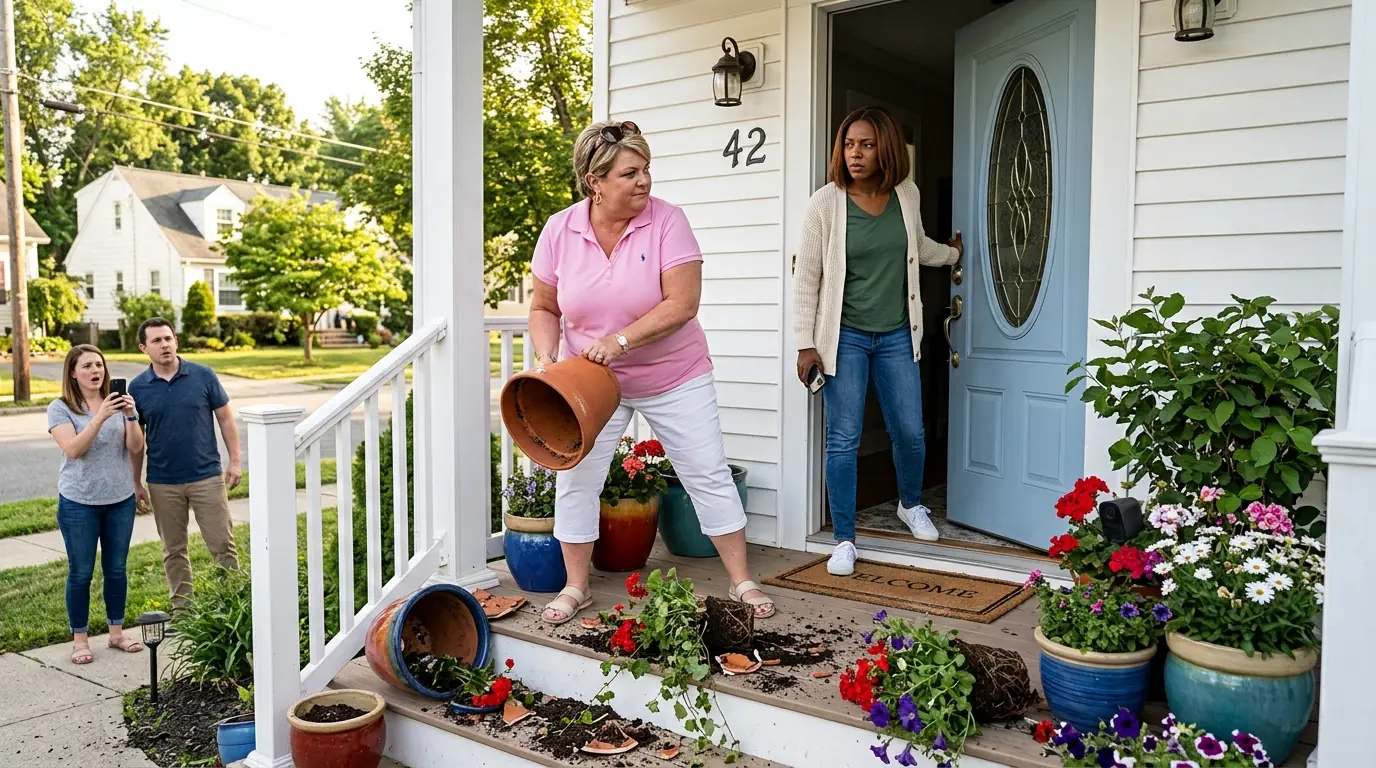
Claire Bennett heard it from the upstairs hallway, a sharp ceramic crack followed by the soft rush of soil spilling across wood. She stopped with one hand on the railing and listened. For half a second, the house went quiet again. Then came another impact, louder this time, followed by the unmistakable scrape of something heavy being dragged across her front porch. By the time Claire reached the window beside the staircase, a third pot had shattered, and the woman responsible was already raising the short-handled garden hammer for another swing.
Susan Pike did not look angry.
That was what Claire would remember later.
Anger might have made the destruction understandable in some primitive way. Susan looked focused. She wore gardening gloves, khaki pants, and a pale green windbreaker zipped neatly to her neck. Her silver-blond hair was tied behind her head. A plastic tote sat beside the porch steps, and inside it Claire could see printed HOA notices, orange violation stickers, and a roll of clear trash bags. Susan was not having a breakdown.
She had come prepared.
The fourth pot broke.
Then the fifth.
Claire watched a terracotta planter that had belonged to her mother split down the middle and collapse around a purple hydrangea they had planted together eight years earlier. The plant rolled sideways, roots exposed, petals pressed against damp soil. Something inside Claire rose so quickly she had to grip the windowsill before doing what every part of her body wanted to do—throw open the door and confront the woman personally.
Instead, Claire reached for her phone.
She recorded.
Not because she was calm.
Because for six months Susan Pike had turned every disagreement into an argument about what could be proven.
Claire had finally learned to stop giving her arguments.
She gave her records.
Outside, Susan moved to the large blue ceramic planter beside the left porch column.
Claire’s breath caught.
That one mattered differently.
The planter itself was not valuable. It had a chipped rim, a faded glaze, and a crack repaired years earlier with marine epoxy. Claire had almost thrown it away twice. Instead, three weeks ago, she had emptied most of its soil, drilled a tiny opening through a section already damaged near the base, then carefully put everything back.
Susan raised the hammer.
Claire whispered, “Go ahead.”
The hammer came down.
Blue ceramic exploded across the porch.
Susan stepped back to avoid the fragments, then kicked the largest piece aside.
She had no idea that buried beneath four inches of potting soil, inside a weatherproof plastic sleeve no larger than two fingers, was a memory card containing the one thing Claire had spent half a year trying to obtain.
Proof.
Six months earlier, Claire had not even known Susan Pike’s name.
She had known the house.
Number 418 Laurel Glen Drive sat across from the bungalow Claire bought in Cedar Hollow, a small planned community outside Raleigh, North Carolina. The neighborhood had been built in phases during the late 1990s and early 2000s, which gave it the strange architectural variety of communities created by several developers pretending they had followed one design. Brick Colonials stood beside vinyl-sided Craftsman houses. Mature oaks shaded narrow streets. The HOA maintained two small ponds, a pool, walking trails, and enough rules to produce a forty-seven-page handbook no sane person could remember completely.
Claire bought 417 Laurel Glen in February.
At forty years old, she had spent most of her adult life renting because homeownership always seemed to move one financial step farther away whenever she approached it. She worked as an occupational therapist at a rehabilitation hospital in Raleigh. The job paid reasonably well, but graduate-school debt, helping her mother through cancer treatment, and years of inflated rent had consumed money faster than she could accumulate it. When her mother died, Claire received a small life-insurance payment and, more importantly, a final instruction written on the inside of an old birthday card.
Buy something that stays when people leave.
Claire used the money for a down payment.
The bungalow was not grand.
Three bedrooms.
One-car garage.
A wide front porch.
Slightly crooked kitchen cabinets.
A backyard with one enormous oak tree and a drainage problem the inspection report described using gentler language than the standing water deserved.
Claire loved it immediately.
Her mother, Evelyn Bennett, had loved plants.
Not sophisticated plants.
She bought what looked cheerful.
Geraniums.
Rosemary.
Mint that escaped every container it touched.
Hydrangeas.
Marigolds.
Her porch in Greensboro had always looked slightly overcrowded, and after Evelyn died, Claire took the surviving pots because throwing them away felt too much like completing a disappearance.
There were twelve when Claire moved to Cedar Hollow.
Two terracotta.
Three glazed ceramic.
Four small herb pots.
One rectangular planter.
One blue pot with the repaired crack.
And a heavy green container Claire’s mother had bought at a roadside stand because, according to Evelyn, “Anything that ugly has earned the right to hold flowers.”
Claire arranged them along the porch railing and steps.
That was how Susan Pike introduced herself.
Not with a welcome basket.
With a clipboard.
It was Claire’s second Saturday in the house. She was kneeling beside the green planter trimming dead leaves when a shadow crossed the porch.
“Claire Bennett?”
Claire looked up.
Susan stood one step below her, smiling.
“Yes?”
“Susan Pike. Landscape and Compliance Committee.”
She said the title as though Claire should recognize it.
Claire stood and brushed soil from her jeans.
“Nice to meet you.”
Susan looked along the porch.
“You moved in quickly.”
“Still moving.”
“I can tell.”
The smile remained.
Claire waited.
Susan pointed toward the pots.
“We generally try to maintain a clean exterior presentation.”
Claire glanced at them.
“Okay.”
“Temporary containers are tolerated in moderation.”
“Tolerated?”
Susan’s smile tightened.
“Our guidelines encourage visual consistency.”
Claire had read the covenants before closing.
She had also spent ten years working in healthcare systems where the difference between policy, recommendation, and somebody’s personal preference could determine whether an insurance company paid for a wheelchair.
“What section?”
Susan blinked.
“Excuse me?”
“What section of the guidelines limits flowerpots?”
Susan looked momentarily surprised.
Then she laughed lightly.
“You're new. Nobody expects you to memorize everything.”
“I read them.”
“Well, there are interpretive standards.”
“Which section?”
Susan’s expression changed.
Not dramatically.
Only enough that Claire noticed.
“I’ll send you the information.”
“Perfect.”
Susan never did.
Three days later, Claire received an email from the HOA.
COURTESY NOTICE: EXCESSIVE FRONT-PORCH DECORATION.
No rule number appeared.
Claire replied politely.
Please identify the covenant, architectural standard, or formally adopted rule applicable to movable flower containers on private porch space.
No response.
A week passed.
Then an orange notice appeared beneath her windshield wiper.
EXTERIOR COMPLIANCE — VISUAL CLUTTER.
Claire photographed it.
Emailed again.
This time Susan answered personally.
The committee has broad discretion to maintain neighborhood appearance. We hope residents will cooperate rather than require formal enforcement.
Claire stared at the sentence for almost a minute.
Then opened the HOA governing documents again.
Broad discretion existed for permanent exterior modifications—paint colors, fences, roofs, sheds, satellite dishes, visible structural work. Temporary patio furniture and planters were regulated only if they blocked walkways, created hazards, or violated common-area restrictions.
Claire’s pots were entirely on her porch.
They blocked nothing.
She sent the relevant pages.
Susan replied fourteen minutes later.
Thank you for your interpretation. The committee will evaluate.
The word interpretation bothered Claire.
Not enough to matter yet.
Then the flowers began dying.
The first was rosemary.
Claire noticed the leaves browning from the tips downward. She assumed overwatering and replaced part of the soil. Three days later, two geraniums wilted simultaneously even though moisture remained normal.
Then the marigolds collapsed.
Claire had never considered herself an expert gardener. Her mother had possessed something closer to intuition. Claire relied on instructions, moisture meters, extension websites, and a willingness to replace plants when she misunderstood them.
But six separate pots did not usually fail together.
She examined for insects.
Nothing obvious.
Root rot?
Possible in one pot.
Not six.
One Saturday, Claire carried a container into the backyard and dumped part of the soil onto a tarp.
There was a smell.
Chemical.
Faint enough she almost dismissed it.
She took a sample.
At work Monday, Claire mentioned it to a rehabilitation technician whose husband worked for a landscaping company. He suggested herbicide contamination but warned her not to assume. Fertilizer burn, salts, cleaners, or contaminated potting mix could produce similar damage.
Claire called the county extension office.
A horticulture agent advised her to preserve samples separately and send them to an appropriate laboratory if she wanted meaningful results.
Claire did.
The result did not provide a courtroom confession.
It showed herbicide residues consistent with a broad-spectrum vegetation-control product in two tested pots at concentrations inconsistent with normal household drift. The lab could not tell Claire who had put it there or exactly when.
Useful.
Not proof.
Then came the photographs.
Susan submitted another HOA violation claiming Claire’s front porch contained “dead, neglected vegetation creating visual blight.”
Attached were five photographs.
Claire opened them on her laptop.
The dead geranium.
The rosemary.
The hydrangea beginning to yellow.
She examined the metadata available in the downloaded files.
Two photographs had been taken at 6:42 a.m.
Claire had left for work at 6:20.
Susan’s house was directly across the street.
Still not proof.
Anyone could photograph a porch from the sidewalk.
Claire requested a board hearing.
The board consisted of five homeowners. Susan was not president, though she often acted as though she were. The actual president, Thomas Weaver, worked long hours as an accountant and delegated most compliance matters to Susan because she volunteered enthusiastically for them.
That was Cedar Hollow’s first structural mistake.
Susan did the work nobody else wanted to do.
Over time, people stopped asking exactly how she did it.
At the hearing Claire brought the covenants, photographs, laboratory results, and emails.
Susan brought twelve printed pictures of Claire’s porch.
Thomas looked uncomfortable almost immediately.
“I’m not sure the pots themselves violate anything.”
Susan turned toward him.
“We have always enforced aesthetic standards.”
“Where?”
“It falls under general maintenance.”
Claire opened the binder.
“General maintenance requires exterior property to be kept in good repair. Movable planters aren't defined as structural property.”
Susan gave her a patient smile.
“You're applying legalistic language to community standards.”
Claire kept her voice even.
“I’m applying the written rules to fines.”
A board member named Helen Cho looked down at the photographs.
“These plants do look dead.”
“They were healthy before someone contaminated the soil.”
Susan sighed.
“There’s no evidence of that.”
Claire placed the laboratory report on the table.
“There’s evidence of contamination.”
“Not evidence anyone from the HOA caused it.”
“I didn't say the HOA did.”
Susan’s eyes narrowed.
For the first time, the room seemed to notice what Claire had carefully not accused her of.
Thomas cleared his throat.
“We're removing the current fine pending review.”
Susan turned.
“Thomas—”
“Pending review.”
Claire left without feeling victorious.
The fine disappeared.
The dead plants remained.
Then packages began moving.
Not stolen.
Moved.
A parcel left at the center of the porch would be sitting near the steps when Claire returned.
A grocery delivery photo showed bags beside the door.
Twenty minutes later, Claire’s doorbell camera showed the frame suddenly go offline.
When the system returned, one bag had been relocated.
Her camera manufacturer blamed weak Wi-Fi.