"Even MIT couldn't solve this equation, Miss Tate. Let's see if the genius they call you is real, or..."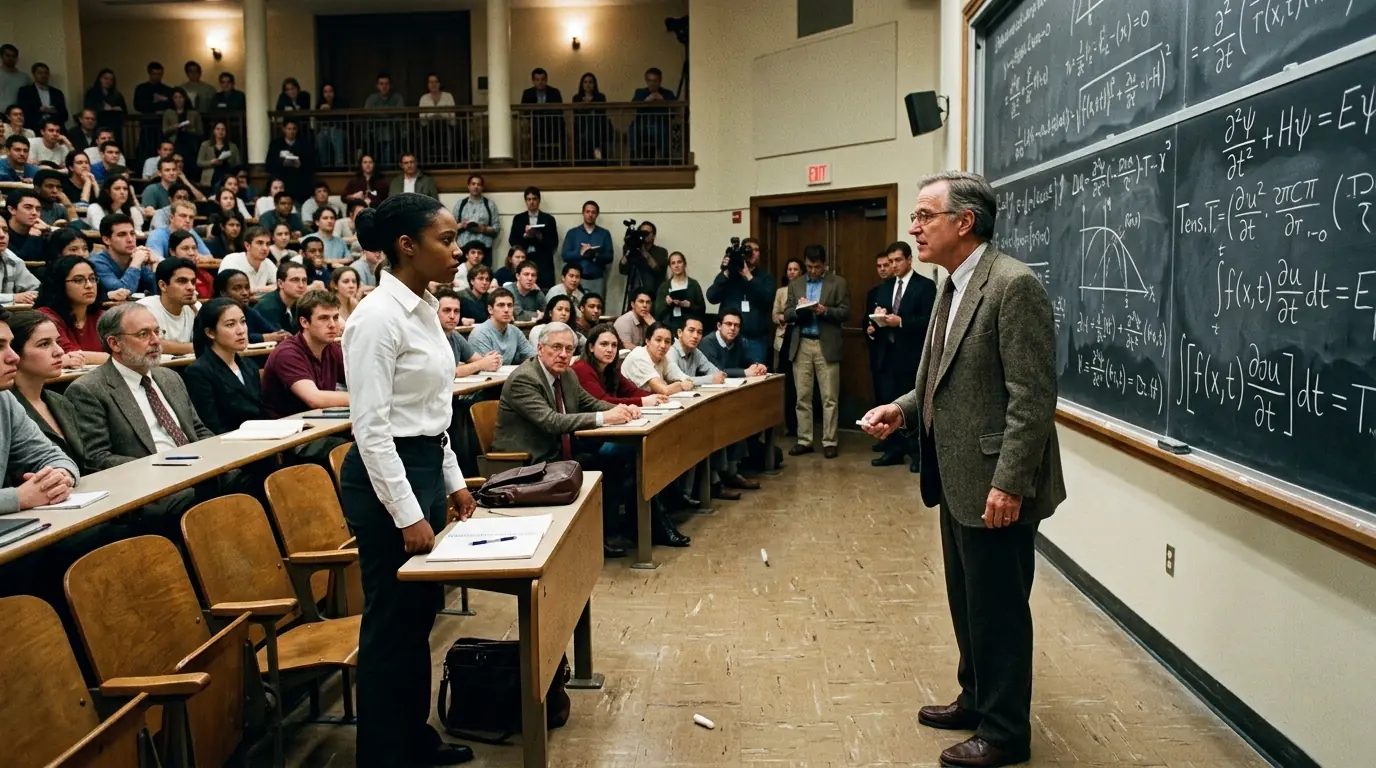
He flicked the chalk. It hit Whitney's desk and rolled to the floor.
"Thirty seconds. Solve it, or you're out of the scholarship program."
Whitney calmly stood up slowly. "Professor, what if I solve it?"
"Dream on, stinking cockroach. Three years I researched this. A fake from the slums isn't solving it. Pick it up, fake genius. Come solve it."
Whitney's hand trembled once, then stopped. She didn't pick up the chalk. She walked past it, past Walsh, straight to the board.
Thirty seconds later, the professor would regret it. Thirty seconds doesn't happen in thirty seconds. And this is how we got there.
To understand what happened in that lecture hall, you need to know who Whitney Tate was, and who Edward Walsh thought she was. Whitney was 22 years old, a senior at MIT on a full scholarship. She lived with her grandmother in a two-bedroom walk-up in Roxbury. The heat worked sometimes. The neighbors knew her by name.
Five nights a week, she worked the late shift at a diner in Central Square. From 11:00 at night until 4:00 in the morning, she poured coffee for taxi drivers and night students. Then she walked twenty minutes to campus and started her day. She slept four hours, sometimes three. Her grandmother had a heart condition. The medications cost $300 a month. The scholarship covered tuition; it did not cover medication, it did not cover groceries, and it did not cover the rent on the walk-up in Roxbury.
So Whitney worked, and she studied, and she did not make excuses. She made math.
Three months before that colloquium, the Journal of Number Theory had published her undergraduate thesis. It was titled Generalizations of Modular Transformations over Imaginary Quadratic Fields. The paper was credited to W. Tate—no first name, no photograph. Most of the math department had skimmed the abstract. A few had read the introduction. Almost none of them knew the author was the quiet Black girl in the third row.
But one person did.
Three years earlier, Edward Walsh had sat on Whitney's freshman placement committee. He had asked her in front of two other professors if she was "comfortable" in the level she'd tested into. He had used the word "comfortable" the way other men use the word "qualified."
Now Walsh was 56 years old, tenured eighteen years, a Cole Prize winner. He had supervised more than thirty PhDs. He wrote op-eds in The Chronicle of Higher Education about what he called "standards drift" at elite universities. When pressed in private, he would say he meant exactly what everyone thought he meant. And he chaired the Vandenberg Memorial Fellowship, the most prestigious research grant the MIT math department awarded.
That fall, Whitney Tate was one of three finalists. Walsh had told two colleagues over coffee that he didn't think she "fit the profile."