The first thing Noah Bell ever learned about money was that it made adults lower their voices.
He was nine years old when he noticed it. At the shelter, people spoke loudly about weather, buses, broken heaters, and whose shoes had gone missing from the hallway. But when rent came up, when medicine came up, when a mother counted coins into her palm and came up short, voices dropped.
Money was not just paper.
It was the difference between soup and sleep.
Between staying together and being separated.
Between a child being called “unlucky” and a child being called “taken care of.”
Noah was twelve the winter he found the wallet.
By then, he had learned many other things too. He knew which bakery threw out day-old bread after seven at night. He knew which church handed out blankets without asking questions. He knew which security guards only shouted and which ones called the police.
He knew how to sleep with one arm through the strap of his backpack.
He knew how to look smaller when adults were angry.
And he knew that if he had one dollar, he had to think very carefully before spending it.
The city was called Briar Glen, though Noah thought there was nothing soft or green about it. It was all wet sidewalks, bus exhaust, brick walls, sirens, and people walking fast beneath bright windows they never invited him inside.
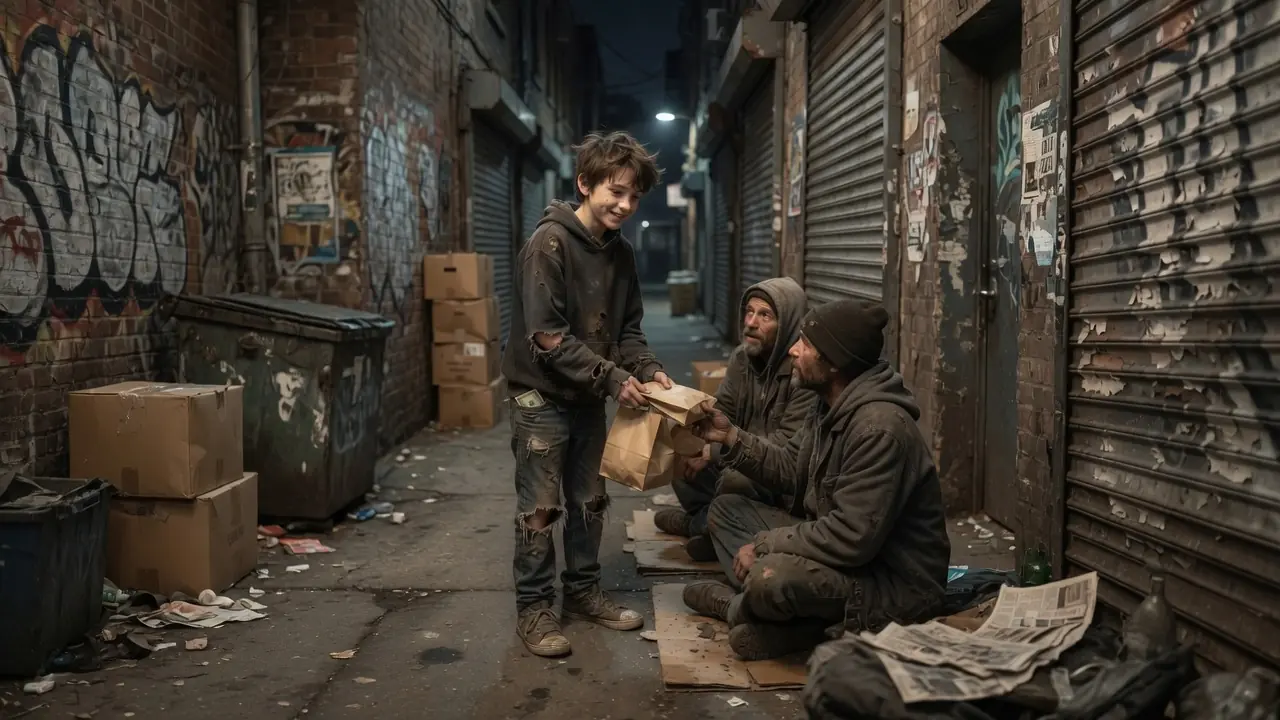
He lived mostly behind the old Apollo Theater, beneath the metal staircase where warm air leaked from a vent when the building’s furnace worked.
His mother had died two years earlier.
His father was a name on an old photograph and nothing more.
After his mother’s funeral, Noah had been placed with an uncle who drank away grocery money and told Noah that boys who cried grew into men nobody respected. One night, when the shouting got worse than usual, Noah packed his backpack with two shirts, a photograph of his mother, and a cracked blue flashlight.
He left before dawn.
Nobody came looking.
That hurt more than he admitted, even to himself.
On the night he found the wallet, snow had turned into freezing rain.
It came down thin and sharp, needling his cheeks as he walked along Harper Avenue with his hood pulled low. The city looked expensive from a distance, all golden windows and holiday lights, but at street level everything was gray and wet.
Noah had earned three dollars that day carrying grocery bags for an old man outside Martin’s Market.
Then he had spent two on a bowl of soup from the corner deli because his hands were shaking too badly to wait. The last dollar sat folded inside his sock.
He was saving it for breakfast.
If nothing went wrong.
Something always went wrong.
Near the bus stop outside the closed library, Noah saw a man drop something.
The man wore a long black coat and walked with a silver cane. His hair was white, but his back was straight. He moved slowly, not like someone weak, but like someone who had all the time in the world and did not care who knew it.
A brown leather wallet slipped from his coat pocket and landed beside the curb.
Noah saw it immediately.
So did no one else.
The man kept walking.
Noah stared at the wallet.
A hundred thoughts hit him at once.
Food.
A motel room.
New socks.
A doctor for the cough that had been sitting in his chest for three weeks.
Maybe enough money to get on a bus and go somewhere warmer, though he did not know where that would be.
The wallet lay open slightly, rain darkening its edges.
Noah ran to pick it up.
It was heavier than he expected.
Inside were crisp bills.
More money than Noah had held in his life.
His breath caught.
He looked down the sidewalk. The man with the cane had nearly reached the corner.
Noah could run the other way.
He could disappear.
The city had taught him that lost things belonged to whoever needed them most.
But his mother’s voice rose in his memory, soft and tired and stubborn.
Needing something does not make it yours, baby.
Noah hated that voice sometimes.
It made survival harder.
He ran after the man.
“Sir!”
The man did not stop.
Noah ran faster.
“Sir! You dropped this!”
The old man paused beneath a streetlamp and turned.
His face was lined deeply, but his eyes were bright. Too bright, Noah thought, for someone standing in freezing rain.
Noah held out the wallet.
“You dropped it back there.”
The man looked at the wallet.
Then at Noah.
“Did I?”
Noah frowned.
“Yes.”
“How fortunate that you found it.”
“I didn’t take anything.”
“I did not say you did.”
Noah pushed the wallet toward him.
The old man did not reach for it.
“What is your name?”
Noah hesitated.
“Why?”
“Because I like knowing the names of honest people.”
Noah almost laughed.
Honest people did not usually sleep under staircases.
“Noah.”
“Noah what?”
“Noah Bell.”
“Bell. A good name. Bells are meant to be heard.”
Noah shifted from one foot to the other.
“Do you want your wallet or not?”
The man chuckled.
“Straight to business. Yes, perhaps I do.”
He took the wallet, opened it, and counted nothing. He simply closed it again and studied Noah’s face.
“You are hungry.”
Noah stiffened.
“I’m fine.”
“That is not what I said.”
“I don’t beg.”
“No. I can see that.”
The old man reached into the wallet and pulled out a single dollar bill.
Noah stared at it.
His pride said no.
His stomach said something else.
The man folded the bill once and held it out.
“For returning what was mine.”
Noah shook his head.
“My mom said you don’t get paid for not stealing.”
“Your mother sounds wise.”
“She was.”
The word came out too sharp.
The old man’s expression softened.
He tucked the dollar back into the wallet.
Then, very strangely, he handed the whole wallet to Noah.
Noah stepped back.
“What are you doing?”
“Giving you a responsibility.”
“I don’t want it.”
“Most people do not want responsibility when it first arrives.”
“I said I don’t want it.”
The man leaned on his cane.
“This wallet will give you money, Noah Bell. But only under one condition.”
Noah looked around, wondering if this was some kind of trick.
“What condition?”
“Whatever you spend from it must be spent with kindness. Food for the hungry. Warmth for the cold. Help for someone who cannot repay you.”
Noah stared at him.
“That’s not how wallets work.”
“No,” the man said. “Most wallets work the other way.”
A bus roared past, throwing dirty water against the curb.
Noah wiped rain from his eyes.
“Are you crazy?”
“Frequently accused. Rarely convicted.”
“I’m not taking some stranger’s wallet.”
The old man placed it carefully on the bench beside him.
“Then leave it there.”
Noah looked at the wallet.
Then at the man.
“What’s your name?”
“Arthur Wren.”
“Do you live around here?”
“I have lived in many places.”
“That’s not an answer.”
“It is the answer I have.”
Noah did not like him.
Or maybe he did.
That was worse.
Arthur Wren tipped his hat, though it was wet enough to be useless.
“Remember, Noah. Money kept too tightly becomes fear. Money spent only on yourself becomes hunger again. Money used kindly learns how to return.”
Then he crossed the street.
A truck passed between them.
When it was gone, Arthur Wren had vanished.
Noah stood in the freezing rain, staring at the empty corner.
Then he looked at the bench.
The wallet was still there.
For five full minutes, he did not touch it.
Then his stomach cramped so hard he bent forward.
He grabbed the wallet and ran.
The first thing Noah bought was not for someone else.
That mattered later.
At the deli, he stood near the counter, dripping rain onto the floor while Mr. Ibrahim, the owner, watched him with tired eyes.
“Soup again?” Mr. Ibrahim asked.
Noah nodded.
“How much?”
“One bowl.”
He opened the wallet.
Inside was a single five-dollar bill.
Noah blinked.
He was sure there had been more before.
Maybe he had imagined it.
He pulled out the five and paid.
Mr. Ibrahim handed him a cup of chicken soup with extra bread tucked beside it, pretending not to notice that it was more than five dollars’ worth.
Noah sat in the corner and ate slowly, trying to make the heat last.
The soup warmed his throat, then his chest, then something deeper.
When he finished, he opened the wallet again.
Two five-dollar bills sat inside.
Noah froze.
He looked around.
No one was watching.
He closed the wallet.
Opened it again.
The bills remained.
His heart began to pound.
Every dollar he spent returned doubled.
That was impossible.
So he tested it.
He bought a carton of milk and a banana from the deli.
Three dollars.
When he checked the wallet in the alley, six dollars had appeared.
He bought a pair of cheap gloves from the pharmacy for four dollars.
Eight dollars appeared.
He bought a hot tea for an old woman named Miss Ada who slept near the subway entrance.
The four dollars became eight.
He bought a sandwich for a man outside the church who had not eaten all day.
The seven dollars became fourteen.
By midnight, Noah sat beneath the theater staircase with the wallet open on his knees, staring at a stack of bills that had not existed that morning.
His hands shook.
Not from cold this time.
From fear.
Because magic was one thing in stories.
In real life, magic meant someone wanted something.
The next morning, Noah woke to the sound of shouting.
A shelter van had arrived near the alley, and two volunteers were handing out coffee and blankets. People crowded around them, pushing not because they were rude, but because cold made patience expensive.
Noah watched from the shadows.
He thought about the wallet in his backpack.
If he used it carefully, he could eat every day.
He could buy new shoes.
He could maybe rent a room.
He could stop being the boy people stepped around.
Then he saw a little girl crying near the back of the line.
She wore no gloves.
Her mother held a baby inside her coat and looked too exhausted to comfort both children.
Noah’s hand moved to the wallet.
Money kept too tightly becomes fear.
He hated Arthur Wren’s voice already.
Noah walked to the corner store and bought all the gloves they had.
Twelve pairs.
The clerk looked at him strangely but took the cash.
Noah stepped outside, checked the wallet, and nearly dropped it.
The money had doubled.
Not just returned.
Doubled.
He went back in and bought hats.
Then socks.
Then granola bars.
Then cartons of milk.
Each time, the wallet refilled with twice what he had spent.
By noon, the shelter volunteers were staring at him.
Miss Ada laughed and called him “little mayor.”
The girl without gloves wore a red pair now and would not stop rubbing her hands together.
Her mother cried quietly into a paper cup of coffee.
Noah pretended not to see.
That became his first rule.
Help people without making them feel watched.
The second rule came later.
Never use the wallet to show off.
For a week, Noah spent money carefully.
Food first.
Blankets second.
Medicine when he could.
He learned which small stores would sell him bulk bread without asking too many questions. He learned which motel clerk would rent a room to a teenager if he paid cash and did not cause trouble. He learned that people cried more often when given socks than when given sandwiches, maybe because socks meant someone had thought about their pain specifically.
The money kept growing.
Twenty became forty.
Forty became eighty.
Eighty became one hundred sixty.
Noah stopped counting after the wallet began holding bills in neat bundles, more than should have fit inside a normal wallet.
But it never became heavy.
That frightened him too.
One evening, he tried to spend the money on himself.
Not food.
Not gloves.
Something he wanted.
In the window of a thrift shop, he saw a navy-blue coat with brass buttons. It looked warm and almost new. More than that, it looked like something a boy with somewhere to go would wear.
Noah bought it.
Thirty dollars.
He stepped outside, heart beating.
He opened the wallet.
Nothing had doubled.
Inside was the exact same amount as before, minus thirty.
Noah stared.
Then he understood.
Food for himself because he was hungry counted.
Gloves for himself because he was cold counted.
But vanity did not.
He kept the coat anyway, ashamed and grateful at the same time.
That night, he found a note tucked inside the wallet.
It had not been there before.
In thin black handwriting, it said:
Kindness is not the same as guilt. Learn the difference.
Noah read it five times.
Then he folded it and hid it inside his shoe.
By the end of the month, rumors began.
Someone was buying food for people near the Apollo Theater.
Someone paid the pharmacy bill for an old veteran named Mr. Cole.
Someone left envelopes at the women’s shelter marked FOR DIAPERS.
Someone bought twenty sleeping bags and vanished before anyone could ask questions.
The newspapers did not care at first.
Briar Glen was a large city. Good deeds disappeared in it almost as easily as bad ones.
But people talked.
And when poor people talk, the city often listens late.
Noah’s biggest problem was no longer hunger.
It was scale.
He could buy sandwiches one by one, but the lines kept growing. He could pay for a motel room for one family, but another family slept under the bridge. He could buy medicine for Miss Ada, but Mr. Cole needed a doctor, and the woman with the baby needed formula, and three teenagers near the bus station needed shoes.
The wallet could multiply money.
It could not multiply Noah.
That was when he met Grace Lin.
She was seventeen, with a shaved head, black boots, and a talent for looking unimpressed by everything. She ran errands for a community kitchen called The Lantern House, though “ran” was generous because Grace did nothing in a hurry unless someone was bleeding.
She caught Noah leaving four bags of groceries near the kitchen door.
“You the food ghost?” she asked.
Noah froze.
“What?”
“You heard me.”
“I’m just dropping stuff off.”
“With whose money?”
“Mine.”
Grace looked him up and down.
“You’re twelve.”
“So?”
“So twelve-year-olds don’t usually donate eighty pounds of rice unless they robbed a restaurant or found God.”
Noah tightened his grip on the empty grocery bag.
“I didn’t rob anyone.”
“Didn’t say you did.”
She leaned against the doorframe.
“You hungry?”
“No.”
“That means yes.”
Grace brought him inside anyway.
The Lantern House was warm, crowded, and loud. Volunteers moved between tables. A man played old jazz on a scratched piano. The air smelled like tomato soup, coffee, onions, and wet wool drying near the radiators.
Noah hated how much he liked it.
Grace gave him a bowl of stew and sat across from him.
“Name?”
“Noah.”
“Grace.”
“I didn’t ask.”
“Rude.”
He ate despite himself.
Grace watched him in silence for three minutes, then said, “If you’re stealing money, stop before you get caught. If you’re being used by someone, tell me before they hurt you. If you’re secretly rich, congratulations on the weirdest hobby ever.”
Noah almost smiled.
“I’m not stealing.”
“Then where’s it coming from?”
He looked down at the stew.
“The wallet.”
“What wallet?”
He should not have told her.
But secrets are heavy, and Noah had been carrying too many.
So he showed her.
Not everything.
Just enough.
He bought two meals from The Lantern House donation counter for ten dollars. Then he opened the wallet under the table.
Twenty dollars sat inside.
Grace stared.
“Do that again.”
“No.”
“Do that again or I’m going to think the stew was drugged.”
He did it again with a five-dollar donation.
Ten appeared.
Grace leaned back.
“Well,” she said. “That’s inconvenient.”
Noah frowned.
“Inconvenient?”
“Yeah. Now we have to be responsible.”
We.
The word startled him.
Grace noticed but did not soften her voice.
“If that thing is real, you can’t just run around buying random sandwiches forever. You need a system.”
“I don’t need anything.”
“You need a haircut, a social worker you trust, a bank account eventually, probably therapy, definitely better shoes, and a system.”
Noah glared.
Grace smiled.
“See? We’re already friends.”
They were not friends.
Then they were.
Not all at once.
Grace helped Noah make lists. People who needed food immediately. People who needed housing. People who needed medicine. Places that could stretch money farther than a twelve-year-old with grocery bags.
She introduced him to Sister Mae, the woman who ran The Lantern House.
Sister Mae was not a nun, despite the name. She was a broad-shouldered Black woman in her sixties who had once been a school principal and still had the voice of someone who could silence a cafeteria with one raised eyebrow.
Noah did not tell her about the magic wallet at first.
He said he had money from a “private donor.”
Sister Mae looked at him for a long time.
“Is this donor safe?”
“Yes.”
“Is this donor asking you to do anything illegal?”
“No.”
“Is this donor alive?”
Noah hesitated.
Grace kicked him under the table.
“Mostly,” Noah said.
Sister Mae sighed.
“I am too old for mysterious children.”
But she accepted the donations.
Under Sister Mae’s guidance, the money became more than emergency food.
It became grocery cards.
Clinic vouchers.
Laundry tokens.
Bus passes.
Temporary motel rooms during snowstorms.
A repaired freezer for The Lantern House.
A used van.
Then a second van.
The wallet continued doubling every dollar spent with genuine kindness, but Noah discovered something important.
It knew motives.
If he spent money to impress Sister Mae, it did not return.
If he spent money because he felt guilty but did not care about the person, it returned only what he spent.
But when the money solved a real need, when the act came from attention and not pride, it multiplied.
Grace called it “a very judgmental wallet.”
Noah called it annoying.
Sister Mae, after finally being told the truth and sitting silently for a full minute, called it “a test.”
“Of what?” Noah asked.
“Character.”
“I hate tests.”
“Most people who need them do.”
The first time Noah failed badly, it involved a camera crew.
By spring, people wanted to know who was funding The Lantern House expansion. A reporter named Blair Sutton began asking questions. She was sharp, ambitious, and skilled at making concern look like friendship.
She found Noah unloading boxes behind the kitchen.
“Aren’t you a little young to be working here?” she asked.
“Aren’t you a little old to sneak up on kids?”
She laughed.
“I’m doing a story on community heroes.”
“No heroes here.”
“That’s usually what heroes say.”
Noah should have walked away.
Instead, some foolish part of him wanted to be seen.
Not as homeless.
Not as dirty.
Not as a problem.
As someone powerful.
So he told her more than he should have.
Not about the wallet’s magic.
But enough that she wrote a story calling him “The Boy Benefactor of Briar Glen.”
There was a photograph too.
Noah in his navy-blue coat, standing beside boxes of food.
For one day, people smiled at him.
For two days, strangers donated.
On the third day, a man tried to steal his backpack.
On the fourth, his uncle found him.
His uncle’s name was Raymond Bell, and he arrived at The Lantern House smelling of cigarettes and wintergreen gum. He had shaved for the occasion, which made him look less dangerous and more dishonest.
“There’s my boy,” Raymond said loudly.
Noah went cold.
Sister Mae stepped between them.
“Can I help you?”
“I’m his uncle. Legal guardian. Been worried sick.”
Noah almost laughed.
Raymond’s eyes moved to Noah’s backpack.
Then to the office where Sister Mae kept donation records.
Grace saw it too.
She grabbed Noah’s sleeve.
Raymond smiled.
“Come on, Noah. Time to go home.”
“I’m not going anywhere with you.”
Raymond’s smile thinned.
“Boy, don’t embarrass me.”
Sister Mae’s principal voice came out.
“You need to leave.”
“I have rights.”
“You have five seconds.”
Raymond looked around at the volunteers now watching him.
Then he leaned slightly toward Noah.
“You got money now. I know it. You owe me.”
Noah’s fear turned into something hot.
“I owe you nothing.”
Raymond’s eyes hardened.
“You owe me for every night I let you sleep under my roof.”
“You mean the roof with no heat?”
Grace muttered, “Not the time, but good point.”
Raymond reached for Noah.
Sister Mae moved faster than anyone expected.
She caught his wrist.
“I said leave.”
Raymond left.
But the damage was done.
That night, the wallet disappeared.
Noah had hidden it inside a loose brick behind the Apollo Theater, the same place he kept the photo of his mother. When he reached in, the brick space was empty.
For a moment, he could not move.
Then he tore the whole hiding place apart.
Nothing.
The wallet was gone.
Raymond.
Noah knew it at once.
He ran through the streets until his lungs burned, checking pawnshops, bars, alleys, places Raymond used to go. He found him near midnight outside a betting parlor, drunk and furious.
Raymond grabbed Noah by the coat.
“What kind of trick wallet is that?”
Noah stopped struggling.
“What did you do?”
“I took money out, and it vanished. I tried to buy myself a drink, and the bills turned into newspaper.” Raymond shook him. “Where’s the real money?”
Noah almost smiled despite the fear.
The wallet knew.
Raymond had stolen it, but greed could not unlock it.
“Give it back.”
Raymond shoved him.
“Not until you make it work.”
Noah hit the ground hard.
His elbow cracked against the curb.
Before Raymond could reach for him again, Grace appeared from nowhere and swung a metal trash-can lid into his shoulder.
It made a sound like thunder.
Raymond cursed and staggered back.
Sister Mae’s van screeched to the curb a second later.
Two volunteers jumped out.
Raymond ran.
Grace helped Noah up.
“You okay?”
“No.”
“Good. Honest answer.”
They found the wallet in the gutter near the betting parlor.
It was wet, muddy, and empty.
Noah picked it up with shaking hands.
“I ruined it.”
Sister Mae stood beside him in the streetlights.
“Maybe. Maybe not.”
“It’s empty.”
“So are fields before planting.”
Noah looked at her.
“That makes no sense.”
“It will later.”
For three days, the wallet produced nothing.
Noah spent the last of the legitimate funds on food for The Lantern House, but the money did not return.
Panic spread through him.
People had begun depending on him.
That was the danger of becoming useful.
If you stopped, people suffered.
On the fourth night, Noah sat alone in the pantry, staring at the empty wallet.
Grace found him there.
“You look tragic.”
“I lost the magic.”
“Maybe it needed a break from your attitude.”
“I’m serious.”
“So am I.”
He threw the wallet against a sack of rice.
“It only worked when I helped people. I was helping people.”
“You also liked being the boy in the newspaper.”
Noah glared at her.
Grace sat beside him.
“I’m not saying you’re bad. I’m saying magic wallets apparently have trust issues.”
Noah looked away.
“I wanted people to know I wasn’t nothing.”
Grace’s voice softened.
“That’s not nothing. That’s human.”
“I messed it up.”
“Then fix what you can without it.”
“How?”
“Same way everyone without a magic wallet helps. Badly. Slowly. Together.”
That answer annoyed him because it sounded true.
So Noah worked without the wallet.
He served soup.
He cleaned tables.
He delivered blankets.
He apologized to Sister Mae for bringing attention before they were ready.
He apologized to the volunteers for acting like money was the only thing holding the place together.
He apologized to Grace for not telling her Raymond had scared him.
She accepted by punching his shoulder lightly and saying, “Don’t be stupid alone next time.”
On the seventh day, a woman came into The Lantern House with two children and no shoes fit for either of them.
Noah reached into his pocket automatically.
No money.
No miracle.
He looked around.
Then he took off his navy-blue coat.
The one with brass buttons.
The one he had bought for himself.
He handed it to the older boy.
The boy was smaller than him but would grow into it.
“Here,” Noah said.
The boy stared.
“That’s yours.”
“I know.”
“Ain’t you cold?”
Noah smiled a little.
“Frequently.”
The boy put it on.
It swallowed him.
His mother began to cry.
Noah felt embarrassed and tried to escape to the pantry.
Inside, on top of a sack of rice, the wallet lay open.
A single dollar sat inside.
Noah picked it up slowly.
Then the dollar became two.
Then four.
Then eight.
He sat down on the floor and cried so suddenly he did not have time to hide it.
Sister Mae found him there.
She did not ask what was wrong.
She simply sat beside him until he stopped.
After that, Noah changed the way he used the wallet.
No more mystery hero.
No more newspaper stories.
No more trying to solve everything alone.
The wallet became a seed, not a spotlight.
Under Sister Mae’s guidance, they created a foundation years later, though at first it was just a locked cashbox, a handwritten ledger, and Grace arguing that “Noah’s Magic Wallet Fund” was a terrible name.
They called it The Bell Fund.
Not because Noah wanted his name on it, but because Sister Mae reminded him what Arthur Wren had said.
Bells are meant to be heard.
The Bell Fund began by supporting The Lantern House.
Then it helped open a free pantry near the bus station.
Then a winter clinic.
Then a program that placed outreach workers in schools to find hungry children before they disappeared into alleys.
The wallet kept multiplying money, but Noah learned that money alone was never enough.
You needed people.
Systems.
Accountability.
Warm rooms.
Reliable hours.
Doctors who did not treat poverty like a personal failure.
Teachers who noticed the child wearing the same clothes all week.
Landlords willing to rent to families rebuilding their lives.
Lawyers willing to fight evictions before people were on the sidewalk.
Grace became the first director of operations because she was still unimpressed by everything and therefore very hard to manipulate.
Sister Mae became chair of the board after refusing the title four times and then rewriting everyone’s job descriptions.
Noah went back to school through a program for unhoused youth.
He was older than some classmates and quieter than most.
He hated math until he realized budgets were math with consequences.
Then he became very good at it.
Years passed.
The city changed slowly.
Not magically.
No city changes magically, even when magic is involved.
But there were fewer children sleeping behind the Apollo Theater. Fewer mothers choosing between diapers and dinner. Fewer old men rationing medicine by cutting pills with a butter knife.
The Bell Fund grew.
By the time Noah was twenty-five, people called him a philanthropist.
He hated the word at first.
It sounded like someone in a suit standing beside an oversized check.
Grace told him to get over himself.
“You are literally giving away money at scale.”
“I don’t like how it sounds.”
“Then do it better.”
So he tried.
He refused gala portraits unless families from the programs spoke first and got paid for their time.
He funded boring things because boring things kept people alive: plumbing, payroll, storage freezers, legal fees, bus passes, translation services, dental care.
He never let donors name buildings after themselves unless they also funded maintenance for twenty years.
This made him unpopular with certain rich people.
Sister Mae loved it.
The wallet stayed with him always.
Its leather never cracked. Its stitching never loosened. It remained the same brown wallet he had found in the rain, though now Noah kept it inside the inner pocket of a plain black jacket.
He still did not understand it.
He stopped trying.
On his thirtieth birthday, Noah received a letter.
No return address.
Inside was a single sheet of cream paper.
The handwriting was thin and black.
Dear Noah Bell,
You have learned that money is not magic.
Good.
Kindness is the magic.
Money merely reveals what a person worships.
Keep listening for the bells.
— A.W.
Noah stood in his office for a long time after reading it.
Then he laughed.
Then he cried.
Then he placed the letter in a frame beside the first note he had ever found in the wallet.
Kindness is not the same as guilt. Learn the difference.
Years later, when The Bell Fund opened its largest project, people came from every part of Briar Glen.
The building stood where the old Apollo Theater had once been. The theater had closed permanently, then nearly been demolished, until Noah bought it through the foundation and restored the front sign.
Now the Apollo Center held a kitchen, clinic, childcare rooms, showers, classrooms, legal aid offices, laundry facilities, and apartments upstairs for families in transition.
Above the entrance, in bronze letters, were the words:
NO ONE EATS ALONE.
Reporters came.
Politicians came.
Donors came.
Families came too, which mattered more.
Noah stood on the small stage in the restored lobby and looked out at the crowd.
Grace stood near the side wall with a clipboard, already annoyed that the mayor had spoken too long.
Sister Mae sat in the front row, older now, leaning on a cane but still able to silence people with one eyebrow.
Miss Ada was there in a red hat.
Mr. Ibrahim from the deli was there too, wiping his eyes and pretending it was allergies.
Noah had prepared a speech.
He did not use most of it.
Instead, he took out the brown wallet.
The room went quiet.
“When I was twelve,” he said, “I thought money was food, warmth, and safety. I was not wrong. But I was not completely right either.”
He looked toward the doors, where children were peeking in from the hallway.
“I once believed that if I had enough money, I would never be afraid again. Then I got money, and I was still afraid. Afraid to lose it. Afraid to use it wrong. Afraid people would only see me if I could give them something.”
His hand closed around the wallet.
“What changed my life was not money. It was a bowl of stew. A girl named Grace who asked rude questions. A woman named Mae who taught me responsibility. A deli owner who gave extra bread and pretended not to. A little girl in red gloves who reminded me that help should arrive before someone has to beg.”
Sister Mae’s eyes shone.
Noah continued.
“Kindness is not soft. It is not sentimental. It is not a photograph of a good deed. Kindness is infrastructure. It is food stocked before hunger becomes desperation. It is heat before frostbite. It is rent help before eviction. It is believing people before their lives collapse loudly enough to become news.”
The room was very still now.
Noah lifted the wallet slightly.
“I found this on a night when I had one dollar and no plan for morning. I thought it was magic because money came back when I spent it to help others. But I was wrong. The wallet was never the miracle.”
He looked out at the crowd.
“You were.”
The applause came slowly at first.
Then louder.
Noah stepped back, overwhelmed.
Grace walked onto the stage and took the microphone.
“He’s done being emotionally devastating now,” she said. “Please eat. The food is free, and if any donor tries to network before dessert, I will personally escort you outside.”
The room laughed.
Noah laughed too.
That evening, after the crowd left and the floors had been swept, Noah walked alone to the back of the building.
The old metal staircase was still there.
Restored now.
Painted black.
Safe.
Beneath it, where he had once slept with his backpack strap wrapped around his arm, there was now a small plaque on the wall.
It did not have his name.
He had refused that.
It said:
For every child who waited for morning.
Noah stood there with his hand on the wallet.
A soft sound came from behind him.
A cane tapping against the floor.
Tap.
Tap.
Tap.
Noah turned.
Arthur Wren stood in the hallway wearing the same long black coat, the same silver cane, and the same faint smile.
He looked no older.
Noah should have been surprised.
Somehow, he was not.
“You’re late,” Noah said.
Arthur smiled.
“By whose clock?”
Noah stepped closer.
“You were real.”
“Mostly.”
“That’s still not an answer.”
“It is still the one I have.”
Noah looked down at the wallet.
“Is it yours?”
Arthur shook his head.
“Never was.”
“Then whose is it?”
Arthur looked toward the kitchen, where volunteers were packing leftovers into containers for families upstairs.
“Whoever understands it least and needs it most.”
Noah thought about that.
Then he held it out.
“I don’t need it most anymore.”
Arthur did not take it.
“No?”
Noah shook his head.
“I have people. Systems. The fund. The center. I have enough.”
Arthur’s eyes warmed.
“Enough is a word many wealthy men die without learning.”
Noah placed the wallet on the old stair rail between them.
“It should go to someone else.”
Arthur looked at him for a long moment.
Then he nodded.
“Perhaps it already has.”
Noah frowned.
The wallet was still on the rail.
Then a child’s voice came from the hallway.
“Mr. Bell?”
Noah turned.
A girl stood near the corner, maybe thirteen, with a backpack held together by green tape. She lived upstairs with her grandmother and two younger brothers. Her name was Amara.
“What are you doing down here?” Noah asked.
She glanced at Arthur, then at the wallet.
“I was looking for you. Mrs. Lin said if I wanted to start the school breakfast cart, I had to bring you a budget.”
Grace, Noah thought, never changed.
Amara stepped closer and held out a folded paper.
“I made a list. It’s not perfect.”
Noah took it.
The list was careful, practical, and ambitious.
Oatmeal.
Fruit.
Milk.
Eggs.
Paper bowls.
Extra snacks for kids who pretend they ate.
Noah smiled at that last line.
When he looked up, Arthur was gone.
So was the wallet.
Amara was staring at the stair rail.
“What was that?”
Noah followed her gaze.
The brown wallet now sat in her hands.
She looked startled.
“I didn’t take it.”
“I know.”
“It just—”
“I know.”
Amara tried to hand it to him.
Noah stepped back.
“Open it.”
She did.
Inside was a single dollar.
Amara frowned.
“That’s not enough for breakfast.”
Noah smiled.
“It’s a start.”
She looked at him suspiciously.
“What kind of weird grown-up lesson is this?”
“The annoying kind.”
“I hate those.”
“Most people who need them do.”
Noah almost heard Sister Mae laughing somewhere upstairs.
He crouched so he was eye level with Amara.
“That wallet is not for buying what makes you look important. It is not for proving you are good. It is not for saving everyone by yourself.”
“What is it for?”
“Paying attention.”
She stared at him.
“That’s vague.”
“Very.”
“How does it work?”
Noah thought of rain, soup, gloves, Grace’s rude questions, Sister Mae’s hard mercy, a navy-blue coat with brass buttons, a city slowly learning to care before crisis.
Then he said, “Spend it kindly. Keep records. Ask for help. And never confuse money with the miracle.”
Amara looked down at the wallet.
“If I mess up?”
“You will.”
“That’s not comforting.”
“It’s honest.”
She tucked the wallet carefully into her taped backpack.
Noah stood.
Upstairs, the center hummed with evening life. A child laughed. A dish dropped in the kitchen. Someone called for more towels near the showers. The building was alive with ordinary needs, which meant it was alive with ordinary chances to answer them.
Amara started toward the stairs, then turned back.
“Mr. Bell?”
“Yes?”
“Did this happen to you too?”
Noah smiled.
“A long time ago.”
“Were you good at it?”
“No.”
That made her grin.
“Okay. Then I’ve got a chance.”
She ran upstairs.
Noah stayed beneath the staircase a moment longer.
For the first time in years, his jacket felt lighter without the wallet inside it.
He touched the plaque on the wall.
For every child who waited for morning.
Then he went upstairs to help pack breakfast bags.
Outside, Briar Glen glittered under a cold sky. People hurried beneath streetlights. Buses sighed at the curb. Somewhere, a child was hungry. Somewhere, an old woman needed medicine. Somewhere, a mother was counting coins and lowering her voice.
There would always be need.
Noah knew that now.
But there would also be bells.
Some loud.
Some small.
Some carried in the hands of children who had not yet learned how much power kindness could hold.
And somewhere in the city, a brown leather wallet had opened again, waiting to teach someone else the truth Noah Bell had spent a lifetime learning.
Money was never the real magic.
The real magic was noticing who was hungry.
And choosing not to walk past.