By the time the third young lady asked if Lady Rose could understand music, Alexander Whitmore began to regret letting his mother organize the afternoon at all.
Rose was sitting less than six feet away. She had been deaf since childhood, not invisible.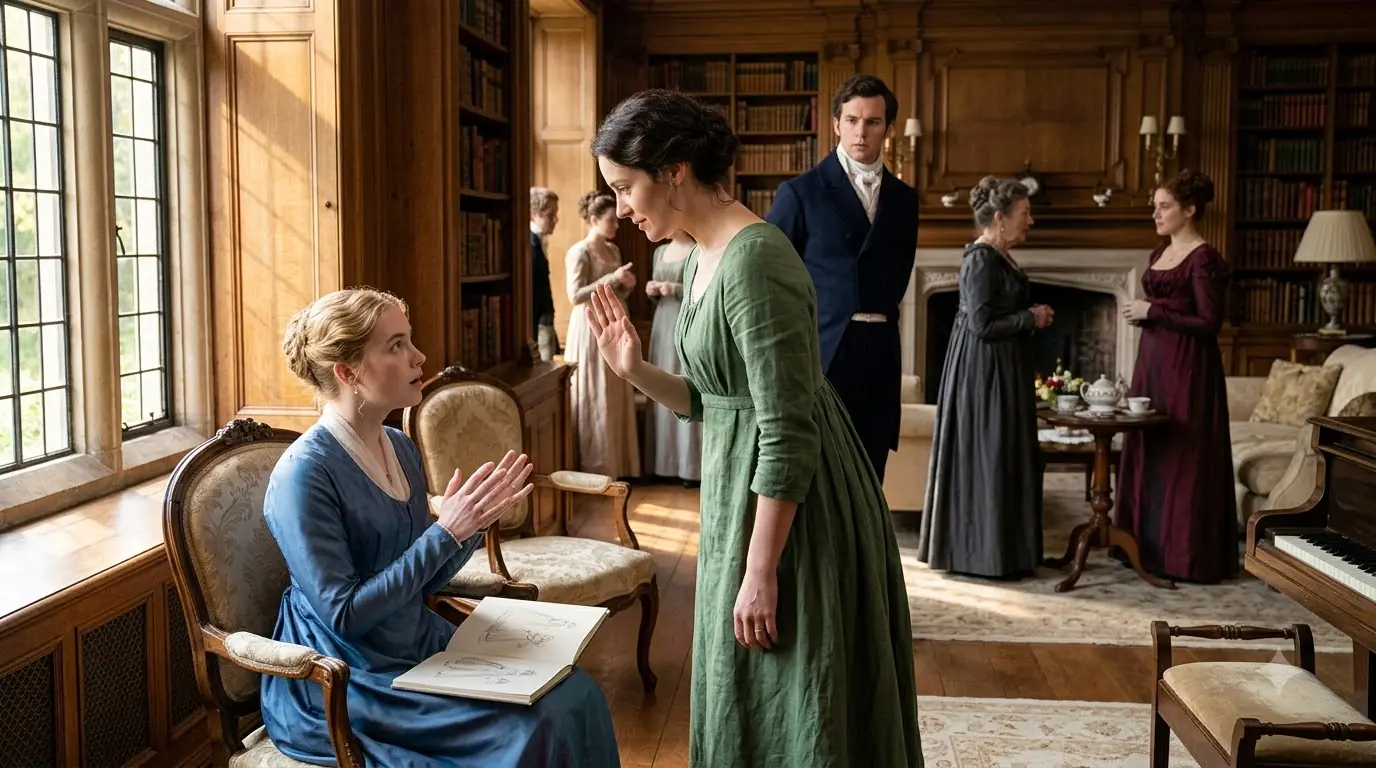
Alexander watched his younger sister lower her eyes to the sketchbook on her lap while Lady Cecilia waited for him to answer for her.
"She understands music differently from you," Alexander said.
Cecilia smiled with visible relief, as though he'd rescued her from an awkward topic. "How fascinating."
Rose looked up just in time to read the last word from her lips. Her expression told Alexander exactly what she thought of it.
The gathering at Whitmore Hall had officially been arranged because his mother wanted to introduce several families before the season's end. Unofficially, everyone knew that the unmarried Duke of Whitmore was expected to choose a wife sooner rather than later. Seven young women had been invited. Each was beautiful, well-connected, and carefully educated. Unfortunately, not one seemed capable of behaving naturally around Rose.
Some avoided speaking to her entirely. Others exaggerated every movement of their mouths, as if ordinary conversation required a theatrical performance. Lady Amelia Weston had spent 10 minutes discussing Rose's health with Alexander while Rose sat right beside her. When Rose finally wrote on a small card, "I am still here," Alexander nearly laughed. Amelia hadn't noticed.
Across the room, another guest had just arrived. Clara Bennett wasn't among the marriage candidates. She had come with Lady Beatrice Morton, an elderly widow considering hiring her as a companion. Clara wore a modest green dress that had clearly been altered more than once. She was 28, perhaps older than most of the women around Alexander, and nothing about her suggested she was there to attract attention. In fact, she seemed determined to avoid it.
While Lady Beatrice joined Alexander's mother near the fireplace, Clara moved toward the bookshelves and stayed there quietly. Then she noticed Rose.
Rose had left the main conversation and taken a chair by the window, where afternoon light fell across her sketchbook. No one followed her. Clara hesitated before approaching. Alexander happened to be watching.
Instead of speaking, Clara stopped a few feet from Rose and raised her hands. Her movements were slightly careful, but unmistakable: May I sit here?
Rose froze. For perhaps two seconds, she simply stared. Then her hands moved quickly: You sign.
Clara smiled: A little. Enough to embarrass myself.
Rose's face transformed. Alexander had seen his sister smile politely dozens of times that afternoon; this was different. She laughed—not loudly, because Rose rarely knew how much sound she was making, but freely enough that several people turned toward the window.
Clara sat beside her. Their hands moved back and forth while Rose occasionally corrected one of Clara's signs. Within minutes, both women were laughing again.
Alexander realized he had stopped listening to Lady Amelia.
"Your Grace?"
He looked back. "Forgive me."
Amelia followed his gaze toward Rose and Clara. "Who is that woman?"
"I do not know." That answer bothered him more than it should have.
A short while later, Clara rose to return a book to the shelf, and Alexander crossed the room before someone else could stop him. "You speak with your hands."
Clara looked at him. "A dangerous accusation, Your Grace."
He almost smiled. "My sister rarely meets anyone outside the family who can sign."
"My aunt lost most of her hearing when I was young. She hated people shouting at her, so eventually the rest of us learned something more useful."
Alexander glanced toward Rose, who was already sketching something with suspicious concentration. "You could have spoken aloud. Rose reads lips."
"I know."
"Then why sign?"
Clara considered the question as though the answer were obvious: "Because she had already spent the afternoon doing all the work of understanding everyone else."
Alexander said nothing. No one had ever described Rose's experience to him quite that way. He had spent years protecting his sister from cruelty, awkward questions, and pity. Yet even he had accepted that Rose should adapt herself to rooms designed for people who heard.
"There you are, Miss Bennett. I feared you had escaped."
"I considered it."
Lady Beatrice gave Alexander an apologetic smile. "Miss Bennett is presently seeking another position."
Alexander looked at Clara. "Another—"
A faint reserve entered her expression. "My previous employment ended."
Lady Beatrice lowered her voice: "Rather unfairly."
Before Clara could object, Lady Cecilia passed behind them and apparently heard enough to understand. "Oh, she is a companion."
Clara turned. "Yes."
Cecilia glanced toward Rose and then back at Alexander. "So, she is not actually a guest."
The sentence was technically harmless. Its meaning was not. Alexander saw Clara's expression become perfectly polite.
Before he could respond, Rose appeared beside them and touched his sleeve. She signed rapidly.
Alexander frowned. "You want what?"
Rose repeated herself: Hire her.
Alexander glanced at Clara, who could clearly understand every sign and looked suddenly uncomfortable. He answered, "Rose—"
For you?
Rose rolled her eyes. Then she signed: No, for yourself. You clearly need help.
Clara covered a laugh with one hand. Alexander stared at his sister. Rose smiled sweetly and walked away.
For the first time that afternoon, Alexander forgot entirely about the seven women his mother had invited him to consider marrying. His attention remained on the one woman who had never been invited for that purpose at all.
Clara had expected to leave Whitmore Hall within the week. Instead, two days after the gathering, Lady Beatrice informed her that the Dowager Duchess wished to offer her a temporary position as Rose's companion for the remainder of the season. The arrangement was practical, well-paid, and far more generous than Clara had expected after losing her previous employment. She accepted.
Alexander told himself that was the only reason he began seeing her everywhere.
Within a fortnight, Clara had become part of Rose's daily life without ever behaving as though Rose needed managing. They read together in the mornings, walked through the gardens when the weather allowed, and spent long afternoons sketching guests who had annoyed them. Rose had a particularly unforgiving talent for caricature, and Clara encouraged it shamelessly.
One afternoon, Alexander entered the drawing room and found Rose holding up a sketch of Lady Cecilia with an enormous feathered hat and an expression of exaggerated horror. Clara was laughing, and Rose signed something quickly. Clara answered.
Alexander stopped beside them. "What am I missing?"
Rose immediately hid the drawing.
"That usually means I should be concerned."