By the time the first dinner at Wycliffe Hall reached its second course, Sebastian Wycliffe had already answered more questions than he cared to remember.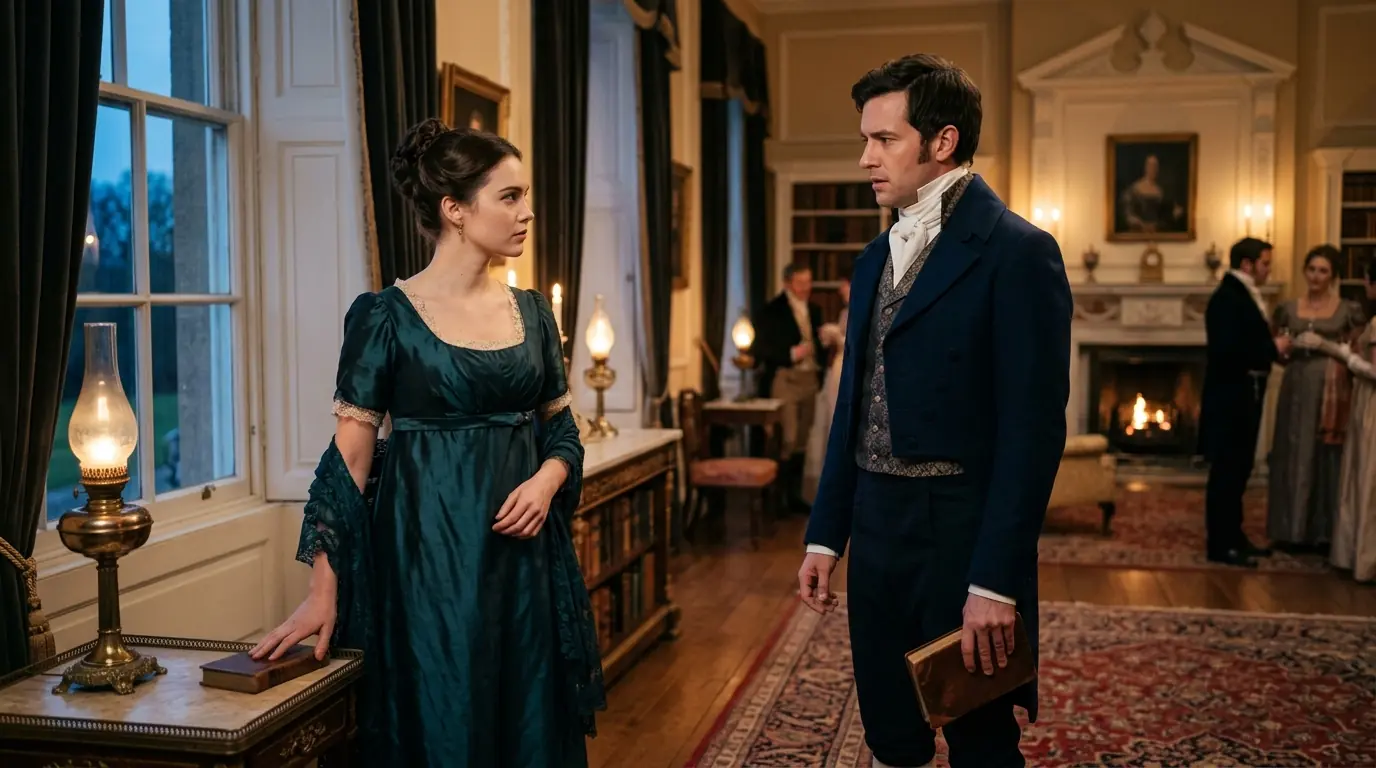
Lady Arabella Kent wanted to know which months he preferred to spend in London. Lady Charlotte Pembroke asked whether he intended to reopen the West Ballroom. Another young woman praised the architecture of Wycliffe Hall with such enthusiasm that Sebastian began to suspect she had memorized the description from a guidebook. He smiled when politeness required it.
His mother had seated him in the center of the table so escape would be impossible. The gathering had been described as a few days among suitable families; no one believed that. The Dowager Duchess had invited eight unmarried women, all from respectable families, all carefully chosen, and all aware that Sebastian was thirty-six, wealthy, unmarried, and under increasing pressure to choose a wife.
His mother had never used the phrase selecting a Duchess. Society had done that for her.
At the far end of the table sat Miss Clara Whitmore. Sebastian had noticed her only because she seemed to be the one person making no effort to be noticed. Her dress was elegant but understated, pale blue rather than one of the brighter colors favored by the other women. She spoke when someone addressed her, listened more than she talked, and had so far made no attempt to steer the conversation toward Sebastian. That alone made her unusual.
Lady Arabella leaned closer to him. "Your Grace, surely you must prefer the country to London. Wycliffe is far too beautiful to abandon for half the year."
Sebastian gave the answer he had given in some form three times already: "I prefer whichever place requires the least conversation about where I prefer to be."
Arabella laughed politely, though Sebastian suspected she had not understood that he was serious. Across the table, Clara lowered her eyes to hide a smile. He noticed.
A moment later, another woman asked whether he intended to host a winter ball. Someone else wanted to know whether he rode before breakfast. Lady Charlotte began describing a charity project she hoped to establish after marriage, although Sebastian could not remember asking about it.
The questions continued. No one appeared interested in the answers for more than a few seconds before moving toward the next opportunity to display taste, intelligence, kindness, or suitability. Sebastian had been through enough social seasons to recognize the pattern. The women were not dishonest; most were simply performing the version of themselves they believed a duke would prefer. He could hardly blame them, but that did not make the evening less exhausting.
By dessert, he had barely touched his food. He rubbed his temple once, then stopped when he realized his mother had noticed. The Dowager Duchess, Helena Wycliffe, sat several places away, observing the table with the satisfaction of someone convinced events were progressing well. Sebastian disagreed.
Lady Arabella had started a story about an orchestra in Vienna when the conversation finally paused. That was when Clara spoke.
"Your Grace."
Sebastian looked toward the far end of the table. It was the first time she had addressed him directly all evening. "Yes, Miss Whitmore?"
She hesitated, as though reconsidering the question. Then she asked, "Are you tired?"
The table became unusually quiet. Sebastian stared at her. Of all the things he had expected to hear that evening, those three words had not been among them. Lady Arabella glanced toward Clara with faint surprise.
Sebastian leaned back slightly. "Why do you ask?"
Clara’s expression remained calm. "Because everyone keeps asking what you think about things."
A few of the women exchanged looks.
Clara continued, "No one has asked whether you still have enough energy left to think about them."
For perhaps two seconds, Sebastian forgot that anyone else was at the table. Then he laughed. Not the polite laugh he had been offering all evening—a real one. His mother looked startled. Clara seemed almost embarrassed by having caused it.
"I am," Sebastian admitted. "Extremely."
"Then I apologize for adding another question."
"It is the first one I have enjoyed answering."
The conversation resumed eventually, though the atmosphere had changed. Sebastian noticed Clara did not try to use the moment to draw him into further conversation. She simply returned to her dessert, as though asking whether a tired man was tired had not just made every other woman at the table look slightly less observant. That interested him more than the question itself.
After dinner, following another round of conversation, he waited longer than necessary before excusing himself, then went looking for Clara. He found her in the library. She stood beside a shelf with a book open in her hands, apparently relieved to have escaped the larger group.
"You disappeared."
Clara looked up. "So did you."
"I live here. That gives me an unfair advantage." Sebastian smiled and walked farther into the room. "Was I truly that obvious?"
She closed the book. "About being tired?"
"Yes."
"Not particularly."
"Then how did you know?"
Clara considered him for a moment. "Because everyone else was watching to see whether you noticed them." Her answer came without judgment. "I happened to be watching you."
Sebastian felt something in his expression change.
Clara seemed to realize what she had said and immediately added, "Not in the way that sounded."
"That is unfortunate."
She almost laughed.
Sebastian leaned against the edge of a nearby table. "You understood why you were invited."
"Of course."
"And yet you have spent most of the evening at the opposite end of every room."
Clara glanced toward the doorway. "My mother would be horrified to hear you say that."
"So your mother expects you to compete."
"My mother expects many things."
"And you?"
Clara looked back at him. "I assumed you would notice if I tried too hard."
Sebastian smiled. "That is probably true."
She hesitated before adding, "And I never expected you to choose me."
There was no false modesty in her words; she simply meant them. Sebastian studied her more carefully. "Why not?"
"I am not the richest woman here, nor the best connected. Lady Arabella already knows half your family, and at least three women at dinner appeared far more suited to the role. But I am hardly important enough for anyone to describe me as the obvious future duchess."
Sebastian considered that. "And does that disappoint you?"
She answered after a moment, "No."
That surprised him more than anything else she had said.
"Not at all," she added. "I didn't come here expecting my life to change because a duke looked across a dinner table and decided I was suitable."
"And if he did?"
Clara’s expression softened with amusement. "I would hope he had a better reason."
Footsteps sounded in the corridor, and Clara glanced toward the door. The evening was calling them back. Sebastian should have returned first. Instead, he remained where he was for another moment.
At dinner, eight women had spent hours trying to make themselves memorable. Only Clara Whitmore had asked whether he was tired. And now, standing in the quiet of his own library, Sebastian realized she had become the only woman there he genuinely wanted to know better.
Sebastian expected Clara to become more careful around him after their conversation in the library. She did not. If anything, the opposite happened. Once they had spoken without an audience, Clara seemed less interested in pretense. She simply answered when Sebastian asked something and disagreed when she thought he deserved it. That alone made their conversations feel strangely different from every other exchange at Wycliffe Hall.
The following morning, he found her walking along the South Terrace while most of the guests were still finishing breakfast.
"You are avoiding everyone again," he said.
Clara looked toward him. "I prefer to think of it as giving them room to impress you without interference."