The letters were in the wall, not hidden, exactly. Hidden implies intention, and whoever had put them there had not been hiding them so much as keeping them the way a person keeps something they cannot throw away and cannot display, tucked into the gap between the plaster and the stone where the old farmhouse wall had cracked and been stuffed with anything that came to hand. Meg Alcott found them on a Thursday afternoon in October when she was repairing the wall of the old gamekeeper’s cottage at the edge of the Thornmere estate.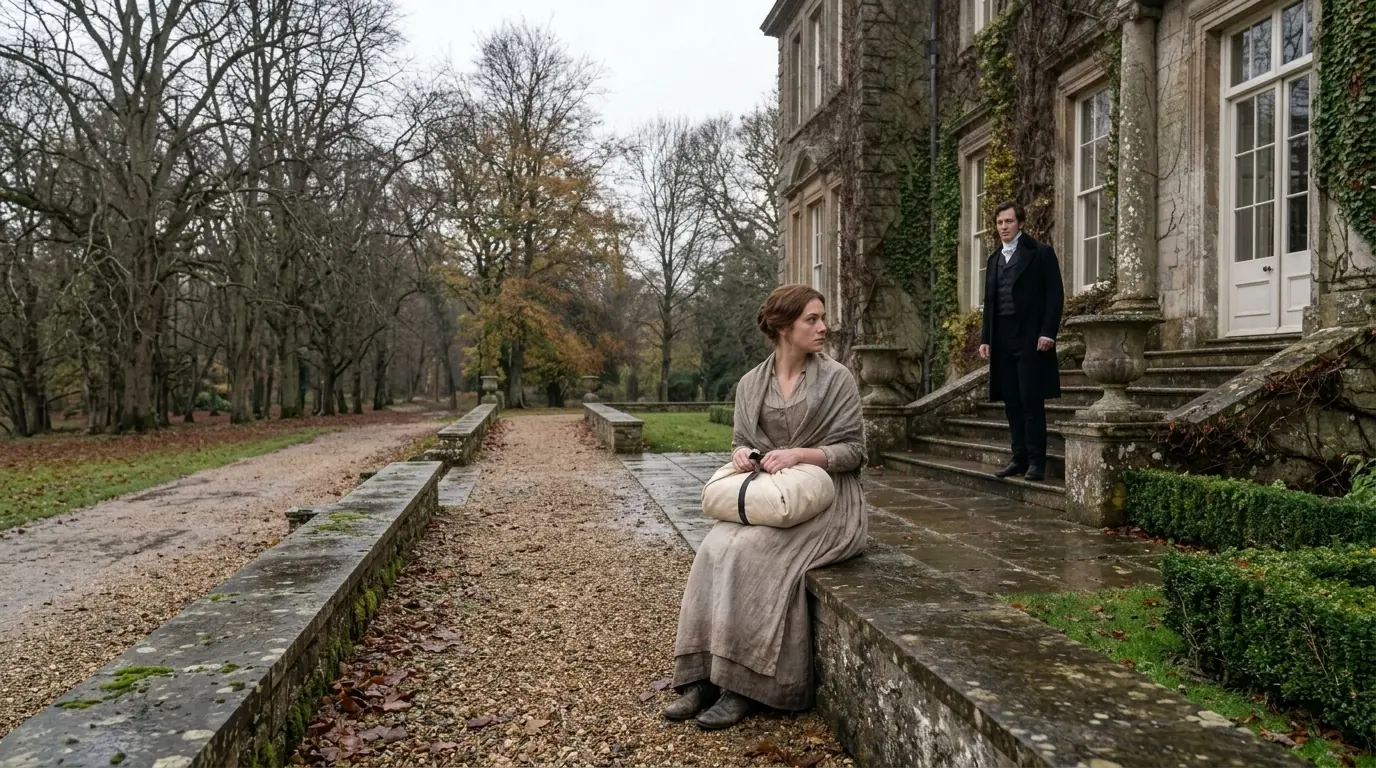
She had been hired by the estate agent to make the cottage habitable again after ten years of standing empty. The repair was part of the job, and the job was what Meg did: general work, useful work, the kind that needed doing and that she was capable of doing. The world had no precise name for it because the world did not expect it to be done by a woman of three-and-twenty who could also keep the village school accounts, lay a hearth, and identify the early symptoms of sheep scab, which she had learned from her father.
She pulled the stuffing from the crack to assess the damage to the plaster behind it. The stuffing came out in a block compacted by years and it was when she began to separate the material that she found the paper. Not one paper, but many. Some were folded; others were rolled.
All were brittle at the edges and soft in the middle from the damp. She sat back on her heels on the cottage floor and unfolded the first one carefully the way you handle something old that has been holding together by good faith. It was a letter, a long one, written in a hand that was educated and urgent and not young. The hand of a person who wrote fast because the thoughts were faster than the pen.
The ink was brown with age. The date at the top said November, but the year had been torn away. She read it. She should not have read it.
She knew that. A letter is a private thing even when it has been in a wall for what appears to be decades, even when the writer is likely dead and the recipient likely gone. She looked for an address. There was none.
No name at the top. No name at the bottom. Only a signature: the single letter E. She read it because it was in her hands and she had never been a woman who could put a thing down before she understood what it was.
She read it the way she read everything. Quickly, attentively, with the particular sharpness of a person who has educated herself from books and newspapers and overheard conversations and the label on the side of a seed packet. Which is to say, from everything available and nothing sufficient. The letter was to someone the writer called only “my dear.” And it was long and wide-ranging and covered a month of thoughts that had apparently accumulated to the point where they needed releasing.
And it was written with the intimacy of a person who knows their reader so well that they do not need to establish the terms. It was about the estate. It was about the winter coming. It was about a decision that had been made that the writer had not agreed with and was now regretting.
It was about a piece of music the writer had heard, and of a garden in summer, a woman's voice, and the smell of lime blossom. The writer was male—she was fairly certain of that from the voice. It ended mid-sentence. She found the rest of it in the second piece of paper which was a continuation without preamble.
The third piece was a different letter entirely, beginning, “I have been thinking about what I said last week,” which implied the letters were a series—a sustained thing written over time. She sat on the floor of the cottage and sorted through everything that had come out of the crack. There were thirty-one pieces of paper in total, most of them complete letters, some fragments. From the context, they appeared to span several years, though she could not date them precisely because the year had been torn from or faded on every one.
She read them all. It took two hours. At the end of two hours she sat in the cold cottage with the letters in her lap and understood that she had found something that was not hers and that she did not know what to do with. She folded them carefully.
She put them in her work bag. She finished the plaster. She walked home to the village with the letters in her bag and the October dark coming down. And she thought about a man who had written thirty-one letters to someone he never named and then put them in a wall instead of sending them.
Her father was at the kitchen table when she came in. Her father was a quiet man, broad and brown, and given to long silences that were comfortable rather than empty. He was the former gamekeeper on the Thornmere estate retired now, and he had a knowledge of the estate that went back forty years. “Papa,” she said, “who was the old Duke?”
He looked up from his pipe. “Which one?”
“The one before the present Duke. His father.”
“Edmund. Edmund Calloway, sixth Duke of Thornmere. He died eight or nine years ago.” He counted silently, then nodded. “Yes. Nine.”
“What was he like?”
Her father considered the question in his usual way, thoroughly and without haste. “A quiet man. Good with the land. He cared about the tenants more than most. He had a wife, but she died young. He never remarried. Lived at the Hall for thirty years on his own, more or less.”
“Was he a letter writer?”
Her father looked at her with the slight narrowing of a man who had raised a daughter whose questions usually had purposes behind them. “Why do you ask?”
She put her bag on the table, took out the letters, and laid them between them. He looked at the folded papers, brown and delicate, and his face made the small inward movement it made when he recognized something.
“Where did you find these?” he asked.
He picked up one letter, examined the single-letter signature, and set it down. “Edmund. Those are his. I am certain of it.”
“Who did he write to?”
“I do not know. He was quiet. I knew he wrote letters because I worked the estate for thirty years, and I saw him on Sunday mornings in the library at the Hall. The window faced the south grounds. I passed it often enough. He was always at the desk writing. I assumed they were estate letters—business matters. You found thirty-one?”
“Thirty-one. None were sent. No address, no names, only this E at the bottom.”
He sat back in his chair. “His name was Edmund. A man does not sign his own name at the bottom of his own letters.”
“No, he does not.”
Her father looked toward the fire. “He had a sister once, but she died before I came to the estate. And there was…” He paused. “There was a woman before the Duchess, before his marriage, a long time ago. I heard it mentioned only once, when old Harker, who kept the gate before me, was dying and no longer guarding his tongue. He said the Duke had loved someone, and she had gone away, and he had never been the same. Harker knew no more than that.”
Meg looked down at the letters. “He wrote to her every Sunday for years, and he never sent them.”
“A man can love a person he cannot write to and still need to write.”
“Why would he put them in a wall?”
“Because he could not throw them away and did not want them found.” He picked up his pipe again. “What are you going to do with them?”
“I do not know,” she said. “Not yet.” She put the letters back into her bag.
She went upstairs and lay on her bed in the dark, thinking about Edmund Calloway, sixth Duke of Thornmere, who had sat at a window every Sunday and written to someone he could not reach. He had kept the letters in the wall of the gamekeeper’s cottage and died without anyone knowing. Meg fell asleep with the question open and woke with the beginning of an answer.
The present Duke was Thomas Calloway, seventh Duke of Thornmere. He had held the title for nine years, was thirty-one, and Meg had seen him perhaps four times, always from a distance at public occasions that required dukes and were attended by everyone in the village whether the village particularly wished to be there or not.
What she knew of him came from the village, which was a reliable source for facts and an unreliable source for almost everything else. He had been away at school and then at the Bar when his father died. He had returned, taken up the estate, and managed it quietly and well, according to Meg’s father, who had served both dukes and regarded the son with the same measured respect he had given the father. Thomas did not entertain much. He was unmarried. He was, by all accounts, an adequate duke and an unknown man.
Meg was going to bring him his father’s letters. That was the answer she had woken with. The letters were not hers. They were not exactly the estate’s, but they were the family’s, and the only family left was the Duke.
She went to the Hall on Friday morning and asked the housekeeper to see His Grace on a matter relating to the estate. She made the request clearly and without embellishment because she was Meg Alcott and did not embellish. The housekeeper knew her father and therefore possessed a framework for Meg that was more than simply a girl from the village. She took Meg to a waiting room and sent word.
Twenty minutes later, a door opened and Meg was shown in. The library had the south-facing window. She recognized it at once from her father’s description, and it was exactly the room in which she would have placed a duke: high-ceilinged and lined with books, with a desk facing the window so the light fell in the proper direction for writing.
The Duke stood behind the desk. He rose when she entered, which she had not expected, and the movement was natural rather than formal—the action of a man who stood for people, not for display. Meg had last seen him at the harvest festival three years earlier from fifty yards away. Up close, he was different in the particular way people always are different up close. He was darker than she had thought and quieter-faced, and he had his father’s hands: broad, capable hands belonging to a family that had once worked its own land and retained the shape of that work in its bones even after the land began working for them.
“Miss Alcott,” he said. “I am told you have something relating to the estate.”
“Relating to the estate and to your family, Your Grace. I found something in the gamekeeper’s cottage while I was repairing the wall.”
She took the letters from her bag and placed them on the desk between them. “Your father’s letters. They were in a crack in the plaster on the east wall, stuffed inside and left.”
He looked at the letters but did not touch them. “How do you know they are my father’s?”
“My father identified the handwriting. He worked the estate for thirty years. He said your father spent Sunday mornings at this desk writing and assumed the letters were estate correspondence. These are not estate letters.”
“What are they?”
“Personal letters. Thirty-one of them. None addressed, none naming the recipient, and each signed with one letter—E—which my father says was your father’s name.”
He continued to look at the letters. His face had the stillness of someone deciding something quickly and unwilling to display the process. “You read them.”
“Yes, Your Grace. I read them before I understood what they were. I read them all before I decided to bring them here. I am sorry for it.”
“Do not apologize. You are an honest woman, and an honest answer is worth more than a polite one.” He looked up at her. “What did they say?”
She told him plainly, without softening or embellishment. She told him about the estate, the music, the lime blossom, the woman who was never named, and the letters that had been written every Sunday for what appeared to be years and never sent.
He listened as her father listened: completely, without the surface movements people made when listening only in order to speak. When she finished, the room was very quiet.
“He never mentioned her,” he said. “My father—in thirty-one years of living with him—never mentioned anyone.”
“He was not a man who spoke of himself,” Meg said. “He wrote instead. He wrote to someone he could not reach because writing was the one way he could continue a conversation that life had interrupted. The letters were not for sending. They were for him. But he could not keep them in the house, because to keep them where he lived would have made the loss too immediate. So he put them somewhere he could reach on foot, close enough to remain part of the estate and far enough to be separate from the Hall.”
The Duke was very still. She had the impression that stillness was his natural state—not the absence of feeling, but the container for it.
“You have thought about this carefully,” he said.
“I have been thinking about it since Thursday. I am sorry I read them. I am not sorry I brought them.”
“You should not be sorry for either. The reading was honest, and the bringing was right.” He rested one hand on the letters without lifting them. “Thank you, Miss Alcott.”
She rose to leave.
“Miss Alcott.”
She turned. He was looking at the letters beneath his hand.
“I have been doing what he did,” he said. The statement was quiet, spoken as her father spoke things that were simply true. “Since he died, I write letters on Sundays. Not the same kind. I write to him. I tell him about the estate, what I have done with it, what I think I should do, and what he might have thought. I do not send them because there is no address.”
“What do you do with them?”
His eyes were dark gray, the color of the sky before rain clears. “I keep them in the bottom drawer of this desk. I have told no one.”
She looked at the desk, then at the man behind it. She thought of a family of men who loved people they could not reach, wrote to them on Sundays, and kept the letters in places outside themselves so the loss did not swallow the living.
“That is a very understandable thing to do,” she said carefully.
“Is it?”
“It is honest. You are continuing a conversation that was interrupted. A letter is a way of maintaining that the conversation is not over, even when the reply cannot come. There is nothing wrong with it.”
“Most people would think it peculiar.”
“Most people do not think carefully about what grief requires. You have found a form for it. Forms matter. Without a form, a thing has no shape, and without shape it cannot be borne.”
He looked at her as people look at someone who has said the thing they were thinking without being told they were thinking it. “Miss Alcott, how old are you?”
“Three-and-twenty.”
“You speak like someone who has thought a great deal about difficult things.”
“I have had occasion to. My mother died when I was fifteen. I kept a journal for three years afterward. I wrote to her in it. I told her what was happening, what I thought, and what she might have said about the things I told her. I understand the impulse.”
“And then?”
“Then I stopped needing to. The grief found a different shape. The journal was the form until a better one became available.”
He said nothing for a moment. She waited because he was a man who thought before speaking, and the thinking was worth waiting for.
“I do not think I have found a better form,” he said.
“No. But you have not looked for one. You have been very busy being a duke.”
“Yes. Dukes generally are.”
The almost-smile was very slight and very quick, but it was there.
“Thank you,” he said, “for the letters, and for the rest.”
“For the rest, you are welcome. Good morning, Your Grace.” She went out.
Meg walked home across the estate grounds in the October light, thinking of the letters in the Hall, the drawer in the Duke’s desk, and the unresolved feeling of a conversation that had found a beginning but not yet its shape.
She finished the cottage in two weeks. She did good work, the kind that would last, and the estate agent confirmed this, paid her, and left satisfied.
She thought about the Duke as she would think about a problem she had encountered but not solved, turning him in her mind and examining him from different angles. She thought about the drawer, nine years of letters to a dead man, his father’s letters in the wall, and the pattern of people who loved deeply and quietly but could not find a way to bring that love into the space where they lived. She thought about it especially on Sundays, which she understood later was because Sunday was when he wrote.
She did not return to the Hall. There was no reason to. She had delivered the letters and said what she had to say, and the door was not her door.
In November, she was hired to repair fencing on the north edge of the estate. The job took three days. On the second, Thomas came past on horseback. He was alone, which she had gathered was his habit. He rode the estate as her father had walked it, because knowing land requires moving through it rather than viewing it from a window. He pulled up when he saw her.
“Miss Alcott.”
“Your Grace.”
“How is the fencing?”
“The north corner is rotten from the ground up. Three posts need replacing. The rest will do another year if the weather is kind.”
He examined the fence. “My father’s fence.”
“His, and the one before him. The original oak posts are at least forty years old, and they are still sound. It is the newer work that has gone.”
“The newer work is mine, then. I put those posts in five years ago.”
“The larch was green when it went in. You can see it in the way the split has traveled. It dried in the ground and pulled the grain sideways. It is a common mistake with larch. Oak or sweet chestnut is better for posts.”
He studied the timber. “How do you know about fencing?”
“My father taught me. He said a gamekeeper who cannot read a fence cannot read an estate.”
She pulled the bad post from the ground and leaned it against the good one.
“He was right,” Thomas said.
“He usually is.”
He dismounted and came to inspect the split post with the same quiet attention he had given his father’s letters. “May I help?”
She looked at him. His riding coat was dark and serviceable, and he had the look of a man who had been on horseback since early morning and did not find physical work distasteful.
“Can you dig?” she asked.
“Yes.”
“The hole needs to be three feet deep. The spade is there.”
He took the spade and began. She trimmed the replacement post, treated the end with the tar she carried for the purpose, and they worked in the November cold without speaking because the work did not require speech and both understood that.
At the third post, he stopped digging and said without looking up, “I read them.”
“The letters?”
“Yes. All thirty-one. I read them on Sunday morning. It took most of the morning.” He rested his weight on the spade. “He was in love for most of his adult life with a woman he could not speak to. She married someone else when they were young. He married someone else. They both had lives, and I think those lives were good, but he never stopped loving her.”
“No.”
“He wrote to her every week for thirty years and put the letters in a wall so they would neither be found nor lost. That is what it looked like to me.” He looked up. “He had a word for it in the twenty-third letter. He called it carrying. He wrote that loving someone you cannot be with is carrying them, and that the carrying is not grief exactly, because grief is for people who are gone. She was not gone. She was somewhere living. He was carrying the weight of a life that had taken a different road.”
Meg stood with the treated post in her hands and considered it. “That is a very precise description of a very particular thing.”
“Yes. He was precise. I had not known that about him. In thirty-one years of living with him, I had never heard him be precise about himself.” He began digging again. “I thought he was a man who did not feel things deeply. I have carried that belief for nine years. I am reconsidering it.”
“People who feel things deeply are often the most contained. The feeling requires so much of them internally that there is little left for the surface.”
“Like pressure in a pipe.”
“Exactly like that.”
He looked at her. “You say things that are very accurate.”
“I say what seems true. I am not always right.”
“You are right more often than most people I speak to.”
“Most people you speak to are telling you what they think you wish to hear.”
“Yes.”
He set the last post into the hole and steadied it while she checked it for plumb.
“You do not,” he said.
“I do not know you well enough to know what you wish to hear, so I say what is true and hope it serves.”
“It serves.”
They finished the posts. He remounted and looked at the fence line, then at her, in the way she had begun to recognize—the way he looked at something he was still thinking about.
“Thank you,” he said.
“For the fencing or the letters?”
“For both.” He paused. “Miss Alcott, I should like to continue this conversation. Not now. Sometime when the fence is not between us.”
The late-November light was flat and gray and entirely without sentiment, which was useful because it allowed her to see him clearly.
“I am generally in the village on Fridays,” she said. “I do accounts at the school in the morning and buy provisions at the market in the afternoon.”
“I will find you,” he said.
He rode away. She stood at the mended fence line and watched him go and thought that this was not what she had expected when she put her hand in a wall crack and found thirty-one letters. He found her on a Friday. He came to the school in the morning unannounced in the way of a man who has thought about something long enough that thinking is no longer sufficient.
He found her at the school accounts table, which stood in the cloakroom because there was no other private space in a school of thirty children. She was not surprised to see him. She had been expecting him—not on this particular Friday, perhaps, but in the way one expects a thing when the logic of a situation points toward it and one has decided to let the logic run.
“Your Grace,” she said.
“I read the letters again,” he said. He took the chair opposite her without being invited. There was only one chair besides hers, and he seemed to understand that standing would make the conversation formal, which he did not want. “The twenty-third in particular. The one about carrying.”
“Yes.”
“I have been thinking about the drawer.”
“The letters you write to your father.”
“Yes. I have been writing to a dead man for nine years. When I found my father’s letters, I understood that he had been doing something similar, and I thought it beautiful and painful. I did not consider whether I was doing the same thing.”
“And now?”
“Now I think the drawer is a form I have continued using beyond the time when it is useful. The way you described your journal—a form that served until a better one became available.” He looked down at the table. “I am not certain what the better form is.”
“A form only for grief, or a form for…” She paused, choosing the word carefully. “For more general things?”
He looked at her, his dark-gray eyes steady. “For more general things.”
She folded her hands on the account book and considered the logic of the situation: a man who had written letters for nine years to address a silence, and the silence in the room now, which was not the same kind of silence at all.
“Thomas,” she said.
It was the first time she had used his name. She had not asked permission. She used it because it was accurate, and accuracy mattered.
He went still.
“I will not sit in the cloakroom of the village school and be formal about this,” she said. “You have come because you wish to say something and are not certain how to begin.”
“I have been thinking about the beginning for two weeks.”
“I will offer it.”
“Say it.”
“You are a man who loves quietly and keeps what he loves in drawers and walls because the living of a life does not always make room for love. I am a woman who says true things and finds it difficult to perform the ordinary social motions that would make the next three months of approaching one another more comfortable. I would rather begin at the beginning and work forward. Can you do that?”
“Can I begin at the beginning?”
“Can you say what you mean when you mean it, hear what I mean when I say it, and not perform the intervening material?”
He looked at her with an expression she had not seen before: the expression of a man who had not been surprised in a long time and was surprised now, and did not know what to do with it.
“I can,” he said.
“Then I will say that I have been thinking about you since October, which is unusual for me. I think the reason is that you are a man who will write thirty letters to someone he cannot reach rather than stop the conversation. A man who does that is a man still trying past the point where trying is easy, and that is a quality I respect more than I can easily say.”
He was quiet. Beyond the cloakroom door came the small, steady sound of thirty children learning.
“I have been thinking about you,” he said, “since you walked into my library with my father’s letters in your work bag and told me that you had read them, and that you were sorry and not sorry in the same sentence. It was the most honest thing anyone had said to me in nine years.”
“Then we are in agreement about the situation.”
“We are.”
“Good.” She opened the account book. “I am finishing these accounts, and then I have the market. I will be free at four.”
“I will meet you at four.”
“I walk home the long way through the estate grounds. My father taught me the paths.”
“I know the paths,” he said. “My father taught them to me.”
Then he went. She finished the accounts. She went to the market and bought provisions and thought about two fathers who had taught their children the paths of the same estate without ever knowing they would need them for the same reason. She walked home at four o’clock.
He was at the gate at the edge of the estate grounds, on foot and without the horse. He fell into step beside her, and they walked the paths his father and hers had both known. Neither performed anything. The conversation found its shape naturally, the way water finds the natural line of the land.
They talked about the estate: the north fence, the cottages, and the school’s need for a larger room. They talked about her father and his father, and the forty years of connection between the two men that had been below the surface all along. Then they talked about the letters.
“My father was a different version of himself in them,” Thomas said. “The version who lived below the surface of the Duke. Meeting that man at sixty years’ remove has been the strangest and most valuable thing that has happened since I inherited the estate.”
“He was happy in the letters,” Meg said. “Not the happiness people perform, but the happiness of someone who has found a way to continue a conversation that matters. The letters were his happiness.”
“He deserved a better form.”
“He used the form he had. He was a man of his time and position. His options were not what they might have been. He made what he could within the limits.”
“You are generous to him.”
“I am accurate about him. There is a difference.”
She stepped over a root she knew was in the path, and he stepped over it a beat later. She thought he would learn the root eventually.
“What will you do with the letters?” she asked.
“Keep them. Not in a drawer. In the library, where the light is right and they will be accessible. He kept them hidden because he had no one to show them to. I have read them now. They need not be hidden.”
“He would not have minded you reading them.”
“How do you know?”
“Because he put them somewhere they were likely to be found when the cottage was repaired. He did not throw them away. He did not burn them. He put them in a wall. A wall is a place, not an absence. He left them to be found.”
Thomas was quiet for a long time. The estate darkened around them, the trees bare and the late afternoon turning toward evening.
“I think you may be right,” he said.
“I am often right about things I have considered carefully. I am wrong about other things.”
“What are you wrong about?”
“I thought that when I returned the letters, I would feel I had done what needed doing and the thing would be closed. I was wrong.”
“What is it instead?”
“Open. The beginning of something rather than the end.”
He looked at her. She looked back plainly in the fading light, without arranging her face for him.
“Yes,” he said. “I thought the same.”
“Then we continue to be in agreement.”
The path brought them to the edge of the estate where it met the village lane, and they stopped.
“Friday afternoons,” she said, “I am free from four.”
“I will be at the gate.”
“And I will sometimes bring the accounts, in case you are interested in what the school needs—which you will be, because you are your father’s son, and he would have been interested.”
“He would have mended the school roof in 1814 if Harker had told him it was leaking,” Thomas said.
“Harker did not tell him.”
“My father told him in a letter he never sent.”
She smiled, a small and accurate smile, not a performed one. “We come from families who keep things in walls and drawers. Between us, perhaps we can learn a different habit.”
He looked at her in the way she had learned: the way he looked at something he was still considering but no longer needed to decide.
“Yes,” he said. “I think we can.”
She walked home along the village lane. He walked back through the estate, and on Sunday morning, for the first time in nine years, the drawer in the East Library desk was not opened. He sat at the window with the south light coming in, and he did not write to his father, and the not writing was not loss. He took the letters he had written to his father out of the drawer the next time she came to the Hall, which was a Wednesday in January, when the estate agent had questions about the cottage that required her practical knowledge.
He showed her the drawer and the letters in it because she had said they should learn a different habit, and this was part of the learning. She read the most recent one. It was about the estate, the fence, and a woman from the village who had found thirty-one letters in a wall. Meg, he had written, was the most direct and honest person he had encountered since his father’s death, and she said things with the same accuracy his father had once possessed in the letters hidden in the wall.
She folded it carefully when she was done and returned it to the drawer.
“You write well,” she said.
“My father wrote better.”
“Your father had thirty years of practice. You have had nine. You will catch up.”
He looked at her across the desk. She looked back.
They were married in March in the village church, with her father, the schoolmistress, and the estate tenants in the pews. The ceremony was quiet, correct, and not elaborate because neither of them was elaborate.
She wore gray, which was the color she wore for work and which was honest, and he wore the same dark coat he always wore, which was serviceable and his. The thirty-one letters were framed. She did this because the letters deserved to be seen and the library was the right room for them. She had them framed in plain wood in pairs with the pages visible so that anyone who wished to read them could.
They hung on the east wall of the library where the light was right, and the duke who had written them stood in the frames, honest and contained, and loving a thing he could not reach. And the house held him the way a house holds everyone who has lived in it, in the walls and the light and the particular quality of a room that has been used by people who cared about it. On Sunday mornings, Thomas sat at the desk and wrote. Not to his father.
The form had changed because a better one was available, as Meg had said it would, and the better form was the one where the person he was writing to was in the next room or across the table or walking the estate paths beside him, and the writing was for her to read, and she read it, and they talked about what he wrote, and the conversation was never interrupted because it was never finished. In the spring, she found, in the crack of the wall in the east bedroom, where the plaster had shifted, a single letter she had not found before. It was different from the others, shorter, folded more carefully. She brought it to him on a Sunday morning.
He read it at the desk with the light entering through the south window, and his face became still and quiet in the way it did when it was full.
“What does it say?” she asked.
He handed it to her, and she read.
It was brief.
“I have found that I am not unhappy. I have found that the carrying is not misery, but a kind of companionship with the person who is not here. I have found that a life can be full and still have a room in it where someone is missing, and I have found that this is not the worst thing. It is perhaps the truest thing I know.”
She folded the letter and placed it with the others.
“He was all right,” she said.
“Yes,” Thomas said. “He was.”
She sat across from him at the desk while the Sunday morning continued around them. The letters were in their frames on the east wall, and the drawer was closed. The room was the room it had always been, and also something it had never been before: inhabited by people who were neither hiding nor performing, but simply living in the light that entered through the south window on a Sunday, in the house that had held everyone who had lived there and was holding them now.