7 years ago, the Duke of Ashbourne buried an empty mahogany casket. The ship carrying his wife splintered against the jagged rocks off the Cornish coast, leaving nothing but driftwood and a lingering, suffocating silence. He spent years drowning in it.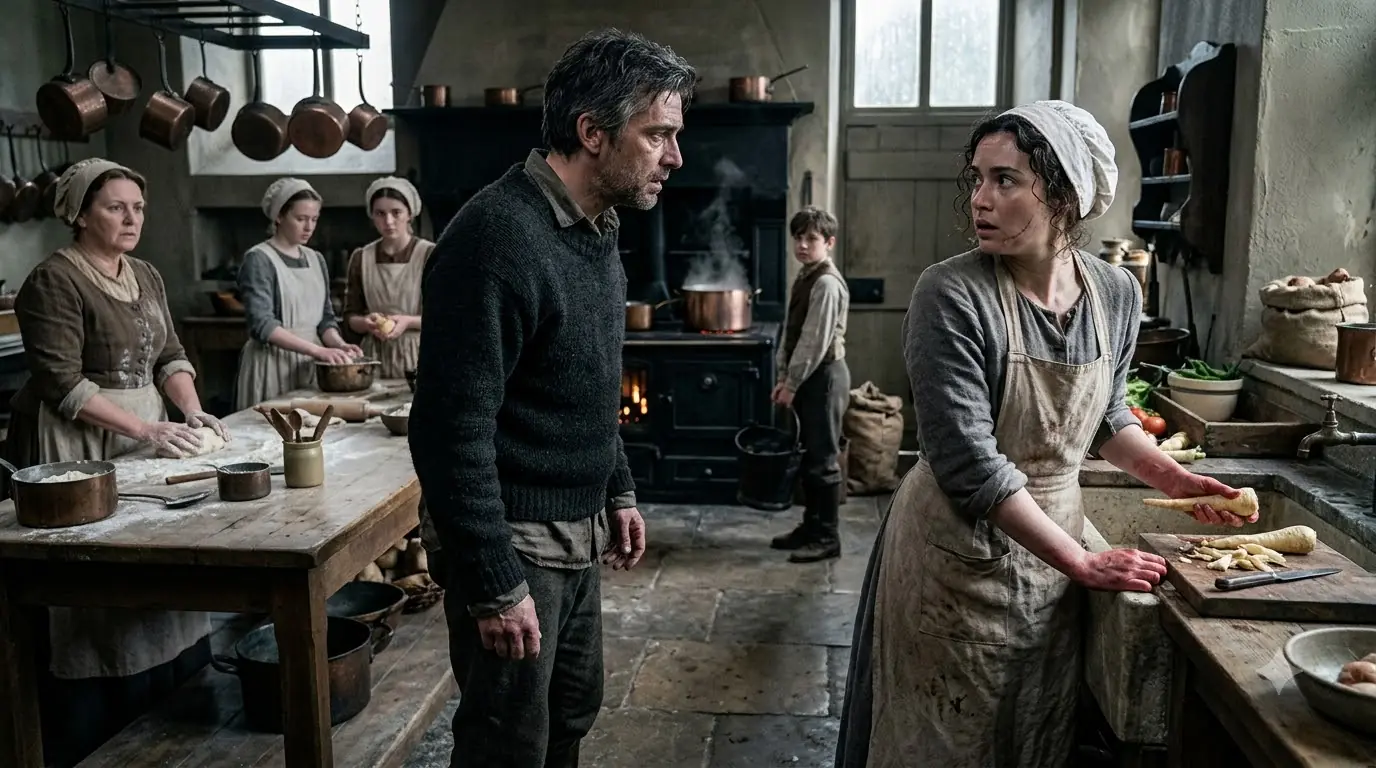
Then, on a miserable Tuesday morning, he walked into the scullery to complain about a cold pot of tea. And there she was, peeling root vegetables. The Duchess he had mourned for nearly a decade, wearing a stained apron.
Richard woke to the sound of rain lashing against the tall glass panes of his bedchamber. Typical. It was a relentless, driving downpour that turned the sprawling grounds of Ashbourne Hall into a gray, muddy swamp. The fire in the hearth had died down to white ash hours ago. The room was freezing.
He stared at the plastered ceiling, tracing the familiar water stain in the corner that looked vaguely like a cracked skull. 7 years. Today marked exactly 7 years since the courier arrived at his club in London, dripping wet and carrying the letter that fractured his reality.
He swung his legs out of bed. The floorboards were like ice. He did not ring for his valet. He dressed himself in yesterday's trousers and a thick woolen sweater that smelled faintly of damp dog and wood smoke. He was 36, but the mirror above the washstand reflected a man who looked 50. Deep lines bracketed his mouth. His dark hair was threaded with premature silver. His eyes, once described by polite society as a striking, lively gray, were now just flat and dull.
Like slate.
He pulled the bell cord for his morning tea and walked to the window, leaning his forehead against the cold glass. The estate was too large. It was a monstrous, cavernous place built for a sprawling dynasty. Not a single bitter widower who spent his evenings drinking brandy in the library until he passed out in the leather armchair.
10 minutes later, a nervous young footman named William entered, balancing a silver tray. The boy was trembling. He set the tray down with a loud clatter on the side table, bowed hastily, and practically ran from the room.
Richard poured the tea. No steam rose from the porcelain cup. He touched the side of the teapot: tepid, not even lukewarm. Normally, he would let it go. He was a cynical man, entirely accustomed to the minor disappointments of a life. He knew his staff whispered about him. They called him the ghost of Ashbourne. They slacked in their duties because they knew he rarely paid attention.
But today, the anniversary, something ugly and restless flared in his chest—a sudden, sharp need for order, for control. If he could not control the sea or the past, he would at least control the temperature of his damned morning tea.
He bypassed the bell cord. He did not summon the butler. Instead, Richard left his chambers and began the long walk down to the servants' quarters.
The house was quiet, too quiet. He passed portraits of stern ancestors who seemed to judge his rough appearance. He pushed through the heavy bay door that separated the family wing from the working heart of the house. Instantly, the atmosphere changed. The air grew warmer, thick with the smells of rendered fat, yeast, and burning coal. The polished oak floors gave way to worn flagstones.
He descended the narrow stone staircase, his boots making a heavy, rhythmic thud against the steps. Voices drifted up from below: a woman laughing, the sharp clatter of cast iron, someone yelling about a late delivery from the butcher. It was a chaotic ecosystem entirely detached from the grim silence of his upstairs world.
Richard stepped into the main kitchen. It was a cavernous room dominated by a massive black iron stove that radiated blistering heat. Copper pots hung from the ceiling beams like oversized brass bells. A half-dozen people were moving in a frenzied, choreographed dance of morning preparation.
Mrs. Abernathy, the head cook, was a formidable woman with a red face and arms like hams. She stood at the large central prep table, vigorously kneading a massive lump of dough. She looked up, froze, and the color drained entirely from her face.
"Your Grace!" she gasped, her hands still buried in the flour.
The kitchen went dead silent. The young scullery maids stopped scrubbing. A boy carrying a bucket of coal halted midstep. The only sound was the fierce crackle of the fire in the stove and the heavy, boiling hiss of a massive stockpot.
Richard ignored them all. His irritation over the tea had already evaporated, replaced by a sudden, intense fatigue. He opened his mouth to tell Mrs. Abernathy to send up a fresh pot, to perhaps reprimand her mildly about the footman's incompetence, but his gaze caught movement in the corner of the room.
By the deep stone sinks, half hidden in the shadows of the pantry doorway, a woman was standing with her back to him. She was hunched over a wooden cutting board, a paring knife moving rhythmically in her hand. She wore a shapeless gray linen dress and a heavy canvas apron stained with soil and vegetable juice. Her hair was tucked beneath a plain white linen cap, but a few loose strands had escaped, clinging to her damp neck—dark, heavy curls, the exact shade of burnt mahogany.
She hadn't turned around. The sudden silence in the kitchen hadn't registered with her. Or perhaps she was ignoring it. She just kept slicing the root vegetable, the blade hitting the wood with a quiet thack, thwack, thwack.
Richard couldn't breathe. The air in the kitchen suddenly felt too thick, like inhaling cotton. His heart gave a violent, painful lurch against his ribs. It was an impossible reaction, a ridiculous trick of the mind. He had seen women from behind in crowds, in carriages, on the streets of London, and for a split second thought it was her. But never here. Never in his own home.
"You there," Richard rasped. His voice sounded like grinding stones.
The woman stiffened. The knife stopped moving. Slowly, she lowered her hands to the edge of the stone sink. She didn't turn.
"Turn around," he commanded.
The volume wasn't there, but the raw, desperate edge in his tone made Mrs. Abernathy take a frightened step backward.
The woman by the sink took a slow, ragged breath, her shoulders rose and fell under the cheap gray linen. Then, gripping the edge of the wooden counter until her knuckles turned white, she turned to face him.
Time fractured. It did not slow down. It simply broke.
Richard stared. The woman staring back at him had a smudge of dirt across her left cheekbone. Her hands, resting against the edge of the butcher block, were red, chapped, and rough. A thin, jagged scar cut across the line of her jaw, disappearing into the collar of her dress. She looked exhausted. She looked older. The soft, luminous beauty of the 22-year-old girl he had married was gone, replaced by something hardened, sharp, and terribly real.
But the eyes were exactly the same: deep, piercing hazel, framed by dark lashes. They were wide now, reflecting a potent mixture of raw panic and utter resignation.
"Genevieve," he whispered.
The name felt foreign on his tongue. He hadn't spoken it aloud in 4 years. He had banned the staff from saying it.