Weathersby, in the wet autumn of the year, was a town that kept its opinions the way other towns kept livestock, fed daily, counted often, never let out of sight. The opinion it had kept longest was also the fattest, and it was the one everybody agreed upon. It was that Miss Winifred Rushton would be somebody's last choice, if she were anybody's at all. They did not say it cruelly, and that was the strange part.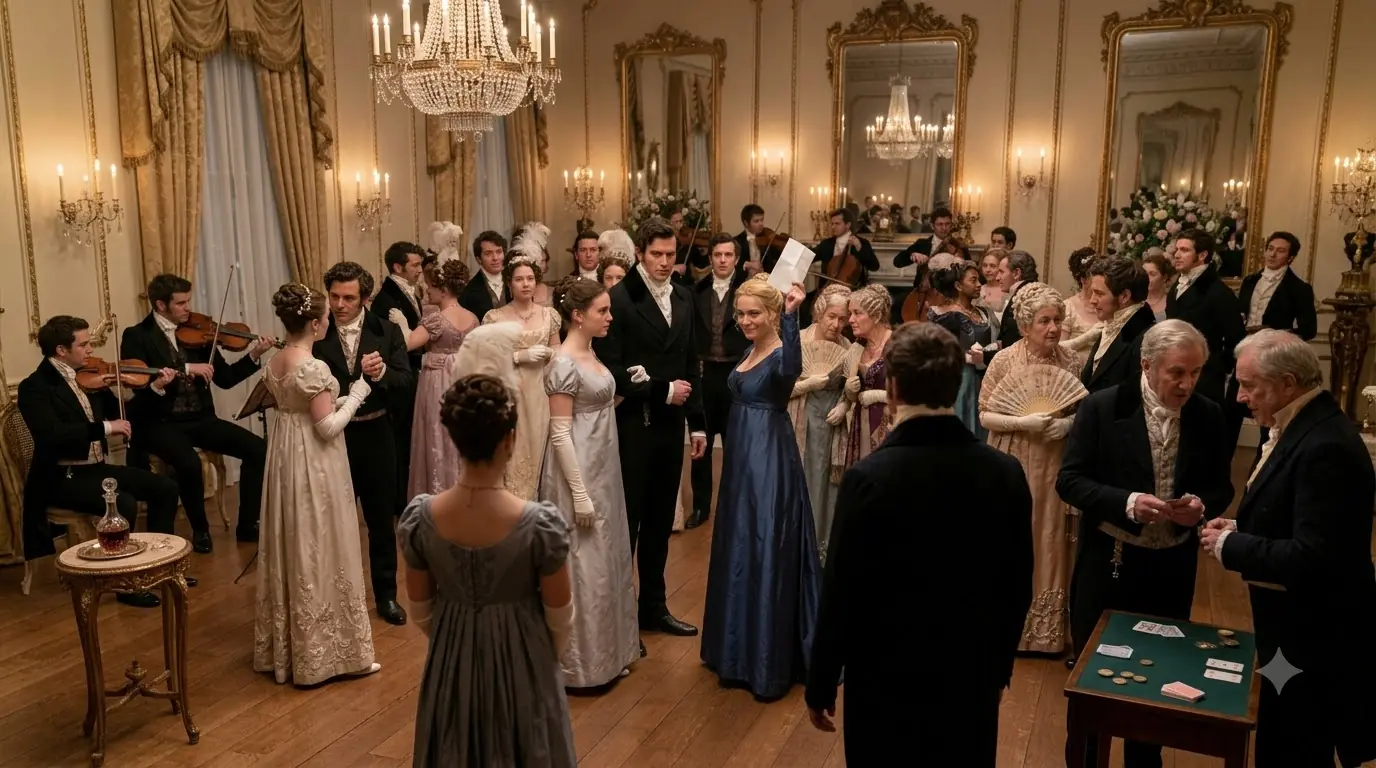
They said it the way they said the mill wheel wanted greasing, or the church roof wanted mending, as a settled fact, as a thing so long true that it had stopped being an insult and become only the weather. She was three-and-twenty, and she was not plain exactly. She was overlooked, which is a worse thing because plainness can at least be argued with. Being overlooked cannot.
There is no answer to a room that does not turn. The notice went into the county paper on a Thursday. It sat in the small print where betrothals lived, between a sale of oak timber and a lost brown mare. And it said what such notices always said.
A marriage was arranged and would shortly take place between His Grace the Duke of Kingsmere of Blackmore and Miss Winifred Rushton of this town. Peg read it first. She was old and read slowly, moving her finger along the line, and she read it three times before she set the paper down on the kitchen table as though it might scold her. "Miss," she said. "Miss, come here." Winifred was at the oven with flour to the elbow and a warmth in her face from the fire.
She did not turn at once, because a loaf at that moment cannot be left. She had learned long ago that the world could wait the length of a loaf.
"A moment," she said.
"It cannot be a moment," said Peg. "It is in the paper."
So Winifred came, wiping her hands, and she read the line, and then she read it again exactly as Peg had. She did not cry out. She did not sit down hard in the chair the way women did in stories.
She only stood very still with the cloth in her hands, and felt the whole shape of the coming day arrange itself in front of her, like furniture in a dark room. Because it was not true. She had never met the Duke of Kingsmere. She had seen him twice across the width of a church and the width of a market square, and both times he had not seen her.
That was the ordinary condition of her being seen by anybody. Now the whole of Weathersby would read this line over its breakfasts, and the whole of Weathersby would do what it did best. It would decide together and at once exactly what the line meant.
"It is a mistake," she said. "Some clerk has put down the wrong name." It has your whole name," said Peg. "Winifred Rushton. There is no other.""
That was true. There was no other.
She folded the paper along its own crease small and put it in her apron pocket. Then she went back to the oven because the loaf could not be left. There was nothing else in the whole wide morning that she knew how to do. To understand why the line landed the way it did, you have to go back five years to the last time Winifred Rushton had stood in front of the town and been looked at.
She had been eighteen and she had been promised. His name was Mr. Brindle, a curate with a good chin and a habit of saying serious things about the poor. Winifred had believed in the way that eighteen believes that a good chin and serious talk were the whole of a man.
The banns were read twice. The town had known. On the third Sunday the banns should have been read for the last time, but Mr. Brindle was not in the church.
He was thirty miles away marrying a maltster's daughter with £4,000 which was £4,000 more than Winifred had. The town sat in its pews and understood the arithmetic before the parson had cleared his throat. Nobody looked at her unkindly. And that again was the thing.
They looked at her with a soft terrible pity. The pity you give a lamed horse. It followed her out the church door and down the years, and it hardened slowly into the settled fact. She would be somebody's last choice, if anybody's.
She had stopped minding, or she had told herself she had stopped, which for practical purposes is nearly the same. She had built a life out of the pieces the town did not want. She kept a small house. She kept an old servant, and she baked.
Her grandmother had taught her in a dough bowl of pale, worn wood, wide as a wash basin, cracked once, and mended with a band of tin. In that bowl, three generations of Rushton women had made bread that people crossed the town to buy. But a lady did not sell bread, so Winifred did not sell it. She gave it.
She gave it to the almshouse and to the two blind sisters on Cutler's Lane, and to any child who stood at her gate, looking as though bread would settle a question for them. A great many children discovered that it did. It was the one thing in her life that turned toward her. Bread rises for anyone who is patient and warm and does not lie to it.
Bread did not care that she was the last choice. It had chosen her every single morning for five years, and she had learned to be content with that, or nearly. She went to market that Thursday, because the household still wanted candles, notice or no notice. She felt the square change as she came into it.
The talk did not stop. It only lowered and bent the way grass bends away from her and toward each other. Two women at the cheese stall put their heads together. A third laughed, then looked ashamed of laughing.
The whole square had read the small print, and the whole square had already decided what it meant. It meant the last choice had reached above herself. It meant there would be a reckoning and a crying off and a fine new grief to pity her for. Weathersby loved her best in her griefs because it had never known what to do with her otherwise.
She bought her candles and kept her chin level. She did not hurry because hurrying would have told them they had struck home. She had learned that lesson at 18 in the church with the whole town watching her not weep. At the corner of Cutler's Lane, the blind sisters were waiting.
They could not read the paper, which was the mercy of them. They knew her only by her step and her bread, and they held out their thin hands. And the older one said, "You are late today, dear. Is anything wrong?"
"Nothing is wrong," said Winifred, and with the two blind women for the length of one street, it was true. The Dowager was to blame for the notice, though Winifred did not know that yet. Millicent, Dowager Duchess of Kingsmere, was eighty-one years old, and she had buried a husband, a son, and most of her patience. She had decided some weeks before that she would not die before she saw her grandson married to a woman with a spine.
She had been watching Winifred Rushton for a year because she ate Winifred's bread every Sunday. The almshouse where the Dowager sat on the board of governors was given four loaves a week. They came from a young woman who wanted nothing for them, who asked nothing and put her name to nothing. She simply left the bread warm on the sill and went away.
The Dowager had made inquiries, and the Dowager was very good at inquiries. She had learned about Mr. Brindle and the maltster's daughter. She had learned about the pity.
From the window of her carriage she had watched a whole market square arrange itself so as not to greet the last choice. Something old and hot had moved in her chest then something she had thought long since burned out and she had a grandson who could not be got to the point. Crispin, Duke of Kingsmere, was one-and-thirty, and he had been chased since he was nineteen by every mother in three counties. He had come to regard the whole business of being wanted as a kind of theft.
Everyone took that to mean never, and he privately took it to mean the same. His grandmother had asked him once plainly what he was waiting for.
"To be wanted by someone who does not want it," he had said. It made no sense, and it made perfect sense, and the Dowager had gone away and thought about it for a month.
Then she had sent the notice to the paper herself. She had not told him and she had not told the girl. She had simply written the line in her own hand and sealed it and paid the fee because she was eighty-one and had run out of subtler weapons. And she had a feeling in her old bones.
If she could only get the two of them into the same room under the same lie, the truth would find its own way out. It was a monstrous thing to do. And she knew it was monstrous, and she did it anyway. She slept well after, which tells you a great deal about the Dowager Duchess of Kingsmere.
The Duke read the notice on Friday. He read it standing at his own breakfast table, and he did not fold it small the way Winifred had. He set it down very carefully, the way a man sets down a thing he does not trust himself to hold, and he said one word. The word was his grandmother's name, Millicent.
Then he called for his horse. The Dowager received him in the yellow room where she always received the people she had wronged because the light was kind and made it harder to shout. He did not shout, for he was not a shouter. He stood in the doorway with the paper in his fist, very white about the mouth, and said, "You will print a retraction." I will not," said the Dowager."
"You have ruined a woman I have never met." I have married you to a woman you have never met," said Millicent."
"There is a difference, though I grant you it is fine." It is a lie." Today," she agreed. She was doing her needle work, and she did not look up from it, which cost him more than any look could have. Most true things begin as lies.
Somebody was brave enough to print. Sit down, Crispin. You are blocking my light. He did not sit down, but he came into the room, which was the same thing, and she knew it.
Do you know what you have done to her? He said, "Not to me, to her. A woman with no fortune and no friends, and you have hung her name from mine in a paper the whole county reads." When it comes out that it is false and it will come out, she will be the woman who reached above herself and was refused. You will have finished what that curate began.
You will have made her a joke that lasts the rest of her life. The needle stopped for the first time. The Dowager looked up and there was something in her old face he had not expected. It was shame, real shame, and under it something harder that was not shame at all.
"Then do not refuse her," she said quietly.""
"Grandmother—"I did not say marry her tomorrow. I said do not refuse her. There is a season between now and any wedding, a long season, and I am asking you to let the lie stand through the winter. Let that girl walk into one drawing room, just one, on the arm of a duke, before you send her back to being nobody.
Give her a single season of being chosen. If at the end of it you want your freedom, you shall have it, and I will print your retraction myself. I will take the whole of the blame in the whole of the county, and you may say what you like of me. But you will give her the winter.
He was silent a long time.
"Why?" he said at last.""
"Why her?" Because she gives bread to blind women and puts no name to it," said the Dowager. Because she has been treated by this county exactly as you have, and she did not go sour. You did because I am old, Crispin, and I have watched everyone in your life want you for your name. I thought just once you might like to meet the one woman in England who does not want it at all."
He went to Weathersby the next day. Winifred saw him from the kitchen. She saw the horse first, a big gray thing, ill-suited to the narrow street, and then she saw the man. She knew him at once, though she had only ever seen him across a church and a market square.
A man who has been looked at his whole life, and has learned to hate it, carries himself in a particular way, as though the air itself is a crowd. She wiped her hands and took off her apron and had time to do neither well. He was already at the gate. Peg was already opening the door with her mouth in a perfect round of terror.
There was nothing to be done but meet it. He filled the low room and had to stoop for the beam. He looked at the wide, worn dough bowl on the table, the bread cooling on the rack, the flour still in the seams of the floor. Then he looked at her and his face did the thing his grandmother had warned him of, and he had not believed.
It changed because Winifred Rushton, standing in her own kitchen with flour on her wrist and her chin up, was not a woman reaching above herself. There was no fear on her face. There was only a great weary readiness to be hurt again, which is a different thing from fear. She was a woman braced to be refused, and he knew that brace, for he had worn it himself for twelve years.
"Miss Rushton," he said.""
"Your Grace." She did not curtsy deeply. She curtsied exactly as much as was correct, and not one inch more. And he noticed that, too.""
"You have come to tell me it was a mistake."
You needn't have ridden so far. I knew it Thursday. I will write to the paper myself, if you like, and take the fault so that none of it need touch your house. He looked at her.
"You would take the fault?" he said.""
"Somebody must. It is cheaper for it to be me. I have very little left to spend."
And that, not her face, not her bread, not any soft thing, was the moment the Duke of Kingsmere stopped being angry with his grandmother. He did not sit because he had not been asked, and she did not ask him, because she did not yet know the rules of a game she had not agreed to play. So they stood, the two of them, in the small warm room, and he told her the truth. All of it, the Dowager, the notice, the winter, the offered freedom at the end.
She listened without moving, for she was good at listening without moving. She had had a great deal of practice at receiving news that rearranged her whole life while she stood still. When he had finished, she was quiet a while. So she said, Your grandmother wishes to buy me a season of being wanted, as one buys a poor child an orange at Christmas, out of kindness.
That is not how she would put it." It is how it is, though." She looked at the bread on the rack.
"I do not want an orange, Your Grace. I am too old for oranges. When the winter ended, I should have to go back to the sill and the blind sisters and the pity."
Only now the pity would have a fine new coat on. The whole county would say, "There goes the woman a duke jilted, and the curate would be nothing beside it. Your grandmother has not thought it through. Old kindness rarely does." He had thought exactly this, and it startled him to hear it in her voice.
"Then refuse me," he said.""
"Now to my face. I will carry the refusal to the paper, and you will be the woman who cried off from a duke, which no woman in this county has ever been. Let them make what pity they can out of that." She looked up sharply because it was clever, genuinely clever, and it was kind under the cleverness.
Nobody had been clever and kind at Winifred Rushton in five years, and she felt it land somewhere she had thought sealed.
"You would let me refuse you," she said slowly, "and take the whole indignity of it, so that I might be armored for the rest of my life." A woman who said no to a duke need never mind being called a last choice again. Yes. Why?
It was the same word his grandmother had thrown at him, and he gave her a truer answer than he had given the old woman. Because I have spent my life being wanted by people who were counting, he said. And you stood in your own kitchen and offered to take the blame to spare my house before I had said a kind word to you. Nobody has tried to spare me anything since I was a boy.
I find I do not want to leave the county owing you nothing for it. The fire settled in the great and one log gave and dropped. You propose an arrangement, she said. I propose an arrangement.
"Say it plainly, then. I have been ruined once by a man who would not say things plainly, and I have no patience left for it. So he said it plainly. They would let the betrothal stand through the winter."
She would come to Blackmore with Peg for propriety and the Dowager for a chaperone the whole county trusted and she would be for one season the affianced bride of the Duke of Kingsmere. She would be seen as such in the drawing rooms that had never turned toward her. At the end, at a time of her choosing, she not he would end it. She would cry off and walk away the one woman in the county who had refused a duke, and the pity would never dare touch her again.
"And you," she said.""
"What do you take from it?" A winter of my grandmother's silence," he said."
"She will stop hunting me if she thinks the hunt is one, and that is worth a good deal to me." He stopped. And she said, "And I confess a curiosity as to what it is like to sit at a table across from a person who is not counting." She looked at him for a long moment.
She was not a fool, and she knew exactly how many ways such an arrangement could end in a deeper ruin than the one she started with. She weighed them one at a time with the plain and unfrightened arithmetic of a woman who had nothing left to lose but her own good opinion of herself. Then she held out her hand, floured to the wrist the way one does over a bargain at a fair.
"Through the winter," she said.""
"And I end it in writing."
You will not be kind to me in a way that lets the town pity me. If you are to be seen with me, be seen as though you mean it. Half kindness is worse than none, and I have had a great deal of halfkindness." He took her floured hand in his ungloved one. It was the first time in twelve years he had shaken hands with a woman as though closing a deal between equals, and he felt the flour, and he did not brush it off after."
Peg saw that and remembered it and told no one.
"As though I mean it," he said. She came to Blackmore on a gray Monday with one trunk and Peg and the dough bowl. She had nearly left the bowl behind, for it was absurd to bring it.
A great house had a great kitchen with bowls enough for an army, and a Duke's affianced bride did not go below stairs to make bread. But she had stood in her own kitchen with the trunk packed and had found she could not shut the door on the bowl. It was the one object in the world that knew her, and she was going somewhere that did not. So it went into the trunk wrapped in her second best shawl, and she did not explain it to anyone.
Blackmore was cold, not in temper, but in fact. The fires were lit and the rooms were fine. And it was cold the way a house is cold when nobody in it is glad. She felt it the moment she stepped into the hall.
The great grieving quiet of a place that had grown used to being unhappy, and something in her, some baker's instinct wanted at once to feed it. The Dowager met her at the top of the stairs. She was smaller than Winifred had imagined and older, and her eyes were very bright and very unashamed. She took both of Winifred's hands and held them and looked at her a long time.
"You are angry with me," she said.""
"Yes," said Winifred.""
"Good," said the Dowager. Anger is the sign of a person who has not given up, and I was afraid you might have given up.
Come, I have put you in the east rooms where the morning is. This house has had quite enough of the dark. The housekeeper was Mrs. Merrow, a spare woman with keys, who had run Blackmore through its long unhappiness, with a stiff and injured pride, and who did not at all approve of a nobody from Weathersby.
She unbent by exactly one degree on the third morning. She came into the kitchen at 6 and found the affianced bride of the Duke of Kingsmere with her sleeves rolled up to the elbow in a batch of dough. At home in the one place in the house Mrs. Merrow had thought no lady would ever go.
"Miss!" said Mrs. Merrow, scandalized.""
"Mrs. Merrow," said Winifred, not stopping.
Your oven draws to the left. Did you know the right side runs cool? Whoever built the flue was in a hurry. It is nothing that cannot be managed.
But you must turn the loaves at the half or you get one pale end. I dare say you have been getting one pale end for years and blaming the flour. Mrs. Merrow had in fact been getting one pale end for years and blaming the flour.
She stood in the door a long moment and then she came in and shut the door behind her against the cold of the passage.
"Show me," she said in an entirely different voice. That was how it began. Not with the Duke, with the oven.
The Duke in those first weeks was a courteous stranger. He came to dinner. He walked her through the long gallery so the portraits could look at her. Since the county could not yet.
He answered her questions in two and three words. Spare as a man paying out rope he was not sure he wanted to lose. She learned the shape of him slowly. The way you learn a dark room by the barked shin and the found chair.
She learned that he rose early and rode the bounds of the estate himself, which no duke needed to do, because the moving air was the only thing that quieted him. She learned that he read at night in the library by one candle, though there were candles enough in the house to light a ballroom. He had grown up watching his father waste and could not break the habit of counting even his own comfort. She learned that he had a brother once, older, the heir, who had died at four-and-twenty of a fall from a horse.
Crispin had never wanted Blackmore, nor the title. He had inherited both the way one inherits a debt, and had been counting the cost of it ever since. She learned all this in pieces over dinners that grew without anyone deciding it longer. The table at Blackmore was very long.
On the first night they sat at its two far ends, a duke and his fiction with a waist of polished oak between them and passed remarks the length of the county down the shining wood. On the fourth night, Winifred, without a word, moved her place three seats up. On the seventh, she moved it three more. By the end of the second week, she sat at his right hand, close enough to pass the salt without a footman.
The long, cold table had quietly become a short, warm one, and neither of them ever spoke of it. The Dowager from her end watched it happen and said nothing at all, which for the Dowager was a great triumph of the will. And there was the bread. It got into the house the way warmth gets into a house from below, from the kitchen up.
First it was only the smell on the stairs in the mornings. Then it was on the table and the Duke, who ate as a man refuels without noticing, noticed. Then it was going out again in baskets to the tenants because Winifred had asked Mrs. Merrow who was ailing in the cottages and Mrs.
Merrow unbending now to three or four degrees had told her. That was how the child came. Her name was Nan, the daughter of a tenant named Corbold, who had the farm and a bad chest and too many children. Nan was the boldest of them, seven years old, with a gap in her teeth and no fear of dukes, because she had never been told to have any.
She followed a bread basket up to the great house one morning, the way a kitten follows milk, and she was found by Winifred on the kitchen step, staring in at the oven with her whole heart in her face.
"You may come in," said Winifred, "if your boots are clean." Nan looked at her boots, which were not clean, and at the oven, which was warm, and made the calculation every child makes. She wiped her boots very hard on the scraper and came in. She came most mornings after that.
She learned to knock the loaves for the hollow sound. She learned to knead badly with her whole small weight. She asked questions without end, and Winifred answered them without end because nobody in five years had wanted so much of what Winifred knew. It turned out that Winifred had a great deal saved up to give.
"Why do you press it down when it’s grown so big?" Nan asked once, watching the dough sink under Winifred's fist.""
"Because it grew too fast and too proud," said Winifred. You knock it back and it grows again, slower and stronger.
And the second rising is the one you keep. Most good things are second risings, Nan. Remember that.
Nan did not understand it and put it away all the same.
The way children put away the sentences they will need in twenty years. The Duke found them there one morning. He had come down for the account books early, and he stopped in the passage door and watched a thing he had not seen in his own house since he was a boy. A woman and a child floured to the elbows, laughing at a loaf that had gone wrong at the far end of a kitchen full of warmth in a house he had thought was permanently cold.
He did not go in. He stood and watched, and something in his chest, some long shut window of a thing, came open a crack and let in a draft he had forgotten the name of. Winifred saw him. Over Nan's head through the flour light.
She saw him in the doorway, and their eyes held one second. Two. She did not smile because that would have made it small, and he did not smile because he had forgotten how. Then Nan said something about the loaf, and the moment closed, and he went away to his account books, and could not, for the length of that morning, make the figures come right.
He came into the kitchen himself a week later. He did not pretend to have an errand. He stood in the doorway a moment, too large for it, and then he came in and sat at the end of the scrubbed table where the light was, and watched her work. Nan had gone home.
It was only the two of them and the warm ticking of the oven.
"Give me a piece of it," he said at last. She looked at him.""
"You will spoil your coat." I have other coats. I have never once made a thing with my hands that a person could eat.
I find I should like to before the winter is out. So she tore off a piece of the dough and set it in front of him and showed him the way of it. He was clumsy, as clumsy as Nan, and far too gentle, afraid of the very thing that wanted his whole weight.
"You are handling it like a lord," she said.
It is not a petition. Lean on it. It wants to be pushed and folded and pushed again until it stops fighting you and starts to give. He leaned on it.
The dough gave under the heel of his hand, and something in his face gave with it. Some cord that had been drawn tight for twelve years. He did not smile, but the almost of a smile moved at the corner of his mouth. The first she had seen there.
And he bent his head over the small task like a boy and did not look up for a long time.
"There," she said quietly, "you have made a thing that a person can eat. "I have made a very poor thing. It is a first rising.""
They are all poor. You knock them back and they come again, slower and stronger." I told Nan the same."
"Most good things are second risings, Your Grace." He looked at her across the flour-dusted table and did not correct her, Your Grace, though something in him wanted to.""
"So you keep saying," he said.""
"I am beginning to believe you mean it about more than bread." She did not answer that. She took the poor gray lump from his hands and set it to prove by the fire beside her own. Then they sat in the warm kitchen while the two loaves rose together. Neither of them said a word.
It was the most that either of them had said to anyone in years. The Dowager took her out into the county in the second week of November. It was the promised thing, the one drawing room, and the Dowager chose it carefully. It was the house of a Mrs.
Holloway, who was harmless and well-connected, and could not keep a piece of news past her own front step. The Dowager dressed Winifred in gray silk of the best sort and put her own small pearls at Winifred's throat and handed her up into the carriage as though she were made of something that would not break.
"You will say very little," the Dowager instructed.""
"You will let them do the reaching."
A woman who is chased has only to stand still. It is a thing you have never been permitted to learn, and it is time you learned it. They came into Mrs. Holloway's drawing room, and the room turned. Winifred felt it in her spine before she understood it.
The whole warm, chattering room turned toward the door, toward her, and did not know what to do with itself. Here was the last choice in gray silk on the arm of a Dowager duchess. The story the county had told for five years had no chair in that room to sit in. They reached exactly as the Dowager had said.
They reached. Women who had cut Winifred in the market square for years now crossed the carpet to press her hand and say how they had always known, always said, what a quiet, deep, deserving girl she was. Winifred said very little, and let them reach, and felt the strangeness of it move through her like a fever that does not hurt. In the carriage home, she was quiet a long time.
"It is not real," she said at last.""
"They do not see me. They see the arm I came in on." No," the Dowager agreed."
"Not yet. But you have learned tonight that a room can turn, and you will never again believe the ones that told you it could not. That is worth the whole evening, whatever else was false in it. The Duke was in the hall when they came home, though it was late and he had no reason to be."
He looked at Winifred in the gray silk and the borrowed pearls, and for a moment he forgot to be spare.
"They saw you," he said.""
"They saw the arm I came in on." No," he said it exactly as his grandmother had and did not know he had done it."
"They saw you."
I have watched that county not see people my whole life. It cannot look at a thing that plainly does not want it. You did not want it. That is why it looked.
Winifred stood in the cold, bright hall and did not answer because there was no safe thing to say to a man who had just described her better than she had ever managed to describe herself. Sidony came to Blackmore in the third week of November. She came uninvited in the county way under cover of a call upon the Dowager, and she came because she had read the notice 5 weeks before, and had not in all that time stopped being astonished by it. Sidony was six-and-twenty and beautiful and had understood since she was fifteen that beauty was a currency to be spent very carefully, the way a clever poor girl spends a small fortune on exactly the right things.
She had spent it for two years on the Duke of Kingsmere. She had made herself, by patient degrees, the obvious answer to a question everyone agreed the Duke must one day ask. She had been within one good season of it, when a line of small print between a timber sale and a lost mare had taken it all away and given it to a nobody who baked bread for blind women. She did not believe it, and that was her whole engine.
She simply did not believe that the Duke of Kingsmere, who had refused every eligible woman in three counties for a decade, had chosen the last choice, the curate's leavings, the woman the town pitied. It offended her sense of how the world was arranged, and Sidony had built her whole life on how the world was arranged. She had come to Blackmore to find the crack in it. She was very charming at dinner.
"Miss Rushton," she said over the soup, in a voice like warm honey, with a wasp in it, "I do so admire your courage. To come into a great house like this with all its ways, all its people who have known it for generations, and you from that dear little town with none of the training. I could not have done it, but you seem quite unbothered. It is a gift, I think, not to feel a thing one has no way of understanding."
"It is a gift," Winifred agreed, "not to feel a great many things. I have several I could recommend." The Duke at her right hand made a small sound into his wine that might have been a cough. Sidony smiled and tried a different door.
"And the wedding," she said. "When is it to be? The whole county is agog, though I confess..." A light laugh, a hand to the throat. "One hears such odd things that it is not to be till the spring that His Grace is in no hurry. But that cannot be right for a man in love does not wait."
So I said to Mama, "They will marry directly. You will see." The table went very quiet because it was of course exactly true. There was no wedding fixed, and there could not be, because there was to be no wedding, only a winter and a crying off. Sidony had put her clever finger straight through the paper of the thing, and knew it, and was watching their faces to see the truth come up.
Winifred felt the whole fiction sway. Then the Duke set down his glass.
"We will marry," he said, "when Miss Rushton wishes, and not one day before. I have waited one-and-thirty years for a woman I did not have to persuade. She has been hurried once in her life by a man in a church, and it went ill. I do not mean to be the second. It was the longest speech anyone at Blackmore had heard him make in a year. Winifred turned her head and looked at him and he was looking at her and for one dangerous moment the fiction was not a fiction at all."
Both of them felt it. Sidony watching felt it too and hated it and understood that she was not going to find her crack in the daylight. So she would have to look for it in the dark. She stayed three days charming for all three.
She walked the gallery and admired the portraits. She sat with the Dowager and lost gracefully at cards. On the third night, when the house was asleep, she did not go to her bed. She went in stocking feet with a candle hooded in her hand to the one place in a great house where its truths are always written down.
The morning room where the Dowager kept her desk. She was looking for a letter, and she did not find a letter. She found something better. It was the household ledger, and folded inside it in the Dowager's own bold hand was the draft of the notice she had sent to the paper.
Beneath it in the same hand was a single line the old woman had written to herself and never sent to anyone. It is the way old women write the truth where only God and the ledger will read it. If I can get them into one room under one lie, the truth will out. He has never been chosen.
Let him be chosen once, even by a trick. Even by me. Sidony read it twice. The way Peg had read the notice and Winifred moving her lips over the arithmetic.
A trick? It was a trick, a charity, a season's kindness bought for a nobody, and it would end in a crying off. And the Duke was not lost after all. He was merely lent.
All Sidony had to do was break the lie in public at the right moment, in front of the right people. Winifred Rushton would be finished forever. The Duke of Kingsmere would be free and Sidony would be there being beautiful when he came looking for a way to mend his pride. She copied the line, put the ledger back exactly, and went to her cold bed to lie awake till dawn, not out of guilt, but out of a hard, bright joy she mistook for being clever.
In the morning she took her leave of Blackmore with the sweetest words in the world. The Dowager, who missed very little, watched her carriage go, and she felt, for no reason she could name, a small, cold finger drawn down her spine. The winter deepened. The lie went on, and under it the truth the Dowager had gambled on began very quietly to grow.
It grew at the table which was short now. It grew in the library where Winifred began to come at night with her own candle. It turned out she read two. The two candles made more light than one, though neither of them ever said that was the reason.
One such night she asked him the thing she had wondered since the kitchen.
"Why did you agree to it?" she said.""
"Not the winter—the curiosity."
You said you wished to sit across from someone who was not counting, but you might have found such a person anywhere and never printed a lie to do it. He was quiet a while, turning the page he was not reading.
"No," he said.""
"I could not have."
A man in my position cannot go looking for a woman who does not want him because the looking gives him away and then they all pretend not to want him which is worse. My grandmother understood that. She did not give me a woman who did not want me. She gave me a woman who wanted only to be rid of me honestly in writing by spring.
It is the only honest wanting I have been offered in twelve years. He looked up. Or the only honest not wanting. I confess I have begun to lose the difference.
Winifred looked down at her book and did not turn the page either.
"May I ask you a thing in return?" she said after a while. You count everything.
Your candles, your coats, your own comfort. Why do you never count the bread? It goes out of this house in baskets to people who will never pay a farthing for it. And you have never once asked me what it costs.
He considered it a long moment, and she saw that no one had ever put the question to him. Because it is the one thing in this house that comes back, he said at last, "Everything I count goes out and does not return. Rents, repairs, the drains, the roof. But you send bread to a sick cottage, and the cottage sends up its child to stand at my kitchen door and be glad." I did not know a thing could be spent and come back larger.
My father never taught me that sum. I am learning it late. He paused. You are teaching it to me, though I do not think you meant to." No," said Winifred.
"I meant only to feed people. The rest is yours." It grew on the estate where she rode the bounds with him now on gray December mornings, learning the land the way she learned everything in particulars.
This field, that weir, the cottage where the Corbolds coughed through the cold. There was a morning she remembered long after. The frost was hard and the sky was low. He stopped the gray at the top of the long field and sat looking down at the whole of Blackmore.
The house lay small and gray in its hollow, one thread of smoke rising thin against the low sky.
"My brother loved it," he said. He did not often speak of his brother.
"I never could. It was always his, and I only mind it now the way a man minds a thing left in his trust, not the way you mind a home."
"You could mind it that way," she said.""
"If you let it be one." He looked at her and did not answer. But the smoke stood straight up from the kitchen chimney where her bread was rising, and they both looked at it, and neither of them said what the smoke meant.
It grew most of all on the morning of the first snow. Nan did not come that morning. Winifred waiting with the dough felt the knot coming before she understood it. The way one feels a missing tooth with the tongue.
By ten she had her cloak on. By noon she was at the far farm in the low dark cottage with the Corbold children ranged along the wall like frightened birds. Nan was on the bed burning. A fever had come up in the night out of nowhere.
The way fevers did, the way one had taken the maltster two winters before. The way they took children every year without asking anyone's leave. Winifred did not send for the doctor and sit and ring her hands.
She had nursed her own mother through the fever that took her. And she knew the work of it, the long unglamorous work, the cool cloths, the raised head, the spoonfuls of broth got in past cracked lips one at a time through a night that has no end. She rolled her sleeves. She sent the frightened children to the neighbor, and she stayed.
The Duke found her there at midnight. He had come home from the far side of the estate to a house where his affianced bride was not, and Mrs. Merrow, white in the hall, and he had not stopped to ask himself why his heart did the thing it did. He had simply called for the gray and ridden through the new snow to the farm.
He came in low under the door, a duke in a tenant's cottage, and he found her by the bed with her hair come down and her sleeves wet to the elbow and Nan's small hand in hers.
"You should not be here," she said, not looking up.""
"It may be catching." So may you be," he said, "and I came for you anyway." She looked up then. It was the plainest thing he had ever said, and he had not meant to say it, and it hung in the small, hot room between them, with the child's harsh breathing under it."
Neither of them touched it. There was work to do, and some true things are too large to be picked up in the middle of a fever. They must be set down and left till there is time. So he stayed, a duke on his knees by a tenant child's bed, wringing cloths in cold water all the long night at the elbow of the last choice, doing the unglamorous work.
He was not good at it. His cloths were too wet, and his big hands were clumsy with the small spoon, and he did every mean small task exactly as she told him, without once asking why it must be done that way. That was the thing she kept afterward, not that a duke had knelt in a tenant's cottage, that he had done as he was told by the last choice all night, and been grateful for the telling. The fever broke near dawn, the way they do or don't.
This time it did. Nan slept true sleep at last. Winifred sat back on her heels, put her wet face in her wet hands, and shook once hard. He put his hand flat between her shoulder blades, and left it there, and said nothing, because there was nothing that would not have made it smaller.
They rode home in the first gray light through the whitened land.
"Crispin," she said.
It was the first time. She had never once used his name.
She had said Your Grace or once or twice in a hurry. Nothing at all. Now tired past the reach of the fiction, past the arrangement, past the whole careful winter, she said his name plainly into the snow. He turned his head.
"Yes," he said.
That was all, but she had said it, and he had answered to it, and both of them knew a line had been crossed in the white morning that could not be uncrossed, whatever they told the paper in the spring. The Dowager took to her bed a few days before Christmas. It was nothing sudden.
It was 81 years, come due at last, the long account closing. She was not afraid, because she had done the one thing she had stayed alive to do, or set it going. She lay in the great bed in the room with the good light, and watched through the door she made them leave open. She watched the two of them moving through her house.
For the first time in a decade, she was entirely at peace. She sent for Winifred on the fourth day.
"Sit," she said.""
"Give me your hand."
There you have flour under your nails. Good. Never lose that. A duchess with flour under her nails is worth 10 with clean hands and nothing in them.
"I am not a duchess," said Winifred.""
"No," the Dowager agreed.""
"Not yet. You are angry with me still, and you are right to be."
I'm going to ask you to forgive me anyway because I am old and I may cheat. She smiled. The old wicked smile. I tricked you.
I tricked you both. I hung your name from his in the paper without your leave, and it was monstrous. And I would do it again tonight because look at you. You have flour under your nails in my grandson's kitchen.
My grandson rode through the snow for a child that is nothing to him. This house has bread in it and light in it for the first time since his brother died. If the price of that was one old woman's soul, then it was cheap, and I have paid it gladly. Winifred could not speak.
"He will offer you your freedom in the spring, as we agreed," the Dowager said. He is honorable, my Crispin—more is the pity—and he will keep the letter of a bargain past all sense. He will offer to let you cry off so that you walk away armored the woman who refused a duke.
And you will want to take it because you have been hurt. And the armored thing is the safe thing. You have been safe a long time, my dear, and safe is a very small house to live in. Her old hand tightened.
"So I am going to spend the last of my cheating on you," she said. Not on him, on you. When he offers you the safe thing, I want you to do the brave one. I want you to choose, not to be chosen.
You have had enough of waiting to be chosen or not chosen all your life. I want you for once to be the one who does the choosing. The last choice made yourself. The one made last and freely and past all the others.
And it stands.
"Promise an old cheat you will at least think of it." I promise," said Winifred, and found she was crying and did not mind. The Dowager died two days after Christmas in her sleep in the good light with the door open."
The house grieved her honestly. And in the grieving a thing happened that neither Winifred nor the Duke had planned for. They leaned on one another without arranging it, without discussing it, the way people do who have quietly become the other's home. He came to her in the library the night of the burial and did not speak and she did not make him.
And they sat by the low fire with the two candles till it was very late.
"She told me you would offer me my freedom in the spring," Winifred said into the fire. She made me promise something before she died, and I have not decided whether I will keep it. He was very still.""
"What did she make you promise?" That is mine," she said."
"Not yet yours. She spent a great deal of her dying on it, and I mean to spend it carefully."
When at last he rose to go, he stopped by her chair and put his hand once against her hair, the way he had put it against her back in the cottage.
"Thank you," he said.""
"For the winter," she heard the past tense in it. For the winter.
As though the winter were ending, as though the bargain were coming due, she sat by the dying fire long after he had gone, turning the Dowager's promise over in the dark, like a coin she was not ready to spend. The county, in the meantime, had begun to turn on its own, and it turned from below. The story of the fever went out from the far farm the way such stories go. The Corbolds told the neighboring cottage and the cottage told the smith and the smith told the whole of market day.
A duke on his knees in a tenant's kitchen all the winter night wringing cloths for a laborer's child. It was not a thing the county had a shelf for. It did not fit the man they had built out of his silence and his shut gates. And beside him in the story always was the last choice, with her sleeves wet to the elbow, doing what no fine lady would do.
Winifred felt it the next time she went into Weathersby for candles. The square did not bend away from her this time. A carter she did not know touched his hat. The woman at the cheese stall, who had put her head together over the notice, came out from behind it now.
She pressed a small crock of honey into Winifred's hands for the poor Corbold child. She said she would take no coin for it. It was clumsy and late, and Winifred knew exactly what it was worth, which was not much. But it was a square that had turned, and she had lived three-and-twenty years in a square that would not.
At the corner of Cutler's Lane, the blind sisters were waiting, as they always were.
"They are saying grand things of you now, dear," the older one said, holding her thin hands out.""
"All the town. Is it true, do you think? Are they kind?" At last they are turned," said Winifred."
"It is not the same as kind. But it is a beginning, and I find I will take a beginning. I have waited a long while for one."
She did not tell them the turning frightened her more than the cold had. A town that turns toward you, she was learning, can turn again. She had built her whole life on being able to stand in a square that did not want her. She did not yet know how to stand in one that did.
Sidony chose the New Year's assembly at Weathersby. She had waited with the patience she was so proud of for the largest room and the fullest one, the assembly the whole county came to. It was the room where the Duke would have to bring his affianced bride at last into the very drawing rooms that had never turned toward her and be seen and be believed. Sidony had waited for that room because a lie broken in a small room is a private thing, mendable, while a lie broken in a full one is a public execution.
She did not want to lend the Duke back. She wanted to win him and to bury Winifred Rushton so deep that no season could ever dig her out. She had the copied line in the Dowager's hand in her reticule. The assembly rooms were bright.
The whole of Weathersby was there, and half the county besides, the very people who had pitied Winifred down five long years. They turned, all of them, when the Duke of Kingsmere came in with the last choice on his arm, and did not know what to do with their faces. The woman they had pitied was in gray silk, with her chin up and a duke's hand under her hand, and the story they had told about her for five years, no longer had anywhere to sit. For an hour, it was the finest hour of Winifred Rushton's life.
Then Sidony crossed the room. She was smiling, for she was always smiling. She came with two of the county's best gossips at her flank, arranged as witnesses without knowing it, and stopped in front of the Duke and Winifred in the middle of the bright room. She said in her honeyed carrying voice, pitched exactly to reach the walls.
"Your Grace, Miss Rushton, how well you look—how happy. It is quite a triumph. One does so love a happy ending. Even the wasp came out of the honey."
Even a purchased one.
The nearest heads turned.
"I beg your pardon," said the Duke, very quietly.""
"Oh, but you needn’t," said Sidony.
I think it a beautiful thing truly, that a great lady at the end of her life should spend her last strength buying a season of happiness for a poor, overlooked girl, who could never, in the natural way of things, have hoped for it. It is charity of the very finest kind, and I only wonder that you kept it so secret." She drew the folded paper from her reticule, not opening it, only letting it be seen, a small white weapon. I have here in the dear Dowager's own hand, God rest her, the whole tender arrangement, the notice she sent to the paper herself, the little trick she played to get the two of you into one room, so that a nobody might be a somebody for one short winter before the crying off in the spring restored the world to its proper shape."
It is all here. Shall I read it? The county does so love a love story, and this is such a kind one. The room had gone silent.
This was the moment Sidony had built for years. The full room, the raised paper, the honeyed voice, the last choice about to be unmade in front of the very people who had made her the last choice in the first place. She had only to open the paper and read the Dowager's line, and Winifred Rushton was finished forever. The Duke was free, and the world came right.
She looked at Winifred to watch it land, and Winifred Rushton was not looking at the paper. She was looking at Sidony, and her face was not the face of a woman being unmade. It was quiet and steady, and it was, of all impossible things, kind. The way you are kind to a person, you have just in a single second completely understood.
Because Winifred knew that face. She had worn it. It was the face of a person who has staked their entire self on one thing and stands to lose it, and is more afraid than they have ever let anyone see. She had been 18 and worn that face in a church.
She knew it from the inside. Looking at Sidony Vesey, beautiful, trembling, triumphant, with the whole of her life folded into one white square of stolen paper, Winifred felt the last of her own old wound go quiet.
"You cannot hate a thing you have finally wholly understood." You may read it," Winifred said. Sidony's smile flickered."
"You may read it," Winifred said again, and her voice, though quiet, went to the walls as clean as Sidony had.""
""Because every word of it is true. The Dowager sent the notice. I never met His Grace before, Michaelmas.
It was a trick and a kindness, and I was angry at it, as you would be. We agreed to a winter and a crying off in the spring and my name armored at the end. All true. You have caught us out entirely, Miss Vesey.
"There is only one thing your paper does not know." The room held its breath.""
"It does not know that I have changed my mind," said Winifred. She turned, not to the room, but to him, to Crispin, standing white and still at her side.
She took her hand out from under his deliberately, so that everyone should see it was freely done, and she faced him in the middle of the bright, silent room, where she had been pitied for five years.
"You mean to offer me my freedom in the spring," she said only to him, though the whole county leaned to hear it. I know you do. You are too honorable to do otherwise.
You will let me cry off and walk away armored the woman who refused a duke. Safe forever. It is a great kindness and it is the safe thing. And your grandmother told me before she died that safe is a very small house to live in.
So I am not going to wait for the spring and I am not going to take the safe thing. I am going to do the choosing myself now here in front of all of them so that no one can ever say again that I was chosen out of charity or married out of a trick. She drew a breath.
""I choose you, Crispin. Not because a paper said so, nor because your grandmother was kind. I have spent my whole life being the last choice, the one left over, the one nobody came to first. And I find I do not mind it any longer because there is another way to be a last choice. To be the one that is chosen last of all, passed every other freely on purpose and kept.
I would rather be your last choice made with your whole heart than any other woman's first made with half of one. That is my crying off, Miss Vesey. I cry off from the arrangement, and I choose the man. For a moment, no one in the room breathed at all.
Then the Duke of Kingsmere, who had not made a speech in a year, who paid out words like a miser, looked down at the woman with flour under her nails. She had just, in front of the whole county, chosen him with her eyes open. He said the only thing there was to say.
"You were never my last choice," he said.
"You are the only one. There was no line of women. Whatever the county believed, there was a cold house and an empty table, and a man who had stopped expecting to be wanted for anything but his name. And there was you, offering to take the blame, to spare a house you had never entered."
I did not choose you last, Winifred. I chose you the moment you offered to be ruined, so that I would not be. Everything since has only been me. Slowly, learning that I had already done it.
He took her floured hand back in his ungloved one in front of them all, the way he had over the bargain in her kitchen, and he did not brush the flour off after. And Sidony Vesey stood in the middle of the bright room with a piece of true paper in her hand that had suddenly proved nothing at all. She had built her whole assault for a lie, and the lie had turned in Winifred's plain voice into the truth, and made the paper worthless. She could read the Dowager's line aloud now, and it would only tell the county what it had just watched happen.
That an old woman had seen before anyone what these two were to each other and had cheated to get them into one room and had been right. There is no cruelty that survives being agreed with. Sidony looked at the paper in her hand and at the two of them and at the county turning now slowly toward Winifred, not with pity, but with the beginning of that warmer, more grudging thing a county gives a woman who has surprised it. She understood all at once with the sick lurch of a person who had spent a fortune on the wrong thing that she had lost.
That she had in fact lost long ago in November in a cold cottage she had never seen and had simply not been told. Her hand holding the paper began to shake. Winifred saw it. She might have let Sidony stand there and be unmade in front of the room.
Exactly as Sidony had meant to unmake her. Instead, she did the thing the Dowager had died hoping she had it in her to do. She was kind. She crossed the small distance between them and stood close, so that what she said next went to Sidony alone under the rising murmur of the room.
"Put it away," she said.""
"Nobody needs to read it. You have carried it a long way and it cost you a great deal and it has come to nothing. I'm sorry because I know what it is to stake everything on one man in one room and watch it go."
I have been where you are standing. It does not last forever, though it feels as though it must. Put the paper away, Miss Vesey, and go home and find something to want that can want you back. It is a better winter than the one you are having.
I promise you it is.
Sidony looked at her. Whatever she had expected, it was not that. She had come armed for scorn, for triumph, for a fight she knew how to have, and instead she had been handed by the woman she had come to destroy.
The one thing she had no defense against, mercy from someone who had earned the right to withhold it. Her eyes filled. She turned that instant before the room could see, and she went quickly through the parting crowd and out into the cold. She did not read the paper, and she did not come back.
The county which had watched the whole of it decided among itself in the way a county decides that it had always known Winifred Rushton was somebody really if you looked and that it was a great pity about that curate all those years ago and how well it had all come right in the end. They were married in the spring at the church in Weathersby, in the plain light of an ordinary Saturday. She wore gray. She had always worn gray, and she was not going to pretend on the one honest day of her life to be a woman who wore anything else.
The Dowager's ring was on her hand. Nan Corbold, quite recovered, carried the flowers and dropped most of them, and did not mind, because she had been promised she might knock the wedding loaves for the hollow sound. Afterward, she considered that by far the more important office. The town came.
The same town that had pitied her, that had done the arithmetic in the pews five years before, came now and filled the church, and turned all of it toward Winifred Rushton. This time the turning was glad. She stood in it and let it be glad because she had learned at last that a room that turns toward you late is still a room that turns. Peg wept in the front pew, unashamed, into a handkerchief she had kept pressed flat in a drawer for five years against exactly this day, which she had never once stopped expecting.
The two blind sisters were there beside her. They could not see the gray silk or the ring or the way the Duke did not once take his eyes from his bride. They knew it all the same by the sound of the church, which was the sound of a whole town's mind being changed at once.
"She is happy," the older one whispered, tilting her head to the warm murmur of it.""
"You can hear it. It is the same as the bread. You always could hear when a thing had risen."
Afterward, in the churchyard, an old man Winifred barely knew took off his hat to her and turned it in his hands and said what a great many of them were thinking.
"We were wrong about you, miss, all of us, all this long while. He did not quite know how to finish it. "I hope you will not hold it against the town.""
"No," said Winifred.
She found, to her own surprise, that it was true. A town is only a great many frightened people standing close together. I have been frightened, too. I hold nothing against anyone who was only afraid.
The old man put his hat back on and nodded as though she had given him something he could carry home. Perhaps she had. She had learned that long winter that mercy is only the last rising of a hurt that has been knocked back enough times and has come up softer instead of harder. It was the one recipe she had that the town had never let her share.
She meant to share it now. The Duke of Kingsmere took her hand at the front of the church.
"Last choice," he said, only to her, under the parson's words. It was not the town's old cruelty in his mouth now.
It was the opposite of it. The whole of the thing turned over and made a blessing. Made last, made freely, made past all the others, and kept.
"And kept," she said.
Blackmore was not cold after that. You would not have known it for the same house. The fires were the same, and the fine rooms were the same. But the great grieving quiet had gone out of it, the way a fever goes in the night when you are not watching.
In its place was the smell of bread on the stairs in the mornings, and Nan Corbold knocking loaves in the kitchen, and Mrs. Merrow entirely unbent now, turning the pans at the half, so that no loaf ever again came out with one pale end. He had the flue rebuilt that summer, the one that had drawn to the left since before his father's time. It was a small thing, and it cost very little.
He did it himself, standing in the yard with the mason, arguing over the draft. His wife had once told a housekeeper that whoever built it had been in a hurry. He was not a man who left things in a hurry anymore. He had learned in one winter the whole slow craft of the second rising.
The long table stayed short. They never moved the places back. Guests remarked on it sometimes, how oddly the Duke and Duchess of Kingsmere sat, crowded up at one end of a table built for 40, close enough to pass the salt without a footman. The Duke never explained it.
The Duchess only smiled, and passed the bread. The dough bowl sat on the kitchen table, pale and worn, mended with its band of tin. The one object in all that great house that had known her before any of it, and it knew her still. Three generations of Rushton women had made bread in it, and a fourth would learn to in time.
The bowl did not care about titles. It rose for anyone patient and warm who did not lie to it, and it had chosen her every morning of her life, back when nobody else would, and she never forgot the debt. On the far farm, Mr. Corbold’s chest was better for the good winters. The good winters came because the bounds of the estate were ridden now by a duke who knew every field by its particulars—this weir, that cottage—and by a duchess who knew who was ailing before the doctor did and sent the baskets. Nan grew tall on that bread. She grew tall enough in time to reach the high shelf where the dough bowl lived and to teach a younger Corbold child the trick of knocking a loaf for the hollow sound. She did not remember much of the fever, but she remembered the sentence about the second risings, exactly as Winifred had said it would happen.
She said it to the younger child over the sinking dough. She did not know yet what it would come to mean to her. In the good light of the old Dowager's room, the door was always kept open now on purpose, so the house should never again forget how to let the morning in. Winifred would sit there sometimes in the early hours before the household woke with her tea going cold.
She would think of an eighty-one-year-old woman who had cheated the whole county out of pure stubborn love and been right. The town had called her the last choice. For five long years it had called her that softly as a settled fact as the weather. And it had been true in the end, though never once in the way the town had meant it.
She was the last choice, the one chosen last of all, passed every other freely, on purpose, with a whole heart and open eyes. Not the leaving, but the keeping. Not the woman nobody came to first. But the woman, one man in a cold house, had been quietly choosing all along, and went on choosing every ordinary morning for the rest of a long and breadwarm life.