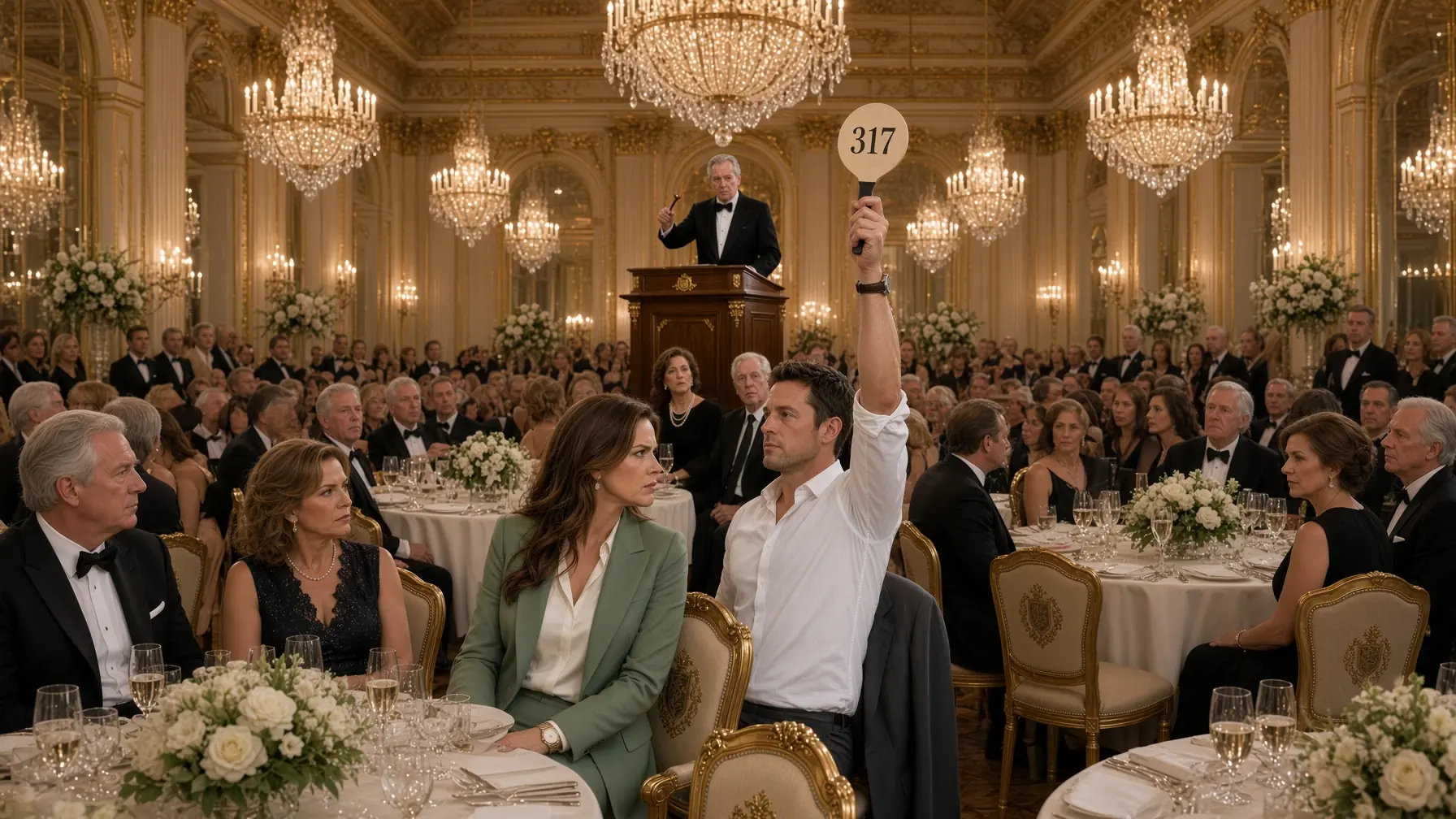
Everyone ignored the single dad at the luxury auction until he raised the final paddle. No one in the gold trimmed auction hall looked at Nolan Avery for more than two seconds. His jacket was worn at the cuffs, his watch was scratched, and the guest card in his hand carried no family name anyone recognized, so the staff assumed he had wandered in through the wrong door. Billionaire Evelyn Blackthornne even waved a hand toward an usher, ordering him moved out of the front row, and the room laughed softly when he obeyed without protest. Nolan said nothing.
He simply held paddle number 317 against his knee and waited for the final lot of the night. When the bidding seemed to close forever, he raised his hand one more time, and the entire hall went silent. If you believe a quiet man can still shake the loudest room in the city, stay until the final paddle falls and watch what the truth is really worth. Nolan Avery arrived at the Hian and Row auction house in an ordinary taxi while the other guests stepped down from long black cars with drivers who knew their names. The doorman mistook him for a driver himself and pointed him toward the service entrance before glancing twice at the card in his hand.
The young woman at the reception counter did the same, gesturing toward a staff corridor until she noticed the seal on his invitation and the seat number printed beneath it. The invitation was genuine, though it listed no title, no company, and no family history that meant anything to the people reading it. He had been assigned paddle number 317 in a chair in the front row, a placement requested personally by the estate of a collector named Harlon Voss. He did not explain why. He simply thanked the receptionist, straightened his jacket, and walked into a room built for people who had never once been questioned at a door.
Inside, the air smelled faintly of lily stems and fresh varnish, and the light fell in soft gold sheets from chandeliers that seemed designed to make everyone beneath them look wealthier than they actually were. Nolan noticed the details most people in the room would never think to notice. The hairline crack repaired along the leg of an antique table. The slight mismatch in the frame nails on a landscape hung near the entrance. The faint smell of fresh lacquer masking a repair job done in a hurry.
Years of restoring frames for people who never once thanked him had taught him to read a room the way other men read a stock ticker. Every object in that hall told a story if a person knew how to look past its price tag, and Nolan had spent most of his adult life learning exactly how to look. He took his seat quietly, set his catalog on his knee, and let the noise of the gathering wash past him without once losing his focus on the single page he had already marked. When Evelyn Blackthornne entered, the entire hall shifted around her like a tide pulled by the moon. Photographers leaned forward with their cameras raised. investors rose from their seats to shake her hand, and Graham Bellamy, the head auctioneer, crossed the floor himself to greet her before she had even removed her coat.
She noticed Nolan almost immediately, and something behind her composed smile tightened for half a breath. This was the same man she had personally pushed out of the appraisal industry 8 years earlier, now sitting in the most important row of the most important sale of the year. Without asking why he had been placed there, she instructed an usher to move him to the back of the room, framing it as a courtesy reserved for what she called serious buyers. Nolan accepted the reassignment without a word of argument, carried his paddle to the last row, and opened a catalog already marked in pencil. Everyone watching assumed the matter was settled and that the strange man in the worn jacket had simply been put back in his place.
Nolan did not feel the sting the way the room seemed to expect him to. He had been dismissed from far more important rooms than this one, from boardrooms with his name still printed on the door outside, from meetings where his opinion had once been the only one that mattered before it suddenly counted for nothing at all. A single push toward the back row from a woman who had already taken everything else from him barely registered as an insult anymore. He settled into his new seat, adjusted the angle of his chair so he could still see the stage clearly, and allowed himself one slow breath before opening the catalog again. Somewhere above him, the chandeliers hummed faintly with electric current.
A sound so quiet that only a patient man would ever notice it at all. What none of them noticed was that Nolan had skipped past every valuable item listed in the early pages of the catalog. He had circled only one lot near the very end, marked simply as lot 40, and beside it he had written a single word in small, careful handwriting, orchard. He did not glance at the diamonds being paraded across velvet trays or the antique clocks being wheeled in on padded carts. His attention stayed fixed on a folded corner of the catalog that no one else in the room had thought worth opening, and he waited with the patience of a man who had already spent 8 years waiting for this exact evening to arrive.
The auction began with pocket watches, strings of pearls, and paintings whose names alone drew gasps from the crowd. Every few minutes, another bidder lifted a paddle simply to be seen lifting it, turning the sale into a quiet performance of who could afford to seem unbothered by the price. Evelyn won the first three lots at figures well beyond anyone's prediction, and each time the auctioneer's gavel came down, the room applauded as though she had conquered new territory rather than spent money. Nolan never raised his paddle once during those early rounds. The servers pouring wine skipped past his row entirely, and two collectors seated nearby joked, just loud enough for him to hear that perhaps he had come only to watch how wealthy people spent their evenings.
He let the comment pass without turning his head, keeping his eyes on the stage, and his hands folded calmly in his lap. The room grew warmer as the evening wore on, thick with perfume, and the low murmur of people discussing figures large enough to buy entire buildings. Waiters moved between the rows with trays of champagne that caught the chandelier light and scattered it across the ceiling in small trembling patterns. Nolan watched all of it the way a man watches weather rolling in from a distance, aware of its power, but untouched by its noise. He thought briefly of the drafty apartment above the where he had spent so many nights sanding down damaged wood by lamplight, and of how strange it was that the same steady hands from those quiet evenings were now resting on a paddle worth $50 million.
He pushed the thought aside before it could distract him and returned his full attention to the stage. During the intermission, Evelyn made a point of walking down to where Nolan sat, her heels striking the marble floor like a countdown. She asked with a smile too polished to be kind whether he still repaired old picture frames in some basement somewhere for a living. He answered evenly that sometimes the most important part of a painting was hidden inside its frame, and for a moment her composure flickered before she recovered it. She told him that holding a paddle did not prove a person actually had the money behind it.
And he offered no reply at all, simply watching as she checked her phone twice within a single minute. He noticed her glancing toward lot 40 in the catalog and exchanging quiet signals with two men seated in different corners of the hall. Through the pattern of their nods and hand gestures, he recognized them immediately as proxy bidders hired to bid on her behalf so that no single failed offer could ever be traced directly back to her name. She was building layers of defense around whatever she believed lot 40 might contain. And Nolan understood watching her that she feared it far more than she was letting anyone see.
Near the end of that segment, his phone buzzed once with a short message from Miriam Shaw, the attorney overseeing the Voss estate. The funding limit for the coalition had been formally confirmed that afternoon, but for the evidence to hold any weight in a courtroom. Nolan himself would need to become the legal documented owner of Lot 40 before anyone else touched it. He read the message twice, deleted it from his lock screen, and slid the phone back into his jacket without a change in his expression. Around him, the wealthiest people in the city continued trading smiles and small talk, entirely unaware that the man they had exiled to the last row was the only person in the building who understood what was actually at stake that night.
He thought of Tessa asleep at home under the quilt her mother had sewn years earlier, unaware that her father was sitting in a room full of people who believed him worthless. He thought of Harlon Voss, frail and stubborn in his final months, gripping Nolan's hand and telling him that some truths were worth losing everything to protect. He thought of the quiet years spent rebuilding a reputation one small restoration job at a time, repairing broken frames for people who never once asked why a man with his training was doing such humble work. None of it showed on his face. He simply turned the page of his catalog, smoothed the crease with his thumb, and waited for the room to finish admiring itself.
Lot 18 was introduced as an undiscovered portrait by the late American painter Silus Ren, and the room leaned forward the moment Graham described its providence. Evelyn had quietly underwritten the paintings authentication months earlier, expecting it to sell for a figure that would headline every arts column by morning. When the bidding crossed $6 million, Nolan interrupted from the back row and asked in a voice calm enough to cut through the noise whether the results of the underlayer paint testing had ever been released to the room. Graham hesitated, clearly reluctant to disrupt momentum this strong. And Evelyn seized the pause to mock him openly, telling the crowd that an unemployed frame repair man had no standing to question the experts at Hian and Row.
Nolan did not raise his voice or defend his credentials. He simply stated that the polymer found in the under layer had not existed commercially during the years Silus Ren was alive. and he described the exact section of canvas where the aging had clearly been created by artificial means. A specialist from the auction house checked the file at Graham's request and after a tense exchange near the podium confirmed enough irregularity that lot 18 was pulled from the sale for further review. A murmur rolled through the crowd, the particular sound of people recalculating an opinion they had been certain of only moments earlier. Somewhere near the front, a well-known collector lowered his phone mid photograph, suddenly unsure whether the painting he had been prepared to praise all evening was even real.
Evelyn's jaw tightened almost imperceptibly, the only outward sign that the ground beneath her had just shifted. She recovered quickly, smoothing her expression back into practiced composure. But for a brief window of time, the entire hall had watched her certainty crack in front of witnesses who mattered to her far more than Nolan ever could. For a brief moment, several people in the crowd turned to look at Nolan with something closer to curiosity than contempt. Rather than accept she might be wrong, Evelyn moved quickly to reshape the narrative, announcing to the row nearest her that Nolan had once been dismissed from Blackthornne Heritage for what she called unstable judgment.
In a single sentence, she transformed the man who had just caught a forgery into a bitter former employee chasing some imagined act of revenge. A few guests who had briefly softened toward him grew wary again, exchanging glances that suggested they were reconsidering their sympathy. Graham warned him quietly that he would not be permitted to interrupt again without solid documentation behind his claims. Nolan absorbed the humiliation without correcting the record. Aware that revealing the full truth too early would only give Evelyn time to stop the sale of lot 40 before it ever reached the floor.
He needed the room to underestimate him for a little while longer. And he was willing to pay that price in public embarrassment if it meant winning the only prize that actually mattered. There was a particular kind of discipline required to sit still while a room decided who you were without ever asking you a single honest question. Nolan had learned that discipline slowly. First in the months after his firing when former colleagues crossed the street rather than greet him, then again in the quiet years afterward when strangers assumed the frame shop was the full measure of his ambition.
He did not need the room to like him. He needed it to keep talking, keep laughing, keep believing the story it had already written about him because a room busy congratulating itself rarely noticed the man quietly waiting near the door for his moment to arrive. As the intermission ended, Evelyn leaned close enough that only he could hear her, reminding him that she had destroyed his career once already and could do it again without effort. Nolan met her eyes without flinching and told her that this time she no longer possessed the one thing capable of saving her. She laughed under her breath and walked away.
Certain the comment meant nothing more than wounded pride talking. He watched her return to her seat surrounded by admirers who had no idea how close she had just come to losing everything. and he let the moment pass in silence, saving his answer for later in the evening when it would actually matter. Eight years earlier, Nolan had served as the head of provenance research at Blackthornne Heritage, responsible for verifying the ownership history of every significant piece that passed through the company's doors. During a routine review, he discovered a cluster of paintings that had been funneled through a chain of shell companies before landing quietly in Blackthornne's private collection. Every ownership trail led back to families who had lost their assets during suspiciously timed bankruptcies decades earlier.
Families who had never willingly sold anything at all. When he refused to sign off on the paperwork certifying clean legal ownership, Evelyn fired him within the week and used her influence to make certain no other reputable auction house would hire him afterward. Word spread quietly that he lacked the judgment for serious appraisal work. A rumor efficient enough to end his career without anyone needing to explain the real reason behind it. He remembered the last afternoon in his old office with painful clarity.
The way security had waited outside his door as though he were dangerous. The way colleagues he had trained suddenly avoided meeting his eyes in the hallway. He had carried a single cardboard box down 11 floors while people he had once mentored studied their phones rather than say goodbye. What stayed with him longest was not the anger, but the silence. the way an entire industry could simply stop speaking his name and call it professionalism. He had told himself then that the truth would eventually surface on its own, the way water always finds its way through even the most carefully sealed foundation.
The timing could not have been cruer. Within months of his dismissal, his wife passed away after a brief illness, leaving him to raise his daughter Tessa alone while fighting an expensive legal battle he could no longer afford to continue. Harlon Voss was the only person in the industry who believed him without hesitation, quietly purchasing several of the disputed paintings himself to keep them safe from being destroyed or resold before the truth could ever surface. Before his death, Harlon uncovered the original ledger kept by the founder of Blackthornne Heritage, a book that recorded every stolen acquisition, every falsified certificate, and every illegal payment made to keep the scheme running for decades. He hid that ledger inside a double layered frame built around Silas Ren's final completed painting, a quiet winter landscape known as the winter orchard.
His will stipulated that the painting had to be sold publicly at auction and that only its rightful documented buyer could authorize the frame to be opened in the presence of legal counsel. Nolan could not simply retrieve the ledger before the sale because Evelyn would have accused him instantly of theft or forgery the moment it surfaced through any other channel. Winning lot 40 honestly in full view of witnesses and cameras was the only way to establish a chain of ownership no lawyer could later challenge in court. The funding behind his paddle had come from a coalition of three museums and a nonprofit dedicated to returning stolen artwork to the families who had lost it. None of them interested in profit or prestige.
They wanted only one outcome from that night, and it was not a painting hanging quietly on a wall somewhere far from public view. It was the truth. Finally pulled out into the light where no one with money or influence could bury it again. Nolan had spent countless evenings after Tessa fell asleep, sitting at the kitchen table with photocopies of ownership records spread out under a single lamp, tracing signatures across decades of paperwork until his eyes ached. He had learned the names of families who no longer even knew what had been taken from them. families scattered across the country who had simply been told decades earlier that their circumstances had changed and their belongings were gone.
Every one of those names had become a quiet obligation he carried long after the official investigation into Blackthornne had stalled for lack of funding and lack of will. When the museums and the foundation finally agreed to back him, it did not feel like victory. It felt like permission at last to finish something he had never been allowed to walk away from in the first place. Sensing something unusually calm in Nolan's demeanor, Evelyn instructed her finance team to quietly verify the credit backing paddle number 317. Before the sale continued any further, a manager approached him in the middle of the auction and asked him to step out for a verification check.
A request delivered loudly enough that half the room turned to watch him go. It made him look for a few humiliating minutes, exactly like a fraud who had finally been caught pretending to belong somewhere he did not. Evelyn watched him leave with a satisfied smile, telling the people near her that Hian and Row should be more careful about who they allowed near the front row for photographs. When the verification returned, however, it confirmed a credit line backing Paddle 317 at $50 million, a figure that startled the manager into silence before confidentiality rules forced him to simply confirm that Nolan could continue bidding. Evelyn had no idea whose money stood behind him, and she assumed instead that he had convinced some naive investor to bankroll an ego trip he could not possibly sustain through the final lots.
While Nolan was away from the floor, her two proxy bidders began testing his reactions by driving up prices on several minor items connected loosely to Silus Ren's earlier career. They hoped to provoke him into spending recklessly before Lot 40 ever reached the stage, wearing down whatever reserves he might actually have. Nolan did not take the bait even once, watching the pattern unfold from a distance with the patience of a man who understood exactly what game was being played against him. A short phone call from Tessa interrupted the tension for a quiet moment, her voice asking simply whether he was all right. He did not tell her about the insults or the accusations, only that he was correcting an old mistake that had waited far too long to be fixed.
She reminded him gently that her mother had always said the truth never needed to be shouted, only that whoever carried it had to find the courage to stand up at the right moment. After the call ended, Nolan stood alone in the corridor for a long moment, letting the noise of the auction hall fade into the low hum of the building around him. He thought of the countless evenings he and Tessa had spent at that same kitchen table, her doing homework, while he sorted through boxes of old receipts, neither of them speaking much, but both aware of the weight the other was carrying. She had grown up faster than he would have liked because of the years he'd spent fighting a battle. No one else believed was worth fighting.
He allowed himself exactly 30 seconds to feel the ache of that thought before straightening his tie and walking back through the doors, ready to finish what he had started. Returning to the floor, Nolan found Evelyn seated beside Adrienne Caldwell, the chairman of the Blackthornne board, quietly trying to convince him to authorize additional credit in case Lot 40 exceeded her initial projections. Adrienne agreed to a ceiling of $46 million, a number he clearly believed generous enough to end any contest before it began. Evelyn accepted the limit with visible confidence, certain that no unknown bidder from the back row could possibly push her anywhere near it. She returned to her seat with the easy posture of a woman who had already decided how the evening would end.
Unaware that the ceiling she had just accepted would soon become the very thing that cost her everything, Nolan watched the exchange from across the room without reaction, filing away the number the same way he had filed away every other detail that evening. He understood now with total certainty exactly how far she could be pushed before her own house of cards ran out of foundation. The lighting in the hall dimmed as Graeme Bellamy stepped forward to introduce the final item of the night. A quiet winter landscape titled The Winter Orchard, painted in 1927 and offered with its original frame alongside a sealed file from the Voss estate. The painting itself was unassuming compared to everything that had come before it, depicting a bare orchard in winter, with a small house nearly swallowed by a shadow near the tree line.
Opening bids started at $5 million, and Evelyn raised her paddle almost before Graham finished the sentence. Several other collectors joined simply because of the name attached to it and the price climbed quickly past 15 million then 20. Nolan sat perfectly still through all of it. His paddle resting flat against his leg while a woman beside him whispered that paddle 317 had apparently learned its place at last. He let the comment settle in the air without response. watching the number on the display climb toward 28 million as the other biders one by one began to fall away.
Somewhere beneath the noise of the bidding, Nolan found himself studying the small house painted near the tree line of the orchard, half swallowed by shadow the way his own name had been swallowed for eight long years. He thought of Harlon Voss standing in that same gallery decades earlier, choosing exactly where to hide the truth so that only patience and honesty could ever uncover it again. The painting had waited quietly through storms, through decades of shifting ownership, through an old man's failing health and a young man's ruined career, never once giving up whatever it was protecting inside its frame. Nolan understood, watching it now under the bright gallery lights, that some things could survive being ignored for exactly as long as it took the right person to finally notice them. Only Evelyn remained by the time Graham called the price for the first time, then a second.
Just before the gavel could fall, Nolan lifted his paddle and offered $30 million, and the room fell into a stunned hush before a few scattered laughs broke out near the front. Evelyn turned to look at him as though he had just chosen in front of everyone she had ever wanted to impress, to destroy himself. She countered at 32 million, and Nolan answered at 33 without the smallest change in his expression. What followed became a direct duel between the two of them, each pause lasting only a few seconds before his paddle rose again in perfect rhythm. Evelyn sent her first proxy in to push the number to 37 million and Nolan matched it without hesitation.
And when her second proxy entered at 40 million to create the illusion of three separate buyers competing at once, Nolan recognized the tactic immediately, but said nothing. understanding that his goal was never to win cheaply, but simply to make certain she could never win at all. By the time Graham announced $43 million, no one in the room was laughing anymore. Evelyn's composure had begun to fracture at the edges, and she called Nolan, a man gambling recklessly with someone else's fortune. He answered that at least his money had never been built on things that belonged to other people, and the silence that followed felt heavier than anything that had come before it in the entire evening. Somewhere near the back of the hall, a photographer lowered her camera entirely, sensing that whatever was happening now mattered more than any photograph she could take of it.
Adrienne Caldwell leaned toward Evelyn and reminded her in a voice barely above a whisper that the board had authorized nothing beyond $46 million under any circumstance. She waved him off with a tightening jaw, certain the ceiling would never actually be tested against a man everyone in the room still believed had no real money behind him at all. The price reached $45 million, and Adrienne repeated his warning more firmly this time, reminding Evelyn that the board's authorization ended precisely where she now stood, she ignored him and raised the bid to 46 million anyway. Convinced that Nolan had finally reached the outer limit of whatever fantasy had carried him this far, Nolan answered at 46, and 500,000. his voice as even as it had been 3 hours earlier when he first sat down in the wrong row. Evelyn demanded additional credit be approved on the spot, but Adrienne refused, citing the unresolved question still hanging over lot 18 and the reputational risk of overextending the company any further that night.
She threatened to remove him from the board the moment the sale concluded, and he answered coldly that her authority had always depended on the trust of shareholders, not on the weight of her family name. Left with no institutional support remaining, Evelyn raised the bid to $47 million using her own personal funds, determined to end the contest through sheer force of will. A message arrived quietly on Nolan's phone from Miriam, confirming that the coalition's funding remained more than sufficient, and that a judge had already signed the order, preserving whatever evidence the painting might contain. All that remained was for Nolan to become its legal, undisputed owner before the night ended. He lifted his paddle one final time, offering $47,800,000, and Graham turned toward Evelyn with the practiced stillness of a man who already sensed how the evening was about to end.
She reached for her phone to call her bank directly. But the additional credit she needed required board approval that would never come in time, and her two proxies had already exhausted the very same line of credit that had failed her only moments before. Graham called the bid for the first time, and and Evelyn accused Nolan loudly of having no real funds at all, demanding an immediate verification before the sale could continue any further. He called it a second time while the room held its breath in near total silence. The chief financial officer of Hian and Row walked forward and handed Graham a signed document confirming that the entire sum behind paddle 317 had been fully secured and verified well before the auction ever began that evening.
Graham called the bid a third and final time and the gavel came down with a sound that seemed to echo through the entire hall. Nolan Avery had won lot 40 for $47,800,000 and not a single person in that room applauded. The very people who had laughed at him only hours earlier now stared at paddle 317 as though it had somehow transformed into something dangerous. Nolan sat perfectly still for a moment before rising, letting the silence stretch rather than filling it with words the room did not yet deserve. He could feel dozens of eyes on him, the same eyes that had slid past him at the doorway only hours earlier.
Now unable to look away, he thought briefly of the taxi that had brought him here, of the doorman who had mistaken him for hired help, and of how little any of that mattered now against the quiet weight of what he was about to reveal. He straightened his jacket, the same worn jacket that had drawn so much quiet ridicule at the start of the evening, and walked toward the stage where Graham stood waiting with the painting. Evelyn accused him openly of fraud and demanded to know who was actually standing behind him. Her voice rising for the first time all evening. Miriam Shaw stepped calmly into the room and announced that Nolan served as the authorized representative of the Avery Restitution Coalition, backed jointly by three national museums and the Voss Foundation.
He was not, as some in the crowd had quietly speculated, a poor man pretending to be wealthy for one dramatic night. He was the one person in the entire building who had been formally entrusted with the task of buying back the truth itself. He had not come to prove he was richer than Evelyn Blackthornne. He had come with something far more powerful than her personal fortune, and that was legitimate documented authority. No one in the room could dispute.
Under the terms of Harlon Voss's will, the legal buyer of lot 40 was entitled to request an immediate inspection of the item once payment had been formally confirmed. Nolan asked that the frame be opened right there in front of legal counsel, a conservation specialist, the auction house's own cameras, and every remaining guest still seated in the hall. Evelyn objected furiously, warning that disassembling the frame risked damaging a painting now valued at nearly $50 million. Nolan explained the structure of the double-layered frame himself, having restored similar pieces years earlier, and located three brass fasteners hidden carefully beneath the wood paneling. His hands moved with the same steady patience they had carried through countless quiet evenings in the frame shop, unhurried even as every camera in the room turned to capture the moment.
When the back panel finally came free, a narrow hidden compartment was revealed containing a leather-bound ledger, a stack of original receipts, and a sealed letter carrying Harlon Voss's own signature. The room, which had been tense all evening, now fell into a silence unlike anything that had come before it. The ledger listed every painting Blackthornne Heritage had quietly acquired through shell companies before reselling them using falsified ownership documents. Several entries carried digital signatures and direct instructions traced back to Evelyn herself, dated across more than a decade of careful concealment. She insisted immediately that Nolan must have planted the ledger inside the frame himself before the sale even began.
Miriam responded by presenting X-ray imaging that Harlon had commissioned years earlier, proving the hidden compartment had existed long before Nolan ever regained possession of the painting. Independent laboratory records and timestamps confirmed the imaging beyond any reasonable dispute, and copies of the ledger had already been forwarded to investigators well before that evening's sale had even opened. The original document recovered from the frame was simply the final piece needed to complete an unbroken chain of custody. Adrienne Caldwell received an official preservation order within minutes requiring Blackthornne Heritage to surrender every related file to investigators without delay. The board convened an emergency session and suspended Evelyn's authority as chief executive pending the outcome of a full inquiry into the company's history.
The very item Evelyn had fought so desperately to acquire in order to bury her past, had instead become public evidence, displayed in front of the press, the board, and everyone in high society she had once controlled effortlessly. Nolan did not celebrate the moment or raise his voice in triumph. He simply looked at Evelyn and told her that she had been right about one thing all along. That holding a paddle alone never proved a person was wealthy. It only proved that person was finally willing to pay whatever price the truth demanded of them.
Evelyn tried to hold on to what remained of her composure, warning the room that everyone standing against her would eventually regret it. The same people who had once fought for a chance to shake her hand now quietly stepped aside as she passed, and her own legal advisers urged her to stop speaking entirely before she made things worse. Adrienne revoked her executive credentials in front of the full board before the night had even ended. Graham Bellamy offered Nolan a formal apology on behalf of the auction house for how its staff had treated him throughout the evening. Nolan did not ask anyone to grovel or perform contrition for the cameras.
He asked only that Hian and Roww publish the full record of what had gone wrong with lot 18 and every document Blackthornne had ever submitted under his old signature. The young receptionist who had once redirected him to the service entrance quietly returned with his coat, her face flushed with embarrassment. She did not try to hide. Nolan accepted it without a trace of resentment, telling her that respect only meant something when it was offered to someone who could not yet do anything for you in return. Evelyn passed him one final time on her way out, asking whether winning a single auction could possibly return the 8 years she had taken from him.
He admitted honestly that it could not bring back his wife, the difficult years that followed her death, or the reputation she had worked so hard to destroy. But it could stop other families from being erased from their own history the way his had nearly been erased from his. Evelyn left the building alone without photographers trailing behind her and without a single assistant rushing to open the door. Before leaving himself, Nolan set paddle number 317 down on Graham's table, and the auctioneer offered to let him keep it as a momento of the evening. Nolan told him gently that the paddle itself had never mattered at all.
What mattered was the exact moment a person finally decided to raise it, knowing full well what it might cost them to do so. 6 months later, Blackthornne Heritage reached formal settlements, returning numerous stolen works to the families and museums that had lost them decades earlier. Evelyn was forced to resign entirely and now faced a lengthy civil investigation into the company her family had built. There were no dramatic arrests or violent confrontations required to complete her downfall. Her collapse was measured instead in lost power, lost reputation, and the sudden inability to control any part of her own story any longer.
The Winter Orchard now hangs in a public museum, and beneath its title is a small plaque listing the family's once erased from its recorded ownership. Visitors often pause longer in front of it than in front of the brighter, more celebrated paintings nearby. drawn by something in the quiet orchard scene they cannot quite name some sense of patience finally rewarded after a long cold season. Nolan was offered the position of director of provenence research at the very museum now displaying the painting and he accepted on one condition that every future finding from the department be made fully public without exception. Tessa attended the opening briefly, standing quietly near the edge of the gallery as she read her father's name engraved on a plaque, honoring those who had helped restore the truth. He never told her exactly how much money had changed hands that night, or how many powerful people had gone quiet in the face of what he uncovered.
He told her only that the painting had finally returned to where it always belonged. In the final frame of the canvas, beneath a thin layer of painted winter frost, the smallest suggestion of new growth can still be seen pushing up through the cold ground. Nolan had once been the man an entire room refused to look at twice. By the end of that night, he was the only one they could not stop looking at. Years later, when Tessa asked him what he remembered most about that evening, he did not describe the number on the final paddle or the sound of the gavel striking the podium.
He described instead the quiet moment just before he raised his hand for the last time, the stillness in his own chest, the certainty that no matter what happened next, he had finally stopped waiting for permission to tell the truth. He told her that most people spend their lives hoping someone else will notice what they already know deep down and that the bravest thing a person can do is stop hoping and simply raise their hand. She kept that answer with her long after the museum lights had dimmed and the crowds had gone home, carrying it the way her father had once carried a single ledger through eight long years of silence. That evening, Nolan did not simply purchase a painting worth nearly $50 million. He bought back the right to tell the truth for every family whose name had quietly been erased from