The first thing they noticed was the truck.
Not the man sitting behind the wheel. Not the way he turned off the engine and sat there for a few quiet seconds, staring at the elegant house in front of him. Not the fact that he had driven nearly four hours just to be there for the most important day of his son’s life.
Just the truck.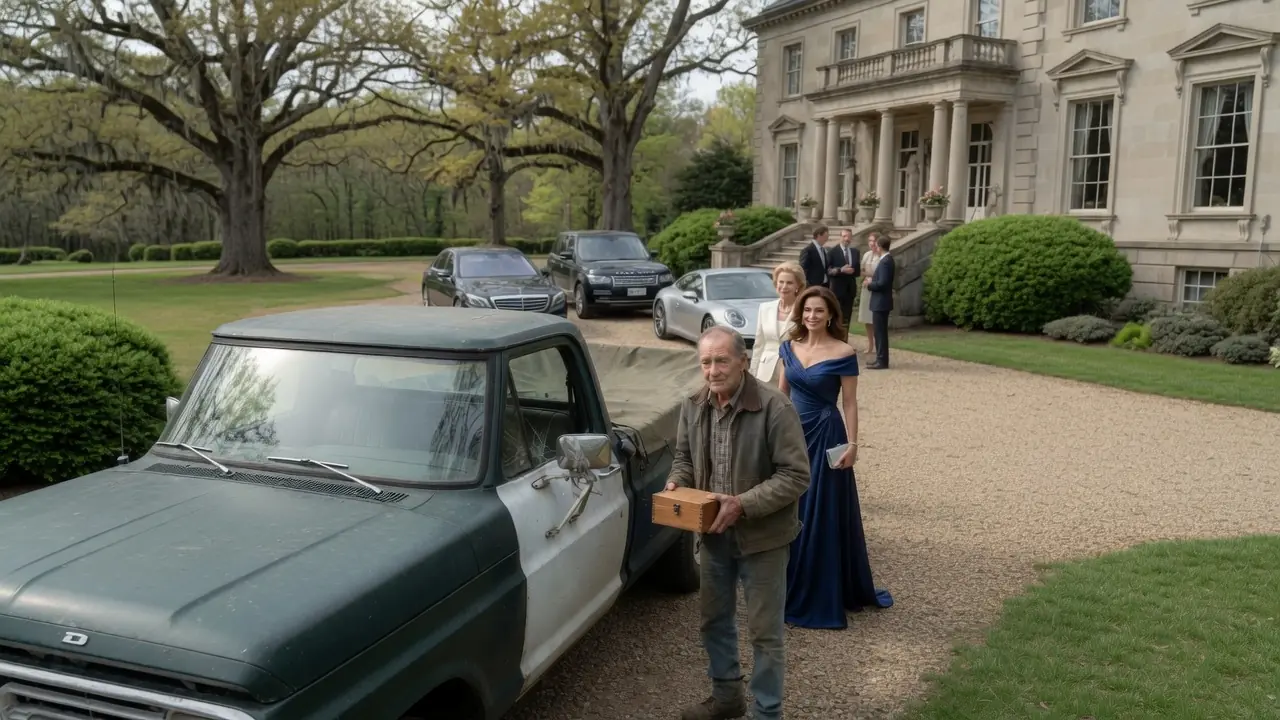
It rolled slowly up the long gravel driveway of the Hawthorne estate, coughing slightly as the old engine struggled against the hill. The faded green paint had lost most of its shine years ago. The passenger door was a different color—white, from a replacement after a minor accident fifteen years earlier. One side mirror was slightly cracked, held together with duct tape and hope. The bed was covered with a weathered tarp, and the back seat was filled with old blankets, work gloves, a toolbox that had seen better decades, and the perpetual smell of sawdust that clung to every fiber of the interior like an old friend.
To most people standing outside that warm spring afternoon, the truck looked like it belonged somewhere else. Anywhere else.
The Hawthorne family property sat outside the fictional town of Bellmont Ridge, Virginia, on twenty acres of perfectly maintained land. Ancient oak trees lined the driveway like sentinels, their branches forming a natural canopy. Luxury vehicles—sleek Mercedes, a gleaming Range Rover, even a vintage Porsche—sat beneath the shade trees. The gardens were trimmed so precisely they looked untouched by human hands, with rose bushes blooming in coordinated colors and fountains trickling softly in the background. Everything about the place quietly announced success, wealth, and generations of careful planning.
And then there was the old pickup truck.
Behind the wheel was Walter Bennett. Sixty-five years old. A man whose entire life had been spent building things—not companies, not luxury homes with his name on brass plaques, but real homes. The kind where children grew up laughing in the hallways. The kind where families gathered around worn kitchen tables for Sunday dinners. The kind where someone came home after a long day and felt truly safe, no matter how imperfect the walls.
Walter’s hands told his story better than any introduction ever could. His fingers were thick and rough from decades of carrying lumber, hammering nails, and operating saws. His palms carried scars from slipped chisels and machines that kicked back without warning. His shoulders had the permanent slight hunch of a man who spent his life lifting things heavier than himself. He wore a simple brown jacket—clean, pressed, but old. The same jacket he had worn every winter for the past twelve years because it was still warm, still reliable, and there was no reason to replace something that worked just fine.
He stepped out of the truck carefully, his knees protesting the long drive, and looked toward the mansion. Then he smiled. Not because he felt comfortable in this world of crystal chandeliers and tailored suits. But because he remembered.
“I don’t know if I’ll ever be able to give you everything in the world, little man. But I swear I’ll give you everything I have.”
At the time, everything he had wasn’t much: a small rental house with leaky pipes, that same old truck (already ten years old then), a battered toolbox, and a heart full of stubborn determination. Margaret had passed away when Daniel was only eight, leaving Walter to raise their son alone while working twelve-hour days framing houses. There were nights when dinner was peanut butter sandwiches and stories read by flashlight because the electricity bill had been tight. There were weekends when Walter would take Daniel to job sites, teaching him how to measure twice and cut once, how to read a level, and how a solid foundation could hold up against any storm.
The front door of the Hawthorne mansion opened. A woman stepped outside—Caroline Hawthorne, the mother of his son’s future wife, Olivia. She wore a cream-colored coat that probably cost more than Walter’s truck was worth at this point. Her smile appeared quickly, practiced and polite. But her eyes moved first. To the truck. Then to Walter. It was only a second. Most people would have missed it. Walter didn’t. He had spent a lifetime reading people—the way clients hesitated when they saw his old tools, the way subcontractors respected the quiet authority in his calloused hands.
“Mr. Bennett?” she asked.
“Yes, ma’am.”
She looked behind him, as if expecting someone else to emerge from the truck. “We were expecting Daniel’s father.”
Walter smiled politely, the lines around his eyes deepening. “I am Daniel’s father.”
A brief silence followed. Caroline recovered quickly, smoothing her expression. “Oh. Of course. Please, come in.”
Walter reached into the passenger seat and picked up the only thing he had brought: a small wooden box. Nothing fancy. No expensive wrapping paper, no shiny bow. Just an old handmade box with scratches along the edges, built from scrap pine and walnut he had saved over the years. The hinges were brass, polished by hand many times.
Caroline noticed it immediately. “Is that the wedding gift?”
Walter looked down at it, his thumb brushing the lid. “Yes.”
Her smile remained polite. “I’m sure Daniel will appreciate it.” But the way she said it carried a quiet assumption—that it probably wasn’t worth much compared to the crystal vases and engraved silver sets already displayed inside.
Walter didn’t respond. He simply carried the box inside with the same care he once used to carry his infant son. Because he knew something most people forgot: the most valuable things in life rarely look expensive.
Inside the mansion, everything was exactly what Walter expected. High ceilings that echoed with every footstep. Crystal chandeliers casting rainbows across marble floors. Paintings on the walls that probably belonged in museums. Furniture that looked like nobody was allowed to sit on it for fear of leaving a mark. The air smelled of fresh lilies and expensive cologne.
Daniel’s future father-in-law, Richard Hawthorne, greeted him near the living room. Richard was a successful businessman who owned several commercial properties across Virginia. Tall, silver-haired, confident. The kind of man who shook hands like every conversation was a negotiation.
“Walter Bennett,” Richard said, extending a firm hand. “Glad you could make it.”
“Thank you for having me,” Walter replied, his grip steady despite the ache in his joints.
Richard glanced at the worn jacket, then at Walter’s hands. “So, Daniel tells me you were in construction.”
“I was. Still do a bit of consulting now and then.”
“Commercial projects?” Richard asked, already assuming.
Walter shook his head. “No. Mostly residential. Single-family homes, some renovations.”
Richard nodded slowly. “Residential.” The word hung there, not insulting, but dismissive. “Small projects, I imagine.”
Walter smiled. “Mostly houses. The kind people live in every day.”
Richard took a drink from his glass of scotch. “I see.” The subtext was clear: small work, small life, small man.
Walter didn’t correct him. He had learned long ago that some people only understood value after seeing results, not promises.
Across the room, Daniel watched everything unfold. Walter saw the discomfort on his son’s face—the same son who had spent years defending his father to anyone who would listen. “My dad built more than houses. He built me.”
Daniel walked over quickly. “Dad.”
Walter’s face immediately softened, the fatigue of the drive melting away. This was his boy. The one person who never made him feel like he needed to prove anything.
“There he is,” Walter said warmly.
They hugged—a real hug, full of years of shared memories, not a formal handshake or quick pat. Daniel was taller now, successful in his own right as the founder of a growing building company, but in that moment, he was still the boy who once helped his father nail shingles on their first roof.
Everyone noticed the embrace. Especially Richard. For a flicker of a second, the old truck outside seemed a little less important.
The evening continued with dinner in the grand dining room. Crystal glasses clinked, conversations flowed like the wine being poured. Walter answered questions politely. He listened more than he spoke. When asked about his work, he described the satisfaction of watching a young family move into a home he helped build. He never complained about the long hours, the injuries, or the lean years after Margaret’s death from cancer when medical bills nearly broke him.
But he noticed something in every conversation: it eventually circled back to money. Properties. Investments. Market trends. Success measured in square footage and profit margins. Nobody asked him what he built with love. Nobody asked how a single father with calloused hands raised a son who became respected by everyone who knew him. They saw the truck, the jacket, the hands—and decided the story before hearing it.
One guest, a business associate of Richard’s, leaned over during dessert. “So, Walter, what does retirement look like for you? Golf? Travel?”
Walter chuckled softly. “I still tinker in my workshop. Built a playhouse for my neighbor’s grandkids last month. Keeps me busy.”
The man smiled awkwardly and changed the subject.
Later that night, after most guests had retired to their rooms, Walter stood alone near the garden. The air was cool, carrying the scent of blooming jasmine. Daniel joined him, two cups of coffee in hand.
“You okay, Dad?”
Walter accepted the coffee with a nod. “I’m fine, son. This is your day. Don’t worry about me.”
“You don’t have to pretend with me. I saw how Richard looked at the truck.”
Walter looked at his son, the moonlight softening the lines on his face. “Do you remember the first house we built together?”
Daniel smiled, his eyes distant. “How could I forget? I was ten. The kitchen cabinets didn’t close right. The bathroom sink leaked for months. My bedroom window wouldn’t shut properly in winter, so we taped plastic over it.”
Walter laughed quietly. “And the roof had a slight dip on one side. But it was ours.”
Daniel nodded. “Mom would have loved it.”
They stood in comfortable silence for a while, the weight of memories bridging the gap between their worlds.
“That’s why I brought the box,” Walter said finally. “You’ll see tomorrow.”
The next morning, the wedding unfolded in the beautiful garden behind the estate. White chairs lined a grassy aisle scattered with rose petals. An arch of fresh flowers framed the altar. Olivia looked radiant in her gown, and Daniel stood tall, his eyes only for her.
The ceremony was perfect—vows exchanged with sincerity, tears shed, laughter shared. After the pronouncement of husband and wife, guests gathered for the reception and gift presentations. The Hawthorne family presented lavish items: a pair of luxury watches, designer luggage, even keys to a downtown condo as a surprise.
Then Walter walked forward, carrying his small wooden box. The chatter quieted. Daniel looked surprised, a mix of curiosity and love in his eyes.
“Dad?”
Walter smiled, his voice steady. “Open it, son.”
Daniel lifted the lid carefully. Inside was not money, not jewelry, not anything flashy. It was a stack of old papers—yellowed blueprints, hand-drawn designs from decades ago, notes scribbled in Walter’s careful handwriting. A small envelope rested on top, containing faded photos of a modest house under construction and a young Daniel hammering nails beside his father.
Olivia stepped closer, peering inside. “What is it?”
Daniel’s voice thickened with emotion as he lifted the pages. “This… this is the first house my dad ever built. Our house.”
The room fell into a profound silence. Richard looked confused at first. “A blueprint?”
Daniel nodded, unfolding one carefully. “Yes. When I was six, I asked Dad why we didn’t live in a big house like my friends. He didn’t have an answer that satisfied a little boy. So instead of explaining, he did something about it.”
Walter stood beside him, hands clasped. “After work, every night and every weekend for nearly two years, I built it. I’d come home exhausted from framing someone else’s dream, then pick up my tools again. Margaret helped where she could before she got sick. We measured, cut, nailed. Learned from mistakes. That house wasn’t perfect, but it was built with everything we had.”
Daniel continued, his voice carrying across the garden. “This house taught me everything. Not just how to swing a hammer, but how the strongest parts of any building—and any life—are the parts nobody sees. The foundation. The support beams. The quiet work done in the dark when no one’s watching.”
Richard watched carefully now, his earlier dismissiveness gone. “What did it teach you, Daniel?”
Daniel smiled at his father. “That real strength comes from sacrifice. That love isn’t loud or expensive—it’s steady. My father worked twelve-hour days, then came home to build walls until midnight, all so I could have a safe place to grow. That foundation became the foundation of my company. Every home I build now carries that lesson.”
Silence blanketed the guests. The old truck parked outside no longer seemed like an eyesore. The worn jacket wasn’t a sign of failure. The rough hands represented a lifetime of quiet heroism.
Richard slowly stepped forward, his usual confidence tempered. “Walter.”
Walter met his gaze.
“I owe you an apology,” Richard said. “I judged you before I knew you. I saw the truck, the hands, and made assumptions. I forgot something important.”
“What’s that?” Walter asked gently.
Richard glanced at Daniel and Olivia. “Behind every successful person is usually someone who believed in them before anyone else did. Who sacrificed without expecting applause. You didn’t just build a house. You built a man.”
Walter looked at his son, pride shining in his eyes. “My father believed in me, even when I didn’t.”
Daniel placed a hand on his father’s shoulder. “And I believed in him. Still do.”
Caroline wiped her eyes, stepping closer. “I’m sorry too, Walter. You’re not what I expected.”
Walter smiled warmly. “Most good stories aren’t, ma’am. They’re built one quiet day at a time.”
The reception continued, but the atmosphere had shifted. Guests approached Walter not with pity, but with genuine respect. One older woman, a distant relative of the Hawthornes, shared stories of her own father, a farmer who taught her the value of hard work. Another guest, a young architect, asked Walter for advice on sustainable home design, listening intently as the older man described lessons from decades in the field.
As the sun dipped lower, casting a golden hue over the garden, Walter found himself sitting with Daniel and Olivia near the edge of the lawn. Olivia held the wooden box carefully.
“I can’t believe you kept all this,” she said softly.
Walter shrugged. “Every blueprint, every photo—it’s our history. When you two start your own family, maybe pass some of it on. Remind them where strength comes from.”
Daniel’s eyes glistened. “Dad, everything I have… it started with you. The company, this life—I named the first development after Mom. Bennett Meadows. But the real foundation is you.”
Years later, people in Bellmont Ridge still talked about that wedding. Not because of the extravagant flowers or the mansion’s opulence or the expensive gifts. They remembered the old green pickup truck that rattled up the driveway. They remembered the man everyone had underestimated at first glance. They remembered the small wooden box that held more value than anything money could buy.
Walter continued living simply in the house he had built with his own hands. He consulted on projects when asked, mentored young builders, and spent quiet evenings in his workshop. Daniel and Olivia visited often, their children playing in the same backyard where Daniel once learned to swing a hammer. Richard and Caroline became true friends, inviting Walter for holidays and seeking his advice on family matters. The Hawthornes even commissioned Walter to design a small guest cottage on their property—a modest but beautifully crafted space that became Walter’s favorite retreat.
Daniel Bennett went on to build some of the most impressive, sustainable homes in the country, winning awards for his focus on quality and community. But whenever someone asked him about his greatest achievement, he never mentioned the company, the buildings, or the accolades.
He always gave the same answer, with a quiet smile: “My father built my first home. And before he built that house… he built me.”
In the end, that was the greatest legacy of all—a foundation strong enough to last generations, built not with wealth, but with unwavering love, sacrifice, and the simple truth that real value is measured in the lives we shape, one careful nail at a time.