By the third Saturday of September, the line at the Callahan table stretched past the funnel cake stand.
Dale Hargrove stood near the front of it with a small glass jar in one hand, slowly turning it under the white canvas roof of the fair pavilion as though the handwritten label might change if he looked at it long enough.
CALLAHAN QUINCE JELLY — $4
The jelly inside was amber-gold where the afternoon light struck it.
Roy Hargrove stood just behind his brother with his hands shoved into the pockets of his jeans.
For once, neither man had anything funny to say.
Nobody at the Wexford County Fair that year could remember the last time the Callahans had sold out of anything before noon.
Blackberry preserves, maybe.
Sweet corn once, years ago.
But not something people had to ask how to pronounce.
And certainly not something made from fruit most of the county had forgotten existed.
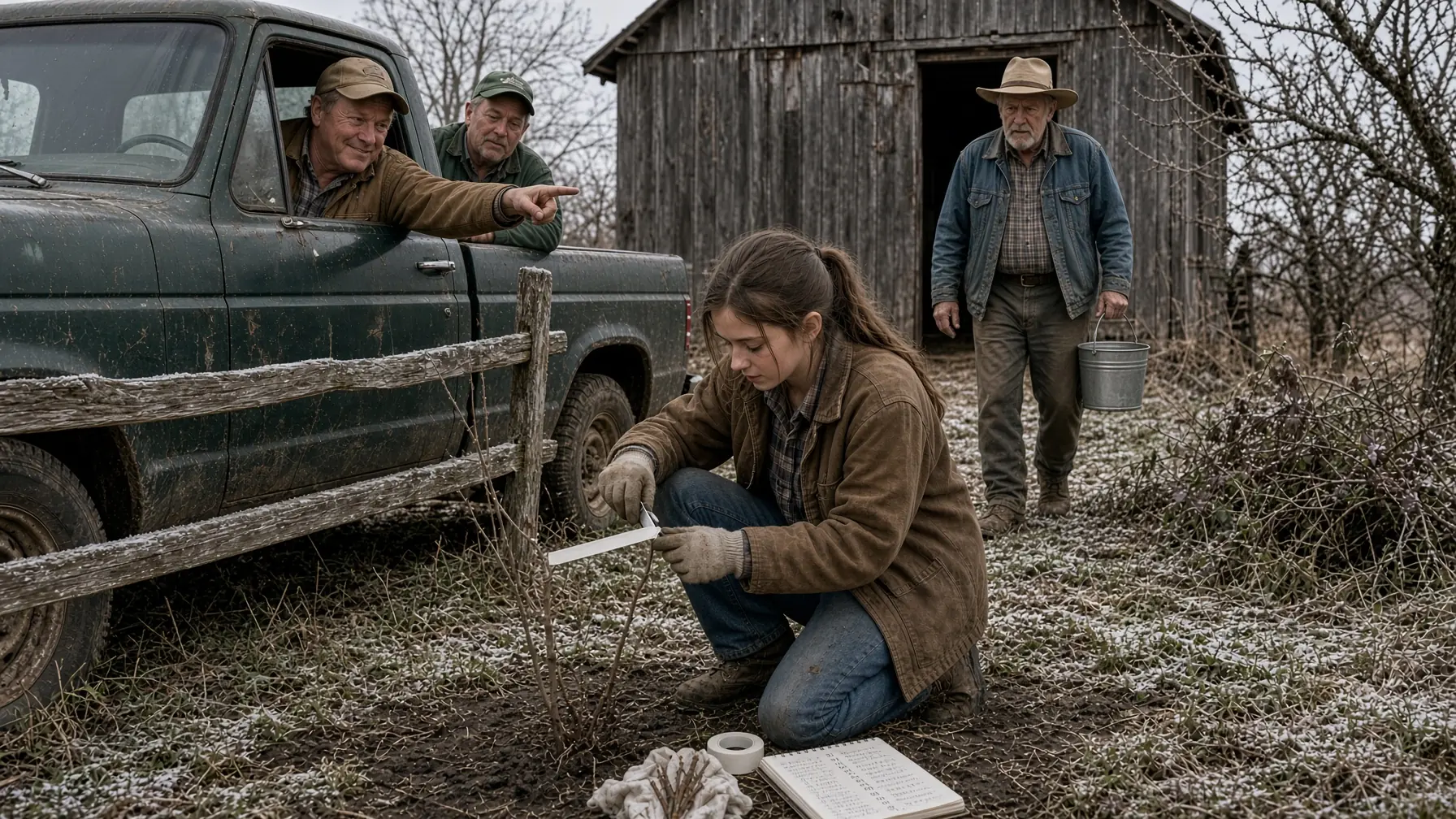
Yet three months earlier, half of Wexford County would have laughed if someone had said a thirteen-year-old girl crouching in weeds behind an old barn was about to bring back a fruit variety that had nearly disappeared from that part of Kentucky.
Sadie Callahan had not set out to impress anyone.
She had not started because somebody told her she could.
She had not even started because somebody told her she couldn’t.
She had her own reason.
For a while, she kept it to herself.
The Callahan farm sat two miles off Route 9, beyond the bend where Coldwater Creek ran close enough to the road that in spring you could hear the water from the front porch.
The farmhouse was white clapboard, old enough that every room seemed slightly out of square. One corner of the porch roof sagged where Walter Callahan had been meaning to fix it for at least three summers. The barn behind the house had faded from red to silver-gray under sixty years of Kentucky sun and rain.
Pastures rolled beyond it toward the tree line.
A split-rail fence marked the edge of Callahan land and the beginning of the Hargrove place. Everybody around there called it the Callahan line as if the fence had been named that by law instead of habit.
Junebug, Walter’s old gray donkey with the torn left ear, spent most mornings grazing beside that fence.
Sadie spent more time there than anyone noticed.
She had grown up on the farm.
So had her mother.
Her grandmother Eleanor had died before Sadie was old enough to remember her voice, but the woman had never entirely left the house.
Her photograph still stood on the mantel.
Her aprons were folded in a cedar chest upstairs.
And in the drawer of the kitchen desk was a thick leather-bound ledger whose corners had gone soft from decades of hands turning the pages.
Walter still used Eleanor’s recipes.
Some evenings, Sadie would find him with the ledger open under the yellow kitchen lamp, one thumb resting on a page as if he were listening to something only he could hear.
Walter Callahan was sixty-eight that year.
A widower.
Trim gray beard.
Weathered hands.
Straw hat that came off for supper, church, and almost nothing else.
He farmed about forty acres now, less than half of what his father had worked when Walter was young.
If anyone asked why, he usually said forty acres were enough trouble for one old man and one granddaughter.
Sadie’s mother, Laura, worked as a nurse in Louisville and came home whenever her schedule allowed. Sadie had lived mostly with Walter since she was nine because the farm was where she wanted to be and because Walter, despite pretending otherwise, needed someone around who noticed when he forgot lunch.
There was one part of the property neither of them used much.
The far patch behind the barn.
Blackberry brambles grew shoulder-high there.
Wild grapevine climbed over fence posts.
Several old fruit trees leaned at strange angles among the weeds, their branches crowded together from decades without pruning.
Walter called it the old orchard when he called it anything at all.
Mostly he ignored it.
Sadie did too.
Until the last week of June.
A red hen escaped from the chicken yard one evening and disappeared into the weeds behind the barn.
Sadie went after it.
She found the chicken scratching beneath a fallen branch.
Then, ten feet farther into the brush, she smelled something.
Sweet.
Floral.
Almost spicy.
Not apple.
Not pear.
Not peach.
She followed the scent until she found a tree nearly swallowed by blackberry vines.
Its trunk twisted out of the ground like an arthritic hand. Gray bark had split in long vertical seams. Several limbs were dead.
But high on one surviving branch hung five strange yellow-green fruits.
Sadie pushed through the brambles.
They were about the size of small apples but shaped more like squat pears. Their skin looked slightly fuzzy in places.
She reached up, twisted one gently, and it came loose in her hand.
The smell became stronger immediately.
She forgot about the chicken for a minute.
That evening, she placed the fruit in the center of the kitchen table.
Walter came in from checking a fence, washed his hands, and stopped when he saw it.
He did not ask where she had found it.
He just stared.
“What is it?” Sadie asked.
Walter picked it up carefully.
“Well.”
He turned it once.
“Hadn’t seen one of these in years.”
“What?”
“A quince.”
Sadie frowned.
“A what?”
“Quince.”
“That a kind of pear?”
“No.”
“Apple?”
“No.”
“Then what is it?”
Walter smiled slightly.
“A quince.”
That was apparently all the explanation he had.
Sadie pulled out a chair.
“Can you eat it?”
“Not like that, you won’t enjoy it.”
“What do you do with it?”
Walter’s expression changed.
He looked toward the window, toward the barn.
“Somebody in this family used to know.”
“Who?”
“Your great-great-grandmother planted those trees, from what I was told.”
Sadie looked back at the fruit.
“That tree is that old?”
“Not sure if it’s the original planting. Might be one grafted from one before it. But it’s old.”
“What kind?”
Walter shook his head.
“Had a name once.”
“You don’t know it?”
“No.”
That surprised her.
Walter knew the names of old cattle lines nobody else cared about. He could identify three kinds of clover from twenty yards away. He knew which fence posts on the south pasture had been set by his father and which had been replaced after the ice storm of 1978.
But the quince?
He knew almost nothing.
“When I was little,” he said, “women used to bring quince jelly to the fair. Quince paste too. Your grandmother Eleanor knew how to make it.”
“Why’d everybody stop?”
Walter shrugged.
“People started buying more at grocery stores. Apples got sweeter. Pears got easier. Quince takes work.”
He set the fruit down.
“Old trees died. Nobody replaced them.”
“Is ours the only one?”
Walter considered that.
“Might be the only one left around here that I know of.”
Sadie looked at the fruit again.
Something about that bothered her.
Not because quince sounded especially important.
She had never heard of it an hour earlier.
That was precisely what bothered her.
A thing could exist for a hundred years.
Then people could simply stop noticing.
And eventually there would be one tree left somewhere behind a barn, and when that tree died, everyone would act as though nothing had happened.
Sadie carried that thought around for three days.
She did not mention it again.
That was normal for her.
Walter believed talking too much about work before beginning it was one of the easiest ways not to finish anything. Sadie seemed to have inherited the same instinct.
On the fourth evening, after Walter went outside to close the chicken coop, Sadie opened the drawer of the kitchen desk.
She pulled out Eleanor’s ledger.
The old leather cover creaked.
Sadie had looked through it before.
Recipes.
Farm accounts.
Weather notes.
A page about curing country ham.
Instructions for making chow-chow.
A remedy for a sick calf that Walter had crossed out and written DON’T DO THIS beside sometime in the 1980s.
Sadie turned the pages slowly.
Near the back, something slipped loose and fell into her lap.
A folded piece of paper.
She opened it carefully.
Faded pencil.
A crude drawing of a branch.
A diagonal cut.
A second piece fitted against it.
Beside the sketch were three words.
Graft in March.
That was all.
No fruit name.
No long explanation.
No reason.
It looked like somebody had planned to come back later and finish the note.
They never had.
Sadie stared at the little drawing.
Then she looked toward the window at the dark outline of the barn.
The next afternoon, she went to the public library.