Let me tell you about a room full of confident men.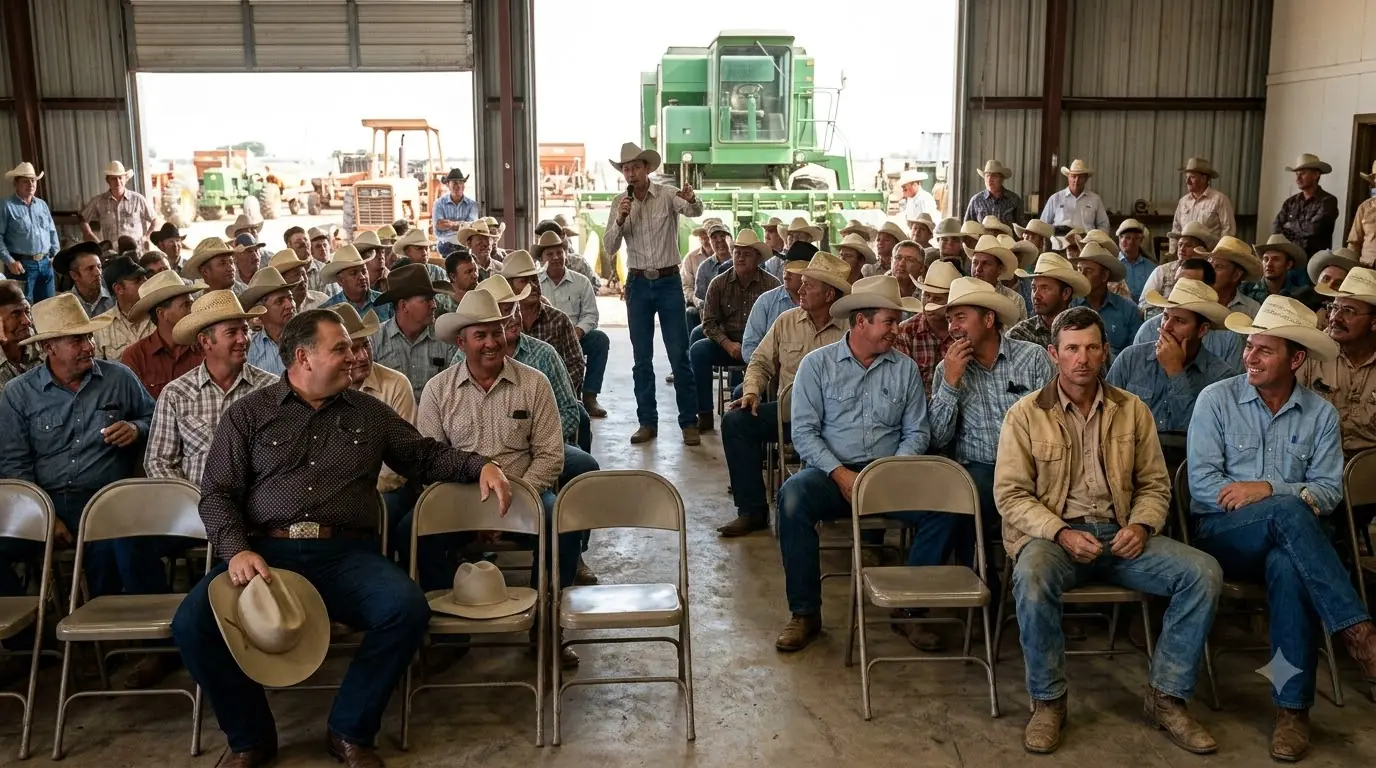
It's August of 1976. The sun outside Lubbock, Texas is doing what the August sun always does out there: pressing down on everything flat and merciless, like it has a personal grudge against shade. The panhandle is bone dry and cotton rich, and the equipment auction at the Haskell Brothers yard on the south side of town is packed to the walls with men who know it.
Pickup trucks are parked three rows deep in the caliche lot. The smell inside is motor oil, coffee from a 30-cup percolator, and the particular kind of sweat that comes from men who work outdoors but have recently put on a clean shirt.
This is boom country in the middle of a boom year. The Soviet grain deal of 1972 had opened export markets nobody had dreamed of before, and cotton prices have been climbing steady for 4 years. If you're farming a thousand acres or more in Lubbock County in 1976, you feel, in a quiet and Texan way, that the world is confirming what you always suspected about yourself.
These men sit near the front. Their boots are cleaner. Their names are on the lips of the auctioneers before the bidding even starts.
Now, here's what you need to understand about that room. There were maybe 90 men in it. 80 of them farmed on credit: operating loans, equipment notes, land mortgages stacked like a hand of cards they were sure they knew how to play. They talked about leverage the way you talk about a tool you're good with. They talked about expansion the way you talk about a destination you've already decided on. The room had a particular hum to it, the hum of men who believed the direction of things would not change.
One man sat near the back wall, in the third row from the last. His name was Earl Pruitt. He was 41 years old. He had driven in alone from Slaton, 30 miles southeast, in a GMC pickup with a cracked dash and 112,000 miles on it.
He was not a tall man, not a loud man, not the kind of man a room noticed when he walked in. His jacket was sun-bleached to a color that had once been tan, and was now the color of old paper. He had a plain face, a farmer's hands, and the particular stillness of a person who has spent years working alone in quiet fields.
He sat with his back straight and his hat on the empty seat beside him, and in the breast pocket of his jacket he carried a single white envelope folded once. Inside that envelope was a cashier's check for $14,200.
He had come for one thing: lot 22 on the auction sheet, a 1968 John Deere 9600 cotton picker, serviced in working condition, with a set of row units that could handle his fields without modification. He had written the lot number at the top of the sheet in pencil and circled it. He had written the number 14,200 in the margin and underlined it twice. That was his ceiling. That was the number.
He sat near the back wall, and nobody turned to look at him.
Now, I have to take you back, because the envelope in Earl Pruitt's pocket didn't appear from nowhere. $14,000 does not arrive in a working farmer's breast pocket by accident. It arrives by a particular kind of discipline, and that discipline came from a particular kind of man, and that man was Earl's father, Curtis Pruitt, who farmed 80 acres outside Slaton, and never farmed more than that in his entire life.
80 acres.
In a county where men measured themselves in thousands, Curtis Pruitt farmed 80 acres of dry land cotton and grain sorghum, and considered himself, without any apparent effort, a free man. The land had come to him from his own father, who had broken it originally in the 1920s. It was not prime ground. It was caliche-heavy on the west end and sand-prone on the east, and it asked more of you than richer ground would. But it was paid for, entirely, completely, on paper and in fact, paid for. Curtis Pruitt owed nothing on it, not to a bank, not to a neighbor, not to anyone.
Earl was born on that land in 1935. He grew up in the house his grandfather had built, which had a linoleum kitchen floor in a pattern of green and white squares, worn smooth in the path from the door to the stove. Most of what Earl learned that mattered, he learned at the table in that kitchen, over supper, in the plain and unhurried way his father talked about farming and land and money.
He was 11 years old, the summer of 1946, when his father said the sentence that would shape the next 50 years of his life.
They had been talking about the Hendersons, a family 3 miles east who had taken on a federal land bank loan to buy an additional quarter section. The land was good, the price was reasonable. Everyone agreed it made sense on paper. Curtis Pruitt listened to his son describe what he'd heard the Henderson boy say about it at school, and then he set down his fork and said quietly and without drama, "What you owe on, the bank holds. Everything else is yours."
Earl didn't write it down. He didn't need to. Some sentences land in a person at exactly the right age and in exactly the right tone of voice, and they don't leave. They become the operating principle, the lens, the measure by which every future decision gets checked.
He worked his father's 80 acres through his 20s, took them over fully when Curtis died in 1963, married a woman named Ruth Ann, who had grown up on a farm herself, and understood, without needing it explained, why he kept a savings ledger in the kitchen drawer and updated it on the first of every month. They had two children. They lived without extravagance, not from deprivation, but from a philosophy so deeply held it had stopped feeling like discipline and started feeling simply like the way things were.