Every afternoon at three o’clock, Rosalie Mercer drove the same battered wagon through Dry Creek.
The right wheel squealed on every revolution. One plank beneath the driver’s seat had split down the middle and been repaired with baling wire. The old sorrel mare pulling it had one white sock, one cloudy eye, and enough patience to tolerate a town that had turned Rosalie’s daily trip into entertainment.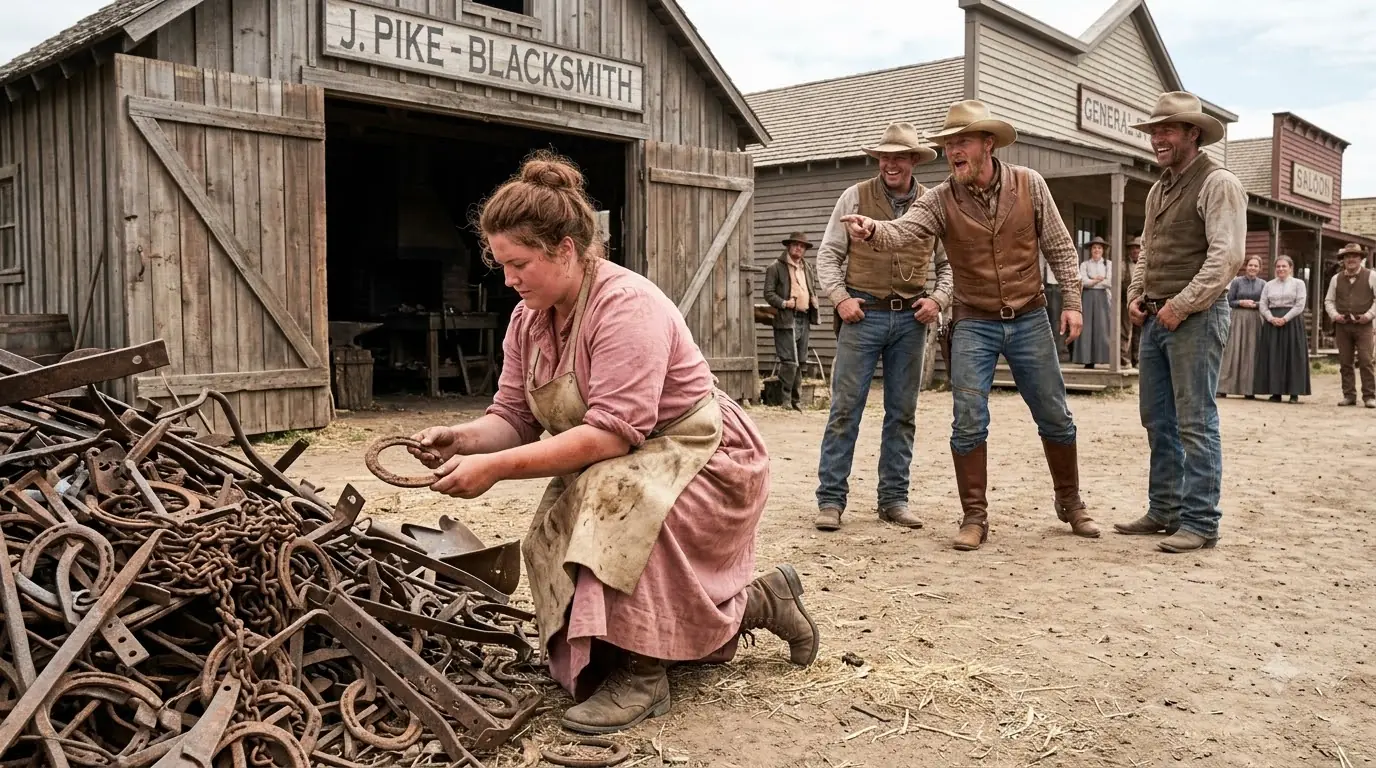
People began waiting for her.
Not officially.
Dry Creek had no shortage of respectable citizens who would have sworn they had better things to do than watch a twenty-seven-year-old woman collect junk behind a blacksmith shop.
Yet somehow there were always men standing outside the Golden Spur Saloon when Rosalie passed.
There were always customers lingering near Wilcox & Son General Merchandise.
And there were always three or four cowboys leaning against the hitching rail beside Jonas Pike’s blacksmith shop by the time Rosalie climbed into the scrap pile behind the building.
“There she goes.”
“Mercer girl’s here for supper.”
“Careful, Rosie. That wagon’s carrying enough weight already.”
That one usually produced the most laughter.
Rosalie heard every word.
She rarely looked up.
She would step over the broken wagon rims, horseshoes, chain, damaged hinges, snapped cultivator teeth, worn nails, discarded gate hardware, and bent iron rods that Jonas considered too troublesome to reuse. Then she would choose carefully.
A horseshoe with one side worn almost smooth.
Two links of heavy chain.
A hinge plate cracked near one bolt hole.
A length of flat bar that had twisted under load but had not broken.
Everything went into the wagon.
Jonas Pike did not charge her.
At first he had tried.
Rosalie simply told him she would stop coming.
Jonas decided the entertainment Rosalie provided the town was probably worth more than the scrap.
He never admitted that part.
The men outside did it for him.
On the hottest Wednesday in June, Horus Bell joined them.
Horus owned nearly twelve hundred acres west of Dry Creek and behaved as though ownership extended naturally to every opinion spoken within twenty miles. He was forty-one, lean, sun-darkened, and always dressed slightly better than the men who worked for him.
He had also spent six months trying to buy Mercer Ranch.
Rosalie was bent over the scrap pile when he approached.
She knew the sound of his boots before she saw him.
Polished heels struck hard-packed dirt differently from work boots.
“Rosalie.”
She continued sorting.
“Horus.”
“You planning to build yourself a new ranch out of garbage?”
“No.”
“Shame.”
His friends laughed.
Rosalie lifted a rusted horseshoe.
Examined the nail holes.
Set it aside.
Horus came closer.
“Your mother finally sign my offer?”
“No.”
“She should.”
Rosalie reached for another shoe.
He smiled.
“Four hundred twenty dollars isn’t much money to some people.”
“It is to us.”
“That’s my point.”
Rosalie straightened slightly.
Her pink work dress was faded nearly white at the shoulders. A thick leather apron covered most of the front, stained by grease, soot, and old rust. Her arms were strong from ranch work, and her body was large enough that men in Dry Creek had apparently decided its existence entitled them to commentary.
Horus looked her over deliberately.
Then smiled.
“You know, Rosie, if you spent half as much time finding a husband as you do crawling through junk, maybe somebody could save that ranch for you.”
The cowboys laughed.
Rosalie looked back toward the scrap.
“One problem.”
“What?”
“I’d have to marry one of you.”
Even Jonas Pike laughed at that.
Horus’s smile tightened.
He stepped nearer.
“Careful.”
Rosalie lifted another horseshoe.
“You started the conversation.”
“I’m trying to help.”
“No.”
“You’re waiting for August so you can buy our land cheaper.”
Horus shrugged.
“Business is business.”
“My mother owes money.”
“The cattle market’s weak.”
“Your father left nothing but bills.”
“Everyone in town knows where this ends.”
Rosalie looked at him.
“Do they?”
“Yes.”
His eyes traveled over her again.
“And let’s be honest. A woman built like you isn’t exactly going to have cowboys fighting to marry into that debt.”
The laughter returned.
Meaner this time.
Rosalie slowly stood.
She was shorter than Horus but broader through the shoulders and hips.
The rusted horseshoe remained in her right hand.
Horus grinned.
“Don’t get angry.”
“I’m not.”
“You look angry.”
“I’m thinking.”
“That dangerous?”
“Sometimes.”
She wiped the horseshoe against her apron.
Then looked directly at him.
“Keep staring at my body, Horus.”
His grin widened.
Rosalie continued.
“It might distract you from noticing what my hands can do.”
A cowboy behind him whistled.
Horus stepped closer.
“No cowboy’s climbing into your bed because you learned to play blacksmith with garbage.”
Rosalie’s eyes did not move.
“Good.”
The laughter softened.
“I’m not building this to get a man into my bed.”
She stepped close enough that Horus stopped smiling.
“I’m building something that’ll make men like you beg to get inside my barn.”
Rosalie dropped the horseshoe into her wagon.
Climbed onto the seat.
And drove home.
By sunset, everyone in Dry Creek had heard the exchange.
Nobody knew she had told the truth.
Mercer Ranch sat four miles east of town.
One hundred sixty acres.
Small by Colorado standards.
Large enough to destroy a family financially if something went wrong.
Something had.
Several things, actually.
Rosalie’s father, Thomas Mercer, died the previous winter after pneumonia turned into something the doctor could not stop. He left behind twenty-nine cattle, eight horses, a house built by his own father, one damaged barn roof, and a $420 note against the property.
In a good year, the debt would have been uncomfortable.
The previous year had not been good.
Drought killed pasture.
Feed prices rose.
Three cows died.
Two calves were lost in a spring storm.
By June, Rosalie’s mother Abigail Mercer had forty-three dollars in cash.
Everything else was tied up in livestock, land, and equipment worth less in forced sale than it should have been.
The creditor, Henry Vaughn, had given them until August thirty-first.
After that, the ranch could be sold.
Horus Bell had already offered three hundred dollars above the debt.
Abigail refused.
Rosalie understood why.
Mercer Ranch had been built by her grandfather Walt Mercer.
He arrived in Colorado with a wagon, a wife, and one mule.
He built the first barn.
Dug the first shallow well.
Planted the cottonwoods beside the house.
And behind the barn, he built a forge.
Walt had been a rancher because he needed land.
He had been a blacksmith because frontier land required someone who could fix what broke.
Rosalie was twelve when he first allowed her near the fire.
Her mother objected.
Walt ignored her.
“Hold the tongs farther back.”
Rosalie did.
“Not that far.”
She moved them.
“Good.”
The first iron she shaped looked terrible.
Walt kept it.
A bent little hook remained nailed inside the barn for fifteen years.
Whenever Rosalie complained she could not do something, Walt pointed toward it.
“You already made something ugly once.”
“You survived.”
“Make the next one better.”
By sixteen, Rosalie could straighten a hinge.
At eighteen, she could punch holes.
At twenty, she could make basic horseshoes.
Then Walt died.
Thomas took over the ranch.
Rosalie stopped using the forge.
Life became cattle, cooking, fencing, hay, and helping Abigail.
Eleven years passed.
Then the debt came due.
And Rosalie walked into the abandoned barn one night carrying six rusted horseshoes.
The forge had become a graveyard.
Dust covered the anvil.
Mice nested beneath the bellows.
A leather strap had cracked.
One hammer handle was rotten.
Rosalie stood inside with a lantern.
She almost left.
Instead, she opened the shutters.
Swept.
Replaced the strap with harness leather.
Cleaned the chimney.
Then built a small fire.
The first horseshoe went into the coals.
Rosalie pumped the bellows.
Orange became yellow.
The old memories returned incorrectly at first.
She pulled the iron too early.
Hit too hard.
The shoe twisted.
She reheated.
Tried correcting.
The metal cracked.
Rosalie threw it into the dirt.
“Damn.”
Nothing answered.
She tried a second.
Worse.
By midnight, she had destroyed three.
Rosalie sat beside the forge.
Her arms ached.
Sweat ran down her neck.
Three ruined horseshoes lay at her feet.
She thought about Horus Bell.
Four hundred twenty dollars.
Forty-three in the kitchen jar.
Twenty-nine cattle that would sell poorly.
August thirty-first.
Then she remembered Walt.
Don’t fight it. Understand what the iron wants to become.
Rosalie picked up the fourth horseshoe.
Turned it in her hand.
What did it want to become?
Not a horseshoe.
Not anymore.
Too worn.
Too thin along one side.
But the thicker curve remained strong.
She heated it slowly.
Opened the curve.
Flattened one section.
Bent another.
An hour later she had something.
Not beautiful.
A wall hook.
The top curved roughly like a horse’s head.
Rosalie hung it against a barn post.
Stared.
It was crude.
But useful.
The next morning Abigail found her asleep on a stool.
“Rosie?”
Rosalie woke.
“What?”
Her mother looked toward the hook.
“Did you make that?”
Rosalie followed her gaze.
“Yes.”
Abigail touched it.
“Your grandfather taught you?”
“He tried.”
Abigail looked around the barn.
Three ruined shoes.
Fire gone cold.
Hammer marks everywhere.
“What are you doing?”
Rosalie stood.
“Making four hundred twenty dollars.”
Her mother stared.
Then laughed.
Not cruelly.
Sadly.
“Oh, honey.”
Rosalie’s jaw tightened.
Abigail stopped.
“I’m sorry.”
“No.”
“You’re thinking what everyone thinks.”
“I’m thinking you haven’t slept.”
“That too.”
Abigail touched Rosalie’s cheek.
“We can sell.”
“No.”
“Rosie—”
“No.”
“Your father wouldn’t want us destroyed trying to save dirt.”
Rosalie looked toward the ranch outside.
“It isn’t dirt.”
“I know.”
Abigail’s voice broke.
“That’s the problem.”
Rosalie hugged her.
Then said:
“Give me until August.”
Her mother closed her eyes.
“You already have until August.”
“Then let me use it.”
Abigail nodded.
Rosalie’s first customer was not intentional.
She made a second hook.
Better.
Then a trivet.
Then two gate latches.
One afternoon Martha Pike, Jonas’s wife, visited Abigail with preserves.
She saw the trivet.
“Where’d you buy that?”
Abigail looked toward Rosalie.
Rosalie said:
“I made it.”
Martha lifted it.
Turned it.
“How much?”
Rosalie froze.
She had imagined customers.
Had not prepared for one.
“Dollar.”
Martha laughed.
“What?”
Rosalie thought she had asked too much.
Then Martha put two dollars on the table.
“Make me another.”
Rosalie stared at the money.
“Why two?”
“Because one means you’ll be stupid enough to keep charging one.”
Martha left with the trivet.
Rosalie held the two dollars for nearly a minute.
That evening she placed them in a second jar.
Not the debt jar.
Forge money.
The next commission came from Martha’s sister.
Then a ranch hand wanted a repaired latch.
Then Jonas himself asked Rosalie to make two simple wall hooks because customers kept asking about the one Martha showed.
Each sale was small.
Fifty cents.
A dollar.
Two.