The first laugh came from somewhere behind Noah Bennett.
The second came from three rows to his right.
By the time Auctioneer Curtis Hall lowered his wooden gavel and announced, “Sold for twelve hundred seventy-five dollars to bidder twenty-seven,” nearly half the equipment barn was laughing openly.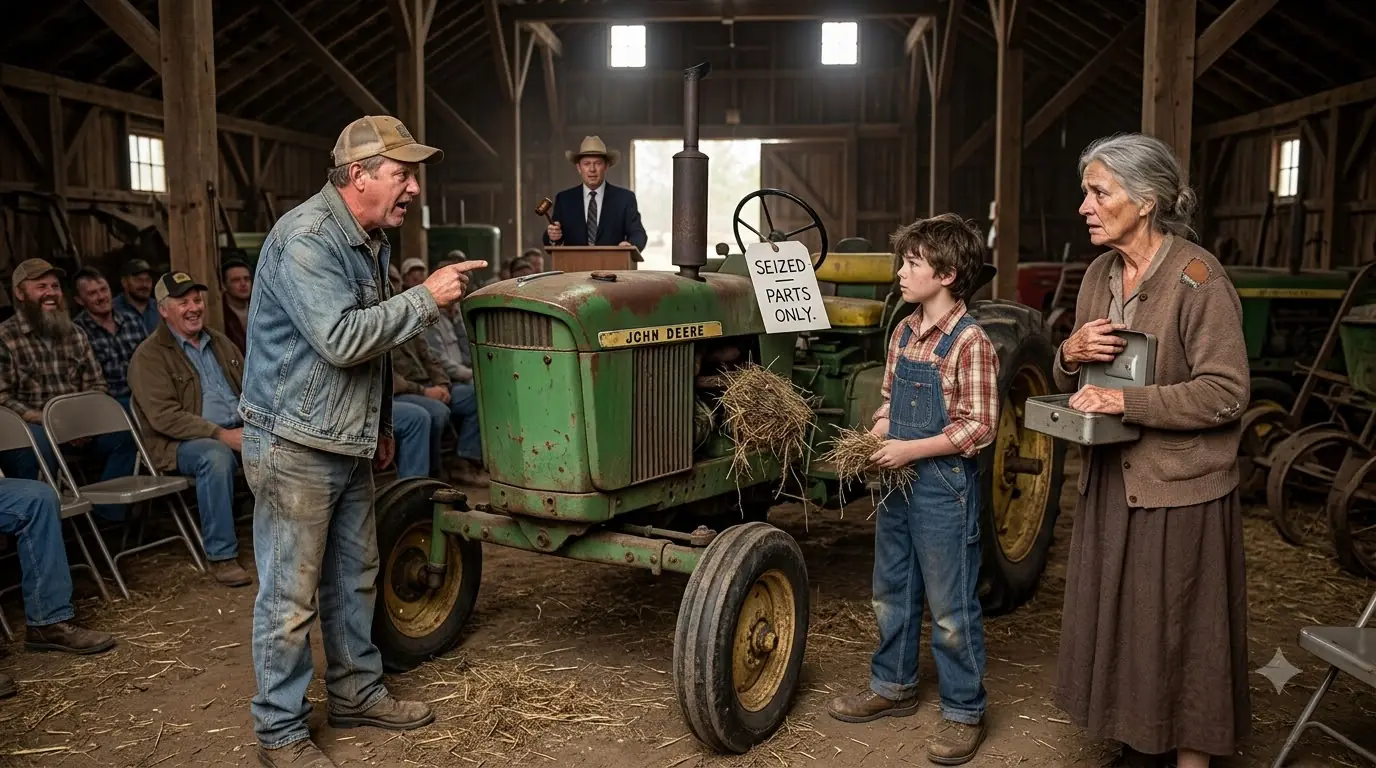
Noah did not turn around.
He stared at the faded green tractor in the center aisle.
A weathered cardboard placard hung from its steering column.
SEIZED — PARTS ONLY.
The John Deere had not moved under its own power in almost twenty years.
Rust covered the hood in orange freckles. The paint had faded almost gray in places, one front tire was nearly smooth, and a black trail of old oil stained the frame beneath the engine. Dust lay thick across the seat, and someone had already removed the battery years earlier.
To the experienced farmers gathered inside the Wexler County Equipment Auction Barn that Saturday morning, the machine was not a tractor anymore.
It was a collection of heavy parts that happened to share an axle.
To Noah, it was something else.
Possibility.
His grandmother stood beside him clutching a dented metal cash box.
Eleanor Bennett was sixty-nine, small and thin, with silver-gray hair pinned loosely behind her head and hands permanently rough from years of gardening, milking, mending, and doing whatever else kept the Bennett place functioning. She wore a faded brown cardigan over an old floral blouse and a long brown skirt because she had come directly from feeding hens before sunrise.
The cardigan was torn slightly at the left shoulder.
Eleanor had sewn the same seam twice.
She had told Noah there was no reason to replace clothing that still kept out the cold.
Now her fingers pressed so tightly around the cash box that her knuckles were nearly white.
“Twelve seventy-five,” she whispered.
Noah finally looked at her.
“I know.”
“That leaves…”
“I know.”
“Noah.”
He lowered his voice.
“Grandma, I know.”
The cash inside that box was not all the money they possessed.
But it was nearly all the money they could risk.
Two thousand three hundred dollars had been set aside during the previous year.
Some came from selling hay.
Some from Eleanor’s widow’s pension.
Some from Noah’s summer work collecting eggs, stacking feed, cleaning stalls for neighbors, and helping Calvin Ross at the feed store every Saturday.
The roof over the back bedroom needed repair before winter.
Their pickup needed front tires.
One of the farm’s well pumps had begun making a grinding sound that Eleanor tried not to discuss.
And their working tractor, a 1968 Massey Ferguson that had belonged to Noah’s grandfather, had finally cracked its transmission housing during spring planting.
A mechanic estimated the repair at more than three thousand dollars.
They did not have three thousand dollars.
That was why they had come to the auction.
Eleanor hoped to find a small old tractor nobody fashionable wanted.
Maybe something ugly but functioning.
Seven hundred dollars.
Eight hundred.
A thousand at the absolute limit.
Instead, Noah had just spent twelve hundred seventy-five dollars on something every adult in the building considered dead.
A loud voice cut through the laughter.
“Boy!”
Noah knew the voice before turning.
Harlan Pike stood near the tractor’s front tire.
Fifty-eight years old.
Heavy denim jacket.
Tan baseball cap.
Sun-reddened face.
Gray mustache.
Harlan owned Pike Farm Machinery outside Columbia and had made a comfortable business buying old equipment cheaply, repairing what deserved repair, dismantling what did not, and selling parts for more than the entire machines had cost.
He knew machinery.
Everyone said so.
Harlan pointed at Noah’s bidder card.
“You understand that number means money, right?”
More laughter.
Noah remained still.
Harlan walked closer.
“I’m serious. They don’t take Monopoly money at the office.”
Eleanor’s mouth tightened.
“Harlan.”
He smiled at her.
“Eleanor, I’m trying to save the boy a lesson.”
“The auction is over.”
“Doesn’t mean Curtis can’t unwind a mistake.”
Auctioneer Curtis Hall was already speaking with the next seller.
Noah said:
“It wasn’t a mistake.”
The laughter softened.
Harlan looked down at him.
Noah was twelve, though strangers often guessed eleven because he had not yet hit the growth spurt his father kept promising would come. He wore dark blue denim bib overalls over a red-and-cream plaid shirt, muddy brown boots, and no hat because he hated how baseball caps made his hair itch.
Messy brown hair fell across his forehead.
His face looked young.
His eyes did not.
Harlan leaned closer.
“You paid almost thirteen hundred dollars for a seized engine.”
Noah looked at the tractor.
“Maybe.”
Harlan laughed.
“There’s no maybe.”
“You tried the crank?”
“Three men did.”
“Who?”
Harlan pointed toward two farmers behind him.
“Me. Calvin Meyer. Auction mechanic.”
“Did the engine turn?”
“No.”
“With the starter?”
“There’s no battery.”
“Then how?”
Harlan’s smile thinned.
“Breaker bar.”
Noah nodded.
“Where?”
Harlan frowned.
“What?”
“Where did you put it?”
“On the crank pulley.”
“And?”
“Wouldn’t move.”
Noah looked toward the tractor’s engine compartment.
“When?”
“Yesterday.”
Noah crouched.
Harlan glanced toward the crowd as if inviting them to appreciate the performance.
“You planning to talk it into starting?”
Noah ignored him.
The tractor was an old John Deere 4020 diesel.
At least, Noah believed it was.
The hood markings were faded, but the engine layout matched photographs he had studied. His grandfather owned a shop manual for the model, even though the Bennett family had never owned one.
Noah had read it three times.
Not because anyone told him.
Because winter evenings on the farm were long, and his grandfather’s manuals were stacked beneath the stairs.
The first time Noah opened one, he was eight.
He understood almost nothing.
Two years later he understood enough to recognize systems.
Fuel.
Air.
Compression.
Lubrication.
Cooling.
Ignition did not matter on a diesel the same way it did on a gasoline engine.
His grandfather, Henry Bennett, had once told him:
“Machines are just arguments between causes and symptoms.”
Noah asked what that meant.
Henry said:
“Means if you mistake one for the other, you’ll replace half the tractor before finding the loose wire.”
Henry had been dead nine months.
Noah still heard his voice whenever something mechanical refused to behave.
He moved closer to the John Deere’s side.
Harlan laughed behind him.
“What are you looking for?”
Noah did not answer.
He had noticed something during inspection before bidding.
At first it seemed meaningless.
A thin steel linkage beside the injection pump sat farther rearward than expected.
Noah had stared.
Then remembered a diagram.
Fuel shutoff.
On that model, the control linkage moved the pump into a no-fuel position when the operator pulled the stop control.
If jammed closed, the engine could crank forever without starting.
That alone did not explain why someone claimed the crankshaft would not turn.
But Noah had another suspicion.
He looked toward the pulley.
“Which direction did you try turning it?”
Harlan’s smile vanished slightly.
“What difference does that make?”
“Did you remove anything?”
“No.”
“Injectors?”
“No.”
“Glow plugs?”
“It doesn’t have glow plugs like that.”
Noah nodded.
He knew.
“Did you make sure the transmission wasn’t holding anything?”
Harlan snorted.
“It’s in neutral.”
Noah looked at the rear wheel.
The tractor’s shifter sat awkwardly.
Not fully centered.
He had noticed that too.
Harlan stepped forward.
“Listen, kid. I’ve bought and sold tractors since before your dad could walk.”
Noah’s expression changed.
His father, Jacob Bennett, had died four years earlier in a highway accident.
Harlan realized too late.
Eleanor stepped forward immediately.
“You want to talk about tractors, Harlan, talk about tractors.”
Harlan cleared his throat.
“I didn’t mean anything.”
Eleanor’s voice turned sharper.
“You laugh at him again, and you can explain to me why a grown man needs a twelve-year-old to make him feel smart.”
The barn quieted.
Someone near the back muttered:
“Damn.”
Harlan flushed.
Noah looked at his grandmother.
She stared straight at Harlan.
The torn cardigan hung slightly from her shoulder.
Noah felt something tighten in his chest.
Eleanor did not enjoy confrontation.
She apologized to furniture when she bumped into it.
But poverty had removed some of her willingness to tolerate humiliation.
Harlan slapped the tractor’s hood.
“This machine is dead, Eleanor.”
Noah stood.
“You don’t know that.”
Harlan turned.
“Yes, I do.”
“No.”
“Two mechanics looked at it.”
“Then maybe two mechanics were wrong.”
Several men made surprised noises.
Harlan stared.
“Boy, you want to be careful.”
Noah swallowed.
His heart beat hard.
But he continued.
“I think I know why it won’t start.”
Silence.
Harlan laughed once.
Not loudly now.
“Go ahead.”
Noah pointed toward the side panel.
“The shutoff linkage is stuck.”
Harlan looked.
“That doesn’t make the engine seized.”
“I know.”
“Then you know nothing.”
Noah walked to the linkage.
He reached behind the pump housing.
His fingers touched dried material.
Hay.
Paper.
Fibers.
Mouse nesting.
He pulled.
A packed knot of shredded insulation, husks, and old fabric came loose.
The crowd leaned forward.
Behind it, a rusted pivot and spring became visible.
The linkage had been held against its stop.
Noah moved it carefully.
It resisted.
Then shifted.
Harlan’s mouth tightened.
Noah held up the filthy nest.
“Fuel’s been shut off.”
Someone laughed.
This time not at Noah.
Harlan snapped:
“That still doesn’t explain the crank.”
Noah nodded.
“No.”
He looked toward the transmission.
“But I don’t think the crank’s locked either.”
Harlan stared.
“You calling me a liar?”
“No.”
“I think you turned something that couldn’t move because the driveline wasn’t actually free.”
Harlan laughed.
“The tractor is in neutral.”
Noah pointed.
“That lever isn’t centered.”
Several farmers turned.