"That boy of yours is out dragging home other men's garbage again, Odell. Either he's lost his mind or you've lost hold of him."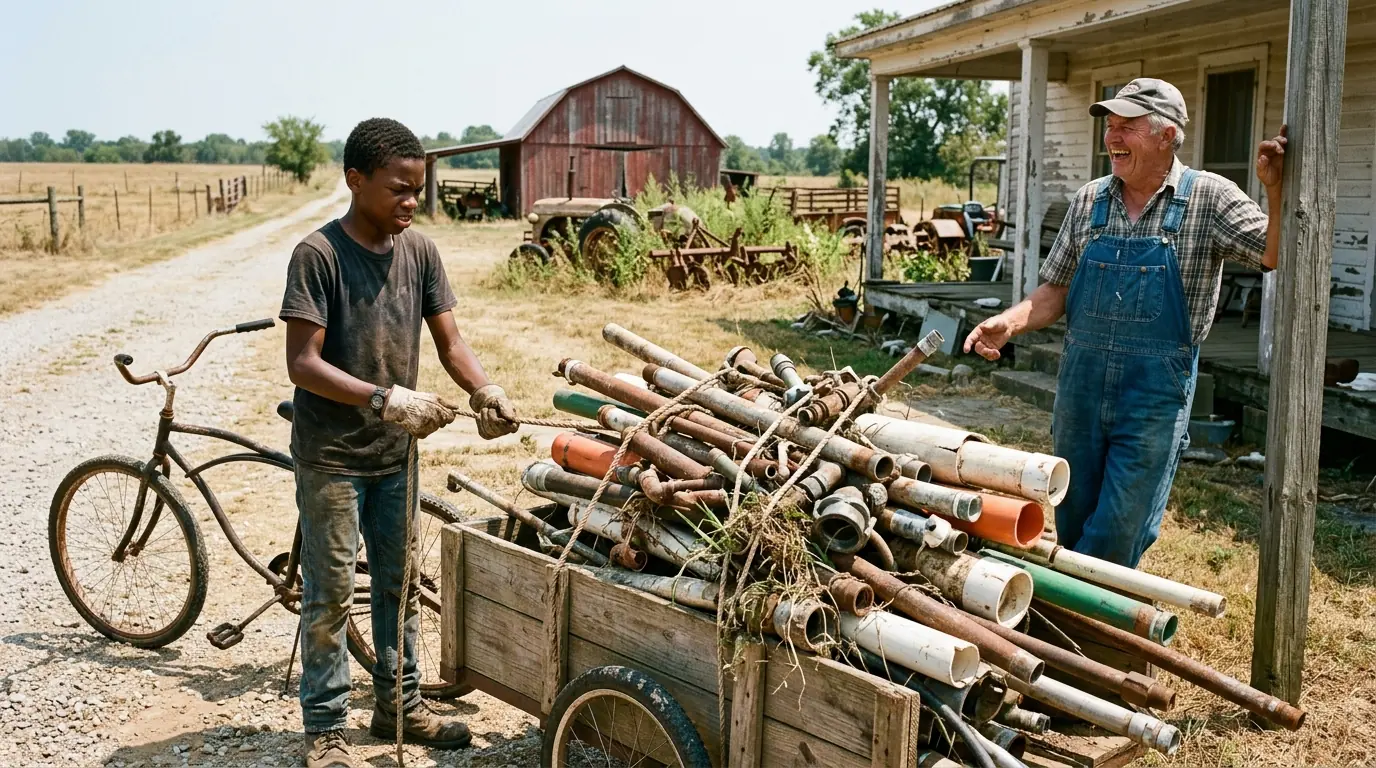
Odell Toliver had no answer. Truth was, he didn't know why his 13-year-old kept hauling back busted, rusted pipe that nobody in three counties wanted. Not to sell, not to build a fort—just one purpose. A big one. And Micah wasn't telling a living soul.
Every Saturday that summer, the boy pedaled the dirt roads of West Tennessee, stopping wherever old equipment sat rusting in the weeds. He knocked, he asked, polite. And farmer after farmer said the same thing:
"Sure, son. Help yourself."
Then they'd lean back on the rail and chuckle. Not cruel, just baffled: a skinny Black kid collecting pipe the whole county had already written off. By August, he had more of it than some working farms. His own father still didn't know why, and they were all about to find out.
The Toliver place sat on forty acres of riverbottom land along the Hatchie in the western corner of Tennessee, where the ground rolls slow and easy toward the water, and the summers arrive overdelivered. By the middle of July, the sky turned the color of old brass. The air smelled of turned earth and diesel and drying hay.
It was the kind of country where a family could farm the same ground for four generations and never once feel the need to apologize for it. The Tolivers had four generations: Micah's great-grandfather had cleared the worst of it by hand, and every man in the line since had bent his back to keep it. That mattered more than a boy his age understood yet. Land like that, held that long by a family like theirs, it wasn't just dirt—it was proof. It was the one thing nobody could take back or explain away.
Odell Toliver worked corn and soybeans and tobacco in the years the price made the trouble worth it. He was a deliberate man, careful with his words, patient with everything except the drought, which had a way of testing him that nothing else could.
Karen, his wife, kept a kitchen garden of outrageous ambition: tomatoes, peppers, squash, pole beans strung up on hand-cut cedar stakes. She was the one who'd first pressed seeds into Micah's palm back when he was small enough to reach the soil without bending his knees.
And in a small room off the back of the farmhouse lived Micah's grandmother, Eunice, eighty-one years old. She spent most mornings at the kitchen table with a cup of black coffee going cold at her elbow and a stack of agricultural extension pamphlets she'd been hoarding since the 1960s. She read them the way other people read novels: slow and twice.
Micah was the middle child of three. And in a house that measured a boy by what he could lift and haul and fix, Micah was quietly the disappointment. Not that anyone said the word—they didn't have to.
"Reuben, come help me with the header," Odell would call. The older boy, sixteen, broad through the shoulders, good with an engine—and the two of them would disappear into the machine shed for the afternoon.
Micah would still be on the porch steps with one of his grandmother's pamphlets open across his knees.
"And you," Odell would say, passing by without slowing down. "Get your head out of those books and go make yourself useful somewhere."
Micah never argued. That was the thing about him: he'd close the pamphlet, mark his place with a strip of feed sack, and go do whatever he'd been told. But it landed somewhere every time. It always landed.
There was one afternoon in June that stayed with the boy longer than it should have. The combine had thrown a belt out in the shed, and Odell had his head down in the engine of it, and he called for a wrench without looking up. Micah was closest. He grabbed the wrench off the bench and put it in his father's open hand. And Odell felt the size of it and frowned and set it down.
"Reuben," Odell called over his son's head toward the house. "Come here. I need somebody who knows the difference between a 3/4 and a 7/8."
It was a small thing: Micah had grabbed the wrong wrench, was all. But he'd stood there with his hand still out, and he'd felt his ears go hot, and he'd walked back to the porch and picked his pamphlet up off the step and read the same paragraph four times without seeing a word of it.
His brother, meanwhile, had ambled out to the shed and handed over the right tool, and his father had said, "There we go," warm as anything. And the two of them had gone on working like Micah had never been standing there at all.
The boy told himself it didn't matter. He was getting a great deal of practice that summer at telling himself things didn't matter.
That was the engine underneath everything the boy did that summer. Not a love of machines, not a gift for tinkering—something simpler and a great deal harder to satisfy: he wanted to matter. He had one small thing that was his and his alone: a flock of a dozen hens out behind the barn and the egg money they made him. He kept it rolled tight in a coffee can under a loose board in his room, and he never told anybody how much was in there.
The one person who saw the boy clearly was the oldest one in the house. Eunice noticed that summer that her grandson watched the fields differently than other children did. Other children looked at the crops; Micah looked at the water: where it pooled, where it ran off and was gone, where the soil cracked open first in a dry spell, and where it stayed dark and damp the longest after a rain.
She didn't say anything about it, not yet. But she started leaving the right pamphlets on the top of the stack.