"And where exactly would a boy like you get that kind of money?" The man in the gray Stetson didn't even turn around when he said it. He didn't think he had to. It was a cold October morning in 1984, and half the county had come to watch the Brandt farm get sold off piece by piece. Seventy years of one family's life auctioned to the highest bidder.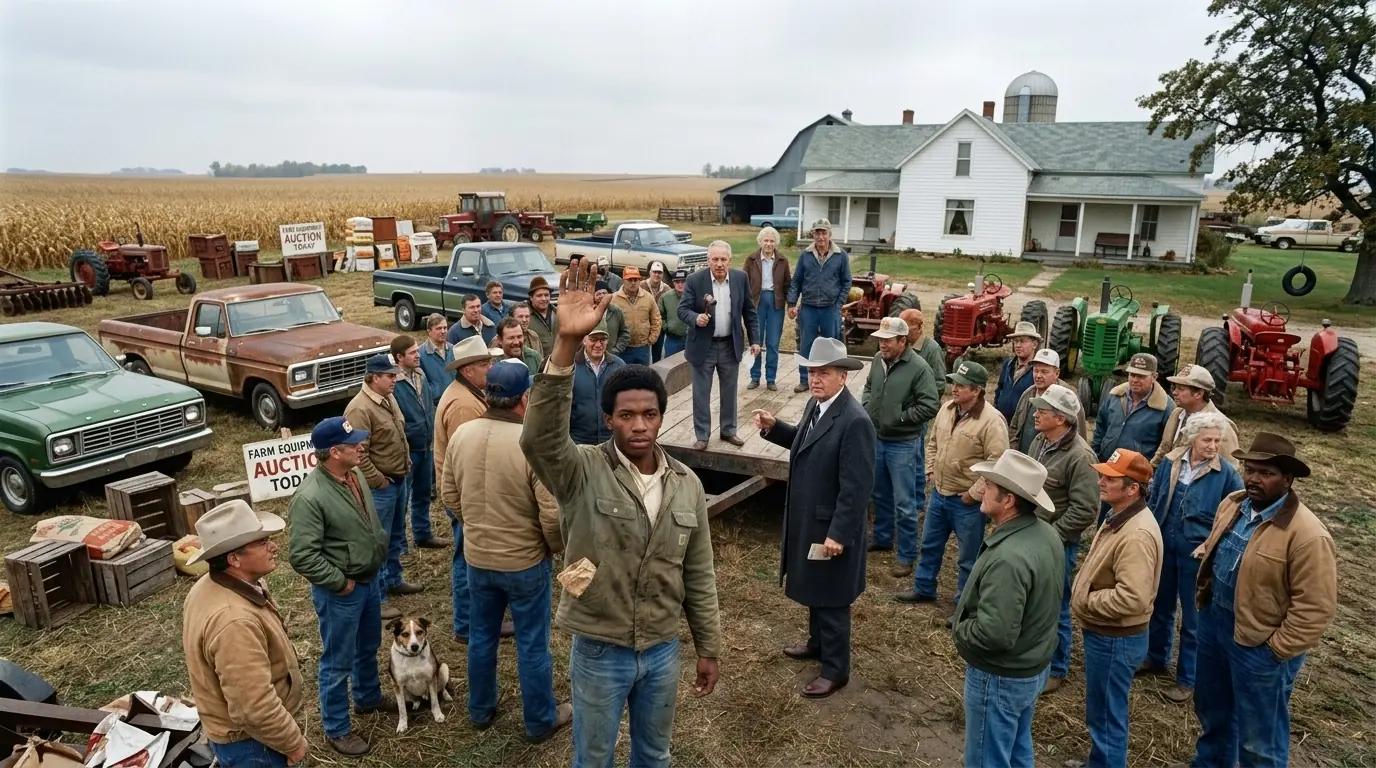
For the men with checkbooks, it was an opportunity. For the family standing at the edge of the crowd, it was a funeral. Nobody noticed the eighteen-year-old in the oil-stained jacket. Nobody took him seriously.
Not the investors, not the auctioneer, not even the family about to lose everything they had. But before that auctioneer could bring down his gavel, this young mechanic would drag the richest men in three counties into a bidding war nobody saw coming. And what he did that day would be told in that town for the rest of their lives. Because to understand that morning, you have to go back eleven days first.
By the third week of October, the frost came every morning now, and Walter Brandt had stopped pretending he didn't know what it meant. He walked the north field a little after dawn, the way he had walked it for most of fifty years. His boots broke a thin white crust that the sun would burn off by 9:00. The corn was down.
The ground lay bare and hard and silver in the early light. It was, he thought, about the most beautiful thing he had ever seen, and he hated that he was only really seeing it now, at the very end of it. There was a sign at the foot of the lane. He didn't have to read it anymore.
He knew what it said. Public auction, real estate, machinery, and livestock. The date was eleven days off. Behind him stood the house and the barn his father had reroofed twice.
In the machine shed was a workbench that Walt's grandfather had built by hand in 1914, the same year the old man broke the first eighty acres of this place out of raw prairie sod with a borrowed team and a single bottom plow. Walt had run his palm across that bench ten thousand times without thinking about it. Lately he couldn't walk past it without stopping. He'd done this walk in every weather a Nebraska sky could throw at a man.
In driving snow with a calf to find, in August heat that bent the air over the rows, in the green roar of a good July when the corn grew so fast you could almost stand still and watch it. He knew the low spot in the northeast corner that always drowned out in a wet year. He knew which fence posts his father had set and which his grandfather had. He knew this ground the way you know the inside of your own hands, and in eleven days it would belong to somebody who didn't know it at all.
Seventy years. Three generations had been born on this ground believing it was theirs, and in eleven days a man with a clipboard was going to sell it off in pieces to whoever raised a hand. People who didn't farm like to ask how this happened to a family that had done everything right for seventy years. The answer wasn't complicated, and that was the cruelest part of it.
In the good years the bank had been generous and the experts certain. Borrow, expand, bet on a future that could only climb, and Walt had bet, the way nearly every farmer he knew had bet. Then the ground shifted under all of them at once. Rates climbed, prices fell, the land itself lost half its worth, and men woke up owing far more than everything they owned could cover.
It wasn't bad luck, and it wasn't laziness. It was a trap baited with good advice, and it closed on a thousand families in the same few seasons. There had been a particular year. Walt could put his finger on it now looking back, the way you can only ever find the moment afterward, when it stopped being a run of bad luck and turned into the thing it actually was.
The spring had come in wet, too wet for too long. The fields sat black and sodden into May, and the planting that should have been finished by the first week went in late, and went in worried. Then the rain quit all at once, as if somebody had closed a valve, and the summer turned dry and hard, and the corn that had gone in late came up thin and tasseled early and gave back that fall a yield that any other year Walt would have been ashamed of. But it was not any other year.
By then the loan payments did not care what the sky had done. They came due in the same amount whether the bins were full or half empty, and that fall they came due against a half-empty bin and a price per bushel that had been sliding all season long. Walt had stood at the edge of that thin field in October and run the math in his head, the way a farmer does, and known, not feared but known, that it was not going to be enough. Not enough to catch up, not enough to get clear, not enough to keep the bank's patience past one more winter.
They didn't say much. There was not a great deal of comfort to be found in a column of debt. "We could sell the back quarter," she said once quietly, not really believing it. "Or the cattle.
Something to show them we're trying." Walt set the pencil down and rubbed his eyes with the heels of his hands. "I've asked everybody there is to ask, Ruthie," he said. "There's no piece of this I can sell that fixes the rest of it. That's the whole trouble with it." She put her hand over his on the table.
Outside the window, the wind leaned against the glass. Neither of them said the word that was coming. Saying it made it real, and they were not ready for it to be real. The letter from the bank had come back in February on a gray afternoon, and it had said what they already knew in language that pretended to be sorry.
Once a bank decides to protect what it's owed, a farmer has almost no room left to stand. By spring, the auction was set. By summer, the neighbors knew, and the neighbors grieved because half of them were one bad year from the very same letter. None of that was unusual in the fall of 1984.
Across Nebraska and Iowa and the Dakotas, the same sale bill was going up at the foot of a thousand lanes. The Brandts weren't special. They were just one more good family losing the only thing they had ever known how to do. And in town, in a cold cinder block garage on the edge of Dunmore, a young man was hearing their name for the very first time.
And unlike everyone else who heard it that week, he was already quietly beginning to wonder what one person could actually do. His name was Cyrus Reeves. He was eighteen years old, and there was not a farmer within 30 miles who could honestly say the boy hadn't saved them money at least once. If a baler jammed in the middle of haying, you called Hank's, and Hank sent the kid.
If a combine died with half the field still standing and rain in the forecast, you called Hank's, and you prayed the kid was there. He had a way with a dead engine that older men talked about the way they talked about a good bird dog, like it was a gift, not a skill. Cyrus knew better than anybody that it was the result of ten thousand hours of practice. His hands told the truth of it.
The creases of his knuckles were permanently dark with engine grease, the kind that doesn't come out no matter how long you stand at the sink. He had given up minding it. Out at a farm, bent over machinery, he was exactly who they needed, and they treated him exactly that way. But Dunmore was a white town in a white county, and the moment Cyrus walked down its main street into the bank to make a deposit, into the diner for a coffee, something in the air shifted by a few degrees.
Conversations didn't stop, not exactly. Eyes just followed him a beat too long. A clerk would count his money twice. A man holding a door would let it ease shut a half second early.
Nobody ever said a thing you could repeat. That was the thing about it. There was never anything you could point to and name out loud. There was only the steady daily arithmetic of being looked at like a question nobody had asked you to answer.
There was one morning that summer he thought about more than he ever let on. He'd gone into the diner on Main for a coffee and a roll before opening up, the way half the men in town did, and he'd taken a stool at the counter, and the talk around him had carried on for a beat, and then thinned, and then arranged itself somehow into a small ring of empty seats on either side of him that nobody filled. The waitress was perfectly nice. She filled his cup.
She called him hun, same as everyone. And still he sat in that little ring of empty stools drinking a coffee he no longer wanted. From one cracked vinyl seat, he understood the whole shape of the town. What made it sit so strangely was that some of those same men would be on the phone to Hank's by noon if their swather quit.
They'd shake his hand out at the farm and mean it. They'd tell their wives the Reeves boy was a wonder with an engine. It was only in town, only on the street, only across a counter that he stopped being a wonder with an engine and went back to being a question. Cyrus had long since given up trying to square the two.
He just learned to carry both at once. Old Hank had taken him on at fourteen when nobody else in town would and the two of them had never once spoken about why. Hank was not a tender man. He'd handed Cyrus a broom the first day, a wrench the second, and a real paycheck the day the boy earned it.
And that, the wrench and the paycheck and the plain expectation that he would be good at this, had been about the closest thing to kindness Cyrus could count on in that town. He never took it lightly. There was a reason Cyrus understood a foreclosure better than most grown men and it had nothing at all to do with engines. When he was eight years old, his own family lost their farm.
The Reeveses had been one of only a handful of black farming families left in that part of the state. The last of a community that had come out onto the plains generations back looking for ground of their own and had mostly been bought out or pushed off in the decades since. His father, Ezra, had held on longer than most. He had held on through the very same trap that was closing on the Brandts now.
The crisis never checked who you were before it took what you had. It reached the Reeveses years before it ever reached a man like Walt Brandt, and it took them just as completely. Cyrus remembered the day of their auction in pieces, the way you remember a fever. He remembered trucks he didn't know coming up the lane.
He remembered strangers walking through the barn with their hands in their pockets, turning over his father's tools, putting prices on a childhood. He remembered the auctioneer's voice rolling out across the yard, fast and bright and horrible, selling off a tractor his father had kept running for 15 years. And he remembered, more clearly than anything else in his whole life, the way his father stood while it happened. Ezra Reeves did not shout.
He did not argue. He stood at the edge of his own yard with his hat in his hands and watched a lifetime get carried off by people who'd forget his name by supper. Not angry, not even bitter. Just a kind of quiet that an 8-year-old had no word for yet, and would spend the next 10 years learning.
That evening, loading the last of their things into a borrowed truck, his father set a hand on his shoulder. The same weight Cyrus would feel in his memory for the rest of his life, and said only one thing. Land like that isn't dirt, son. At 8, the words meant nothing.
They were just something sad his father said. It would take Cyrus another 10 years and another family's auction to understand them all the way down. After the farm, the Reeveses did not fall apart, though plenty of families did. They moved to the edge of Dunmore.
Ezra took steady work, a maintenance job at the grain elevator, dependable, indoor, nothing at all like the life he'd had, and he kept his family fed and housed and together. It was a smaller life. He never said a single word against it. But Cyrus saw what it cost his father to fold himself down into it, and he never forgot that, either.
So, when Cyrus started working, he started saving, and he saved like a man possessed. While the other boys his age put their money into trucks and Friday nights, Cyrus put his into a dented tin coffee can under a loose board in his room. He took every night shift Hank would give him. He took the emergency calls nobody else wanted, the ones that came at two in the morning in a sleet storm.
He drove the same rust-eaten pickup he'd bought at sixteen, and he let his friends laugh about it. Year after year, dollar after dollar, the can got heavier. His mother worried about it a little. A boy his age with no truck worth driving and no Friday nights to speak of, squirreling money into a can like an old man burying it in the yard.
She'd ask him gently what on earth he was saving for, and he'd shrug and tell her he didn't rightly know, which was the plain truth. His father never asked. His father, Cyrus thought, understood it better than Cyrus understood it himself, and chose, the way Ezra chose most things, to leave a man his silence until he was ready to fill it. He could not have told you what it was for, not exactly.
He only knew that it was for something, something that had to do with the weight of his father's hand on his shoulder, and a promise he had never once spoken out loud. By the fall of 1984, there was more in that tin can than most grown men in Dunmore had sitting in the bank. Not enough to make him rich, just enough maybe to give a poor kid one single dangerous option that nobody in the world knew he had. He heard about the Brandt place the way you hear about most things in a town like Dunmore, across the counter of the garage, in pieces, from the men whose machines he fixed.
A farmer mentioned it first, almost in passing. Auction out at the Brandt spot. Real estate and all. Damn shame.
Over the next few days, the pieces kept coming. How long the family had been on that ground, how deep the bank had them, which investors were already circling. Cyrus listened and wiped his hands and said little and felt something tighten in his chest that he recognized and did not want to. Because it sounded exactly like his own life told back to him in someone else's name.
One evening, instead of driving home, he drove out toward the Brandt farm. He told himself he was only curious. He pulled the truck onto the shoulder at the foot of the lane and sat there with the engine ticking just looking at it. A house, a barn, a machine shed, fields running flat and gold to the horizon.
It looked like a hundred other farms, except that knowing made it look like none of them. Out near the buildings, a man was working, moving slow. Not from age, Cyrus thought, from the kind of weight he had once watched settle onto his own father. Even from the road, you could feel how quiet the place was.
It was a held-breath kind of quiet. The quiet of people waiting on something they were praying would not come. Cyrus sat there a few minutes and then he drove away, but somewhere on that shoulder, in the ticking dark, it had stopped being a story. The buildings were real.
The fields were real. The man moving slow in the yard was real. And the auction, eleven days off, had stopped being something that happened to other people. As the day came closer, the buyers came out to look.
They drove up the Brandt lane in clean sedans and late-model pickups. Men who bought land the way other men bought stock. Some to bolt more acres onto an operation a county over, some to flip when the market turned. They walked the fields with their hands in their pockets, talking soil and yields and dollars per acre, unfailingly polite to Walt Brandt.
And not one of them looked at the house like it was anything but a line item. The name Cyrus heard the most was Sutton. Roland Sutton was the kind of man who arrived early and arrived certain. Gray Stetson, a top coat that had never seen a day's work, and who let everyone in the room understand without a single word that he expected to leave owning whatever he came for.
He had bought up half a dozen failed places that year already. People said he had a plan for the Brandt ground. Assemble the whole spread, house and fields together, and sell it on as one tidy farm to somebody with money and no history in it. To a man like Sutton, that made the house worth fighting for.
A farm without its farmhouse is a harder thing to sell. Cyrus turned all of it over while he worked. The numbers people kept throwing around. Who would bid and how high and how hard.
The picture it painted was plain enough. If he set one foot in that auction, he would be standing against men who had purchased more land than he would ever lay eyes on, and who had no idea, none at all, that a kid in a grease-stained jacket meant to stand against them. He saw Sutton once in town the week before the sale, not to speak to. The man came out of the bank in that top coat, climbing into a clean car, talking back over his shoulder to another man in a suit.
And as they passed, Cyrus caught a single fragment of it. Something about the Brandt house. The word tear out. And a short, easy laugh between the two of them.
They didn't see him. Men like that rarely did. And Cyrus stood on the sidewalk a moment after the car had gone, turning that one word over. Tear out.
The barn Otto built, the bench in the shed, the porch some family had sat on for seventy years. Just a thing to be cleared off to make the package cleaner. Something settled in him then that had not quite settled before. It was not anger exactly.
Cyrus had learned a long time ago that anger was a luxury that cost too much to keep. It was closer to certainty. Whatever happened in that yard, those men were not going to get the heart of the Brandt place for the price of a laugh on a sidewalk. Not if he could help it.
The evening before he made up his mind for good, Cyrus drove out to his parents' place for supper. He was quiet through most of it, and his father noticed the way Ezra noticed most things about his son without seeming to look. Ezra set down his coffee and studied his son across the table. "You've been quiet about that Brandt place all week," he said.
"A man's only that quiet when he's already decided something." Cyrus turned the dented tin cup in his oil-stained hands and said nothing. "I taught you to fix engines, son, not to lie to your daddy," Ezra added, the corner of his mouth lifting. "I might bid on it," Cyrus finally said. For a long moment, his father just looked at him.
Outside the wind moved through the dry corn. Ezra leaned back, and when he spoke again, his voice had dropped to something lower, something that had been waiting eighteen years to come out. "When they sold our place, I stood in that yard and I let it happen. You were eight years old.
You held my hand and you asked me why nobody was stopping it. I never did find an answer for you." Cyrus looked up. "Land like that isn't dirt. It's every morning a family ever woke up believing tomorrow still belonged to them.
If you get the chance to hand that back to somebody, you don't ask whether you can afford it. You ask whether you can live with watching it go." They didn't talk much more about it. They didn't have to.
His father's words went home with him and sat in the cab of the truck the whole dark drive back louder than the engine. The night before the auction, Cyrus did not sleep. But it was nothing like the sleeplessness that had bent his father or Walt Brandt over a kitchen table full of bad numbers. Theirs was the wakefulness of men with no moves left.
His was the opposite. A mind running fast and clear, laying every piece out on the table and checking each one twice. Past midnight, he pried up the loose board and lifted out the tin can and counted it on his bed, the way he'd counted it a dozen times that week, as if the total might somehow have changed. It hadn't.
It was what it was. Years of his life pressed flat and held with a rubber band. Everything he had. He sat with it a long time and he thought about the men in the gray top coats and the size of what he was about to do and how easy it would be to just stay home and let the morning happen without him.
He thought too about all the ways it could go wrong because he was not a foolish boy and he would not let himself pretend the morning was already won. He might raise his hand and watch the number climb straight past everything in the can and have to stand there in front of the whole county and lower it again. Beaten. The kid who thought he could play with the big men, put back in his place in front of everyone he knew.
He turned that picture over honestly. It was a real possibility. It might even be the likely one. And he found somewhat to his own surprise that he could live with it.
What he could not live with was the other thing. Staying home, safe, reading about the sale in the county paper, and knowing he had carried that can for 10 years for nothing. And every time he got close to that, staying home, he saw his father's face at the edge of a yard, hat in his hands, watching it all get carried off. He saw himself at eight years old holding that hand, asking a question that nobody ever answered.
Sometime before dawn, he put the money in a paper sack and put the sack inside his jacket and went out and started the old truck in the cold and the dark. The auction was only a few hours away. The road in front of him ran out black past the headlights. He drove toward it anyway.
By the time the sun was full up, the cars had been coming for an hour. Pickups rolled slow down the gravel. Sedans carrying bankers and buyers came in behind them. And neighbors came, too.
They came out of respect, out of grief, and out of the helpless need to stand beside a family on the worst day of its life. By 8:00 a.m., the Brandt yard was full of people, talking low in clusters near the machine shed, drifting past the long rows of equipment that wouldn't belong to anyone they knew by nightfall. The mood was strange, half funeral and half market. Everyone there understood exactly which half they had come for.
Walt had been up since before dawn. He had walked the north field one more time in the dark. Now he stood near the porch with Ruth in a clean shirt, shaking the hands of men who had come to buy his life, and doing it with a steadiness that caused more than anybody watching could have guessed. The auctioneer climbed up onto a flatbed trailer a little after 9:00, welcomed them all, and then it began.
The small things went first. Tools, spare parts, a welder, a workbench. To the crowd, it was routine, a number, a nod, a hand in the air. To the Brandts, every single lot carried a ghost.
That toolbox had been Walt's father's. That bench had stood in the same spot since 1914. The prices did not matter to them at all. The memories did.
Ruth kept her chin up and her eyes dry, and only those standing close enough saw the way her gaze followed the combine when it sold, the machine Walt had babyed through a decade of harvests to a stranger from two counties over for a fraction of what it was worth. And then they came to the land. Because no matter how much steel changed hands that morning, the land was the thing every one of them had really come for. And they all knew it.
The auctioneer did not sell it all at once. He sold it the way the bank had broken it up, parcel by parcel. The east quarter, the river bottom, the forty along the section line. One by one, the fields that three generations of Brandts had cleared and worked and walked went up.
And one by one, the men with the checkbooks took them. Sutton bought, calm and unhurried, raising a single finger like a man a little bored at his own party. The big operation from the next county bought. Between the two of them, they carved the Brandt farm into pieces and divided it up across a single autumn morning.
And there was nothing on earth anyone could do but stand there and watch it happen. An old neighbor near the front took off his cap when the river bottom sold, the way a man takes off his cap when a hearse goes by, and then seemed embarrassed by it and put it back on. That was about as close as anyone came to a protest. There was nothing to protest.
It was all perfectly legal, perfectly orderly, perfectly final. A bank collecting what it was owed, and men with money buying ground at a fair price in a bad year, and a family being taken apart in front of its friends one signature at a time, and not a single piece of it against any law on the books. Walt watched his fields get sold out from under his own name, one after another, and his face did not move. Ruth reached over at some point and took his hand and held it.
By the time the cropland was gone, most of the crowd had quietly written the whole day off as finished. The fields were sold. The family would leave. The story would end the way these stories always ended.
There was one lot left. The auctioneer paused before he announced it, and something across the yard went still. The home place. The house and the barn and the first eighty acres Otto Brandt had broken out of Bear Prairie seventy years ago.
The heart of all of it. The one piece a man like Sutton needed to turn all those scattered fields into a single farm he could sell whole. The buyers straightened up. Notepads came back out of coat pockets.
This was the lot they had come for. The opening bid was called, and a hand went up. Sutton. Then the big operation.
The number climbed easy and quick the way it climbs among men who do this for a living. And then, near the back of the crowd, an eighteen-year-old in an oil-stained jacket raised his hand. For a moment, almost nobody noticed. The auctioneer caught the bid and rolled straight on.
A farmer who knew the boy from the garage turned and blinked. The number climbed again, and the investors answered it without even looking. And then, Cyrus raised two fingers. The auctioneer's chant stumbled for half a second before he caught it and called the new number.
A few heads turned. Somewhere off in the crowd, a man laughed under his breath. Sutton finally looked back over his shoulder, taking in the boy in the work jacket like he was reading a price tag that didn't add up. Son, how old are you?
He asked. Cyrus held his eyes. Old enough to raise my hand. Sutton turned back to the front, shaking his head.
And where exactly would a boy like you get that kind of money? Under your mattress? A ripple of laughter moved through the yard. Cyrus didn't laugh.
He just raised his hand again. The laughter died faster than it had come, because the boy did not stop. The auctioneer called for more, and the work jacket answered. Called again, answered again.
The number climbed past the point where a joke could survive it, up into territory where the men in the top coats had to actually start thinking, and the whole character of the yard began to change. People who had been half turned away turned all the way around. The big operation from the next county leaned in, conferred, frowned, and dropped out. And then there were two.
Roland Sutton and an eighteen-year-old mechanic alone at the top of the bidding with a crowd gone dead silent around them. Nobody cheered. This was not that kind of crowd, and Dunmore was not that kind of town. They simply watched, riveted and uneasy, the way people watch something they don't have a category for.
A few of them, deep down, had decided hours ago exactly what a boy like Cyrus was and was not. And the boy kept raising his hand, and reality kept refusing to match the picture. Sutton adjusted his hat and bid. Cyrus answered.
Sutton bid again, harder. Cyrus answered again. But the two men were not doing the same thing, and that was the part nobody in the yard could see yet. Sutton was running a calculation.
To him, the home place was worth exactly as much as it added to the package he could resell. A number with a ceiling. A margin. A point past which a smart man simply walks away.
Cyrus had no ceiling. Cyrus had a paper sack inside his jacket holding every dollar of his life and a reason that had nothing to do with margins. And he was prepared to spend all of it down to the very last bill. Across the yard at the edge of the crowd, Walt Brandt was watching a boy he had never met.
He didn't understand it. He could not have told you why a stranger half his age was still standing in this fight. But for the first time in a year of letters and lawyers and bad arithmetic, something small and unfamiliar moved in his chest. Hope, thin and frightened and real.
The bidding went on longer than anyone there had ever seen a bidding go. Sutton would let a beat pass as if to give the boy a chance to come to his senses and then bid. Cyrus would answer before the auctioneer had finished asking. Back and forth.
Back and forth. The number climbing in steady steps into a country none of them had expected to visit that day. The auctioneer, an old hand who had called a thousand sales and figured nothing could surprise him anymore, caught himself slowing his own chant, drawing it out, looking from the man in the top coat to the boy in the work jacket and back like a man watching something he would tell his grandchildren about. Ruth Brandt had a hand pressed flat to her mouth.
She did not know the boy's name. She would learn it within the hour and never once forget it as long as she lived. But in that moment, she only knew that a stranger was standing between her family and the end of everything and that she could not for the life of her understand why. Beside her, Walt had gone very still.
The stillness of a man afraid that hope, if he moved, might notice him and leave. And Cyrus had stopped hearing the crowd at all. The laughter, the whispers, the weight of two hundred pairs of eyes deciding what he was, all of it had gone quiet and far away. There was only the auctioneer's voice and the number and the paper sack against his chest going lighter in his mind with every raise.
And underneath all of it, steady as a heartbeat, his father's voice. "You don't ask whether you can afford it. You ask whether you can live with watching it go." He had watched it go once already. He had been eight years old the last time.
He was not about to watch it go again. By now, Sutton had stopped smiling. He turned full around this time and looked at the boy for a long moment, and the easy contempt had gone out of his face, replaced by something narrower. The look of a man recalculating a problem he had badly misjudged.
When he spoke again, he pitched it low, almost reasonable, just for Cyrus. "You don't want this, son," he said. "Take it from a man who's done this his whole life. You walk away now, you've got a story to tell.
You keep going, you've got a debt you can't carry and a hard lesson you'll spend years paying off." Cyrus looked back at him, steady. "I'm not borrowing a dime," he said. "And that lesson you're talking about, I already learned it. I was eight years old." Something moved across Sutton's face.
Not understanding, not quite, only the first cold suspicion that the boy in front of him was not bluffing and was not going to break. Sutton went quiet for a moment. He looked at the boy. He looked at the auctioneer.
And then he made his move. Not a nudge, but the biggest bid of the morning, called out flat and final—the kind of number that ends things. The crowd let out a breath. Surely that was it.
Surely the kid was done. Even the men who had started somewhere in the last few minutes to quietly want him to win, even they figured the wall had finally come. The auctioneer turned to Cyrus. "Do I have another?" he asked.
Cyrus looked down. For just a second he was not in that yard at all. He was eight years old holding his father's hand, and his father was watching everything get carried away, and there was nobody, nobody willing to step out in front of it. Then he raised his hand.
The yard gasped. The auctioneer took the bid. Roland Sutton stared at him as if a tool had spoken. The auctioneer called for more.
Silence. He called again. Sutton's jaw worked. He was a smart man, and a smart man knows the exact moment the math turns against him, and the math had turned.
One more call. Nothing. Going once. The wind moved through the yard.
Going twice. Nobody breathed. Sold.
For a moment no one moved at all. No one was entirely sure what they had just watched. An eighteen-year-old in a grease-stained jacket had stood in front of the richest men in three counties and refused to move, and the heart of the Brandt place, the house and Otto's first eighty acres, belonged to him. The crowd closed in around him before he had even lowered his hand.
The questions came from everywhere at once, and Cyrus answered almost none of them. What was he going to do with it? Was he going to farm it? Was he going to sell it?
How long had a kid like him been sitting on money like that? He did not owe them the story, and he did not tell it. He asked instead to speak with Walt Brandt alone. The two of them walked off toward the edge of the yard away from the noise, and they talked for the better part of an hour.
Nobody heard what was said. People only pieced it together later from what came after, and from the one detail several of them swore to, which was that at some point the old farmer, who had stood dry-eyed through the sale of his whole life, finally put a hand over his face. Whatever passed between them, it was not the easy thing the story would one day become. It was two men who had each watched the ground go out from under a family, recognizing it in one another.
Cyrus did not need the farm. He had never wanted the farm. What he had wanted since he was eight years old was for one family, just one, not to have to walk away from the only place they had ever belonged. He told Walt more or less that he had no intention of putting the Brandts off their land.
That they would work the rest of it out in time. That they could stay. It was not a fairy tale, and it would do the boy no honor to tell it like one. The fields were gone.
They had been sold off that same day, parcel by parcel, to Sutton and the others. And no eighteen-year-old's tin can was ever going to buy them back. The Brandts had lost the farm—the working heart of seventy years, the acres that had fed three generations of them.
That loss was real. And it was permanent. And the road in front of them was going to be a hard one for a long time.
But the house was theirs to stay in. And the first eighty acres Otto had broken by hand, the founding ground, the piece with the home and the barn and the workbench on it. That was Cyrus's now. And Cyrus had no intention of moving a single Brandt off of it.
They would not farm the way they once had. But they would wake up tomorrow and the day after that on Brandt ground. They would not be erased from it. For the first time in a year, that much was no longer in question.
Cyrus Reeves never once called himself a hero, and he bristled at anyone who tried to. He would tell you he just remembered what it felt like to watch a family lose everything, and that when the chance came to spare another family that particular pain, he took it. He would tell you his father taught him the only thing about it that mattered a long time ago at the edge of another yard. The story got out the way stories do in a place where everyone knows everyone.
By the end of that week, they were telling it in the diner on Main. The same diner, the same counter, and a few of the men telling it had stood in that yard, and a few telling it had laughed out loud when the boy first raised his hand. It changed less than you'd hope. Men who had looked at Cyrus a certain way on the street did not all wake the next morning changed.
That is not how it goes, and it would be a lie to dress it up that way. But, something had happened that the old picture simply couldn't hold. In the years after, more than a few of them started bringing their work to Hank's and asking for the Reeves boy by name. Not for the engine, or not only for the engine.
Some never said a word about any of it. They only nodded at him a little longer on the street than they used to, and Cyrus took the nods and the work the same way he took everything, quietly, without ever making more of it than it was. He had not done it to change their minds. He'd done it for a reason that lived a good deal deeper than that.
Years later, people in Dunmore still got it wrong half the time. They'd say a mechanic bought the Brandt farm and let the family stay, like it was a simple kindness, a nice thing a nice young man once did. But, the ones who were there knew it was harder than that, and smaller, and bigger all at once. He hadn't saved the farm.
The fields were gone, sold off that same afternoon lot by lot to men who'd never walk them again. What Cyrus Reeves owned when the dust settled was the house, the first eighty acres Otto Brandt had ever broken by hand, and not one inch more. But on that ground stood a family that didn't have to leave it. He had stood in a yard full of people who had already decided what a boy like him was worth.
And he handed their neighbors back the one thing the bank, the buyers, and that whole brutal year had been trying to take. Not the land. The right to keep waking up on it. Stories like Cyrus Reeves's don't make the history books.
They get passed around kitchen tables and diner counters, and too often, they get forgotten.