The auctioneer had already tried to sell the grain dryer three times before Maggie Turner raised her hand.
Nobody else moved.
Not one bidder.
A cold October wind rolled across the Mill Creek co-op yard outside Cedar Falls, Iowa, carrying the smell of mud, diesel fuel, and dry corn dust from the elevators beyond the railroad tracks. Farmers stood in loose groups between tractors and wagons, shoulders hunched against the weather, waiting for the useful equipment to come up for sale.
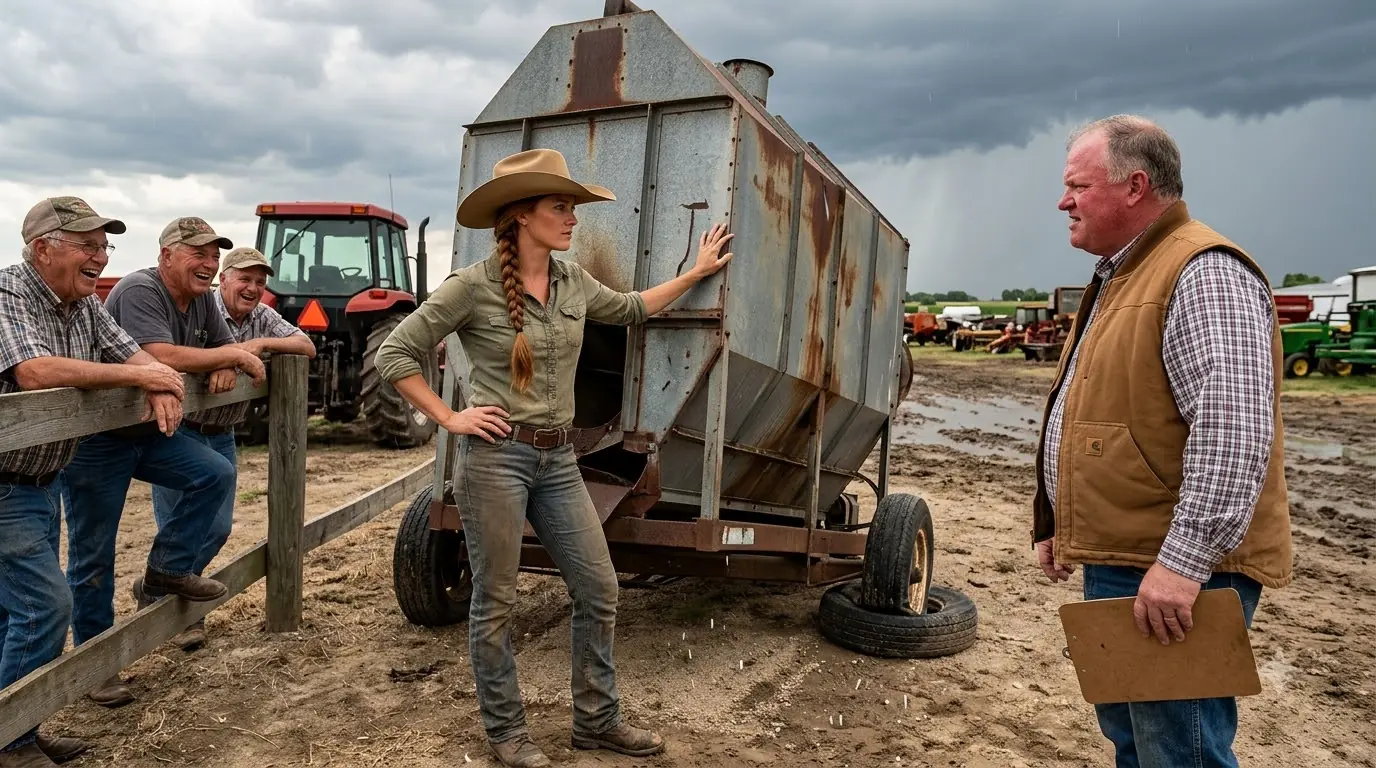
The dryer was not useful.
At least that was what everybody believed.
It sat crooked on two soft tires near the edge of the equipment lot, its cylindrical steel body streaked orange with rust, one access panel hanging open, its control box yellowed by age. A faded manufacturer plate barely clung to the frame.
The thing looked less like farm equipment and more like something that should have been hauled to a scrapyard years earlier.
Auctioneer Dale Merritt slapped the side of the machine.
“Anybody give me a hundred dollars?”
Silence.
Someone laughed.
Dale looked over the crowd.
“Come on, boys. There’s more than a hundred dollars of iron sitting here.”
A farmer behind Maggie called out, “Then sell it by the pound.”
Several men laughed.
Maggie did not.
She was studying the dryer.
Her tan cowboy hat sat low over her auburn hair, which she had braided over one shoulder that morning. She wore a faded olive-green work shirt, dusty blue jeans, brown work boots, and a leather belt that had belonged to her father.
At thirty-two, Maggie Turner had been farming full-time for almost nine years.
People still spoke to her as if she had arrived last Tuesday.
Part of that was because her father, Jack Turner, had been known throughout Black Hawk County.
Jack could rebuild an engine, weld a cracked cultivator frame, repair a hydraulic pump, and somehow keep machinery working long after the manufacturer believed it should have died.
When he died unexpectedly three years earlier, many people assumed Maggie would lease the farm out.
She had not.
Then they assumed she would sell.
She had not done that either.
Instead, she kept planting.
Two hundred and forty acres of corn and soybeans.
Not a giant operation.
Not small enough to be a hobby.
Exactly large enough to ruin a person if two bad seasons arrived in a row.
And two bad seasons had almost arrived.
Last year brought drought.
This year brought debt.
Maggie had money tied up in fertilizer, fuel, seed, repairs, crop insurance premiums, and a tractor transmission that had failed at exactly the wrong time.
Every dollar mattered.
Which was why the men around her could not understand what happened next.
Dale raised his voice.
“Fifty dollars!”
Nothing.
“Somebody rescue me here.”
Maggie lifted one hand.
“Two hundred.”
The entire auction yard went strangely quiet.
Dale stared at her.
“Two hundred?”
Maggie nodded.
“Two hundred.”
Someone behind her burst out laughing.
Then another.
Within seconds the silence disappeared under a wave of amusement.
Dale looked almost guilty.
“Maggie, you know I was asking fifty.”
“I know.”
“You just bid against yourself.”
“I know that too.”
The laughter grew louder.
Maggie kept looking at the dryer.
She was not looking at the rust.
She was looking at the burner housing.
The fan assembly.
The old gearbox.
The intake auger.
Most importantly, she was looking at the model plate.
Harrison Field Systems.
Model 620.
Propane-fired batch dryer.
Built in 1979.
Maggie knew that machine.
Not that exact machine.
But the design.
Her father had owned a Harrison 610 when she was a child.
Smaller.
Older.
Same principles.
Simple electrical system.
Mechanical timers.
No computerized moisture management.
No proprietary software.
No digital controller that became useless when one circuit board failed.
Jack had once told her, “Ugly equipment has one advantage, Maggie. Nobody tries to make it smarter than the person fixing it.”
At twelve, she had rolled her eyes.
At thirty-two, she understood exactly what he meant.
Dale looked around.
“Do I hear two fifty?”
Nobody bid.
One older farmer yelled, “Let her have it before she changes her mind.”
More laughter.
Dale raised the gavel.
“Sold. Two hundred dollars to Maggie Turner.”
The gavel struck.
And that was when Rick Hanley walked over.
Rick was fifty-one, heavyset, red-faced, and manager of Mill Creek Cooperative.
He had spent almost twenty-seven years working his way from scale clerk to operations manager and had developed the personality of a man who believed years inside a system meant he personally owned it.
He carried a brown clipboard under one arm.
His plaid shirt was clean.
His brown vest was cleaner.
His boots had never touched enough mud to justify their price.
Rick stopped in front of Maggie.
Behind him, several farmers leaned against the auction fence, still smiling.
Rick looked at the dryer.
Then at Maggie.
“Tell me you didn’t actually buy this.”
Maggie rested one hand against the rusted steel.
“I did.”
“For two hundred dollars?”
“That’s usually what ‘sold’ means.”
A few men laughed again.
Rick slapped the clipboard against his palm.
“Maggie, this thing hasn’t run in twelve years.”
“Eleven.”
He blinked.
“What?”
“Inspection sticker says eleven.”
Rick glanced at the plate.
Then back at her.
“You think that makes it better?”
“No.”
“Then what are you doing?”
“Buying a dryer.”
Rick shook his head.
“That isn’t a dryer. That’s scrap.”
Maggie looked toward the northwest.
Heavy clouds were forming above the flat Iowa horizon.
The weather service had been changing its forecast all week.
Originally twenty percent chance of rain.
Then forty.
Then sixty.
Now the latest estimate showed several systems converging over eastern Iowa during peak harvest.
Rick followed her gaze.
“You worried about that?”
“I pay attention to weather.”
“We all do.”
“Not all the same way.”
Rick smiled.
He liked audiences.
And right now he had one.
He stepped closer.
“You just blew two hundred dollars on dead scrap, Maggie. You bought yourself a punchline.”
Maggie rested her elbow against the machine.
“Laugh while you can.”
Rick raised an eyebrow.
“That machine may be worth more than your whole setup before this storm is over.”
The farmers behind him erupted.
One nearly dropped his coffee.
Rick pointed toward the dryer.
“This?”
“Yes.”
“When rain hits, your corn’s going to sit wet in wagons while that dinosaur refuses to start.”
Maggie looked at him calmly.
“Maybe.”
“You’ll be at my scale asking us to squeeze you in.”
“Maybe.”
Rick grinned.
“Then I’ll remind you about today.”
Maggie looked toward the dark clouds again.
“Do that.”
The first cold drop of rain struck the brim of her hat.
Then another.
Maggie turned back toward Rick.
“But when your dryers shut down, I want to see who comes begging first.”
The laughter followed her all the way to her truck.
By sunset, the story had already traveled across half the county.
Maggie Turner had paid two hundred dollars for dead machinery.
By morning, the story had improved itself.
According to one version, Maggie had paid five hundred.
Another said she planned to dry the entire county’s corn.
A third claimed she believed the old dryer would make her rich.
Maggie ignored all of it.
At 6:15 the following morning, a flatbed truck pulled into Turner Farm carrying the Harrison 620.
Her neighbor, Earl Benson, drove behind it in a faded Ford pickup.
Earl was sixty-four, thin, gray-bearded, and one of the few people who never treated Maggie like a temporary replacement for her father.
He stepped from the truck and stared at the machine.
“Well.”
Maggie crossed her arms.
“Well what?”
“It’s uglier in daylight.”
She smiled.
“Thank you.”
Earl walked around it.
“Tires are done.”
“I know.”
“Burner looks rough.”
“I know.”
“Control box might be full of mice.”
“Probably.”
“Fan bearings?”
“Unknown.”
He kicked the frame lightly.
“Frame is solid.”
“That’s what I saw.”
Earl looked at her.
“You saw something else too.”
Maggie pointed toward the fan housing.
“Harrison built these with oversized bearings.”
Earl nodded.
“Dad had one.”
“I remember.”
“Burner assembly is basically rebuildable with off-the-shelf components.”
“Mostly.”
“Motor?”
“Three-phase.”
“You don’t have three-phase at the old shed.”
“I have a phase converter.”
Earl looked at her.
“Since when?”
“Tuesday.”
He laughed.
“You planned this.”
“I planned the possibility.”
“That sounds like your father.”
Maggie’s expression softened.
“That’s probably why I’m nervous.”
They unloaded the dryer beside the old machine shed.
For the next eight hours Maggie did not touch a wrench.
That surprised Earl.
Instead she cleaned.
Every panel.
Every vent.
Every electrical box.
She photographed wiring before removing anything.
She labeled connectors.
She wrote bearing numbers on masking tape.
She found the original service manual online through a university equipment archive and printed eighty-six pages.
By noon the shop floor looked like a machine had exploded in an organized pattern.
Earl watched from a stool.
“You going to fix something today?”
“I am fixing it.”
“You’re cleaning.”
“I’m learning what failed.”
“Same difference?”