The old-timers called it the white scar. It stretched for nearly two miles along the western edge of Harney County, Oregon, in the high desert country where the wind never quite stopped, and the sky sat so wide and pale, it felt like the world had forgotten to put a roof on itself. The flat was blinding on summer mornings when the sun hit the salt crust and threw the light back hard enough to make a person's eyes water from a quarter mile away. Nothing grew there. Nothing had grown there in living memory.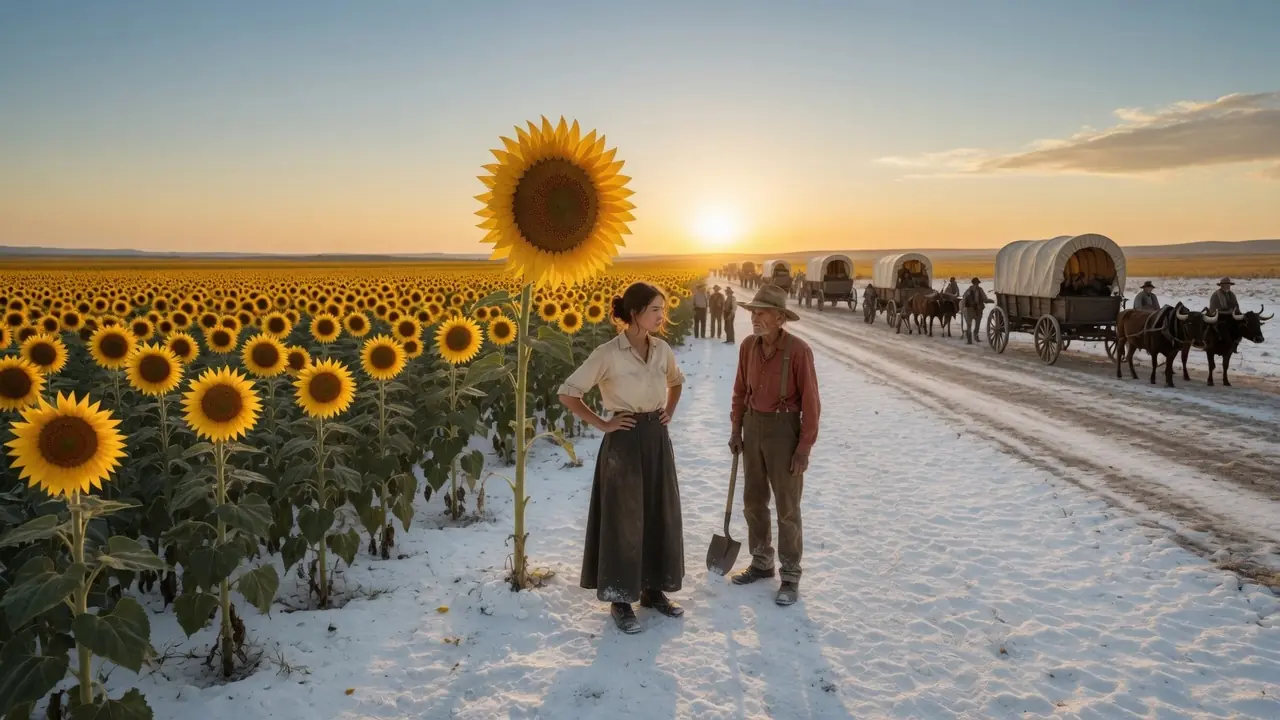
Not a blade of bunchgrass, not a scrub of sage, not a single knob of bitterbrush pushing up through the white. The ground was alkali-poisoned clean through, soil so sour and salt-laden that even the jackrabbits gave it wide passage, and coyotes trotted around its edges rather than cross it. The settlers of the little community called Dunmore Crossing had long since written the flat off entirely. It was not land. It was a wound in the earth, useful for nothing except perhaps reminding a person how cruel this country could be when it had a mind to.
She was 22 years old in the spring of 1884 when she first walked out onto it alone. She had arrived in Harney County the previous autumn with a wagon, a mule named Fletcher, her father's iron-banded trunk, and a land claim filed through the Desert Land Act in her own name. She was not the first woman to file a claim in the territory, but she was among the youngest, and the man at the land office in Burns had looked at her the way men sometimes looked at things they did not expect to see standing upright. She had paid him no particular mind. Her claim included 80 acres of decent high desert range, a creek tributary that ran cold in April and thin in August, and because the survey lines fell where they fell, a long tongue of the white scar itself stretching along her western boundary like a hem of bleached bone.
Her neighbors, the Alcott family to the north and Old Decker to the east, had warned her about the flat in the way people warn against something they have already given up on. She had listened politely. She had nodded. And then, on a cold March morning when the sage still held frost along its branches, she had walked out to the edge of the white crust, knelt down in her work dress, and pressed her fingers into the surface. The ground was hard-packed and bitter-smelling, almost chemical, the way a dry lake bed smells when the water has been gone so long it's left only its ghost behind.
She pressed deeper where the crust broke into pale granular soil and brought a small pinch of it to her nose. She had read about alkali flats in a soil pamphlet printed by an agricultural society in Pennsylvania, a pamphlet her father had folded into the back of his trunk along with seed catalogs and a worn copy of a farming almanac. She sat back on her heels and looked out across the white scar. She was already thinking. She rose from the crust and walked back to the cabin slowly, her mind moving faster than her feet.
The pamphlet had said that alkali soil, the kind poisoned white by years of salt accumulation and poor drainage, was not necessarily dead. It was locked. The minerals that made it hostile were the same minerals that, in different proportions, fed plant roots. The problem was concentration. Too much sodium, too much carbonate, layered so thick that water sheeted off instead of sinking in, and roots that tried to push through shriveled like thread in a flame.
But the pamphlet had also said something she had underlined with a careful pencil stroke. Organic matter, introduced in sufficient quantity over sufficient time, could begin to shift the balance. Break the crust. Invite water downward. Coax chemistry toward something living.
She pulled the pamphlet from the trunk that evening by lamplight, smoothing its creases across the kitchen table. She had read it before, but now she read it differently. The way you read a map once you know where you are standing. Kelp ash, wood ash, and green plant material could be worked into the surface layer. These added potassium, loosened the sodium's grip, and introduced the kind of slow bacterial work that turned dead mineral into something a root could drink from.
She had no kelp. She was three days by wagon from anything resembling a coast. But she had something close. The alkali marshes a mile south of her land, where tule reeds grew thick and brittle at the edge of a shallow seasonal lake. Tule was not kelp, but it was organic.
She did not tell the Alcotts. She did not tell Decker. Not yet. There was nothing to show anyone, and she had learned early that people formed opinions before evidence arrived, and that opinions, once said, were harder to uproot than salt crust. She would work first.
She would talk later. Over the following 2 weeks, she made three trips to the marsh with her wagon and a long-handled fork, cutting tule reeds and loading them until the wagon groaned. The marsh smell clung to her clothes. Her shoulders ached every evening with a deep, clean pain that told her she had done real work. She hauled the reeds to the edge of the white scar, piled them in long windrows, and began turning them into the surface with a spade.
She did not dig deeply, only enough to break the crust and let the fibers sit inside it like a slow-burning fuse. On her fourth trip, Decker rode past on his mule and pulled up at the road's edge, watching her without speaking for a long moment. “ Miss,” he finally called, “you know nothing grows on that flat.” She straightened, wiped her face with her sleeve, and looked back at him steadily. “ Not yet,” she said.
She turned back to her spade and Decker rode on, shaking his head. She barely noticed. She was already counting rows. The rows she was counting existed only in her head, but they were precise. She had paced the flat a dozen times by then, measuring with her stride, marking corner stakes with twisted willow branches.
The white scar stretched roughly four acres at its widest. Not enormous, but large enough that standing at its center the road behind her disappeared and the horizon in every direction became the same blinding white. She had learned to bring a wide-brimmed hat and to work in the early morning before the reflected glare turned the flat into something that made her eyes ache. The reed windrows were doing their slow work. She could see it already.
The crust where she had turned the tool fiber was beginning to darken in thin stripes, holding moisture differently than the surrounding surface. She crouched and pressed her palm flat against one of those darker strips. Cool. The salt was still present. She was not foolish enough to believe otherwise, but the fiber was changing the texture, breaking the tight mineral surface that shed water like a tin roof.
That month she made two more visits to the creek bed east of town and hauled back gray ash from the lye works, careful to spread it thin so the wind would not carry it off before she could work it in. She mixed the ash with water from her barrel, let it steep overnight in a wooden trough until it turned cloudy and sharp-smelling, then poured it in slow passes down the rows. It was a leaching experiment, imprecise and patient. She had read in a single borrowed agricultural pamphlet dated 1871, its cover soft from handling, that certain salts in low-lying flats could be shifted downward with repeated wet and acid treatments over seasons. Not removed, shifted.
Made tolerable in the upper layer where roots would first reach. Tolerable was enough. She was not asking the flat for perfection. She was asking for a chance. The sunflower seeds were still in their cloth pouch tucked inside a tin on her shelf at the homestead.
She had not planted them yet. The pamphlet had been clear on that point in its dry academic way. Amend first, plant after. Amending would take at least one full season, perhaps two. She allowed herself to look at the seeds only on evenings when she had worked a full day on the flat, treating it as a kind of reward.
They were large and heavy, a variety she had never seen sold at the trading post. The woman in Cheyenne who gave them to her had called them by a name she could not quite recall, something in another language, and had said only that they were bred for difficult ground. She believed that. She had to believe it because the alternative was three seasons of labor for a field of husks. What she had not anticipated was that her trips back and forth along the road would eventually draw a kind of reluctant audience.
Not admirers, not yet, but watchers. And watchers, she had learned on the frontier, eventually became something else entirely. The first watchers came on horseback. Two men from the Halverson Ranch, riding the road to town for supplies, slowed their animals to a walk when they passed the flat and saw her there. She was knee-deep in the white crust, dragging a rake through ground that sounded hollow beneath her boots.
They said nothing that first time. She felt their eyes on her back the way you feel a drop in temperature before a storm, and she kept raking. The second time they passed, returning with a loaded wagon, one of them called out something she chose not to fully hear. She raised a hand in acknowledgement without turning around. She had learned that particular art in her first year on the frontier: receiving mockery with the posture of a woman who simply did not notice it.
By the following week, it was not just the Halverson men. A family in a canvas-topped wagon stopped altogether, the husband standing up on the seat to get a better look at what she was doing. She heard the wife ask a question in a low voice. She heard the husband laugh. Their children, hanging over the wagon side rail, watched with open curiosity, which she found more bearable than the adult versions of the same attention.
Children at least had the honesty to stare plainly, without the performance of dismissal layered on top. She came home that evening with her shoulders aching and her boots full of salt grit, and she sat on the step of her homestead and looked at the plain around her as the last light turned everything the color of old brass. She did not feel defeated. She felt something closer to resolved. The way a piece of wood feels after it has been planed smooth, when all the rough grain has been worked down, and what remains is clean and sure.
She had chosen this. Every morning she chose it again. The laughter of strangers passing on a road was not a reason to stop. It was barely a reason to pause. What began to trouble her more in those weeks was the practical problem she had not yet solved.
The ash and tule reeds were doing their work slowly. She could see that. Where she had raked it deepest into the cracked white surface, the soil beneath was beginning to show a faint change in color. It was almost gray-brown instead of chalk white. But the flat was large, far larger than she could amend by hand in a single season.
And she was one person with one pair of arms and a borrowed horse that she returned each evening to a neighbor's barn. If the amendment work fell behind the growing season, she would miss her planting window entirely. She had done the arithmetic more than once, on the back of a flour sack, and the numbers always came out the same uncomfortable way. She needed a solution she had not yet thought of, or she needed help she had not yet asked for. She was not sure which of those possibilities frightened her more, or which one the flat would eventually force upon her.
She chose help. It was not an easy choice because asking meant explaining. And explaining meant exposing the whole strange enterprise to fresh ridicule at a moment when she was not sure she could bear it gracefully. But the arithmetic on the flour sack did not lie. And the flat did not care about her pride.
She went first to the woman who ran the trading post at the edge of town. She was a broad-shouldered widow in her fifties who had seen enough peculiar ventures during her years in the territory. Very little surprised her anymore. She listened without interrupting. That was already more than most people had offered.
When the explanation was finished, the widow turned back to her counter, restacked a row of tins that did not need restacking. Then she said that she had a nephew with a mule and too much spare time on his hands. She said she would send him Tuesday. He arrived Wednesday with the mule. He also brought a flat-bedded wagon.
He wore a skeptical expression the way younger men wore their hats: tilted and unconvinced. But he did not say a word against the work. He hauled three loads of ash before noon, three more than she could have moved alone in the same time. She thanked him plainly. She paid him with two jars of preserved plums she had put up the previous autumn.
She said nothing about whether he believed in what she was doing. That was not a conversation she needed to have. More help came in ways she had not anticipated. A farm girl of 18, the daughter of a sodbuster whose land abutted the eastern edge of the flat began appearing in the early mornings without announcement. She would simply be there when the sun came up, rake already in hand, hair pinned back, boots caked white from crossing the crust.
She never asked questions. She raked. On the third morning she appeared, the young woman felt something shift in the quality of the silence between them. It became companionable rather than merely quiet, the kind of silence that means two people have agreed on something without speaking it aloud. With two of them working steadily and the nephew's mule making weekly loads, the amendment spread faster than the arithmetic had predicted.
By the time the warming broke fully into the first true heat of spring, almost two-thirds of the flat had been raked and turned, the gray-brown seam in the soil widening like a slow tide across the white. The seeds were still wrapped in the cloth, still waiting. She checked them every few days, pressing a fingertip gently against each one, the way her grandmother had taught her to test for viability, a practice so old it had no name, only instinct passed down through hands. One evening she sat at the edge of the flat as the light went copper and counted what remained to be done. The number was no longer impossible.
It was merely difficult, which was a different thing entirely. She unfolded the flour sack and drew a new line across her old arithmetic, marking what had changed. The planting came on a Tuesday, which felt right to her in a way she could not explain. It was not a Monday, which carried the weight of beginning, nor a Wednesday, which belonged to the middle of things. A Tuesday was a working day with no ceremony attached to it, and she wanted no ceremony.
She wanted only the seeds in the ground before doubt had time to settle back into her chest. She had soaked each seed for precisely thirty-six hours in creek water mixed with a careful measure of wood ash tea following the notes she had made from memory of an old agricultural pamphlet she had read twice through at the trading post three winters before and never forgotten. The soaking was meant to soften the hull and give the young root something it already recognized. It was alkaline, yes, but gentler than the flat. Something like a rehearsal for what lay ahead.
They planted in rows, she and the older woman, moving slowly and deliberately, using a sharpened stick to open each hole to the measured depth of two knuckles. She had worked out that depth through her own reckoning, balancing what she knew of sunflower germination against the particular crust of this soil, which was still inclined to seal itself overnight like a healing wound. The holes had to be deep enough to hold moisture, but not so deep that the shoot would exhaust itself reaching light. The older woman did not speak much while they worked, but once she paused, pressed a hand flat to the raked earth between two rows, and held it there for a long moment, the way a person listens to something too low to be called sound. She looked up and said only that the ground was not as cold as she had expected.
That was all. But both of them understood it was a good sign. By midday they had planted the first third of the seeds. By late afternoon, two thirds. The sun had moved past its highest point and was pulling the shadows long across the flat when she pressed the last seed into its hole, tamped the soil gently over it with her thumb, and sat back on her heels.
The flat looked no different. It was still pale, still enormous, still carrying the faint mineral smell of old alkali rising in the heat. Nothing visible had changed. She had known it would look this way and had prepared herself for it. But the unchanged whiteness still required a moment of steady breathing before she stood.
She marked each row end with a small cairn of darker creek stones so she could find them again because in a heavy rain or a blowing dust, the soil would shift. And she needed to know where to begin watching. Then she filled the water barrel on the wagon, drove it out across the flat, and walked each row with the slow pour of a tin cup, going carefully to each plant site. One measured cup per seed, no more. The water disappeared into the earth almost immediately, drawn down into the dark amendment below, and she followed it with her eyes as far as she could.
The first week passed in silence. She came to the flat each morning before the heat built, walking the cairn-marked rows with her tin cup and her water barrel, pouring one careful measure to each site, and moving on. The white crust between the rows stayed undisturbed. No sprout broke the surface. No green showed anywhere.
She had expected this and told herself she had expected this. But expectation is a different thing from the long, quiet wait of standing over bare earth day after day with nothing to show for the labor of the previous 3 years. By the second week, a boy from the Hessler place rode by on his way to the trading post and stopped his horse at the flat's edge. He watched her working the rows from a distance and then called out wanting to know what she was doing. She told him she was watering her sunflowers.
He looked across the white ground with its absence of anything green, looked back at her, and rode on without another word. She heard him laughing before he was fully out of earshot. The kind of laugh that is not unkind so much as genuinely bewildered. The third week, a dry wind came from the southwest and blew steadily for four days. She stretched a length of burlap between two stakes at the windward end of the rows to slow the surface scour.
And she weighed the bottom edge with creek stones. It was not much protection, but it was something. The cairns held. She watered through the wind, squinting against the grit. And when the wind finally broke on a Thursday evening, she walked the whole flat and found the amended soil still present beneath the crust, dark and slightly moist when she pressed her fingers down.
On the twenty-third morning, she saw it. She almost walked past it. It was the smallest thing. A pale green curve, barely the width of a bootlace, just beginning to push against the white crust near the third cairn in the second row. She stopped and crouched and looked at it for a long time without touching it.
It was real. The crust had not cracked yet. The seedling was just beginning to press upward, feeling for the open air the way a new thing does when it has no knowledge of what waits above it, only the certainty of direction. She sat down beside it on the flat ground, not caring about the alkali dust on her skirt. The sky overhead was enormous and pale and going gold at the eastern edge where the sun was climbing.
A meadowlark called once from somewhere past the tree line. The seedling held its small green curve against the white earth and did not move because new things do not move fast, but they do not have to. They only have to be present. She counted the days since planting on her fingers and made a note in the small book she kept in her apron pocket. Then she stood, picked up her tin cup, and finished watering the rest of the rows with the same careful measure she had given every other morning.
No more, no less. Nothing changed in the practice because one seedling had arrived. By the end of that week, three more seedlings had come up. She did not tell anyone. The town had not asked after her in some time, and she had grown accustomed to the silence that replaces mockery once people decide a person is simply beyond help.
The woman at the dry goods counter had stopped making small remarks about the wagons of ash and tule reeds. The men at the feed store had stopped pausing their conversations when she walked in. She had become, in the language of the frontier, a settled fact. Strange and unprofitable, but no longer interesting. That suited her.
It left her free to work without the weight of other people's attention pressing down on the rows. She extended the stake line that week, driving new markers into the white crust at careful intervals, measuring by foot and by eye the way her father had taught her to measure a garden plot before the ground was turned. Her father had believed that a field should be planned before it was planted. That the invisible structure of a thing mattered as much as its visible growth. She had thought of him often over the past months, more than she had expected.
And she thought of him again now as she drove the last stake and stood back to read the shape of what she had made. Four seedlings in one quadrant. Bare soil in the rest, still pale, still ringed with the fine white alkaline powder that the morning dew lifted and resettled each day like a habit it could not break. But the soil was different than it had been. She could feel it through her boots when she walked the rows.
Not soft, exactly, but less rigid. Less hostile. The years of ash had done something slow and chemical beneath the surface, while the tule reeds had done something else that was harder to name. Together, they held water just long enough and released it slowly enough for roots to follow it downward instead of reaching and finding nothing. The fourth seedling was the tallest of the four, already past the first true leaf stage, its small paired leaves turned up toward the light with a posture she could only describe as deliberate.
She crouched beside it and looked at the base of the stem where it met the soil, checking for the signs of alkali burn she had feared all winter. The yellowing, the curl, the slow collapse that had taken last year's test seeds before they could establish. There was nothing. The stem was clean and green and faintly rough with the first suggestion of the coarse texture that sunflowers develop as they age into themselves. She pressed two fingers gently into the soil beside it, reading the moisture the way a person reads a page they have read many times before, not searching for surprise but confirming what they already half know.
It was right. The balance she had spent three years trying to find in dead ground was holding. She moved to the next row and kept working. By the end of May, the four seedlings had become 11, and by mid-June, the 11 had become something she no longer counted by individual stems, but by the way the field looked from the rise above the flat, a scatter of green that interrupted the white crust the way a first few stars interrupt an evening sky. It was not overwhelming yet.
It was not even impressive to anyone who had not watched the ground beneath those stems the way she had, who had not known what that ground was made of, and what it had turned back for generations. But to her it was overwhelming. She stood on that rise more mornings than she could account for and simply looked. The town had not stopped watching her. If anything, the watching had grown more concentrated as the stems grew taller.
She was aware of it. The pauses at the trading post when she came in for twine or vinegar. The conversations that shifted register when she entered a room. She had long since stopped caring about the content of those conversations. What she cared about was the ground and the water and the ash and the particular quality of the afternoon light in late June that fell across the flat at an angle that made the green of the leaves almost painful to look at directly.
She began adding a second daily water application in the heat of July, carrying it before sunrise and again in the hour before dusk, working by feel through the last of the light. The stems were thickening now, the lower leaves broad and coarse, and the first of the buds had begun to form, tight green fists at the tops of the tallest plants, not open, not yet declaring themselves, but present in a way that made her breath catch each morning when she came close enough to see. She wrapped her hands around the base of the largest stem and felt the faint resistance of a living thing that had decided to continue. That was all she had ever asked of them. She kept the water careful.
Too much, and the amended soil would flush, disrupting the balance she had built before the roots were deep enough to anchor through it. Too little and July would take them the way July takes everything that has not gone deep enough to find what lies below the reach of heat. She had been reading the leaves for signs. The slight cupping. The soft downward droop at midday that could mean either reasonable heat response or early distress.
And so far the leaves had told her only that they were managing. She believed them. She began to notice that people from town were stopping on the road above the flat. They did not come down. They did not speak to her.
Just stopping their wagons and looking down across the white crust at the green that had no business being there. She did not wave. She kept working. The buds at the tops of the tallest plants had begun to show the first faint loosening of their wrapping. A suggestion of gold at the seam.
A color the flat had never held before. They opened in the first week of August. It was not one or two. All of them opened within three days of one another. As though they had agreed on it.
She came down the slope in the early morning when the light was still low and amber. And the flat was no longer white. It was gold. There were towers of gold. Face after face turned east toward the rising sun.
Each had the size of a dinner plate. Each one ringed in petals the color of a flame held steady in still air. She stood at the edge and could not move for a long moment. She had believed this was possible. She had worked six years on the certainty that it was possible.
But belief and the thing itself are not the same. And standing inside the fact of it was something she had not prepared for. She walked between the rows slowly. The plants stood taller than her head. The stalks were as thick as her wrist.
The roots had gone down through everything she had given the soil. The ash, the tule reeds, the careful water, and the patience had helped them find something beneath all of it that she could not account for. Some older generosity in the earth that the salt crust had only been hiding. She put her hand against one stalk and felt it solid as young timber. By mid-morning the road above the flat held a dozen wagons.
By afternoon it held more. She could see them from inside the rows. The shapes of people standing at the rim looking down. Some of them were the same people who had called her foolish. Some of them were the ones who had laughed.
She did not hold that against them. They had seen what the flat had always been. She had chosen to see what it might become. That was the only difference between them and it was not a difference worth carrying as a grievance. A woman she recognized from the dry goods came down the slope and stopped at the field's edge saying nothing for a long while before she finally spoke.
She said she had never seen anything like it in all her years in the territory. She said it quiet, almost to herself. She answered that the land had done the work; she had only asked it the question. In September, she harvested. The heads were heavy past what she had expected.
Seed packed dense inside each one, oil rich and full, enough for pressing, enough for planting again, enough to trade. She had a buyer from two counties over who had heard the word and come to see and stayed to make an agreement. The following spring, she broke ground on the next section of the flat. No one laughed. The soil she had built was still there, waiting for what she would ask of it next, patient as the land has always been patient, not empty, not finished, but resting between one season and whatever stubborn, believing hand would come and make it bloom again.