"Boy, that thing's dead. Drag it out back with the rest of the junk." Cordell Tarver was 14 years old and he did not move. It was a Tuesday morning in March of 1987 and he was standing at the edge of his father's equipment shed in Wilcox County, Alabama watching a perfectly good day's work die before it ever started.
The welder in front of him, his father's Lincoln 225, a machine that had held the Tarver place together for 11 years, had quit somewhere between the switch and the transformer. And flipping it on one more time was not going to change that. He had $40 in his pocket. He had a corn planter with a cracked hitch that had to be in the ground before the rain came and he had exactly zero experience inside a welding machine.
His father was in town at the parts store. The work was not going to wait. Somebody had already decided that machine was finished. Nobody had asked the boy.
Before any of the rest of it makes sense, you have to understand the place. Wilcox County sits in the lower middle of Alabama in the Black Belt, which got its name from the dirt long before it got its name from anything else. Dark, heavy soil that grew cotton for 150 years and then grew soybeans and cattle and pine when the cotton money went somewhere else and did not come back. By 1987, it was one of the poorest counties in the United States and everybody who lived there knew it and nobody who lived there said it out loud very often because saying it out loud does not fix a fence.
Camden was the county seat. 2,000 people, give or take. A grain elevator, a parts store, a diner that ran the same breakfast plate 7 days a week, and would have been offended if you asked for something else. And a counter.
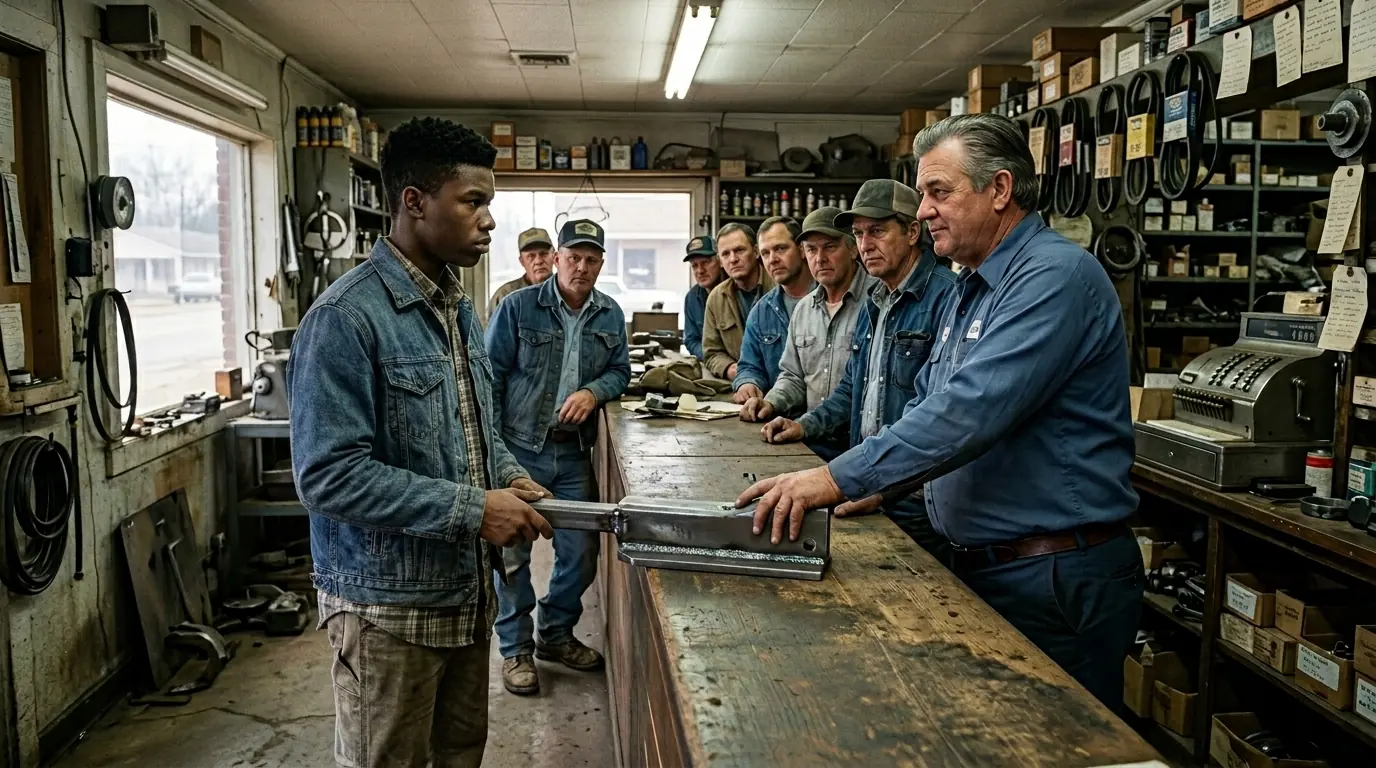
A long wooden counter at the front of the parts store, where men gathered on Saturday mornings to talk about fertilizer prices and diesel and whatever piece of equipment had died on somebody since the last time they stood there. The farms in Wilcox County were not big. Not by Midwest standards. They were the kind of operations that ran on repair instead of replacement, because replacement was a thing that happened to other people in other counties.
The Tarver family had held the same 160 acres since 1921. That is a sentence. And it is a short one. And in that part of Alabama in that year, it carried more weight than a paragraph.
Alton Tarver farmed it. And when the farming did not cover the year, he fixed other men's machines for cash. Hydraulics, hitches, cracked frames, bent implements. The way his father had, and his father's father before him.
He worked methodically. He did not complain. And he held a deep and permanent suspicion of anything that cost more than it was worth. He did not throw things away. That last part matters more than anything else in this story, so hold on to it.
Let me tell you about the lean-to. Purvis Tarver, Cordell's grandfather, built it behind the main barn in 1938 out of salvaged tin and heart pine. And then he spent the next 40 years filling it. Every busted tool, every cracked implement, every seized motor, every bent frame, every gearbox that had ground itself to powder.
Purvis had come up through the depression in a county where a man who could not fix a thing did not eat. And he had come out the other side of it with a single unshakable principle that he passed to Alton, and Alton passed to Cordell in almost exactly the same words. "Junk is a thing you can't fix."
Purvis would let that sentence sit in the air until it had some weight on it. "Everything else is just a thing you ain't fixed yet." By 1987, the lean-to had grown into something roughly the size of a two-car garage stacked floor to ceiling. And Cordell Tarver had spent most of his childhood inside it.
He knew that shed the way other boys knew baseball cards. He knew which shelf held the stator out of a 1962 generator that had thrown itself apart the year his father graduated high school. He knew where Purvis had stored the drive chain off a corn picker that had not turned since Eisenhower. He knew the smell of the place, old grease, iron filings, and the particular sweetness of rust that has been sitting undisturbed for a very long time. And he found it more interesting than nearly anything else in the world.
His mother, Odessa Tarver, said the boy had motor oil where his blood ought to be. His father said nothing. And in Alton Tarver's vocabulary, silence was the highest form of agreement available. So when the welder died on that Tuesday morning in March, Cordell did not panic, and he did not go looking for a grown man.
He carried it into the lean-to, set it on his grandfather's bench, and started taking the case off. He was 14 years old. He had never been inside a welding machine in his life. But he had read every issue of Popular Mechanics the Camden library carried, and a stack of old service manuals his father had kept in a feed sack. And he had spent enough hours in that shed to understand the one principle Purvis had drilled into him before he was tall enough to see over the bench.
"If you know how a thing was put together, you can figure out why it came apart." What he found inside took him most of the morning to piece together. A mouse nest, scorched black on one side. A selector switch burned dark at two of its contacts. And a secondary lead where the insulation had cracked and gone to ground against the frame, which was the actual killer, and which was invisible until he pulled the transformer forward and turned it toward the light.
He cleaned the damaged contacts carefully and repaired the cracked insulation on the lead. And for the switch, he went to a parts bin on the north wall, a bin his grandfather had labeled by hand in 1974. And he pulled a selector out of a dead buzz box that had been sitting in there since before Cordell was born. It took him 3 hours. Then he clamped the ground to the planter frame, struck an arc, and the machine came alive under his hands with a sound like a hive waking up.
"There you go." He welded the hitch that afternoon. Then, because the machine was running and the day was not over, he built 11 corral panels out of pipe that had been leaning against the barn since 1981.
He did not tell his father what had happened. Alton found out anyway. Fathers do. And his response, delivered at the supper table that evening without ever once looking up from his plate, was four words.
"Good work today, son."