The first thing apeople noticed was not the little girl in the wheelchair.
It was the man behind her.
He was enormous, the kind of enormous that made doorways look badly designed. Six-foot-three, close to three hundred pounds, with a shaved head, a thick black beard streaked with silver, and tattooed arms that looked like they belonged around motorcycle handlebars, not a child’s pink pool bag.
Then they saw the tail.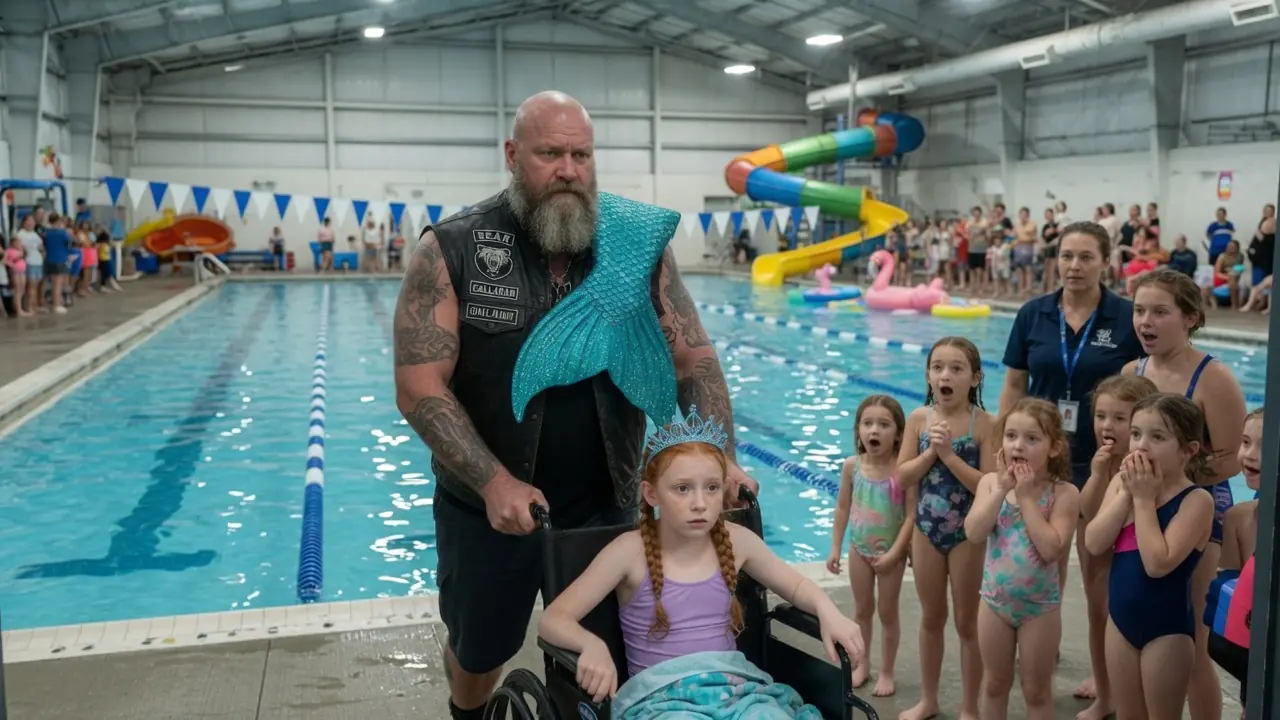
A glittering turquoise mermaid tail hung over one of his shoulders, sparkling under the New Mexico sun like something stolen from a little girl’s birthday party.
That was when the laughter started.
Not polite laughter.
Not the kind people tried to hide behind a cough.
Real laughter.
The kind that lands hard when you are already trying to be brave.
It was a Saturday afternoon in Gallup, two turns off old Route 66, and the public pool was packed with families trying to survive the desert heat. The air smelled like chlorine, sunblock, hot concrete, and nachos from the concession stand. Children screamed in the shallow end. Lifeguards blew whistles. Parents sat under umbrellas, pretending not to be exhausted.
I was there with my nephew, Mateo, who had spent most of the morning showing me how many ways a six-year-old could jump into water without actually swimming.
Then the rumble came.
Deep.
Slow.
Heavy.
A motorcycle rolled into the parking lot, and heads turned before the engine even stopped.
The man killed the Harley, swung one boot over the side, and walked toward the pool gate pushing a small wheelchair in front of him.
The girl in the chair was maybe eight years old.
She was thin in a way that made her towel look too big around her shoulders. Her skin was pale, her face dotted with faint freckles, and her copper-red hair had been braided carefully to one side. She wore a lavender swimsuit and a plastic crown with tiny blue gems stuck crookedly across the front.
Her legs rested beneath a beach towel printed with seashells.
Her hands gripped the arms of the wheelchair.
Not tightly enough to be angry.
Tightly enough to be afraid.
The man pushed her through the gate like he was bringing royalty into a kingdom that had forgotten how to bow.
Later, I learned his name was Jonah “Bear” Callahan.
At that moment, most of us knew only what we could see.
A giant biker in black jeans, heavy boots, and a leather vest with faded patches. A man with skull tattoos, scarred knuckles, and the kind of face people invented stories about before he opened his mouth.
And over his shoulder, that ridiculous mermaid tail.
A teenage girl near the snack machine whispered, “No way.”
A boy by the diving board said, “Is that for him?”
One of the dads sitting behind me chuckled and muttered, “Somebody lost a bet.”
Jonah heard it.
I saw his jaw move once.
But he did not turn around.
He parked the wheelchair near the edge of the pool, where the blue water flashed and trembled under the afternoon light. Then he knelt beside the girl, lowering himself slowly because men built like him do not fold easily.
The little girl looked at the water.
Then at him.
“Is she really coming?” she asked.
Her voice was small but clear.
Jonah took the mermaid tail off his shoulder.
“She already did.”
The girl frowned.
“Where?”
He held up the tail.
The glitter caught the sun.
For one second, her serious little face softened.
“You?”
“Best the mermaid union could send on short notice.”
She almost smiled.
Almost.
Then someone laughed too loudly from the far side of the pool.
The smile vanished.
Jonah noticed.
He always noticed.
He laid one massive hand on the armrest of her chair, close but not trapping her fingers. His hands were rough, the backs sunburned, the nails cut short and darkened with old machine grease. But the way he touched that wheelchair was careful, almost reverent.
“Look at me, Junie,” he said.
Junie.
That was her name.
June Callahan.
She lifted her eyes.
“I promised you I’d do it,” he said.
“But people are looking.”
“People look at sunsets too. Doesn’t mean the sun should quit.”
She stared at him like she was deciding whether to believe that.
I was close enough to hear him only because Mateo had finally collapsed beside me with a melting snow cone and sticky fingers.
Jonah leaned closer.
“You don’t have to swim today,” he told her. “You don’t have to do one thing your heart isn’t ready for. But if you want to touch the water, I’ll be right there. Tail and all.”
June looked again at the pool.
The water seemed to scare her and call to her at the same time.
That was the part most people missed.
They saw a child in a wheelchair.
They saw a biker in a costume.
They did not see the battle happening in her face.
Jonah stood and began removing his boots.
The pool grew quieter.
Not silent.
Public pools are never truly silent.
But a strange attention moved through the place.
He unfastened the leather vest and folded it carefully over the back of June’s wheelchair. Beneath it, he wore a black sleeveless shirt stretched across a chest as broad as a refrigerator door. His arms were covered in tattoos: skulls, roses, flames, old military numbers, a tiny cartoon turtle near his wrist.
Then he sat down on the hot concrete and started pulling the mermaid tail over his legs.
It did not go smoothly.
The tail had clearly not been designed with Jonah Callahan in mind.
He grunted once.
June covered her mouth.
Not in embarrassment.
In laughter.
Real laughter.
The kind children make before the world teaches them to lower the volume.
The tail stuck halfway over his knees.
Jonah looked down at it.
“Mermaids got smaller hips than I expected.”
June laughed harder.
A few people laughed too.
But some were still cruel about it.
A teenage boy near the diving board raised his phone.
“This is going online.”
Jonah heard that too.
This time, he turned.
Not sharply.
Not dramatically.
Just enough for the boy to see his eyes.
“Film my daughter without permission,” Jonah said, voice low, “and your phone learns to swim.”
The boy lowered it.
Fast.
A lifeguard walked over, young, blond, nervous, probably no older than nineteen.
“Sir, I’m not sure that tail is safe for swimming.”
Jonah nodded.
“Fair.”
The lifeguard blinked, surprised not to be argued with.
Jonah held up the bottom of the tail.
“I cut the fin open. Legs can move. It’s just for show.”
“You can swim?”
“Better than I dance.”
June whispered, “He dances terrible.”
“Traitor,” Jonah said.
The lifeguard smiled despite herself.
“Okay. But stay in the shallow end at first.”
“Yes, ma’am.”
That “ma’am” did something to people.
It did to me.
A man who looked like he could break furniture by leaning on it had just addressed a teenage lifeguard with more respect than half the parents at the pool had shown her all summer.
Jonah finished pulling the tail into place.
It shimmered around his huge body, tight in all the wrong places and ridiculous in every possible way.
He stood.
The pool exploded into laughter again.
June flinched.
Jonah did not.
He spread his tattooed arms, gave the crowd a deep bow, and said, “Autographs after the swim.”
Some of the laughter changed then.
Not all of it.
But enough.
There is a difference between laughing at a person and being invited to laugh with him.
Jonah knew the difference.
He stepped into the shallow end.
The water came up around his knees, then his thighs. The tail floated awkwardly, glitter spreading across the surface. June watched him like he had crossed into another world and might not return.
“Still alive,” he called.
She did not answer.
He moved closer to the pool steps and held both hands out.
“You want to come sit on the edge?”
June’s fingers tightened.
“I don’t know.”
“That’s an answer.”
“I hate that answer.”
“It’s still allowed.”
A woman nearby, maybe in her thirties, leaned toward her friend and whispered loudly enough for half the pool to hear.
“Why bring her if she can’t even swim?”
Jonah’s face changed.
For the first time, I saw the anger in him fully.
It was not loud.
That made it worse.
He looked at the woman, and all the air seemed to leave her expression.
“She can hear you,” he said.
The woman looked away.
June stared at her lap.
Jonah climbed out of the pool, water pouring off the glittering tail, and knelt beside June again.
“Hey.”
She would not look up.
“I told you,” she whispered. “This was stupid.”
“No.”
“Everybody thinks I’m weird.”
“Everybody is wrong a lot.”
“I can’t even get in by myself.”
“Lots of people need help getting places.”
“Not into a pool.”
“Junie.”
His voice softened until even my nephew stopped licking syrup off his hand and listened.
“You think needing help means you don’t belong somewhere?”
June’s mouth trembled.
“I don’t know.”
Jonah swallowed hard.
Then he said something that made no sense to me yet.
“Your mom needed help the day she won the lake race.”
June looked up.
“Because the boat tipped.”
“Exactly. She still won.”
“She said mermaids don’t quit.”
Jonah smiled, but it hurt his face.
“Your mom said a lot of dangerous things.”
June touched the edge of the towel across her legs.
“I miss her.”
The words were so plain.
So small.
Jonah closed his eyes for half a second.
“Me too, baby girl.”
That was when I first noticed the patch inside his leather vest.
The vest hung over the back of the wheelchair, open slightly. Sewn into the lining was a small silver seashell with a name stitched beneath it in blue thread.
Nora.
I did not know who Nora was.
Not yet.
But I knew the way Jonah looked at that patch.
Like it was the last warm place in a cold room.
He reached into the pool bag and pulled out a folded photograph sealed inside a plastic sleeve. He handed it to June.
She held it with both hands.
From where I sat, I could see only part of it.
A woman in a blue mermaid tail, smiling from a pool edge, holding a tiny toddler in her lap.
June touched the photo.
“She looked pretty.”
“She looked impossible.”
“Did people laugh at her?”
“Sometimes.”
“Did she care?”
Jonah exhaled.
“She pretended not to.”
June looked at him.
“Like you?”
He nodded.
“Like me.”
Later, the story came together in pieces.
From the lifeguard.
From the woman at the front desk.
From Jonah himself, after the whole pool stopped laughing and started listening.
Nora Callahan had been June’s mother.
She had been the opposite of Jonah in nearly every visible way. Small where he was huge. Bright where he was dark. A swimming instructor with sun-brown skin, wild black curls, and a laugh that reportedly made strangers smile before they knew why.
She taught adaptive swimming classes at that very pool.
Children with braces.
Children with missing limbs.
Children afraid of water.
Children whose doctors had said maybe not, and Nora had replied, “Let’s see what the child says.”
She wore a mermaid tail every Saturday in the summer.
Not because it was practical.
Because terrified children forgot fear for a moment when they believed a mermaid had come to teach them.
June had been four when the accident happened.
A drunk driver ran a red light on Route 66 and hit Nora’s car on the way home from a swim meet.
June survived in the back seat.
Her spine did not.
Nora did not survive at all.
After that, June would not go near deep water.
Not the pool.
Not a lake.
Not even the bathtub with more than a few inches.
Jonah tried everything.
Therapists.
Doctors.
Gentle encouragement.
Leaving it alone.
He never pushed.
But he watched his daughter look at old pictures of Nora in that mermaid tail. Watched her trace the glittery scales with one finger. Watched her ask questions about a mother she remembered in pieces and water she loved before fear stole it.
Then June said one night, very quietly, “If Mom was here, I think I could swim.”
Jonah did not sleep that night.
The next week, he found one of Nora’s old mermaid tails in a storage bin.
It was far too small.
Of course it was.
So he called a costume maker in Albuquerque and paid extra for rush work. When she asked for measurements, he gave them and waited through the silence on the other end of the phone.
“For you?” she finally asked.
“For my daughter,” he said.
“She wearing it?”
“No.”
Another silence.
Then the woman said, softer, “I’ll make it strong.”
That was how Jonah Callahan came to Gallup public pool on a Saturday afternoon in July, wearing a mermaid tail big enough to shame him and bright enough to honor his wife.
He was not trying to be funny.
He was trying to bring Nora back in the only way he could.
The first attempt to get June near the water failed.
She reached for Jonah’s neck, then froze before he could lift her from the wheelchair.
“I can’t.”
“Okay.”
“I’m sorry.”
“No sorry.”
“I wanted to.”
“I know.”
“But I can’t.”
“Then we sit.”
So they sat.
Jonah, still dripping in the ridiculous tail, lowered himself beside her wheelchair on the concrete. The tail spread around him like a glittering puddle. June held the photo of Nora against her chest.
For ten minutes, they did nothing.
People started returning to their own business.
Children splashed again.
Parents resumed conversations.
The teenage boy at the diving board kept glancing over but did not raise his phone again.
Then Mateo, my nephew, stood.
I grabbed his arm.
“Where are you going?”
“To say hi.”
“Mateo—”
But he had already waddled over in his little shark swim trunks, holding a melted snow cone cup.
He stopped in front of June.
“My name is Mateo,” he announced. “I can’t swim good either. I mostly sink with confidence.”
June stared at him.
Jonah looked like he was trying not to laugh.
Mateo pointed at Jonah.
“Your dad is a big mermaid.”
June’s lips twitched.
“He knows.”
“Is he nice?”
“Mostly.”
Mateo nodded.
“My dad snores. Is that worse?”
June looked at Jonah.
Jonah said, “Depends how loud.”
Mateo held out his snow cone cup.
“Want the last blue part?”
June looked unsure.
Then she took it.
That tiny exchange did what all the adults could not.
It made June visible as a child instead of an event.
Soon, two more kids came over.
Then another.
A little girl with goggles too big for her face asked if Jonah was a real mermaid king.
Jonah said, “Only on weekends.”
The kids accepted this.
Children are often kinder than adults because they have not yet learned all the rules of embarrassment.
June began to smile.
Small at first.
Then more.
The lifeguard, whose name was Abby, returned with a floating pool chair used for adaptive swim lessons.
“We still have this,” she said to Jonah. “Mrs. Callahan used to use it.”
Jonah looked at the chair.
His face went still.
Abby’s voice softened.
“She taught my little brother. He has cerebral palsy. First time he floated without panicking was with Nora.”
June looked up quickly.
“You knew my mom?”
Abby smiled.
“I was twelve. She told me my brother wasn’t afraid of water. He was afraid nobody would listen when he said slow down.”
June absorbed that.
Jonah looked away.
His eyes were wet.
The woman who had whispered earlier came over then, looking ashamed.
She crouched a few feet from June, careful not to crowd her.
“I’m sorry,” she said. “What I said was cruel. I didn’t know.”
June looked at her.
Jonah said nothing.
He let his daughter decide whether the apology deserved a place to land.
June held the photo tighter.
“My mom said people should think before words jump out.”
The woman gave a sad little laugh.
“Your mom was right.”
“Yes,” June said.
That could have been the end of it.
But apologies, when real, change the air around them.
The pool felt different after that.
Less like a crowd watching something strange.
More like witnesses waiting for something brave.
Jonah turned to June.
“Want to try the chair?”
She looked at the floating chair.
Then the water.
Then the photo.
“I’m scared.”
“I know.”
“What if I panic?”
“Then I take you out.”
“What if people laugh?”
Jonah looked around.
“They’ll answer to me.”
That time, several people laughed gently.
Not at him.
With him.
June breathed in.
Then nodded.
The process took time.
Jonah did not rush it.
He moved the wheelchair closer to the edge. Abby helped position the floating chair in the shallow water. Jonah climbed down first, tail glittering as it floated around his hips, his tattoos dark against the blue.
He turned back to June.
“Ready?”
“No.”
“Want to stop?”
“No.”
“That’s my girl.”
He lifted her from the wheelchair.
The tenderness of it silenced the entire pool.
There are ways a strong person can handle a fragile person that tell you everything about who they are.
Jonah’s arms, which looked built for bar fights and broken engines, held June like she was made of breath.
She wrapped her arms around his neck.
Her face pressed into his wet shoulder.
“I’ve got you,” he whispered.
“I know.”
“No, listen. I’ve got you if you swim. I’ve got you if you cry. I’ve got you if you decide this whole thing stinks and we go get fries.”
June gave a shaky laugh.
“I like fries.”
“Me too.”
He lowered her slowly into the floating chair.
The moment her body touched the water, she gasped.
Not from cold.
From memory.
Her hands flew to Jonah’s arms.
“Dad.”
“I’m here.”
“Dad.”
“I’m right here.”
Abby stood close, calm and ready.
Mateo whispered beside me, “She’s doing it.”
I nodded, unable to speak.
June’s breathing went fast.
Too fast.
Jonah put both hands on the chair, steadying it without trapping her.
“Look at me.”
She did.
“Name five things you see.”
June swallowed.
“You.”
“One.”
“The water.”
“Two.”
“The lifeguard.”
“Three.”
“Mateo’s blue mouth.”
Mateo looked proud.
“Four.”
June’s eyes moved across the pool.
“People not laughing.”
Jonah’s face broke for half a second.
“Five.”
Her breathing slowed.
The floating chair rocked gently.
Water moved around her legs beneath the swimsuit and towel.
She looked down.
“I’m in.”
“You’re in.”
“I’m not sinking.”
“No.”
“I’m not dying.”
Jonah’s voice cracked.
“No, baby girl. You’re not dying.”
She looked at the photograph of Nora, still held in one hand inside the plastic sleeve.
“Mom would like this?”
Jonah wiped water from his face.
Or maybe tears.
“She’d be screaming so loud they’d kick us out.”
June laughed.
The sound spread across the pool like sunlight.
Jonah began moving the floating chair slowly through the shallow end. Abby stayed nearby. Mateo walked along the edge, narrating like a sports announcer.
“Mermaid princess is moving. Big mermaid dad is pushing. No sharks detected.”
June laughed again.
Then, after a few minutes, she said, “Can I touch the water with my hands?”
Jonah stopped.
“You sure?”
She nodded.
He guided the chair closer to the steps.
June lowered one hand into the pool.
Her fingers disappeared beneath the surface.
She stared.
The whole pool seemed to hold still.
Then she splashed Jonah.
Not much.
Just a tiny flick.
Water hit his beard.
He gasped like she had attacked him with a fire hose.
“Mutiny.”
June splashed him again.
Mateo yelled, “Battle!”
That was all the invitation the children needed.
Suddenly the shallow end became a controlled riot of splashing, laughter, and shrieking. Jonah stayed beside June the whole time, using his huge body as a wall between her and chaos whenever kids got too excited.
But he let her laugh.
He let her be part of it.
Not protected from joy.
Protected enough to enter it.
After fifteen minutes, June grew tired.
Her face paled, and Jonah noticed before anyone else did.
“Break time.”
“I can do more.”
“I know. Break time anyway.”
He lifted her from the floating chair and set her back into the wheelchair, wrapping the seashell towel around her shoulders. Abby brought another towel for her hair.
June leaned back, exhausted.
But her eyes were different.
Not healed.
That would be too easy.
But open.
Like a window cracked after a long winter.
The teenage boy from the diving board approached slowly.
His phone was nowhere visible.
“Hey,” he said awkwardly. “I’m sorry I laughed.”
Jonah looked at June.
Again, her choice.
June studied him.
Then said, “Your swim trunks have flamingos on them.”
The boy looked down.
“Yeah.”
“That’s also kind of weird.”
He grinned despite himself.
“Fair.”
“You can laugh if people can laugh back,” she said.
The boy nodded.
“That’s a good rule.”
“It’s my mom’s.”
He swallowed.
“Your mom sounds cool.”
“She was a mermaid.”
“Yeah,” he said. “I guess she was.”
By late afternoon, the whole pool knew some version of the story.
Not because Jonah announced it.
He did not.
But stories move through public places the way wind moves through dry grass.
Nora Callahan.
The swim teacher.
The accident.
The little girl afraid of water.
The biker father who put on the mermaid tail.
People who had laughed at first now found reasons to come by and say kind things.
Some did it clumsily.
Some did it well.
One older man told Jonah, “Takes guts to do what you did.”
Jonah looked at the tail.
“Takes Lycra.”
The man laughed.
Then said, more quietly, “No. Guts.”
Jonah nodded once.
When it was time to leave, June surprised everyone.
“Dad?”
“Yeah?”
“Can we come back next Saturday?”
Jonah went very still.
Abby, standing nearby, covered her mouth.
Jonah crouched in front of June.
“Only if you want.”
“I want.”
“You sure?”
“No.”
He smiled.
“That’s allowed too.”
June touched the mermaid tail.
“You have to wear it again.”
“I was afraid of that.”
“And maybe I get one.”
His eyes widened.
“For you?”
She nodded.
“Purple.”
“Of course purple.”
“And not too tight like yours.”
“Low blow, Junie.”
She giggled.
That laugh was worth every cruel stare he had taken.
As Jonah packed the pool bag, I saw him pick up the leather vest.
He ran his thumb over the silver seashell patch inside.
Nora.
Then he slipped the vest on over his wet black tank top, the mermaid tail still awkwardly covering his lower body because he had not yet managed to peel it off.
He looked impossible.
A giant tattooed biker in a leather vest and glittering tail, standing beside a small girl with a plastic crown and wet hair.
But nobody laughed now.
Or if they did, it was soft.
Kind.
Changed.
Mateo ran over before they left.
“Bye, mermaid king!”
Jonah gave him a serious nod.
“Keep sinking with confidence.”
“I will!”
June smiled at Mateo.
“See you next Saturday?”
Mateo looked at me with desperate eyes.
I nodded.
“Yes!” he shouted.
Jonah pushed June toward the exit.
Outside, the sun had begun to drop, turning the parking lot gold. Heat still rose from the pavement, but the day had softened.
Parents watched them go.
Some with shame.
Some with admiration.
Some with the quiet look of people who had learned something they had not come to the pool to learn.
Jonah helped June into the sidecar attached to his Harley, a custom-built one with extra support and painted tiny seashells along the edge. He folded her wheelchair and secured it with practiced care.
Then he took off the mermaid tail.
It took effort.
June laughed the entire time.
At one point, Jonah lost his balance and sat down hard on the pavement.
The laughter that followed, from June and several people nearby, was not cruel.
It was relief.
It was life returning.
Jonah finally freed himself, rolled the tail up, and placed it carefully in the pink pool bag.
Before starting the motorcycle, he leaned down and adjusted June’s plastic crown.
“Princess secure?”
“Mermaid princess.”
“My mistake.”
She looked up at him.
“Dad?”
“Yeah?”
“I think Mom saw.”
Jonah’s face changed.
He looked toward the pool building, then toward the desert sky where clouds were beginning to turn pink.
“I think she did too.”
The motorcycle rumbled to life.
June waved as they pulled away.
Mateo waved back with both arms.
I watched until they disappeared onto the road, the sidecar’s little seashells flashing once in the sun.
The next Saturday, half the pool seemed to be waiting.
That is the truth.
People pretended they were not.
They applied sunscreen.
They adjusted towels.
They checked phones.
But every time a motorcycle passed on the road, heads turned.
At 1:17 p.m., the Harley rolled in.
Jonah came through the gate wearing his leather vest, black swim trunks, and a new expression that looked suspiciously like surrender.
June came in her wheelchair wearing a purple mermaid tail across her lap.
Behind them, hanging from Jonah’s shoulder, was the turquoise tail.
The crowd clapped.
Not wildly.
Not like a performance.
Gently.
Respectfully.
June looked startled.
Jonah looked uncomfortable.
Mateo shouted, “Mermaid king!”
Jonah pointed at him.
“You again.”
“Me again!”
Abby had already set up the floating chair.
A few parents had brought their own children over, including the woman who had apologized the week before. Her son had sensory issues and was terrified of putting his face in the water. Another family brought a little girl with leg braces. Someone else mentioned a cousin who had stopped swimming after surgery.
By the end of that day, Jonah was not the only one wearing a tail.
He had become something he never intended to be.
A symbol.
Which annoyed him deeply.
“Don’t make me inspirational,” he told Abby.
She laughed.
“Too late.”
“I hate that.”
“I know.”
But he kept showing up.
Every Saturday.
Same Harley.
Same pink pool bag.
Same leather vest with Nora’s seashell patch.
Some days June got in the water.
Some days she only sat at the edge and kicked her hands through the surface.
Some days she panicked and had to stop.
Jonah never treated those days like failure.
He would wrap her in the towel, buy her fries, and say, “Mermaids have office hours.”
June began teaching other kids Nora’s sayings.
“Slow is still swimming.”
“Water listens better when you breathe.”
“Fear can come with you, but it doesn’t get to drive.”
People started donating to restart Nora’s adaptive swim program.
At first, Jonah refused to be involved.
Then June told him, “Mom would say stop being stubborn.”
He said, “Your mom married me. She liked stubborn.”
June replied, “She also liked fixing things.”
That ended the argument.
By the end of summer, the Gallup pool had a new Saturday program.
They called it Nora’s Mermaids.
Jonah hated the name until June approved it.
Then he defended it like scripture.
He did not run the lessons.
He was not trained for that.
Abby and two certified adaptive swim instructors handled the water safety. Volunteers helped with chairs, ramps, towels, snacks, and frightened first attempts.
Jonah mostly carried things.
Fixed things.
Scared off rude people.
And, when necessary, put on the turquoise mermaid tail.
The first time a local news reporter tried to interview him, he stared at the microphone like it had insulted his family.
“Talk to my daughter,” he said.
June, now sitting proudly beside the pool in her purple tail, gave the interview.
She said her mom had been a mermaid, her dad was a very large substitute mermaid, and kids who needed help in water still belonged in water.
The clip went viral locally.
Then farther.
People loved the giant biker mermaid.
Jonah did not care about being loved by strangers.
But he cared when parents began emailing the pool.
My son saw June and wants to try.
My daughter uses a wheelchair and asked if mermaids can have wheels.
My nephew has been afraid since his accident, but he watched the video three times.
Jonah read every message.
June did too.
One night, she found him sitting in the garage, holding Nora’s old photo and crying silently.
She did not say anything at first.
She rolled close and took his hand.
“Dad?”
He wiped his face quickly.
“Dust.”
“In the garage?”
“Very dusty garage.”
She looked at the photo.
“Do you think Mom would be mad that you wore her tail idea?”
Jonah shook his head.
“No.”
“Do you think she’d laugh?”
“Oh, she’d laugh until she couldn’t breathe.”
June smiled.
“Then it’s okay.”
He looked at her.
“Yeah?”
“Yeah. Laughing and loving can happen at the same time.”
Jonah stared at his daughter as if she had handed him something he lost years ago.
Then he kissed her forehead.
“You sound like your mom.”
June leaned into him.
“I know.”
The last Saturday of summer was hotter than anyone expected.
The pool held a small celebration for Nora’s Mermaids. Nothing fancy. Paper signs. Cupcakes. A donation jar. Kids in bright towels rolling, walking, limping, and running around the shallow end.
June entered the water with less fear that day.
Not no fear.
Less.
That mattered.
She floated in the adaptive chair, then held Abby’s hands and practiced leaning back. Her auburn braid spread on the water like fire. Jonah stood nearby in his tail, pretending not to hover and failing badly.
“Dad,” June said.
“Yeah?”
“Let go of the chair.”
His whole body froze.
Abby looked at him.
June looked at him.
The pool seemed to pause.
“Junie—”
“I want to try.”
His hands remained on the chair.
She did not rush him.
That was love too.
Letting the protector be scared.
Finally, one finger at a time, Jonah let go.
Abby kept her hands ready.
June floated.
Only three seconds.
Maybe four.
But she floated without Jonah touching the chair.
The pool erupted.
Cheers.
Clapping.
Whistles.
Mateo yelled so loud his voice cracked.
Jonah covered his face with both hands.
The mermaid king cried in front of everyone.
No one laughed.
June looked at him from the water.
“I did it.”
His voice broke.
“You did it.”
“Mom saw.”
“Yes,” he whispered. “She saw.”
Later, when the celebration ended and the sun dropped behind the low desert hills, Jonah and June sat alone near the edge of the pool.
The staff had let them stay a few extra minutes.
The water was still.
Quiet.
June held Nora’s photo in her lap.
“Do you still miss her every day?” she asked.
Jonah sat beside her, tail half-off, leather vest around his shoulders.
“Every day.”
“Does it get better?”
He thought about lying.
Then did not.
“It gets different.”
“How?”
“At first missing her was like drowning. Couldn’t breathe. Couldn’t see anything else. Then one day, it was still water, but I learned where the surface was.”
June looked at the pool.
“Like swimming.”
“Yeah,” he said. “Like swimming.”
She leaned against him.
“I don’t want to forget her.”
“You won’t.”
“What if I forget her voice?”
“I’ll tell you what it sounded like.”
“What if you forget?”
Jonah touched the seashell patch inside his vest.
“Then we ask the water.”
June smiled a little.
“That’s weird.”
“Your mom liked weird.”
“She married you.”
“Exactly.”
They sat until Abby came to lock the gate.
As Jonah lifted June into the sidecar, she touched the turquoise tail in the pool bag.
“Dad?”
“Yeah?”
“Next summer, can we make you a better one?”
“A better what?”
“Tail.”
He groaned.
“What’s wrong with that one?”
“It makes you walk like a trapped walrus.”
Abby burst out laughing.
Jonah looked betrayed.
“Everybody’s a critic.”
June grinned.
“Mom would want upgrades.”
“She would,” he admitted.
Then he started the Harley.
The engine rumbled into the warm evening.
Before they pulled away, June looked back at the pool.
The place where people had laughed at her father.
The place where she had touched water again.
The place where grief did not disappear, but learned to float.
She lifted one hand and waved.
Not to the building.
Not to the people.
To something only she and Jonah could feel.
A mother in a blue mermaid tail.
A memory stitched into leather.
A love that had refused to stay buried under fear.
People in Gallup still talk about the day the giant biker became a mermaid.
Some tell it like a funny story.
A huge man with skull tattoos squeezed into glitter.
A Harley in the parking lot.
A child calling him ugly and magical at the same time.
But those of us who were there know better.
It was never really about the tail.
It was about a father who understood that children do not always need us to look dignified.
Sometimes they need us to look ridiculous.
Sometimes they need us to stand between them and the laughter.
Sometimes they need us to carry the memory of someone they lost into a place they are afraid to enter.
Jonah Callahan did not become a mermaid because he was fearless.
He did it because he was afraid and loved his daughter more.
That is the part people remember now.
Not the tattoos.
Not the laughter.
Not the tail stretched over a body it was never made for.
They remember June’s hand touching the water.
They remember the pool going quiet.
They remember a giant man crying when his little girl floated for four seconds without him.
And they remember the lesson stitched into that strange summer afternoon in Gallup:
Real love does not always look graceful.
Sometimes it looks like a biker in a glittering mermaid tail, standing in shallow water while the world laughs, whispering to his daughter, “I’ve got you,” until she believes him enough to let go.