The banquet hall of the Ridgemont Hotel glittered under crystal chandeliers, and outside, a dusty gray pickup truck rolled into a parking lot filled with luxury cars. Ethan Caldwell sat behind the wheel for a long moment before he turned off the engine, staring at his own reflection in the rearview mirror. He wore a suit that was 15 years old, the same one he had worn to his own graduation, and it still fit him, though the fabric had faded at the elbows. He was 39 now, a single father who had raised his son alone since his divorce. A man who ran a small machine shop on the edge of town and asked nothing of anyone.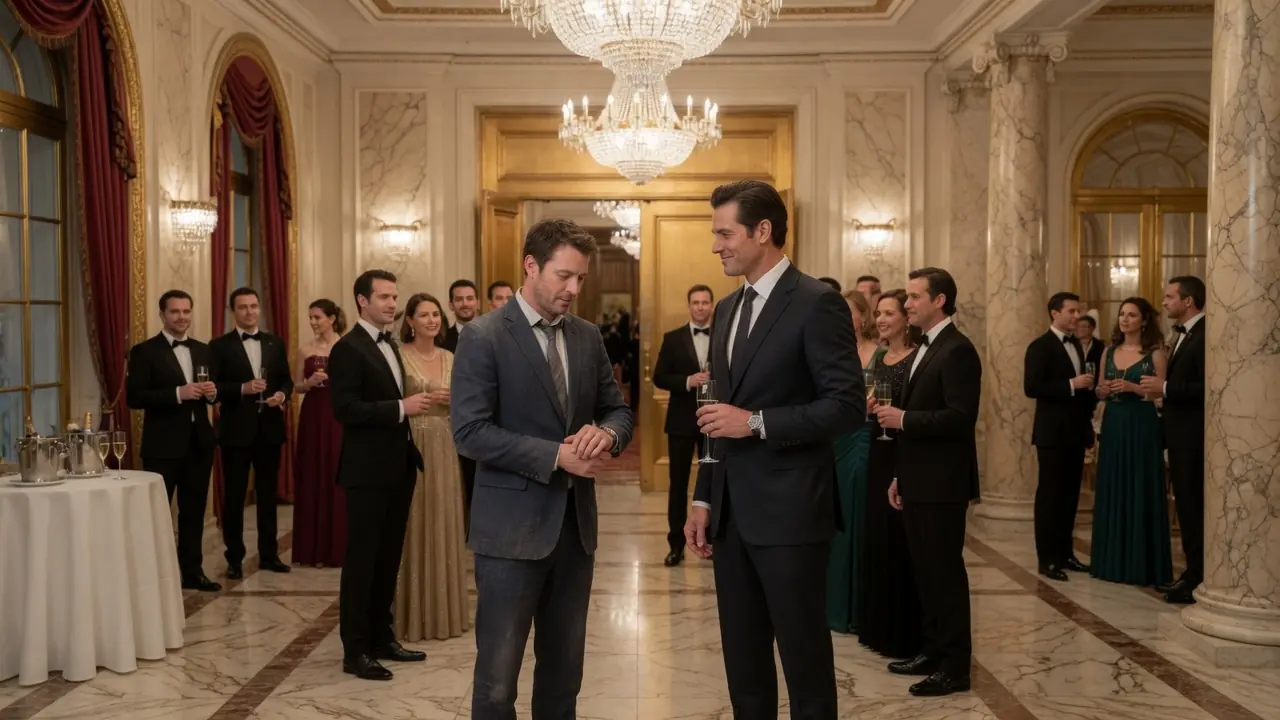
For 3 weeks, the invitation to his 15-year reunion had sat unopened on his kitchen counter. And for 3 weeks, he had told himself he would not go. Then the messages started arriving one after another from people he had not spoken to in over a decade. And something about their tone made him change his mind. The first message came from a woman named Brooke Sanders who wrote, "It has been so long.
We would love to see you again." Followed almost immediately by a message from a man named Trevor Higgins that read, "Heard you are living a pretty normal life these days. Hope you still come out." Ethan read that second message three times, feeling the quiet sting hidden inside the word normal. The way certain people could make an insult sound like a compliment, he was not going to prove anything to anyone, he told himself, because he had stopped needing anyone's approval a long time ago, somewhere between the divorce papers and the nights he spent alone in his workshop, turning steel into something useful.
But there was a part of him, small and stubborn, that wanted to walk back into that room and simply be present, unashamed, unafraid, and finally at peace with the version of himself that people had once dismissed. So he laced up his old dress shoes, straightened his tie in the mirror one final time, and walked toward the golden doors of the Ridgemont Hotel, with nothing to prove and everything to release. The moment he stepped inside, the noise of clinking glasses and easy laughter faltered. Just for a few seconds, as heads turned toward the man in the outdated suit, it was the kind of silence that spreads through a room like a held breath, the kind that says clearly without a single word being spoken, that everyone had already decided who Ethan Caldwell was and where he belonged. He felt the weight of a dozen eyes measuring him, his shoes, his watch, the absence of a woman on his arm, and he simply nodded once calmly before making his way toward the bar.
Somewhere near the center of the room, a tall man in a tailored charcoal suit turned to his companions and smiled the smile of someone who had already decided the night's entertainment had just walked in, wearing last decade's fashion. That man was Damian Cross, chairman of a real estate empire that spanned four states, and he had never once in 15 years forgotten the satisfaction of feeling superior to Ethan Caldwell. The evening unfolded exactly as Ethan expected it would. Each former classmate taking their turn to announce the shape their success had taken. A woman named Melissa Grant explained almost breathlessly that she now ran the largest law firm in the state, handling mergers worth hundreds of millions of dollars.
A man named Curtis Boonee described the hospital chain he had built from a single clinic into a regional empire employing over 3,000 people. Someone else spoke of hedge funds. Someone else of skyscrapers. Someone else of private jets that sat waiting on runways for the smallest whim. And every story circled back to the same unspoken competition, who among them had climbed the highest since graduation.
Ethan listened politely, offered congratulations where they were due, and drank his water slowly, content to remain in the background where he had always felt most comfortable. It was Damian inevitably who could not resist turning the group's attention toward the man standing quietly at the edge of the circle. Damian raised his glass toward Ethan with a theatrical flourish and asked the question everyone else had been too polite or too indifferent to ask directly. "So, Caldwell," he said, drawing out the name the way a predator draws out the approach to something wounded. "What exactly does a man like you do these days?"
Ethan only smiled, unbothered on the surface, offering no defense and no explanation, because he had learned long ago that some rooms were not worth arguing in. A woman named Paige Turner, who had barely spoken to Ethan back in school, leaned toward her husband and whispered something behind a raised hand. Though her voice carried further than she intended, and the word normal drifted across the table again like an unwelcome echo, Trevor Higgins, the same man who had messaged Ethan weeks earlier, made a show of glancing at his own watch, an expensive one, angling his wrist just enough that the metal caught the light and drew attention away from the awkward silence following Ethan's answer. Ethan noticed none of this seemed to bother him the way it might have bothered him 10 years earlier, back when he still measured his own worth against the noise other people made about theirs. He had learned slowly and painfully through divorce and long nights alone in an empty workshop, that dignity was something a person carried internally, untouched by whatever a room decided to believe about him.
Still, there was a flicker of something behind his calm expression, not shame, but a quiet weariness at how little some people had changed since the hallways of their old school, still measuring worth in watches and titles rather than character. Not content with the small victory of Ethan's simple answer, Damian pressed further, insisting with mock generosity that Ethan join him on the small stage set up near the dance floor for what he called a friendly walk down memory lane. Ethan hesitated, sensing exactly where this was headed. But he agreed rather than make a scene, following Damen up the two short steps while the crowd gathered closer. Sensing entertainment the way a crowd always senses blood in shallow water, Damen gestured toward a projector screen where old photographs began appearing. pulled from some forgotten class archive, including one particularly unflattering image of Ethan from years earlier.
Exhausted and disheveled after an overnight shift at the factory where he once worked, he reminded the room with exaggerated sympathy of the semester Ethan had briefly dropped out of his engineering program to cover his mother's medical bills, framing years of quiet sacrifice as evidence of failure rather than devotion. Laughter rippled through the crowd again. Someone lifted a phone to record the moment. And Ethan stood beneath the harsh stage lighting without flinching. His jaw tight, but his composure entirely intact, refusing to give Damian the reaction he was so clearly hunting for.
It was in the middle of that laughter. While Damian basked in the small cruelty he had orchestrated that the master of ceremonies stepped to the microphone and cleared his throat for attention. He announced with visible excitement that a very special guest would be joining the reunion that evening. Someone whose presence he promised would make this the most memorable night in the history of their graduating class. A murmur of curiosity spread through the room.
Phones lifting instinctively, conversations pausing mid-sentence as everyone tried to guess who could possibly warrant such a dramatic introduction. Damian straightened his jacket and smoothed his hair. Already certain in the deep and comfortable arrogance that had defined him since childhood, that whoever this guest was, the night belonged to men like him. Ethan simply lowered his glass and turned his eyes toward the entrance, feeling something shift in the air of the room that he could not yet explain. Outside the hotel, a line of black vehicles pulled smoothly to the curb, their engines nearly silent, their windows tinted against the evening light.
Security personnel in dark suits stepped out first, forming a brief corridor before the rear door of the center vehicle opened, and the crowd gathered near the entrance instinctively parted. The woman who emerged, moved with the unmistakable calm of someone who had long since stopped needing to prove her importance to anyone, dressed simply but impeccably. Her presence somehow filling the space before she had spoken a single word. Her name was Celeste Ashford, founder and chief executive of one of the fastest growing energy technology companies in the country. A woman whose net worth had made headlines for years and whose name commanded silence in boardrooms across three continents.
When she stepped through the golden doors of the Ridgemont Hotel, every guest in the room rose to their feet almost in unison, as though pulled upward by an invisible current of instinct and awe. Damian Cross moved faster than anyone else, cutting across the room with the eager, practiced smile of a man who had spent his entire career chasing rooms exactly like this one. He extended his hand towards Celeste before she had even fully crossed the threshold, already speaking, already positioning himself, already imagining the photograph that would appear on his social accounts within the hour. Celeste glanced at his outstretched hand for the briefest moment, offered a polite but distant nod, and then turned her attention past him entirely, scanning the room as though searching for something far more important than any handshake. Her eyes moved over the crowd of successful lawyers, doctors, and executives without pausing until finally she spoke, her voice calm, but carrying easily across the sudden hush that had fallen over the hall.
"Is Ethan Caldwell here tonight?" she asked. The question landed like a stone dropped into still water, sending ripples of confusion and disbelief through every corner of the room. For a moment, nobody moved because nobody could quite process what they had just heard. The name of the man they had spent the last hour quietly mocking, now spoken with reverence by one of the wealthiest women in the country. Damian's smile faltered just slightly as his eyes darted toward Ethan, standing near the bar, still holding his glass of water.
His expression unreadable. Celeste did not wait for anyone to answer her question aloud because she had already found him, her gaze locking onto his across the crowded room, with the certainty of someone who had been searching for this exact face for a very long time. Without another glance at Damian, without acknowledging the dozens of hands eager to shake hers, or the flashes of phone cameras already capturing the moment, she began walking directly toward Ethan Caldwell. The crowd parted before her. the way water parts before a ship, And every eye in the room followed her path with a mixture of confusion, disbelief, and dawning suspicion that something none of them understood was about to unfold. She crossed the length of the hall in a silence so complete that the click of her heels against the marble floor seemed to echo off every wall, past tables of stunned lawyers and executives who had spent the evening congratulating themselves on their achievements.
Damian stood frozen where she had left him, his outstretched hand slowly falling back to his side, his face shifting through confusion, disbelief, and something close to dread. Ethan set his glass down carefully on the bar as Celeste approached, his heart beating a little faster despite the calm expression he kept fixed on his face, though nothing in his posture betrayed the storm building quietly inside him. When she finally stopped in front of him, close enough that the rest of the room seemed to fade into a blur of watching eyes, she smiled, a genuine and warm smile that softened the sharp authority she carried like armor. "Thank you for coming tonight," she said simply, and the words, though ordinary, carried a weight that made it clear this was no chance encounter between strangers. A wave of whispers spread instantly through the crowd.
Guests leaning toward one another, trying to piece together some explanation for what they were witnessing. Some past connection they might have missed. Perhaps they had dated once, someone murmured. Perhaps he had done some work for her company. Perhaps this was simply a coincidence of two people who happened to share a hometown.
None of these guesses came close to the truth. And Celeste, sensing the swirl of speculation building around them, did not rush to correct it. Choosing instead to let the moment breathe a little longer before she revealed what she had actually come to say, she studied Ethan's face for a long moment, the years falling away between them as though no time had passed at all, since they had last stood together in a much smaller, much quieter room. Then, in a voice steady enough for the entire hall to hear, she spoke the words that would change everything anyone in that room believed they knew about Ethan Caldwell. "I owe you my entire career," she said.
And the silence that followed was so absolute that even the ice in the glasses seemed to stop moving. To understand what Celeste meant, the story had to travel backward 15 years to a time long before energy conglomerates and billion-dollar valuations back to a cramped garage on the outskirts of the city where a young woman with more ambition than money was slowly watching her dream collapse. Celeste Ashford had been 26 years old then, an engineer with a radical idea for efficient energy storage that every bank in the city had refused to fund. Every investor dismissing her prototype as impractical, unrealistic, and far too risky. She had poured every dollar of her savings into components that sat half assembled on a workbench.
A system riddled with flaws she could not solve alone. No matter how many nights she stayed awake trying, rejection had become a familiar rhythm in her life by then. A closed door followed by another closed door until she had nearly convinced herself that the idea and perhaps she herself simply was not good enough. It was during those darkest months that she met a quiet mechanical engineer working nights at a manufacturing plant. A man named Ethan Caldwell who happened to see her failing prototype and recognized something in it that no investor ever had.
Ethan had not been looking for a project or a cause when he first examined Celeste's designs. Spread haphazardly across a folding table in that cramped garage, illuminated by a single bare bulb hanging from the ceiling, he noticed immediately what the investors had missed. A flaw in the mechanical framework rather than the underlying concept, a problem of engineering rather than imagination, something that could actually be fixed with patience and skill. Over the following months, he spent countless evenings after his own shifts ended, driving straight to that garage, sleeves rolled up, hands stained with grease, quietly reworking every mechanical component of her failing system without asking for a single dollar in return. Celeste offered to pay him more times than she could count.
And every time he refused, telling her simply that money was not why he was there, that he believed in what she was building, and wanted nothing more than to see it succeed. When she pressed him one final time, demanding to know what she could possibly give him in exchange for months of unpaid labor, he gave her an answer she never forgot, telling her only, "If you succeed, help someone else the way I helped you." There was one night, Celeste remembered clearly, when a storm knocked out power across half the city, and the garage sat freezing and dark. And instead of leaving, Ethan simply pulled a flashlight from his truck and kept working by its narrow beam until the connections finally held. She had asked him then why he bothered staying in weather like that for a stranger's project for no pay and no promise of anything in return, and he had shrugged and said only that quitting felt worse than being cold.
That answer stayed with her longer than almost anything else from those months. A small sentence that somehow contained an entire philosophy of persistence she would later try imperfectly to build into the culture of her own growing company. There were other nights too, quieter ones, when the two of them sat on overturned crates, sharing coffee from a dented thermos, talking not about circuits or investors, but about ordinary things, families, small disappointments, the strange loneliness of building something nobody else yet believed in. Celeste never forgot the particular way Ethan listened during those conversations. Fully present, unhurried, as though her half-formed dream deserved the same careful attention he gave to the wiring beneath his hands.
Not long after the system finally worked, running clean and efficient for the first time in 18 months of failed attempts, Life pulled the two of them in different directions, the way it often does to people who cross paths at exactly the right moment for exactly the wrong length of time. Ethan's marriage was unraveling around him during those same months, consuming every spare hour he had once spent in that garage, and Celeste's business began accelerating rapidly once a small investment firm finally took a chance on her corrected design. Phone numbers changed, addresses changed, and somewhere in the chaos of both their lives being rebuilt from entirely different foundations, they simply lost touch with one another. The way countless meaningful connections quietly dissolve under the weight of ordinary life. Celeste never forgot him.
Not for a single year, carrying the memory of that generous stranger through every meeting, every product launch, and every milestone her company achieved on the back of the system he had helped her fix. Ethan, for his part, rarely spoke of that chapter of his life to anyone, not even to his closest friends, because to him it had simply been the right thing to do. Not a story worth telling. Standing in the ballroom 15 years later, Celeste reached into the small bag she carried and withdrew a worn leather notebook, its cover cracked with age, its pages yellowed and soft from years of careful handling. She held it up for the crowd to see, and even from a distance, the handwriting scrolled across its pages was unmistakably technical, dense with diagrams, equations, and small handwritten notes crammed into every margin.
"This belonged to Ethan," she announced, her voice carrying clearly across the silent hall, explaining that every page contained the original mechanical corrections that had transformed her failing prototype into the foundation of the company she now led. "The very technology powering millions of homes today," she said, "began in a garage with no heating, on a night when this man refused to let me give up on myself." Damian Cross stood frozen near the edge of the crowd, his face draining of color as the full weight of what he had mocked earlier that evening began to settle over him like a slow, suffocating fog. Around the room, the same classmates who had laughed at Ethan's simple description of running a machine shop, now stared at him with an entirely different expression, one that mixed disbelief with something close to shame. Melissa Grant, who had spoken so proudly of her law firm's billion-dollar mergers, found herself unable to look away from the notebook in Celeste's hands, recalculating everything she thought she understood about the quiet man from the bar.
Curtis Boone lowered his glass slowly, his earlier confidence replaced by a creeping awareness that whatever he had built, it had never once required him to save someone else's entire future for nothing in return. The whispers that filled the room now carried a different tone than before, no longer mocking, no longer dismissive, but hushed with the particular awe reserved for stories too remarkable to have been anticipated. Celeste allowed the silence to stretch a moment longer before continuing because what she had revealed so far, as extraordinary as it was, remained only half of the truth she had come there to share. "There is something else," Celeste said, turning the notebook over in her hands before setting it gently on the nearby table. Something that even Ethan himself may not fully understand yet.
On the day her company completed its initial public offering, years after that garage had become nothing more than a memory, she had made a decision that she never publicly disclosed to shareholders, journalists, or even her own closest advisers. She had set aside a private allocation of company shares under Ethan's name. A promise fulfilled quietly and without ceremony, honoring the debt she felt she could never fully repay through words alone. He never knew, she admitted because she had never told him, choosing instead to let the shares accumulate silently over the years. Waiting for a moment she somehow always believed would eventually arrive.
That moment, she said, looking directly at Ethan now, had finally come, standing here tonight in front of everyone who had once looked at him and seen nothing worth noticing. The number she spoke next landed on the room like a physical blow. The current value of those shares now exceeded several billion dollars. A fortune quietly waiting for a man who had spent the last decade running a small machine shop and raising his son alone. Gasps rippled through the crowd.
Phones lowered in stunned disbelief. And somewhere near the back, a glass slipped from someone's fingers and shattered unnoticed against the marble floor. Damian Cross reached for the back of a nearby chair, his legs suddenly unsteady beneath him. The arrogance that had defined his every word that evening, collapsing under the sheer impossibility of what he was hearing. He had spent 15 years believing himself the most successful man in that room, and in the span of a single announcement, he understood with brutal clarity exactly how small his measure of success truly was.
Ethan, for his part, said nothing at first, his eyes fixed on Celeste, on the notebook resting on the table between them. On the weight of a truth he had never expected to carry into a hotel ballroom on an ordinary Saturday evening When Ethan finally spoke, his voice was quiet but steady, carrying easily through a room that had gone completely still in anticipation of his response. "I did not come here for this," he said simply. And there was no bitterness in his tone, no false modesty either, only the plain honesty of a man who had genuinely never expected repayment for kindness offered freely. He told Celeste and the room listening around them that he would accept what she had set aside, not out of greed, but because refusing it now would dishonor the years of effort she had poured into keeping that promise alive.
But he would not keep it for himself. He continued, explaining that he intended to use the majority of it to establish a foundation, one designed to support young engineers, small manufacturing businesses, and working people with ideas nobody else believed in yet. Celeste's expression shifted as she listened. Something like recognition passing across her face because this exactly this was the same man she had met in that cold garage 15 years earlier. Unchanged by 15 years and unmoved by the promise of sudden fortune, the room seemed to exhale collectively.
A wave of emotion moving through guests who moments earlier had been trading stories of luxury cars and corner offices, now confronted with a definition of success they had never considered. Melissa Grant wiped quietly at the corner of her eye, and Curtis Boone found himself nodding slowly, as though something long buried inside him had just been gently unearthed and examined in new light. It was Damian Cross, of all people, who finally broke the silence, stepping forward from the edge of the crowd with none of the swagger he had carried into the evening, his voice noticeably unsteady as he began to speak. He admitted in front of every classmate who had ever admired him that he had spent 15 years measuring success only in dollars, square footage, and the envy of people around him. Standing there now, he confessed he understood for the first time that Ethan Caldwell, the man he had mocked without hesitation just hours earlier, possessed something far more valuable than anything listed on a balance sheet.
A character that could not be bought, borrowed, or faked. The apology Damian offered was not eloquent, and it did not need to be, because the sincerity in his broken voice carried more weight than any polished speech he had ever delivered in a boardroom. He turned to Ethan directly, extending his hand, not for a photograph this time, not for status, but simply in recognition of a mistake he wished he had caught 15 years sooner. Ethan accepted the handshake without hesitation, without lingering resentment, because he had learned long ago that holding on to old grudges cost more than it ever returned. Around them, the room began to rise, one guest at a time, until every person in that grand ballroom stood on their feet.
Applauding not for wealth or title, but for something far rarer and far harder to earn, the master of ceremonies, visibly moved, stepped back toward the microphone and announced that the evening's final award would be presented not according to the original program, but according to what everyone in that room had just witnessed with their own eyes. He explained that the reunion committee had originally planned to honor the most financially successful graduate of their class, a title many had assumed, quietly or openly, would belong to someone like Damian Cross. But the events of the evening had made it impossible to proceed with that plan in good conscience. And so the committee had unanimously agreed, in the span of a few whispered minutes, to change the honor entirely. The new award, he announced, would go to the graduate who had created the most lasting value for others without ever asking for recognition, without ever expecting to be repaid.
He called Ethan Caldwell's name, and the applause that followed was louder and more sustained than anything the room had produced all evening, a standing ovation that seemed to shake the very chandeliers overhead. Celeste stepped forward as Ethan rose from his seat, meeting him at the front of the room, and together they stood before a crowd that had arrived that evening, believing they already understood exactly who mattered and who did not. Celeste took the microphone briefly, her eyes scanning the room one final time before she spoke the words that would close the evening. "There are people who change the world," she said, "and never once need to stand beneath a spotlight to do it. Ethan Caldwell is one of them."
She reminded the room that true wealth was never measured by the number of zeros in a bank account, but by the number of lives quietly made better by a person's presence, patience, and generosity. She extended an invitation to Ethan, then in front of everyone, asking him to join her, not simply as a shareholder, but as an active partner in leading the innovation fund the newly allocated shares would help create. Ethan looked out at the room, at the faces that had laughed at him just hours earlier, now watching him with something closer to admiration. And he accepted. Not because his life required the validation, but because the work itself mattered, as the applause finally settled, and the evening drew toward its close, small groups of former classmates lingered near Ethan, offering quiet apologies, genuine curiosity, and in some cases, simple gratitude for the reminder his story had given them.
Damian Cross stayed longer than anyone expected, speaking with Ethan in a corner of the room for nearly 20 minutes. A conversation neither man chose to make public, but one that visibly softened something between them by the time it ended. Celeste watched from a short distance, a quiet satisfaction settling over her, because the debt she had carried for 15 years had finally in its own way been honored in front of the very people who once doubted the man who paid it. Outside, the black vehicles waited patiently at the curb, but Celeste chose to walk to hers slowly, matching pace with Ethan, continuing the conversation that had been interrupted 15 years earlier by nothing more than the ordinary chaos of two separate lives. Before they parted for the evening, she turned to him one final time and told him plainly that some of the most powerful people in the world were never the ones standing under the brightest lights, but the ones quietly building the foundation. everyone else eventually stood upon.
Ethan drove home that night in the same dusty pickup truck he had arrived in, past the same dark roads, toward the same quiet house that had been his for years. And yet nothing about the drive felt the same as it had that morning. He thought about his son, about the machine shop waiting for him on Monday, about the notebook Celeste had carried for 15 years without ever once telling him it still existed. He thought too about the foundation he had promised to build, about the young engineers and small business owners who might someday sit in a garage of their own. Convinced no one believed in them the way Celeste once had, he understood, driving home beneath a sky full of quiet stars, that his life had not changed because a fortune had suddenly appeared in his name, but because the truth of who he had always been, was finally allowed to stand in the light.
And somewhere behind him, in a ballroom slowly emptying of its guests, the story of that evening had already begun to spread, carried forward by people who would never again mistake quiet humility for a lack of greatness. In the weeks that followed, word of what had happened at the reunion moved quickly through the small city where Ethan had spent his entire life, though he himself never spoke of it publicly. Never gave an interview, never allowed a single photograph to circulate beyond what guests had already captured on their own. His machine shop remained open every weekday morning at the same early hour it always had. The same handful of employees clocking in beside him.
The same steady hum of machinery filling the space that had always felt more like home to him than any boardroom ever could. Celeste visited the shop herself only once in those early weeks. Arriving without an entourage, without cameras, dressed simply enough that none of Ethan's employees recognized her until she introduced herself. She walked slowly through the workshop, running her fingers along a workbench not unlike the one from that garage 15 years earlier, and told Ethan quietly that this, more than any office tower she had ever built, felt like the truest beginning of everything she had accomplished. Together, over the following months, they built the framework for the foundation Ethan had promised that night, structuring it not as a charity handing out funds, but as a partnership, offering mentorship, workshop space, and patient investment to people, the traditional financial world had already dismissed.
They named it deliberately after nothing grand, choosing instead a simple phrase that had once been spoken in a cold garage on a night neither of them had ever forgotten. "If you succeed, help someone else." The first recipients of their support were not chosen for flash or spectacle, but for the same quiet persistence Ethan himself had once recognized in Celeste, engineers and small manufacturers whose ideas needed only patience and correction rather than reinvention. Damian Cross, in a decision that surprised almost everyone who knew him, quietly contributed funding of his own to the foundation, asking for no recognition, no plaque, no mention of his name attached to the gift. When Ethan asked him why, Damian answered simply that he had spent 15 years building things that made him comfortable.
And for the first time in his life, he wanted to help build something that actually mattered. The story of that reunion evening never became the kind of headline that dominated the front pages of national newspapers because Ethan made certain of that, insisting on privacy, even as Celeste's public profile made complete secrecy impossible to maintain. But among those who had been in that ballroom, the memory remained vivid and unshaken. A permanent correction to whatever assumptions they had once carried about who deserved admiration and who did not. Melissa Grant later admitted to a close friend that she thought of Ethan every time a young associate at her firm hesitated to speak up in a meeting, remembering how easily brilliance could hide behind quiet uncertainty.
Curtis Boonee, in a small and private gesture, began offering free medical consultations one evening a week to families who could not otherwise afford them. A decision he traced directly back to a single sentence spoken in a hotel ballroom about lives quietly changed. Even the master of ceremonies, a man who had hosted dozens of similar events before and since, later called that particular reunion the only one he had ever attended that actually changed the way he measured a person's worth. Ethan's son, now old enough to understand more of the world around him, asked his father once why he had never mentioned any of it before that night. Why 15 years of quiet generosity had remained locked inside a leather notebook and an even quieter memory.
Ethan considered the question carefully before answering, telling his son that some things are worth doing simply because they are right, not because anyone will ever know they happened. He explained that the value of a kindness does not depend on whether it is later rewarded or discovered or celebrated in a crowded room full of people who once misunderstood you completely. What mattered, he said, was the choice made in that cold garage 15 years earlier, long before any reward could have been imagined when a tired engineer chose to stay a little longer and fix what someone else had already given up on. His son listened closely, and something in the way he nodded suggested the lesson had settled somewhere deeper than mere memory into the quiet architecture of the person he would eventually become. Celeste, for her part, continued building her company with the same relentless drive that had carried her from a failing garage prototype to one of the most influential energy technology firms in the country.
But something about her had visibly softened since that reunion night. She spoke more openly in interviews about the early struggles of her career. No longer hiding the desperation of those first 18 months, no longer allowing the world to believe her success had arrived fully formed and inevitable. She credited Ethan by name whenever the opportunity arose, insisting that history remember the truth of how her company had actually begun, refusing to let quiet generosity be erased simply because it made for a less impressive origin story. Investors and journalists alike found themselves drawn not just to her financial success, but to the story of the debt she had carried and finally repaid.
A narrative that reshaped how the public understood the foundations of enormous fortunes. In boardrooms across the country. Her insistence on crediting the people who helped her rise became something of a quiet standard, a reminder that behind every celebrated success story countless unnamed hands that had once reached out without expecting anything in return. Years from that reunion evening, long after the initial shock of the night had faded into a story people told at dinner parties and family gatherings, the foundation Ethan and Celeste built together had grown into something neither of them could have fully anticipated in that ballroom. Dozens of small engineering firms had launched with its support.
Each one carrying forward the same principle etched into that worn leather notebook that ideas deserved patience before judgment and that talent often hid itself in the quietest, least impressive places. Ethan never stopped running his machine shop, choosing to divide his time between the workbench he loved and the foundation's growing responsibilities, refusing to let either commitment replace the other entirely. Celeste often said in the rare interviews where she allowed herself to speak personally rather than professionally, that meeting Ethan twice in one lifetime, once in desperation and once in celebration, had taught her more about the true nature of success than any business school ever could. And somewhere in that lesson, carried quietly from a cold garage to a golden ballroom, and finally into a foundation that would outlast them both, lived the simple truth that the world rarely measures greatness correctly the first time it looks. Not every change that followed the reunion was public or dramatic, and some of the most meaningful ones unfolded quietly in small rooms far from any spotlight.
In the months and years that came after, a young engineer named Nathan Pierce, barely 23 and drowning in rejected loan applications for a water filtration device he had spent 2 years designing, became one of the foundation's first supported ventures. And years later, he would say that the patience shown to him in that first meeting felt like being handed a second chance he did not know he was allowed to ask for. A woman named Grace Whitfield, running a struggling family-owned tooling company out of a converted barn, received not just funding, but months of hands-on mechanical guidance from Ethan himself. guidance that saved 40 jobs in a town that had been quietly bleeding manufacturing work for a decade. Neither of these stories made headlines, and neither Ethan nor Celeste ever intended them to, because the entire foundation had been built on the belief that the most important work rarely announces itself loudly. It simply continued, "One workbench and one overlooked idea at a time, carrying forward the same quiet promise first spoken in a cold garage, that success, once achieved, is meant to be passed forward rather than hoarded."
The final image many who attended that reunion carried with them afterward was not the shock of Celeste's arrival, nor the staggering number attached to those long-held shares, but a much smaller and quieter moment that unfolded near the end of the evening as the crowd slowly dispersed and the chandeliers dimmed toward closing hour. Ethan stood near the entrance of the hotel with Celeste beside him. Both of them watching the last guests filter out into the cool night air. Damian Cross passed them on his way out, pausing just long enough to shake Ethan's hand one final time, a gesture that carried none of the performance it might have held earlier that evening.
Ethan thanked him simply, without irony, without triumph, because whatever satisfaction the night might have offered him, he had never come there seeking it in the first place. And as the doors of the Ridgemont Hotel finally closed behind the last departing guest, the story that would be told and retold for years afterward was not one of revenge or vindication, but of a truth quietly waiting 15 years for the right room and the right moment to finally be spoken aloud.