“I know where you are.”
Three words. That was all Preston Vale needed to send at 2:47 in the morning to remind Tessa Roland that she had never truly escaped him.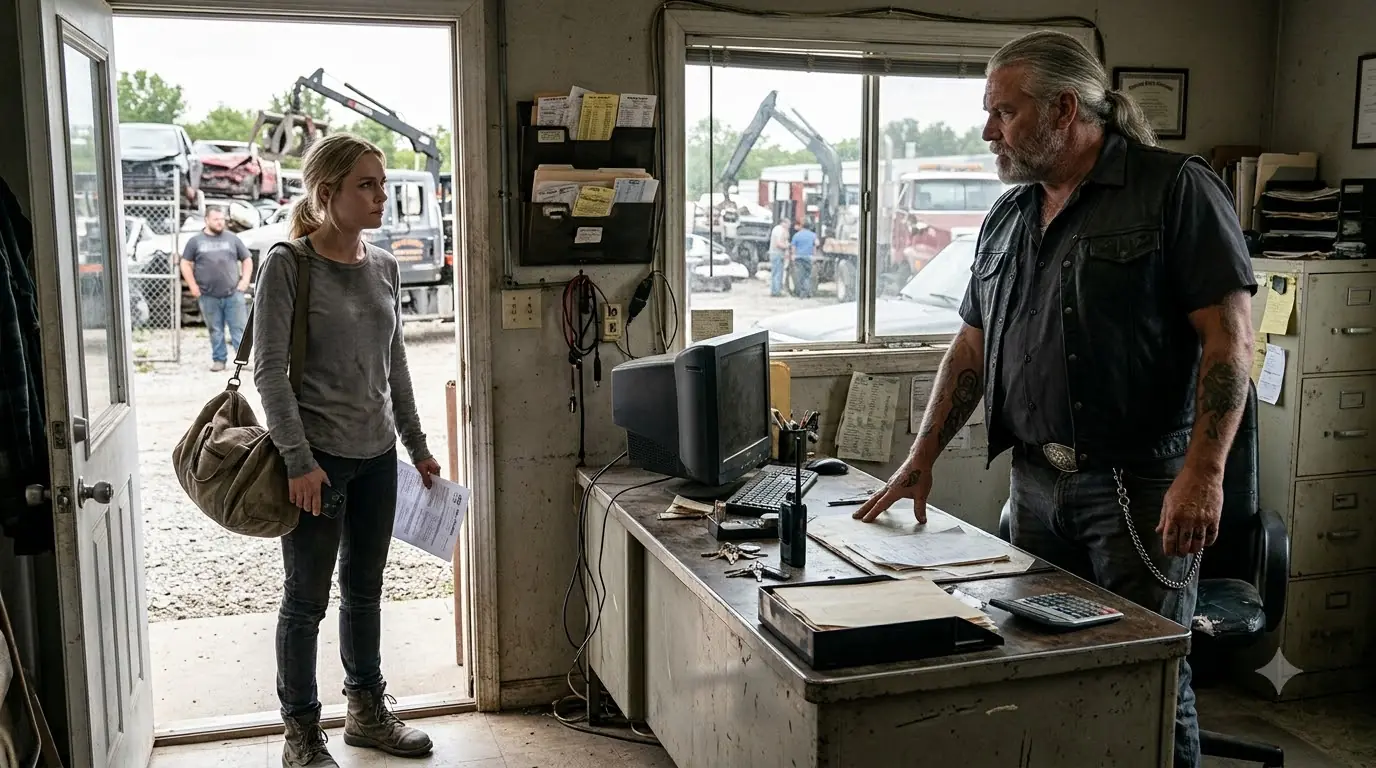
She stared at those words until her screen went dark, then looked down at the $38.16 in her palm, every cent she had left in the world, and made the only decision a woman with nothing left to lose could make. She walked toward the one place everyone else had already turned down.
The sign above the gate had been repainted at least three times, and you could still read the ghost of older letters bleeding through the newest coat of black, like the yard itself refused to let anything stay buried completely. Iron Meridian Auto Salvage sat on 12 acres of flattened earth at the eastern edge of Callaway County, and the first thing every person noticed when they pulled up to its chain-link entrance was not the towers of crushed vehicles stacked four high along the southern fence, nor the oil-dark stains spread across the gravel like old bruises, nor the sound, that constant industrial grinding of hydraulic equipment chewing through metal somewhere deep in the property.
The first thing every person noticed was the quiet. Not the absence of sound, but the presence of silence underneath the noise. A deliberate, organized quiet that said, “We see you. We already know why you’re here. Whether you stay depends on reasons we haven’t told you yet.”
Tessa Roland noticed it the moment she stepped out of the rideshare that had cost her $11.40, reducing her life savings to that precise $38.16 she had already counted twice during the ride. She stood at the entrance for exactly four seconds before making herself walk forward because she had learned a long time ago that hesitation at the threshold of something frightening never made the frightening thing smaller. It only made you smaller.
She was 28 years old. She had a cracked phone screen, the kind where the fracture ran diagonally across the glass like a fault line waiting for the final earthquake. She had a single duffel bag over her left shoulder, clothes chosen for practicality rather than warmth, and a face that most people in better circumstances would describe as pretty in a tired way.
Blond hair pulled back not for style, but because she hadn’t had time to think about style in longer than she could clearly remember. Blue eyes that had learned to go flat and neutral in the presence of strangers, a skill developed not out of coldness, but out of necessity, the way certain animals learn to be still.
The job listing had been the last result on the third page of a search she’d run at the public library while her phone charged at the outlet near the periodical shelf.
Administrative Assistant, Scrapyard Operations.
Filing, data entry, scale office support.
No experience required. Immediate start.
Below that, in small gray text that most applicants probably scrolled past without reading: Iron Meridian Auto Salvage. Callaway County Road 7.
She had looked up Iron Meridian before she left the library. The search results had been informative in a specific way. Mostly old county permit filings, one business registry entry, and two forum threads she’d found through a secondary search that referenced the yard in ways that suggested it was not, strictly speaking, a place where people without connections went looking for work.
One thread had said, “Don’t bother. Place is run by people who don’t want outsiders.”
Another had said simply, “H.A. yard. Stay away if you don’t know what that means.”
Tessa knew what it meant. She had applied anyway because $38.16 and a message from Preston Vale that said, “I know where you are,” did not leave a person with the luxury of staying away from things that frightened them.
The man at the gate did not introduce himself. He was heavyset, mid-40s, with a weathered face and the particular posture of someone who had spent a long time outdoors doing physical work and had stopped noticing the weather.
He looked at the printed application she held out, looked at her face, looked back at the application.
“You’re the office girl,” he said.
Not meanly. Just flat.
“I applied for the administrative position,” Tessa said.
“Same thing.”
He picked up a radio from the hook on the gate post and said something into it she couldn’t fully make out. The squelch was too loud and the transmission too brief. He listened to whatever came back, put the radio down, and said, “Rafe says bring her through.”
“Thank you,” she said.
He looked at her like gratitude was a foreign language he recognized but didn’t speak. Then he opened the gate.
The walk from the main gate to the scale office took about three minutes at a normal pace. Tessa made it last longer, not because she was hesitating, but because she was reading.
That was the thing about her that most people didn’t catch immediately. She was always reading. Not books. Environments.
The way a space was organized told you almost everything about the people who ran it if you knew how to look. What she read at Iron Meridian surprised her.
The yard was chaotic on the surface. Vehicles in various states of disassembly, parts organized in systems that looked random until you noticed the tags, the color-coded rope markers, the numbered positions staked into the gravel at intervals she estimated at roughly 12 feet. The noise was constant but directional.
Every piece of equipment she could hear was positioned in a logical relationship to the others. People moved with purpose. Nobody stood around talking.
It was not the chaos she had expected. It was organized aggression, a place that looked dangerous to people who didn’t understand it and revealed its logic only to people willing to pay close attention.
She was paying very close attention.
The scale office was a prefab building set on a concrete pad near the center of the property, its exterior beaten by weather to a color somewhere between gray and brown that she suspected had once been white. The door was open.
Before she reached it, a voice came through that stopped her mid-step.
“You’re late.”
She checked her phone. She was nine minutes early.
“I don’t think I am.”
“Keep going,” he said.
The man who appeared in the doorway was not what she had been mentally preparing for during the walk. She wasn’t sure exactly what she had been preparing for. Something louder, maybe. Something that performed his authority more visibly.
Rafe Calder was 58 years old, built like someone who had been strong once and had kept the architecture of that strength even as time rearranged the surface details. His hair was gray, pulled back. His beard was trimmed close.
His arms, crossed over his chest in the doorway, were covered from wrist to sleeve edge in tattoos. Not the kind people got to be decorative, the kind people got because each one marked something they needed to carry on the outside of their skin.
He wore a sleeveless black leather vest with the patch on the back that she had seen in her research and had made herself look at directly rather than look away from. He looked at her the same way the gate man had, flat and assessing, not hostile but not warm.
“Scale office,” he said, stepping back from the door to let her in. “Filing cabinet on the left hasn’t been touched properly in eight months. Scrap tickets are in the boxes on the right. You do data entry?”
“Yes.”
“You know Excel?”
“Yes.”
“What else?”
“Accounts receivable, records management, document compliance, basic bookkeeping.”
She paused.
“I learn fast.”
Something shifted in his expression. Not much, barely at all, but she caught it, a fractional recalibration, the way a face moved when the information it received didn’t match the information it expected.
“Why do you want this job?” he said.
It was the question she had prepared for and then released because there was no good answer that was also a true answer, and she had decided somewhere between the library and the gate that she wasn’t going to lie to this man if she could avoid it.
Not because she was certain he deserved the truth, but because she was tired. Lying took energy she didn’t have.
“Because I need work,” she said, “and because I’m good at it, and because no one else applied.”
Rafe Calder looked at her for a long moment. Then he uncrossed his arms and moved toward the desk at the far wall.
“We’ll start with the filing cabinet,” he said. “Don’t touch anything on the desk. Don’t go into the back section of the yard without telling someone. Don’t ask questions about things that aren’t your business, and you’ll know which things those are because they have nothing to do with filing or data entry.”
He sat down.
“You have questions?”
“One,” she said.
“Go ahead.”
“What happened to the person who had this job before me?”
He looked at her again. That same recalibration, faster this time, and she had the sudden impression that Rafe Calder was not a man who was often surprised, and that the fact that she had surprised him twice in the span of three minutes was something he had noted and filed away for later consideration.
“She quit,” he said. “The work wasn’t what she expected.”
“What did she expect?”
“Something simpler.”
He turned back to whatever he had been doing before she arrived.
“Go ahead and start.”
She started.
The filing cabinet was worse than eight months of neglect. It was more accurately described as eight months of strategic avoidance, papers jammed into folders in the wrong order, folders filed in categories that bore no relationship to their contents. The entire drawer system was organized according to a logic that appeared to have been invented by someone who understood neither filing nor logic, but was committed to the performance of both.
Tessa pulled the first drawer open, looked at it for about 30 seconds without touching anything, and then began to understand it. Not the chaos, the system underneath the chaos.
Because there was one buried there, inconsistent, half-collapsed, but present. Someone had started with a real organizational structure and then slowly abandoned it over time, probably as the volume of paperwork increased and the person responsible for maintaining it became overwhelmed.
She could see the point of collapse in the drawer, a specific date range about 14 months back where the organization stopped being intentional and started being reactive. She didn’t say any of this out loud. She just started working.
The rule she had developed over years of office work, years that Preston had alternately supported and undermined depending on how useful her competence was to his image at any given moment, was that you never announced what you were doing before you did it. You just did it.
Announcements invited interference. Results invited acknowledgment, and acknowledgment, when it finally came, was harder to take back than a promise.
She worked for two hours before anyone spoke to her again.
The man who came in for the scale ticket she had been expecting, based on the pattern she’d noticed in the morning log, was shorter than Rafe, broader in the shoulders, with a name tag on his vest that said DUTCH in block letters that looked hand-stamped.
He looked at her, looked at the filing cabinet, looked at the partially organized stack of scrap tickets on the table beside her, and said, “You actually doing that?”
“Yes,” she said.
“Huh.”
He handed her the ticket.
“Log it under incoming ferrous. Separate column from the non-ferrous.”
“I already found the column structure,” she said. “I reorganized the spreadsheet this morning.”
Dutch looked at the monitor, looked at her, then back at the monitor.
“Rafe know you did that?”
“He said I could use the computer for data entry,” she said. “The original spreadsheet was formatted in a way that created duplicates in the reporting. I corrected the structure. I didn’t delete anything. I archived the original version with a timestamp.”
Dutch was quiet for a moment.
Then he said, “How long you’ve been here?”
“Two hours and 14 minutes.”
He left without saying anything else. But she noticed, and she noticed everything, that he didn’t seem unhappy.
He seemed, in the way the men at Iron Meridian seemed to communicate things sideways rather than directly, impressed.
She filed the ticket and went back to the cabinet.
By noon she had processed 47 scrap tickets, reorganized the first two drawers of the filing cabinet, created a dated archive of the original spreadsheet structure, begun a separate log of what she was privately categorizing as discrepancy files, papers that didn’t match records, that contradicted each other, documentation that appeared to have been filled out after the fact rather than in real time, and eaten the peanut butter sandwich she’d packed from the motel room she was paying for by the day at $29 a night.
That meant she had nine more nights of shelter before her money ran out entirely.
She ate at the desk because she didn’t know where people went for lunch and she hadn’t asked.
Rafe came in at 12:43. He stood in the doorway for a moment looking at the cabinet drawers, now visibly structurally different from that morning, and then looked at the desk where she sat.
“You eat,” he said.
“Yes.”
“Where?”
“Here.”
Something crossed his face. She couldn’t read it completely. It wasn’t pity. She would have recognized pity and flinched from it, but it was adjacent to something human.
“There’s a break room behind the main garage,” he said. “It’s not much, but people eat there.”
“Thank you,” she said. “I’ll remember that.”
He moved toward the filing cabinet and opened the second drawer, looked through it for a moment.
“This is different,” he said.
“Yes. I reorganized the category structure to match the digital log. The original physical system and the digital system weren’t synchronized. Records were being filed twice under different names and missed in search.”
“How’d you know what the digital system used?”
“I looked at the spreadsheet first thing this morning and reverse-engineered the category logic from the existing entries. Then I matched the physical folders to it.”
Rafe closed the drawer.
“How many of these did you find?” he said.
He meant the discrepancy files.
She wasn’t sure how he knew about them. She hadn’t told anyone. But she had the feeling Rafe Calder knew about most things that happened in his yard without being told.
“Fourteen so far,” she said. “I haven’t finished the first two drawers.”
“Show me.”
She showed him.
She had created a separate manila folder labeled REVIEW in pencil. Deliberately pencil, not pen, because pencil meant provisional, meant subject to correction, meant I found something, but I’m not making accusations.
Inside it, she had arranged the discrepancies in chronological order with a brief handwritten note on each one explaining the specific nature of the mismatch.
Rafe read through three of them without expression.
Then he said, “Don’t tell anyone else about these.”
“I wasn’t going to,” she said.
He looked at her directly, the kind of look that tried to assess whether a person meant what they said.
“All right,” he said finally, and left.
The afternoon passed in a rhythm she found genuinely calming, not because the work was easy, but because it was real. Every ticket she processed, every discrepancy she noted, every file she reorganized was a small act of order imposed on chaos.
And order was the thing she had been most starved of in the years with Preston. Not safety exactly, though she had been starved of that too.
Order. The ability to make something correct and have it stay correct without someone coming along behind you to uncorrect it for reasons of control.
At 3:15 her phone buzzed. She had set the notification to silent, but she felt it against her thigh through her jeans pocket. A long buzz, the pattern she had assigned to his number.
She had not been able to bring herself to delete the contact because deleting it felt like pretending he didn’t exist, and she couldn’t afford to pretend he didn’t exist.
She did not look at the phone. She kept working for 30 seconds.
Then she took it out, turned away from the door, and read the message.
I filed the paperwork. You know which paperwork. The kind that has your name on it and a judge’s signature.
Come home, Tessa. This is getting embarrassing.
She read it twice. Then she put the phone away, took a breath that she made deliberately slow, in for four, hold for four, out for four, the breathing exercise the counselor had taught her in the two sessions she’d managed before Preston found out about them and the sessions had ended, and went back to the filing cabinet.
She was on the third drawer when she heard two men talking in the yard outside the open window. She wasn’t eavesdropping. She simply had good hearing, and the window was open.
“Don’t know where Rafe found her,” one voice said.
“He didn’t,” said the other voice, Dutch, she thought. “She found us.”
“You think she’ll last?”
A pause.
“She reorganized two drawers in four hours,” Dutch said, “and she made the spreadsheet actually work. Vic’s been fighting that thing for a year.”
“That’s not what I asked.”
Another pause. Longer.
“I don’t know,” Dutch said. “She’s got something on her. You can tell, but she doesn’t shake.”
“That’s either brave or stupid.”
“Around here,” Dutch said, “it’s usually both.”
She lasted the rest of the day.
At 5:30 the gate man she had met that morning, whose name she now knew from the sign-in sheet was Garrett, came to the scale office and told her the yard was closing and she could sign out at the front office.
She signed out. She picked up her duffel bag from the locker Rafe had wordlessly pointed her toward at 8:15 that morning without explaining what it was for, a gesture she had interpreted correctly as an indication that she had somewhere to put her things, which meant she was expected to stay the day.
She was almost to the gate when she heard Rafe’s voice behind her.
“Tessa.”
She stopped and turned.
He was standing 10 feet behind her, and for a moment the evening light turned everything between them into the kind of scene that looked significant from a distance, two people stopped in a space that required something to be said.
“You find more discrepancies in that third drawer?” he said.
“Six more,” she said. “I noted them in the folder.”
He nodded, looked at her for a moment, that same assessing look, but something had shifted in it since that morning. Less testing. More deliberate.
“It’s a long walk to the county road,” he said.
“I know.”
“Garrett can take you to the transit stop.”
“That’s not necessary.”
“I didn’t say it was necessary,” he said. “I said Garrett can take you.”
She understood this for what it was, not an offer and not a question. An arrangement.
“Thank you,” she said.
“Tomorrow,” Rafe said, “finish the filing cabinet, then start on the tow records.”
She started to turn away.
“Tessa.”
She turned back.
“That review folder,” he said. “Keep building it quietly.”
She held his gaze for a moment.
“What am I building it toward?”
He looked at her with something that was not quite a warning and not quite a confidence, something in between.
“Something’s coming,” he said. “Has been for a while. We’ll need to be ready.”
She waited to see if he would say more. He didn’t.
“Okay,” she said, and meant it.
That night, back in the motel room with the door chain latched and a chair wedged under the handle, an old habit, the kind you don’t unlearn even when the immediate danger is in another county, she sat on the edge of the bed and went through what she had found.
Not to review it. She had a good memory. She didn’t need to review it.
She went through it because going through it was the only way she knew to test whether what she thought she was seeing was real or whether exhaustion and fear were bending her perception the way they sometimes did.
The discrepancies in the filing cabinet were real. She was certain of that.
She had found 20 by the end of the day. Twenty documents that didn’t match records, that contradicted each other, dates that didn’t align with the physical evidence logged in the same file.
Most of them were small, the kind of small that looked accidental. The kind of small that added up over time to something that was absolutely not accidental.
She had also found something else that she hadn’t told Rafe about yet because she wasn’t sure what it meant and she needed to be sure before she said anything.
In the third drawer, in a folder labeled MSK Vendor Correspondence that was mostly junk solicitation letters, expired contracts, and some handwritten notes from vendors she didn’t recognize, there was a photocopy of a county inspection report.
Standard form. Dated eight months ago. Signed by an inspector whose name she had read twice to make sure she’d read it correctly.
The report had passed Iron Meridian on all counts, which was normal.
What was not normal was the fact that there were three different versions of the same report in three different files, each one slightly different from the others in ways that suggested they had not been copied from the same original.
Which meant someone had created at least two duplicate versions of an official county inspection form.
Which meant someone somewhere was preparing for a moment when the original form would be challenged.
She set her phone face down on the nightstand. Preston’s message was still there.
I filed the paperwork. You know which paperwork.
She did know. She had been waiting for it.
He had threatened it for six months, the motion to have their separation contested on grounds he had constructed carefully, the kind of legal architecture that cost money to build and money to fight, money she didn’t have.
He had been patient about it.
Preston Vale was always patient when patience was the sharper instrument.
She turned the light off and lay in the dark and thought about the three versions of the inspection report and what they meant and what was coming, which Rafe had told her was coming, which she had already guessed was coming before he said it.
Then she thought about the $38.16 that was now $26.76 after the rideshare expense, the motel’s nightly rate, and the fact that she had a job tomorrow and the fact that the work was real and that she was good at it.