"Sir, your horse isn't angry. He's scared. I can help."
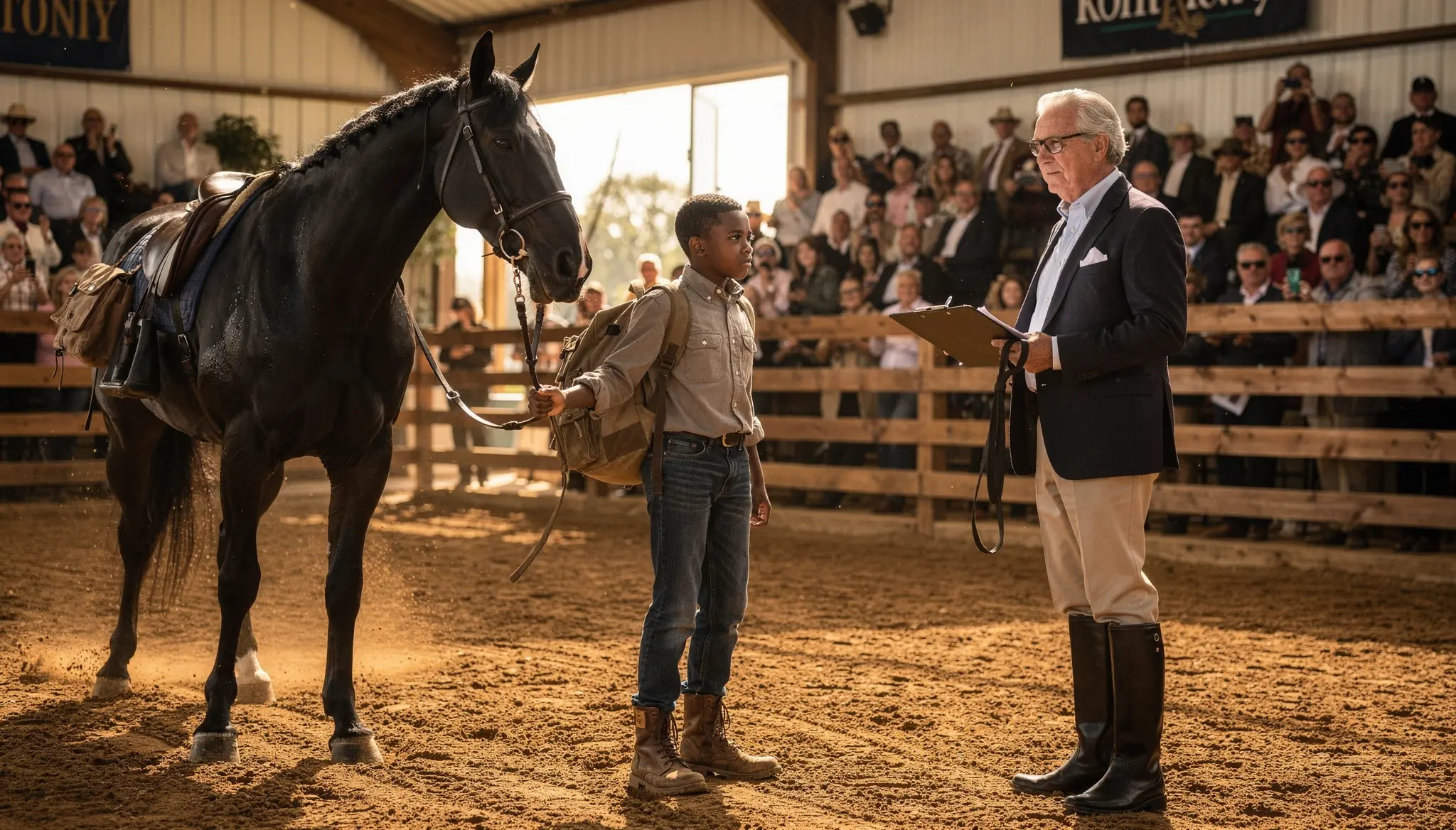
Harrison Caldwell III looked the boy up and down: cracked sneakers, a filthy backpack, dark skin, and hands rougher than most fifteen-year-olds should have. Then he laughed. "And you think you know more than my Olympic trainers? Men with decades of experience and actual degrees?" He stepped closer, his contempt clear even without raising his voice. "People like you do not touch horses like mine. Get off my property."
A woman laughed into her wine glass. A girl lifted her phone and streamed the scene. Nearly three hundred people watched a billionaire publicly dismiss a homeless fifteen-year-old Black boy, and not one of them stepped forward to stop him. What none of them knew was that the boy standing there was about to win a $1.5 million training challenge, and the horse everyone had already written off would be the one to decide whether he deserved it.
Three weeks earlier, Lexington, Kentucky, had looked exactly the way people imagined Bluegrass country should look. White wooden fences ran for miles along rolling green hills. Morning mist settled over pastures worth more than many neighborhoods, and the air carried the smell of fresh-cut hay and old money. This was horse country, and horse country in Kentucky had always had a certain look.
Every face on the billboards, every portrait hanging in the clubhouses, and every name engraved on the most prestigious trophies seemed to come from the same kind of world. At the center of it all stood Caldwell Farms, four generations of thoroughbred breeding and a name that carried weight in nearly every auction house east of the Mississippi. At its head was Harrison Caldwell III.
Harrison was fifty-eight years old and had spent nearly all of those years believing the world was arranged exactly as it should be. He interrupted people mid-sentence as if it were his birthright, called trainers by their last names only, and sometimes seemed to inspect a person's hands before deciding how warmly to shake them. In four generations, Caldwell Farms had never hired a Black trainer. There was no written rule saying it could not, only the familiar explanation Harrison liked to repeat: "The right candidates never came along."
Three miles from those manicured pastures, behind an abandoned hay barn near the Lexington Fairgrounds, there was a blue tarp. Under that tarp was a sleeping bag, a milk crate holding one change of clothes, a library book, and a fifteen-year-old Black boy named Uriah Howard. For two months, that had been home.
Uriah had run from his third foster placement, a house where the locks were on the outside of the bedroom doors. He had not left because he was reckless. He left because staying felt worse. Every morning, he woke before dawn, washed his face with freezing water from a spigot behind the fairgrounds, and walked to nearby farms asking for work.
Most farms took one look at him, a Black kid alone with no parent beside him and no explanation they wanted to hear, and gave him the polite version of no. "We're all set today," they would say. It sounded friendly enough to avoid cruelty and final enough to close the door. Uriah learned to thank them anyway and keep walking.
One farm said yes. It belonged to an older white man named Ray, who ran a modest operation without Caldwell money or prestige. Ray did not ask Uriah where his parents were or where he slept. He simply handed him a shovel and said, "Stalls need mucking. Forty dollars when you're done."
Uriah respected Ray for one simple reason. Ray paid him for what he did, not for what he looked like. But Uriah was not only cleaning stalls. He was watching, studying, remembering, and building on knowledge that had begun years earlier in another barn.
Before the foster homes, before the tarp, before all of it, Uriah had a grandfather. Grandpa Howard was a farrier in rural Georgia, a Black man who spent his life working with horses. He belonged to a long, mostly uncelebrated tradition of Black horsemen who helped shape American horse culture while rarely receiving the recognition their knowledge deserved.
Grandpa Howard had raised Uriah from the time the boy's mother died. He taught him how to read a horse's ear position, how to notice the difference between a deep breath and a shallow one, and how to shift his own posture so that an animal twice his size might decide he was safe. When Uriah was nine, his grandfather finally put the lesson into words.
They were standing in a Georgia barn with morning light coming through the slats. Grandpa Howard rested one hand on a horse's neck and said, "A horse tells you everything, Uriah. You just have to be quiet enough to hear it." Then he added, more softly, "Same goes for people, especially the ones who think they already know what you are."
Grandpa Howard died when Uriah was twelve. It was sudden. One morning he was teaching Uriah how to trim a hoof, and by afternoon he was gone. The barn, the horses, the quiet mornings, and the only man who had ever made Uriah feel completely safe disappeared from his daily life all at once.
Three foster homes followed in three years. The first family forgot his birthday. The second kept the pantry locked. The third put locks on the outside of bedroom doors. By then, Uriah had stopped waiting for the system to protect him and had decided to protect himself.
Yet he carried one thing almost no one knew about. Under the tarp, worked on by flashlight after dark, was a notebook filled with hand-drawn horse anatomy. There were muscle diagrams copied from library books, behavioral notes written in small neat handwriting, observations from Ray's farm, and memories of his grandfather's barn that Uriah wrote down before time could blur them.
Every page was proof that Uriah Howard was building something even while the rest of his life was falling apart. No teacher had assigned the work. No trainer had promised him a credential. The notebook was his secret classroom and his inheritance, Grandpa Howard still alive in pencil and paper.
One Saturday morning at Ray's farm, Uriah was working near a nervous mare. The horse pinned her ears, shifted her weight, and tossed her head whenever one of the other workers approached. Most of them gave her space, assuming she was difficult.
Uriah stepped closer, but not directly. He did not reach for her or try to take control. He turned his body sideways, lowered his shoulders, and slowed his breathing. The mare watched him. After a while, her head dropped and she exhaled.
She allowed him to stand beside her. Ray watched the whole thing from the doorway and said nothing. The next Saturday, however, he assigned Uriah to the horses everyone else considered difficult. It was the first time anyone had trusted Uriah because of what he could do instead of judging him by where he came from.
The Lexington Invitational Showcase brought together two worlds that should never have crossed. Harrison Caldwell III arrived in a black Range Rover while handlers opened doors and crowds made room for him. Uriah Howard arrived on foot from behind the hay barn, a worn backpack holding nearly everything he owned slung over one shoulder and mud on his boots.
The showcase had a problem that week, a very expensive and very public one. His name was Sovereign. He was a jet-black stallion with a two-million-dollar bloodline, a body built like compressed power, and behavior that had made even seasoned horse professionals wary.
Sovereign had struck his stall door hard enough to dent steel. He had charged a round pen fence and cracked a post. Three professional trainers, all credentialed men with years around championship horses, had tried to work with him that week. One had been thrown hard against a rail, another could not safely get within ten feet, and a third walked away with a serious wrist injury and did not return.
They all used versions of the same approach: pressure, control, and force. All three failed. The buyers, trainers, media people, and wealthy guests at the showcase watched with the murmuring unease that means money is being lost. A horse this volatile could become an insurance problem instead of an investment.
Harrison Caldwell owned Sovereign, and the horse's behavior was becoming an embarrassment in front of Harrison's peers. So Harrison did what he often did when something threatened his authority. He blamed the problem itself.
He stepped into the center of the courtyard and spoke loudly enough for the people nearby to hear. "This animal is broken. There is no discipline left in him. We're pulling him from the showcase." He shook his head with the confidence of a man who believed the failure belonged to someone or something else.
Uriah was thirty yards away carrying feed bags across the grounds as a day laborer. It was the lowest rung at the event. He was also one of the only Black workers there who was not part of the catering staff. Nobody had shown him where to eat or where the bathrooms were. He had figured both out himself.
When Sovereign reared behind the fence and sent several spectators stepping backward, Uriah stopped. He set down the feed bag and watched. Not with fear, pity, or the detached curiosity of people who had already written the horse off. He watched the way Grandpa Howard had taught him, with his whole body quiet.
Uriah saw details others were missing. Sovereign's ears were not fixed in an aggressive position. They flattened and released in rapid bursts. His nostrils were not flaring with the steady force Uriah associated with challenge. The breaths came shallow and fast.