The morning of the county fair broke gray and cool over the village of Millbrook with a thin mist clinging to the low fields and the smell of wet hay drifting up from the barns. Petra Winford stood at the edge of the village green with a small basket over her arm watching the crowd gather. She wore a plain blue dress and a bonnet that had seen two summers and she carried a paper cone of roasted chestnuts that warmed her fingers through her gloves. She was 24 years old and had lived in Millbrook her whole life and she knew the fair the way she knew her own kitchen.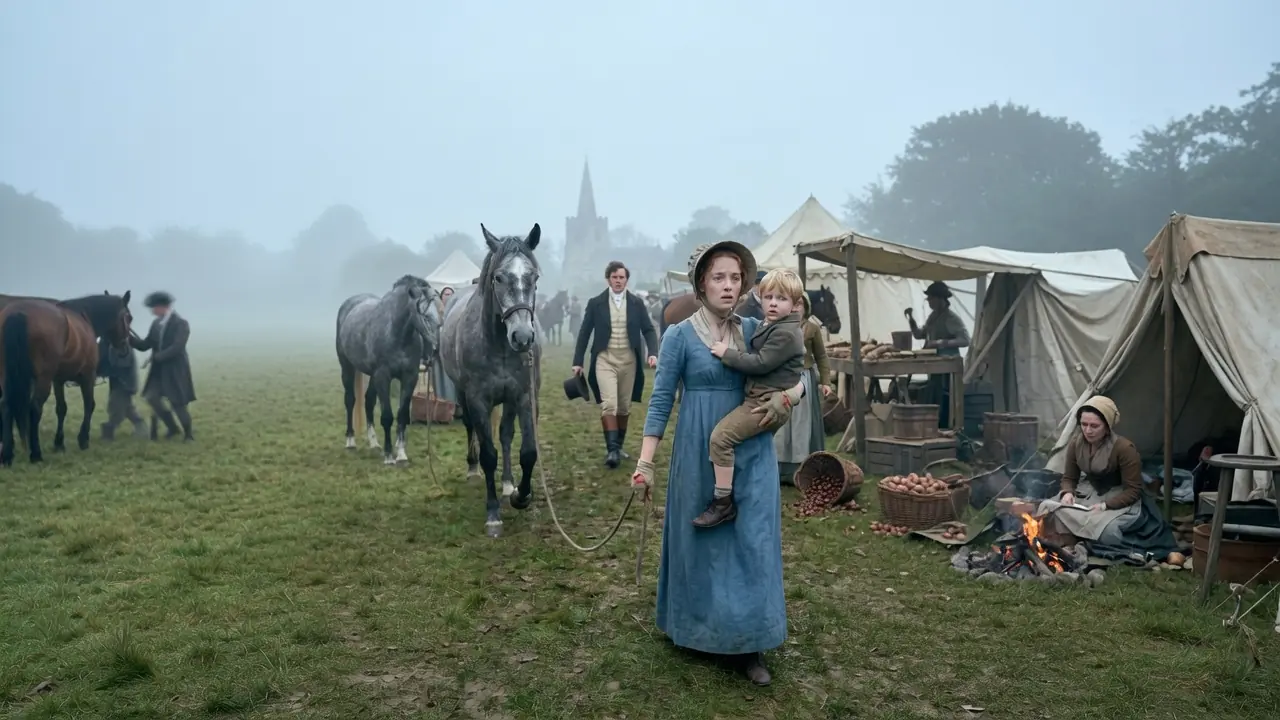
She knew where the bread stall would be and where the ribbon seller would set out her wares and where the children would gather to watch the horses being led in from the far pasture. She knew all of it and yet on this morning something felt different. The air had a sharpness to it the kind that came before a storm or before a piece of news that changed a life. She could not have said why she felt it.
She only knew that her hand kept going to the ribbon at her throat and that her breath came a little quicker than the walk from her cottage should have made it. She had come to the fair alone. Her mother had passed three winters ago and her father worked the small farm on the edge of the village with the help of a hired boy and he had said he would come along later in the day when the milking was done. Petra did not mind being alone at the fair.
She liked to watch. She liked the way the village looked when it was full of strangers the way the ordinary lanes felt bigger and stranger with carts and tents and horses filling them. She stood near the low stone wall by the church and ate a chestnut slowly letting the heat of it sting her tongue and she watched the fair come to life around her. The sound of the fair was a soft roar like water over stones made of many small sounds that could not be picked apart.
A fiddler tuned his strings under the yew tree. Two boys ran past chasing a dog with a red ribbon tied around its neck. A woman called out the price of her jam from a small table piled with jars that caught the pale light. Petra smiled without meaning to, and the smile stayed on her face longer than she noticed.
Across the green, the smell of horses grew stronger. The horse dealers had come from as far as three counties over, and their beasts stood in a rough line along the far side of the field. Tied to a long rope stretched between two posts, there were plow horses with hooves the size of dinner plates, and slim mares with soft brown eyes, and a few showy hunters that the young gentleman would come to look at later. Among them stood one horse that drew Petra's eye.
He was a tall gray, taller than the rest, with a small white star on his forehead, and the long, clean legs of a horse bred for speed. He was not tied like the others. He was held by a groom who kept a short grip on the lead rope, and even from where she stood, Petra could see that the horse's ears moved fast, back and forward, back and forward, and that his tail was up. She had grown up around horses.
She knew that tail. It was the tail of a horse who was not calm. It was the tail of a horse who was thinking about running. She watched him for a long moment.
The groom holding him was a thin man with a red face, and he kept tugging the lead rope in a way that Petra did not like. Every time he pulled, the gray horse tossed his head and stepped sideways. The man was making it worse, and did not know it. Petra thought about walking over to say something, but she did not.
It was not her horse and not her business, and a woman in a plain blue dress could not walk up to a horse dealer's groom and tell him how to handle his beast. She turned her eyes away and looked down at her chestnuts. She told herself the horse would be fine. She told herself the groom would settle him, or another man would come, or the horse would tire and stand quiet.
She told herself many small useful lies, the way a person does when she does not want to see a thing coming. The morning wore on. The sun tried to break through the mist and did not quite make it, and the light stayed pale and soft. Petra bought a length of green ribbon from the ribbon seller, who was an old friend of her mother's and would not take her money at first.
She talked with the baker's wife about the price of flour. She stopped by the small tent where a traveling man was selling books, and she ran her finger along the spines and wished she could take three of them home. She did not buy any. Books cost more than ribbon, and a farmer's daughter counted her coins.
She walked on past the stall selling honey, past the man with the trained monkey, past the corner where two old men were arguing about the weather. She was near the center of the green now, where a small platform had been raised for the mayor to make his speech later in the afternoon. She stopped and turned in a slow circle, taking it all in. That was when she saw the child.
He was small, perhaps 4 years old, with a mop of dark hair and a coat that was a size too big for him. He was walking through the crowd alone, holding a stick that he must have picked up somewhere, dragging it behind him in the grass. His face was serious, the way small children's faces are serious when they are thinking hard about something. He did not look lost.
He looked like a child who had wandered off from somewhere and did not yet know it. Petra watched him for a moment, waiting to see a mother or a nurse hurry after him. No one came. The boy walked on, dragging his stick, and he was walking toward the far side of the green, toward the rope line where the horses were tied.
Petra took a step forward before she knew she had moved. She was not sure why. The boy was not in danger. He was only walking.
And yet something in her chest tightened, and she began to walk toward him, weaving between two women who were laughing over a bolt of yellow cloth. She kept her eyes on the small dark head. He was still walking. He had stopped dragging the stick and now held it upright like a small soldier's spear, and he was heading straight for the gray horse.
At the same moment, the wind changed. It was a small change, a breath of wind from the north, cool and quick, that lifted the edges of the ladies' shawls and made the ribbons on the stalls flutter. It rattled a piece of loose canvas on the bookseller's tent, and the canvas made a sharp cracking sound, like a small whip. Petra saw the gray horse's head come up.
She saw his eyes go wide and white at the edges. She saw the groom pull hard on the rope, and she saw the horse rear. Everything after that happened both very fast and very slowly. The gray horse reared straight up, and the groom, still holding the rope, was lifted clean off his feet for a moment before he lost his grip and fell hard on his back in the mud.
The rope whipped through the air. The horse came down on his front hooves and stood shaking for one long second, and in that second Petra saw everything about him at once, the white showing all around his dark eyes, the flare of his wide nostrils, the sweat already beginning to darken the gray hair of his neck. He was not a bad horse. He was a frightened horse, and a frightened horse is a runaway horse waiting to happen.
She knew it before it happened. She knew it in her bones. Then, he ran. He turned on his back legs so fast that his tail whipped a small cloud of dust up from the ground, and he burst forward through the crowd.
People began to scream. The sound of screaming was a strange sound in the middle of a fair, and for one moment it felt like a sound from a dream. Petra did not scream. She stood very still, and her eyes went straight to the child.
The child had turned at the sound of the horse. He was standing in the middle of the grass with his stick in his hand and his mouth open, and he was directly in the path of the gray horse's run. The crowd stepped back. They stepped back the way crowds always do when something terrible is about to happen.
They stepped back in a wide ragged circle, and their faces were white, and their hands went to their mouths. Petra saw a farmer she had known all her life step back. She saw the baker's wife step back. She saw two young men in fine coats step back, and one of them dropped a glass of ale, and the glass broke on a stone, but nobody heard it break because everyone was watching the horse.
Everyone stepped back from the runaway horse. Every single person on that green stepped back. Petra stepped forward. She did not think about it.
If she had thought about it, she might have stepped back, too, because she was a woman of 24 in a blue dress with a paper cone of chestnuts in her hand, and she was not a hero. She was not brave. She was afraid of thunderstorms and of the dark hallway upstairs in her father's house when the lamp had gone out. She was afraid of many small ordinary things, but she was not afraid in that moment of the horse, or perhaps she was, and it did not matter.
What mattered was the child. The child was in the path, and the child would be crushed, and no one else was moving. She dropped the chestnuts. She heard the paper cone hit the grass.
She lifted her skirts with one hand, and she ran. The green was not large. From where she stood to where the child stood was perhaps 30 paces. She ran those 30 paces in what felt like a hundred heartbeats and also in no time at all.
The horse was coming from her left thundering across the grass. His gray body a blur of muscle and speed. She could hear his hooves now. A hard drumming sound that seemed to shake the ground under her feet.
She could smell him, too. The hot smell of a running horse, sweat and grass and the sharp animal smell of fear. She reached the child a half second before the horse did. She scooped him up with one arm pressing him hard against her side and with her other hand she reached out and grabbed the trailing rope.
The rope burned her palm through her glove. It burned in a way she felt without feeling because her whole mind was somewhere else. She held on. The horse's weight hit the end of the rope and nearly took her off her feet.
She staggered. She did not let go. She dug her heels into the soft grass and she leaned back with her whole body. And she held the child tight against her ribs with her other arm and she pulled.
She was not strong enough to stop him. She knew that. Nobody was strong enough to stop a runaway horse with one hand. But she did not need to stop him.
She needed to turn him. She needed to turn his head just enough that his body would follow and his body would go past the child and the child would live. She pulled the rope down and to the side. She pulled with all her weight.
She heard herself make a sound that was not a scream only a low sharp noise like a woman lifting something too heavy. The gray horse's head came around. His body followed. His shoulder brushed her skirt as he passed her so close that she felt the heat of him.
And she smelled the sharp smell of his sweat. And she felt a small shower of grass and dirt kicked up by his hooves hit her cheek. He thundered past. He ran for another 20 paces before he slowed.
Then he stopped, blowing hard, his sides heaving, the rope trailing loose behind him where it had slipped from her burning hand. Petra stood in the middle of the green with a strange child in her arms and her heart making a sound in her ears like a drum, and for a moment she could not remember how to breathe. The child was crying now. He had not been crying before.
It had gone silent while she was running, and she had not noticed. She noticed now. She looked up and saw a hundred faces looking back at her. Nobody spoke.
The fiddler under the yew tree had stopped playing. The baker's wife had her apron pressed to her mouth. The two young men in fine coats stood with their hands frozen in the air. Even the dog with the red ribbon had stopped barking.
It was as if the whole village and everyone in it had been turned to stone in the same moment, and only she was still alive, standing in the middle of the grass, holding a child who was not hers. Then, from the edge of the green, a woman screamed. It was a different kind of scream from the screams that had come before. It was not the scream of fear at something happening.
It was the scream of a mother who has just seen her child. Petra turned toward the sound. A young woman in a rose-colored dress was running across the grass, her hat gone, her hair coming loose, her hands stretched out in front of her, she was running as fast as her skirts would let her, and her mouth was open, and she was crying and screaming at the same time. Behind her, coming at a slower pace but with long hard strides, was a man.
He was tall. That was the first thing Petra saw about him. He was tall and dressed in dark riding clothes, and he did not run the way the woman ran, in a panic, but with a long steady stride that closed the distance between them faster than a run should have. His hat was in his hand.
His dark hair was pushed back off a face that was not smiling and not frowning, but held so still that it was hard to read. His eyes were on the child. Then his eyes were on her. The young woman reached them first.
She threw herself at Petra, and Petra let her take the child, and the child cried harder, and reached his arms around his mother's neck, and the mother sank to her knees in the grass with him in her arms, and rocked back and forth, and pressed her wet face against his hair.
"Oh God," the young woman said, over and over.
"Oh God.
Oh God. Oh God. Bram. Bram.
My Bram." Petra stepped back to give them space. She did not know what else to do. Her hand hurt.
She looked at it and saw that her glove had torn open across the palm, and that underneath there was a bright red line where the rope had burned her. She did not feel it yet, not really. She felt a distant sting, like a memory of pain rather than pain itself. The tall man had reached them.
He stopped a few steps away. He did not go to the mother and child. He stood and he looked at Petra, and his gray eyes were the color of the sky above the mist, and they did not move.
"Are you hurt?" he said.
His voice was quiet. He did not say it as a question. He said it as a thing he needed to know. She shook her head.
Her throat was not working yet. She tried to speak and no sound came out. She tried again.
"No," she said at last.
Her voice was small.
"No, I do not think so."
He looked at her hand. He crossed the two steps between them and without asking took her wrist very gently and turned her palm up. His fingers were warm. She felt the warmth of them through her sleeve.
He did not touch the burn. He only held her wrist and looked and then he let her go and turned to a man who had come up behind him. A stout older man in a good coat who must have been a servant of some kind.
"Send for the surgeon," he said.
"Have him meet us at the inn."
"At once, Your Grace," said the older man.
"Your Grace."
The words fell into Petra's ears and stayed there. She looked at the tall man again. She looked at the fit of his coat and the polish of his boots and the way the older man had bowed his head when he spoke and she understood, slowly, what she was looking at. He was not a country gentleman.
He was not a squire's son. He was a duke. He was the duke, she thought, though she did not know which duke, only that a duke had come to the fair with his sister or his cousin and her child and that his sister or cousin was now on her knees in the grass and the child was safe and the duke was standing in front of her looking at her burned hand.
"I do not need a surgeon," Petra said.
"It is only a scrape.
I have had worse from a garden thorn."
"You will see the surgeon," he said.
He did not raise his voice. He did not need to. There was a weight in the way he spoke, the weight of a man who had never in his life said a thing twice. She lifted her chin.
She was frightened and she was shaking and her hand hurt more with every passing second, and she did not like being told what to do by a man she did not know. Duke or no Duke.
"I will see whoever I choose to see," she said.
"I thank you for your concern, sir, but the child is safe, and I am not badly hurt, and I will go home now."
His mouth did something. It did not smile. It moved only a very little, as if he had almost smiled and stopped himself in time. He looked at her for another long moment, and she felt herself flush under the look, and she did not know whether it was from anger or something else.
"As you wish," he said.
"But I would count it a very great favor, madam, if you would allow the surgeon to see your hand before you walk home.
My nephew is 4 years old. You have given him back to his mother. I would be a poor sort of man if I let you walk away with a rope burn and no care taken for it." Nephew.
So, the young woman was his sister or his sister-in-law. And the child was his nephew. She looked at the small dark head buried in the mother's neck, and she thought of the sound the horses' hooves had made on the grass, and she thought of how close she had come to being too late. Her knees felt very weak all at once.
She put her good hand out, and without thinking, she took hold of the sleeve of the Duke's coat just to keep herself upright. He did not move. He let her hold on. He did not offer her his arm, and he did not step back.
He only stood, and he waited, and after a moment she found her balance again, and let go.
"Very well," she said.
She could hear that her voice had lost some of its edge.
"The surgeon, but only for the hand, and then I will go home."
"Only for the hand," he agreed.
"And then wherever you wish to go."
He turned and gave a low word to another man who had come up, and things began to happen around her that she did not have to attend to. Someone brought his sister a cloak and helped her to her feet. Someone else was walking the gray horse in slow careful circles at the far end of the green, talking to him in a soft steady voice, cooling him down. The crowd was moving again, breaking into small groups, murmuring, glancing at her and looking away.
The fair had begun to breathe again. She stood in the middle of it and let the world come back to her one piece at a time. The duke offered her his arm. She took it.
His coat was dark wool and it smelled of horse and cold air and underneath of some clean scent she could not name. Something like soap and pine bark. She walked beside him across the green toward the inn on the far side and she was aware of every eye on her and she kept her chin up because her mother had always told her to a woman walked as if she owned the ground she stood on whether or not she did. At the inn they were shown into a small private parlor with a fire already lit.
The innkeeper's wife brought tea. Petra sat in a chair by the fire and the duke stood by the window and neither of them spoke while they waited for the surgeon. The silence was not comfortable but it was not unfriendly either. It was the silence of two people who had just seen something they were still trying to understand.
The surgeon came. He was a kind man with cold hands. He cleaned her palm with something that stung and he wrapped it in a strip of clean linen and he told her to keep it dry for 3 days and to come back if it grew hot or red. She thanked him.
He bowed to the duke and left. When he was gone the duke came away from the window and sat down opposite her. He did not sit near her. He sat across the small hearth with the fire between them, and he leaned his elbows on his knees and looked at her the way a man looks at a book he intends to read carefully.
"I do not know your name," he said.
"Petra Winford," she said.
"My father is a farmer on the West Road.
My mother, before she died, was a schoolmistress at the parish school."
"Miss Winford," he said.
"I am Alaric Ashcombe.
I own the estate at Thornley, 4 miles from here." Thornley. She knew the name. Everybody in the county knew the name.
Thornley was the great house at the end of the North Lane with its gates that were always closed and its long avenue of oak trees and its owner who did not come often to the county and who, when he did, kept to himself. She had walked past those gates twice a year for her whole life and never once seen inside them.
"Your Grace," she said.
"Alaric," he said.
"Please, not in this room."
She looked at him. He looked back. The fire popped between them.
"I do not know why you would say such a thing to a woman you met an hour ago," she said.
"Nor do I," he said.
"I only find that I would prefer, in this room, not to be Your Grace."
She did not know what to say to that. She looked down at her bandaged hand instead. The linen was very white against the skin of her wrist. She turned her hand over and back again.
"How is the child?" she said.
"How is Bram?"
"He is with his mother," Alaric said.
"She is my sister.
Her husband is at sea, and she has been staying at Thornley this summer while he is away. Bram wandered off from his nurse. It will not happen again. The nurse will be sent home and my sister will not let him out of her sight for a fortnight, and by then he will be trying to escape again because he is 4 years old and there is no keeping such a creature quiet."
He said the last part with something like the shape of a smile at the corner of his mouth, and she saw for the first time that he was younger than she had first thought. Not young, but not old. Perhaps 30. Perhaps a year or two more.
There were fine lines at the corners of his eyes, but his hair was dark and his shoulders were straight. And when he almost smiled, the whole shape of his face changed.
"He is a fine boy," she said.
"He was very brave.
He did not run."
"He froze," Alaric said, "which was fortunate.
If he had run, he would have run in the wrong direction. As it was, he stood and you came." He looked at the fire. He looked at his own hands, which were folded loosely between his knees. He looked at her again.
"Everyone stepped back," he said.
His voice was low. It had lost the calm authority of the green and become something else, something more raw.
"I stepped back.
I saw the horse rear and I stepped back. I saw Bram in the grass and my body would not move. I have ridden into worse. I have done things in the army that I do not speak of.
And this morning I stood on that green and I could not move. And I watched a woman I had never seen before run toward the thing I could not go near." Petra sat very still. The fire made a small warm sound in the hearth.
Somewhere outside a door opened and closed. She did not know what to say to a duke who had just told her something like that. She thought about saying nothing. She thought about telling him he had done nothing wrong.
That no one could have moved faster. That the horse had been too close. All of those things would have been kind. None of them would have been true.
"You had a moment," she said at last.
"That is all.
Everyone has a moment. Mine was longer than usual this morning, and yours was shorter. Another day it will be the other way around."
He looked at her.
"You are being generous," he said.
"I am being honest," she said.
"There is a difference."
He was quiet. Then he said, "Yes, I see the difference." The innkeeper's wife came in with fresh tea. She fussed over Petra and asked to see her hand and clucked over the bandage and offered her a slice of cake.
And Petra took the cake because she found to her surprise that she was very hungry. Alaric watched her eat. He did not eat. He drank his tea and he watched her, and it was not a rude looking, only a steady one, as if he was still trying to understand something.
When the innkeeper's wife had gone again, he said, "May I ask you something that you may find impertinent?"
"You may ask," she said.
"I do not promise to answer."
"Fair," he said.
"How did you know to grab the rope?
Not to pull the child clear, to grab the rope." She thought about it. She turned her cup in her hands.
"My father keeps horses," she said.
"Only two, but I have known them since I was small.
When I was seven, a mare of ours broke a fence and ran through the kitchen garden. I went after her because my mother had just planted the roses and I was very fond of the roses and I did not want them trampled. I was seven. I was small.
I could not stop her. But I got the lead and I pulled her head around and she went past the roses instead of through them. My father saw me do it. He did not scold me.
He sat me down afterward and he told me that a horse follows his head. He said if I only remembered one thing about horses, to remember that. A horse follows his head. Where the head goes, the body goes." She paused.
"I have not thought about it in 15 years.
This morning I did not think about it either. But I suppose it was there, still in my hands. Alaric was quiet for a long moment. Then he said, "Your father sounds like a good man."
"He is," she said.
"The best I know."
"I should like to meet him," Alaric said.
"If it would not be improper for me to call."
Petra set her cup down. She looked at him across the fire.
"Your Grace," she said.
"Alaric," he said.
"Sir," she said, meeting him halfway.
"You are a duke, and I am a farmer's daughter.
You do not call on farmer's daughters. Not even farmer's daughters who have grabbed the reins of runaway horses. I do not know what you think you are proposing, but I would rather you did not propose it. I have had enough of a morning.
I do not need a stranger from a great house calling at my father's cottage and setting the whole village to talking. Please, let me go home. Let this be a story we both remember, and neither of us tells." He looked at her for a long time.
He did not argue. He did not try to persuade her. He only looked at her with those gray eyes that were the color of the sky above the mist, and at last he nodded.
"As you wish," he said.
"But I would ask one thing of you before you go."
"What is that?" she said.
"That you take my carriage home," he said.
"I know you would rather walk, but your hand is bandaged, and it is 4 miles to the west road, and the mist has come back thicker than it was this morning.
Take the carriage. Send it back when you are safely at your door. That is all." She wanted to refuse.
She had refused everything else. But her hand was beginning to throb, and her legs, when she thought about it, were still not quite steady, and the mist against the parlor window was a heavy gray thing that promised rain before the hour was out.
"Very well," she said.
"The carriage?"
"Thank you."
He rose. She rose. He walked her out to the yard of the inn, where a plain black carriage was already waiting with two matched bays and a coachman on the box who tipped his hat when he saw her. Alaric handed her up himself.
His hand under her elbow was steady and warm and did not linger. Before he closed the door, he said, "Quietly, Miss Winford, thank you." She looked down at him from the step of the carriage.
"You are welcome, Your Grace," she said.
He did not correct her this time. He only stepped back and closed the door and the carriage moved forward and Millbrook Fair slid past the window in a soft blur of tents and voices and gray light. She thought, as the carriage rocked her home, that she would never see him again. She was wrong.
The first thing she saw when she woke the next morning was a bouquet of white roses on the small table by her bed. Her father had brought them up. He stood in the doorway of her room with his hat in his hands and a strange look on his face.
"They came at first light," he said.
"A boy on a good horse.
There was a note." He held out the note. Petra took it with her uninjured hand. It was written on heavy cream paper and the seal was a small dark thing pressed with a coat of arms she did not know.
Inside, the writing was neat and small.
"Miss Winford," it said.
"I have kept my word and shall not call, but I have promised no one that I shall not send flowers.
If you should ever wish to speak to me again for any reason at all, send word to Thornley. Yours, Alaric Ashcombe." She read it twice. She folded it.
She put it under her pillow.
"Well," her father said.
He was watching her carefully.
"You did not tell me it was a duke, girl."
"I did not want to say," she said.
"It seemed a strange thing to boast of."
"You are not boasting," he said.
"You are hiding, which is different.
And I would like to know why." She looked at him. Her father was a big man with white hair and a slow way of moving that had always made her feel safe. He had never once shouted at her in her life.
He had raised her mostly alone since her mother died, and he had done it with the same steady care with which he handled his two horses and his one field and the small circle of things she loved.
"I do not want anything from him, Father," she said.
"He is a duke.
I am a farmer's daughter. I do not want the village whispering. I do not want to be a story people tell over their pints. I saved a child. That is all."
"It should be enough."
"It is enough," her father said.
"For you, it is enough for you, my girl.
But it may not be enough for him. And you cannot make it enough for him by hiding under your pillow." She almost laughed. She did not because her hand hurt when she moved it, but she almost did.
"I will write him a letter," she said.
"I will thank him for the roses.
I will tell him I am well. And I will not encourage him further."
"That is fair," her father said.
He came into the room and set the roses on the wider table by the window where the light was better.
"They are very fine roses, Petra."
"Yes," she said, watching them.
"They are."
She wrote the letter that afternoon. She kept it short. She thanked him for the flowers and for the surgeon and for the carriage. She told him her hand was healing well.
She wished him and his sister and his nephew a peaceful summer, and she signed her name. She did not invite him to write again. He wrote again. It came 3 days later.
It was not long. It was two sentences. He hoped her hand was mending. He wished to know if Bram might, when he was old enough to speak properly, send a note of his own thanks.
He did not sign his title. He signed again only Alaric Ashcombe. She answered. She told herself she was only answering out of politeness, and she almost believed it.
She wrote that Bram was very welcome to send a note when he was ready, and that she would keep it always, and that she hoped he grew up to be a great deal less trouble than he had already proved himself capable of. She surprised herself by smiling as she wrote it. He wrote again. He asked, this time, whether her father would consider selling any of his hay crop this autumn.
He needed feed for the Thornley stables, and preferred to buy from local farmers when he could. It was a business letter. It was addressed to her, but it concerned her father. There was nothing improper in it.
She showed it to her father. Her father read it twice and put it down.
"He is clever," her father said.
"He is buying hay."
Petra said.
"Yes," her father said.
"He is buying hay from me."
"Through you."
"On paper."
"In a way no one can talk about."
"He is clever, Petra."
She did not answer. She wrote back on behalf of her father. Her father did have hay to sell. The terms were fair.
The price was more than fair, though not so much more that it looked like charity. The arrangement was made. A cart came for the hay in the second week of July, and the cart came back in August for a second load, and by the end of the summer the barn was empty, and their small purse was heavier than it had been in 3 years, and Petra had written seven letters to Thornley and received seven back. The letters became less about hay.
They became about small things. He asked her once what she was reading. She told him. He wrote back and said he had read the same book two winters before and disagreed with the ending.
She wrote back defending the ending. He wrote back conceding one point and holding his ground on the other. She laughed aloud when she read it and her father looked up from his tea and did not say anything and she saw the corner of his mouth move. She did not go to Thornley.
He did not come to her cottage. That was the shape of it. Two people writing letters across four miles of hedgerow and lane telling each other small true things saying nothing important and everything important at the same time. She thought about him more than she wanted to admit.
She thought about him at odd moments while she was hanging out the wash. While she was walking home from the village with a basket of eggs. While she was mending a tear in her father's coat by the fire. She thought about the way he had almost smiled in the parlor of the inn.
She thought about the color of his eyes. She thought about the warmth of his fingers on her wrist and the smell of his coat. Soap and pine bark and the cold air of a morning that had almost gone very badly. She thought about all of these things and she told herself sternly that she was a farmer's daughter and that dukes did not marry farmer's daughters and that a friendship by letter was one thing but a foolish hope was another.
She told herself many things none of which quite worked. Autumn came. The hedgerows turned gold and red and the mornings grew crisp and the smoke from the cottages hung longer in the air. Her hand had healed by then leaving only a thin pink line across the palm that she could see when she turned her hand toward the light.
It did not hurt. It only reminded her. In late September, an invitation came. It was not from Alaric.
It was from his sister. Her name was Mira Ashcombe Halstead, and she wrote a warm, quick letter in a hand that sloped and skipped.
"Bram had asked," she said, "if the lady from the fair might come to tea.
He was 4 years old, and he did not forget things, and he had asked three times in the last week whether she might come. And Mira had not been able to answer him because she did not know whether Miss Winford would wish to come." Would she wish to come? Not to Thornley proper.
Mira and Bram were staying in the small dower house on the estate, which was much less grand and much less frightening. And there would be no one there but Mira and Bram and a nurse and a cook. It would be a small tea. It would be only a tea.
But Bram would be so pleased. Would she come? Petra read the letter twice. She put it down.
She picked it up and read it again.
"Well," her father said.
He was carving a piece of wood by the fire, and he did not look up.
"Are you going, then?" her father asked.
"How did you know it was from Thornley?" she said.
"I know your face, girl," he said.
She was quiet for a long moment. Then she said, "It is only tea."
"Yes," her father said, "only tea."
She wrote back and said she would come. The dower house at Thornley was a small stone building with ivy on its walls and a red door and a garden that had been let go wild for a few years and was beginning to be tamed again. Mira Halstead met her at the door in a plain morning dress, and Bram came running down the hall behind her with a wooden horse in his hand and stopped in front of Petra and stared up at her with his very serious dark eyes. Then he lifted the wooden horse to her, solemn as a knight offering a sword.
"For you," he said, "because you saved me."
Petra took the horse. She knelt down in the doorway so that her face was level with his.
"Thank you, Bram," she said.
"I will keep him forever."
He nodded as if that was the correct answer, and then he took her uninjured hand in his small, warm one and led her into the parlor as if she were a guest of great importance, and the whole day was decided from that moment. They had tea. They had small cakes with jam on them, and Bram spilled his milk twice, and Mira did not scold him, and Petra told them both a story about a goose her father had once owned that had chased the vicar down the lane. Mira laughed until she had to hold her sides.
Bram fell asleep in Petra's lap with the wooden horse pressed against her collarbone, and Petra stroked his hair with her healed hand and did not say anything, and Mira watched her without seeming to. After a while, Mira said, "My brother did not come today."
"No," Petra said.
"He very much wanted to," Mira said.
"He very much did not want to make you uncomfortable.
So, he went riding on the far side of the estate, and he left instructions with the cook to prepare enough cake for four people in case you should stay long enough to want a second." Petra looked down at the sleeping child.
"That is a very careful sort of not coming," she said.
"He is a very careful man," Mira said.
"He was not always, but he is now."
Petra did not answer. Mira sat forward a little and refilled her cup.
"Do you know what he did?"
Mira said, "the day after the fair? Do you know?"
"He sent roses," Petra said.
"He sent roses," Mira agreed.
"And then he went out to the stables and he had every rope in the yard inspected, and every horse turned out to run its temper off in the paddocks, and he had a long conversation with the head groom that ended with the head groom being given a rise in his wages.
Because my brother said, and I heard him say it, that he would not have a man in his employ who was too poor to sleep and too tired to see when a horse was about to break. He gave that man a rise, and then he wrote a letter to the horse dealer who had brought the gray to the fair, and he offered to buy the horse. Not to punish him. To take him off the road.
He said he would not have a frightened animal being sold as a saddle horse to a family with children. He paid twice what the beast was worth. The gray is at Thornley now. He has a paddock of his own.
My brother sits on the fence sometimes in the evening and just looks at him. Not to break him. Only to look. I asked him why. He would not say."
Petra had gone very still. Bram breathed softly against her collarbone. The fire made a small comfortable sound in the hearth.
"He did not tell me any of that," she said.
"No," Mira said.
"He would not.
He does not think it counts as anything. He thinks it is only what a man ought to do." Petra looked out the small window of the parlor at the wild garden and the pale autumn sky beyond it. Her eyes stung.
She did not know why. She blinked and blinked again, and looked back at Mira.
"He is a good man," she said.
"Yes," Mira said.
"He is."
They sat for a long moment without speaking. Then Mira gently said, "I do not know what you feel, Miss Winford. I do not ask. I only wanted you to know.
He would not tell you himself. So, I told you. That is all." Petra nodded.
She did not trust her voice. Bram woke a little later, and there was more cake, and Mira played the pianoforte very badly and made them all laugh. And Petra stayed until the afternoon light was beginning to slant low through the ivy at the window. When she rose to go, Mira embraced her, which surprised her, and Bram gave her three more solemn wooden horses that he had lined up on the table, insisting that she must have them all.
And Petra promised him she would build a small stable for them at home. She walked back to her cottage in the low golden light. The carriage had been offered and she had refused it. 4 miles was nothing on such an afternoon.
She wanted the walk. She wanted the time. She thought about the gray horse in his paddock. She thought about a duke sitting on a fence at dusk watching a frightened animal.
She thought about a man who would not tell a woman what he had done for her because he did not think it counted as anything. She thought about how easy it was to step back. Everyone had stepped back. She had stepped forward.
And now, she thought, it was happening again. Only now the horse was not on the green. The horse was something else. Something she had been telling herself she must not want.
Something she must not reach for. Because a farmer's daughter did not reach. She walked and the low sun made long shadows across the lane. And the hedgerows smelled of blackberries and dust and the first hint of wood smoke from a hearth somewhere ahead.
By the time she reached her father's gate, she had made a decision. She wrote to Alaric that night. She did not write about tea. She did not write about her afternoon.
She wrote one line. I should like to see you. If you are willing, come to the West Road tomorrow at 3:00. I will walk out to meet you at the stile.
She sealed the letter. She gave it to the boy at first light. She did not tell her father what she had done. He came.
He came alone on a plain bay horse wearing a dark riding coat and no hat. He dismounted at the stile and tied his horse to the fence post and turned and when he saw her walking toward him down the lane, he did not step forward. He stood and he waited and she came to him. She stopped on her side of the stile.
He stood on his. They were separated by a low stone wall and a wooden step and neither of them moved to cross it.
"Your Grace," she said.
"Alaric," he said.
"Alaric," she said and her voice was steady and her heart was not.
"Your sister told me about the gray horse."
He said nothing.
"She told me about the head groom, too," she said.
"And the ropes in the yard and the paddock.
She told me all of it." He looked down at his gloves. He looked up again.
"She should not have," he said.
"I am glad she did," Petra said.
"I need to ask you something.
I need you to answer me honestly. Will you answer me honestly?"
"I will," he said.
She drew a breath.
"Why did you buy the gray horse?" she said.
"Why did you give the groom a rise?
Why did you write to me about hay when you did not need hay? Why did you send roses at first light? Why have you not come to my father's gate in 3 months? Why do you sit on a fence at dusk?
Why? All of it. Why?" He was quiet for so long that she thought he was not going to answer.
He looked past her down the lane at nothing in particular. His mouth did the thing it had done in the parlor of the inn. The almost smile that never quite arrived. His gray eyes came back to her.
"Because I stepped back," he said.
She waited.
"I stepped back on that green," he said, "and I have been trying ever since to be a man who does not step back. I bought the horse because he was afraid. I paid the groom more because he was tired. I asked your father for hay because I could not think of any other honest way to give him money without insulting him. I sent the roses because I could not bear to send nothing. I did not come to your father's gate because you asked me not to. I have kept every letter you have written to me in the drawer of my desk. I sit on the fence at dusk because it is the only time in the day when I feel that I have done a decent thing. That is why. All of it. That is why."
Petra did not move for a long moment. The wind moved a strand of hair against her cheek. Somewhere behind her a bird called out once and stopped. She lifted her hand.
Her healed hand with its thin pink line across the palm. She held it out over the stile. Not for him to take. Only for him to see.
"Look at that," she said. "Do you see it?"
"Yes," he said.
"It does not hurt," she said. "It has not hurt for weeks. I look at it and think of that morning. I think of a child in my arms. I think of you standing on the grass. I think of my whole village stepping back at the same time. I think of what it means to step forward. Do you understand what I am telling you?"
"I think so," he said.
His voice had gone rough.
"I did not step forward that morning because I am brave," she said. "I stepped forward because I could not bear not to. That is all it is. That is all it ever is. Alaric, come over the stile."
He did not move.
He looked at her as if she had said something in a language he did not quite dare to believe he had understood.
"Petra," he said.
It was the first time he had spoken her name. She had not known until she heard him say it, how much she had wanted him to.
"Come over the stile," she said again.
He came over the stile. He came slowly, one long stride, and he stopped in front of her. And he did not touch her. He stood close enough that she could smell his coat again, soap and pine bark and cold air.
And he looked down at her with his gray eyes, and she looked up at him. And neither of them looked away.
"I am a farmer's daughter," she said.
"I am aware," he said.
"I have no dowry," she said.
"I have no family in society.
I have no fine clothes and no accomplishments and no polish. I do not sing. I do not paint. I read too much.
I speak my mind. I have opinions about the ends of books. I have a bad temper when I am tired."
"I am aware," he said.
There was a smile at the corner of his mouth now. It was not the almost smile. It was a real one, small and slow.
"Then you understand," she said, "that if you are going to ask me something, you should ask it plainly.
Because I will not be gathered up into a fine gesture. I will not be swept away. I am not a woman who is swept. I need to be asked plainly, in words I can understand."
He looked at her for a long moment. Then, very slowly, he took her healed hand in both of his. He turned it palm up. He looked at the thin pink line.
He bent his head, and he pressed his mouth once, briefly, to the scar. Then he looked up at her.
"Petra Winford," he said, "I am asking you, plainly, will you marry me?"
She heard the wind in the hedgerow. She heard the plain bay horse shift his weight against the fence post. She heard, somewhere very far away, a dog bark twice and then be quiet. She heard her own breath. She heard his.
"Yes," she said.
"I will."
He closed his eyes. His hands tightened on hers, only a little. He opened his eyes again. And he did not kiss her, though she thought he wanted to.
He only lifted her hand and pressed it once to his own cheek and held it there and let it go.
"Thank you," he said.
"For what?" she said.
"For stepping forward," he said.
Again, they walked back to her father's cottage together, leading the plain bay horse behind them. Her father was in the yard splitting wood. He saw them coming from a long way off. He set down the axe.
He wiped his hands on the sides of his trousers. He did not look surprised. He looked, Petra thought, like a man who had been waiting for a thing to arrive and had known it would arrive and only wondered which afternoon. The three of them sat at the kitchen table together.
There was tea, and there was bread, and there was a piece of cheese wrapped in a cloth. Alaric asked her father formally for his consent. Her father took a long time to answer. He looked at Alaric and he looked at Petra and he looked at Alaric again.
"You will be good to her," he said.
It was not a question.
"I will," Alaric said.
"You will not try to make her into something she is not," her father said.
"No, sir," Alaric said.
"I would sooner die."
Her father nodded once and reached across the table and shook Alaric's hand.
"Then you have my consent," he said.
"And my thanks for asking."
They were married in the small parish church at Millbrook six weeks later on a bright cold morning in early November. It was a small wedding. Mira came, and Bram, who carried the ring on a small cushion and dropped it once and picked it up again with the great seriousness of a small knight. Her father gave her away.
The village came, all of them, the baker's wife, the fiddler from under the yew tree, the two old men who had been arguing about the weather, the ribbon seller with her mother's eyes. They filled the church. They filled the churchyard. When Petra came out on Alaric's arm into the cold clear light, they did not step back.
They stepped forward, all of them, and they clapped, and they cried, and the baker's wife pressed a small posy of dried lavender into Petra's hand as she passed. Alaric looked down at her as they walked to the carriage.
"Are you well?" he said.
"I am well," she said.
They lived at Thornley. Mostly in the summer they went to the Dower House with Mira and Bram, and in the winter they stayed in the Great House with its long avenue of oak trees, and Petra learned, one room at a time, that a house was only a house, and that the woman who walked through its rooms was the same woman who had walked out to a stile on a bright autumn afternoon. A year after the wedding, she stood at the paddock at dusk. The gray horse was in the far corner, cropping grass, calm as a summer pond.
Alaric was leaning on the fence beside her. His hand rested on the wood a hand's width from hers. She could smell his coat, soap and pine bark and cold air, and she could hear, from the direction of the house, the sound of Bram's laughter and Mira's voice calling him inside for supper. Alaric turned his head and looked at her.
"You are smiling," he said.
"I am," she said.
He did not ask why. He only moved his hand along the fence rail very slowly until his little finger touched hers. He left it there. She left hers there.
The gray horse lifted his head and looked at them both across the paddock in the low golden light and then he went back to his grass. She thought, standing there, that the whole world could step back and still, if you were lucky, one person would step forward with you and stay.