Clare Bennett stopped beneath the oldest apple tree on the farm and looked up.
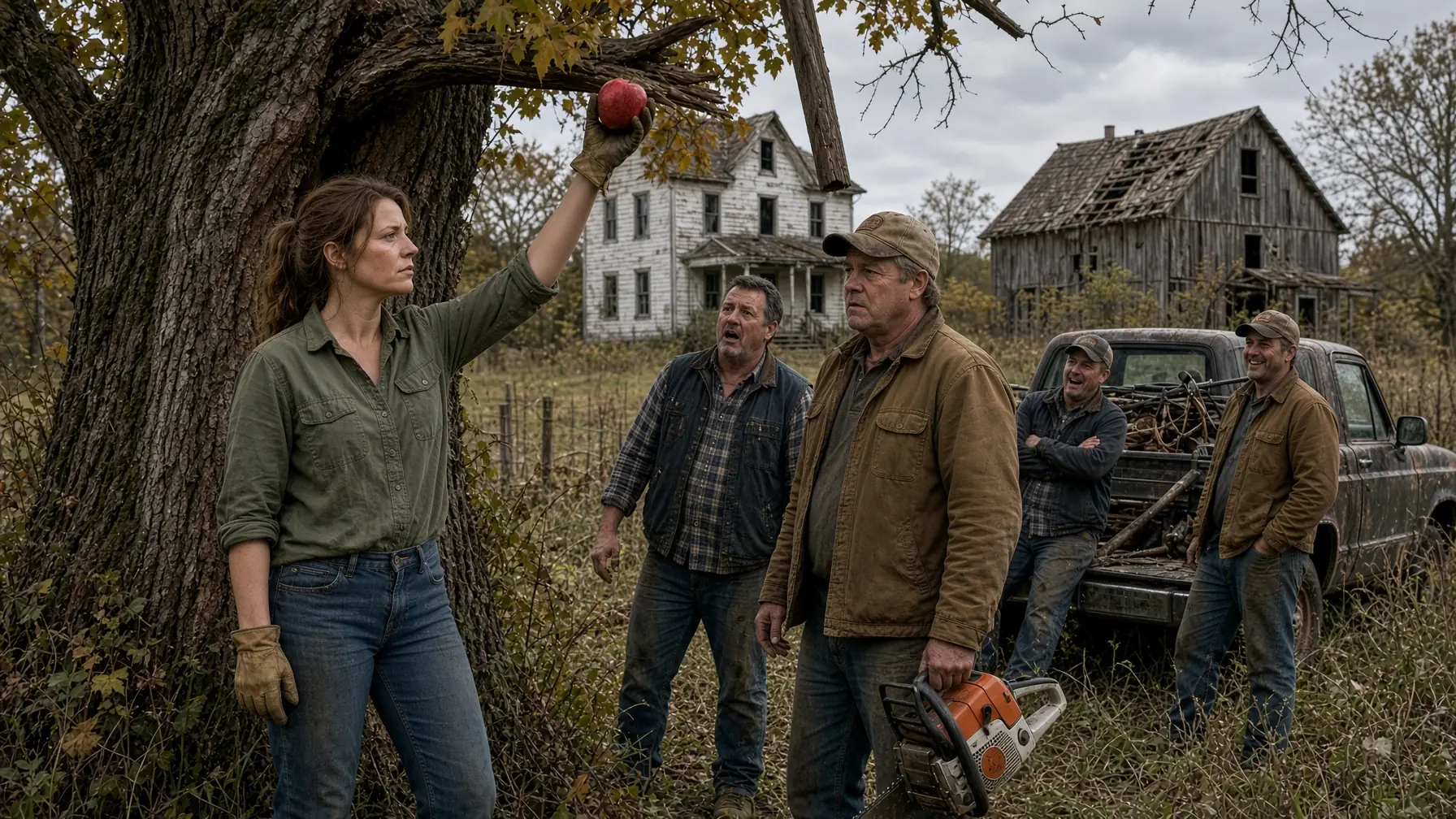
Something red was hanging from a branch that almost everyone in town had told her to cut down.
The tree did not look rescued.
Its trunk was split deeply through the center. Moss covered most of the northern side. One major limb had died years earlier and another leaned so low that Clare had finally built a wooden support beneath it to keep the weight from tearing it away completely.
From twenty yards away, the tree still looked like firewood.
Yet between a handful of tired leaves hung one apple.
Clare reached up and twisted it carefully from the branch.
The skin was rough.
One side was darker than the other.
A scar curved beneath the stem.
Nothing about it looked like fruit selected for a supermarket display.
But that was not why the three men standing behind Clare had gone quiet.
A year earlier, two of those men had told her the tree was finished.
They had said the same thing about the farm.
Seventy neglected acres stretched behind a rusted gate at the edge of town. The farmhouse had been empty for years. Part of the barn roof had collapsed. Blackberry vines buried fence lines, and young maples and black locusts had grown through fields that no longer looked like fields at all.
When Clare first bought the place, nearly everybody gave her some version of the same advice.
Clear it.
Cut it.
Burn what remained.
Start over.
For a while, even Clare wondered if they were right.
Then she found the rows.
And after that, nothing about the farm looked the same again.
Clare had not been looking for seventy acres.
In fact, when she first saw the real-estate listing, she nearly closed the page without reading the description.
The photographs were terrible.
One showed a white farmhouse with peeling paint and a porch sagging toward one corner.
Another showed a barn with a section of roof collapsed inward.
The final photograph was mostly weeds.
Tall grass.
Gray tree trunks.
Tangled vines.
The asking price was low enough to make Clare suspicious.
That was what finally made her drive out to see it.
The property sat several miles beyond the last gas station in town, past fields that were still being actively farmed and houses with fresh fencing and clean gravel driveways.
By the time Clare reached the rusted gate, the paved road had narrowed to gravel.
The real-estate agent was already waiting beside his truck.
He did not try very hard to sell her on the place.
“The house needs work.”
Clare looked at the missing shingles.
“I can see that.”
“The barn probably needs more.”
She looked at the collapsed section.
“I can see that too.”
He smiled.
“And most of the acreage hasn’t been maintained in years.”
That turned out to be the understatement.
Behind the house, blackberry canes reached nearly to Clare’s shoulders.
Wild grapevine wrapped around old fence posts.
Young maples and locust trees had grown through areas that must once have been pasture.
In several places, old woven-wire fencing had disappeared completely beneath brush.
The farther Clare walked, the more abandoned the property felt.
But the land was quiet.
That was what she remembered later.
Not the collapsed roof.
Not the weeds.
The quiet.
No highway noise.
No construction.
Only wind moving through tall grass and the occasional call of a crow somewhere beyond the barn.
Clare had spent most of her adult life working in town.
She knew almost nothing about restoring an old farm.
What she did know was that she wanted space.
Space to grow food.
Space to work with her hands.
Space that had not already been divided, paved, polished, or turned into someone else’s idea of what land ought to become.
When she told people she was considering buying the property, the reactions were predictable.
“That place?”
“I thought nobody had lived there in twenty years.”
“You’ll spend more clearing it than the land is worth.”
A man at the hardware store laughed outright.
“Only sensible thing is a dozer. Push out the brush, cut the old trees, burn the piles, start clean.”
Even the real-estate agent referred to the twisted trunks behind the barn as “old junk trees.”
Clare did not argue.
She had no reason to.
She signed the papers anyway.
And on the morning the keys became hers, she stood alone beside the rusted gate looking across seventy acres everybody else had already decided were finished.
She had no real plan.
Only a strange feeling that the land had been judged too quickly.
For the first several weeks, Clare treated the place exactly the way everyone expected.
As a cleanup project.
She cleared a path from the house to the barn.
Cut blackberry canes away from the back porch.
Dragged broken fence wire into piles.
Marked rotten boards.
Covered a leak in the farmhouse roof before the first autumn rain.
The old trees behind the barn barely registered.
They were simply part of the mess.
Then one evening near sunset, Clare walked beyond the barn with pruning shears in her back pocket and stopped beside one of the larger trunks.
It was ugly.
The bark was deeply ridged.
One side had been damaged years earlier, leaving a hollow large enough to fit her hand inside.
Dead vines hung from the crown like rope.
She almost walked past it.
Then she noticed another trunk directly ahead.
And another beyond that.
Clare stopped.
She shifted a few feet to the left.
The three trees lined up.
She looked farther.
There was another.
Then a gap.
Then another.
Clare stepped sideways again.
A second line appeared.
The spacing was too regular to be accidental.
She stood still and stared through the brush.
Once she understood what she was looking for, the pattern became impossible to ignore.
Tree.
Gap.
Tree.
Gap.
Tree.
Rows.
Not random trees surviving in an abandoned field.
An orchard.
The next morning Clare returned with a roll of orange survey ribbon.
She tied a strip around every trunk she believed belonged to the pattern.
By noon, there were twenty-three.
By evening, forty-one.
Two days later, she had marked more than seventy.
Some were little more than hollow shells.
Several had already fallen and were slowly disappearing beneath leaves.
Others were trapped under young maples, locusts, and thick vines that had climbed above their crowns and stolen most of the sunlight.
But a few were different.
One had leaves near the top.
Another had a thin shoot emerging from a low branch.
A third appeared dead from several yards away but held one small section of supple wood near the end of a limb.
Clare became curious enough to test it.
She took out her pocketknife and gently scratched a tiny piece of bark.
Underneath the gray surface was a thin green layer.
Living tissue.
Clare stared at it.
The tree was not healthy.
Not even close.
But it was alive.
That tiny strip of green created a larger question than the broken farmhouse or collapsed barn ever had.
If these trees had really been finished decades ago, why were they still alive?
And if they were alive, what exactly had she bought?
Clare began with one tree.
Not cutting it.
Just freeing it.
She removed blackberry canes around the trunk.
Cut grapevine away from the branches.
Removed a few saplings growing directly beneath the crown.
When she stepped back, the tree’s shape became visible for the first time.
Wide.
Low.
Spreading.
Branches arranged in a structure no wild tree would naturally choose.
Someone had trained it for fruit.
That evening, Clare stood at the edge of the newly visible row as the light faded.