The first sound I heard while I lay face down in my own driveway with a fake cop's knee on my neck was the low rumble of three black Suburbans turning onto my street. The second was a young agent in tactical gear shouting one word: "FBI!"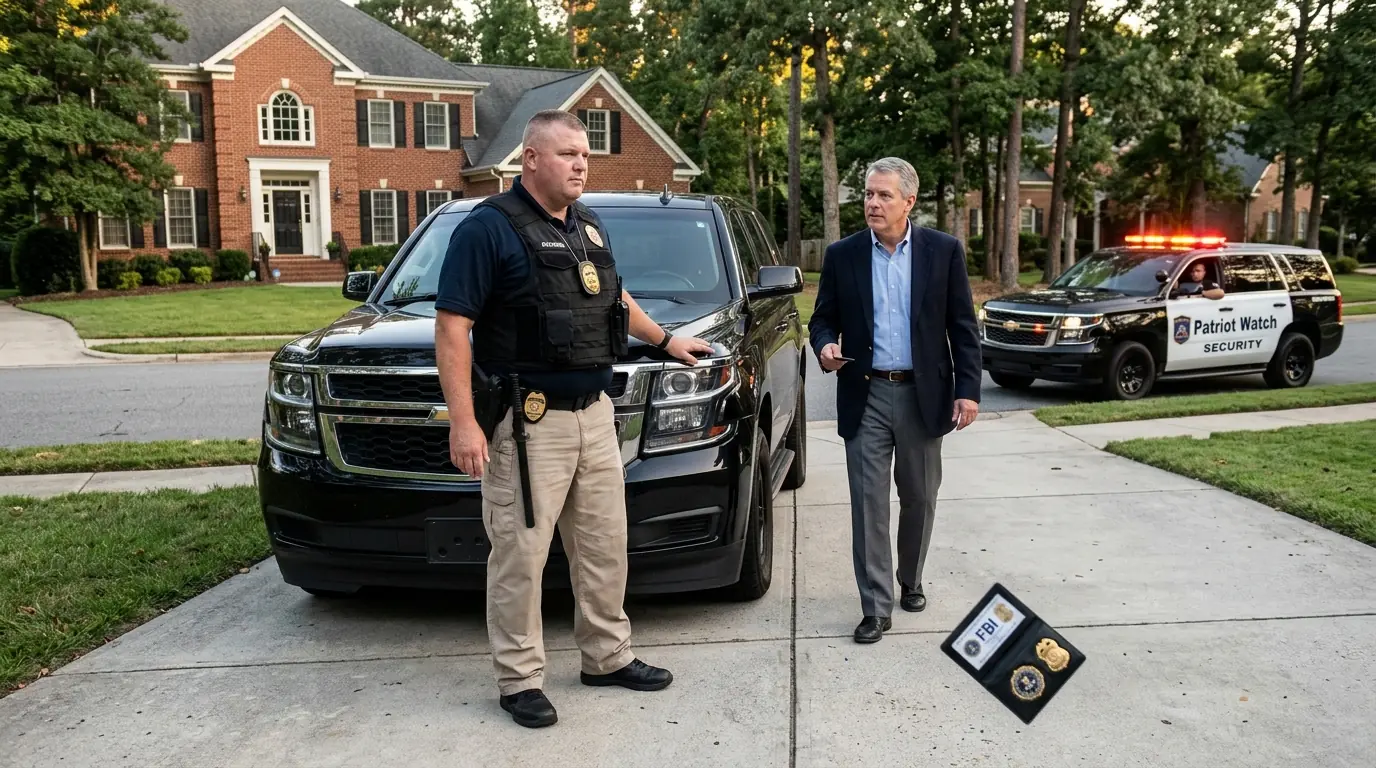
The knee came off my back instantly. Wade Chrisman, the fired prison guard who ten minutes earlier had been laughing at the gold seal on my fake credentials, stood up so fast he stumbled. The second officer dropped to his knees with his hands above his head before anyone told him to. The third one had already laid his unauthorized sidearm on the hood of his Tahoe.
Two real agents helped me to my feet. They unlocked Wade's handcuffs from my wrists. I picked up my credentials from the driveway and held the gold seal six inches from Wade's face.
"Mr. Chrisman, a moment ago you told me these were fake. Would you like to take another look?"
He sat down heavily on the concrete.
The other half of this story is how three men in fake uniforms ended up tackling the wrong man in his own driveway. To make sense of any of it, I have to take you back six months to the morning we moved into Hartford Pines.
I had been with the Bureau for twenty-five years before Caroline and I bought the house on Sycamore Lane. Twenty-five years of search warrants, cold case files, and 4:00 a.m. stakeouts in cars that smelled like old coffee and stale donuts. I started in the Memphis Field Office working bank robberies. I moved to Cincinnati in 2009 to work white-collar fraud. By 2017, I was in Charlotte running public corruption. Mostly I worked civil rights cases—the kind where a sheriff in some county nobody had ever heard of had been beating up arrestees for fifteen years and nobody had ever filed a complaint that survived the front desk.
Title 18, United States Code, Section 242: Deprivation of Rights Under Color of Law. That was the statute I lived in.
Caroline taught at the elementary school four blocks from our house. Children's librarian, technically. Storytime queen. The kind of woman who could quiet a room of forty kindergarteners by lowering her voice instead of raising it. She read to our son, Cooper, every night until he was fourteen and decided he was too cool for it. He came back to it the year after that and didn't tell anybody.
We bought the house in Hartford Pines because Caroline wanted a screened porch deep enough to fit a swing. She'd grown up in Asheville on a porch like that, watching her grandfather whittle bird whistles. She wanted Cooper to have the same thing—the same quiet, the same long Carolina evenings with the cicadas humming in the loblollies and the smell of pine sap on the air.
We didn't tell the neighbors what I did. That wasn't paranoia; that was procedure. I had testified against three different militia groups in federal court over my career, and one of them had distributed a photograph of me at a rally in West Virginia two years before we moved. I drove a black Toyota Tundra most days. Sometimes I drove a Bureau-issued Explorer. The Explorer didn't have markings, but it had government plates, and any neighbor who stared long enough could read them.
The HOA president decided I was retired military. The HOA president was wrong.
Patrice Dollinger ran Hartford Pines like a cruise director with a grievance. She wore pastel cardigans and pearl drop earrings. Her hair was the exact shade of yellow you only get from a salon that charges extra to lie about your roots. She drove a white Cadillac SUV and kept a leather-bound clipboard on the passenger seat at all times.
She introduced herself the day we moved in by walking up our driveway uninvited and informing Caroline, who was carrying a box of cookbooks, that the back of her husband's truck had a tow hitch, and they didn't allow visible utility on the front-facing side of the property.
Caroline set the box down very gently, smiled, and said, "We'll do our best to keep it tasteful."
That was the most Caroline ever said to Patrice Dollinger. Patrice nodded the way a woman nods when she's already mentally drafting your first violation notice. Then she turned to me. I was unloading the last box from the bed of the Tundra, and her eyes did a little flicker. Big man, working clothes, tow hitch, quiet wife.
"And what is it you do, Mr. Bellamy?" she asked brightly.
I smiled. "Federal employee, ma'am. Office work."
"Oh," she said. "Postal Service?"
"Something like that."
That night, Caroline stood at the kitchen sink and said, "She's going to be a problem."
I poured her a glass of Cabernet. "She's going to be a study," I said.
The first violation notice landed in our mailbox forty-eight hours after we moved in. Cream paper, Hartford Pines HOA letterhead embossed in green foil. The notice cited me for visible utility hardware on a front-facing vehicle in the form of an exposed tow hitch—a violation, Patrice claimed, of section 7.2.4 of the Hartford Pines CC&Rs.
Fine: $150. Remove the hitch within fourteen days.
I read the notice twice on the porch, with my coffee getting cold and a Carolina wren chattering somewhere in the loblollies. Then I read the CC&Rs. I found section 7.2.4. It prohibited commercial signage or branded equipment visibly mounted on personal vehicles. Tow hitches were not mentioned anywhere in the document. I'm an FBI agent; reading rule books is what I do for breakfast.
I drafted a one-page response, attached photos with timestamps, and politely requested the violation be vacated. I dropped it through the slot on the management office door.
Three days later, Patrice sent me an amended notice. Same fine, new justification: aesthetic non-conformance per board discretion.
That night, Caroline read it at the kitchen counter, snorted once, and said, "Aesthetic discretion? From a woman who has a faux wagon wheel mailbox."
I laughed. We let it go. I paid the fine.
A week later, Patriot Watch Security drove down our street for the first time. I was on the screened porch with a glass of bourbon when I heard them. A black Chevy Tahoe with a full LED light bar across the top, amber and red strobes mounted in the front grill, decorative push bars on the bumper, and the words *Patriot Watch Security* in dark gray block letters across the rear quarter panel. Below the words was a stylized eight-point gold star that, at a glance in the fading evening light, looked exactly like a deputy sheriff's shield.
I sat very still and watched it crawl past my driveway at five miles an hour. The driver was a heavy-set man in his late thirties, wearing a black tactical vest over a dark blue button-down with what appeared to be a metal badge clipped to his chest. He had a duty belt. He had a holster. He had a portable radio crackling on his shoulder.
He was not a police officer. He was not a deputy. He had no statutory authority over anyone in Hartford Pines, including the dust on the asphalt under his tires. I knew this because Section 14-4-908 of the North Carolina General Statutes, the impersonation of an officer statute, was a chapter I had read in detail three years earlier on a different case.
I waited until the Tahoe rolled out of sight. Then I walked inside, pulled my work laptop out of the kitchen drawer, and ran a quick LLC search on Patriot Watch Security. The registered agent was Dale Dollinger—Patrice's husband.
I sat at the kitchen counter for a long time. The kitchen lights were dim, the cicadas humming on the porch. Caroline came in around eleven, saw my face, and said, "What is it?"
I turned the screen so she could see. "Patrice's husband," I said, "is running an impersonation operation in our neighborhood."
She read for a minute. "Is that illegal?"
"Federally and at the state level, yes."
She poured herself a small glass of Cabernet, sat down across from me, and said, "What are you going to do?"
I closed the laptop and looked her in the eye. "I'm going to do absolutely nothing visible. I'm going to let them dig. I'm going to document everything. And when they make the kind of mistake people like that always make, I'm going to be standing right where they can fall on me."
Caroline reached across the counter and took my hand. "Cooper's in the house, Mason. Whatever this turns into, his mother needs to know it's safe."
I squeezed her hand back. "It will be safe. People who pretend to be police are afraid of real ones. They don't get reckless until they think nobody's watching. Right now, somebody's watching."
Caroline looked at me for a long moment, then she nodded.
The next morning, the second violation notice was already in our mailbox. Patrice was punctual. It was going to be a long six months.
The second wave of violations was where Patrice graduated from petty into something darker. Over the next four weeks, I received eleven notices. A non-conforming garden hose reel. A structural intrusion on our flower bed border. A single decorative river rock that had migrated three inches outside the line on a survey map I had never seen. An unsanctioned exterior color complaint about a porch swing Caroline's grandfather had built in 1971.
Each notice carried a $150 fine. Each fine could be paid two ways: through the official HOA management portal or, conveniently, through Patriot Watch Security on-site enforcement. The bottom of every notice said in small print: *Pay your fine the easy way. Patriot Watch officers will accept cash on weekends.*
I stared at that line for a long time the first time I saw it. Cash payments to a private company that was being mistaken for police, collected at homes, in driveways, with a uniformed officer present. That wasn't an HOA; that was extortion under color of law with a uniform-enabling charade. Title 18, United States Code, Section 1951: The Hobbs Act. I had taught a young agents' class on it in 2019.
I did not pay through Patriot Watch. I paid every fine through the official portal on my Bureau-issued laptop, leaving an electronic paper trail an investigator could follow without breaking a sweat. I also began screen-recording the HOA portal each time I made a payment.
Then, on a Saturday in late October, I watched two Patriot Watch officers stop a teenage girl at the corner of our street. Her name was Becca Halverson. She was thirteen. She lived four doors down. She was riding her bike home from a friend's house with a soft pretzel from the Sheetz on Route 49.
The Tahoe rolled up next to her. Two officers got out. They told her she had been speeding on a Hartford Pines internal road and demanded ID. She didn't have ID; she was thirteen. They asked for her parents' names and addresses. They told her if she didn't comply, they'd have to call backup. They held her at the curb for nineteen minutes while one of them filled out a violation report. Then they told her she could go.
She went home crying. Her mother, a school counselor named Janette Halverson, called Patrice Dollinger. Patrice told her in writing that Patriot Watch was fully authorized to detain residents during enforcement activities and that Becca had demonstrated a "defiant attitude" that necessitated escalation.
Janette knocked on our door the following Monday with the printout in her hand. She did not know what I did for a living. She had come to us because Caroline had been kind to her at the school carnival in August, and she didn't have anyone else to ask.
I read the printout twice. Caroline put a kettle on.
I asked Janette if Becca had any visible bruising or marks. She said no, just that her daughter wouldn't ride her bike anymore and was sleeping with her bedroom light on. I asked if Patriot Watch had touched her in any way. She said one of them had held her wrist for a moment when she tried to wheel her bike forward.
That single sentence—*held her wrist for a moment*—moved this entire situation into the realm of federal civil rights deprivation. Title 18, USC 242, the same statute I had carried in my back pocket for twenty years.
I wrote down everything Janette told me. I asked her if she would be willing to sign a sworn statement at a later date. I told her there might be other neighbors with similar experiences. I told her, very gently, that I worked for a federal agency and that I was about to make a few phone calls.
She asked me which agency. I told her. Her eyes got very wide, and she set her tea down.
"Are we in danger, Mr. Bellamy?"
I looked at her across our kitchen island, at the kettle steaming behind her, at the pine boughs swaying outside the window. "No, Janette. They are."
That night, I called my Special Agent in Charge. We met at a Waffle House on Route 49 the following morning at 6:00 a.m. I laid out everything—the Patriot Watch operation, the LLC ownership, the cash collection scheme, the Halverson incident—across two paper placemats. She listened. She drank black coffee. She did not interrupt.
When I finished, she said, "Mason, I want this case, but you cannot run it. Conflict of interest. I'm going to assign Brendan."
I nodded. I figured as much.
"Your job," she said, "is to live there. Document everything. Don't blow your cover. Let them keep digging. We'll come in when there's a body of evidence a grand jury can't ignore."
I shook her hand. I drove home through the morning mist. The trap was officially set.
The third escalation came on a Friday afternoon in November when Patriot Watch detained Cooper's best friend. His name was Tyler Reinhardt. He was sixteen. He lived two streets over in the smaller homes near the back of the subdivision—the section where Patrice had quietly been pushing for a rezoning study on the grounds that the houses were lowering the median curb appeal. His mother, Lorraine, was a single nurse working twelve-hour shifts at the cardiac unit of WakeMed Cary. She had no time for Hartford Pines politics. She had no money for Patriot Watch fines.
Patrice had filed seventeen violations against Lorraine Reinhardt in twenty months. The Reinhardts had paid rehabilitation on eight of them. They were behind on the rest.
That Friday, Tyler was riding his skateboard down the access path that connected the back lots to the community pool. The path was a public easement paved by the county, posted with a county sign. Skateboarding on it had been legal for thirty years. Two Patriot Watch officers blocked the path with their Tahoe.
The lead officer that day was a man named Wade Chrisman. Forty-one years old, six-foot-two, heavy set, shaved head, with a neck tattoo of a Maltese cross. He had been fired from the Mecklenburg County Detention Facility in 2020 for the use of unauthorized escalating force on three separate inmates. He had not held a real law enforcement job since. He had passed the vetting at Patriot Watch because the vetting at Patriot Watch consisted of Dale Dollinger asking, "Can you start Monday?"
Wade ordered Tyler off his skateboard. Tyler asked why. Wade pulled out a pair of stainless steel handcuffs.
In the next ninety seconds—recorded on a Ring camera mounted to the Mendelson family's mailbox at the entrance to the path, footage I would obtain three days later via a polite knock and a friendly conversation—Wade Chrisman placed the sixteen-year-old boy in handcuffs, walked him to the rear of the Tahoe, and locked him inside the prisoner cage in the back seat.
Tyler sat in that cage for forty-one minutes with the air conditioner off. The temperature outside was 74 degrees. The interior temperature of the Tahoe rose to 97. When Wade finally let him out, Tyler was crying and dehydrated. Wade told him he was being released with a warning. He told him not to skate on Hartford Pines property again. He told him if his mother didn't catch up on her HOA fines by the end of the month, there would be consequences for the whole family.
Tyler walked home holding his skateboard with both hands.
Lorraine called me that evening. I had given her my cell number two weeks earlier after the Halverson incident, when I had begun quietly collecting accounts from any neighbor who had been stopped or fined inappropriately. Lorraine had been one of the first families I'd interviewed. She had told me almost nothing initially because she was scared. That night, she told me everything.
I drove to her house in plain clothes. I sat at her kitchen table with her son. I asked Tyler to walk me through every minute of the encounter. He did in a quiet voice, picking at the corner of his lip with a fingernail. He showed me the red marks on his wrists where the cuffs had been on too long. He showed me a photo on his phone of the inside of the Tahoe cage.
I asked Lorraine if I could photograph Tyler's wrists. She said yes. I asked if I could keep the audio recording I had been making on my phone. She said yes.
I turned to Tyler. "Son, what happened to you today is a federal civil rights crime. Several of them. I'm going to need you to tell your story exactly the way you told me, to a federal grand jury, sometime in the next few months. Can you do that?"
Tyler looked at his mother. She nodded at him. He looked back at me. "Yes, sir."
I drove home through the loblollies. I sat on my screened porch in the dark with a glass of bourbon and watched the cicadas. Caroline came out around midnight in her bathrobe. She didn't ask where I had been. She knew. She sat next to me and put her hand on my arm.
"Mason," she said quietly, "how long until you put them down?"
I watched a moth drift past the porch light. "Soon. Very soon."
That weekend, I called Brendon, my SAC's lead investigator on the case, and told her we had a witness, a victim, and a video.
She said, "Then we have a federal case." The hunt was officially on.
The truth was worse than I'd imagined. It took me three weeks of patient digging, public records pulls, LLC corporate filings, North Carolina Secretary of State filings, county business licenses, and one very long Saturday morning with a retired FBI forensic accountant named Hollis Penberthy, who lived four doors down. I had not known Hollis was former Bureau when we moved in. He had not known I was current Bureau. We had nodded at each other at the mailbox a dozen times.
The first time I knocked on his door with my folder under my arm, he opened it, looked at me, looked at the folder, and said, "Bellamy, about damn time."
He had been quietly watching Patrice Dollinger for fourteen months. Hollis had worked thirty-two years in the Bureau on white-collar crime. His specialty had been spotting money flow inside private contractor schemes that looked legitimate from the outside but were skimming on the inside.
Patriot Watch Security was textbook. He laid it out at his kitchen table with two yellow legal pads. The pattern was clean. Patrice, as HOA president, had steered an annual security contract from Hartford Pines to Patriot Watch—a contract she had signed both as board president and benefited from through her husband. It was $180,000 per year for a two-hundred-house subdivision. Comparable contracts elsewhere ran around $32,000. Patrice was pocketing the spread through consulting fees routed back to herself through a Delaware shell company.
That was wire fraud, mail fraud, honest services fraud, and self-dealing.
The cash collection scheme—Patriot Watch officers taking fines in driveways—was the second layer. None of those payments went to the HOA. They went to Dale Dollinger's personal account at a credit union in Garner. That was extortion under color of law.
The hiring of Wade Chrisman and two other officers with disqualifying backgrounds, deployed in police-imitating uniforms in a sustained pattern of stops and detentions of residents, was the third layer. That was federal impersonation of an officer, civil rights deprivation under color of law, and conspiracy.
Hollis pushed his legal pads across the table. "You have a RICO case, Mason."
I sat for a long time looking at his timeline, the smell of his coffee, the hum of his ancient Frigidaire, the framed picture of his late wife on the wall. "Why hasn't anyone caught them?"
Hollis smiled, not unkindly. "Because the people they target are too tired to fight, too scared to talk, or too poor to hire lawyers. Patrice picks her victims like a wolf picks deer. Old, lame, alone. And the local sheriff doesn't even know Patriot Watch exists because they operate inside the gates of an HOA and never cross paths with real law enforcement." He sipped his coffee. "You, my friend, are the first target with a badge in his sock drawer."
I asked if he'd help me build it out. He was halfway out of his chair before I finished the sentence.
That night, I sat at our kitchen table and laid out a single index card for Caroline. On one side, I wrote what we had. On the other, I wrote what we needed. She read both sides, poured herself a small glass of Cabernet, and said, "How do you want me to help?"
"Just keep being you," I said. "Don't engage with Patrice. Don't react. Live your life. The closer to normal we look, the more reckless they get."
She kissed my forehead. The hunt had moved to the federal level. Patrice Dollinger had no idea she was the prey.
The next nine weeks were the most disciplined work of my career. The Bureau opened a formal investigation under file number 281D-CE-2025-2110, designated as a public corruption matter with a civil rights overlay. It was assigned to Special Agent Tessa Brendon out of the Charlotte Field Office, a fifteen-year veteran I had worked with on three previous cases. Tessa was patient, quiet, and methodical. She worked in green ink and kept her notes in a leather portfolio her late father had carried in Vietnam.
Tessa came to our house twice in plain clothes. We met at the kitchen table with the curtains drawn, Caroline's apple pie cooling on the counter, and laid out the case on yellow legal pads.
What we had: Hollis's financial timeline, the Halverson statement, the Reinhardt audio recording, the Mendelson Ring footage of Tyler's detention, eleven separate Patriot Watch citations in my own files, and cash receipts from three different neighbors who had paid Patriot Watch in their driveways and kept the carbons.
What we needed: subpoenas for Patriot Watch's financial records, bank records on Dale Dollinger's credit union account, HOA financials, a pen register on Patriot Watch's dispatch radio frequency, and most importantly, an overt act on tape. A real, undeniable, video-recorded act of impersonation or force by Patriot Watch officers against a person they did not know was a federal agent.
Tessa looked at me across the table. "We need them to do it to you, Mason."
I nodded. I had already worked that out. "I'll let them," I said.
Tessa pushed her glasses up her nose. "We can't bait them. They have to come to you on their own. You're just going to be wearing a wire."
I told her I would.
In the meantime, I quietly did seven other things. First, I had four miniature HD cameras installed at the corners of my property and one inside the dashboard of my own vehicle—cellular uplink, continuous record, secure FBI server. Second, I obtained, through Tessa, a federal surveillance order covering my driveway and front yard. Third, I was issued a body-worn audio device disguised as a tie clip; it activated the moment I touched my left lapel. Fourth, Hollis and I cross-referenced every single payment Patriot Watch had ever received from Hartford Pines residents—over four hundred transactions in eighteen months—and built a flowchart matched to Dale Dollinger's bank records via subpoena. Fifth, I conducted twenty-three off-the-record interviews with current and former Hartford Pines residents who had been stopped, fined, or detained by Patriot Watch. Twelve agreed to sign sworn statements; three would later become grand jury witnesses. Sixth, I drove out to the Wake County Sheriff's Office and met with Sheriff Wendell Carmody, a no-nonsense former Marine who had been sheriff for nineteen years. He had not known Patriot Watch existed. When I explained, his face went a particular shade of red I had only seen previously on men whose wives had told them they'd backed over the dog. He pledged the full resources of his department. Seventh, I called Cooper into my home office on a Sunday afternoon and told him exactly what was about to happen. He was sixteen, tall now, quiet like his mother. I told him there might be a day in the next few weeks when he came home from school and the driveway was full of squad cars and federal agents, and his father might be on the ground. I told him that if it happened, he was not to panic, not to speak, not to interfere. He was to walk into the house, lock the door, and call his mother.
He listened, nodded, hugged me, and said, "Dad, get them."
I told him I would.
Tessa called me on the morning of February twenty-first. "Mason, the grand jury convenes on March fourteenth. We need the overt act before then."
I sat at my kitchen table, watching the pine boughs sway outside the window. "I'll get it for you this week."
That afternoon, I drove the Bureau Explorer home for the first time in a month and parked it in the driveway in plain sight of the street. I went inside, poured a bourbon, sat down at the kitchen island, and I waited.
Patriot Watch took the bait on a Monday afternoon at 4:47 p.m. I was on the screened porch, a glass of iced tea sweating beside me, my tie clip resting on my collar, and four cameras live on my phone. Caroline was at the school for a parent-teacher conference. Cooper was at baseball practice.
I heard the Tahoe before I saw it—the crunch of a heavy tire turning into our driveway, the thunk of a door, boots on concrete. I waited a full thirty seconds before I stood up. When I walked out the front door, Wade Chrisman was standing beside my Bureau Explorer with his hand on the driver's side door handle.
He looked up and saw me, his mouth twitching into a smile. "Mr. Bellamy."
"Officer Chrisman."
He liked that. He liked being called officer. I had filed that away weeks earlier.
"This vehicle," he said, "doesn't have a current Hartford Pines parking sticker. Didn't see you affix one to the windshield."
"It's my driveway," I said.
"Doesn't matter. Visible parking on driveways is governed by HOA policy 12A. Patriot Watch is the contracted enforcement arm."
"I see."
He grinned. "Going to need you to pop the door. We need to inspect the registration."
I tilted my head. "Why would Patriot Watch need to inspect a federal vehicle registration?"
His grin slipped half a millimeter, but he recovered. "This is a federal vehicle?"
"It is."
"You'll need to prove that."
I reached very slowly into my breast pocket. I produced my FBI credentials and held them up at chest height. Wade looked at the gold seal. He looked at the photo. He looked at me. Then, he laughed.
"Nice try, Fed boy. These are fake."
He said it loud—loud enough that the second officer, a wiry kid named Devin Pratchett, twenty-four, second cousin to Dale Dollinger, who was also disqualified from law enforcement training because of a 2019 misdemeanor assault conviction in Nash County, heard him from the passenger side of the Tahoe. Devin laughed, too.
A third officer climbed out of the back of the Tahoe. He was a man named Bart Eustace, wearing a black tactical vest, a duty belt, and a sidearm in a hip holster. He had no permit to carry that sidearm openly in this state. I noted that. I noted everything.
I touched my left lapel. The tie clip activated.
"Gentlemen," I said calmly, "I'm asking you to step away from my vehicle."
Wade pocketed my credentials. "Sir, you're going to need to sit down right there on the curb until we can verify these. We have reason to believe you're impersonating a federal officer."
"That's a serious charge," I said. "Are you placing me under arrest?"
"Detention," Wade said, "pending verification."
"On whose authority?"
"Patriot Watch has full citizen's authority under HOA contract."
"That's not a real thing, Mr. Chrisman."
His jaw tightened. He looked at Devin, and Devin stepped forward.
"Sir," Wade said, "I'm going to need you to sit down on the curb."
"I'm not going to do that."
"Sir."
I did not move. I did not raise my voice. I kept my hands at my sides, my palms visible, my body at a forty-five-degree angle to the three of them—the standard stance the Bureau teaches you for de-escalation.
Wade stepped toward me.
I said, very clearly, "I do not consent to a search. I do not consent to detention. I am identifying as a senior special agent of the Federal Bureau of Investigation. Be advised that this encounter is being recorded."
Wade smiled. "Fed boy thinks he's Hollywood." He grabbed my left arm.
What happened in the next nine seconds was on tape from four angles, plus my dashboard, plus my tie clip. I did not strike. I did not push back. I did not break his grip. I did exactly what I had told Tessa I would do: I let him commit a felony.
He twisted my arm behind me. Devin swept my left leg from behind. Bart Eustace stepped in and shoved my shoulder forward. My knee hit the concrete, then my chest, then my cheek.
"Stop resisting!" Wade yelled. He yelled it three times. I had not moved.
His knee came down on the back of my neck. He pulled my credentials from his pocket and threw them onto the driveway, where they skittered eight feet and came to rest under his boot. He cuffed me with a stainless steel pair of his own handcuffs. He read me a fake Miranda warning from memory. He missed the right to remain silent. He missed the right to an attorney. He invented a right to comply with HOA enforcement.
I lay perfectly still, the side of my face on the concrete, the smell of Carolina pine and motor oil in my nose. Inside my left ear, in a frequency only I could hear, the small earpiece I had been wearing all afternoon crackled to life. It was Tessa Brendon's voice.
"Mason, we have it. SWAT is rolling. Hold position."
I closed my eyes. I exhaled slowly into the concrete. I held position.
I lay face down on my own driveway for nine minutes and twelve seconds. I know because I counted in my head, the way you learn to in interrogation training, breath by breath. Wade Chrisman knelt on my back the entire time. He had a knee on my neck for the first three minutes. He took it off when Devin Pratchett, looking nervous, told him, "Wade, ease up. The dude isn't fighting." Bart Eustace stood guard at the end of my driveway, hand on his unauthorized sidearm, looking up and down Sycamore Lane.
While I lay there, Wade interrogated me. He asked me where I was really from. He asked me who had given me the fake badge. He asked me if I was deep state. He told me he had been expecting someone like me. He told me Patriot Watch had instructions to deal with federal infiltrators on site. I said nothing. I memorized everything.
He searched my Explorer. He found my service weapon, a Glock 19M secured in a locked dashboard safe. He could not open the safe; he tried for forty seconds and gave up. He found my Bureau credentials wallet in the center console, a copy of the federal vehicle registration, and a Bureau-issued radio. He did not know what the radio was. He turned to Devin and said, "What is this?" Devin did not know either.
Bart Eustace, the only one of the three with even minimal exposure to real law enforcement equipment, walked over, looked at the radio, looked at the registration, looked at the credentials wallet, and said very quietly, "Wade, we need to leave."
Wade laughed at him. "Bart, relax. The badge is fake."
Bart said, "The radio is real."
Wade told Bart to shut up.
In my left ear, Tessa Brendon's voice came again, calm and even. "Mason, tactical is two minutes out. Status?"
I could not speak. I tapped the concrete twice with my fingertip. The sensor on my watch, concealed under the cuff Wade had not been able to remove because it locked at a Bureau-only release point, sent the prearranged signal: two taps, holding, vitals stable.
Tessa said, "Copy. Stay down. They're going to be loud."
Forty-six seconds later, the cul-de-sac became loud. Two black Suburbans pulled in at the far end of the street with their lights off. Three Wake County Sheriff's cruisers came in behind them with their lights on. A black armored response vehicle, an MRAP unit out of the Charlotte Field Office, rolled up directly behind the Tahoe, blocking it.
A line of agents in tactical gear poured out of the Suburbans with weapons raised. I heard the command before I saw the speaker.
"FBI! Hands!"
Wade's knee came off my back instantly. Devin Pratchett dropped to his knees with his hands above his head before anyone told him to. Smart kid; he had read the situation correctly two minutes earlier and had been waiting for an exit. Wade Chrisman, on the other hand, made the worst decision of his life. He stood up. He turned toward the FBI line. He kept his hand on his service-style baton.
A young agent, name tag Hennessy, gave him exactly one warning: "Drop the baton." Wade dropped the baton.
Bart Eustace had already laid his unauthorized sidearm on the hood of the Tahoe and put his hands behind his head. He was sitting on the curb with his eyes closed by the time the second wave of agents reached the driveway.
Two agents helped me to my feet. They unlocked Wade's handcuffs from my wrists with a key the FBI carries specifically for situations involving wrongful detention. They walked me thirty feet down the driveway away from the Tahoe.
Tessa Brendon walked across my lawn in a black tactical jacket, her FBI credentials on a lanyard around her neck, her green ink notebook in her hand. She stopped six feet from Wade Chrisman.
"Mr. Chrisman?"
"Who are you?"
"Special Agent Tessa Brendon, Federal Bureau of Investigation. You are under arrest on federal charges of impersonation of a federal officer, deprivation of rights under color of law, conspiracy, extortion, and assault on a federal agent. Anything you say can and will be used against you."
Wade's mouth opened, closed, and opened again. He looked over Tessa's shoulder at me.
I had picked up my FBI credentials from the driveway. I held them up the way I had held them up nine minutes earlier. I said, very quietly, "Mr. Chrisman, a moment ago you told me these were fake. Would you like to take another look?"
Wade looked at the gold seal. He looked at me. He sat down very heavily on the concrete.
A fifth vehicle pulled into the cul-de-sac. It was a white Cadillac SUV. Patrice Dollinger had come to supervise.
By the time Patrice Dollinger's white Cadillac stopped at the foot of my driveway, the cul-de-sac was full. It had started with Hollis Penberthy. He'd been on his porch when the first Suburban rolled in. He had picked up his cordless phone and called four neighbors. Four had become eight. Eight had become twenty-two.
Tyler Reinhardt and his mother, Lorraine, were standing at the property line by then. Becca Halverson and her mother, Janette, were two driveways down. Three different couples whose names I had only learned during my interviews stood in the quiet semicircle along the curb—the Mendelsons, the Crawfords, the Bartholomews. Eighteen of the people on Sycamore Lane that afternoon had paid Patrice Dollinger or Patriot Watch in some unfair, illegal, or fabricated way over the past two years.
A WBTV news van pulled up six minutes after the FBI did. A young reporter named Lacy Bramwell got out with her cameraman. She had been tipped off, I would learn later, by the dispatcher at the Wake County Sheriff's Office, who happened to be Lacy's stepmother.
Patrice climbed out of her Cadillac in a peach-colored cardigan and white slacks. She was carrying her leather-bound clipboard. She walked up the cul-de-sac with her chin in the air, like a woman walking onto a stage. She did not know yet that she was the show.
She made it eight steps before she registered the Bureau Suburbans, the MRAP, the FBI tactical gear, the sheriff's deputies, the news camera, and her own husband, Dale, being walked out of his Patriot Watch headquarters across town in a parallel raid happening at that exact moment in real time. Her face did something I had only seen twice in my career: it collapsed in stages.
Tessa Brendon turned and walked the thirty feet to Patrice in steady, measured strides. "Patrice Dollinger?"
"Y-yes."
"Special Agent Brendon, Federal Bureau of Investigation. I have a warrant for your arrest on charges of conspiracy to deprive citizens of civil rights under color of law, mail fraud, wire fraud, honest services fraud, federal racketeering, and self-dealing." She paused. "I also have a search warrant for your residence and the offices of Patriot Watch Security."
Patrice's mouth opened. The clipboard slipped out of her hand and clattered onto the asphalt. Tessa cuffed her in front of forty-three witnesses and a rolling news camera.
I crossed the lawn and stood beside Tessa. I looked at Patrice—the peach cardigan, the pearl earrings, the shellacked yellow hair drooping in the spring humidity.
"Mrs. Dollinger," I said, "I want you to look at the people standing behind me."
She did not move.
"Look at them, Patrice."
She turned her head.
"Every one of them paid you," I said. "Every one of them got a citation, a fine, a tow, a cash demand at the curb, or a child detained. One of them is sixteen years old. He spent forty-one minutes locked in the back of a fake police car on a 74-degree afternoon because his mother was three weeks behind on a non-conforming mailbox fine."
Tyler Reinhardt did not look down. He looked her right in the eye. I kept going.
"You decided you were the law in this neighborhood. You were not. You decided you could pretend to be the law to make yourself rich. You can't. And the part you really got wrong—the part that's about to make this story rather public—is that you decided I was a postal worker."
Patrice's eyes flickered.
I took out my FBI credentials and opened them slowly, holding them six inches from her face. "Federal employee, ma'am. Office work."
Her knees actually buckled. Tessa caught her elbow.
Sergeant Norville, one of the sheriff's deputies, walked Patrice to the sheriff's cruiser. As she was lowered into the back seat, she turned and looked at me one final time. I lifted my coffee mug, which I had picked up on the way out of the house.
"Drive safe, Patrice."
The cruiser door closed.
Sheriff Wendell Carmody, with his Marine-cropped white hair and his gold star uniform, stepped forward to address the crowd. He did not raise his voice; he did not need to.
"Folks, Patriot Watch Security has been impersonating law enforcement officers in your neighborhood for eighteen months. They have no statutory authority. They never did. If you have ever been stopped, fined, detained, or had cash collected from you by a Patriot Watch officer, please come see Special Agent Brendon. We are opening a victims' restitution file right now. Bring everything you have."
People started moving toward Tessa before he even finished his sentence. Lacy Bramwell turned her microphone toward me. "Senior Agent Bellamy, can you comment on how this case came to the Bureau's attention?"
I looked into the camera with the calm I reserve for the worst days of my career. "Twelve neighbors built this case. A retired forensic accountant on this street built a third of it. A sixteen-year-old boy and his mother built another third. I just made the phone calls. The credit belongs to the people standing on this street."
I turned and looked at the semicircle of neighbors. A few of them were crying. Tyler Reinhardt was holding his mother's hand; Lorraine had her eyes closed. I crossed the lawn and shook Tyler's hand. "You did good, son."
He nodded once, but did not speak. Behind us, the news camera kept rolling.
The federal grand jury returned a forty-seven-count indictment against Patrice and Dale Dollinger, plus three Patriot Watch officers—Wade Chrisman, Devin Pratchett, and Bart Eustace—eleven days later.
Patrice pleaded down to fraud, conspiracy, and racketeering. She received seven years in federal prison and was ordered to pay restitution of $440,000 across thirty-one victims. Dale received five years. Wade Chrisman, who had multiple prior incidents and was the most aggressive defendant on the tape, was convicted at trial of civil rights deprivation under color of law, assault on a federal agent, and impersonation. He received eleven years. Devin Pratchett, who had cooperated, received three years. Bart Eustace served fourteen months.
Patriot Watch Security was dissolved and its assets were seized. The eight-thousand square feet of office space it had occupied in Garner became the new headquarters of the Wake County Sheriff's Auxiliary Volunteer Program.
The Hartford Pines HOA was placed under court-ordered receivership. A new board was elected the following spring. Hollis Penberthy served as president for one term, refused to sit a second, and handed the gavel to Lorraine Reinhardt, Tyler's mother, whose first official act was to fire the management company and rewrite the CC&Rs from forty-four pages to nine. She tore down the gates at the entrance to the subdivision the same week.
I went back to work at the Charlotte Field Office. Tessa got a commendation. Hollis got a thank-you letter signed by the director. Sheriff Carmody got himself another five-year term and a regional law enforcement award.
But the part of this story that mattered most happened the following October. On a warm Saturday afternoon, half the neighborhood gathered in our backyard for the first annual Hartford Pines Citizens Education Day. Sheriff Carmody brought two deputies and a folding table full of brochures. A retired Wake County Superior Court judge gave a forty-minute talk in our gazebo on what private security companies can and cannot legally do. A volunteer from the ACLU walked teenagers through their rights during a stop. Hollis taught a thirty-minute crash course on how to read your CC&Rs without getting hosed.
Tyler Reinhardt, now seventeen and an inch taller, a full year wiser, gave the closing remarks. He read for six minutes in a steady voice from a sheet of yellow legal paper Hollis had helped him draft. He talked about what it had felt like to be in the back of that Tahoe. He talked about the silence afterward. He talked about the moment he had decided to tell the truth in front of a grand jury, and how that decision had felt larger than he was.
He ended his speech with one sentence: "My mom and I aren't going anywhere, and neither is anyone else on this street."
The crowd stood and cheered.
That afternoon, I planted a small dogwood tree at the back of our property in memory of my old partner, Charlie Eldridge, who had been killed five years earlier in a botched takedown of a sovereign citizen militia in Mineral Wells, West Virginia. Charlie had spent his whole career chasing fake cops; he never got to see one go down on a federal indictment. I told Caroline that night on the porch that the dogwood was for him.
She said, "He'd be proud of you, Mason."
I said, "He'd be proud of all of us."
We sat on the porch swing for a long time, watching the cicadas hum in the loblollies, the smell of pine sap on the air, the long Carolina evening settling around us like a quilt. Cooper came out around 9:00 p.m. in his sock feet with a mug of cocoa. He sat down between us. He didn't say anything. He didn't have to.
The cul-de-sac was quiet. The gates were gone. The fake cops were in federal prison. The neighborhood I had wanted Caroline to have was finally the neighborhood we lived in.
The dogwood tree took root that fall. By the following May, it bloomed white as paper. A volunteer attorney from the Wake County Bar drove up from Raleigh that same spring and helped Lorraine Reinhardt set up a small fund—the Sycamore Civil Rights Project—that pays for camera systems, doorbell recorders, and one free hour of legal review for any homeowner in the county who suspects their HOA is operating outside the law. In its first eight months, the fund equipped forty-one houses across three subdivisions and helped two boards get voted out clean. The corkboard above our kitchen counter has been getting fuller every month since.
It wasn't a beating. It wasn't even my badge. What got them was discipline, documentation, and the slow, patient work of letting the predator do the same thing he had been doing for two years—this time in front of four cameras, a federal wire, and a U.S. magistrate surveillance order. The villains in our neighborhoods expect us to be too scared to share our space or too embarrassed to fight back. They get reckless when they think no one is watching.
The protagonist wins not by being louder, not by being angrier, but by being patient enough to let the world prove what the villains truly are. You don't need a federal badge to do this. You need a phone with a camera, a paper trail, and neighbors willing to write down what they saw. That's how you take down fake cops. That's how you take back your street.