"My name is Vivian Abler. I am a United States District Judge for the Eastern District of Virginia. You need to verify that immediately."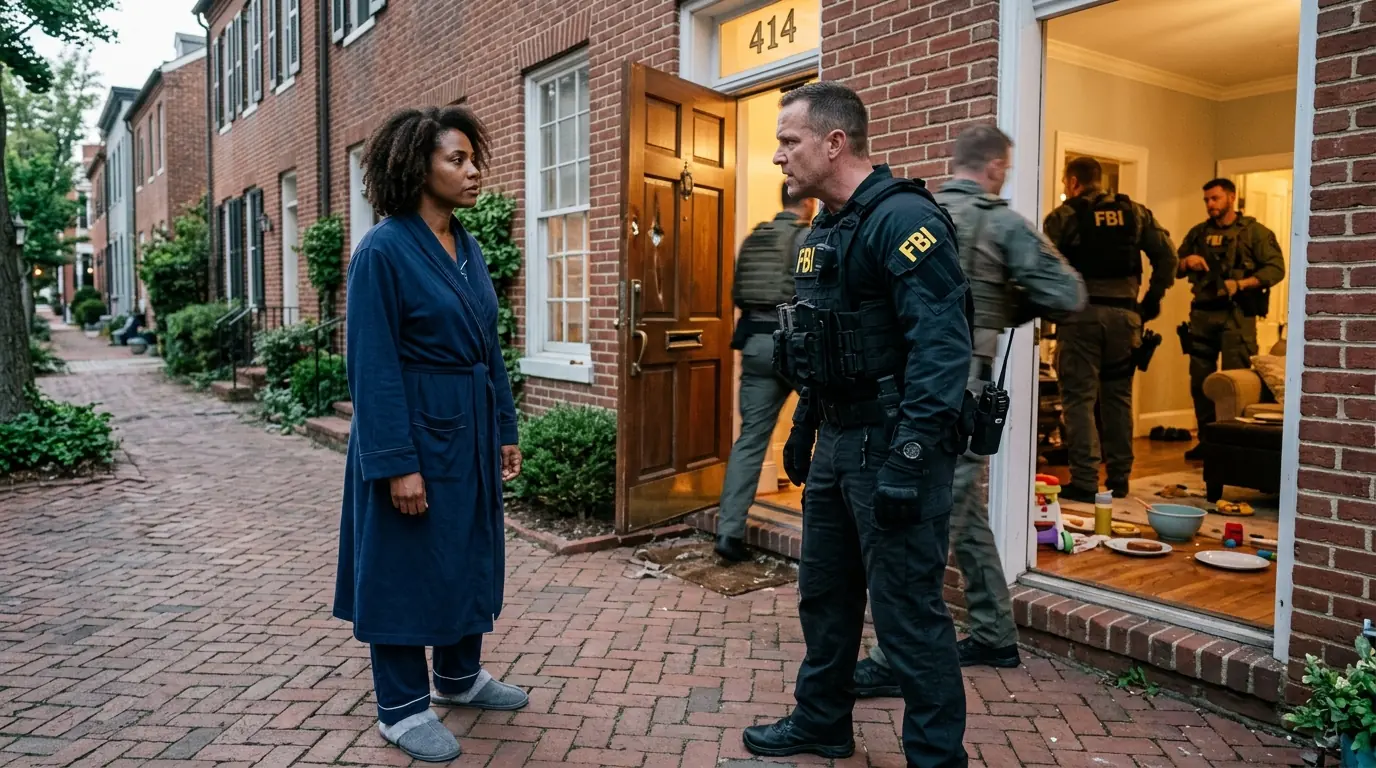
"Oh, I know exactly what name is on this address, and I don't care what title you think protects you. We have intelligence tying this house to suspicious foreign act."
At 6:12 a.m. on Sunday, March 1st, 2026, the smell of pancakes filled a narrow Alexandria townhouse three blocks from the Potomac. Judge Vivien Achebe Laurent stood at the stove in a cotton robe flipping batter while her seven-year-old son Solomon sat cross-legged on the couch watching cartoons with the volume too loud. Upstairs, her 11-year-old daughter Nadia was already dressed for church, arguing through the bathroom door that Solomon had taken her hairbrush again.
It was the kind of morning that didn't make the news: quiet, ordinary, warm.
Vivien was 44 years old, Harvard Law, top of her class. She had spent six years as a federal prosecutor at the Department of Justice before being nominated to the US District Court for the Eastern District of Virginia. Senate confirmed four years ago with bipartisan support. She carried an active caseload that included two national security matters and a high-profile civil rights case that had drawn attention from Washington and beyond. She was disciplined, private, and careful with every word she spoke on and off the bench.
That morning, her church dress hung on the back of her bedroom door. Solomon's clip-on tie sat on the kitchen counter next to a sippy cup he swore he didn't use anymore. Nadia's Bible study notebook was open on the dining table, a colored pencil still wedged in the spine.
Vivien had no idea that in less than 30 minutes, the front door of her home would be blown off its hinges, that federal agents in tactical gear would pour into her kitchen, that her son would be dragged off that couch and put face down on the floor, that her daughter would be grabbed by the arm at the top of those stairs, and that everything about this morning—every quiet, ordinary detail—would become evidence in one of the most devastating federal civil rights cases in modern American history.
Six weeks earlier, on a Tuesday afternoon in January, FBI counterintelligence analyst Craig Stenner sat at his desk inside the J. Edgar Hoover building in Washington, scrolling through the bureau's online tip portal. Stenner was 36, competent enough on paper, but known among colleagues as someone who chased volume over accuracy. He flagged more tips than anyone in his unit. Most went nowhere. He didn't seem to mind.
At 2:17 p.m., a submission caught his eye. It alleged that a woman living at 814 Braddock Lane in Alexandria, Virginia, had been making wire transfers to financial entities with suspected ties to Iranian intelligence. The tip included a name: Vivien Achebe Laurent; a partial physical description listed as Black female, early 40s; and a claim that she had been photographed at a restaurant in Georgetown with a known Iranian diplomatic attaché.
There was no supporting documentation, no account numbers, no surveillance imagery, no name attached to the person submitting the tip. It had come through an anonymous portal entry routed through a burner email.
Stenner flagged it and forwarded it to his supervisor, Special Agent in Charge Brent Kirkwood. Kirkwood was 52, a career bureau man with a reputation for aggressive case development and a deep interest in counterintelligence headlines. He read the tip once, asked no follow-up questions, and approved it for preliminary investigation the same afternoon.
No one ran Vivien's name through the federal judiciary employee database. No one checked whether she held a government position. No one cross-referenced her address with any law enforcement or intelligence personnel records. The tip was vague, uncorroborated, and anonymous. It should have been flagged for further vetting at minimum, or dismissed outright.
Instead, Kirkwood told his team to move fast. He called it a potential high-value lead. And from that moment on, every decision that followed was built on a foundation that no one in the bureau had bothered to verify.
Over the next six weeks, every safeguard that should have caught the mistake failed. Not one of them held.
Stenner built the case file the way he built most of his cases: fast, surface-level, and with just enough material to look thorough without actually being thorough. He pulled Vivien's financial records through a parallel channel typically reserved for FISA-adjacent national security requests, a move that bypassed the more rigorous internal review process.
What he found should have told him everything he needed to know. Vivien had made recurring donations to a legal aid nonprofit that served immigrant communities, including clients from the Middle East. The transactions were modest, documented, and tax-deductible. Stenner flagged them as suspect wire transfers to entities with foreign ties. He never contacted the nonprofit, never checked its tax status, never noted that it had been operating legally in Virginia for over a decade.
Then came the photograph. During a 2024 legal conference in Washington hosted by the American Bar Association, Vivien had posed in a group photo with more than a dozen attendees. One of them happened to be a mid-level Iranian diplomatic attaché who had been invited to a panel on international law. Vivien hadn't spoken to him individually. She didn't know his name. But the photo made it into the file, captioned as evidence of a potential clandestine relationship.
A junior analyst in the unit, Priya Venkatesh, 29, raised concerns in a written memo. She pointed out that the financial records didn't support the conclusion being drawn, that the tip was anonymous and uncorroborated, and that no one had verified the subject's employment or government affiliation.
Kirkwood read the memo, called her into his office, and told her to stay in her lane. Two days later, her objections were removed from the case file entirely. Kirkwood told his team this could be a big one, and no one left in the room was willing to tell him he was wrong.
The warrant application landed on the desk of a federal magistrate judge in the Eastern District of Virginia on February 26th, 2026. The affidavit was 12 pages long and built almost entirely on three pillars: the anonymous tip, the mischaracterized financial records, and the conference photograph.
Each piece of evidence had been framed to suggest something it did not actually prove. The charitable donations became suspect international transfers. The group photo became a documented meeting with a foreign intelligence-linked operative. The anonymous tip became a credible source with knowledge of the subject's activities.