The steel barricade gave a violent metallic rattle when Officer Travis Cole drove Dr. Maya Bennett sideways into it. Her laminated festival credential snapped from its lanyard and struck the hot pavement beneath their feet, skidding between two orange traffic cones before stopping faceup in the restricted access lane. Maya twisted instinctively, trying to keep the rounded curve of her seven-month pregnancy away from the metal rail, but Cole had one hand around her upper arm and the other pressed between her shoulder blades. A line of families waiting to enter Richmond County’s annual Riverfront Summer Festival fell almost completely silent. Somewhere beyond the checkpoint, a country band continued playing from the main stage, but at Gate Four the only sound anyone seemed to hear was Maya breathing through the sudden pain in her shoulder. Cole looked toward the people watching and raised his voice as if the audience were the point. “Fake badge,” he announced. “Everybody thinks a lanyard means they can walk wherever they want.”
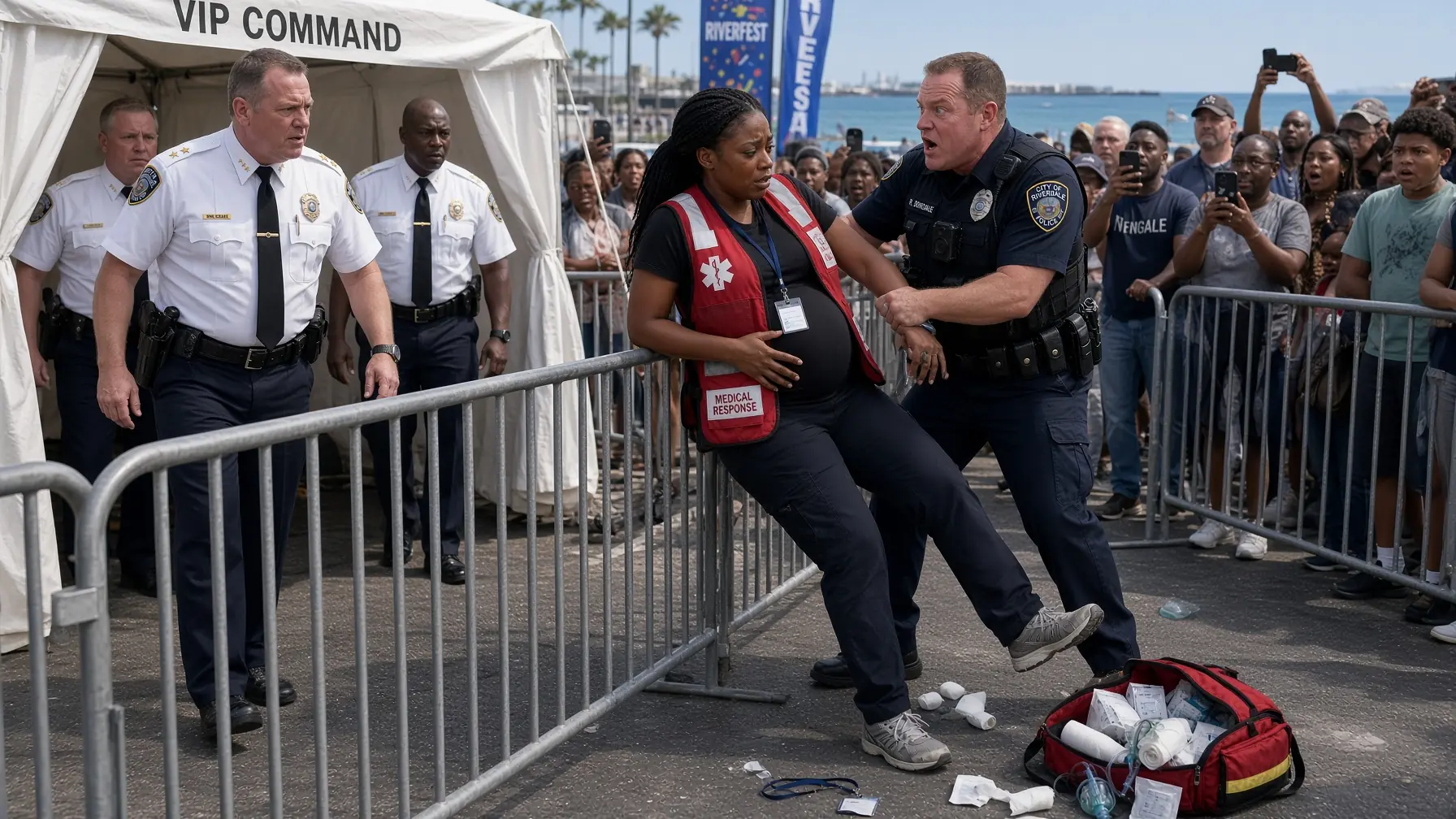
Maya closed her eyes for half a second and forced herself not to react to the humiliation. She was thirty-six, Black, twenty-nine weeks pregnant, and wearing navy medical scrubs beneath a lightweight red emergency-response vest with MEDICAL OPERATIONS printed across the back in white reflective letters. Her jump bag had been resting beside her right leg when Cole stopped her, and a portable radio clipped to her vest had been broadcasting festival command traffic every few seconds. Nothing about her appearance proved she was authorized to enter a restricted lane, but almost everything around her offered an easy way to check. Her photograph was printed on the badge now lying near Cole’s boot. Her name appeared on the checkpoint roster. Her call sign, Medical One, was active on the same radio network Cole was carrying. Maya kept both hands visible and said, “Officer, my name is on your roster. Check your clipboard or call command.”
Cole tightened his grip. “I don’t need you telling me how to work my checkpoint.” Maya looked toward the folding table beside him where a three-page access list sat beneath a plastic cover, the first page clipped open in plain view. She could see the top of her own name from where she stood: BENNETT, MAYA — COUNTY EMS MEDICAL DIRECTOR — ALL ACCESS / MEDICAL COMMAND. Cole had not looked at it once. Instead, he had seen her walking toward the VIP-and-emergency entrance without waiting in the public line and decided the credential hanging from her neck had to be fraudulent. When Maya told him an ambulance route needed to remain open because temperatures were approaching ninety-six degrees, he had treated the explanation as further evidence that she was pretending to be important. Now he leaned closer and said quietly, “Badges don’t make you important. I decide who gets through here.”
Ten feet away, thirteen-year-old Lucas Moreno had already lifted his phone. His mother put one hand on his forearm, not to stop the recording but because she was frightened by how quickly the encounter had changed. Beside them, another mother pulled a stroller backward while her toddler slept beneath a fabric shade. Two volunteers in yellow event shirts exchanged nervous glances but did not approach. Cole had been at Gate Four since eight that morning, and everyone working nearby had learned that he preferred people to obey before asking why. Maya noticed the phones, the witnesses, and the body camera centered on Cole’s chest, but none of those things made her feel safe. Cameras documented consequences; they did not prevent them. She kept her voice low and said, “You are holding a pregnant woman against a steel barrier. I am not resisting you. Please release my arm and verify the credential.”
“Stop with the pregnancy routine,” Cole answered. “I can see you’re pregnant.” Then, with the kind of contempt that sounds almost casual when someone believes authority will protect it, he added, “That doesn’t mean you get special access.” Maya’s expression changed. “I’m not asking for special access. I am assigned to the medical command zone.” Cole glanced down at the red jump bag near her feet. “And what’s in that?” Maya told him emergency airway equipment, medications, obstetric supplies, pediatric masks, trauma dressings, and an automated blood-pressure cuff. Cole gave a short laugh. “So you’re carrying drugs into a restricted area too.” Maya stared at him. “Emergency medications, sealed under county EMS inventory.” Instead of checking, he kicked the bag away from her.
The red case slid six feet across the asphalt, struck a curb, and rolled onto its side. One zipper had not been completely closed because Maya had used the bag fifteen minutes earlier at the first-aid station, and the impact pulled it open. Sterile gauze packets, two pediatric oxygen masks, sealed syringes, an infant bag-valve mask, and several individually wrapped medical items scattered onto dirty pavement. Maya gasped more from anger than fear. “Do not touch that equipment.” Cole looked toward the spilled supplies, then back toward the crowd as though he had just exposed contraband. “You’re trespassing in a controlled area,” he said. “You’re going in cuffs until we figure out who you actually are.” Maya’s face had gone pale, but her voice remained remarkably even. “Who I am is written on the badge you knocked off me.”
Cole reached toward his belt. “You people always have an explanation once somebody starts checking.” The words hung in the heat between them. He had not used a racial slur, and later he would insist you people meant anyone trying to bypass security. But several witnesses would remember where his eyes went when he said it, from Maya’s braids to her face and then toward the public line behind her. Maya noticed too. She did not argue about what he meant because she understood the difference between documenting words and pretending she could read his mind. Instead she nodded toward his radio. “Call Medical Command. Ask for Medical One.” Cole unclipped his handcuffs and answered, “I’m done taking instructions from you.” He pulled Maya’s left wrist behind her, and she winced sharply as her abdomen pressed toward the barricade.
“Officer, please don’t push my stomach into the rail.” That request should have ended the physical struggle immediately because Maya was doing exactly what he told her to do. Instead Cole adjusted his position and used his forearm against her upper back to keep her turned. The crowd reacted audibly. A woman near the stroller said, “She’s pregnant,” and Cole barked without looking over, “Everybody stay back.” Maya felt a tightening low in her abdomen, not severe enough to identify as a contraction but sharp enough to frighten her. She had experienced hypertension earlier in the pregnancy and knew stress could produce symptoms that were usually harmless but sometimes were not. “I need you to let me stand upright,” she said. “If you won’t, call EMS.” Cole laughed once. “You’re claiming to be EMS.”
Maya looked toward the large white command tent barely twenty feet beyond the barricade. Air-conditioning units hummed beside it, and thick power cables ran beneath protective ramps toward a bank of radios, laptops, and incident maps inside. She had been in that tent less than forty minutes earlier, briefing fire, police, EMS, and festival management on the heat-response plan. She had left only to inspect a secondary cooling station after a volunteer reported low oxygen inventory. Her return should have taken six minutes. Instead she had spent almost five standing against a barricade while an officer refused to perform a ten-second verification. “Officer Cole,” she said, reading his name plate for the first time, “you really do not want to put those cuffs on me before you check that list.”
Cole smiled. “Watch me.”
The first cuff opened in his hand.
Then the canvas flap of the command tent flew outward.
Police Chief Marcus Holloway stepped into the sunlight with Deputy Chief Elena Ramirez and Patrol Captain Stephen Doyle directly behind him. Holloway was fifty-two, Black, broad-shouldered, and wearing the white command polo used by senior officials during large public events. He had not rushed outside because someone had secretly told him a powerful person was being mistreated. A radio dispatcher inside the tent had asked twice why Medical One had stopped responding to a request from the western aid station, then a volunteer entered and said a pregnant medic appeared to be arguing with an officer at Gate Four. Holloway had walked out expecting a credential dispute. He stopped dead when he saw Cole’s hand around Maya’s wrist and the crushed red response vest against the steel barricade.
“Let go of her.”
Holloway did not shout. He did not need to. Cole’s entire posture changed at the sound of his chief’s voice. The smugness disappeared first. Then the pressure against Maya’s arm. He released her so suddenly she had to catch the barricade to keep her balance. Holloway crossed the distance between them, looked once at Maya’s face, then at the medical supplies scattered across the pavement. His eyes moved to the badge near Cole’s boot. He bent, picked it up, and read the name even though he already knew exactly who she was.
DR. MAYA BENNETT
COUNTY EMS MEDICAL DIRECTOR
MEDICAL ONE
ALL ACCESS
Holloway looked at Cole. “What exactly are you doing?”
Cole swallowed. “Chief, she attempted unauthorized access through the VIP lane. I believed the credential might be fraudulent.”
Holloway glanced toward the large sign mounted above the checkpoint. It did not say VIP ONLY. It read VIP / STAFF / EMERGENCY ACCESS. Then he looked at the clipboard on Cole’s table. “Did you check the roster?”
Cole hesitated.
“I was conducting a field verification.”
“That wasn't my question.”
“No, sir.”
“Did you radio command?”
“No.”
“Did you scan the badge?”
“No.”
Holloway’s voice became quieter.
“Then what did you verify?”
Cole had no answer.
Maya took one hand from the barricade and pressed it against the underside of her abdomen. Deputy Chief Ramirez noticed immediately. “Maya?” she asked. Maya nodded once. “I’m okay, but I’m having some tightening and I want my blood pressure checked.” Ramirez turned toward the command tent and called for an EMS team. Cole looked suddenly desperate to explain himself. “Chief, I had a suspicious access attempt. She became argumentative and kept trying to direct my actions.” Captain Doyle glanced toward Cole’s body camera. “Was she physically resisting?” Cole said she refused to comply with instructions. Maya looked at him. “I complied with every physical instruction you gave me. I refused to agree that my badge was fake.”
Holloway raised one hand before the discussion became an argument. “Nobody debates this at the checkpoint. Captain Doyle, take Officer Cole off the gate and secure his body-camera footage. Deputy Chief, preserve the roster, radio traffic, checkpoint video, and incident logs.” Cole stared at him. “Chief, you’re taking me off post because she’s your medical director?” Holloway’s expression hardened. “I’m taking you off post because I just watched you holding a pregnant woman against a barricade while the credential you refused to verify was lying at your feet. The investigation will decide the rest.” That distinction mattered. Holloway did not fire him. He did not accuse him publicly of racism. He stopped an active situation, preserved evidence, and removed an officer from a position where emotion had already replaced judgment.
The EMS team arrived from inside the festival grounds within two minutes. Maya sat beneath a shade canopy while paramedic Andrea Lewis checked her blood pressure and fetal heart rate with equipment from a clean backup kit. Her first reading was high enough to concern Andrea but not yet an emergency. The abdominal tightening gradually eased while Maya drank water and answered questions about pain, dizziness, bleeding, and fetal movement. There was no direct trauma to her abdomen because she had twisted away from the rail, but her shoulder had already begun to bruise. Andrea recommended transport to the hospital for obstetric evaluation because of the combination of pregnancy, elevated blood pressure, stress, and physical restraint. Maya agreed, which meant the county medical director left the festival she had helped plan inside her own ambulance system.
Cole watched from fifty feet away while Captain Doyle stood beside him. “I didn’t know who she was,” Cole said quietly. Doyle looked at him. “That sentence is going to hurt you.” Cole frowned. “Why? She had a fake-looking badge and was coming through a restricted lane.” Doyle pointed toward the access roster. “You didn’t know who she was because you refused every method available to find out.” Cole opened his mouth. Doyle continued before he could speak. “And if she had been a temporary volunteer instead of the county medical director, you still would have needed a reason to throw her against a barricade.” Cole looked toward Holloway and said, “He knows her personally.” Doyle nodded. “So do I. She chaired the emergency-medicine briefing this morning. That doesn't create her rights.”