Abel Marsh had been in Millhaven, Montana for 17 years when the five men rode in. And in those 17 years, he had built exactly one thing worth mentioning. He had arrived in 1867 with a wagon, a wife, $300, and a stubbornness that the Montana winters had tested thoroughly and failed to break. Millhaven in 1867 was four buildings and a mud road and the specific optimism of men who believed that the right place could become something if you stayed long enough to make it.
Abel had bought a lot on the main street for $40 and spent two years building the saloon with his own hands, learning what he didn’t know as he built, making mistakes in wood and correcting them in wood, arriving eventually at something solid and real that bore the accumulated knowledge of every mistake he’d made getting there. The saloon had become the center of Millhaven, the way certain places became centers, not by design, but by accumulation. The place where news arrived and departed, where men who disagreed about everything sat at the same tables because the whiskey was honest and Abel didn’t ask about the disagreements.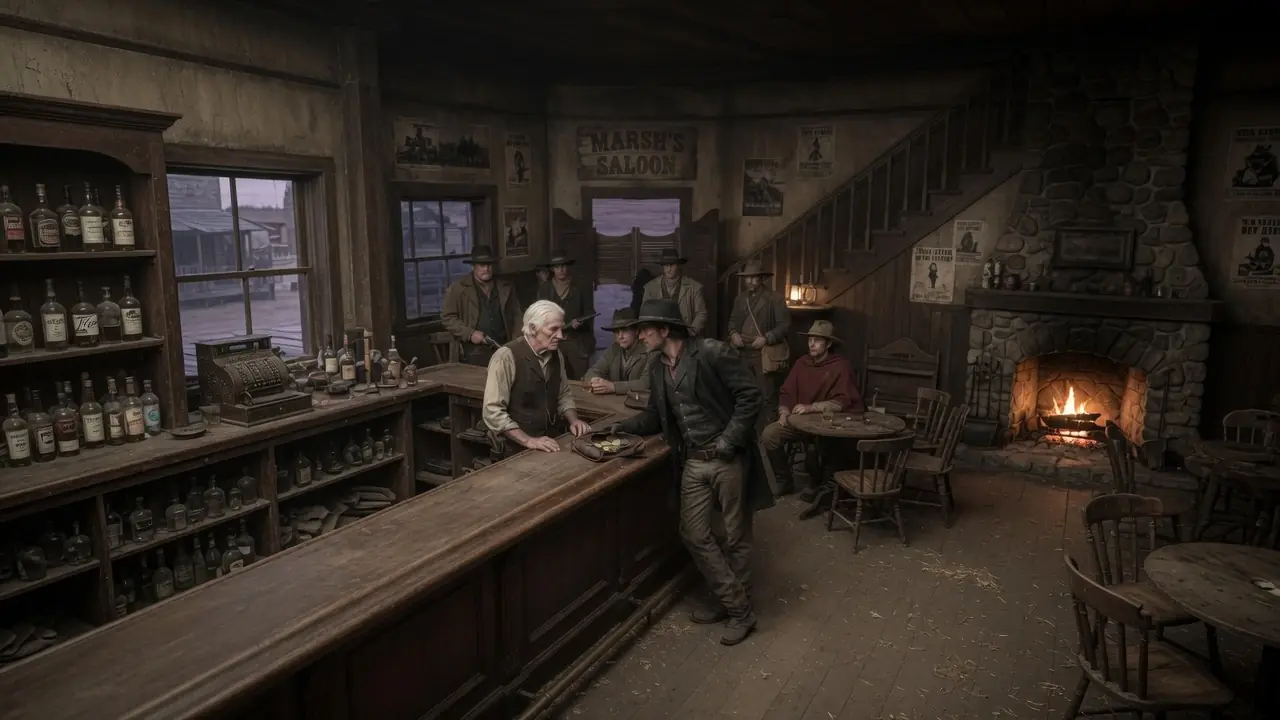
The cattle drovers coming up from the Bozeman Trail stopped here. The ranchers from the Yellowstone River country stopped here. For 17 years, Millhaven had passed through Marsh’s saloon and Marsh’s saloon had held it. His wife had died in 1878.
His sons went east. Abel had stayed. In 1879, he found a man in his cellar with a bullet wound and a fever and three days from dying. He brought food and clean cloth and a jug of something medicinal and left the man his privacy because a man sleeping in your cellar with a fever deserved privacy more than he deserved questions.
On the fourth morning, the man was gone. And there was money on the floor. More than the food and cloth were worth. Abel had not known the man’s name.
He had kept the money for two years, then spent it on a new mirror for behind the bar. The mirror that was about to be destroyed. He had ridden into Millhaven because the road went through it and Scout needed water. He tied Scout at the rail outside the saloon with the painted sign above the door: Marsh’s.
Then he went inside. The saloon was what a saloon became when the man who built it had been at it for 17 years. Good wood, a long, honest bar. Tables arranged by someone who had thought about where things should go.
An old man behind the bar with white hair and hands that had seen decades of work. He sat at the corner table. Wall on two sides, clear line to the door. He was on his first whiskey when Scout’s visible through the window went south and held.
Both ears locked. He set the glass down. He looked through the window at the south ridge. Five riders came over it.
He read them before they reached the bottom of the ridge: the formation, the pace, the way the leader sat his horse with a forward lean and his right arm carried slightly different from the left. The way a man carried an arm that had been rebuilt around damage that never fully healed. He had put that damage there. He moved his right hand under the table.
He kept his face on the glass. He waited. Cole Mattocks had been looking for him for three years. Not obsessively. Cole was not a man who let one thing consume everything else. He had his operations, his men, the territory he had been building across the Arizona border country since before the pistolero had ridden through and changed the mechanics of his shooting arm in a single morning.
when a stranger in a burgundy poncho had intervened with a single shot that took Cole’s right shoulder before Cole had finished processing that the stranger existed. The man Cole had been about to kill had run. The stranger had looked at Cole on the ground and said, Some debts don’t need to be collected. Then he had ridden away.
Cole had spent six months learning to shoot with his left hand. It was slower and it always carried the ghost of what had been lost. He’d spent two and a half years after that building toward something larger. Five men, a plan for the Montana Territory, a saloon in Millhaven that sat on the Bozeman Trail where every drover and rancher in the region passed through.
Not the saloon itself. The position. A man who controlled the right gathering place controlled information. And information in the Montana Territory of 1884 was worth more than any cattle herd. Land disputes, water rights, grazing conflicts.
The machinery that resolved these things in established states didn’t exist yet in Montana. What filled that gap was knowing things before other people knew them. Cole had understood this. He had been building toward it.
What he had not planned for was the man in the corner table. The five men came through the saloon door the way men who had done this before came through doors. Two first, the large one and the rider, reading the room, clearing the entry. Then Cole. Then the other two, spreading left and right along the wall.
The air in the saloon changed the way air changed when something heavy entered it. The four regular patrons didn’t need a signal. They went very still in the way men went still when the body understood the situation before the mind caught up. Abel put both hands on the bar. Visible. Still.
Cole’s eyes moved across the room and stopped. Found the man at the corner table. The man at the corner table was looking back at him with pale, hazel-green eyes and the small scar below the left eye. And the calm of someone who had seen this coming through a window and had spent 2 minutes deciding.
Cole stopped walking. The four men behind him felt it and stopped, too. The two men looked at each other across the length of Marsh’s Saloon. Then Cole looked at Abel.
Old man, he said. This is a business arrangement. That saloon of yours sits at the best stopping point between the Yellowstone country and the Bozeman Trail. Every drover, every rancher, every land agent in the territory comes through here.
He let that sit. You’re sitting on an intelligence position worth 10 cattle operations. I intend to use it. Abel looked at him.
You intend to take it, Abel said. Cole tilted his head. The small concession of a man who didn’t find the distinction meaningful. I intend to compensate you for it.
Abel looked at the hands on the bar. His hands. 17 years in that wood. He said nothing. Cole looked at the corner table.
The man at the corner table looked at Cole. This doesn’t involve you, Cole said. He looked at Cole, at the left hand loose near the holster, slower than the original right had been. The three years of adaptation still carrying the memory of the loss.
At the four men positioned along the walls. He looked at Abel, at the white hair, at the hands on the bar, at something in the old man’s face that he recognized without being able to name. The expression of someone who had been told that the thing they built was going to be taken, and who had not yet decided what to do with that information, but was arriving at the decision fast. I know this man, he said.
Cole read that. Read it completely. How? Cole said. From a road I happen to be on, he said.
Cole understood what that meant, and what it didn’t mean, and what it implied about the next 30 seconds of his life. His jaw tightened. The four men along the walls read their leader, and their hands moved. He moved his hand.
What happened next didn’t go the way anyone planned. The first thing that happened was the mirror. The atirador had been on the roof of the dry goods warehouse across the street for 20 minutes, positioned before the other four went inside, covering the exits. Scout had been tracking him since he went up the ladder.
When the hands inside started moving, the atirador made his decision. The shot came through the front window. It found the mirror behind the bar, the mirror Abel had bought with the money left on the cellar floor in 1879, and the mirror came apart in a sound like a year’s worth of bad luck. The distraction cost him a half second.
Cole used it. The left hand was slower than the right had been, but it was not slow. The shot caught him along the left arm, not through, a burning channel across the outside of the forearm, and the impact knocked him sideways against the corner table. He went down behind it.
The bar was 4 feet to his left. He moved. Abel was already moving, too. Hands off the bar and reaching under it for the coach gun he had kept there for 11 years. double-barrel, sawed short.
The kind of weapon a man kept when he understood that what he needed was not precision, but certainty at close range. He came up beside Abel behind the bar. One breath. Then they both moved. The large man was coming over the bar.
Abel fired first. The coach gun at 4 feet was not a shot. It was a verdict. The large man stopped coming over the bar and went back the way he had come with the finality of something that was no longer a question.
The sound of it in the enclosed space was enormous. The smell of black powder filled the saloon like weather. He was up from behind the bar before the echo finished. Left arm burning.
The Colt in the right hand. The rider on the left flank had used the coach gun’s noise to move. Was halfway to a flanking position when the Colt found him. One shot. The rider went down. That left Cole, the explosive Esta, and the man on the right wall.
Cole had taken cover behind an overturned table, moving with the practiced efficiency of a man who had survived enough situations to know what cover looked like and how to reach it fast. The left hand was up, waiting for a target. He didn’t give him one. He went low along the bar, using the bar’s length, keeping the wood between himself and Cole’s angle.
The left arm was dripping now, not fast, but consistent. The specific reminder of a wound that intended to be accounted for. The man on the right wall made a decision. He went for the door.
Outside, Scout heard the running footsteps on the wooden floor a half second before the man hit the door. The horse had been at the rail, had moved after the mirror shot, to the edge of the porch, not in the doorway, at the edge of it. When the man came through the door, Scout was there. Not blocking, standing close enough that the sudden presence of 1,100 pounds of horse in the man’s peripheral vision made him check his stride for one exact second.
That second was enough. He had come around the end of the bar and had the angle. One shot, the man’s gun hand. He went down on the porch, weapon gone.
The specific howl of someone who had made a calculation and found the calculation wrong. Three down. Cole, the explosivista, and the atirador were still on the roof. Cole was behind the overturned table and not surrendering. He fired twice more with the left hand, controlled, measured, not panicked.
The shots were good. Not as good as the right hand had been, but good enough that he had to move twice to stay out of the angle. The left arm was making its opinions known with increasing specificity. He put a shot through the table, not to hit Cole, to move him.
Cole moved right, which put him closer to the window. He moved left, used the end of the bar, came around it low. Cole saw him. Both of them moved at the same time.
Cole’s shot went past his ear, half an inch. The sound of it was a physical thing. His shot found Cole’s left shoulder. The symmetry was not an accident.
He had known which shoulder before he fired. Cole sat down against the wall with his left arm useless now to match the right. A man with two damaged shoulders and the specific expression of someone whose three-year calculation had arrived at an answer he hadn’t planned for. The explosivista was at the back door.
He had heard the sequence of the fight and had made the professional decision that professionals made when the operation had failed. Find the exit that wasn’t covered. The back door opened onto the alley. Scout was in the alley.
The horse had come around the building during the roof shot, moving through the side passage between the saloon and the hardware store, reading the geometry of what was happening inside through sound and smell and the specific intelligence of an animal that had been in situations like this enough times to understand what the sounds meant. The explosivista stepped into the alley and found a horse looking at him. He looked at Scout. He looked at the alley walls on both sides.
He looked at Scout again. He put his hands up. The atirador on the roof was the last problem. He had come through the alley to the base of the warehouse ladder.
The left arm was wrapped in a strip torn from his shirt. Not clean, not adequate. The field solution of a man who needed the bleeding managed long enough to finish what needed finishing. Scout was at the base of the ladder.
He looked at the horse, at the roof above. He looked at the ladder. The atirador had a rifle, a clear line of sight to the street, and no knowledge of what had happened inside the saloon. He was waiting for a signal that was not going to come.
He put his left hand on Scout’s neck for a moment. Scout stood still. Then he called up. It’s done, he said. Come down.
A long silence. Then movement at the roof edge. The atirador looked down, read the situation below, read the man with the bloody arm and the Colt and the horse at the base of his only exit, and made the calculation that professionals made when the math stopped working. He came down.
He walked the four surviving men—Cole, the explosivista, the man with the damaged hand, and the atirador—to the fence rail outside the livery and tied them with rope. Cole said nothing during the walk. His two ruined shoulders made the binding something he could not resist practically, and he was not a man who performed resistance when resistance was not practical. He looked at the man tying the rope, and the man looked back at him, and neither of them said what was between them because what was between them didn’t require saying.
The town marshal arrived 12 minutes later, a young man who had heard the shots and had taken the time to process the situation before walking into it, which was either cowardice or intelligence, and he chose not to decide which. He gave the marshal a clean account, It took less time than the marshal expected, then he went back to the saloon. Abel was behind the bar, the coach gun was put away. He was sweeping glass from the mirror, the mirror he had bought with money left on a cellar floor, now in pieces across the bar and the floor around it.
He swept with the methodical focus of a man doing something with his hands because his hands needed an occupation, and this was what was available. The four regular patrons had returned, carefully, one at a time, checking the room the way men checked rooms after something irreversible had passed through. They sat at their tables with the careful quality of people resuming an interrupted activity while being very aware that the interruption had happened. He sat at the corner table.
Abel came with the whiskey without being asked. He looked at the old man. Abel looked at the left arm, the makeshift bandage, the dried blood on the shirt beneath. He went to the back without a word and came back with clean cloth and a bottle of something that smelled medicinal, and did the proper job on the arm without ceremony, the way a man tended to a wound when tending wounds was what the situation required.
When he finished, he sat down across the table. The two of them in the quiet of a saloon that had just been through something. You were in my cellar, Abel said. He looked at the old man.
He said nothing. Abel looked at the bar, at the space where the mirror had been. You left money, he said. Yes, he said.
Abel was quiet. I bought a mirror with it, Abel said. He looked at the pieces on the floor. His voice was level, the voice of a man reporting a fact rather than registering a loss, though the loss was visible in the reporting of it.
He looked at the broken glass. I’ll replace it, he said. Abel waved this off, not dismissing the offer, dismissing the need for it. It was a mirror, Abel said.
He looked at the old man. Abel looked at the room around him, at the good wood of the bar still intact, at the tables, at the chair where the large man had fallen and been carried out by the marshal’s deputy, at the window with the hole in it from the atirador’s shot. He built it and it was still here. The mirror was gone.
The room remained. You didn’t have to stay, Abel said. He looked at his glass. I had a drink to finish, he said.
Abel was quiet for a long time, then What’s your name? He looked at the old man, at 70 years of not leaving what he had built. He almost told him. He didn’t. Some things were better left in the shape they were already in.
He put on his hat, set money on the table for the whiskey and for the mirror. Abel looked at the money and did not pick it up yet. Take care of the place, he said. He went to the door.
The left arm was properly wrapped at the livery, the liveryman having supplies because men in Millhaven had learned that having supplies was prudent given the kind of men who passed through on the Bozeman Trail. He sat on a hay bale while the liveryman worked and let his mind go where it went. He thought about Cole tied to the fence rail outside. About three years of planning arriving at two ruined shoulders and a marshal and a fence rail in Montana.
About whether the answer Cole had found was the one he had needed or just the latest version of a question that kept not resolving. He didn’t know. That was Cole’s accounting to do, not his. He thought about the mirror.
About Abel sweeping the pieces with the methodical focus of a man who had absorbed the loss and was moving through it rather than around it. The money on the cellar floor in 1879 had become a mirror. The mirror had lasted five years and been destroyed in the space of one rifle shot. And now there was money on a saloon table that would become something else, another mirror maybe or something entirely different.
Or nothing at all if Abel decided that the wall looked fine without it. That was the way of things. You gave what you could. What it became was not always in your hands.
What Cole Mattocks was trying to build in that saloon was real. And understanding it matters. The Montana Territory in 1884 was expanding faster than any legal structure could follow. The cattle industry had exploded after the railroad reached the territory.
Herds coming up from Texas on the Bozeman Trail. Ranchers pushing north and east into land that the Lakota and Crow had used for generations and that the territorial government was now distributing with the efficiency of people who had decided that distribution was the same as ownership. Land disputes, water rights, grazing conflicts between large operations and small ones. The machinery that resolved these things in established states simply did not exist yet in Montana.
What filled that gap was information and power. A man who knew which rancher was overextended before the rancher knew it himself, who knew which water rights were contested before the lawyers arrived, who heard the conversations that men had when they were relaxed and believed they were among friends. A saloon on the Bozeman Trail was not a business. It was a position.
Cole had understood this with the clarity of a man who had spent years building advantages out of information rather than brute force. The saloon that Abel Marsh had built over 17 years, the place where every drover and rancher and land agent in the region stopped was, to Cole’s way of thinking, the most valuable piece of real estate in the Montana Territory that nobody had recognized as such. What Cole had not understood was that positions had people in them and some people were not variables you could move. He saddled Scout in the October dusk.
The Montana sky at that hour was the kind of sky that made you understand why men came here and stayed. Enormous and cold and full of a light that went from gold to purple to black in the space of 20 minutes. The mountains to the west doing things with color that had no name for them. Scout stood still for the saddling.
The left arm registered the motion of tightening the cinch, a tight specific complaint that was going to be his companion for the next 2 weeks. He noted it and kept working. He thought about Abel’s question. What’s your name?
He had almost answered. Not because names mattered in the way that most things didn’t matter to him, but because the question had come from Abel, who had asked it the way a man asked something he genuinely wanted to know, rather than something he was entitled to. Abel had not asked in 1879, had given 3 days of food and silence and privacy to a stranger in a fever without asking anything. Had waited five years and a destroyed mirror and one very bad afternoon before asking.
That deserved an answer. He had not given one. Some debts were better carried than cleared. The carrying was its own kind of payment.
He led Scout out of the livery into the Montana evening. Cole was still at the fence rail. He had expected the marshal to have moved him by now, but the marshal was apparently still dealing with the paperwork of the situation, and Cole was still tied to the post with the specific stillness of a man who had run out of options and was waiting for the next version of things. He stopped. Cole looked at him.
three years, Cole said. His voice was flat, not angry, emptied. He looked at Cole, at the two ruined shoulders, at the three years in the face of him. You built something, he said.
In Arizona, in Montana. He paused. Find something to build that doesn’t require taking what belongs to other people. Cole looked at him for a long moment. Some debts don’t need to be collected, Cole said.
His own words returned to him. He looked at Cole. Some don’t. He said. He turned Scout north and rode. The road north of Millhaven ran along the base of a long ridge before it opened into the broader Montana plain.
And for the first mile, it gave a man time to think without requiring him to do anything about what he thought. Scout moved at the easy ground-covering trot of a horse that had finished one thing and found the interval between things agreeable. He thought about the afternoon. About the mirror shot, the atirador breaking it before anything else happened, the half second of distraction that had cost him the graze on the left arm.
About going down behind the corner table and moving for the bar and Abel already moving for the coach gun without being told. The way the old man had come up beside him with the double-barrel sawed-short and had fired without hesitation. Not a man who needed instruction in what the situation required. Just a man who needed the moment to arrive.
70 years old. He thought about what it meant that Abel had kept that gun under the bar for 11 years without using it. Kept it because experience had taught him that certain mornings required preparation. Kept it without letting the preparation become the expectation that something terrible was always coming.
The balance of a man who had been around long enough to know that the world contained bad things and had decided that knowing this was not the same as being defined by it. The left arm ached with the cold. He rode. Five men. A saloon that a man had built with his own hands and refused to leave. A mirror that lasted five years from the money left on a cellar floor.
A debt paid without either man knowing for most of the afternoon that it was being paid. And Cole Mattocks, who had spent three years looking for an answer and found two destroyed shoulders instead of one, which was either justice or irony. And might be both. Think about Abel sweeping broken glass.
Not the fight. The sweeping. Because the fight was one afternoon and the sweeping was what came after. And what came after was what the man actually was. He could have sat down.
He could have closed early, gone home, let someone else clean up the wreckage of a Tuesday that had been considerably worse than most Tuesdays. He swept glass. Because that was who Abel Marsh was. The man who showed up and did the work that needed doing every morning for 17 years because the thing he had built required it.
And he had decided that the thing he had built was worth requiring things of him. The saloon had cost him his youth and his wife and his son’s proximity and two years of his hands and 17 years of his mornings. In exchange it had given him something that couldn’t be counted cleanly. A place that was real, that mattered to the people who passed through it.
That was genuinely his in the way that things were yours when you had paid for them with the actual currency of yourself rather than money. Cole had wanted to take that position. What he hadn’t understood was that a position built on 17 years of showing up was not a thing you could take in an afternoon. You could break the mirror.
You couldn’t break what the mirror represented. Scout’s ears were north, already reading the dark ahead of them. The Montana stars coming out in the particular density that Montana produced. More sky than most places.
More room for what filled it.