Adaeze Morgan knew rotten mangoes.
She knew what anthracnose looked like before a black lesion had spread wider than a thumbnail.
She knew the soft, sour collapse of fruit harvested too late after heavy rain.
She knew stem-end rot, internal breakdown, sunburn, latex staining, bruising caused by careless bins, fruit fly damage, chilling injury, and the subtle fermentation smell that appeared before an inexperienced buyer recognized anything was wrong.
She also knew what a good mango felt like in her hand.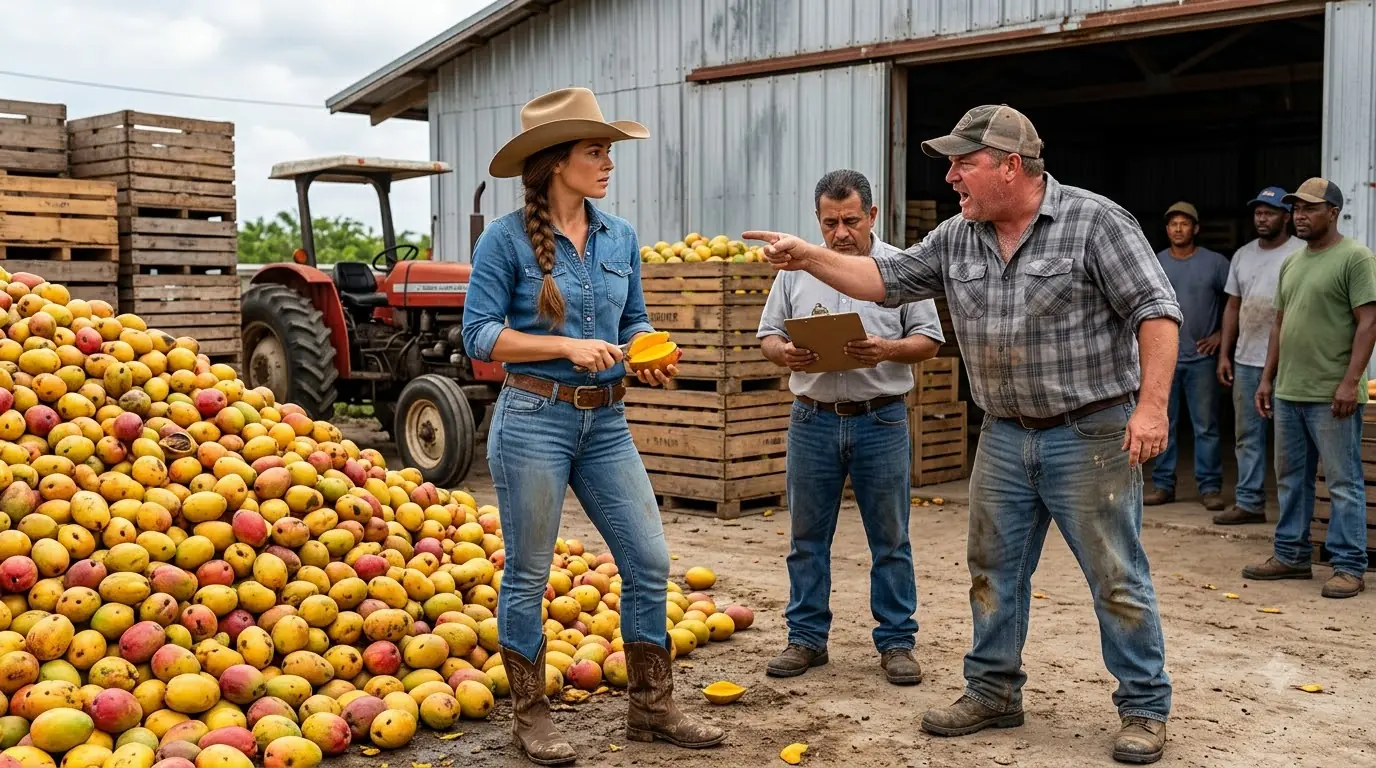
Firm.
Heavy for its size.
Skin intact.
No suspicious softness near the stem.
No fermented odor.
No collapse beneath thumb pressure.
So when Graham Voss pointed at the mountain of yellow-red fruit behind the Homestead Produce Exchange and called it garbage, Adaeze already knew he was lying about at least some of it.
Maybe most.
She stood beside the pile wearing a tan cowboy hat against the Florida sun, faded jeans tucked loosely over mud-marked boots, and a blue denim work shirt rolled to the elbows.
One mango rested in her left hand.
Graham stood across from her, red-faced and sweating beneath a dirty trucker cap.
“Put that down.”
Adaeze looked at the fruit.
Then at him.
“No.”
Graham laughed without humor.
“This is private property.”
“You invited the county inspection office onto the property three weeks ago.”
“For the packing line.”
“And waste handling is part of the packing operation.”
“Not today.”
Adaeze turned the mango slowly.
It was warm from the sun.
Some dirt marked the peel.
Otherwise it was beautiful.
She drew a folding produce knife from the leather sheath on her belt.
Graham stepped forward.
“Don't cut that.”
Adaeze looked at him.
“Why?”
“Because I told you not to.”
She sliced through the fruit.
Bright orange flesh appeared.
Smooth.
Dense.
Sweet perfume lifted immediately.
No rot.
No larvae.
No internal discoloration.
Nothing.
Workers near the loading bay stopped pretending not to watch.
Adaeze cut off a small section.
Held it toward Graham.
“Eat it.”
His expression hardened.
“I'm not eating something from the dump.”
“You called it rotten.”
“It is.”
“Then show me.”
He pointed toward another part of the pile.
“Look around.”
Adaeze did.
Some mangoes were spoiled.
Of course.
A pile this large left in heat would deteriorate quickly.
But she could also see hundreds that had been discarded intact.
Maybe thousands.
Fresh fruit underneath bruised fruit.
Recently harvested mangoes mixed with older waste.
That was not normal culling.
At least not at this volume.
Behind them, the weathered red packing shed stretched along the yard.
Stacks of wooden field crates rose near the loading doors.
An old red tractor sat near a fuel tank.
Beyond the fence were rows of mango trees heavy with late-season fruit.
Luis Ortega stood beside the loading dock holding a clipboard.
Fifty-four.
Sun-browned face.
Gray at the mustache.
A man who had worked produce long enough to keep his shoulders slightly forward even when standing still.
Graham noticed Adaeze looking at him.
“Luis.”
The porter stiffened.
“Back to work.”
Luis nodded.
He did not move.
Adaeze wiped mango juice from her knife.
“Five tons.”
Graham frowned.
“What?”
“That's the number your waste hauler gave the county.”
“Then ask them.”
“I did.”
His expression changed almost imperceptibly.
Adaeze continued.
“Average weekly pickup for the last nine weeks: between nine thousand and eleven thousand pounds.”
“So?”
“So you're a medium-size wholesale operation, not a cannery.”
“Bad season.”
Adaeze looked toward the orchard.
“No.”
Graham folded his arms.
“You a farmer now?”
“My father grew mangoes for twenty-eight years.”
That silenced him for half a second.
Then he shrugged.
“Then you know bad fruit happens.”
“Yes.”
Adaeze held up the cut mango.
“And I know good fruit happens too.”
Workers were openly watching now.
Graham turned toward them.
“What are you looking at?”
People immediately found jobs.
Crates moved.
A forklift engine started.
Someone disappeared inside the loading bay.
Adaeze walked toward the nearest stack of rejects.
A cardboard tag had been stapled to one crate.
QUALITY HOLD — LOT 7C
She pulled it loose.
Graham moved closer.
“You done?”
“No.”
Adaeze read.
Grower: Hernandez Family Farms.
Received: Monday.
Disposition: Rejected.
Reason: Mixed rot / unacceptable condition.
Quantity: 1,840 pounds.
Inspector line.
Signature.
She stared.
The signature looked like three quick loops.
Nothing legible.
“Who inspected this lot?”
Graham glanced.
“Quality.”
“Name.”
“It's on the form.”
“No, a signature is on the form.”
“Then read it.”
“I can't.”
“Not my problem.”
Adaeze turned toward Luis.
“Luis.”
He looked down.
Graham's voice sharpened.
“Don't drag him into this.”
Adaeze ignored Graham.
“Who signs rejection slips?”
Luis rubbed one thumb against the clipboard edge.
“Quality people.”
“Which quality people?”
No answer.
Graham stepped between them.
“Enough.”
Adaeze moved sideways and looked around him.
“Luis, whose signature is supposed to be right here?”
Luis stared at the form.
His hands began shaking.
Graham saw.
“Go inside.”
Luis stayed.
Adaeze waited.
She knew better than to fill silence for a frightened witness.
Luis finally whispered:
“I don't know.”
Graham exploded.
“What do you mean you don't know?”
Luis looked at him.
“You told me not to answer.”
“I told you to work.”
Adaeze's eyes narrowed.
Luis swallowed.
“I never see inspector.”
The yard went quieter.
Graham laughed.
“He doesn't work quality.”
“No,” Adaeze said. “He handles rejected loads.”
Graham's jaw tightened.
Adaeze looked at Luis.
“Who gives you these forms?”
Luis hesitated.
Then looked toward a side office attached to the shed.
“Office.”
“Who in the office?”
Graham stepped forward.
“Conversation's over.”
Adaeze held up one hand.
“Touch me and it becomes a different inspection.”
He stopped.
Adaeze returned to Luis.
“Who?”
Luis lowered his voice.
“Sometimes Mr. Voss.”
The nearest worker dropped a crate.
Wood cracked.
Nobody moved to pick it up.
Graham's face turned dark.
“You better think very carefully before you accuse me of anything.”
Luis shook his head quickly.
“I no accuse.”
“Then shut your mouth.”
Adaeze's tone changed.
“Don't speak to him like that.”
Graham pointed at her.
“This is my yard.”
“And that's county-regulated produce.”
“You think your little badge means you own the place?”
Adaeze stepped closer.
“No.”
She raised the rejection slip between them.
“I think paper has names for a reason.”
Graham snatched for it.
Adaeze pulled it back.
His hand closed on air.
The workers stopped again.
Graham realized he had made a mistake.
He lowered his arm.
“Get off the property.”
Adaeze smiled slightly.
“That request should've come before you handed me access records last month.”
His eyes narrowed.
“What records?”
“All waste disposition documentation for the quarter.”
For the first time, genuine concern entered his face.
Adaeze folded the rejection form.
Placed it in her shirt pocket.
“I'll send a preservation notice before I leave.”
“You're not taking company paperwork.”
“Copy.”
“It belongs here.”
“Then you'll be delighted to receive a receipt.”
Graham stared at her.
Adaeze walked toward Luis.
“Did you personally dump this lot?”
He nodded.
“Yesterday?”
“Yes.”
“Was it already spoiled?”
Luis looked toward Graham.
Adaeze noticed.
“Look at me.”
He did.
“Was it?”
“No.”
Graham cursed.
Luis rushed on.
“Some bad. Not all.”
“How much good?”
“I don't know.”
“Half?”
He looked at the pile.
“Maybe more.”
Graham shouted: