34,000 ft, 143 souls, two pilots down.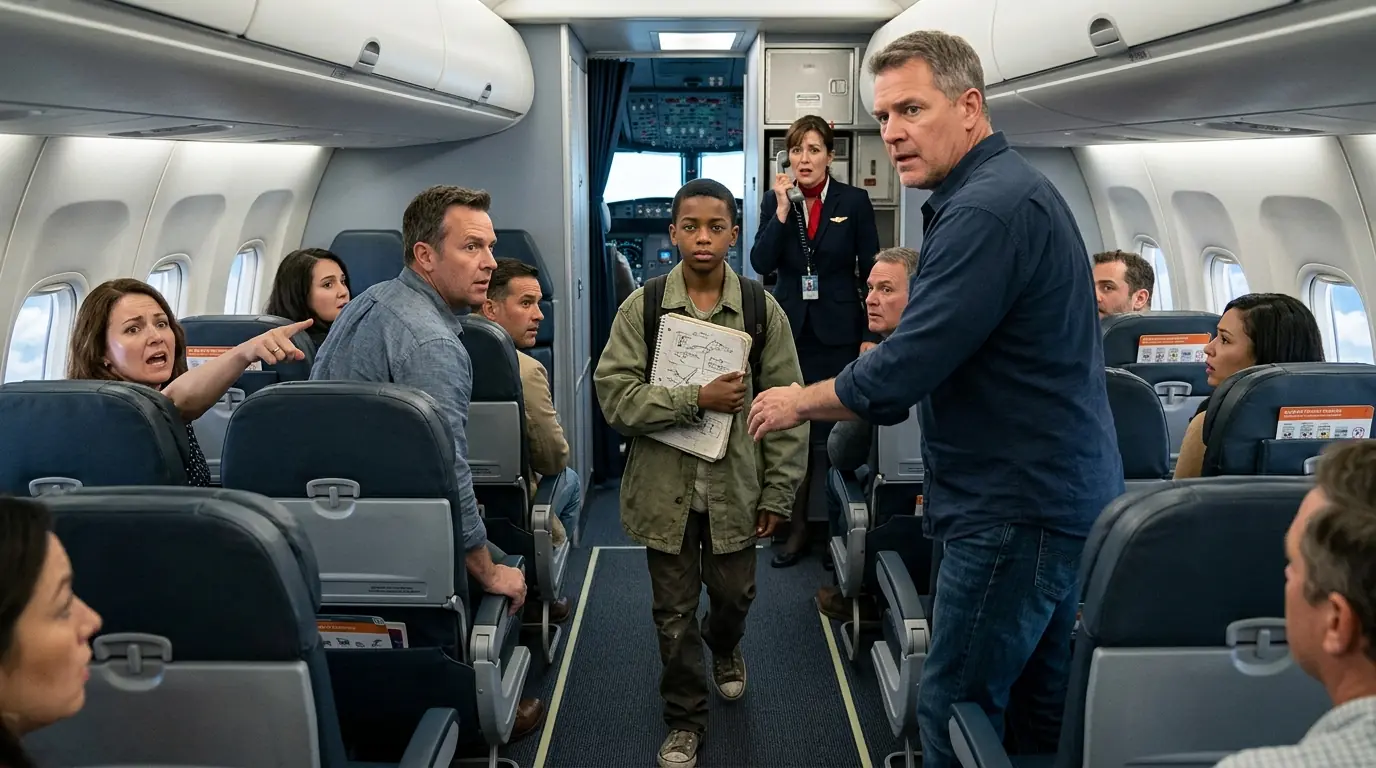
At 3:48 p.m. Eastern, somewhere over northern Alabama, flight attendant Donna Holloway stood in the open cockpit doorway and screamed into the cabin, "Can anyone fly this plane?"
Behind her, Captain Ross Beckett was slumped against the center console, pulse 52. First Officer Nolan Greer lay crumpled on the floor. The master caution light blinked amber across instruments no conscious crew member could read. 4 seconds of silence. At cruise altitude, silence is the loudest sound there is.
Then, in the last row, seat 38C, middle seat next to the lavatory, a thin, homeless boy in an olive green jacket two sizes too large, closed the book in his lap. He stood up. He stepped into the aisle. And he started walking toward the cockpit.
Every head in the cabin turned. A dozen voices erupted at once. "Stop him! Grab that kid! He's going to get us all killed!" Not one person shouted, "Let him through."
34,000 ft and not a single qualified hand on the yoke. That sentence alone made my chest tight the first time I read it. I'm Vance, narrator, and I spend most of my time chasing stories about people who were never supposed to be in the room when it mattered.
The boy in the last row, the one who just closed his book, he's about to walk 38 rows toward the front of that plane, and every single person between here and that cockpit door is going to try to stop him.
11 months earlier, on a Tuesday morning cold enough to see his own breath, Freddy Palmer sat on a plastic milk crate outside the perimeter fence of Centennial Airport, a small general aviation field south of Denver. He was 13 then. He had been homeless for 6 days. Everything he owned fit inside a black backpack with a broken left zipper. Two shirts, a toothbrush, a laminated photograph of his father, and a spiral notebook he had been filling with drawings since he was 9 years old.
The notebook was open on his knees. On the page, rendered in neat block letters and ruled lines, was a cockpit instrument panel. Airspeed indicator in the upper left, attitude indicator center, altimeter upper right, heading indicator below center, vertical speed to the right, turn coordinator lower left. Every gauge was labeled. Every dial was to scale. At the bottom of the page, in small handwriting: "737 NG PFD layout, drawn from X-Plane 12 screenshots, verified against FAA handbook chapter 8."
He was watching a white Cessna 172 rotate off runway 28 when he heard footsteps on the gravel behind him. The man was 70 years old, white-haired, wearing a Delta Airlines cap so sun-bleached it had turned from navy to gray. His name was Walt Givens, retired. 31,000 flight hours across three decades. He lived alone in a small house near the airport's south perimeter, and he had noticed the boy on the milk crate every day for 2 weeks.
Walt looked at the notebook, then at the boy, then back at the notebook. "Who taught you to draw an instrument scan?"
"My dad. He was a crew chief. 56th Fighter Wing, Luke Air Force Base. He got his private license before I was born."
"Where is he now?"
Freddy closed the notebook. "He died. Pancreatic cancer. 5 weeks and 3 days ago."
Walt Givens did not say he was sorry. He said, "You want to come inside? I've got a simulator in my living room that's a lot better than a milk crate."
That was the beginning. Over 8 months, Walt taught Freddy on a desktop running X-Plane 12 with dual monitors and a yoke and pedal set that cost more than everything in Freddy's backpack combined. Freddy logged roughly 200 hours. He memorized the memory items for engine failure, rapid decompression, and emergency descent. He learned the glass cockpit layout of the 737 NG series from simulator sessions and from Walt's patient, precise explanations. He learned ATC communication protocols, the clipped, rhythmic language of call signs and readbacks that keeps the sky organized.
He never sat in a real cockpit, but he could close his eyes and touch every switch on the overhead panel of a 737-800 from memory. Walt never asked where Freddy slept. Freddy never volunteered the answer. Some lessons don't require a home address.
Now, rewind to the same afternoon, the day of the flight. 1:15 p.m. Mountain Time. Gerald Whitmore sat in the Pinnacle Airlines Admiral's Club at Denver International Airport, a Breitling Navitimer on his left wrist reading the time in three zones. He was 58, silver-haired, tailored navy suit, and senior vice president of operations at Ridgeline Aerospace Group, a major avionic subcontractor that had just secured a $140 million firmware contract for auto throttle systems across three domestic carriers. He was reviewing a quarterly earnings call script on his iPad when a notification slid down from the top of the screen. Subject line: RE RE T9 field report, urgent.
Gerald glanced at it for half a second, then swiped it away. He had a connecting flight to make.
2 hours later, both men boarded Pinnacle Airlines flight 2234, Denver to Atlanta, scheduled arrival 7:14 p.m. Eastern. Gerald turned left into first class, seat 3A. Freddy turned right. He walked the full length of the cabin, 38 rows, past business travelers and families and a woman in row 12 who pulled her handbag closer to her body as he passed. Freddy noticed. He said nothing. He sat down in 38C, opened the FAA Pilot's Handbook of Aeronautical Knowledge to chapter 6, and began reading.
In the forward galley, a catering cart from Rocky Mountain Catering rolled into place. Two insulated trays stamped crew, captain/FO, containing shrimp linguine, lot number 1189. The trays were loaded at 1:50 p.m. Mountain. The shrimp had been sitting at 46° Fahrenheit, 6° above safe holding temperature, for over 90 minutes. Nobody noticed. Nobody checks crew meals twice. The shrimp linguine was already working before the wheels left Denver.
So, picture this with me for a second. You've got a 14-year-old kid who spent 8 months drawing cockpit instruments by hand on a milk crate because it was the closest thing to flying he could afford. And three rows from the front, you've got a man in a $3,000 suit who just flicked away an urgent safety report about the exact system that's about to fail on this airplane. Two people, same flight, same recycled air, and neither one has any idea the other exists.
Life sets up its cruelest jokes real quiet, doesn't it? Because that tray of shrimp linguine nobody thought to double-check, that's the thing that's about to force these two worlds into the same 6 by 8-ft cockpit.
Back to 3:48 p.m., the question still echoing. In first class, a man stood up immediately. Silver hair, navy suit, the posture of someone accustomed to being in charge. Gerald Whitmore walked toward the cockpit with the confidence of a man who had 6,000 hours in logbooks and a Gulfstream G650 type rating on his certificate. Passengers watched him pass and visibly relaxed. Broad shoulders, expensive watch, gray at the temples. This was the man.
Donna stepped aside. Gerald entered the cockpit, lowered himself into the left seat, and gripped the yoke with both hands. He stared at the primary flight display. The instruments stared back. Collins Aerospace, not Honeywell. Not the PlaneView suite he knew from the Gulfstream. Different layout, different symbology, different logic. Gerald's jaw tightened. His hands did not move.
38 rows back, Freddy Palmer felt the book in his hands go heavy. He set it on the middle seat, opened his backpack, pulled out the spiral notebook, and turned to the page labeled 737 NG, emergency comms. His father's voice, quiet and clear in his memory: "Fly the airplane first. Everything else is second."
He stood up. The overhead bin caught the top of his head. He stepped into the aisle.
Douglas Crawford, seat 38A, 45 years old, broad-shouldered, an accountant from Colorado Springs, closed his hand around Freddy's wrist. Thick fingers, firm grip. "Sit down, kid. Let the adults handle this."
Freddy looked at the hand, then at the man. "Sir, I... I fly this plane."
Crawford laughed. A single sharp sound. Freddy did not smile. He peeled Crawford's fingers off his wrist one by one, the way you remove a zip tie, calmly, with purpose, and stepped into the aisle.
He made it 10 rows before the second wall. A woman in row 28 saw him walking forward and shouted, "Someone stop that boy! He's heading for the cockpit!"