He set the badge down on the glass desk without a single word. Not thrown, not slammed, just placed quietly, deliberately, finally, right in front of the woman who had ordered him to obey or get out. The whole engineering floor stopped breathing. Damian Carter, the maintenance man nobody ever looked at twice, picked up his toolbox, turned his back on a billion-dollar company, and walked toward the door like a man who had already made peace with losing everything.
But here is what Victoria Sterling did not know. The man she had just pushed out was the only person alive who understood why her company was about to fall apart.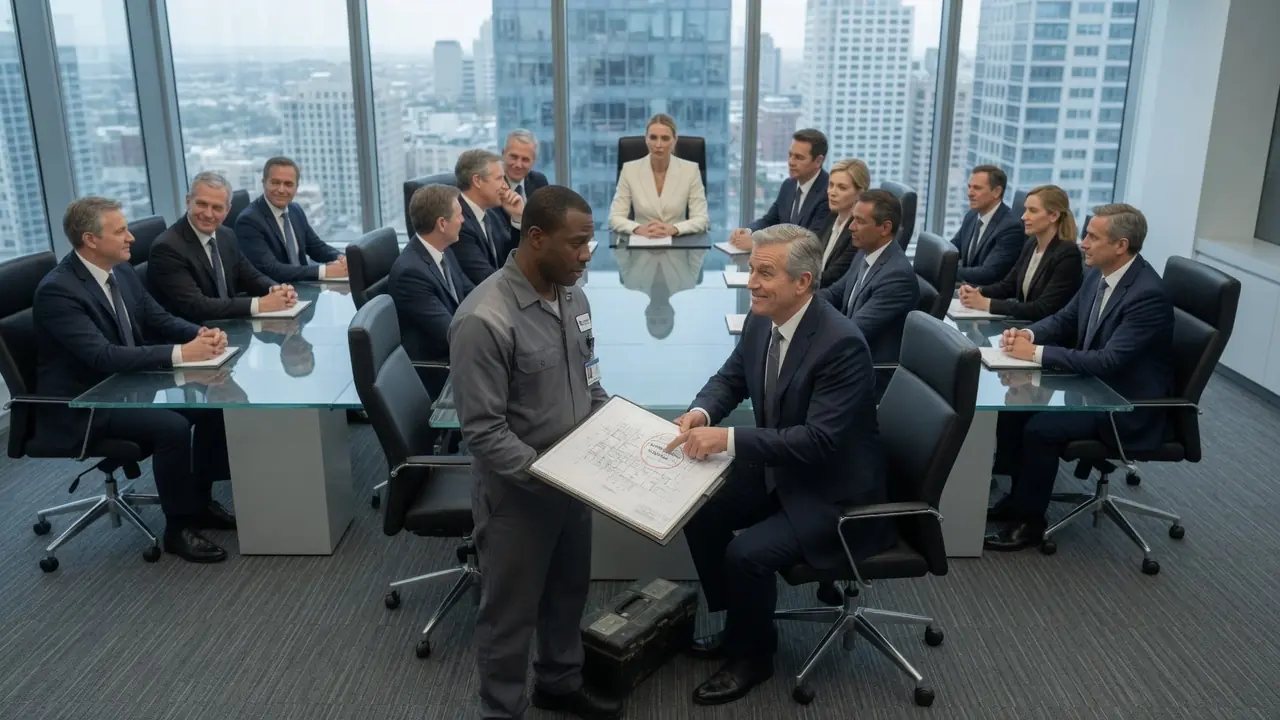
At 4:40 in the morning, Damian Carter was already awake. He did not need an alarm anymore. His body had learned the hour on its own, the way a body learns everything it has to survive. He lay still for a moment in the dark, listening to the old radiator tick, listening to the small sound of his daughter breathing down the hall.
Then he swung his legs off the bed, planted his feet on the cold floor, and got up. There was breakfast to make. There was a lunch to pack. There was a little girl who deserved to wake up to a father who had never once let her feel like an afterthought.
In the kitchen, he moved by habit. Coffee first, because the coffee kept the rest of the world running. Then two eggs in the pan, scrambled soft the way Lily liked them. A piece of toast cut into triangles because she said triangles tasted better than squares, and he had stopped arguing about that a long time ago.
“Dad.”
He turned. She was standing in the doorway in her pajamas, hair a mess, one sock on and one sock gone.
“You’re up early, baby.”
“I couldn’t sleep. I kept thinking about the science fair.”
“The volcano?”
“It’s not a volcano, Dad. It’s a model of the water cycle. We already talked about this.”
He put a hand over his heart like she had wounded him. “The water cycle. My mistake. Come sit down. Eggs are ready.”
She climbed into the chair and pulled her knees up under her. He set the plate in front of her, and for one small, perfect minute, the whole apartment was just the sound of a fork scraping a plate and a little girl humming to herself. Damian stood at the counter with his coffee and thought, not for the first time, that if this was all he ever had, it would be enough.
But it was not all he had. He knew it, and the knowing followed him everywhere.
“Dad, are we okay on money?”
He almost dropped the cup. “Where’s that coming from?”
“Marcus at school said his dad lost his job, and now they can’t get the good cereal anymore. And I was just thinking, are we okay?”
Damian set the cup down slowly. He came around the counter and crouched in front of her so they were eye to eye, because there were some things you did not say to a child from across a room. “Look at me, Lily. You listening?”
“I’m listening.”
“You have never had to worry about a thing in your life, and you’re not going to start at seven years old. That’s my job. Worrying is my job. Your job is the water cycle. Deal?”
She smiled, a small one, the kind that told him she was not completely convinced, but she wanted to be. “Deal.”
“Now go find your other sock. You look like a pirate.”
She laughed and ran off. He stayed there crouched for a second longer than he needed to, one hand on the chair she had been sitting in, and let out a breath he had not known he was holding. The truth was, they were okay for now. Rent was paid, the fridge was full, and the good cereal was in the cabinet, but “for now” was a thin thread to hang a life on.
Every single day, he woke up praying that thread would hold one more day. He had made himself a promise standing over his wife’s grave three years ago. Whatever it costs, whatever I have to swallow, that little girl will never go without. He had kept that promise every day since, and he intended to keep it forever.
He had no idea that the promise was about to cost him more than he ever imagined.
By 6:15, he had Lily fed, dressed, backpack loaded, and hair braided. He had learned to braid from a video and a lot of failure, and he could do a clean French braid now, which he was quietly proud of in a way he would never admit to another man. He walked her to Mrs. Alvarez next door, who watched her and two other kids until the school bus came.
“There he is,” Mrs. Alvarez said, opening the door. “The only father on this whole block who braids better than me.”
“Don’t tell the other dads. They’ll want lessons.”
“How are you holding up, Damian?”
“Same as always. Standing.”
“Standing is underrated.” She took Lily’s hand. “Go on. She’s fine. Go be brilliant.”
He knelt down one more time. “Have a good day, baby. I’ll be here at 3:30.”
“You always are.”
“That’s right. I always am.”
He kissed the top of her head. Then he walked to the bus stop, and then he rode across the city to the tall building with the glass front where they let him fix their machines and forgot his name. Sterling Technologies took up eighteen floors of a downtown tower, and the men and women who ran it wore suits that cost more than Damian made in a month. He came in through the service entrance the way he always did, scanned his badge, and rode the freight elevator down to the sublevels where the real machines lived.
Those were the machines that kept the lights on, the servers cool, and the whole gleaming operation from grinding to a halt. Up on the executive floors, they talked about disruption and market share. Down here, Damian Carter kept the actual company alive with his two hands, and almost nobody upstairs knew he existed. But the engineers knew.
“Carter.” Big Tom Reyes, thirty years on the systems team, met him at the door with two coffees and handed one over. “You are not going to believe the morning we’re having.”
“Try me.”
“They pushed the integration timeline again. Whole new system goes live in three weeks. Three. The board wants it done before the shareholder meeting.”
Damian stopped walking. “Three weeks, Tom? That migration was scoped for four months.”
“Tell that to the corner office.”
“That’s not a timeline. That’s a suicide note.”
“You want to be the one who says that to the new CEO?” Tom shook his head. “She’s already fired two managers this quarter for, quote, negative energy.”
Damian took a slow sip of the coffee and did not answer because he was already doing the math, and the math was ugly. Victoria Sterling had taken over the company eight months ago after her father stepped down. Damian had seen her exactly twice, both times from across a room, both times surrounded by people nodding at everything she said.
She was young, early thirties maybe, sharp, fast-talking, and clearly carrying the weight of a name she was terrified of failing. He did not dislike her. He did not know her well enough to dislike her. But he had watched enough executives come and go to recognize the look in her eye.
It was the look of someone who had decided that being right and being fast were the same thing. They were not. He knew that better than anyone. He had the scars to prove it.
“Where do you need me?” Damian asked.
“Cooling loop on the server floor is acting up again, and they want us to sign off on the new power routing for the integration.”
“Sign off?” Damian repeated.
“Sign off.”
“Have you looked at the routing?”
Tom hesitated. “I looked at it.” Then Tom lowered his voice even though there was nobody around. “And I don’t like it. But I’ve got two kids in college, Carter, and I’m sixty-one. I’m not about to be the guy who tanks the timeline. You want to look at it, you look at it. You’ve always seen things the rest of us miss.”
That should have been a compliment. It landed like a warning.
Damian looked at it. He looked at it for three hours in the cold hum of the sublevel, with the schematic spread across a workbench and a pencil behind his ear. The longer he looked, the colder he got, and it had nothing to do with the temperature.
The new system was routing critical load through a junction that was not rated for it. Under normal use, it would hold. But this system was not going to run under normal use. It was going to run at full capacity on day one, feeding an integration nobody had properly stress-tested because there had been no time to stress-test anything.
That junction, that one undersized junction buried three levels below where any executive would ever look, was the kind of thing that held fine right up until the day it did not. On the day it did not, it would not be a glitch. It would be a cascade. It would take down the cooling.
When the cooling went, the servers went. When the servers went, so did every client depending on them. He had seen it before. Not here, somewhere else a long time ago.
He carried that somewhere else with him every day of his life.
He set down the pencil. “Tom,” he called, “come look at this.”
Tom came over, put on his glasses, followed Damian’s finger across the schematic, and watched his face change.
“Oh,” Tom said quietly. “Oh, that’s bad.”
“That’s a fire waiting for a match.”
“Can we route around it?”
“Yeah, but it adds time. Real time. You can’t fix this in three weeks and do it right.”
Tom took his glasses off, rubbed his eyes, and looked every one of his sixty-one years. “They’re not going to want to hear that.”
“I know.”
“Carter, listen to me. I’ve watched a lot of good men get chewed up in this building for being right at the wrong time. You’ve got that little girl. Don’t put your neck out for a company that doesn’t even know your last name.”
Damian looked at the schematic for a long moment. Then he looked at Tom.
“If I sign off on this and it fails, people could get hurt. And I’d know every day for the rest of my life. I’d know.”
“So don’t sign it. Just don’t say anything. Let it be somebody else’s problem.”
“You know I can’t do that.”
Tom sighed the sigh of a man who had already lost the argument. “Yeah,” he said. “I know you can’t. That’s your whole problem, Damian. You’re the only honest man in a building full of people getting rich off pretending.”
Damian wrote the report that afternoon. He did not dress it up. He did not soften it. He laid it out the way he would lay out a problem to another engineer.
Here is the fault. Here is why it fails. Here is what it costs to fix it. Here is what it costs if you do not.
He attached the schematics. He circled the junction in red. At the bottom, he wrote one line in plain English so nobody could pretend they had not understood it.
Then he did something he almost never did. He walked it upstairs himself. He rode the passenger elevator, the one with the mirrored walls, the one he was not technically supposed to use, up to the executive floor. He stood in that carpeted quiet in his gray uniform with a folder in his hand, and he felt every set of eyes track him like he had wandered in off the street.
“Can I help you?” A young man in a slim suit, some kind of assistant, stepped in front of him.
“I need to get this to Ms. Sterling. It’s about the integration project. It’s urgent.”
“You can leave it with me.”
“No, I need to make sure she sees it. It’s a safety issue.”
The assistant’s eyes flicked down to the gray uniform, and Damian watched a decision get made behind them. The decision was that whatever a man in that uniform had to say could not possibly be urgent.
“I’ll see that it gets to the right people.”
“The right person is her.”
“Sir—”
“Let him through.”
The voice came from an open office door. Victoria Sterling stood in the doorway, arms crossed, watching. Behind her, through the glass, Damian could see a conference room full of people mid-meeting. All of them turned to look.
“You’re maintenance,” she said. It was not a question.
“Yes, ma’am. Damian Carter.”
“And you have something urgent about my integration project that couldn’t go through your supervisor?”
“It did go through my supervisor. He agrees with me. I just didn’t trust it to make it up all the floors before it stopped mattering.”
Something in her expression sharpened. Annoyance, maybe curiosity, maybe both.
“Come in. You’ve got two minutes. I’m in the middle of something.”
The conference room went quiet when he walked in. There were eight or nine of them around the table, and Damian recognized a couple by sight, division heads and project leads. At Victoria’s right hand, leaning back in his chair with the easy confidence of a man who had never once been told no, sat Richard Cole, senior VP, the man whose name was on the integration contract.
“Everyone,” Victoria said, “this is Mr. Carter from facilities. He has a safety concern. Mr. Carter, the floor is yours. Two minutes.”
Damian did not sit. He set the folder on the table, opened it, and turned it so they could see the new integration routes.
“Primary load through junction 4C on sublevel three. That junction is not rated for the load it’s going to carry at full capacity. Under this timeline, it goes live before anyone stress-tests it. If it fails, and I’m telling you it will fail, it takes the cooling system with it. When the cooling goes, so does everything above it. Servers, client data, all of it.”
Silence.
Then Richard Cole laughed. Not loud. Just a soft, dismissive exhale. The kind of laugh designed to make the person it was aimed at feel small.
“And you determined all this from the basement?” Cole said.
“I determined it from the schematics. Your schematics. I circled the junction in red. Page two.”
“Mr. Carter.” Cole folded his hands. “We have an entire engineering team. We have consultants. We have sign-off at every level. And you’re telling this room that you, a maintenance technician, caught something that dozens of degreed engineers missed.”
“I’m telling you what’s in front of you on the page. You don’t have to believe me. You have three weeks. Test the junction. If I’m wrong, you’ve lost a day. If I’m right, you’ve saved the whole company.”
“We don’t have a day,” Cole said. “The shareholder meeting is—”
“Then you don’t have a system that works,” Damian said. “You just have one that hasn’t failed yet.”
The room went very still.
Victoria had not said a word. She was looking at the folder. Damian watched her eyes move across the schematic, watched them stop on the red circle, and for one second, just one, he thought he saw it land. He thought he saw her understand.
Then Cole leaned toward her and said, low but not low enough, “Victoria, this is exactly what I warned you about. Every timeline has a doomsayer. If we start chasing every worst-case scenario from every corner of this building, we’ll never ship anything. This project is your first real test in front of the board. Don’t let a man with a wrench turn it into a circus.”
Damian watched the understanding leave her face. He watched her remember who she was supposed to be. He watched her remember she was young, untested, terrified of looking weak, and surrounded by men waiting for her to blink.
He understood with a sinking certainty that he had just lost. Not because he was wrong, but because being right had become inconvenient at exactly the wrong moment.
“Mr. Carter,” Victoria said, and her voice had changed. It had gone flat and cold and executive. “I appreciate your diligence, but this project has been reviewed and approved by people whose job it is to review and approve it. The timeline stands.”
“Ma’am—”
“The timeline stands.”
“Then at least test the junction. That’s all I’m asking. One test.”
“The answer is no.”
Damian stood there. He looked at the folder on the table, the red circle, the plain English line at the bottom that any one of them could have read. Then he made a choice, the same choice he made every time it counted.
It was the choice that had cost him raises, promotions, and easy years. The choice he would make again on his deathbed if he had to.
“Then I can’t sign off on it,” he said quietly. “I won’t put my name on something I know is going to fail. You can build it, but you’ll build it without my signature because my signature means I checked it. I checked it, and it’s not safe.”
Later, people who were in that room would tell the story differently depending on where they sat, but everyone agreed on what happened next. Victoria Sterling stood up. She was not a tall woman, but she stood like the whole company was behind her. Maybe in that moment, she believed it was.
She looked at Damian across the table, a maintenance worker in a gray uniform who had just told the CEO of a billion-dollar company no in front of her senior staff and in front of the man she trusted most. Then she said the words that would follow her for the rest of her life.
“Mr. Carter, in this company, we move forward together, or we don’t move forward at all. So let me be very clear. You follow my rules, or you leave.”
The room held its breath. Every person at that table had seen this scene before. They knew how it went.
The man in the uniform would swallow it. He would apologize. He would say, “Of course, Ms. Sterling. I misspoke. I only meant to help.” He would lower his head and shuffle back to the basement, grateful to still have a job.
Because that was what men in gray uniforms did when women in the corner office drew a line.
That was what everyone expected.
That was not what happened.
Damian Carter reached up slowly and unclipped the badge from his chest. He set it down on the glass table, right next to the folder, right next to the red circle. He took his access card out of his pocket and laid it beside the badge. He squared it up, careful, the way a man puts down something he is finished with.
“Here are my rules,” he said. “Simple ones. I don’t lie about people’s safety, and I don’t put my name on a thing that’s going to hurt somebody so a couple men in this room can hit a deadline.”
He looked at Victoria, and there was no anger in it. That was the part that unsettled her most later when she replayed it a thousand times. There was no rage. There was just a kind of tired, immovable dignity.
It was the dignity of a man who had already lost more than a job and knew exactly what a job was worth.
“You said follow the rules or leave.” He picked up his toolbox. “I’m choosing leave.”
Then he walked out.
Nobody moved. Nobody spoke. Richard Cole opened his mouth and closed it again. Victoria Sterling stood at the head of her table with her hands flat on the glass, looking down at a company badge and an access card lined up neat as soldiers.
For the first time since she had taken her father’s chair, she had the sick, disorienting feeling that she had just done something she could not take back. But she buried it. She was good at that.
She looked around the table, made her face hard, and said, “All right. Where were we?”
The meeting went on. She told herself she had just fired a difficult employee. She had no idea she had just handed the only man who could save her company his toolbox and shown him the door.
Damian rode the freight elevator down for the last time. He did not feel triumphant. That was the thing nobody in that room would have understood. There was no swell of music in his chest. No righteous fire.
There was just a plummeting, hollow fear growing bigger with every floor. With every floor, he was closer to the ground, and the ground was where Lily was. Lily needed the good cereal in the cabinet, rent was due in eighteen days, and he had just walked away from the only steady thing standing between his daughter and the version of the world he had sworn she would never have to see.
Tom was waiting by the service door.
“Word’s fast,” Tom said.
“Yeah.”
“You really put the badge on the table?”
“Yeah.”
Tom exhaled and shook his head, half in disbelief, half in something that looked a lot like pride. “You crazy, beautiful fool.”
“Probably.”
“You need anything? Money, a place to—”
“I’m okay, Tom.”
“You’re not. But I appreciate you saying it.” Tom gripped his shoulder hard. “Listen to me. That junction is still going to blow. You know it, and I know it. When it does, this whole tower is going to come looking for the man who tried to warn them and got thrown out for it. You hear me? This isn’t over.”
“It’s over for me.”
“No.” Tom’s grip tightened. “It’s over for the man they think you are. It ain’t even started for the man you actually are.”
Damian did not understand what he meant. Not then. He just nodded because Tom was a good man, and the good ones deserved a nod.
He pushed through the service door out into the gray afternoon with his toolbox in his hand and no job to go back to. He stood on the sidewalk for a minute. Just stood there while the city went by, while men and women with places to be flowed around him like water around a stone.
Then he did the thing he always did when the fear got too big to carry. He thought about the promise. Whatever it costs, that little girl will never go without. He had made that promise over a grave. He had meant it.
Now, standing on a cold sidewalk with his whole steady life behind a locked glass door, he understood that keeping the promise was going to be a lot harder tomorrow than it had been yesterday.
Then he checked his watch. It was 2:50. Whatever else was falling apart, one thing was not going to change. He was going to be at that school at 3:30.
He always was.
Lily saw it on his face the second she got in the car. She was seven, but she was not stupid. She had spent three years learning to read her father the way other kids learned to read books. After her mother was gone, he was the whole weather system of her life, and you learn to watch the sky when the sky is all you have got.
“Dad, what happened?”
“Nothing happened, baby. How was the water cycle?”
“You’re doing the smile.”
“What smile?”
“The one where your mouth smiles, but your eyes are somewhere else. You do it when something’s wrong and you don’t want me to know.” She crossed her arms. “So what’s wrong?”
Damian pulled the car over. He put it in park and turned to look at his daughter. Then he made a decision he would think about for a long time afterward.
It was the decision not to lie to her, because he had walked out of a building today rather than tell a lie, and it seemed like a poor kind of principle if it stopped at the office door and did not make it home.
“I left my job today,” he said.
Her eyes went wide. “You got fired?”
“Not exactly. My boss asked me to do something I thought was wrong. Something that could have hurt people. She told me I had to follow the rules or leave.” He paused. “So I left.”
Lily was quiet for a second. He watched her work through it, watched the fear come up in her because she was Marcus’s classmate, and Marcus’s dad had lost his job. Now there was no good cereal.
He braced himself for the tears. For the how are we going to be okay? For the weight of a child’s fear landing on top of everything else.
Instead, she said, “Was it really the wrong thing? What they wanted you to do?”
“Yeah, baby. It was.”
“Would somebody have gotten hurt?”
“Maybe.”
“Maybe a lot of somebodies?”
“Yeah.”
Lily nodded slowly the way she did over her homework when a hard problem finally made sense. “Then you did the right thing,” she said.
It broke something open in him right there in the parked car. This seven-year-old girl with one sock, who had just heard her whole world had gotten less safe, and whose first instinct was not how does this hurt me, but did my dad do right?
He had to look out the window for a second. He had to take a breath.
“You’re not scared?” he asked.
“A little. But you always figure it out. You said worrying is your job, so I’m not going to do your job for you.”
She reached over and patted his arm, this tiny hand on his forearm absolving him. “You always figure it out, Dad.”
“Yeah,” he said, and his voice was not quite steady. “Yeah, I always do.”
He put the car back in drive. As he pulled into traffic, one hand on the wheel and his daughter humming beside him, Damian Carter had no way of knowing that the badge he had left on that glass table was not the end of his story. It was the first thing that had gone right in a long, long time.
Because in three weeks, junction 4C on sublevel three was going to do exactly what he said it would do. When it did, the whole gleaming tower was going to remember the quiet man in the gray uniform who tried to warn them. The young CEO who told him to follow the rules or leave was going to learn the hard way that the most valuable person in her entire company had been the one she never bothered to see.
But that was three weeks away. Tonight, there was dinner to make and a water cycle to finish and a little girl to braid for in the morning. Tonight, a good man went home.
The first week without a job, Damian did what he had always done when the ground shifted under him. He got up at 4:40 anyway. There was no reason to. There was no freight elevator waiting, no cooling loop to check, no schematics to circle in red.
But his body did not know that. Honestly, neither did his pride. So he got up, made the coffee, scrambled the eggs soft, and cut the toast into triangles. When Lily wandered out with her hair a mess, he was standing at the counter like a man who still had somewhere to be.
“You’re up early again,” she said.
“I’m always up early.”
“But you don’t have work.”
“I’ve got the most important work there is.” He set the plate in front of her. “Getting you to school with your homework done and your hair not looking like a bird slept in it. Sit down.”
She sat. She ate, and she watched him over the rim of her juice glass with that too-old look she got sometimes, the one that made him forget she was seven.
“Marcus’s dad stayed in bed,” she said after he lost his job. “Marcus said he didn’t get up for like a whole week.”
“Well, Marcus’s dad and I are different men.”
“How come you got up?”
Damian thought about it. He did not give her the easy answer. He had promised himself he would not give her easy answers because easy answers were just small lies wearing nice clothes.
“Because the day you let the bad thing decide when you get out of bed,” he said, “is the day the bad thing wins. And I don’t lose to bad things. Not while you’re watching. Eat your eggs.”
He walked her to Mrs. Alvarez’s and braided her hair on the doorstep because he had not gotten to it, quick, clean fingers working through it while she stood patient and still. Mrs. Alvarez watched from the door with her arms crossed and something soft in her face.
“You heard yet?” she asked him quietly over Lily’s head.
“Heard what?”
“Marisol’s boy works security in that building of yours. Says the whole floor is talking about the maintenance man who told off the new CEO and walked out. Says they’re calling you a legend down in the basement.”
“They’re calling me unemployed down in my kitchen.”
“Damian.” She reached out and touched his arm. “You did a hard thing. Don’t let them make you feel small for it.”
“I don’t feel small.” He finished the braid, tied it off, and patted Lily’s shoulder. “I feel scared. There’s a difference. You can be scared and still be right. Go on, baby. Bus is coming.”
Lily ran, and Mrs. Alvarez watched her go. Then she looked back at Damian.
“You need money, you tell me. I’ve got a little put by.”
“You’ve got three grandkids and a bad hip, Rosa. I’m not taking your money.”
“Stubborn.”
“That’s what everybody keeps telling me.”
He went home, and then he did the thing that scared him more than the CEO, more than the empty schedule, more than any of it. He opened his laptop and started looking for work. He was good. He knew he was good.
Twelve years of experience. Certifications. Most of the men upstairs could not have passed a working knowledge of the systems. The consultants got paid three hundred an hour to pretend to understand.
On paper, he should have had ten offers by Friday. But paper was the problem. Because on paper, Damian Carter’s last twelve years said maintenance technician. The men who read paper for a living did not read past those two words.
He applied to nineteen places that first week. He heard back from four. Three were automatic rejections. The fourth was a phone screen with a hiring manager named Dell, who talked to him for six minutes and spent five of them explaining why Damian was overqualified for the jobs he would take and underqualified on paper for the jobs he could actually do.
“See, the thing is,” Dell said, “a company sees maintenance and a certain salary history, they get nervous about bringing you in higher. It’s a box thing. You’re outside the box.”
“I’ve spent twelve years keeping billion-dollar systems from catching fire. That’s the box I’m in.”
“I hear you. I do. It’s just the way the software sorts it.”
“The software.”
“The software filters on job titles. Yours says maintenance.”
“So it never gets me to the good part where I keep things from catching fire.”
A pause. “Between you and me, it’s a broken system. But it’s the system.”
Damian thanked him, hung up, and sat at his kitchen table for a long time looking at the drawing on the refrigerator. Lily had made it in kindergarten. It was him, a stick figure in gray with a triangle for a toolbox. Under it, in the wobbly letters of a five-year-old, she had written, My dad fixes everything.
“Not everything, baby,” he said out loud to nobody. “Turns out I can’t fix a broken system.”
He almost laughed at that. Almost.
Then he closed the laptop and went to pick up his daughter because it was 3:00, and some systems he could still keep running by hand.
Up in the glass tower, meanwhile, Victoria Sterling was learning that a system does not have to fail all at once to start telling you the truth. It started small. It always started small.
Nine days after she had told a maintenance worker to follow the rules or leave, a monitoring alert flagged an irregularity in the cooling loop on sublevel three. Minor. A temperature reading a few degrees off, corrected within the hour. The kind of thing that happened.
Her operations director mentioned it in the Monday meeting, waved it off, and moved on. Two days later, it happened again. Same loop, same few degrees, corrected again. The third time, it was not a few degrees, and it did not correct on its own.
A technician had to go down and reset a junction by hand, and the integration test that was supposed to run that afternoon had to be pushed a day.
“Pushed a day,” Victoria repeated in the meeting.
The whole table went quiet because she had said it in the flat voice, the one they had all learned to be afraid of.
“We’re three weeks from the shareholder presentation, and we’re pushing tests a day at a time. Somebody explain that to me.”
“It’s a calibration issue,” her operations director said. “The new sensors are sensitive. We’re getting false—”
“Is it false, or is something actually running hot down there?”
“We’re looking into it.”
“Look faster.”
Richard Cole leaned back in his chair, easy as always. “Victoria, this is normal. Every major integration has teething problems. You commission a new system, it complains for a couple weeks, then it settles. If we jumped every time a sensor blinked, we’d never ship anything. We’re on track.”
She wanted to believe him. God, she wanted to believe him. Richard had been her father’s man for twenty years. Richard had stood at her elbow through every terrifying week since she had taken the chair and told her she was doing fine.
He told her she belonged there. He told her the doubters were just doubters. She needed one person in that building who thought she could do this. Richard was that person.
But she had been raised by an engineer, whatever else her father had been, and something at the back of her mind would not lie down.
“What’s on sublevel three?” she asked.
“Ma’am?”
“The cooling loop that keeps hiccuping. What’s it routed through? Show me the schematic.”
The room shifted. She felt it. A small, uncomfortable shift, like everyone had suddenly found something interesting on their legal pads.
“I don’t have it in front of me,” the operations director said.
“Then get it.”
They got it. That afternoon, alone in her office with the door closed, Victoria Sterling spread the schematic of sublevel three across her desk and made herself read it the way her father had taught her to read a drawing when she was twelve years old. Before she ever wanted the company back, when she just wanted to sit in his lap and understand what the lines meant, she followed the primary load.
She followed it across the page, through the routing, down into the junctions. Then she stopped at a spot on sublevel three, a junction labeled 4C. She felt the floor tilt very slightly under her.
Because she had seen this before. Not the drawing. The junction. The red circle.
She had seen it circled in red on a folder on her own conference table, held by a man in a gray uniform she had thrown out of the building.
“No,” she said quietly. “No, no, no.”
She pulled up the file system. She searched for it, any report, any memo, anything with the words the man had used. Then she found it. A single document submitted three weeks earlier, flagged urgent, then buried under an approval override.
She opened it. She read it. She read the plain English line at the bottom, the one written so nobody could pretend they had not understood it. Then she read it again.
This system is not safe to go live on the current timeline. Recommend immediate review before proceeding.
The report was signed Damian Carter. Attached to it, she scrolled, her heart going strange in her chest, was the same schematic on her desk. Junction 4C was circled in red with a handwritten note beside it, scanned in.
Not rated for full load. Will fail under commissioning stress. Route around before go-live.
He had told her. He had stood in her conference room and told her exactly this, and she had told him to follow the rules or leave. Richard Cole had laughed, and she had let him laugh.
Now the junction the man had circled in red was the junction that had been running hot for a week and a half.
She sat very still. Then she did something she had not done in her office in the eight months she had run the company. She picked up the phone and called Richard Cole and asked him to come to her office right now.
When he arrived, easy and smiling, she did not ask him to sit.
“Richard, the cooling loop on sublevel three. It’s routed through junction 4C.”
“Is it? I’d have to check.”
“It is. I have the schematic on my desk, and I have a report from three weeks ago that says junction 4C isn’t rated for the load and is going to fail under commissioning stress.”
She turned her monitor toward him. “That’s what’s been running hot for ten days, Richard. That’s not a sensor calibration. That’s exactly what this report said would happen.”
Richard glanced at the screen. His face did not change. Later, that would matter to her, the fact that his face did not change, because a man surprised by bad news looks surprised. Richard did not.
“Where’d you dig this up?”
“It’s in our own system. It was submitted through channels and flagged urgent, and then somebody buried it under an override.” She watched him. “Do you know who buried it?”
“Victoria, come on.” He spread his hands. “You get a hundred of these. Every technician in the building thinks the sky is falling on his little corner of the system. If we chase down every doomsday memo from every—”
“This one was right.”
“We don’t know that.”
“It’s been running hot for ten days. Richard, it said it would run hot, and it’s running hot. At what point does ‘we don’t know that’ stop being a thing you get to say?”
For just a second, something flickered under Richard Cole’s easy face. She saw it. She did not have a name for it yet, but she saw it, and it made her cold.
“Who signed this report?” she asked.
He knew. She could tell he knew, but he made her say it.
“Damian Carter,” she said. “The maintenance worker. The one you told me was a doomsayer with a wrench. The one I threw out of this building in front of my entire senior staff because you leaned over and told me not to let a man with a wrench turn my first big project into a circus.”
Her voice had gone very quiet. “You knew about this report.”
“I knew there was a report. There are always reports.”
“You knew what it said.”
“Victoria—”
“Get out of my office.”
He stood there a second, recalibrating. She watched him decide how to play it. He decided on wounded loyalty.
“I have given twenty years to this company,” he said. “To your father. To you. And you’re going to take the word of a signature on a memo over—”
“I’m going to take the word of a junction that’s been running hot for ten days exactly like the memo said. Get out. I need to think.”
“I—”
He got out.
Victoria Sterling sat alone in her office with the schematic on her desk, the report on her screen, and a cold dawning understanding spreading through her. The understanding was this: she had made the biggest mistake of her short career. She had made it because she had wanted so badly to look strong that she had thrown away the one man in the building who tried to keep her from looking like a fool.
She started reading. Not just the one report, everything. She pulled Damian Carter’s whole file, twelve years of it, and she sat there past dark, past the time the cleaning crew came through, past the time the tower emptied out and the city lit up below her window, reading about a man she had known for two minutes and dismissed in one.
What she found did not make sense. The file said maintenance technician. But the file also said, if you read the old parts, the parts from before, that Damian Carter had come to Sterling Technologies twelve years ago not as maintenance, but as a junior systems engineer. A promising one.
There were performance reviews from those first two years that used words like exceptional and original and the kind of mind we build companies around. There was a note faded in the record that he had been on a fast track, that her father personally had flagged him as one to watch.
Then abruptly, six months in, the record changed. The engineering title went away. The maintenance title appeared. The salary dropped.
From that point on, for ten years, Damian Carter had quietly kept the physical systems of the company running and never once appeared on a promotion list again.
Something had happened. Something had knocked a fast-track engineer down to the basement and left him there for a decade. The file did not say what.
Victoria found the answer three days later. It was not in a file. It was in a person.
His name was Walter Briggs. He was seventy-one years old and long retired. He had run engineering at Sterling for thirty years, and Victoria tracked him down because his was one of the names on those early glowing reviews.
She called him. She told him who she was. She told him she was trying to understand something about a man named Damian Carter.
There was a long silence on the phone.
“Now there’s a name I didn’t expect to hear,” Walter said. “How is Damian?”
“I was hoping you could tell me about him. His file doesn’t—there’s a gap. He came in as an engineer, a good one, and then twelve years ago, something happened, and he ended up in maintenance and stayed there. I can’t find what happened.”
“You won’t find it,” Walter said. “It’s not in any file. Your father made sure of that. What do you want to know for?”
She hesitated. Then, because she was tired and because she had been carrying this alone, she told the truth.
“Because I made a mistake, Mr. Briggs. He tried to warn me about something, and I threw him out of the building. Now the thing he warned me about is happening, and I’m trying to understand who I threw away.”
Another long silence. Then Walter Briggs sighed the sigh of an old man deciding to open a door he had kept shut a long time.
“You got an hour?” he said. “Because this isn’t a short story, and it’s not a nice one. When I’m done, you’re going to feel worse than you do now. But you should hear it. Somebody in that building should finally hear it.”
“I’ve got an hour.”
“Twelve years ago,” Walter said, “we had a project. Big one. Career-making, company-making. And we had a young engineer, twenty-three years old, sharp as anybody I ever worked with in thirty years. Damian Carter.”
“Three weeks before we shipped, that kid came into my office white as a sheet and told me the whole thing was going to fail. Said there was a flaw in the core design. Said it would hold in testing and blow in the field. He was so sure and so scared that I believed him.”
“What happened?”
“I took it up the chain, and the chain didn’t want to hear it because the chain had promised the board a ship date. Sound familiar?”
Victoria closed her eyes. “Yes.”
“There was a man above me. Ambitious. His bonus was tied to that ship date, and he did a very clever, very quiet thing. He didn’t argue with Damian. He just made sure Damian’s warning never reached the people who could act on it. Buried it. And then when it looked like the kid wouldn’t let it go, he made the kid the problem. Said Damian was unstable, difficult, not a team player. Poisoned the well so thoroughly that by the time it mattered, nobody upstairs would take a call from him.”
“Who was the man?” Victoria asked, though something in her already knew.
“You sure you want that name?”
“Who was it, Mr. Briggs?”
“Richard Cole,” Walter said. “He was a rising VP then. He’s a senior one now, I hear. He’s still there, isn’t he?”
Victoria could not answer for a second. “He’s still here,” she said finally.
“Of course he is. Men like that always are.” Walter’s voice was heavy. “So we shipped the project on time, just like the board wanted. And you know what happened? It failed. It failed in the field exactly the way that twenty-three-year-old kid said it would, right down to the component.”
“It cost the company a fortune, and it cost something worse than money, because when a system like that fails, sometimes people get hurt. This time, somebody did. Not badly, thank God, but badly enough.”
Walter’s voice dropped. “And Damian, here’s the part that’ll keep you up nights. When it all came apart and they went looking for someone to blame, Richard Cole pointed at Damian. Said the kid had signed off on the design. There was a signature, Damian’s signature, on an early document from before he ever found the flaw. Cole waved that signature around and buried the warning report where nobody would look. Just like that, the boy who tried to save the company became the boy who had broken it.”
“That’s a lie,” Victoria whispered. “That’s—you knew it was a lie. Why didn’t you—”
“I tried. I went to your father. And your father, Victoria.” He paused. “I’m going to tell you something about your father, and you’re not going to like it. But you asked.”
“Your father knew. Your father looked at all of it and understood that Damian was innocent and Cole was the problem. Your father made a business decision.”
Cole was connected. Cole brought in clients. Cleaning up the truth meant a scandal. It meant admitting the company had shipped a product it knew was flawed. Damian was twenty-three years old with no power and no allies.
Walter paused.
“So your father made it quiet. He didn’t fire Damian. Firing him would have raised questions. He offered him a choice instead. Stay quietly off the engineering track. No more trouble. Keep your head down and your job, or leave with the blame following you everywhere you ever applied.”
Victoria felt sick. “And he stayed.”
“He stayed. You want to know why he stayed? Because two months before all this, that boy had gotten married, and his wife was pregnant. A young Black engineer with a failed project and a whisper campaign following his name. You think that man gets another job in this industry? He does not. He knew it. So he swallowed a lie that wasn’t his, took the basement, and kept his family fed. He traded his whole future for a steady paycheck because he had a baby coming and no other way to protect her.”
Walter’s voice cracked just slightly. “I watched the best young engineer I ever trained spend ten years fixing air conditioners because a man like Richard Cole needed somebody to blame, and your father decided the truth was too expensive. I retired two years later because I couldn’t look at it anymore. So there. Now you know. Feel worse?”
“Yes,” Victoria said. Her voice was barely there. “I feel worse.”
“Good. You should.” Then, gentler, he added, “But feeling worse isn’t worth a damn thing by itself, young lady. Your father had the same information I’m giving you now, and all he did with it was feel bad and keep quiet. Question is whether you’re going to be your father or whether you’re going to be something better. Because that man is still down in your basement, or he was till you threw him out, carrying a lie that belongs to Richard Cole. And you’re the only person alive with the power to give it back to the man it belongs to.”
Victoria did not sleep that night. She sat up in her apartment, thirty-two years old, running a company she had inherited from a father she had just discovered she did not fully know. She thought about a man in a gray uniform who had set a badge down on her conference table without a word.
She had thought he was proud. She had thought he was stubborn. She had thought he was a problem.
He was not any of those things. He was a man who had been punished twelve years ago for doing exactly what he had done in her conference room three weeks ago, telling the truth to people who did not want to hear it.
Instead of learning from what happened to him, instead of protecting himself, instead of finally keeping his head down after a decade of consequences, he had walked into her conference room and done it again. Knowing what it had cost the last time. Knowing what it might cost now, with a daughter at home and rent due.
He had done the right thing twice, twelve years apart, and both times this company had thrown him away for it.
She thought about her father saying the truth was too expensive. Sitting there in the dark, she thought, Not this time.
The next morning, she called her operations director before the sun was up.
“Shut down the commissioning test on sublevel three. Now. Today. I don’t care about the timeline.”
“Ma’am, the shareholder—”
“I don’t care about the shareholder meeting. If that junction fails during commissioning, we don’t have a shareholder meeting. We have a disaster and a lawsuit and maybe somebody in a hospital. Shut it down. Route around junction 4C exactly the way the Carter report specifies. It’s in the system. Read it. Do what it says.”
“That’ll add three weeks minimum to—”
“Then it adds three weeks. Do it.”
She hung up. Then she sat with her coffee going cold and understood that shutting down the test was the easy part. The easy part was fixing the machine. The hard part was the man.
A badge on a table was not something you undid with a phone call. She had humiliated him in front of his peers. She had repeated, word for word, the exact injustice this company had done to him twelve years before.
She could not fix it from behind a glass desk on the eighteenth floor. She would have to go to him. She would have to find him and stand in front of him with nothing but the truth and an apology. She had no idea if he would even open the door.
She pulled his address from the file and looked at it for a long time. It was in a part of the city she had never had a reason to go.
Down in that part of the city at that same hour, Damian Carter was standing at his kitchen counter making the coffee and scrambling the eggs soft because it was 4:40 in the morning, and his body still did not know he was out of a job. Lily wandered out in her pajamas, one sock on and one sock gone, the way she always was.
“You’re up early,” she said the way she always said.
“I’m always up early.” He set the plate down. “Sit. Eat. Big day. Science fair, right?”
“Tomorrow. Today is just regular.”
She climbed into the chair and looked at him with that too-old look.
“Dad, did you find a job yet?”
He did not lie to her. He had promised himself.
“Not yet, baby, but I’m looking. Something will turn up.”
“Marcus’s dad said that too. For a long time.”
“Marcus’s dad and I are different men, remember?”
“How are you different?”
Damian leaned on the counter and looked at his daughter, this small, serious person who watched him like the weather. He gave her the truest thing he had.
“Marcus’s dad quit looking,” he said. “I don’t quit. I have never once quit on anything that mattered, and you are the thing that matters most. So I promise you, I will knock on every door in this city before I stop. You hear me? I don’t quit.”
She studied him a second. Then she nodded, satisfied, and went back to her eggs.
“Okay,” she said. “Then we’re okay.”
“Then we’re okay.”
He did not know it standing there, but a woman in a black car was already pulling out of a garage eighteen floors below the sky with his address written on a piece of paper on the seat beside her. She was driving toward a part of the city she had never seen, toward a small apartment with a child’s drawing on the refrigerator, toward the man she had thrown away, and toward the truth she was finally, twelve years too late, coming to give back.
He poured himself the coffee. He looked at the drawing on the fridge, the stick figure in gray. My dad fixes everything. For the first time in nine days, he let himself believe, just a little, that maybe something was about to turn.
He was right. He just had no idea how far it would turn, what it would cost, or who was about to knock on his door.
The knock came at 9:00 in the morning, and Damian almost did not answer it. He had just gotten back from dropping Lily at Mrs. Alvarez’s. He was standing at the kitchen table with the laptop open and a list of five more places to apply to.
When the knock came, his first thought was that it was the landlord, because the only people who knocked on his door in the morning were people who wanted something from him. So he braced himself the way you brace for a bill, opened the door, and found Victoria Sterling standing in his hallway in a coat that cost more than his car.
For a second, neither of them said anything.
She looked wrong there. That was his first thought. She looked like a photograph that had been cut out of one magazine and pasted into another.
All that expensive fabric standing in a hallway with a water stain on the ceiling and a bicycle chained to the radiator two doors down. She looked like she knew she looked wrong there too and was making herself stand still anyway.
“Mr. Carter,” she said.
“Ms. Sterling.” His voice gave away nothing. Twelve years of keeping his head down had taught him that much. “You’re a long way from the eighteenth floor.”
“I am. Can I—” She stopped. “I know I have no right to ask. Can I come in? Ten minutes. That’s all.”
He did not move out of the doorway. “How’d you get my address?”
“Your file.”
“My file.” Something hardened in his face. “So the company that couldn’t be bothered to know my name for ten years suddenly knows where I live.”
“That’s fair.”
“It’s not fair. Fair would be you not being here. But you are here, so I’ll ask you straight. What do you want?”
Victoria Sterling had rehearsed a dozen versions of this in the car. She had built a careful speech to keep her dignity intact. But she threw all of it out and just told him the truth right there in the hallway with the door half open between them.
“You were right,” she said. “About the junction. It’s been running hot for ten days, exactly like your report said. I found your report. I read it, and then I read everything else. I know what Richard Cole did to you twelve years ago. I came here to tell you that I know and to say I’m sorry. I don’t expect it to mean anything because sorry is cheap, and you’ve heard it before from people who owed you a lot more than sorry. But I couldn’t do it over the phone. I owed you a door. So there it is.”
Damian stood very still. Of everything she could have said, that was the one thing he had not armored himself against. He had been ready for her to offer him money. He had been ready for her to try to buy his silence, or worse, to threaten him.
He was not ready for her to stand in his hallway and say the name Richard Cole and twelve years ago in the same breath. There were maybe four people alive who knew what those words meant strung together, and he had been carrying them alone for so long that hearing them out loud from a stranger nearly took his knees.
“Who told you?” he said. Quiet. Dangerous quiet.
“Walter Briggs.”
Damian closed his eyes. When he opened them, something in his face had changed.
“Walter’s alive.”
“Seventy-one and angry. He talked to me for an hour. He told me all of it. The project, the flaw, Cole burying your warning, the failure, the blame. He told me what my father offered you.” Her voice caught just slightly. “He told me you took the basement so your wife and your baby would eat. And he told me I should feel worse than I do. I do, Mr. Carter. I feel a lot worse than I did.”
Damian looked at her for a long moment. Then he stepped back from the door.
“Ten minutes,” he said. “And keep your voice down. My daughter draws on those walls, and I don’t want her hearing any of this when she gets home.”
She came in. She stood in the middle of his small living room, and he watched her take it in. Not sneering. He would have thrown her out for sneering. But taking it in: the worn couch, the kitchen table doubling as a desk, and the drawings all over the refrigerator.
He watched her eyes land on the stick figure in gray. My dad fixes everything. He watched her read it, and he watched something move across her face that he could not name and did not trust yet.
“Sit,” he said. “You’ve got a coat that costs more than my rent. You might as well use my couch.”
She sat. He did not. He stayed standing, arms crossed, because a man learns to keep his feet under him when a Sterling is in the room.
“Say what you came to say,” he told her.
“I already said the important part. You were right, and I’m sorry.” She looked up at him. “But I didn’t just come to apologize. I came because I need your help. And I know how that sounds. I know exactly how that sounds. I threw you out of the building, and now I’m sitting on your couch asking for help. You can throw me out. I’d understand.”
“I’m thinking about it.”
“I know. But before you do, the junction is the least of it. I shut the test down. I’m routing around 4C like your report says. That part is just engineering. I can fix that. The problem is bigger than the junction.”
She leaned forward. “The problem is Richard Cole is still in my building. He buried your report three weeks ago the same way he buried it twelve years ago. Same move, same man. He’s got his hands on the whole integration contract, and I’m starting to think the timeline pressure isn’t coming from where I was told it was coming from.”
“I think Richard has been pushing this deal for a reason that has nothing to do with the company. I can’t prove it because he spent twenty years making sure the paper always points somewhere else. He’s good at it. You know how good he is. You’ve got the scars.”
Damian did not say anything for a while. He walked to the window and looked out at the street, at the ordinary morning, at a world that had spent twelve years believing a lie about him.
“You want to know something?” he said, not turning around. “For ten years, I told myself I made peace with it. Took the basement, kept my head down, told myself it didn’t matter. Told myself the only thing that mattered was Lily eating and the rent getting paid. I believed it mostly. You can believe almost anything if a child is depending on you to keep it together.”
He turned around. “Then three weeks ago, I stood in your conference room, and I felt it all over again. Twenty-three years old, standing in a room full of people who had already decided I was wrong before I opened my mouth. Same feeling. Exact same feeling. I thought, not again. I am not doing this again. I am not swallowing another lie so a man like Cole can hit a number. So I put the badge down.”
He shook his head. “Cost me my job. But it was the first time in twelve years I felt like myself.”
“I’m the one who made you choose,” Victoria said quietly. “I said follow the rules or leave.”
“You did.”
“I’m ashamed of that. I want you to know that. I’ve said a lot of things in that chair trying to look like I belonged in it. That’s the one I can’t stop hearing.”
Damian studied her, and something in him, the part that had spent twelve years reading people, reading executives, learning the difference between the ones performing decency and the ones actually feeling it, decided she was not performing.
“Why do you care?” he asked. “Honest question. Your father didn’t. Your father knew every bit of what Cole did, and he made it quiet because the truth was expensive. Walter tell you that too?”
“He told me.”
“So it runs in the family, burying inconvenient men in basements. Why are you different?”
Victoria Sterling looked at the man she had wronged and gave him the truest answer she had, the one she had not even known was true until she said it out loud.
“Because I didn’t know,” she said. “My father knew and buried it anyway. That’s a choice. I have to live with the fact that he made it and that his money paid for my whole life. But I didn’t know. Now I do.”
“I figured out that the only thing worse than a man who buries the truth to protect himself is a person who finds the truth already dug up, sitting right in front of her, and buries it again because fixing it is hard.” Her voice was steady now. “I’m not going to be that person. I don’t care what it costs. I’ve spent eight months trying to prove I deserve that chair. Turns out I don’t get to deserve it by looking strong in meetings. I get to deserve it by doing the one thing my father wouldn’t.”
“So that’s why I care, Mr. Carter. Because I’d rather lose the company doing right than keep it doing what he did.”
The apartment was quiet. Damian Carter had spent twelve years waiting for someone with power to say something like that. He had long ago stopped believing he would ever hear it.
Now here it was on his worn couch, in a coat that cost more than his rent. The strange thing, the thing that undid him a little, was that it did not feel like victory. It felt like grief, because it was twelve years too late for the young man he had been.
Nothing she said could give that man his career back or unmake the decade in the basement. But it was not too late for the man he was now. It was not too late for Lily’s father to stop carrying a lie.
“Sit-down’s over,” he said. “You can stand up now. I’ll help you.”
She looked up, startled. “You will?”
“I’ve got conditions, but yeah. I’ll help you.”
He finally sat across from her, elbows on his knees. “First condition. This isn’t about my job. I’m not doing this to get hired back. If you offer me my old badge as payment for this, I’ll walk you to the door myself. Understand? I’m not for sale. I never was.”
“That was always the thing Cole and your father never understood about me. They thought a man in the basement was a man who had been bought. I wasn’t bought. I was cornered. There’s a difference.”
“There’s a difference,” she agreed. “Understood. What else?”
“Second condition. When we take down Cole, and we’re going to take him down, not embarrass him, take him down, we do it clean. With evidence. The right way. Because if we do it dirty, if we cut a corner to get him faster, then we’re just Cole with better intentions. And I’ve spent twelve years watching what good intentions with cut corners do to people.”
“We do it clean.”
“Yes.”
“Third condition.” Here his voice changed. It went lower, to the place that mattered most. “My daughter never becomes part of this. Not a headline, not a photo, not a sad story about the single dad in the basement who got vindicated. If this turns into a circus and my little girl becomes the emotional hook of somebody’s press release, I’m done. No matter how far in we are. She’s not a prop. She’s a person. She’s the whole reason I’m still standing. She stays out of it completely.”
“She stays out of it,” Victoria said. “I give you my word.”
“Your word?” Damian almost smiled. “Three weeks ago, your word was follow the rules or leave.”
“I know. I’m asking you to let me be worth more than my worst sentence.”
She held his eyes. “You’re a man who did the right thing twice, twelve years apart, and got punished both times. I’m asking you to do it a third time. I’m promising you that this time, I’ll be standing next to you when the room turns cold. I won’t lean back and let somebody bury you. Not again. That’s my word. I know it’s not worth much yet, but it’s what I’ve got, and I mean to make it worth something.”
Damian sat with that. Then he stood, and he held out his hand. She stood and took it. They shook, the CEO and the man she had thrown away, in a small living room under a drawing that said, My dad fixes everything.
“Okay,” Damian said. “Then let’s go dig up the truth. But I’m telling you now, Cole has had twelve years and a lot of practice at burying it. It’s going to be down deep.”
They started that afternoon at his kitchen table because he would not set foot in the building yet. She understood why. It turned out Damian Carter had been quietly digging for twelve years without ever calling it that.
“You have to understand how a man survives ten years in a basement he doesn’t belong in,” he told her, pulling a battered accordion folder out of a closet. “You keep records. Not because you think anybody will ever listen, but because it’s the only way to stay sane.”
“Every time I saw Cole cut a corner, every time I fixed something that shouldn’t have broken, every time a system failed the way I had predicted and got written up as an accident, I kept a copy. Dates, photos, my own notes. Nobody ever asked to see them, but I kept them because a man has to hold on to proof that he’s not crazy, that he’s not the problem. The problem is the men upstairs who keep breaking things and blaming the guy with the wrench.”
Victoria stared at the folder. “How much is in there?”
“Twelve years.” He set it on the table. “Twelve years of watching Richard Cole cut corners and land on his feet. It won’t prove the old thing. The project that ruined me, that’s mostly Cole’s word against a dead paper trail. But it’ll prove the pattern. And the new thing, the junction, the timeline, that’s fresh. That’s still bleeding.”
“If Cole did what I think he did on this contract, there’ll be a trail because he’s gotten arrogant. Men like him always do. Twelve years of getting away with it, and you stop being careful.”
She was already pulling documents out, spreading them across the table where the eggs had been that morning.
“This is—Mr. Carter, this is incredible. This is exactly what I couldn’t get from inside. Everybody inside protects Cole because Cole has been there longer than any of them, and he decides who gets promoted. Nobody would talk to me.”
“They’ll talk to you now. Once the junction fails to fail, once you route around it and the disaster you were all racing toward just quietly doesn’t happen, some of them are going to start wondering how you knew. A few of them, the honest ones, the ones like Tom Reyes, have been sitting on things for years, same as me. They just needed one person up top they could trust.”
He looked at her. “You give them that person, they’ll come out of the woodwork. There are more honest people in that building than you think. They’re just scared. Cole taught them to be scared. Watching what he did to me was the lesson.”
They worked until it was time to get Lily. That was the moment Victoria would think later that everything changed for her. Not the folder, not the evidence, but what happened at 2:50 when Damian Carter looked at his watch and all the intensity went out of him at once.
“That’s it,” he said. “We’re done for today.”
“We’re just getting somewhere.”
“I pick my daughter up at 3:30 every day. I have never once been late.”
He was already stacking the papers, sliding them back in the folder.
“You can come back tomorrow, but right now, I’ve got the only appointment I don’t break.”
“Of course. I’m sorry. I’ll go.”
But he stopped at the door with the folder under his arm and looked at her. Something in him unbent just a little.
“You want to understand who you threw out of your building?” he said. “Come with me. Not into her life. You stay in the car. You don’t meet her. She stays out of it, like I said. But you can watch. You can see the thing I chose the basement over. Because your father offered me a career if I’d stay quiet, and I said no. Everybody in that building spent twelve years thinking I was a fool for it. Come see what I said yes to instead.”
She rode in his old car through a part of the city she had never seen. She stayed in the passenger seat like he told her. She watched Damian Carter stand outside an elementary school at 3:30 exactly. She watched a little girl with one sock, always somehow going missing, come tearing across the yard yelling, “Dad!” like he was the best thing that had ever happened to anybody.
She watched him catch her and swing her up. She watched him listen, really listen, head bent, completely present to some enormous story about the science fair. She understood something she had not understood in eight months of running a billion-dollar company.
She understood what her father had actually taken from this man. Not a career. Careers were replaceable. Her father had taken twelve years of a man being told he was worth less than he was.
Twelve years of a good man swallowing a lie so this exact moment, this kid, this yard, this sock, could keep happening. The man had paid it gladly without complaint, and her family had gotten rich partly on the back of that silence.
She was crying in the passenger seat when he got back in the car. She was furious at herself for it and wiped it away fast.
“You okay?” he asked.
“Fine. Something in my eye.”
“Uh-huh.”
He did not push it. He started the car. In the back seat, Lily was buckling herself in, and then she noticed the woman in the front and went instantly, cautiously quiet the way kids do around strangers.
“Dad, who’s that?”
“That’s Ms. Sterling, baby. She’s—we’re working on something together. She was just leaving.”
“Is she your new boss?”
Damian Carter looked at Victoria Sterling, and something almost like humor crossed his face, the first she had seen from him. “No,” he said. “She’s not my boss. I don’t think I’ve got a boss anymore.”
“But she’s—”
He paused, choosing it carefully because he did not lie to his daughter. “She’s somebody who did a wrong thing and came all the way across the city to try and make it right. That’s rarer than you’d think, Lily. Most people who do wrong things just hope you forget.”
Lily considered this with the gravity of a seven-year-old judge. “Did you say sorry?” she asked Victoria directly.
Victoria turned around in her seat. “I did. A big one.”
“Did you mean it?”
“Yes.”
“Then it’s okay.” Lily nodded, case closed, and went back to her backpack. “Dad says everybody does a wrong thing sometimes. He says the only thing that matters is what you do after.”
Victoria looked at Damian. He was watching the road, but his jaw had tightened, and she understood she had just heard, in a seven-year-old’s voice, the entire moral code of the man beside her passed down clean to the next generation.
“Your dad’s a smart man,” she said quietly.
“I know,” said Lily. “He fixes everything.”
They dropped Victoria at a corner where she had left her car. Before she got out, she turned to Damian one more time.
“Tomorrow,” she said.
“Same time.”
“Same time.”
“After nine. Before three. Those are my hours now.” He almost smiled again. “Turns out unemployment has a flexible schedule.”
“Mr. Carter.” She paused with her hand on the door. “The junction, when we route around it and the failure doesn’t happen, Cole is going to know something changed. He’s going to know somebody read your report. He’s smart. He’s going to come looking. When he figures out it’s you and it’s me, he’s going to fight dirty the way he fought twelve years ago. I need you to be ready for that.”
“Ms. Sterling.” Damian’s voice was calm, almost gentle. “I’ve been ready for that for twelve years. The only thing that’s different now is that this time, I’m not fighting him alone in a basement. This time, somebody up top is fighting next to me.”
He looked at her. “Don’t lean back. That’s all I ask. When the room turns cold, and it will, don’t lean back and let him bury me. You do that, we win. You do that, this whole thing works.”
“I won’t lean back,” she said. “I promise you. I will not lean back.”
She got out. She watched his old car pull away with a good man at the wheel and a little girl in the back. She stood on the corner in her expensive coat and understood that she had come to his door that morning to fix a mistake and was leaving having found something else entirely.
A partner. A conscience. A fight worth having. The first true measure she had ever taken of what leadership actually cost.
Then she got in her own car and drove back toward the tower, toward Richard Cole, toward the truth that had been buried for twelve years and was finally about to come up out of the ground.
They routed around junction 4C on a Thursday, and the disaster that had been racing toward Sterling Technologies for three weeks simply, quietly, did not happen. That was the strange thing about doing it right. When you fix a thing before it breaks, there is no moment. No alarm, no smoke, no crisis meeting.
The junction that had been running hot for ten days went cool. The commissioning test that had been failing a day at a time ran clean. To everyone in the building who did not know what had almost happened, it looked like nothing at all.
Which was exactly the problem, because the people who most needed to understand what Damian Carter had saved them from would never feel the weight of a catastrophe that did not arrive.
But one man understood immediately.
Richard Cole came into Victoria’s office without knocking, which he had been doing for twenty years and had never once been told not to. He set a printout on her desk and said, “Somebody rerouted the primary load off 4C without my sign-off on a contract I run.”
“I rerouted it,” Victoria said. She did not look up. “It was going to fail. It’s fixed now.”
“It wasn’t going to fail. It was a calibration—”
“It was running hot for ten days, exactly like the report said it would, Richard. Now it’s not because we did what the report told us to do three weeks ago. So it’s fixed. You’re welcome.”
Cole was quiet for a moment. Victoria, who had spent eight months reading this man as a mentor and had only just started reading him as an adversary, made herself look up and watch his face because Damian had told her, Watch him. When the ground shifts under him, that’s when you see who he really is.
What she saw was a man doing math. Not surprise. Not relief that a disaster had been averted. Math.
He was calculating who could have read that report, who had the access, who had the motive, and how much trouble he was in.
“Who told you to look at that report?” Cole asked, casual. Too casual.
“Does it matter?”
“It matters because that report came from a man I had to let go for insubordination. A man who put his badge on your conference table and walked out. Now, three weeks later, his buried report resurfaces, and you’re rerouting my contracts around it.”
Cole smiled, and it was the smile of a man laying down a card he had held for years.
“Victoria, I need to say this as somebody who loved your father. Be careful who you listen to. Damian Carter has a history. Twelve years ago, he was part of the worst product failure this company ever had. He signed off on a flawed design, and people got hurt. Your father, God rest him, was generous enough to keep him on quietly instead of destroying his career. This is the man whose reports you’re now treating as gospel.”
There it was. The exact move. Twelve years apart, the same move delivered in the same reasonable, wounded, loyal voice. Make the honest man the problem. Bury the truth under his character.
Victoria felt something cold and clarifying settle over her because she had read about this move in Walter Briggs’s telling, and now she was watching it happen live, aimed at the same target. It was somehow worse to see it than to hear about it.
She could have swung right then. She had the folder. She had Walter’s testimony. More than anything in eight months, she wanted to stand up and tell Richard Cole she knew exactly what he had done twelve years ago and exactly what he had done three weeks ago, and watch his face come apart.
But she remembered her second promise to Damian. We do it clean with evidence, the right way, or we don’t do it. Swinging now on instinct with half the picture was exactly the dirty corner he had warned her about.
So she did the hardest thing she had done since taking the chair. She swallowed it.
“You may be right,” she said, keeping her voice mild. “I’ll keep it in mind. But the junction’s fixed either way, and that’s what matters this week. Thank you, Richard.”
Cole studied her a beat longer, not quite satisfied. Then he picked up his printout and left.
The second the door closed, Victoria let out a breath she had been holding, reached for her phone, and called Damian.
“He came in,” she said.
“Cole?”
“He knows the report surfaced, and he ran the exact play from twelve years ago. Product failure. You signed off. My father was generous to keep you. Word for word, almost. I could have killed him.”
“But you didn’t swing.”
“No. I swallowed it. It nearly choked me, but I swallowed it.”
There was a pause on the line. Then Damian said quietly, “Good. That’s it, Ms. Sterling. That’s the first time in twelve years somebody with power heard Cole tell that lie and didn’t buy it. You don’t know what that’s worth. You held. That’s the whole game. He’s going to think you bought it, and that’s exactly where we want him. A man who thinks he’s winning gets careless.”
“So what do we do now?”
“Now,” Damian said, “we go find Tom Reyes. Cole just told you the junction fix is my fault, which means Cole is going to start looking for me, which means we’ve got maybe a week before he figures out we’re working together. In that week, we need the honest people.”
“Tom’s the first one. He’s been sitting on things for years, same as me. Meet me tomorrow, not at my place. There’s a diner on the south side where nobody from the tower ever sets foot. Tom will come there. He won’t come anywhere near that building for this.”
Tom Reyes came to the diner in a windbreaker with his reading glasses hanging off his collar. When he saw Victoria sitting in the booth next to Damian, he stopped dead in the aisle.
“Oh no,” Tom said. “No, no, Carter. What is this? You told me a friend needed help. You didn’t say the friend was the CEO who fired you.”
“Sit down, Tom.”
“I’ve got two kids in college.”
“Sit down, Tom. Nobody’s getting fired. Nobody’s getting hurt. Sit down, order a coffee, and listen for five minutes. If you don’t like what you hear, you can walk out, and I’ll never bring it up again.”
Tom sat wearily at the very edge of the booth like a man keeping his exit open. Victoria did not say anything. Damian had told her not to.
Tom won’t trust it coming from you. Not yet. You’re the tower to him. Let me.
So she stayed quiet and let Damian talk to his friend.
“Tom, how many years have you been down in that basement watching Cole break things and land on his feet?”
“Too many.”
“How many times have you fixed something that failed exactly the way you knew it would and watched it get written up as an accident? How many times did you keep your mouth shut because you’ve got kids and a mortgage and you saw what happened to me?”
Tom did not answer, but his jaw worked, and that was an answer.
“I know,” Damian said gently. “I know, Tom, because I did the same thing for twelve years. Three weeks ago, I finally couldn’t do it anymore, and it cost me my job. And you know what? It was worth it because, for the first time in twelve years, I looked in the mirror and saw myself instead of the man Cole made me pretend to be.”
He leaned forward. “Ms. Sterling knows now. All of it. The old project. What Cole did to me. The whole thing. Walter Briggs told her. She came to my apartment and apologized to my face, and she’s not leaning back this time. Tom, she’s fighting, and she’s got the one thing you and I never had. She’s got the chair. But she can’t do it alone from up top, and I can’t do it alone from the outside. We need the people in the middle. We need the honest ones to stop being scared.”
Tom looked at Victoria for the first time. Really looked at her.
“You know what he gave up,” he said. It was not a question. “Twelve years ago. You know what it cost him.”
“I know,” Victoria said. “I watched him pick his daughter up from school yesterday. I know exactly what it cost him. I know my family got rich partly because he stayed quiet. I’m not proud of that, but I’m here.”
Tom was quiet a long moment. Then he reached into the inside pocket of his windbreaker and pulled out a folded envelope worn soft at the creases like it had been carried a long time. He set it on the table between them.
“Nineteen months ago,” Tom said, “Cole pushed a maintenance contract through to a vendor. Cut-rate outfit, cheapest bid by a mile, way under everybody else. I flagged it because you don’t get bids that low unless somebody is cutting something they shouldn’t. Cole told me to mind my own business. So I did. But I made a copy of the paperwork first because I’m an old man, and I don’t trust anybody.”
He tapped the envelope. “That vendor, I looked it up. Registered eight months before the contract to an address that’s a mailbox store. One of the two names on the incorporation is a woman named Diane Puit.” He looked at Victoria. “You know who Diane Puit is?”
“No.”
“She’s Richard Cole’s sister-in-law.”
The booth went very still.
“Cole has been routing company contracts to a shell company his own family owns,” Tom said. “Cheapest bid so nobody questions it, so it always wins. Then the shell company skims and delivers the bare minimum. Cole covers the gaps by pushing the real work down onto guys like me and Carter, who fix it quiet so it never shows up as a failure.”
“He’s been doing it for at least nineteen months that I can prove. Probably longer.” Tom sat back. “That’s why he wanted the integration deal rushed. It’s not about the shareholder meeting. He’s got the same shell outfit in on the integration maintenance contract, and if the thing ships on his timeline, the contract auto-renews for five years before anybody audits it. That’s his bonus. Just not the bonus that’s on the books.”
Damian let out a long, slow breath. When he spoke, his voice was rough.
“Nineteen months, Tom. You’ve been sitting on this for nineteen months.”
“What was I going to do, Carter? Take it to who? Cole ran the whole chain. I saw what happened when you took the truth upstairs. You want me to be the next guy in the basement? I’ve got kids.”
Tom’s voice cracked. “I told myself I’d hold on to it. Wait for the day somebody up top could actually do something with it. I’ve been carrying that envelope for nineteen months, waiting for a person I could trust.”
He looked at Victoria. “Are you that person? Because if I hand this over and you bury it like your father buried Carter, I’m finished. I’m too old to start over.”
Victoria reached across the table, but she did not take the envelope. She left it sitting there.
“I’m not going to take that from you,” she said. “Not today. Because if I take it and it goes wrong, you’re right. You’re finished. I don’t have the right to risk your life on my word when my word is only three weeks old to you.”
She pushed it back toward him an inch. “Keep it. Copy it. Put the copy somewhere safe that isn’t your house or the building. When we go to the board, and we are going to the board with everything all at once so Cole can’t pick us off one at a time the way he did twelve years ago, you’ll walk in with the original in your hand and hand it over in front of witnesses. Not in a diner. Not to me alone. In the boardroom, on the record, where Cole can’t bury it and I can’t lose it. That’s how we protect you. That’s how we do it clean.”
Damian was looking at her, and there was something new in his face. Not surprise exactly, but a kind of recognition.
She had just done the thing he had been testing for since the day she showed up at his door. She had the evidence within reach, the thing that would win. Instead of grabbing it, she protected the man who carried it. She chose clean over fast. She chose the person over the win.
Tom looked at Damian. “She for real?”
“Yeah,” Damian said quietly. “She’s for real. I wasn’t sure either. She’s for real.”
Tom put the envelope back in his windbreaker. His hand was shaking a little. Then he nodded.
“Okay,” he said. “Okay, then I’m in. God help me, I’m in. What do you need?”
“More people,” Damian said. “You’re not the only one carrying an envelope, Tom. You know that. There are others. The ones who watched what Cole did and kept copies because keeping copies was the only way to stay sane. We need them. All of them. One at a time, quiet, and none of them show a single card until we’re all in the room together.”
Over the next eleven days, the honest people came out of the woodwork exactly the way Damian said they would. It started with Tom. Then Tom vouched for a woman named Reyes, no relation, in procurement, who had been quietly documenting the shell company bids for a year. She vouched for a young analyst named Okafor, who had noticed the auto-renewal clause and gotten a strange, threatening non-answer when he asked about it.
Okafor knew a contractor who had worked for the shell company and quit in disgust when he saw what they were and were not delivering. One at a time, in the diner, at Damian’s kitchen table after Lily was asleep, and in Victoria’s car in a parking garage, the people Richard Cole had spent twenty years teaching to be afraid started to unlearn the lesson. Because for the first time, there was somebody at the top worth being brave for.
The strange thing, the thing Victoria had not expected, was that the person they were being brave for was not really her. It was Damian.
Every single one of them, when they finally agreed to talk, said some version of the same thing.
“Carter’s really back in this?” the procurement woman asked. “After what they did to him? If Carter thinks it’s worth the risk, then okay. I trust Carter. Everybody in that basement trusts Carter.”
He had been in the basement for twelve years, invisible to the eighteenth floor. In all that time, he had built something the executives never had and never would. The complete, unshakable trust of the people who actually kept the company running.
They did not come out for the CEO. They came out for the maintenance man who had never once lied to them, never once thrown one of them under the bus, and never once used his own troubles as an excuse to be less than decent to the next guy. That was the currency Damian had been quietly banking for twelve years while he thought he was just surviving.
Victoria said as much to him one night at his kitchen table, both of them blurry over the growing pile of evidence, Lily long asleep down the hall.
“You know they’re not doing this for me,” she said. “All of them, Tom, procurement, Okafor. They’re doing it for you. You realize that?”
“They’re doing it because it’s right.”
“They’re doing it because you asked and they trust you. They don’t trust anybody with a corner office, including me. Twelve years in that basement, and you built more loyalty than my father built in forty. He had their fear. You’ve got their trust.”
She shook her head. “My father would never have understood the difference. He thought they were the same thing. Make people afraid enough and they’ll follow you. You made people trust you enough that they’ll risk their jobs for you. That’s a kind of power he never had and never knew existed.”
Damian was quiet for a moment, turning his coffee cup in his hands.
“It’s not power,” he said finally. “It’s just—Ms. Sterling, when you’re the man everybody overlooks, you learn what it feels like to be overlooked. Once you know what it feels like, you can’t do it to anybody else. So you learn people’s names. You cover for the guy having a bad month. You don’t step on the new kid to make yourself look better because you remember being the new kid nobody helped.”
“It’s not strategy. It’s just that you become the person you needed and nobody was.” He looked up. “That’s the only thing the basement ever gave me. It taught me not to become the man who put me there.”
Victoria did not say anything for a while. Then quietly, she said, “My father put you there.”
“Cole put me there. Your father just decided the truth was too expensive to dig me out.” Damian set his cup down. “I stopped being angry at your father a long time ago, Ms. Sterling. Anger is heavy, and I had a baby to carry. But I’ll tell you the thing I never forgave. It wasn’t the basement. It was that he had the power to fix it every single day for ten years, and every single day, he chose not to.”
“Cole did a wrong thing once. Your father did a small wrong thing ten thousand times. Every morning, he woke up knowing the truth and drank his coffee and didn’t fix it.”
He held her eyes. “That’s the thing you’re not going to do. That’s the whole reason I’m sitting at this table. Because you found the truth already dug up, and you didn’t drink your coffee and walk away. Don’t ever become the man who drinks the coffee. That’s the only thing I’ll ever ask you.”
“I won’t,” she said. Her voice was not quite steady. “I promise you, Damian, I won’t.”
It was the first time she had used his first name. Neither of them remarked on it, but something shifted in the small kitchen. Some final wall between the CEO and the man she had wronged.
What stood in its place was just two people at a table who had decided the same thing mattered more than what it cost.
They had two more days of quiet before Richard Cole figured it out.
He figured it out because he was smart and because Victoria had held too clean for too long. A CEO who had bought his story about Carter should have moved on. Instead, she kept finding reasons to review old contracts, kept pulling procurement records, kept asking the kind of questions that only made sense if she was building toward something.
Cole watched and calculated. One afternoon, he walked into her office again without knocking. This time, he did not sit down, and he did not smile.
“You’re working with him,” Cole said. “Carter, aren’t you?”
Victoria’s heart went cold, but her face did not move. Damian had drilled her on this. When he confronts you, and he will, don’t confirm and don’t deny. Confirming gives him time to prepare. Denying makes you a liar he can expose later. Just make him unsure.
“I’m reviewing contracts,” she said. “That’s my job, Richard. It’s been my job for eight months. You’ve never had a problem with it before.”
“You’ve pulled every procurement file from the last two years. You’ve had three separate meetings with people I can’t account for. And a maintenance man I fired for cause keeps turning up in the margins of everything you touch.”
Cole put both hands on her desk and leaned in. For the first time in eight months, the mentor was completely gone, and what was left was something Victoria found genuinely frightening.
“I’ve been at this company thirty years, Victoria. I made your father a rich man. I made you. Do you understand that? The board wanted an outsider when your father stepped down. A real executive. I’m the one who stood up and said, the daughter can do it. Give her a chance. I put you in that chair.”
“And I’m supposed to be grateful enough to stop asking questions.”
“You’re supposed to remember who your friends are.” His voice dropped. “Carter is a liability. He always was. Whatever he’s told you about twelve years ago, it’s the bitter story of a man who failed and needed somebody to blame. If you tie yourself to him, if you build something on his word, you’re building on sand.”
“When it collapses, and it will, it won’t take me down, Victoria. I’ve survived worse than a maintenance man with a grudge. It’ll take you down. Your first year. Your father’s company. All of it gone because you trusted the wrong man.”
He straightened up. “I’m telling you this because I still care about you. Walk away from Carter today before this becomes something neither of us can stop.”
Victoria Sterling looked up at the man who had buried Damian Carter twelve years ago and was trying to bury him again. The man who had just admitted in so many words that he had the power to end her. She felt afraid, genuinely, physically afraid.
Underneath the fear, she felt something her father had apparently never felt in the same situation, which was a total, bedrock refusal.
“Get your hands off my desk, Richard,” she said quietly.
He blinked.
“You heard me. Off my desk. This is my office. My father’s name is on the building, but the chair is mine, and you will not lean over my desk and threaten me in it.”
She stood up so they were eye to eye.
“You want to know if I’m working with Damian Carter? Here’s your answer. I’m working with the truth. If the truth happens to have Damian Carter’s name on it, that’s not my problem, Richard. That’s yours.”
For a moment, something flickered across Cole’s face that she had never seen there: uncertainty.
He had expected her to fold. Everyone always folded. Her father had folded. Instead, the young woman he had put in the chair was standing up straight and telling him to get his hands off her desk.
He did not have a script for that because, in thirty years, nobody in that building had ever refused to be afraid of him.
He recovered fast. “You’re making a mistake.”
“Maybe. But it’s mine to make, and I’d rather make it standing up than make my father’s sitting down. We’re done here. Close the door on your way out.”
Cole left. The moment he was gone, Victoria sat down hard because her legs had gone to water. She picked up her phone with a shaking hand and called Damian.
“He knows,” she said. “He confronted me. He threatened me. Not the junction. Me. My job. The whole thing. He said he put me in this chair and he can take me out of it. He’s not wrong, Damian. He’s connected to half the board. If he moves first, he could actually do it.”
“What did you tell him?”
“I told him to get his hands off my desk.”
There was a silence on the line. Then Damian Carter laughed, a real laugh surprised out of him, the first full laugh she had ever heard from the man.
“You told him to get his hands off your desk?” he repeated.
“Was that wrong? Tom said don’t confirm or deny, but I—”
“No. No, it wasn’t wrong. Ms. Sterling—Victoria, that’s the most right thing you’ve done yet.”
His voice had gone warm and certain. “Twelve years ago, I stood in front of that man, and I had nobody. No power, no allies, no chair, no folder, nothing but the truth and a signature they twisted against me. I lost. I’ve spent twelve years wondering if I lost because I was weak or because the game was rigged. You just told me the answer. You had the chair and you had the fear, and you stood up anyway. The game was rigged. It was always rigged. It just took somebody with power finally deciding not to play it.”
“He’s going to move first, Damian. He said this becomes something neither of us can stop. He’s not going to wait for us to be ready. He’s going to go to the board and get ahead of it and paint us both as—”
“Then we don’t wait either.” Damian’s voice was steady now, decided. “He’s spooked, and a spooked man moves fast and sloppy. That’s our opening. We call the board meeting first. Everybody at once. Everything at once. Every envelope in every honest hand, all in the same room where he can’t pick us off one at a time.”
“Tom walks in with his original. Procurement walks in with hers. Okafor with the auto-renewal clause. Walter Briggs on a video call for the old story. And me.” He paused. “I walk back into that building I walked out of. This time, I don’t put my badge on the table. This time, I put the truth on it. All of it. And you stand next to me, and you don’t lean back.”
“When?”
“Three days. It has to be before Cole can get his story to the board first. Can you call an emergency session in three days?”
Victoria closed her eyes. Three days. Everything all at once. No room for error, against a man who had been winning this exact game for thirty years, with her own job on the line and her father’s company in the balance.
“Yes,” she said. “I can call it in three days.”
“Then it’s three days.”
A beat.
“Victoria, get some sleep tonight. You did good today. You did the thing I couldn’t do twelve years ago. Whatever happens in that boardroom, you already did the hardest part. You stood up.”
She hung up and sat alone in her office as the light went down over the city. Thirty-two years old, three days from the fight of her life. For the first time since she had taken her father’s chair, she did not feel like a fraud sitting in it.
She felt like she was finally actually earning it. Not by looking strong, not by never blinking, not by making people afraid, but by standing next to a good man and refusing to lean back.
Across the city, Damian Carter set down his phone and stood in his kitchen for a long time under the drawing that said, My dad fixes everything. Then he went down the hall and looked in on his daughter, asleep with one sock on and one sock somewhere in the bed. He stood in her doorway the way he did every night and made her the same promise he made every night, silent in his head.
Whatever it costs, you’ll never go without.
Only this time, there was something new underneath it. For twelve years, he had kept that promise by swallowing a lie, by keeping his head down, by being smaller than he was so his daughter could be safe. In three days, he was going to keep it a different way.
He was going to walk back into the building that had thrown him away, stand up straight, and take the truth back from the man who had stolen it. Not just for himself, not just for Victoria, and not just for the honest people in the basement who had finally stopped being afraid.
For her.
So that someday, when she was old enough to understand it, Lily would know that her father had not just fixed everything. He had fixed the one thing that mattered most.
Three days later, Damian Carter walked back into the building he had walked out of, and this time he came through the front door. He had thought about that on the drive over, that for twelve years he had used the service entrance, badge scanned, freight elevator down to the basement, where the company kept the man it was ashamed of. Now he parked in the visitor lot, crossed the lobby in the one good suit he owned, the one he had worn to his wife’s funeral and had not put on since, and walked past the security desk.
A young guard started to stop him, then did not, because Victoria had left his name at the front. There are some men who, when they finally stand up straight, you do not stop.
She was waiting for him by the elevators. She looked at the suit and did not say anything about it, which he appreciated.
“You ready?” she asked.
“Twelve years ready.”
“Cole is already up there. He got wind of the session and got there early. He’s been in the boardroom twenty minutes working the room before anybody else arrived.” Her jaw tightened. “He’s doing exactly what he did to you. Getting ahead of it. Poisoning the well before we even walk in.”
“Good,” Damian said. “Good. Let him spend his twenty minutes. A man working the room that hard is a man who’s scared. You don’t work a room you think you own.”
He looked at her. “Is everybody here? Tom, procurement, Okafor?”
“All of them downstairs, on my signal.”
“Will they come up together?”
She held up her phone. “Walter Briggs is standing by for the video call. He said, and I quote, he’s waited twelve years to say this on the record, and he’s not going to be late for it.”
Damian almost smiled. “Then let’s not keep Walter waiting.”
They rode up together. In the mirrored elevator, watching the floor numbers climb, Victoria said the thing she had been holding.
“Damian, if this goes wrong, if Cole gets to enough of the board first, if they side with him, it’s not just me who loses my chair. You lose everything you’ve built these three weeks. The honest ones downstairs, Tom, all of them, they came out because of you. If we lose, Cole comes for every single one of them. I need you to know I know that. This isn’t only my risk. It’s theirs. It’s yours.”
“I know.”
“How are you so calm?”
Damian watched the numbers climb. “Because I already lost this fight once,” he said. “Twelve years ago, in that same building, and I lost it alone, with no allies, no evidence, and no chair on my side. I survived it. I raised a daughter through it. So whatever happens up there today, it can’t be worse than what already happened.”
“Last time I was alone.” He looked at her. “This time, I’m not. That’s the whole difference. A man who has already survived losing everything and come out the other side with a good kid and his soul still intact, that man isn’t afraid of a boardroom, Victoria. There’s nothing in that room that can take anything from me I haven’t already learned to live without.”
The doors opened on the eighteenth floor.
The boardroom was full when they walked in. Eleven board members around the long table and Richard Cole standing at the head of it like he already ran the meeting, mid-sentence. Damian caught the tail of it as he came through the door.
“And I think we all owe Victoria some grace here. She’s young. She’s under pressure. And she’s fallen under the influence of a former employee with a serious grudge and a documented history of—”
Cole saw them. He stopped.
Damian watched it happen, the thing he had been waiting twelve years to see. He watched Richard Cole look at him, not the maintenance man in gray, not the kid he had buried, but a man in a dark suit walking into the boardroom with his head up and the CEO at his side.
For half a second, uncertainty crossed Cole’s face before the mask snapped back into place.
“Ah,” Cole said, recovering, turning it into theater for the board. “Speak of the devil. Damian Carter himself. Victoria, you actually brought him into a board meeting. I have to say, this confirms every concern I just raised.”
“Sit down, Richard,” Victoria said.
“I’m only trying to—”
“Sit down.”
There was something in her voice that had not been there eight months ago, or even three weeks ago. Richard Cole heard it. The board heard it. Cole sat.
Victoria took the head of the table. Damian stood at her right hand where Cole used to stand.
“I called this session,” Victoria said to the eleven faces around the table, “because three weeks ago, I made the worst decision of my time in this chair. I’ve spent every day since trying to understand how I made it and how to undo it. Some of you already have opinions about the man standing next to me because Richard has had twenty minutes, and I’m sure he used them well. So before anyone decides anything, I’m going to ask you to do the one thing this company failed to do twelve years ago. I’m going to ask you to look at the evidence before you look at the man.”
She turned. Damian Carter, who had rehearsed nothing, who had spent twelve years learning that the truth does not need decoration, laid it out.
He did not raise his voice. He did not make it about himself. He walked them through the junction first because the junction was fresh and provable. The report, the buried override, the ten days it ran hot exactly as predicted, the disaster that did not happen only because they had rerouted around it at the last possible moment.
He put the timeline on the table. He put the override on the table. He watched the board’s faces move from skepticism to attention because engineers who fail are one thing, but engineers who predict a failure to the day are another. There were enough people at that table who understood machines to know the difference.
“That’s the junction,” Damian said. “That’s just the thing that almost happened this month. But the junction is a symptom. So I’ll show you the disease.”
He looked at Victoria. She nodded. She sent the signal.
The door opened, and the honest people came in.
Tom Reyes first, in his good windbreaker, gripping the worn envelope he had carried for nineteen months. Then the procurement woman with her year of documented shell company bids. Then Okafor, young and pale and terrified, and there anyway with the auto-renewal clause that would have locked the fraud in for five years.
They came in one after another and stood along the wall of the boardroom, ordinary people from the middle and the bottom of the company, the ones the board had never learned the names of. Their presence alone changed the temperature of the room.
“These are the people who actually run this company,” Damian said quietly. “You don’t know them. That’s not their fault. It’s yours, and it’s mine, and it’s the whole way this place has been built. The people who know the truth are always the people nobody bothers to look at. Well, look at them now.”
“Tom.”
Tom Reyes stepped forward. His hands were shaking. He looked at Victoria, and she gave him the smallest nod.
In the room. On the record. Where nobody can bury it.
Tom set his envelope on the boardroom table in front of eleven witnesses and opened it.
“Nineteen months ago,” Tom said, his voice unsteady and then steadying as he went, “Richard Cole pushed a maintenance contract to a vendor called Meridian Facilities Group. Cheapest bid by a mile. I flagged it. He told me to mind my business, so I copied the paperwork first.”
He laid it out page by page the way Damian had coached him. The incorporation. The mailbox address. The registration eight months before the contract. And the name.
“One of the two owners of Meridian is Diane Puit. Diane Puit is Richard Cole’s sister-in-law. He’s been routing company money to his own family’s shell company for at least nineteen months and covering the gaps by making men like me and Carter fix the shortfalls quietly so it never showed up as a failure.”
The room went absolutely still.
Richard Cole, who had survived thirty years by always having somewhere to point, stood up.
“This is—” His voice was tight now, the easy confidence gone. “This is a coordinated ambush. A disgruntled maintenance man, a technician looking to save his own skin, and a CEO in over her head. All of them—”
“Diane Puit,” said one of the board members, an older woman near the far end who had been silent until now. She was looking at Tom’s paperwork through half glasses. “Richard, your wife’s maiden name is Puit. I’ve been to your house. I’ve met Diane.” She looked up. “Is this your sister-in-law’s company?”
Cole opened his mouth. For the first time in the story of Richard Cole, nothing came out that could save him.
“There’s more,” Damian said into the silence. “Procurement has a year of the bids. Okafor has the auto-renewal clause that would have locked it in for five years if the integration had shipped on Cole’s timeline. That’s why he pushed it so hard. Not the shareholder meeting. The renewal. And there’s one more voice you should hear because this isn’t the first time Richard Cole buried the truth to protect himself.”
He looked at Victoria. “Walter.”
Victoria turned her laptop toward the table, and Walter Briggs’s face filled the screen. Seventy-one years old. Angry and clear. Twelve years of waiting in his eyes.
“My name is Walter Briggs,” the old man said. “I ran engineering at this company for thirty years, and I retired because I couldn’t stomach what I’m about to tell you.”
“Twelve years ago, a twenty-three-year-old engineer named Damian Carter warned this company that a flagship product was going to fail. He was right. Richard Cole buried the warning, shipped the product, and when it failed and someone got hurt, Cole pinned it on the boy who tried to stop it. This company’s leadership decided the truth was too expensive, and they put the best young engineer I ever trained in the basement for twelve years to keep it quiet.”
Walter leaned toward the camera. “I’ve carried that for twelve years. So has that man standing in your boardroom. So I’ll say it once on the record for anybody at that table who still has a conscience. Damian Carter didn’t fail this company twelve years ago. This company failed him. If you let Richard Cole walk out of that room today, you’re not eleven board members. You’re just the next people who decided the truth was too expensive.”
The screen went quiet. Nobody at the table spoke for a long moment.
Then Victoria Sterling stood.
“Twelve years ago,” she said, “my father sat where I’m sitting, and he had all of this same information. He made a choice. He chose to protect Richard Cole and bury Damian Carter because fixing it was expensive and inconvenient and would have embarrassed this company. I found that out three weeks ago, and I’ve had to live with the fact that my whole life was paid for partly by that silence.”
Her voice was steady and carrying. “I can’t undo my father’s choice, but I can refuse to make it again. So here’s what happens now. Richard Cole is removed effective immediately, pending a full independent audit of every contract he’s touched, which we will refer to the authorities.”
“You have no idea what you’re doing,” Cole cut in. Now there was real venom in it, the mask entirely gone. “I built this company. I built you. And you’re throwing it all away for a maintenance man and his sob story.”
Damian Carter finally spoke to Richard Cole directly for the first time in twelve years. His voice was quiet, and it filled the room.
“I want you to say it.”
Cole stopped. “Say what?”
“The thing you always say. The thing you said twelve years ago and the thing you tried to say to Victoria three weeks ago. Say I’m just a maintenance man. Say I’m replaceable. Say it out loud one more time in front of all of them.”
Damian took a step toward him. “Because for twelve years, you were right. I let you be right. I put my head down and let the whole building believe the man in the basement was small because I had a baby to feed and no way to fight you. So go ahead, Richard. Call me replaceable one more time. I want these people to hear it, and I want them to hear what comes after it.”
Cole’s jaw worked. Then, because a cornered man reaches for the only weapon he has ever known, he said it.
“You are replaceable. You always were. You’re a technician with a wrench and a grudge. The only reason anybody in this room is listening to you is—”
“The man you just called replaceable,” Victoria said. She was on her feet, and her voice cut off like a blade. “Is the reason this company still exists. He warned us about a failure that would have taken down every client system in this building. When we ignored him, he was proven right down to the day. He built the safety systems half of you have relied on for a decade without knowing his name. He kept your machines running for twelve years while this company pretended he didn’t exist. When he finally stood up and told the truth, we fired him for it, the same way we buried him twelve years ago.”
She looked around the table, eleven faces. “So no, Richard. He’s not the replaceable one in this room. You are. You’re the one we’re going to do just fine without. He’s the one we nearly didn’t survive losing.”
Cole looked around the table and found no faces to point at, no ally, no exit. In thirty years, he had never once been in a room where the truth was out and there was nowhere left to route it. Security was already at the door. Victoria had arranged that too.
Richard Cole, who had put a good man in a basement for twelve years, was walked out of the building he thought he owned. The door closed behind him. It was over.
But Damian did not feel the thing he had expected to feel. For twelve years, he had imagined this moment, the vindication, the room turning, Cole exposed. Now that it was here, standing in the quiet boardroom, what he felt was not triumph.
It was something quieter and deeper. It was the feeling of setting down a weight he had carried so long that he had forgotten it was not part of him.
The board voted that afternoon, not just to remove Cole, but to formally clear Damian Carter’s record twelve years late, on the record, in the minutes where it would live as long as the company did. The failure that had ruined a twenty-three-year-old was reassigned to the man who had actually caused it. The older board member who had recognized Diane Puit’s name made a motion, and it carried unanimously, that the company issue Damian Carter twelve years of back pay and standing and a formal apology signed by every person at that table.
Then Victoria offered him the job. Not his old one. She was clear about that.
“I’m creating a position,” she told him that evening after the board had gone, the two of them alone in the boardroom where it had all finally come apart and back together. “Vice president of systems integrity. You’d oversee safety and integrity across the whole company. You’d have the authority to stop any project, any timeline, any contract, including mine, if you found it wasn’t safe. Nobody could bury a report of yours ever again because you’d be the one they report to.”
She looked at him. “You’d never be in the basement again, Damian. You’d be at the top of the building, where you should have been twelve years ago.”
Damian was quiet for a long moment.
“I’ve got one condition,” he said.
“Name it.”
“The same one I told you three weeks ago. No position in this company, not mine, not yours, not anybody’s, should ever require a person to ignore the truth to keep it. You write that into the job, into the whole company. You make it so the next kid who walks into a boardroom scared, holding a report nobody wants to read, doesn’t end up where I ended up. You build a place where telling the truth costs you nothing. That’s my condition. Not for me. I’m fine now. For the next one.”
“Done,” Victoria said. “I’ll write it myself.”
He took the job. That was how the man who had walked out of that building with a toolbox walked back into it three weeks later with a title, an office, and the authority to make sure no one would ever again be punished for doing what he had done.
Months passed, and the strange, wonderful thing was how little of Damian Carter’s life actually changed. He still got up at 4:40 because his body still did not know how to do anything else. Now it did not have to, but he liked it, the quiet hour before the world woke. So he kept it.
He still made the coffee, scrambled the eggs soft, and cut the toast into triangles. He still braided Lily’s hair on the doorstep some mornings when they were running late. Every single afternoon, no matter what meeting was on the calendar, no matter which executive wanted five more minutes at 2:50, Damian Carter stood up and said, “That’s it. I’ve got the only appointment I don’t break.”
Then he drove across the city and stood outside an elementary school at 3:30 exactly because he always was, and he always would be.
Victoria changed more than he did. She became, over those months, a different kind of CEO than the one who told a maintenance man to follow the rules or leave. She learned the names of the people in the basement. She learned that the quietest person in a meeting is often the one worth listening to, and that a room full of people nodding is usually a room where something is about to go wrong.
She stopped confusing being feared with being followed. When the shareholders at that same meeting she had once been so terrified of asked her how she had caught the fraud that had been bleeding the company for years, she stood up in front of all of them and told the truth. She had not caught it. A man everyone had overlooked had been trying to tell them for over a decade, and the only thing she had done right was finally, at last, decide to listen.
She kept coming to dinner. It started as work, late nights at the kitchen table going over integrity reports. Then somewhere along the way, it stopped being work.
Lily decided she liked her. Lily, who judged people with the clean severity of a seven-year-old, decided that a woman who did a wrong thing and drove all the way across the city to make it right was a woman worth keeping around. Once Lily decided that, the thing was more or less settled, because Damian Carter had never in his life been able to argue with his daughter about who was worth keeping.
One evening in the spring, Victoria knocked on the door, the same door she had stood at that first morning in a coat that cost more than his car, and Lily opened it, grinning.
“You came for dinner again?”
Victoria laughed. “Only if your dad says yes.”
From the kitchen, over the sound of something good on the stove, Damian Carter looked up at the woman who had thrown him away and then spent everything she had to make it right. He found that the anger he had carried for twelve years was simply gone. It had been gone for a while.
What stood in its place was something he had not let himself feel since his wife died. The possibility, just the quiet possibility, that a man who had spent so long carrying everything alone might not have to carry it alone forever.
“Yeah,” he said. “Yeah, I say yes.”
He had walked out of that building once with a toolbox and nothing else, certain he was losing everything. It had turned out to be the day he finally started getting it all back. His name. His truth. His worth. And something he had stopped believing was for him.
He had spent twelve years being the man everyone overlooked, the quiet one in the gray uniform, the one the world judged before it ever heard his story. The world had heard his story now. In the end, the man who put his badge on the table rather than sign his name to a lie did not just save a company, clear his name, or find his way from the basement to the top floor.
He proved the one thing the powerful men who buried him never understood and never would. The truest measure of a person is never the title on their door or the suit on their back. It is what they refuse to do when doing wrong would be easier.
The man everyone overlooks is very often the only one strong enough to save them all.
Damian Carter had always known his own worth. Now, at last, so did everyone.