The marriage was signed before the sun had fully risen.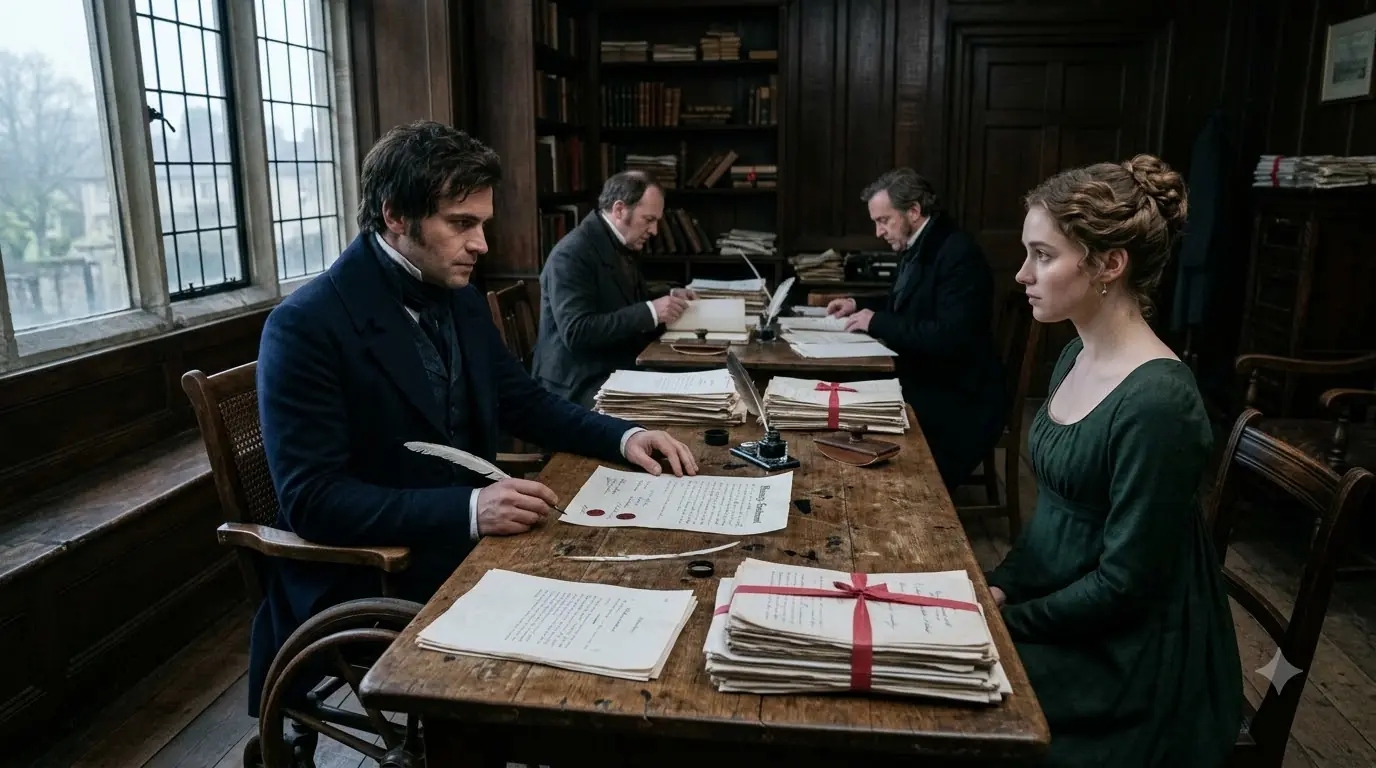
There were no flowers, no music, no smiling relatives whispering good wishes—only a narrow office in Somerset, a long wooden table, and two witnesses who kept their eyes carefully on the paper instead of the couple sitting across from them.
Genevieve Carlisle was 21 years old, and on that quiet October morning in 1812, she became the Duchess of Summerfield.
She had imagined this moment many times in the weeks before it arrived. Each version had been colder than the last. Every whisper she had heard about the Duke had shaped the picture in her mind: a bitter man, a broken soldier, a widower who had returned from war with legs that no longer obeyed him, and a temper that frightened even his servants.
She had prepared herself to meet a monster. What she did not prepare for was the silence.
Nicholas Windrest, the Duke of Summerfield, signed the marriage document with a steady hand. His face gave away nothing. He did not look at her once during the ceremony. His posture was straight in the wheelchair beside the table, controlled and quiet in a way that felt heavier than anger.
It was the stillness of someone who had already decided the world held nothing left to offer him.
When the papers were finished, he gave a short nod to the witnesses. "That will be all."
His voice was calm, low, perfectly polite. Then he turned his chair toward the door. The entire marriage had lasted less than 10 minutes.
Genevieve watched him leave and felt a strange, unexpected thought move through her mind. That was not cruelty. That was surrender.
Four hours later, the carriage carrying the new duchess rolled slowly through the gray countryside of Somerset. Rain streaked the window glass in soft lines. The sky had turned the pale color of early autumn fog.
Inside the carriage, Genevieve sat very straight with her hands folded neatly in her lap. She had promised herself one thing: she would not gasp when she saw Windrest Hall.
The house appeared gradually through the mist like a stone ship rising from water. It was enormous. Tall gray walls climbed above carefully trimmed lawns. Iron gates stood open at the end of a sweeping gravel drive. The building had the kind of quiet authority that came from centuries of history.
But what struck her most was not the size. It was the stillness.
Nothing moved. No laughter drifted from the windows. No servants hurried across the steps. Even the air seemed to pause around the house as if the place had been holding its breath for years.
The carriage stopped. Her maid Clara touched her arm gently. "My lady, we have arrived."
Genevieve stepped down onto the gravel. The cold October air settled instantly into her bones. She looked up at the great stone house and studied it carefully, the way a general studies a battlefield.
Everything was perfect. The lawns were trimmed. The gravel drive was spotless. Not a single weed broke through the pale stones. Everything was maintained, but maintained like a museum—precise, untouched, as if no one had laughed inside these walls for a very long time.
Her eyes moved to the windows. Almost every one of them was dark, except two. At the far end of the ground floor, behind thick curtains, a faint golden light flickered softly.
"He is there," she thought, "watching me arrive." And he did not come outside.
Genevieve breathed slowly through her nose once, then lifted her chin and walked toward the front door.
The housekeeper met her in the entrance hall. Mrs. Eldridge was a sturdy woman with gray hair and observant eyes that suggested she had seen far more of life than she spoke about. She curtsied politely. "Lady Genevieve, welcome to Windrest Hall."
There was a brief pause. "His Grace sends his apologies. He was detained."
Genevieve smiled gently. It was not a social smile meant to impress; it was the quiet kind that said she understood more than people expected. "Of course," she said softly. "May I be shown to my rooms first? I would like to change before dinner."
Relief passed briefly across the housekeeper's face.
The rooms prepared for her were beautiful. That was the second surprise. Her suite overlooked the eastern gardens, where rows of silver birch trees stretched toward the far edge of the estate. The bed was large, polished mahogany with soft ivory curtains. A fire had been lit recently in the fireplace, though the warmth had not yet fully reached the corners of the room.
Genevieve stood in the center of the chamber after her maid left to unpack the trunks. "He ordered the fire lit. He did not greet me, but he ordered the fire."
The thought stayed with her. Windrest Hall was silent in a way that felt different from ordinary quiet houses; this was the silence of a place holding its breath.
Later that evening, she found a small folded card waiting on the writing desk:
Dinner is served at 7:00. Your presence is not required if you are fatigued from travel.
— W.
She read the message twice. "Your presence is not required." Not welcome. Not expected.
Something stubborn stirred inside her chest. Dinner was at 7:00; she would be there five minutes early.
She found him before dinner. Not intentionally.
She had been searching for the library when she noticed the door slightly open at the end of the corridor. Warm candlelight spilled across the floor. Inside the room, a large desk stood near the fireplace surrounded by towering shelves filled with books.
And behind that desk sat the Duke of Summerfield. Nicholas Windrest.
He was in a wheelchair. Genevieve had known this already; her mother had mentioned it carefully when the marriage was arranged. But seeing it was different.
He was younger than she expected—perhaps 32. Dark hair slightly unsettled as though he had run a hand through it. Broad shoulders that hinted at the strength he must have once carried easily. His posture was completely still, controlled with a discipline that felt almost military.
He looked up. His eyes were blue—deep blue, the kind of blue the sky turns before a storm begins. They studied her carefully.
"Lady Genevieve." His voice was low and steady.
"Your Grace." She stepped just inside the doorway but did not move farther. "I apologize for interrupting. I was looking for the library."
A pause. "You have found it," he said simply.
She glanced at the shelves surrounding them. "It is remarkable."
For a moment something flickered across his expression, then it disappeared. "Is there something you require?"
"Yes," she thought, "I need to know who you are."
Instead, she said politely, "A book."
He studied her another moment before turning back to the papers on his desk. "South wall," he said. "Fiction is arranged alphabetically."
She found a novel. She left quietly. But she felt the exact moment his eyes lifted from the page to watch her leave.
Dinner that evening was quiet. The table could have seated 20 people, but only the two of them sat at opposite ends beneath the warm glow of candlelight. The meal was excellent: roast lamb, fresh bread, buttered vegetables.
The Duke spoke twice: once to ask if the food was satisfactory, and once to mention that rain was expected the following week.
When the meal ended, he pushed his chair back from the table. "Good night, Lady Genevieve."
"Good night, Your Grace."
He left the room. Genevieve remained sitting at the table for a moment longer, listening to the quiet sound of his wheels rolling across the stone floor. She looked down at her glass of wine.
She had expected loneliness. What she felt instead was something else: curiosity.
She lifted her eyes toward the dark doorway where he had disappeared. "What broke you?" she wondered. "And why are you so determined that no one ever finds out?"
Nicholas asked to see her the next morning. He did not send an invitation; he sent a request. Genevieve noticed the difference.
Mrs. Eldridge delivered the message with a tray of tea while gray rain tapped gently against the windows of her bedroom. "His Grace would like to speak with you in the blue sitting room, my lady."
Genevieve had already been awake for two hours. She had spent the early morning reading beside the fireplace while the house slowly woke around her. Windrest Hall moved quietly, like a place that had forgotten what it meant to be alive.
By the time she walked down the staircase, the rain had turned the gardens outside into a pale watercolor of silver and gray.