Three days passed in suffocating silence. Genevieve took her meals alone, walked the portrait gallery alone, sat in the music room before a pianoforte she dared not play. The servants treated her with cautious courtesy, but she saw the questions in their eyes. What sort of marriage was this, where husband and wife existed as strangers in separate wings? She had tried that first morning to approach Lord Ashford at breakfast. She had descended early, hope fluttering foolishly in her chest, thinking perhaps daylight and duty might soften his resolve. But when she entered the dining room, he had looked up from his correspondence with such naked hostility that words died unspoken on her tongue. He had risen, folded his newspaper with deliberate precision, and left without a single syllable passing his lips. The message was clear. She was unwelcome even in shared spaces.
So she retreated as she had learned to do in her father's house when his temper darkened. Invisibility was a skill she had perfected long before this marriage. Be quiet. Be small. Be nothing at all. Survive. On the fourth morning she woke to discover a note slipped beneath her door. The handwriting was sharp, masculine, unforgiving. You will attend dinner tonight. We have guests. Present yourself appropriately. Do not embarrass me.
Genevieve's hands trembled as she read it once, twice, three times. He required her presence, but only as ornament, only as proof of respectability before witnesses. She was to be trotted out like a prize mare, displayed and dismissed. Very well. If Lord Ashford wanted a decorative wife who spoke only when spoken to, she would give him exactly that. She had survived worse than indifference. She would survive this, too, even if it hollowed her out completely.
The gown laid out for her was exquisite, pale blue silk with ivory lace, cut to flatter without drawing undue attention. Genevieve wondered who had selected it. Surely not her husband, who could barely stand to acknowledge her existence. Perhaps the housekeeper, Mrs. Daventry, who had shown her small kindnesses these past days. She dressed with care, pinning her dark hair in a simple style that would not invite criticism. No jewels adorned her throat. She owned none, but the candlelight would be forgiving. She studied her reflection with detachment, seeing what Lord Ashford would see: an adequate wife, properly attired, sufficiently invisible.
When she descended the stairs, her heart hammering against her ribs, she found him waiting in the entrance hall. He wore evening blacks that emphasized the harsh lines of his face, the military precision of his bearing. He did not smile. He did not offer his arm. He simply assessed her with those winter-storm eyes, looking for flaws he might catalog and resent. "The Carwells are old family friends," he said, his voice devoid of warmth. "You will be polite, demure, and speak only if directly addressed. You will not mention your father. You will not embarrass me. Do you understand?" Each word was a small violence.
Genevieve lifted her chin, meeting his gaze with hard-won composure. "Perfectly, my lord." Something flickered in his expression, surprise perhaps that she did not cower or weep, but it vanished as quickly as it had appeared, replaced by that impenetrable coldness. "Good," he said, and finally, grudgingly, offered his arm. She placed her hand upon his sleeve, feeling the tension coiled in his muscles, the heat of him burning through expensive fabric. For one breath, two, they stood suspended in mutual awareness before he moved, guiding her toward the drawing room where voices and laughter waited, sounds foreign in this house of ghosts.
The Carwells proved to be exactly as Genevieve expected: a jovial baronet with a fondness for port, and his wife, a pleasant woman who smiled too much and noticed too keenly. Their daughter, a striking blonde named Cecilia, watched Lord Ashford with barely concealed longing that made Genevieve's stomach twist with something she refused to name as jealousy. Dinner unfolded with agonizing formality. Genevieve sat at the far end of the table, her husband a distant, forbidding presence at its head. She spoke when addressed. Yes, the weather was fine. No, she had not yet explored the gardens. Yes, Ashford Hall was quite grand. And otherwise remained silent, a decorative statue in blue silk.
Lord Ashford ignored her completely, directing all conversation toward Sir Carwell and his daughter. When Cecilia laughed at something he said, touching his arm with casual intimacy, Genevieve felt each breath grow sharper, more difficult. "And how are you finding married life, Lady Ashford?" Lady Carwell asked suddenly, her keen eyes studying Genevieve with unsettling focus. The table fell silent. Genevieve felt her husband's gaze upon her, heavy with unspoken warning. She set down her fork with careful precision, summoning every lesson in deportment her governess had beaten into her. "It is an adjustment, Lady Carwell," she said softly, truthfully. "But Ashford Hall is beautiful, and I am grateful for Lord Ashford's..." She paused, searching for a word that was not quite a lie. "...generosity."
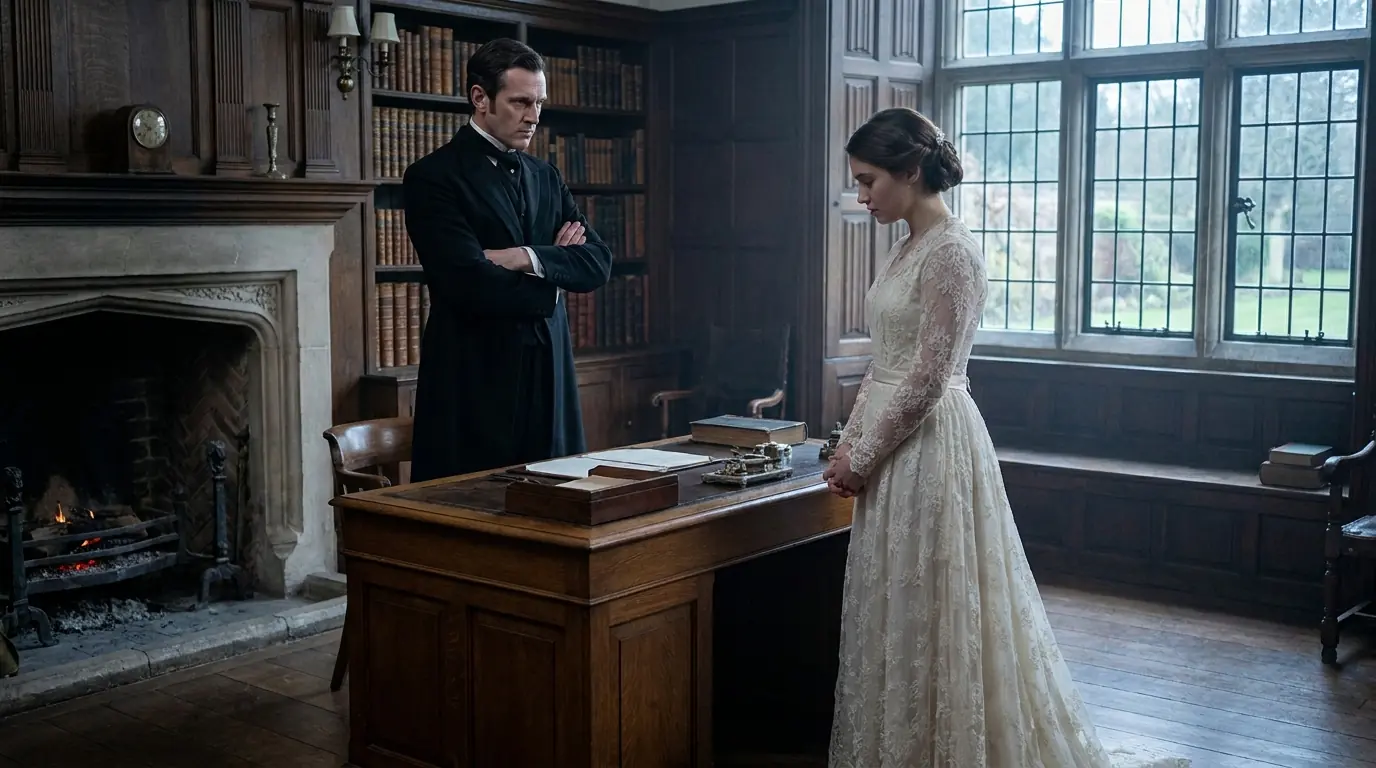
Dominic's jaw tightened. Something dangerous flashed in his eyes: anger, perhaps, that she had not played her part with more enthusiasm, or perhaps recognition that her words held multiple meanings, none of them complimentary. "How lovely," Lady Carwell murmured, though her tone suggested she believed nothing of the sort. The remainder of dinner stretched like eternity, each course another small torture, until Genevieve thought she might shatter from the weight of pretending.