Dad, I'm here. Two words. That's all she said. But those two words hit that courtroom like a freight train through a glass wall. Every head turned, every breath stopped because the young woman standing in that doorway in a perfectly tailored lawyer suit.
The one holding a legal folder like she owned the room was supposed to be nobody. She was supposed to be gone. She was supposed to be forgotten. But Emily Carter doesn't forget the man who refused to forget her. And Marcus Walker, sitting alone at that defense table with his hands folded and his future dissolving, looked up and for the first time in months, he didn't look like a man who had already accepted his fate.
He looked like a father. Now, let's go back to where this really begins. The courtroom smelled like old wood and recycled air and the specific kind of tension that fills a room when everyone present believes they already know how something ends. Marcus Stone Walker sat at the defense table and did not look at the jury. He had made that decision on the first morning of trial and he had not broken it since.
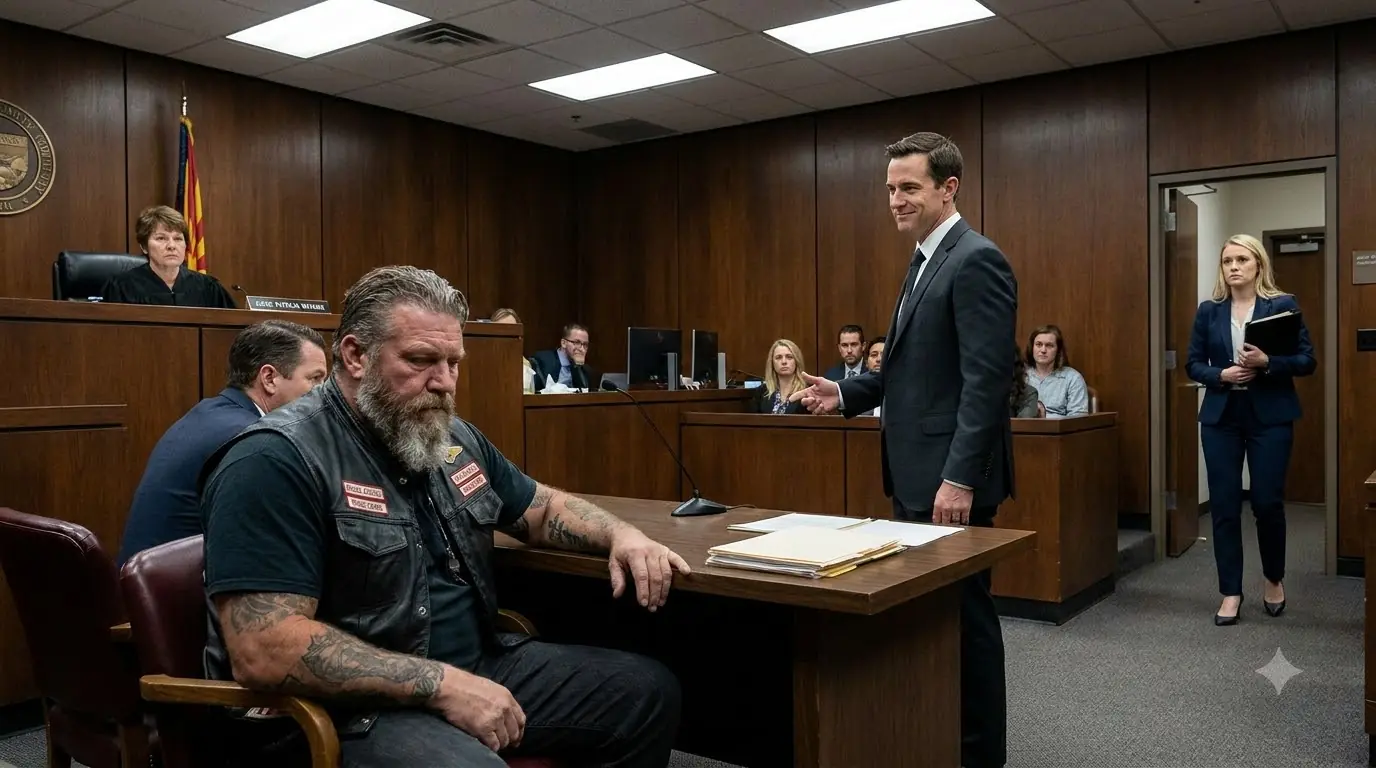
His lawyer, a tired man named Gerald How, who wore the same blue tie every day, had told him to make eye contact, to appear open, to appear human. Marcus had nodded and then quietly done exactly what he felt was right because the jury had already decided what he was the moment they saw his arms. He knew that the way you know winter is coming before the temperature actually drops. You can feel it in the air. You can feel it in the way people look at you.
Not at your eyes, not at your mouth, but at the ink running from his wrists up past his elbows. At the faded patches of color that told a story he had spent 15 years trying to move past. Hell's Angels. Two words that meant more to a jury than anything his lawyer could say. Gerald had warned him about this during their third meeting, leaning across a scratched conference table in a windowless room at the county courthouse.
Marcus, I need you to understand something. The evidence they have, it's circumstantial. It's built on coincidence and manipulation. In a normal case with a normal defendant, we would have a real shot. Marcus had waited.
But you are not a normal defendant. I know, Marcus said. When that jury walks in and looks at you, they are not going to see a 58-year-old mechanic who spent a decade being a decent human being. They are going to see I know what they're going to see, Gerald. Gerald had sat back and rubbed his eyes beneath his glasses.
I'm not trying to insult you. You're not, Marcus said. You're just telling me the truth. I appreciate that more than you know. That had been 6 weeks ago.
Now, Marcus sat at that table and listened to the prosecution explain in measured and confident language exactly why Marcus Walker was guilty of corporate espionage and theft of restricted intellectual property. The prosecutor's name was Andrew Reigns. He was 43 years old, sharp featured with the kind of easy confidence that came from winning most of his cases. He wore expensive shoes and spoke in full sentences, and he had a particular way of pausing just long enough and after saying something damning to let it sink into the jury like a stone dropped into still water. "Ladies and gentlemen," Re said, moving slowly in front of the jury box.
"The defense will ask you to believe in coincidence. They will ask you to believe that a man with a documented history of association with a known criminal organization, a man whose fingerprints were found on restricted company equipment, a man whose security badge was used to access a confidential archive at 11:47 on the evening of March 14th. They will ask you to believe that all of this is simply a misunderstanding. He paused. Let it breathe.
But coincidences don't stack up this neatly. Evidence doesn't arrange itself. And a jury's job isn't to give the benefit of the doubt to someone with this man's history simply because his lawyer uses the word misunderstanding. Marcus kept his hands folded on the table and his eyes on a fixed point on the far wall. He had learned long ago that anger was a luxury he couldn't afford in rooms like this one.
Gerald leaned close. "Don't react," he murmured. "I'm not reacting," Marcus said quietly. "I know. I'm just reminding myself."
The first witness for the prosecution was a security analyst named Paul Greer, who walked the jury through the digital access logs with the kind of detailed patience that made Marcus' headache. Every time stamp, every door, every badge scan, and they're highlighted in red on the projected display was Marcus Walker's employee ID. Accessed restricted archive b 11:47 p.m. March 14th. This badge, Greer explained pointing at the screen, granted access to a section of the Meridian Technologies server room that holds proprietary design data worth an estimated $42 million. The same data that was subsequently found to have been copied and transmitted to a competitor.
Reigns nodded thoughtfully. And whose badge granted that access? Marcus Walkers. The jury wrote things down. Gerald Cross examined Greer for 40 minutes and managed to establish that a badge could theoretically be used by someone other than its registered owner.
That digital logs recorded badge used not the physical identity of the user. It was good work, but Marcus could see from the jury's faces that it wasn't enough because Gerald's argument required them to believe that someone had stolen Marcus' badge and used it deliberately. And for them to believe that they first had to believe Marcus was worth framing. They had to believe he wasn't simply the most obvious explanation. A man like him working inside a technology company.
A man like him with access to a restricted server room. A man like him. The lunch recess came and Marcus sat alone in the holding area with a paper cup of coffee that had gone cold. He thought about Emily. I thought about the Sunday 2 months ago when she had called at her usual time, 6:00 p.m. Exactly not a minute later.
She had never once been late in 9 years, and he hadn't answered because his phone had already been confiscated as part of the arrest processing. He had spent that first night in a holding cell thinking about the phone ringing in his empty house, about Emily calling and calling and getting no answer and not knowing why. I thought about the conversation they'd finally had 3 days later after Gerald had arranged a supervised call. Emily's voice had been completely steady. That was the first thing he noticed.
Not shaky, not panicked, steady. "Tell me everything," she said. He had She had asked questions, specific, clear questions, the kind that told him her brain had already shifted into a different mode. "Not daughter mode, something more focused. Have they shown you the fingerprint analysis report?"