The smokehouse behind Red Willow Ranch had been built long before anyone in the valley called it a smokehouse.
Its lower walls were old stone, sunk deep into the earth, older than the barn, older than the whitewashed ranch house, older even than the name nailed above the front gate. Most people saw only the weathered boards, the iron hooks inside, the smoke stains along the rafters, and the narrow door that always stuck in wet weather. But Clara Bellamy had grown up hearing her mother tell stories about what lay beneath it.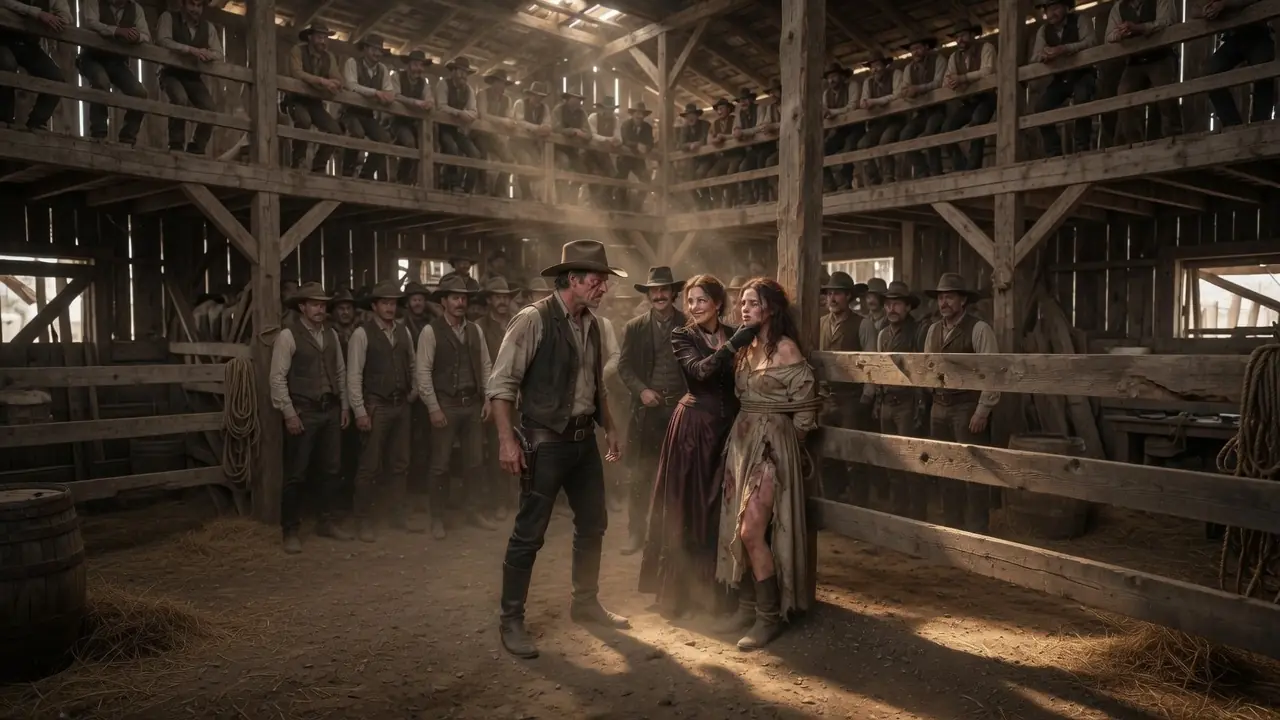
“Every old ranch has a second way out,” her mother used to say. “One door for visitors, and one door for trouble.”
Clara remembered those words only after the flames had already climbed halfway up the wall.
Heat rolled across the room in waves so thick she could barely breathe. Smoke gathered near the ceiling, black and heavy, curling down in choking ribbons. Beside her, her younger brother Jonah coughed violently, one arm wrapped around a leather satchel full of papers that half the valley would have killed to destroy.
“We’re trapped,” Jonah gasped.
Across from them stood Caleb Rourke, the legendary gunslinger people from Helena to Abilene still whispered about when the whiskey was low and the night was long. He was older now, gray at the temples, scarred across one cheek, and slower than the stories claimed. But his eyes still had the calm of a man who had survived too many close calls to waste fear on the wrong second.
He looked around once.
Only once.
Then his gaze settled on the stone foundation beneath a wall of scorched crates.
“This building was not always for meat,” he said.
Clara’s mind snapped back to childhood.
Her mother’s voice.
The kitchen lamp.
The smell of cornbread cooling on the table.
One door for visitors, and one door for trouble.
Clara dropped to her knees and began dragging away the burning crates stacked against the far wall. Jonah stumbled forward to help her, coughing so hard his face had gone pale. Caleb kicked aside a broken shelf, tested the floorboards with his boot, then drove his heel down hard against a loose square of old timber.
The board cracked.
Cold air rushed upward.
“There,” Caleb shouted. “Tunnel.”
One by one, they dropped into the narrow passage under the smokehouse just as the burning roof gave way behind them.
Above them, Red Willow’s smokehouse disappeared in a tower of flames.
Outside, more than forty men stood watching the fire.
Some were ranch hands loyal to Silas Draven. Some were hired riders. Some were neighbors who had learned that silence was safer than conscience in a valley where Draven owned the sheriff, the judge, the bank, and nearly every drop of moving water.
Silas Draven himself watched the flames with his hands folded over the silver head of his cane.
“No one walks out of that,” he murmured.
His son, Abel, smiled beside him.
Neither man saw three figures crawl out nearly two hundred yards away, emerging from an abandoned well hidden by sagebrush, tall grass, and the mercy of old ranch secrets.
The fire behind them was not the beginning.
It was the mistake Silas Draven made when he believed fear could finish what fraud had started.
Red Willow Valley had once belonged to families with names carved into church pews, cemetery stones, and old fence posts weathered silver by Montana wind. The Bellamys owned the largest spring on the western slope, a cold underground source that fed two creeks, three cattle ranges, and half the settlement’s wells during dry summers. Whoever controlled that spring controlled the valley.
Clara’s father, Nathaniel Bellamy, understood that.
That was why he refused to sell.
For years, Silas Draven tried to buy him out. He came first with polite offers, then with bank pressure, then with legal language dressed up as neighborly advice. Nathaniel turned him away each time. He believed water belonged to the valley, not to one man’s greed.
Then Nathaniel died in a riding accident that never sat right with anyone who loved him.
A month later, a new will appeared.
According to that will, Nathaniel Bellamy had signed away half his water rights and placed Red Willow Ranch under the authority of his brother, Vernon Bellamy, until Clara reached what the document called “a suitable marital arrangement.” Vernon had always been weak around strong men and cruel around people weaker than himself. Silas Draven knew exactly how to use him.
Within a year, Red Willow changed.
Families who had grazed cattle there for generations were told their leases had expired. Widows received eviction notices. Small homesteaders downstream found their water gates locked. Men who complained were visited at night by riders who did not give names.
Sheriff Amos Kade called it a property dispute.
The county clerk lost records.
Judge Wilfred Pike ruled in Draven’s favor so often that people stopped pretending the courthouse was neutral ground.
Clara was seventeen when her father died.
By twenty-three, she had learned that grief could turn into work if a person refused to let it rot.
She kept ledgers hidden under floorboards. She copied old maps by lamplight. She listened when drunken cowhands spoke too freely near the kitchen door. She learned which men were paid to lie, which men were frightened into silence, and which men still had enough decency left to look ashamed when her eyes met theirs.
Her brother Jonah was fifteen, restless, quick, and brave in the dangerous way boys become when they are old enough to understand injustice but not old enough to measure bullets.
Clara spent half her life keeping him alive.
The other half she spent gathering proof.
The first real piece came from Dr. Miriam Vale, who ran the small clinic outside Millstone Crossing. Miriam had treated broken ribs, rope burns, bullet grazes, and crushed fingers from men who all claimed to have fallen, slipped, or been kicked by horses in the exact week they had refused to sell land to Silas Draven.
She kept her own records.
Not official ones.
The official ones were inspected too often.
Miriam wrote the true injuries in a separate notebook, using initials, dates, and little marks only she understood. When Clara found out, she did not ask why Miriam had kept quiet. Fear was not a mystery in Red Willow Valley. It had a house in every family.
The second piece came from Deputy Eli Marrow.
Eli was young, nervous, and not brave by nature. But cowardice has limits, and his limit came the night Abel Draven beat an old rancher named Thomas Greer nearly unconscious in front of the livery for refusing to clear his herd off land he legally owned. Sheriff Kade ordered Eli to write the injury as a drunken fall.
Eli wrote the false report.
Then he copied the real one and hid it in Clara’s flour barrel.
The third piece came from Clara’s mother’s cedar trunk.
Her mother, Rose Bellamy, had died when Clara was twelve, but she had left behind more than quilts and letters. Beneath a false bottom in the trunk, Clara found the original water agreement signed by five founding families and witnessed by a federal land officer. It stated that the underground spring beneath Red Willow was protected shared valley resource, never to be sold, sealed, diverted, or controlled by one ranch owner.
It was the document Silas Draven had spent twenty years pretending did not exist.
The final piece came from Vernon Bellamy himself.
Not willingly.
Vernon had become meaner with age and whiskey, but careless with both. One night, after losing heavily at cards, he bragged that Draven had paid him enough for “one little signature” to make his brother’s stubbornness someone else’s problem. Jonah overheard him.
Clara confronted Vernon the next morning.
He slapped her hard enough to split her lip.
Then he made the mistake of saying, “You think your father’s will was real because men like you need papers to believe what powerful men already decided.”
That sentence told Clara where to look.
The forged will was stored in the county records building under three layers of clerical protection, but Clara had learned patience from watching men underestimate her. She waited until a storm took down the telegraph line, until Sheriff Kade rode out to inspect a washed bridge, until the clerk’s assistant left the side door unlocked for a woman bringing supper to her cousin.
She slipped inside with Jonah standing watch.
In a back cabinet, beneath tax assessments and land transfer copies, she found what she needed.
Not only the forged will.
The payment ledger.
Names. Dates. Amounts. Sheriff Kade. Judge Pike. Vernon Bellamy. County clerk Harold Tuck. Witnesses paid. Witnesses threatened. Witnesses disappeared.
At the back of the ledger was a list titled Remaining Witnesses.
Twelve names.
People who had seen too much.
People Silas Draven had not yet silenced.
Clara placed the papers in a satchel and walked out into the rain with her heart beating so hard she could feel it in her wrists.
She almost made it home.
Draven’s riders were waiting near the old creek crossing.
Jonah saw them first and fired once into the air, not to hit, only to startle the horses. Clara ran. Jonah ran behind her. They reached the cottonwood ridge before the first bullet cut through Clara’s sleeve.
That was when Caleb Rourke appeared.
He stepped from the trees with a rifle in his hands and said, “Walk away. Now.”
There were four riders.
All younger.
All armed.
All men who had grown used to watching others flinch.
They looked at Caleb Rourke, and one by one, recognition moved across their faces. Every valley had its myths. Caleb was one of the few who had lived long enough to become tired of his own.
A former lawman.
A former marshal.
A man who had ended range wars, killed men who deserved trials and men who probably did not, and then vanished into the high country after refusing to serve one more sheriff who thought justice meant protecting whoever paid better.
The lead rider tried to smile.
“You ain’t wearing a badge anymore, Rourke.”
“No,” Caleb said. “That makes my advice less official.”
He leveled the rifle.
“Not less serious.”
The riders left.
Not because they lacked courage.
Because courage and stupidity only look similar from far away.
Caleb took Clara and Jonah to an abandoned line cabin he used when passing through the valley. There, by lantern light, she showed him the documents. He read slowly, lips tightening only once, when he reached the list of witnesses.
“You know what this is?” he asked.
“Proof.”
“Yes,” Caleb said. “And a death sentence if you take it to the wrong person.”
“I know.”
“Then we take it to the right one.”
That was their plan.
Helena.
Federal court.
Judge Abigail Harrow.
A woman known throughout the territory for refusing bribes so often that rich men stopped insulting her by offering them directly. She had put railroad agents in prison, fined county officials, and once held a sheriff in contempt for lying under oath. Men called her difficult when what they meant was incorruptible.
But they needed to survive long enough to reach her.
Silas Draven moved faster.
By dusk, his men had found the line cabin. Caleb got Clara and Jonah out through the back, but the road north was cut off. They fled toward Red Willow, hoping to reach the old wash trail through the eastern hills. Instead, Vernon’s men drove them toward the smokehouse.
It was a trap, but it was the only shelter close enough.
They barred the door from inside.
Outside, forty men gathered.
Some rode for Draven. Some worked for Vernon. Some were simply townsmen who came to watch and decided watching was safer than choosing. Sheriff Kade stood near the gate with his thumbs hooked in his belt, doing nothing.
Draven walked up to the smokehouse door and spoke through the wood.
“Give me the satchel, Miss Bellamy.”
Clara held the leather strap tight in both hands.
“No.”
“You are protecting papers that cannot protect you.”
“They already have.”
“You think Rourke will save you?”
Caleb stood beside the door, gun ready.
“I already did once,” he said.
Draven laughed softly.
“A dead legend in a burning shed is still dead.”
Then the fire started.
At first, it was smoke under the door.
Then flame.
Then heat.
Then the walls groaning, roof cracking, Jonah coughing, Caleb looking once around the room and seeing what Clara had forgotten.
Root cellar.
Tunnel.
Second way out.
They escaped through the earth while Draven watched the smokehouse burn and believed the valley had finally learned to stay quiet.
By the next morning, they were already miles away.
Caleb rode ahead, silent and watchful. Clara rode behind him with the satchel under her coat. Jonah rode last, pale from smoke but stubborn enough to pretend he was fine.
They reached Helena after dark.
Judge Abigail Harrow received them before sunrise.
She wore a black dress, wire spectacles, and the expression of a woman who did not enjoy being awakened but enjoyed corruption even less. Her office smelled of ink, old paper, coffee, and cold determination. She listened without interrupting as Clara laid every document on her desk.
The original will.
The forged will.
The protected spring agreement.
The hidden water maps.
The bribery ledger.
Deputy Eli’s copied report.
Dr. Miriam Vale’s injury notes.
The list titled Remaining Witnesses.
Judge Harrow read everything.
The room stayed silent except for paper turning.
At last, she removed her spectacles and looked at Clara.
“I have waited eighteen years for someone to bring me evidence like this.”
Clara felt her knees weaken.
Not from fear.
From the sudden terrible weight of being believed.
Within forty-eight hours, federal marshals moved through Red Willow Valley.
They came at dawn, not with threats, but with warrants.
Red Willow Ranch.
Silas Draven’s headquarters.
The sheriff’s office.
The county records building.
The bank.
The private safe in Judge Pike’s chambers.
Doors opened that had stayed closed for years.
Ledgers were seized. Deeds were reviewed. Bribe accounts were frozen. Witnesses who had remained silent out of terror finally stepped forward when they saw federal authority standing between them and Draven’s riders.
Dr. Miriam Vale testified first.
She brought her hidden notebook and read aloud injury after injury, each one tied to a land dispute, a threat, or a refusal to sell. Her hands shook, but her voice did not.
Deputy Eli Marrow came next.
He admitted Sheriff Kade had ordered him to ignore complaints, alter reports, and discourage families from filing charges against Draven men. He named dates. He named riders. He named the night Abel Draven beat Thomas Greer and the sheriff told everyone to let it go.
Vernon Bellamy broke after two hours of questioning.
He admitted the will was forged.
He admitted Silas Draven paid him.
He admitted Clara’s father had never agreed to sell the spring.
Then Abel Draven tried to blame everything on his father and made the mistake of mentioning things the marshals had not yet asked about.
By sunset, the empire began collapsing under the weight of its own records.
Sheriff Kade surrendered his badge without a word.
Judge Pike claimed illness until federal deputies escorted him from his home.
Vernon Bellamy was arrested for fraud, assault, unlawful confinement, and conspiracy.
Abel Draven was arrested for attempted murder, witness intimidation, and violent enforcement of fraudulent land claims.
And Silas Draven, who had spent twenty years believing money made truth negotiable, stood before Judge Harrow with his cane in one hand and contempt in both eyes.
“You have papers,” he said calmly. “I have influence.”
Judge Harrow looked at him over her spectacles.
“Influence bends weak men,” she said. “It does not bend federal law.”
The courtroom was full.
Ranchers. Widows. Former deputies. Men who had once laughed in saloons about families driven off their land and now avoided looking at those same families across the aisle. Clara sat in the front row with Jonah beside her and Caleb standing against the back wall, hat in hand, eyes on every exit.
Draven’s lawyers argued for delays.
Judge Harrow denied them.
They argued jurisdiction.
She overruled them.
They argued confusion, old boundaries, inheritance disputes, and business misunderstandings.
She let them talk long enough for the whole courtroom to understand exactly how little they had.
Then she voided every fraudulent deed tied to the spring.
She ordered stolen ranches returned to rightful families.
She froze Draven’s assets to compensate those forced from their homes.
She referred county officials for prosecution.
And when Silas Draven was sentenced to spend the rest of his life in federal prison, the silence in that courtroom felt less like shock than exhale.
As deputies led him away, Draven stopped near Clara.
His face had aged ten years in two weeks.
“You destroyed everything I built.”
Clara looked at him.
“No,” she said. “The truth did.”
The valley did not heal all at once.
No place does.
Families returned to houses with broken roofs, fields gone wild, fences pulled down, wells fouled by neglect, and grief waiting in corners. Some land could be restored. Some graves could not. Some apologies arrived. Some never did.
But the water flowed again.
Judge Harrow’s order declared the underground spring protected community land under federal oversight. No single rancher, company, bank, or sheriff could control it again. The water gates were unlocked. Channels were repaired. In August, when the dry heat settled over the valley, three creeks ran clear where they had once been diverted behind locked timber.
Red Willow Ranch changed too.
Clara refused to turn it back into what it had been under Vernon’s hand.
She made it a refuge.
Widows found work there.
Displaced families found temporary rooms.
Travelers found food.
Children slept in the upstairs rooms where Clara had once whispered to Jonah that things would not always be this way. The old barn, where men had once been beaten for refusing Draven’s terms, became a storage hall for shared grain, tools, blankets, and seed.
Dr. Miriam opened a proper clinic in the front parlor.
Deputy Eli left law enforcement and became the valley’s schoolteacher.
Jonah grew three inches, gained too much confidence, and began talking about studying law, which Clara blamed entirely on Judge Harrow.
Caleb Rourke stayed longer than he said he would.
At first, he claimed he was only watching the roads until Draven’s remaining men scattered. Then he claimed the east fence was poorly set and needed work. Then he claimed the barn roof had the wrong pitch for winter snow and that leaving before fixing it would offend his judgment.
Clara let him keep making excuses.
One autumn afternoon, she found him under the old cottonwood at the edge of Red Willow property.
The tree had stood there since before Clara was born. Her mother had taught her to ride beneath it, walking beside her with one hand on the saddle and the other ready to catch her if she fell. Its roots reached deep toward the underground spring, and its leaves had turned gold in the cooling light.
Caleb leaned against the fence, watching families rebuild cabins in the distance.
Clara stood beside him.
“Everyone says you saved me,” she said.
Caleb kept looking across the valley.
“I opened one door.”
“No,” Clara said. “You reminded me I was allowed to walk through it.”
He glanced at her then.
For once, the legendary gunslinger had no quick answer.
After a moment, he reached into his coat and took out an old marshal’s badge. The silver had dulled. The edges were worn. It looked heavier than metal had any right to be.
“I carried this fifteen years,” he said. “Thought justice came from wearing it.”
“And now?”
He looked toward the ranch, toward children laughing near the barn, toward widows hanging laundry, toward Jonah arguing with Eli about books, toward Dr. Miriam helping an old rancher down the steps.
“Now I think justice comes from ordinary people refusing to stay afraid.”
Clara touched the badge.
“Keep it.”
“Why?”
“Because there will always be another valley. Another frightened witness. Another family being told to stay quiet.”
She smiled, soft but certain.
“And someone will need to hear you say, ‘Walk away. Now.’”
Caleb laughed quietly.
It was not the laugh of a legend.
It was the laugh of a tired man who had finally found a reason to stop running from every place that asked him to care.
Years later, children at Red Willow would ask why the old cottonwood still stood untouched in the center of the ranch, even after storms split its largest branch and age hollowed part of its trunk.
Clara always answered the same way.
“Some trees become landmarks,” she would say. “This one became a promise.”
A promise that when fear tells good people to look away, someone will step forward.
A promise that papers hidden in trunks can outlive lies told by powerful men.
A promise that water belongs to the valley, truth belongs to the brave, and no fire burns hot enough to destroy what people are willing to carry through the dark.
That was how Red Willow Valley changed.
Not all at once.
Not because one gunslinger drew a gun.
But because a woman refused to hand over the truth.
Because a boy kept running with a satchel full of evidence.
Because a doctor wrote injuries in a hidden book.
Because a deputy finally told the truth.
Because an old judge had been waiting for proof.
Because forty men watched a building burn and believed silence would save them, while three people crawled through smoke, earth, and darkness toward justice.
And when they emerged on the other side, the valley was never the same again.