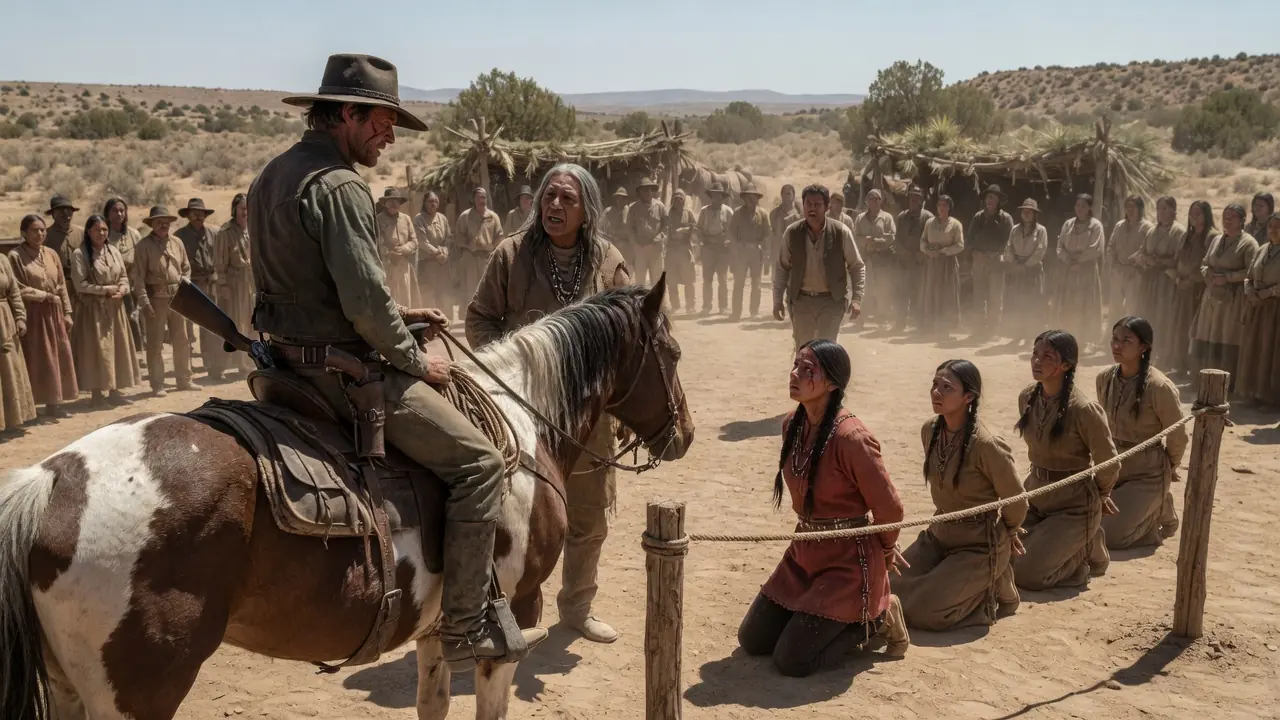
The rope was already up. That's the first thing I saw when I came over that last ridge. Four women kneeling in the dust and one rope strung between two cedar posts and a whole village watching. I'd been riding since before light, hadn't eaten since noon the day before, and my horse had a stone bruise on his left front that was making him favor his steps.
None of that mattered much once I saw the rope. I pulled up and sat there a moment. My canteen was empty. The sun was straight overhead, and the heat was the kind that presses on you from all sides at once, the kind that makes the air above the ground go wavy and strange.
There were maybe 40, 50 people gathered in that flat place below me. The women kneeling were Apache, all four of them, and they were young, younger than I had first thought. Their wrists were bound behind them with rawhide. They weren't crying.
That's what I remember most clearly from that first sight of them. Not one of them was making a sound. I'd been through enough country to know what I was looking at and why. I'd heard the talk at the last trading post three days back. Four wives condemned by their husbands and the council for failure to produce children.
Barren, the men said, useless, they said. In some bands, the sentence was death. In others, it was exile into country where death came slower and alone. What I was seeing was the first kind. I sat up there on that ridge for maybe 30 seconds.
No longer. I know a man who would have turned his horse around and told himself it wasn't his affair. And I know men who would have gone down there and gotten themselves killed for nothing. I'm neither one. I thought it through in about the time it takes to draw a breath.
And what I came to was this. I was the only living soul on that ridge. There wasn't anybody else coming. And if I rode away, those four women were dead before the sun moved another hands width across the sky. So I rode down.
My name is Caleb Dowd. I was 38 years old that summer. Though I looked older, I had no land, no family, no fixed address. I worked cattle when there was work, scouted for the army when I needed money fast, ran freight when I couldn't get anything better. I've been shot twice and stabbed once, and I had a scar along my left jaw from a man who'd come at me with a bottle in a saloon in Prescott.
I'm telling you this not to make myself sound like something I wasn't. I was a drifting man, a tired man, a man who'd spent 20 years doing hard work in hard country and had precious little to show for it. I'm telling you because what happened that day changed every single thing about how the rest of my life went. And you need to know what kind of man I was when it started. I rode down that ridge at a steady walk because running a horse at a crowd is a good way to start a fight you can't finish.
I kept my hands visible. I had a Winchester in the scabbard and a colt on my hip, but I didn't touch either one. When I got close enough, I pulled up and waited. The man who came out to meet me was broad through the shoulders with iron gray hair and the eyes of somebody who'd been making hard decisions for a long time. Chief or close enough to it.
He stood in the path of my horse and looked up at me and didn't say a word. I looked back at him the same way. I found that's often the best opening. Silence, eye contact, and enough stillness that the other man can take your measure without feeling rushed. I spoke some Apache, not fluent enough.
I'd learned it working as a scout in my 20s, and I'd kept it up the way you keep up a skill you're not sure you'll need, but feel better for having. I said in Apache that I wanted to talk, and that I had something to offer. He didn't move, but he didn't gesture for someone to pull me off my horse either, which I took as permission to keep talking. I asked what the women had done. He told me they were barren, all four of them.
Their husbands had council-sanctioned the sentence. It was done. The law of the people said it was done. His voice was flat saying it. Not cruel, but not soft either.
I said I would take the women off their hands—all four of them—and ride out with them that day, taking them into my keeping. And he'd never see any of them again. They'd be gone from his people, gone from his country. No longer any burden or shame to anyone. In exchange, I would give him my horse, the paint gelding I was sitting on, which was a fine animal despite the stone bruise, strong chested and sound everywhere else.
Not a horse you came across easy, my Winchester, my saddle, and everything in my saddle bags, which included a decent amount of trade goods I'd been hauling north. He looked at the horse for a long time. He looked at the rifle. He reached up and ran his hand once down the gelding's neck, slow and deliberate, the way a man does when he's estimating something. He looked at me.
I don't know what he saw. A gaunt weathered Anglo on a good horse with nothing to lose, maybe. Or maybe something else. I've never been able to figure what it is that makes a man listen when he has every reason not to. He turned and spoke to the others.
There was a back and forth I couldn't fully follow. They moved fast through it, and some words were ones I didn't have, and one man stepped forward, young, angry, somebody's husband, and he said something hard and sharp, pointing first at the kneeling women and then at me. The chief answered him in a voice like a stone door closing, short, final, no room in it for argument. The young man stepped back and stood there with his hands at his sides and his jaw tight, but he stepped back. The chief looked at me again and said, "Yes."
I got down off that horse. I want to stop here and say something about what it felt like to hand over that horse and that rifle because people always ask later whether I was scared. The truth is, I was past scared by then. You get to a point in a moment like that where fear isn't useful, so it just goes away. Like a dog that wanders off when it can't get fed.
What I felt was something simpler and harder to name. Like the feeling you get when you've just made a bet you can't take back that settling in your chest. That particular kind of quiet. I walked the geling to the chief and handed him the reins. Then I went to the saddle and pulled out the Winchester and handed that over too.
He took it and turned it over once, looking at it the way you look at something you already know you're going to keep. I took off the saddle and laid it on the ground. Pulled the saddle bags off and set them beside it. Then I walked up to the four women myself, took out my knife, and I felt the whole crowd tighten when that blade came out, felt it in the air like a breath held, and I cut the rawhide on their wrists. They didn't move.
They were kneeling there in the dust, and they looked at me with expressions I can only describe as waiting, not grateful, not afraid, just waiting to see what the next thing was going to be. Like women who had learned over a number of years to hold still and see which way the wind turned before they moved. I said in Apache as plain as I could that I'd bought them from the council and they were coming with me. I said I wouldn't hurt them. I said beyond that we'd figure the rest out.
The one closest to me, I'd later learn her name was Nasha, looked straight at me for a long moment. She was maybe 25, strong boned with a cut above one eye from where she'd fallen or been made to fall. And she looked at me with eyes that were doing about 10 things at once. She said in English that surprised me absolutely flat-footed, "You're on foot now." I said, "Yes, ma'am, I am."
She stood up. The other three followed her because that's the kind of woman Nasha was. Others moved when she moved without needing to be asked, and the five of us walked out of that village with nothing but the clothes on our backs and a knife and a Colt revolver and six rounds in it. I did not look back. There's a thing about not looking back that matters.
Not because looking back is weak, but because when you've made a decision like that one, looking back is asking yourself a question you already answered. The first day was spent walking. I didn't know much about those women and they didn't know much about me and we all had the good sense to recognize that wasn't the time for talk. I set a pace that covered ground without breaking anyone down. And I kept us moving south and west away from that village into rougher country where we'd be harder to follow if anyone changed their mind about the deal.
I was watching the women. I'll be honest about that. When you've just taken on responsibility for four lives in country that's trying to kill you, you need to know fast what you're working with. What I was working with, I realized by midmorning, was a lot more than I'd expected. They moved right.
They read the ground automatically, the way people do who have always lived on it. They conserved water without being told. When I angled us toward shade, they angled with me without me having to say anything. And when I stopped to scan the country ahead, two of them had already drifted to higher ground to scan from there. I also noticed something else by midmorning.
The youngest one, who I'd learned was called Doli, was favoring her left foot. Not badly, but enough. I'd seen enough people try to walk through problems they ought to acknowledge that I could spot it. I fell back beside her and looked down and didn't say anything, just raised an eyebrow. She looked away, proud.
I like that. I stopped us at a rocky outcrop and said we were resting for 10 minutes, which was a lie. We probably needed to keep moving. And while the others found shade, I knelt in front of Doli and looked at her foot without touching it until she reluctantly took off her moccasin and showed me. A blister the size of a silver dollar that had already broken.
The skin around it was raw and weeping. I had nothing. No salve, no bandage, nothing. What I had was the bandana from my pocket and the contents of my canteen, which wasn't much. I cleaned it as well as I could and tore the bandana into strips and wrapped her foot, which was poor medicine, but better than leaving it open in the dust.
She sat through all of it without a sound. When I was done, she put her moccasin back on and looked at me with the same waiting expression they all seemed to have, like she was revising something in her head. We kept walking. By mid-afternoon, we were out of the flat and into canyon country. Red rock on both sides, thin shade, a seep of water I knew about from a prior trip through that territory.
We stopped there and drank. I had nothing to give them to eat. I told them that plainly. Nasha had been moving through country with her eyes open since we left the village. She disappeared into the brush for 20 minutes and came back with mesquite pods and something else I couldn't identify.
Some kind of root she'd found under a wash bank. She sat down and processed those pods with a flat rock she'd found. Quick and efficient as a woman who' done it a thousand times. She said nothing about what she was doing or why. She just started dividing what she'd made into portions.
She handed me mine last, which I figured was the way it was going to be for a while, and that seemed right. The other three women, Doli, who was the youngest and the quietest, maybe 19, with hands that were always doing something, fixing her moccasin or braiding a fringe or picking apart the bark of a stick in idle moments. But it wasn't idleness. I'd learned later she was thinking and that her hands moved when her mind moved. Luli, who was tall and moved like someone who'd been a runner, easyst strided, loose in the knees, watching everything with a calm that looked like indifference but wasn't.
And Sikino, who I learned was from a northern band and had ended up in that Apache village by a trade marriage that hadn't worked out for anyone. Sikino had very little Apache and no English. And we communicated for the first several weeks in hand signs and guesswork. But what she couldn't say, she made up for by being observant in a way that was almost uncomfortable. She'd watch your hands and your face and your feet and put it all together somehow.
That first night, I put my back against a rock and kept watch and let the women sleep. Nobody came after us. I'd been right about the trade. The horse and the rifle were worth more to the chief than the satisfaction of killing four women who'd already been cast out of their households. By taking them, I'd also removed the problem cleanly, which is a thing a man in that position appreciates.
Nothing to follow up on. Done. In the dark, I thought about what I'd done. Not with regret. Just with the clarity you get at night when the heat is off and there's nothing pressing on you but your own thoughts.
I'd given away my horse, my rifle, and everything I owned. I was on foot in Apache territory with four women who had no reason to trust me, no supplies worth speaking of, and no particular destination. I was, by any reasonable measure, in a significantly worse situation than I'd been in that morning. And yet, there's a feeling I'd been chasing for a long time and mostly failing to find. The feeling of having done the thing that needed doing, not the right thing in some church sermon sense, just the necessary thing, the thing that the moment required, the thing that nobody else was going to do.
I'd felt it twice before in my life. Both times in situations involving other men's trouble. And each time it left me feeling more awake than I'd felt in months, more solid somehow, more like the man I meant to be when I was young and hadn't yet figured out how hard that was. This was like that only larger, like the difference between a single lamp and a whole room of them. I watched the stars move and thought, "All right, Caleb.
Now figure out what comes next." What came next was finding horses. I knew a man, a Mexican freighter named Ruiz, who ran a supply line between Tucson and the smaller settlements to the north, who owed me a favor from two years back when I'd pulled him out of a flash flood with his wagon still attached. I'd found him by chance, or near enough to chance, sitting on the bank of an arroyo that was running bankful and brown after a cloud burst up in the hills, watching his wagon disappear into the current a piece at a time. And I'd gone in after it with my rope and my horse, and the stubbornness that has gotten me into as much trouble as it's gotten me out of.
We saved the wagon. We saved most of the load. Ruiz had said he'd repay me, and I'd said, "Don't worry about it." and meant it. And he'd said he was going to repay me anyway.
And I'd known from his face that he meant it, too. Ruiz operated out of a way station about 40 mi southwest of where we were. I could get us there in 3 days on foot, maybe 2 and a half if the women's pace held. Their pace was better than mine. That was the short version.
Nasha set the morning walk and she said it like someone who understood distances and heat and the relationship between water and surviving. And the other three kept up without complaint or visible effort. I kept up by not letting myself fall behind, which took more effort than I'd like to say. By the end of the second day, I was doing the internal arithmetic that men do when their body is asking questions about their age that they don't want to answer. On the second morning, Nasha fell into step beside me.
She'd been doing this in my peripheral vision since the first afternoon, taking in details, measuring things, drawing conclusions. I'd let her. I'd do the same in her position. She said, "Where are you taking us?" I told her about Ruiz.
Told her my plan was to get horses, then get us north into territory where nobody knew any of us, and start from there. She said, "Start what?" I said, "I hadn't fully decided yet, which was honest. I said I knew there was a settlement about a 100 miles north, mostly farmers, a few ranchers, a handful of families that had come out from the east and were trying to make something out of hard land. I said I might know of something near there, some land nobody was fighting over, but land."
She looked at me sideways and said, "You're going to buy land." I said I was going to try. She said with what? I said I was working on that part. She didn't say anything for a while.
Then she said you gave your horse. I said yes. She said for us. I said yes. She walked beside me for another stretch without talking.
Then she said no one did that before. I said I suppose not. She said why? I'd been thinking about how to answer that since the ridge. I'd run through several versions in my head, the practical one, the moral one, the self-deprecating one where I made it sound like I just done something obvious that anyone might have done.
None of them were right. So, I said what was actually true. I said I couldn't watch that and ride away. That I tried to ride past things before and it followed me too long afterward. And I decided some years back that I'd rather deal with the weight of doing the thing than with the weight of not doing it.
She thought about that for a while. She said that is a strange reason. I said most of my reasons were there was something in the air between us after that that wasn't exactly easier but was more settled the way it gets when two people have stopped circling each other and figured out roughly what they're dealing with. We walked the rest of that day mostly in silence, but it was a different kind of silence than before. When I counted my assets in my head that second evening, I had one Colt revolver, and six rounds, a skinning knife, the hat on my head, the boots on my feet, and a small amount of information I'd been sitting on for 3 years that had the potential to be worth something.
Six years back, I'd worked a brief stint helping a mining assayer do site surveys in the Northern Territories. I was young enough to find it interesting and not yet experienced enough to know how rare a useful thing that kind of knowledge was. The assayer's name was Hendricks, and he was thorough to the point of tedium, which is exactly what you want in a man who is evaluating rock, and he taught me enough that I could read a hillside and have some idea of what might be behind it. Three years later, prospecting on my own between cattle jobs, I found a played-out mine shaft up in the northern hills. The surface claim was abandoned.
No one was working it. The last man who'd worked it had given up on the primary vein, which was indeed exhausted. What he'd missed, because he'd been focused on the vein and not on the wall, was a secondary seam in the east face of the shaft, angled differently, shallower, but with color that I recognized from Hendricks's teaching. I pulled three pieces of rock and studied them in good light, and convinced myself I wasn't imagining it. Then I sealed the shaft as best I could, made my marks, and rode away.
I hadn't had the capital to do anything with it. I hadn't had the right partner. I'd been carrying that information around like a stone in my pocket for 3 years, waiting for the right moment. Sitting on that ridge, watching four women kneel in the dust. I wouldn't have said that was the moment, but here we were.
I told Nasha about it. Not all of it at once. I told her over the course of those three days of walking, a little at a time, the way you tell someone something when you're still working out whether you trust them enough to finish the telling. She listened without speaking much. Sometimes she'd ask a question, a precise question, not a curiosity question, but a clarifying one, the kind that told me she was building a picture in her head rather than just passing time.
How deep was the shaft? What was the condition of the support timbers when I'd last seen them? Had I assayed any of the rock from the secondary seam, and if so, what had the color told me? I asked her how she knew about assaying. She said her father had worked the copper mines east of the San Pedro for six years before she was born, and she had grown up hearing him talk about it.
She said he'd had a gift for reading rock, but hadn't had the right opportunities, which was a thing that happened to men like her father. I asked her how she spoke English. She said her mother had spoken English. Her mother had learned it from a missionary school before she'd gone back to the people. She decided the school wasn't worth staying for, but the language was worth keeping.
She'd said it was a tool, the same as any other, and you kept tools that were useful, even if you didn't like where they came from. I thought about that for a while. There was something in it about choosing what to carry and what to leave that felt true about more things than just languages. I didn't have a clean way to say what I was thinking, so I said nothing, which was probably the right call. On the third afternoon, we came to Ruiz's way station, which was a low adobe building in a dry creek bend with a pen of mules behind it and a Mexican flag someone had nailed to a cedar post and apparently decided to leave.
Ruiz was there, which was luck, and he was glad to see me, which was better luck. And when I explained my situation, he looked at me and the four women behind me, and then he laughed so hard he had to sit down on the hitching rail and grip it with both hands. When he got his breath back, he said something about me in Spanish that I won't repeat exactly, but the general drift was that I was the most consistently impractical man he'd ever had the pleasure of knowing, and that this was almost certainly not a compliment, but wasn't entirely not one either. Then he got up and led me around back to his remuda and told me to take what I needed. I took four mules, not horses.
Mules are more sensible than horses in rough country and they're less likely to be recognized or stolen because people covet good horses and largely ignore mules even when the mules are better animals. I also took a pack animal loaded with what Ruiz had to spare. Flour, salt pork, dried beans, a small amount of coffee, some rope and canvas and basic tools. I told Ruiz I'd come back with payment when I had it. He said he knew I would.
Then he said in Spanish that it was a remarkable woman who would follow a fool up a ridge and it was a remarkable fool who would ride down from one. He said I should take care of those women or he would hear about it even in the desert and find me. I said I would. He shook my hand and stood watching us ride out. The mine shaft was where I'd left it, which sounds simple but never is.
Country changes, landmarks shift in your memory. I'd been through that general territory twice in three years, but not to the shaft itself, and I spent most of a morning with my gut tightening before we found the right arroyo. There was a twist in it that I'd remembered differently, and a dead juniper that had been alive when I marked it that had come down in a winter storm, and changed the look of things considerably. We followed the arroyo up to the stand of white-barked aspen and found the shaft mouth behind a shelf of rock. I'd stacked across it to slow any curious animals from falling in.
The timbers were drier than I'd have liked, but they hadn't buckled. I went in with the lantern while the women waited outside, and I made my way back to the east face and spent 15 minutes with the light close to the wall. When I came out, I had three pieces of rock in my hands. Nasha was already looking at me when I emerged, not at the rock at me, reading whatever my face showed. I held up one of the pieces.
She stepped forward and took it from me and turned it in the morning light for a long time without saying anything. Then she said, "This is real." I said, "I know it." She handed it back and looked at the shaft mouth, then up the slope above it. Reading the hillside, she said, "There's more up the grade.
The seam runs up, not across." I said I'd thought the same. She said, "We need timber and water rights, and someone who knows the legal side." I said I'd handle the legal side. I knew a land agent in the settlement I'd been pointing us toward, a man named Pritchard, who I'd heard was honest, and who had handled a friend of mine's claim some years back without cheating him.
That was enough of a recommendation for me. She said, "You know many people." I said, "I'd been drifting long enough to accumulate them." She looked at me a moment. She said, "You are a strange kind of rich."
I said, "I suppose I am." She was quiet for a beat, still looking at the hillside. Then she said, "We should move. The timber question is the first one." We moved.
The town was called Bardau, which doesn't mean anything as far as I've ever found out. Just a name somebody hung on a place and it stuck. It sat on the eastern edge of the high plateau. Cold winters, dry summers, the kind of place that was always about three bad years away from becoming a ghost. There were maybe 80 people there when we rode in.
And every one of those 80 people stopped what they were doing and stared at the five of us with the open directness you only get in towns where strangers are rare enough to count as events. I didn't look back at them. I rode straight for Pritchard's office, which was a sign on a door in the main building and not much else. Pritchard was a bald, precise man with spectacles on a string around his neck, and the careful quality of someone who'd learned that most trouble comes from moving too fast. He looked at me, then at the four women behind me, then back at me with no expression I could read.
He said, "What do you need?" I told him the 40 acres that included the hillside above the shaft, the mine claim itself, which would need to be filed properly, water rights if there were any to be had, or the right to develop the spring I'd found up the grade. He got out maps and a plat book, and we spent the better part of 2 hours at his table, and Nasha sat across from him and asked questions that made him look up at her twice with his eyebrows raised slightly. By the end of those two hours, I'd filed on the land in my name with a working arrangement attached that I'd worked out with Nasha. She and the other three women would hold working shares in whatever came out of the mine, a quarter each of profit above operating costs.
Pritchard looked up from what he was writing and looked at me steadily. He said, "Are you certain about the working shares?" I said, "Yes." He said, "You understand that's not?" and stopped and chose his words.
Most men wouldn't structure it that way. I said most men hadn't had four Apache women keep them fed. And moving for 3 days in canyon country with nothing to eat but mesquite pods. He made a sound in his throat that might have been a laugh, he wrote it the way I'd asked. Walking out of his office, I felt something settle in my chest.
The kind of settling that happens when a thing that's been unresolved gets resolved. I've been making this up as I went since I came down that ridge. And the plan had been loose and unguaranteed the whole way. And here was the first fixed thing. 40 acres and a claim in writing and four women who had an actual legal stake in what happened next.
It wasn't much yet, but it was a foundation. Nasha walked beside me and said nothing for a block. Then she said, "A quarter each." I said, "Yes." She said, "That's all four of us.
That's 100%." I said, "Yes, ma'am." She stopped walking. I went two steps more before I realized it and turned back. She was standing on the board sidewalk with people moving past her on both sides, looking at me with an expression I couldn't quite name.
It was somewhere between surprise and something more complicated. She said, "That leaves you nothing." I said, "That's not right. I've got the land and the claim. Pritchard and I worked it, so my name is on both.
Profit above cost goes to the four of you. If I need to draw a wage for my work in the mine, I'll set one. There's room in the arrangement." She said, "You did not mention a wage." I said I'd been focused on getting the bigger pieces right first.
She looked at me for another long moment. Then she said, "All right." And we walked on. I'm going to tell you about the building because the building matters. We put it up in the late summer and into fall.
All five of us working, which was faster and slower than you'd think depending on the day. The site I had chosen was a bench on the hillside above the claim. Enough of a flat space to build on. A good view down to the valley, protected from the north by a rock formation that broke the winter wind. The spring was 50 yards above us, which meant water would run down to the house rather than needing to be hauled up.
I'd built before, but not much and not fast. What I found was that the women worked. Not the way you say it to mean they worked hard. I mean, they worked the way people work when they're building something for themselves, constantly, systematically, without needing to be told what the next step was because they could see the whole shape of it, and they moved toward it. Doli had an eye for level that was better than mine.
Luli could carry stone that I'd have needed help with. Sikino figured out the Adobe mixture by feel after a few experimental batches, and after that she was the one who supervised that part of it, gesturing and correcting without a common language between us, which mostly worked. We had the walls up before the first frost. We had the roof on before the first snow. The night we slept inside for the first time, it was already cold.
One of those September nights in high country that jumps ahead three months without warning. And we had a fire going in the fireplace I built, which drew well enough that I was more relieved than I let show. Doli had managed some kind of stew from which she'd been growing in a temporary kitchen garden down the slope. And we ate it sitting around the fire on a rough bench I'd knocked together and some stones we dragged in. And outside the wind was starting to have real bite in it.
And inside it was warm. There's a picture from that evening that I've carried for 30 years and will probably carry until I'm done. All of us in that unfinished room with the smell of new adobe and pine smoke and Doli's stew. The fire making everything orange and warm. Luli saying something in Apache that made Nasha laugh.
A real laugh. Sudden nothing careful about it. And the sound of it in that room that we'd built filling the room up completely. I hadn't heard Nasha laugh before that. I thought, "There it is.
That's what I rode down for." I didn't know yet that I was only partway there. The mine started producing real yield in the second year. Not a bonanza. I want to say that plainly.
This isn't a story about sudden fortune. It was a working yield, steady and reliable, the kind that a careful operation could sustain. We hired two men from Bardau to work the shaft, brothers named Garrett, Cal, and Davis, who were strong and honest, and had been having a hard time of it on their homestead claim up the valley. Good men. They learned the work fast, and they treated the women with the plain decency you'd hope for from men who knew what was good for them, which was enough.
There was a morning in that first winter when the shaft nearly came in. I won't dress it up. We'd gone deeper into the east wall following the seam, and I'd been watching the upper timber for 2 days with a feeling in my stomach that the feeling in my stomach is usually right about. I was at the face with a pick when I heard the sound. Not a crack, more of a deep settling groan, the sound of something heavy giving up on being where it was.
I dropped the pick and moved without thinking, just pure reflex, and I was almost to the entry when a section of the upper wall let go and took a cross timber with it. The dust was something you couldn't see through for a long moment. I was on the ground where I'd landed when I dove. And what I felt before I saw anything was just the pressure of it. The air displacement of tons of earth moving close to you is a physical thing.
A push against your chest and your ears. Then the dust started to thin and I sat up and I wasn't dead. I was not dead, but I was on the wrong side of about 8 ft of collapsed material between me and the entry and the lantern had gone out. I sat in the dark and took stock. Both hands worked.
Both feet. My ears were ringing, and I'd hit my head on something that had already found a lump above my right ear. But my thinking was clear enough. There was air. The cave-in had sealed badly.
Not completely, which meant I had time if someone on the outside knew to come. What I hadn't counted on was how fast. I heard her before I could figure out which direction sound was coming from. In the dark, I heard the scrape of material being moved, steady and fast. And then I heard her voice, Nasha, calling my name in a way that was not quite calm, but was managing to stay close enough to calm that she could keep working while she did it.
She called it the way you call for something you are not going to stop looking for. I called back to let her know where I was and that I was whole. The cave-in had compressed the entry passage, but hadn't filled it. There was a gap along the upper left that she'd seen and started clearing before I knew what was happening. She had the Garrett brothers with her by the time I got close enough to see the lantern light through the gap.
And Cal Garrett is a big man. And what the three of them moved in the next 40 minutes, I don't think I could have moved in 2 hours. I came through that gap into the light and the cold air of the hillside. And Nasha was right there. She looked at me.
She put one hand against my face and turned my head left and right, checking. She found the lump above my ear and pressed on it, and I made a sound I'd rather not have made, and she said, "Sit down." I sat down on the hillside in the cold. She crouched in front of me and looked at my eyes, checking something I didn't ask about, and then she sat back on her heels, and the expression on her face shifted from the concentrated thing it had been to something else. Not tears, just the plain sudden look of a person who has been holding something very tight and is now letting go of the tight.
She said quietly, "Don't do that again." I said, "I'd try not to." She stood up and turned and started directing Cal Garrett on how to shore the gap before anything else shifted. And that was that. But I sat there on the hillside for a while longer with the cold air in my lungs and the lump on my head and I thought about the look on her face in that moment.
The look of someone who would have kept calling no matter how long it took. I didn't take it for granted then and I haven't since. Most of the problems did not come from the mine. The problems were mostly Bardau. Not all of Bardau was a problem.
I want to be fair about that. There were people in that settlement who minded their business and treated us with plain courtesy and over time became, if not friends exactly, then the kind of familiar faces that make a place feel like home. A woman named Hawthorne, who ran the dry goods, and who I think admired Nasha's business sense in the particular way women sometimes admire each other for things men don't notice. A German family named Strauss, who'd been farming that plateau for six years, and who had learned the wisdom of getting along with whoever their neighbors turned out to be. Pritchard himself, who was consistent in his fairness, and who came to rely on Nasha's judgment for things that went beyond what he'd hire her for.
But there were others. There are always others. Men who look at a situation and see in it something that isn't there or something they feel entitled to or just something they can't stand to leave alone. I dealt with two incidents in the first year that I won't go into the particulars of because the particulars aren't something I want to spend time on. What I'll say is that both times I stood between what those men intended and the women they were intending it toward.
And both times the Colt was in my hand before I'd consciously decided to draw it. And both times it ended without shooting. After the second time, we didn't have that particular kind of trouble again. What I mean when I say I protected those women is not that I was a one-man army or that I was never afraid. I mean that every day I was the fixed point.
The man who was there. The man who made it plain, not with speeches but with my presence, that this was my house and these were my people and anyone who had business with them had to come through me first. It's mostly not dramatic that kind of protection. It's showing up. It's being so consistent in your standing that eventually the people who want to test you do the math and decide the math doesn't work in their favor.
That's the job. That's what it was every day for a long time. Meanwhile, Doli's garden expanded to half an acre by the second spring, and she was feeding not just the household, but selling enough produce down to Bardau to generate a small but real income. Luli had become as good in the shaft as any man we had, with a particular skill for reading the direction of the seam that made her indispensable when we were deciding where to cut next. And Sikino had become something I never would have predicted from that first week on the trail.
The closest thing Bardau had to a professional translator. It had started because Pritchard was handling a land dispute between a Mexican family and a settler and couldn't get a clear picture from either side. Nasha had suggested Sikino could help. Sikino had by that point assembled a working vocabulary of English, Apache, and Spanish. Plus her own northern tongue.
And she had a gift I'd never seen before for finding the shape of what someone meant underneath what they were saying. She sat at Pritchard's table, and within 2 hours she'd found the misunderstanding, not a dispute at all, but two parties who'd been operating on different assumptions about a boundary that both of them had been right about according to their own reckoning, and resolved it. Pritchard paid her. He told me afterward she'd saved him a legal proceeding that would have cost both parties money and time they couldn't afford. After that she worked for him regularly.
She worked for other people too whenever there was a transaction or a conversation that crossed language lines which in that territory was frequent. She was by the third year the best employed person in our household and possibly in Bardau generally and she wore the fact of it with a quiet satisfaction that was good to see. I want to tell you about the thing Nasha said to me that 3rd November. We'd been going through a stretch that was hard in the particular way that the second and third year of a thing can be hard. You've gotten past the initial urgency and you haven't yet arrived at the ease.
And what you have is the long middle, which is just work and more work and the gradual erosion of anything that isn't essential. Money had been tight. The Garrett brothers had both gotten sick at the same time, and we'd lost three weeks of productive time in the shaft at a bad moment, and a supplier in Tucson had missed two deliveries in a row, and we'd had to scramble for timber that cost more than it should have. I'd been quiet for several days, not withdrawn, just settled down into myself, working through it, which is how I've always processed hard stretches. One evening I was in the main room working on accounts at the table, which I did by lantern light because my eyes were going at distances but were still good close up and I was running the numbers for the fourth time trying to find a margin that wasn't quite there when Nasha sat down across from me.
She said without preamble, "You haven't told me why you came down that ridge." I said, "I told you on the trail. I saw what was happening and I made a trade." She said, "That's what you did. I'm asking why."
I looked up from the account book. She was looking at me the way she sometimes did, direct, patient, nothing hurried about it. I thought about it for a real moment. I said I wasn't the kind of man who could watch a wrong happen in front of him and live with having ridden away. I said I'd tried it earlier in my life in smaller situations, and the weight of it had followed me for years.
I said, "I decided at some point that I'd rather deal with the weight of acting than the weight of not acting." She said, "But four women. You knew nothing about us." I said that didn't change what the situation was. She was quiet for a while.
Outside, the wind was doing what it did every November in that country, pressing in from the north and finding all the gaps in things and reminding you that winter didn't need permission. The fire had banked down to coals and the room was dim. She said, "You gave everything you had. Your horse, your rifle, everything you owned." I said, "I hadn't had much to give."
She said, "That's not the point. You gave everything. And since then, you've been working like a man who expects nothing back. You built the house and filed the claim and stood between us and every man who came looking. And you've never once said it out loud what it cost.
I said it hadn't cost more than I was willing to spend. She leaned forward slightly. She said, "That is why I'm saying it because you won't." There was a long quiet. The fire shifted.
I looked at my hands on the table. They were cut up from the work in the dry air, and mine grit in the creases that washing barely touched anymore, and a new scar across the back of the right one from where a timber brace had let go, and caught me across the knuckles 3 weeks back. She reached across the table and put her hand over mine. Not a gentle hand, a working hand, calloused and strong. She held it there on top of mine, and didn't say anything for a while.
Then she said, "My people have a word for a man like you. I'm not going to say it in English because English won't hold it right, but you should know that I know what you are." I said, "What am I?" She said, "A man who holds." I didn't say anything.
There was nothing to say that wouldn't have made it smaller. She sat there with her hand over mine until I stopped pretending to look at the account book, and then she sat there a while longer. In the third year, Nasha gave birth to our daughter. I want to say that plainly. She was mine and hers.
A child born on land we had built something on. In a house we had built with our hands, in a territory that had said to us in every way it knew how that we didn't belong and wouldn't last. And yet here we were, and here was this child, as plain and specific a rebuttal as you could ask for. We named her Elise for Nasha's mother, the woman who had left the missionary school but kept the language, who had decided what was worth carrying out of a place that hadn't been worth staying in. It seemed right to name a daughter after a woman who understood the difference between those two things.
The day Elise was born, I sat outside the building in the cold for a long time. It was a clear night full of stars, the kind of sky you only get at altitude where the air is clean enough that the light comes through without haze. I sat with my back against the wall of the house, listening to the sounds from inside, the low voices of the women who were with Nasha, and then eventually the small particular sound of a new person, which is not like any other sound in the world. I thought about that ridge. I thought if I had turned around.
I've never been a religious man in any formal sense. I don't have the vocabulary for what I believe or don't believe about how things are arranged. But sitting on that hillside, I noticed in the cold with my back against the wall of the house we built and listening to my daughter make her first sounds in the world that the whole weight of it, everything that had happened, everything we'd made hung on one decision on one ridge in one moment when I was too tired and too hungry and on a horse with a stone bruise on his left front foot to be making any decisions at all. I'd made it anyway, not because I was brave, because I couldn't find any other way to be the man I meant to be. The door opened behind me and Doli came out and said in the English she'd gotten very good at by then.
"She's here. She's well. Nasha is asking for you." I went inside. There's a morning I think about more than most others.
It was the following April early before the light had gotten all the way up. I'd been out before dawn to check on the spring feed channel, which had been giving trouble through the freeze thaw cycle. Ice heave cracking the clay lining and losing water we couldn't afford to lose. I'd been at it since before light, cold to my back teeth, hands numb, and I'd fixed what I could fix with what I had and left the rest for when I could get more material from Bardau. I was on my way back to the house, stiff and cold and hungry.
And I came around the corner of the building, and there was Nasha in the yard. She was standing in the first real light of that morning, the sun still below the mountain line, but the sky already going pale and gold above it. She had Elise on her hip. She wasn't doing anything particular, just standing there looking out at the country below us, the valley, the dark line of Bardau's rooftops. A mile off the plateau running west to the mountains.
Elise was awake looking at the same things her mother was looking at. The way very young children look at things when they're trying to make sense of them. She heard me coming. She didn't turn right away. When she turned, she looked at me straight, clear, the way she always looked at things.
Nothing held back. She held out her free arm. I went and stood beside her and she tucked herself under my arm and leaned her head once briefly against my shoulder and Elise grabbed my finger in her small fist with that grip that is somehow the strongest thing you've ever felt. The grip of a child who doesn't know yet to hold back. We stood there in the yard in the early light.
The country below us was still mostly shadow, the valley floor flat and gray. The town putting out its first morning smoke in the still air above us. The mine shaft was silent, the timbers waiting, the seam in the east wall going wherever it went deeper in the hill. The spring was running down its channel, and I could hear it low and constant, and below Doli's garden was greening along the edges of the beds. None of it looked like much from the outside.
Most things don't. What it was was ours. What we'd made from the ground up out of a trade that cost me a horse and a rifle and everything I owned and gave me this this yard in the early morning this woman's weight against my side this child's fist around my finger "A man who holds," Nasha had said. That was what I tried to be not always well not without help not without the four women who'd walked out of that village with me into country that didn't care whether we lived or died and who had found food and water and made a way forward when I'd been more will than means. Not without Ruiz, who'd laughed at me and given me mules anyway.
Not without Pritchard, who'd written it down the way I asked. Not without the Garretts, who'd worked the shaft with the same care they'd have given their own claim. None of it a man does alone, but somebody has to be the one who rides down the ridge. I held them both there in the morning light and thought about the 38-year-old man I'd been on that ridge. Tired, empty-canteened, foot sore horse, rifle on his hip, nothing to his name and nowhere to be except wherever the next job was.
And I thought how little he knew about where the next thing was going to take him. You never know. You only know you can't stay where you are. You only know that there are some things you don't ride away from. The light came up slow over the plateau.
The smoke rose from Bardau in the still air, and I could smell wood fires and the cold smell of the spring. And Elise made some small sound of contentment against my chest, and Nasha's hand tightened once on my arm. I thought, "This is enough. This is more than enough."