They expected four strangers, girls in fresh calico, wide-eyed grateful. The kind of brides men like the Whitlow brothers thought they could send for, package, deliver, and possess. But the train brought something else entirely. It brought four sisters, not strangers, not soft, not searching for husbands.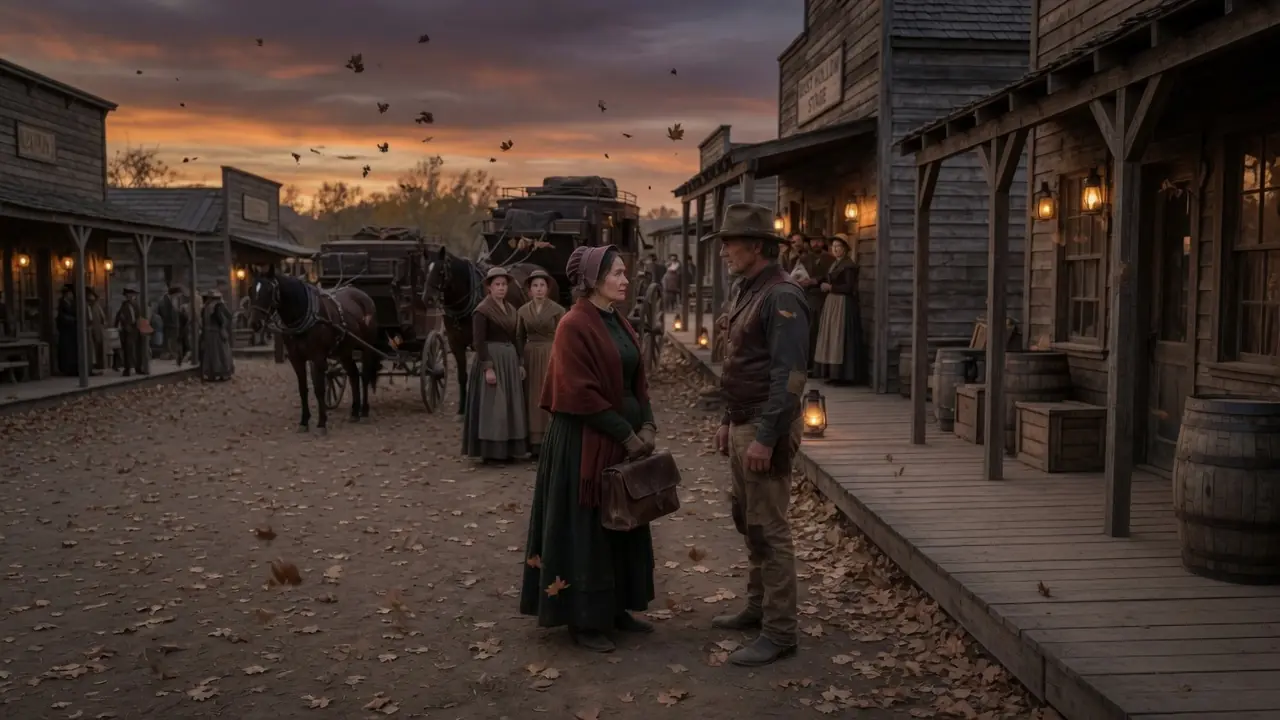
They came with quiet steps, woven shawls, and names too old-fashioned for this frontier town to remember. One of them was Edith Mercy Langley, the eldest. She wasn't young, she wasn't delicate, and she wasn't sent for. Yet, she came anyway with a letter she never mailed and a heart she never gave up on.
What the brothers didn't know, what the town didn't ask was why four women would cross half a country with nothing but shared grief and a single secret sewn into the hem of a travel-worn coat. One of them carried it in silence. One of them still wore it in her body. One of them had buried it behind a church years ago.
And one—Edith—had lived with it so long that it became the way she stood, the way she cooked, and the way she breathed. They weren't here to be wives. Not exactly. They were here to find what was taken, to reclaim what was theirs, to rebuild the part of themselves that the world once called unworthy.
But Dust Hollow isn't the kind of town that lets women rewrite their names, especially not women who are too old, too plain, too scarred, or too much. So when the townsfolk started whispering, when one of the sisters vanished into the dark, and when a quiet drifter named Silas chose Edith not for what she could offer, but for who she was, the real story began. This isn't just a tale of mail-order brides. It's a story of late-blooming love, of women who were once forgotten, and of the one man who saw a fifty-year-old woman and said, "You're the first one I choose."
Sometimes the West didn't kill kindness. Sometimes it gave it room to grow. In the world of mail-order brides, no one sends for the oldest. They write for beauty, for youth, for softness.
Not for a woman whose hands have known hard winters. Not for one who walks with a limp or whose hair has gone silver in places she stopped bothering to dye. But Edith Mercy Langley was not one to wait to be chosen. She had spent thirty years caring for others.
First her widowed father, then her three younger sisters, Charlotte, Nora, and May. She taught them to stitch and read, to bake with their own hands, and to walk away from men who only wanted obedience. But she hadn't taught herself to walk away from silence. When their father died and the homestead was sold, the sisters all agreed to place bride ads, one for each of them.
Three men replied. Three invitations came. None of them were for Edith. "You'll come with us," Charlotte had insisted.
They rode west together, four women with a single trunk and letters from the brothers in Dust Hollow, a small frontier town surrounded by cottonwood trees and men who thought women arrived to be folded into their lives like table linens. Edith said little on the journey. She mended hems, watched the skies, and read the letters over and over, memorizing the brothers' names. Not one of them knew she was coming.
They arrived at dusk. Dust Hollow glowed with oil lamps and quiet looks. The Whitlow brothers were waiting by the gate. Silas, Emmett, John, and Levi were strong men, broad-shouldered and sun-darkened, each scanning the stagecoach as it creaked to a stop.
Three women stepped down. Three matched faces. And then came Edith, slower, steadier, older. The youngest brother, Levi, frowned.
She wasn't in the letters. Charlotte stepped forward, chin high. "She's our sister." John scratched his jaw.
"She's older." "Not what we paid for," Emmett muttered. Edith did not cry. She did not apologize for being present.
She simply turned to the others and said softly, "I'll find a boarding house. You settle in." But before she could take a step, a voice cut the evening air like a gentle hum, "She can stay if she wants to." It was Silas, the eldest, quietest of them all.
He didn't smile, didn't soften, but he looked at Edith like someone seeing something not quite beautiful, yet still worth keeping. That night, she slept in a room behind the barn beside crates of canned beans and an old rocking chair. She watched moonlight spill through the rafters, wrapped herself in her own shawl, and thought, "I wasn't invited." But maybe, just maybe, I was meant to arrive.
She wasn't the one they asked for, but perhaps she was the one someone quietly needed. The morning after they arrived, Edith rose early. She always had. She folded the quilt she'd slept under—an old one with stitched initials that weren't hers—and stepped out into the thin chill of a Dust Hollow dawn.
Her sisters were still asleep in the house. She didn't envy them, not for their youth, nor their suitors, only for how naturally they assumed they belonged. Edith never assumed. The barnyard was quiet except for the muffled sounds of hens complaining and the rustle of oats from the feed bins.
She wasn't sure what she meant to do exactly, only that she had to move to contribute. She was scattering feed for the chickens when she heard the low creak of boots. Silas Whitlow stood by the fence, arms crossed, hat in hand. He didn't clear his throat or speak right away, just watched her like he was trying to place her inside a story he didn't quite know.
"You don't have to be out here," he said at last. She looked up, her expression calm but tired. "I wasn't sure where else to be." He stepped closer, then handed her a tin cup of coffee, still steaming.
"Could have left it on the porch," he said, "but I figured warm things ought to be handed to someone, not just set down." It was such a small thing. But Edith hadn't had something warm handed to her in years. Over the next few days, no one assigned her tasks.
No one thanked her either. But Edith sewed torn sleeves, shelled beans, and sat beside the fire in the evenings, listening without interrupting. Charlotte, Nora, and May were busy finding their footing with the three younger brothers, each pair dancing around expectation and discomfort in the way strangers do when pretending to belong. Only Silas remained as he was: quiet, rough-handed, and slow-moving.
He didn't ask questions, but sometimes he lingered near wherever Edith happened to be. He fixed the hinge on the barn door without being asked, chopped kindling, and left it stacked by the back of her little room. He tied a sprig of rosemary to the side of the windowsill. "To keep the moths out," he said.
But Edith knew rosemary meant something else, too. Remembrance, grief. The parts of yourself you still carry even when no one else sees them. One evening, she found a small tin on her cot inside a pair of mended gloves.
Her gloves, she hadn't even noticed she'd lost one. There was no note, but tucked into the left glove was a single matchstick, a gesture, a symbol. "Here's something to help you keep warm." She sat long after dark that night, fingers around the tin, her eyes not tearful but full.
She wasn't young. She wasn't what men had asked for. But somehow this quiet man was noticing all the things no one ever had. Not loudly, not quickly, but deeply.
He didn't flatter her. He just fixed what was broken and handed her warm things without needing thanks. And maybe, just maybe, that was how healing began. By the second week, Dust Hollow had decided it didn't know quite what to make of her.
Three young women stepping off a stagecoach with hopeful smiles and dowry letters made sense. Folks could nod at that, smile, ask polite questions, and offer canned peaches. But a fourth woman—older, grayer, heavier around the middle, with no letter and no man assigned to her—made people pause. Edith Mercy Langley didn't belong in the script they'd written.
So the whispers began. "She's the sister, ain't she—the one no one sent for? I heard she's sleeping in the barn, and Silas is letting her stay out of pity, I imagine. I'd feel bad, too, if I was her age and still, you know, unchosen."
Edith heard every word, not directly, but through slanted glances and paused conversations, and in the silence that always fell when she entered the general store, or passed two women speaking softly near the dry goods barrels. One afternoon, she stopped by the well with a bucket and overheard a voice brittle and amused. "I suppose even charity looks like romance if you're desperate enough." She didn't know who said it, but she knew what it meant.
That night, Silas found her mending socks by lantern light, her hands steady, but her jaw tight. "Something wrong?" he asked. She hesitated, then folded the sock slowly. "People think I'm here because no one else wanted me. That you're doing me a kindness."
Silas leaned against the door frame, arms crossed. "Well," he said, "they're half right." She blinked, heart sinking. "I am doing you a kindness," he continued, "but not because no one wanted you."
He stepped closer. "I'm doing it because I do." Edith didn't know what to say. Kindness she understood.
Gratitude she'd practiced. But being wanted—not out of guilt or obligation, but by preference—was harder. And still the town kept looking. Judging.
Even her sisters began to ask subtle questions. May, the youngest and most outspoken, took her aside one evening and said, "You sure you're not staying? Just because it's easier than leaving?" Edith didn't answer right away because the truth was she wasn't sure.
But that night, she walked outside long after the others had gone to bed. The stars were sharp and quiet. She stood near the fence and thought about leaving. About taking the morning coach, about slipping out before anyone had to explain her absence.
Then she heard it. The creak of a porch board. Silas. He didn't ask what she was doing, just held out a tin cup of warm cider and said, "For whatever you're thinking about doing, maybe sleep on it one more night."
She took the cup, held it in both hands, and stayed. They whispered she didn't belong, but he didn't ask her to stay. He simply made space beside him until she chose for herself. The first frost came gentle, clinging to windows like breath.
Dust Hollow woke to white-tipped fences, stiff laundry lines, and silence thicker than usual. But in the kitchen behind the Whitlow house, Edith Mercy Langley had already been awake for hours. She wore her oldest shaw, the one with the pinecone stitching, and her apron tied snug over her wide hips. Her hands moved with purpose through flour, water, salt, and time.
She wasn't baking for the brothers. She was baking for the town. They called it market day, though most came just to talk or watch. Women in scarves, men with worn boots, children still sticky from jam.
Stalls lined the edge of the square like mismatched teeth: jars of pickles, woven goods, and pie slices on napkins too thin for them. Edith didn't take a stall. She took a basket and she walked. One by one, she approached each woman who had stared, whispered, or paused too long before greeting.
She didn't offer explanations. She offered bread, still warm, still soft, still dusted with rosemary and crushed lavender. To Mrs. Halbert, who once said, "Some women don't know when to let go," she handed a thick heel of sourdough.
To Millie Darnell, who had muttered in passing about charity cases and barn rooms, she offered a honey roll. They stared. Some stammered. One said, "I didn't—" Edith smiled, gentle but steady.
"You don't have to eat it, but you can." She wasn't performing. She wasn't proving. She was reclaiming.
Every step, every slice, every loaf was her saying, "I am not what you think I am, and I am still here." When she returned to the house, Silas was sitting on the porch with a hammer in his hand, nails in a tin. He looked up. "Good walk."
She nodded. "I didn't run." He set the hammer down. "I didn't think you would."
That night, the house was full of quiet. Her sisters had settled into their own spaces, their own men. The fire crackled, and someone had brought in cinnamon wood, its scent drifting through the floorboards like memory. Edith sat alone at the table, not lonely, just still.
Then she felt it, a hand warm and weathered resting over hers. Silas. He didn't speak, but his hand stayed. For years, Edith had offered meals, care, and a shoulder, hoping to earn safety.
But this was different. This time she wasn't offering, she was receiving. And it didn't come with a price. She didn't raise her voice; she raised bread.
And that was enough to remind them all that kindness offered without apology can be its own kind of freedom. Snow had begun to settle in Dust Hollow. Not heavy, not loud, but quiet and certain, like something that had been waiting its turn. Inside the Whitlow home, the walls held warmth, not just from the fire, but from split wood, stacked where it should be, chairs pulled close without comment, and hands brushing beside the kettle like old songs.
Edith Mercy Langley had not left, not because she had nowhere else to go, but because slowly she had begun to want to stay. Silas Whitlow remained steady as ever. He didn't court her, not in the way her sisters were courted with gestures and trinkets. He didn't bring her wildflowers or call her pretty in front of others, but he brought her things that mattered.
He repaired the roof of her room without telling her. He remembered how she took her tea: barely sweet and full-bodied. He sat beside her without fidgeting, like someone who'd been waiting to feel that kind of quiet. One night, just before supper, Edith was folding laundry when he stepped into the doorway holding a small box carved from walnut.
"I had this made years ago," he said. "Didn't know who for. I just kept it." He handed it to her.
Inside were a brass thimble, a small compass, and a plain ring, heavy and without shine. "I didn't order a bride," Silas said softly. "But I've come to realize I've chosen one." Edith didn't cry.
She looked at the ring, at the compass, at the thimble that fit perfectly over her worn finger. "These aren't romantic," she said, smiling a little. "No," he agreed. "They're honest."
She didn't answer right away. She set the ring down, then took his hand and placed it gently over her heart, beneath the apron and shawl, and said in the softest voice, "Then let me stay where I am already loved." That winter there was no wedding ceremony, no invitation sent, no white dress, but on the first day of the new year, when the snow melted just enough for boots to find dry soil, Edith moved from the barn room into the main house. Not as a guest, not as an extra, but as his.
She planted rosemary by the steps, hung her old apron beside his, and left the door open for the wind and whatever kindness might follow it in. He didn't choose her to fill a role. He chose her because the silence made more sense when she was in it. And after half a lifetime of waiting, Edith Mercy Langley had finally been chosen fully, freely, and without conditions.
In the months that followed, something unexpected happened. People stopped calling her the extra one. They stopped wondering when she'd leave. They started bringing questions.
"How do you keep rosemary from freezing too early? Do you have a recipe for salt pie that doesn't turn bitter? My boy's been having bad dreams. Do you know a way to calm his sleep?"
Edith Mercy Langley, the woman they once whispered about, became the one they quietly sought. Not because she demanded attention, but because she had stopped apologizing for being here. The house changed. She lined the shelves with jars labeled in her precise hand, restitched the curtains with patches that told a quiet story of color and history, sanded the old table until it felt like river-worn wood, soft and clean.
And she laughed. Not often, not loud. But when she did, Silas would stop whatever he was doing and just listen. Like a man hearing his favorite hymn again after too many winters.
One afternoon, a girl appeared at the edge of the property. Not more than seventeen, her shoes torn and her cheeks red from cold. She wouldn't speak, wouldn't meet anyone's eyes. Edith didn't press.
She just made tea, left a blanket by the fire, and hummed while peeling apples. The girl stayed. Others came in time. Not many, not often, but enough to know that the house was becoming something larger than a home.
It was a harbor. And at its center was Edith not playing hostess, just being. One night, as they closed up the house, Silas looked at her across the kitchen. "You ever think," he asked, "how many folks don't know where to put their sadness?"
She nodded. "Maybe they don't need a place to put it, just a place where it's allowed to exist." And so the Whitlow home became that place. Not grand, not loud, but warm and worn and open.
Like Edith herself, she didn't ask to become anyone's answer. But by living gently, with open doors and steady hands, she reminded the whole town that sometimes the people we overlook become the heart of where we return. By June, the cottonwood trees were blooming again. Edith Mercy Langley stood on the porch most mornings, mug of chicory coffee in hand, watching bees hover around the rosemary patch.
Her hair had grown longer, silver in soft waves. She didn't tie it back so tight anymore. Some days she baked, some days she just rocked and watched the wind. But always she belonged.
One such morning, the mail wagon brought a small bundle of parchment, yellowed at the edges and tied with string. It was addressed in handwriting she hadn't seen in over thirty years: "Aunt Mercy Langley." The name hit like a held breath released too fast. Inside was a letter from Calvin, her brother's only son.
The boy she had once raised after his mother died until his father remarried and sent him away to a cousin in Ohio. "I never forgot you," it read. "You taught me to tie my shoes, to sit with my fears, and to hum when the dark got too loud; Mama said you were too strict, but I always thought you were the only grown-up who saw me clearly. I don't know if this will find you, but if it does, thank you; I've tried to raise my girls the way you raised me, with firm hands and a soft voice; I hope you're safe and loved; and if you ever want to visit, well, the door's open."
Edith didn't cry. She folded the letter, carefully, tucked it into her apron, and went to find Silas, who was trimming fence posts out back. He looked up when she reached him. "You all right?" he asked.
She nodded. "Just thinking about how strange and kind the world can be." That evening, they didn't speak much. They just sat side by side on the steps, watching the first fireflies rise from the field.
And when Silas reached over to hold her hand, she didn't flinch like she once had. She let it rest there, fingers interwoven like a root system under old soil. Nothing flashy, nothing young, but strong, anchored, alive. Because in the end, Edith Mercy Langley hadn't been chosen by fate.
She had walked into her place, stood still long enough to be seen, and loved not in spite of who she was, but because of it. The world once said she was too late, too large, too much. But she turned quiet kindness into home, and found love not in a letter, but in the life she built while waiting. And maybe that's the kind of love that lasts the longest.
Sometimes the people this world calls too late are exactly who someone's been waiting for. Edith Mercy Langley didn't arrive with promise. She arrived with silence, with the kind of grace that only years of heartbreak can shape and the kind of strength you don't brag about, but simply live. She wasn't chosen by mail.
She wasn't picked out like cloth or cattle. But in the end, she was chosen by a man who saw not what she lacked, but what she carried. And maybe that's the lesson here, that love doesn't always knock loud or come young. Sometimes it finds you through broken fences and cups of tea left steaming on cold mornings. Through people who stay when others turn away, through being exactly who you are without shrinking.