The elm leaves above the yard hardly moved, yet the whole ranch seemed to be holding its breath.
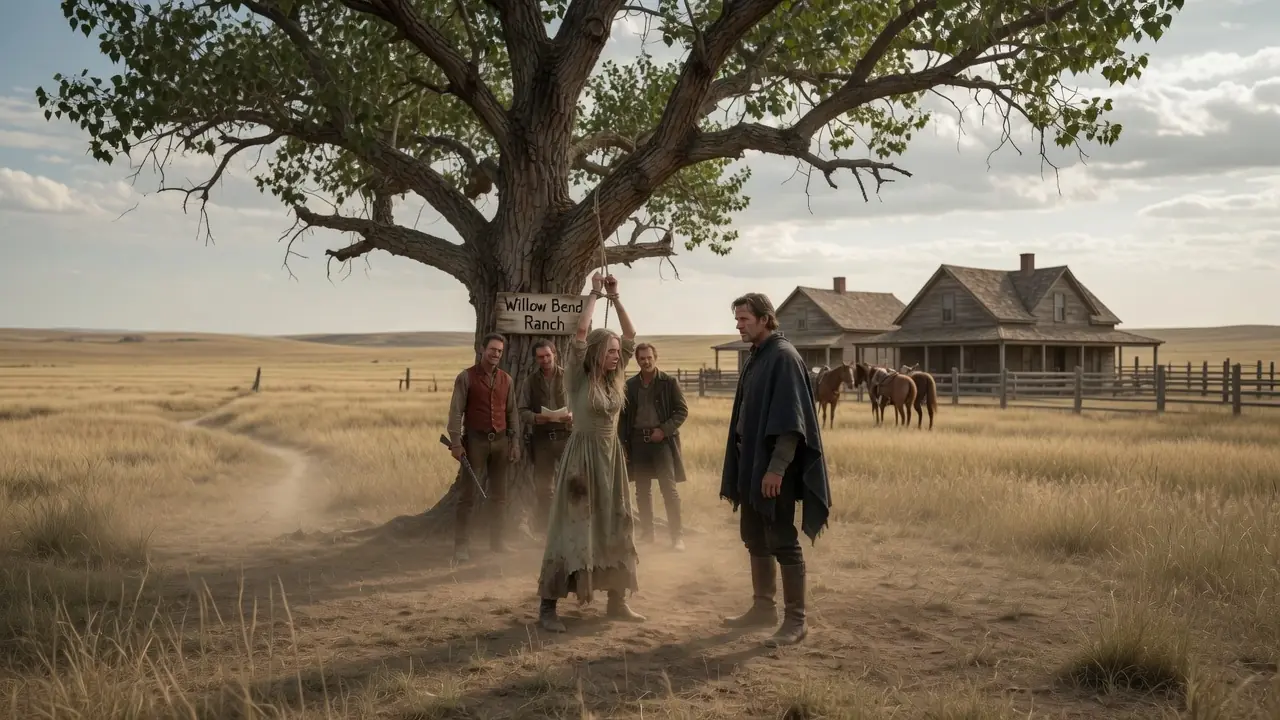
Martha Caine stood beneath the old tree with rope cutting into her wrists, her gray hair slipping loose around a bruised face, while four men surrounded her with the pleased expressions of people who believed the world already belonged to them. Kansas heat pressed down over the yard, thick and dry, and the dust under her boots tasted bitter whenever the wind lifted it.
They wanted her land.
More than that, they wanted her fear.
A legal paper lay on the barrel beside her, weighted down with a revolver so it would not blow away. A crooked deputy stood near the fence with his thumbs hooked in his belt, staring at anything except Martha’s face. The men had brought witnesses too, neighbors who lingered along the road pretending they had stopped by accident.
The leader, Elias Crowder, smiled beneath the brim of his hat.
“Sign it, Martha,” he said. “Nobody has to get hurt today.”
Martha looked at the paper.
Then at the house her husband had built.
Then at the stretch of land where her children had once run barefoot through summer grass.
“No,” she said.
It was not a loud word.
It did not need to be.
Men like Crowder did not hate loud women most. They hated steady ones. Loud could be mocked. Steady had to be broken.
Crowder’s smile disappeared.
One of his men tightened the rope until Martha’s fingers went numb. Another lifted a whip from his saddle and let it uncoil in the dust. The deputy shifted his weight but said nothing.
Across the fence, the watching neighbors lowered their eyes.
Nobody wanted to be next.
The whip cracked once.
The sound split the dry afternoon.
Then a gunshot answered it from the ridge.
Sharp.
Clean.
Final.
The whip snapped in half in the man’s hand, the leather falling uselessly into the dirt.
Every head turned.
A rider sat high on the ridge above South Fork Ranch, dark against the sun, his horse standing still as if carved from the same shadow. His hat was low, his coat dusty, his face hidden by distance and glare.
He did not shout.
He did not hurry.
He only started down the slope with the slow certainty of a man who had already counted every gun in the yard and decided none of them would matter.
His voice carried over the field.
“Touch her again, and you will not have that hand tomorrow.”
Crowder’s men stared.
The deputy reached for his revolver, then thought better of it.
One of the hired men was not as wise. His fingers dropped toward his holster.
The rider fired before the man cleared leather.
The pistol jumped from the hired man’s hand and landed in the dust several feet away.
No one cheered.
Fear does not cheer.
It holds still.
Martha stared at the rider as he came through the open gate. Her wrists were bound, her cheek was swelling, and pain pulsed behind her eyes, but she knew him before he came close enough for anyone else to understand.
She knew the way he sat a horse.
She knew the shape of his silence.
She knew him from the boy he had been before grief sent him riding away.
Fifteen years had passed.
Still, a mother knows.
Her son had come home.
Jonah Caine dismounted without looking at anyone but Crowder. He was taller than Martha remembered, broader through the shoulders, with a face hardened by weather, bad roads, and the kind of work no mother wants to imagine for her child. There was a scar along his jaw that had not been there when he left.
Crowder tried to recover his smile.
“You interfering in lawful business, stranger?”
“Lawful business does not usually need rope.”
The deputy cleared his throat.
“Careful now. This is a property matter.”
Jonah turned his eyes on him.
The deputy stopped talking.
Crowder’s mouth tightened.
“Widow Caine owes money. We offered a fair purchase.”
“I owe no man enough to sell my husband’s grave,” Martha said.
Crowder glanced at her with irritation.
“You see? Stubbornness. That is all this is.”
Jonah stepped closer.
“My mother said no.”
The word mother moved through the yard like a match dropped in dry straw.
The deputy went pale.
Crowder’s men looked at one another.
Everyone in that part of Kansas had heard of Jonah Caine, though few had seen him. Some said he had been a marshal once. Some said he had ridden with bounty men. Others said he had killed two brothers outside Dodge City and vanished before dawn.
Most stories were wrong.
Enough of them were right to make the men in Martha’s yard rethink the afternoon.
Jonah drew his knife and cut the rope from his mother’s wrists.
Martha did not cry.
Not then.
She only rubbed blood back into her fingers and looked at Crowder.
“You heard my answer.”
Crowder backed toward his horse with a face full of hatred.
“This is not finished.”
Jonah picked up the revolver weighting the deed and tossed it into the trough.
“It is for today.”
Two of Crowder’s men left their guns in the dirt when they rode out.
Men do not abandon guns unless they meet something that frightens them worse than death.
By sundown, South Fork Ranch had gone quiet again.
Inside the house, lamplight flickered over rough plank walls, a black iron stove, and a kitchen table marked by years of knives, elbows, bread dough, and grief. Martha sat with a damp cloth against her cheek. Her wrists were raw, but she had refused bandages until the coffee was poured.
Jonah sat across from her.
Neither had yet said what mattered.
Some families speak easily because nothing essential has been lost.
Others need silence first because the truth is too heavy to lift all at once.
Martha slid a tin cup toward him.
“Still take it black?”
Jonah nodded.
“You remember that?”
“I remember the things mothers remember.”
He looked down at the coffee.
Outside, the wind moved along the porch boards and nudged a loose shutter against the frame. The sound filled the room where conversation should have been.
Fifteen years earlier, there had been another chair at that table.
Lila Caine had sat there with her bare feet tucked beneath her dress, stealing the last biscuit and laughing when Jonah threatened to tell. She had been thirteen, quick-eyed, stubborn, always running ahead on Mercy Road no matter how often Martha told her not to.
Then one morning she did not come home.
No body.
No clear track.
No answer.
Just a ribbon found near the cottonwoods and a town suddenly full of people who had seen nothing.
Jonah left two months later.
He said he was going to find her.
Martha watched him ride away and understood she was losing a second child to the same road.
Years made a hard crust over that memory, but they did not bury it.
Martha reached beneath the table and pulled out a small wooden box. It was plain, darkened by age, with one corner cracked from the winter it had fallen from a shelf. She set it between them like an offering.
Jonah looked at it.
His face closed.
“What is that?”
“What I should have shown you the moment you arrived.”
She opened the lid.
Inside lay a faded photograph of Lila, an unopened letter, and a yellowed freight receipt folded into thirds.
Jonah reached for the receipt first.
Paper was easier than faces.
His eyes moved over the writing until they stopped on a stamped name near the bottom.
The Scarlet Finch.
He did not know the place.
But something in him recoiled from it.
“What is this?”
Martha pressed her fingers together.
“A girl brought it six days ago.”
Jonah looked up.
“What girl?”
“Her name was Naomi Bell.”
The room changed.
Jonah felt it before he understood why.
“She came here alone,” Martha said. “Hungry. Half-scared out of her skin. She said men were following her, and she had nowhere else to go.”
“Where is she now?”
Martha looked toward the dark window.
“Gone.”
Jonah’s jaw tightened.
“You let her leave?”
“She left before dawn while I was sleeping. I found that receipt under her cup.”
Martha picked up the unopened letter, but her hands trembled too much to break the seal.
“Before she left, she told me she had seen Lila’s name in a ledger.”
Jonah went still.
For fifteen years, every rumor had died in dust. Every witness had forgotten. Every trail had turned into some man’s lie, some drunk’s story, some dead end behind a saloon.
But this was different.
A name in a ledger meant not chance.
Not grief.
Not a child wandering too far.
It meant someone had written her down.
Jonah’s voice lowered.
“Where did Naomi come from?”
Martha shook her head.
“She would not say. Only that there was a place near the rail line. A house with music at night and locked doors in the back.”
The Scarlet Finch.
Jonah folded the receipt carefully.
Outside, the prairie darkened beneath a wide and indifferent sky.
Somewhere beyond the ranch, Naomi Bell had vanished into the same country that had swallowed his sister.
This time, Jonah did not intend to arrive fifteen years too late.
He left before sunrise.
Martha stood on the porch in a shawl and watched him saddle his horse. Neither of them said goodbye. Goodbye was too close to a promise, and neither trusted promises made before a hunt.
The receipt led him toward a freight depot twenty miles east, past abandoned homesteads and fields gone pale under the July heat. The road was quiet except for insects and the creak of leather. Dust trailed behind his horse like a second rider.
Near a dry creek crossing, Jonah found wagon tracks.
Heavy wagon.
Three horses.
Fresh.
He dismounted and searched the brush on foot. A torn strip of blue fabric clung to a thorn branch, caught and left behind by someone moving fast.
Naomi.
The trail continued to an abandoned rail station half-collapsed beneath the sun. Boards covered the windows. The roof sagged in the middle. Old tracks stretched away toward the horizon like a promise made by a liar.
Jonah tied his horse in the shade and approached the door with one hand near his gun.
Inside, the air smelled of rot, oil, and old smoke.
A muffled sound came from the far room.
Jonah pushed the door open with his boot.
Three men turned.
A young woman sat tied to a chair beneath a hanging lantern, her face bruised, her eyes wide but not broken.
Naomi Bell.
One man reached for his gun.
Jonah fired into the lantern.
Glass burst. Flame died. Darkness swallowed the room.
The next shot knocked a revolver from a hand.
The third shot buried itself in the floorboards between another man’s boots and convinced him life still had possibilities if he stopped moving.
Within seconds, the fight was over.
Jonah cut Naomi’s ropes with care.
She flinched anyway.
He stepped back immediately.
“You came from my mother’s house,” he said.
Naomi rubbed her wrists.
“You came faster than I expected.”
“I do not like being expected.”
Her mouth twitched, but the expression died quickly.
“They said you would chase Lila Caine until it killed you.”
Jonah stilled.
“What do you know about my sister?”
Naomi reached inside her torn coat and pulled out folded pages wrapped in cloth. Her hands shook as she gave them to him.
“Not everything. Enough.”
Jonah unfolded the pages.
Ledger pages.
Names.
Dates.
Destinations.
False initials beside real lives.
Then he saw it.
Lila Caine.
His sister’s name sat in neat black ink, surrounded by other names of girls who had disappeared over years from towns no one powerful cared about.
But Lila’s entry was not marked dead.
It was not marked sold.
It was marked transferred.
And the date beside the final notation was only three years old.
Jonah’s vision narrowed.
Naomi watched him carefully.
“I told your mother I saw the name once,” she said. “That was not true.”
He looked at her.
“I saw it three times.”
The station seemed to go colder though the day outside burned.
People did not keep writing down the dead.
They kept writing down the useful.
Jonah folded the pages and put them inside his coat.
Naomi looked toward the door.
“They will come after those.”
“Let them.”
“No,” she said sharply. “That is exactly how men like you die. You think courage is walking straight at the gun.”
Jonah looked at her.
“What is it, then?”
Naomi’s eyes hardened.
“Surviving long enough to tell the truth where more than one person can hear it.”
It was the kind of answer Jonah disliked because it sounded too much like wisdom.
They rode back to South Fork after dark.
Martha opened the door before they knocked. She did not ask questions when she saw Naomi alive. She simply stepped aside and let them in.
That was the thing about women who had lost too much.
They understood shelter before explanation.
By lamplight, they spread the ledger pages across the kitchen table. Martha stood with one hand on the chair where Lila had once sat. Naomi wrapped both hands around a coffee cup and watched every shadow as if it might move.
The pages showed routes from Kansas into New Mexico Territory. Freight numbers. Dates. Names disguised in partial initials. A recurring mark beside certain entries.
A small bird drawn in red ink.
The Scarlet Finch.
At midnight, a horse screamed outside.
Jonah grabbed Naomi and pulled her away from the window just as a bullet shattered the glass. Martha dropped behind the stove. Another shot cracked through the house and struck the cupboard, raining splinters across the floor.
Three riders circled in the dark.
Not thieves.
Not drunks.
Hunters.
Jonah returned fire from the side window and clipped one rider’s hat clean off. The men scattered within a minute, but their message remained in the broken glass and the smell of gunpowder.
Someone knew about the ledger.
Someone knew where Naomi had run.
And that meant South Fork Ranch had been watched before Jonah came home.
Martha swept the glass with a broom at one in the morning while Jonah stood in the doorway with a rifle. Naomi tried to help, but Martha sent her back to the table with a look that allowed no argument.
“Rest while somebody lets you,” Martha said.
Naomi obeyed.
At dawn, a woman arrived at the ranch in a black wagon.
Her name was Agnes Wren, owner of the boarding house in Miller’s Crossing, the nearest town with a courthouse, a rail office, and enough lies to require both. She was broad-shouldered, sharp-eyed, and dressed in black from collar to hem, not mourning exactly, but ready for it.
Agnes entered the kitchen and placed a marked timetable on the table.
“Train leaves in two days,” she said. “Southbound. Same number as the ledger.”
Naomi leaned forward.
Her face drained.
“They are moving girls again.”
Jonah reached for his hat.
Agnes stopped him with one sentence.
“If you ride in alone, they will bury you before supper.”
Jonah looked at her.
Agnes did not blink.
“Do not mistake loneliness for courage, Mr. Caine. They count on men doing that.”
Martha said nothing.
But her eyes agreed.
Agnes led them to Miller’s Crossing that afternoon. The town looked ordinary at first glance. Wagons creaked past storefronts. Children ran near the pump. Men argued outside the feed store. A train whistle sounded in the distance, long and lonely.
But Naomi saw the other town beneath it.
She saw the alley near the livery where girls were told to wait.
She saw the freight office where names became numbers.
She saw the bright windows of the Scarlet Finch at the far end of town, respectable in daylight, wicked after dark.
Agnes’s boarding house sat near the rail line. Inside, the smell of coffee and soap almost covered old fear. Several women sat in the parlor, sewing, reading, pretending not to listen.
All of them looked up when Naomi entered.
One of them began to cry.
No one asked why.
People who had survived the same kind of darkness recognized one another without introductions.
Agnes took them through the back hall to a telegraph room where a thin operator named Caleb Pike waited beside a clicking machine. He kept his eyes low and his hands ready.
“This town has two records,” Agnes said. “The one stamped at the rail office and the one frightened people send when no one is watching.”
Caleb handed Jonah a packet of copied telegrams.
Payments.
Warnings.
Transfer confirmations.
One name appeared again and again.
Victor Dane.
Owner of the Scarlet Finch.
Jonah read silently.
Martha watched him from the doorway.
She could see the fight building in him, not like fire, but like a storm behind mountains.
They took the packet to Judge Silas Merritt, a federal magistrate whose office sat behind the courthouse with two broken windowpanes and one armed clerk. Merritt was old, thin, and tired in the manner of a man who had been disappointed by justice often but had not yet abandoned it.
He studied the ledger pages.
Then the telegrams.
Then Naomi.
“You understand what you are accusing them of?”
Naomi lifted her chin.
“Yes.”
“You understand men like Victor Dane do not fall alone?”
Jonah answered.
“Then pull down whoever he is holding.”
The judge gave him a humorless smile.
“If only the law worked that clean.”
He unlocked a drawer and removed a thin file.
“I have been tracking missing girls along this route for five years. Every time I got close, evidence vanished. Witnesses recanted. Deputies were transferred. Judges were pressured.”
Martha’s hands curled into fists.
“Did you find my daughter?”
Judge Merritt looked at her with care.
“I found her name.”
He opened the file and placed one page on the desk.
Lila Caine.
Martha touched the paper with two fingers.
Jonah did not move.
The judge removed his spectacles.
“Her name appears differently from the others. She was not simply moved. She was protected at certain points. Hidden from men who had paid for her transfer.”
Naomi frowned.
“Protected by who?”
“That,” the judge said, “is what I do not know.”
Jonah stared at the name.
“Is she alive?”
The judge’s silence answered first.
Then he said, “I cannot prove she is dead.”
For a grieving family, that was both mercy and cruelty.
They argued until nightfall.
Judge Merritt wanted warrants and more witnesses.
Agnes wanted the women hidden first.
Naomi wanted to stop the train.
Jonah wanted Victor Dane.
The old habit in him rose hard.
Ride in.
Draw.
End it.
The West had taught him that direct violence solved direct problems. It had not taught him what to do with systems, papers, bribes, timetables, and men whose hands stayed clean while others did the dragging.
At midnight, Jonah went to the Scarlet Finch anyway.
Naomi followed him.
He told her to stay back.
She laughed once.
“I survived that place longer than you have known its name.”
The Scarlet Finch looked elegant from the street. Red curtains. Polished brass lamps. Music drifting through open windows. Men walked in smiling, pretending they were entering pleasure instead of a market.
Inside, the air was thick with perfume, whiskey, cigar smoke, and dread.
Victor Dane stood near the bar in a gray suit, gold watch shining against his vest. He was handsome in the way snakes can be beautiful, smooth and cold and arranged for deception.
Jonah asked questions too openly.
Too angrily.
He said Lila’s name where everyone could hear it.
Dane smiled.
That should have warned him.
Naomi disappeared in the back hallway.
One moment she was behind Jonah.
The next she was gone.
By the time Jonah realized the room had shifted around him, the ledger pages had been taken from his coat, two men had guns drawn beneath the table, and every woman in the room had turned her face away out of practiced terror.
Victor Dane sipped his drink.
“You should have listened to the boarding house woman,” he said.
Jonah’s hand hovered near his gun.
Dane smiled wider.
“If you shoot me, Mr. Caine, Naomi dies before you reach the door.”
Jonah did not shoot.
That restraint cost him more than blood would have.
By dawn, Naomi was gone again.
The ledger pages were gone.
And Victor Dane remained untouched.
Judge Merritt’s emergency filing was delayed the next morning by a county clerk who suddenly could not find the proper seal. The sheriff refused assistance. The rail office denied access to freight records. Miller’s Crossing returned to its old posture.
Eyes down.
Mouths shut.
Fear doing its work.
Jonah rode back to South Fork with no plan and more shame than he knew how to carry.
Martha found him on the porch after dark.
He sat with his elbows on his knees and his hat in his hands.
“You went alone,” she said.
He did not answer.
“You lost the girl.”
Still nothing.
Martha sat beside him.
“You have been trying to save Lila by yourself for fifteen years.”
His jaw tightened.
“And I failed.”
“Yes,” Martha said.
He looked at her then, startled.
A softer woman might have lied.
Martha had lost too much to waste time on soft lies.
“You failed because one man cannot fight what a whole town keeps pretending not to see.”
Jonah looked away.
After a long silence, he said, “I do not know how to do it another way.”
Martha placed her hand over his.
“Then learn.”
Hoofbeats broke through the dark before dawn.
A rider arrived at the ranch with a note tucked into his coat and fear written across his face. He would not come inside. He only handed the paper to Jonah and rode off before questions could form.
Jonah opened it.
Two lines.
Naomi escaped.
Lila Caine is the reason.
Martha gripped the porch post.
Jonah read the words three times.
The following afternoon, Agnes arrived with news.
Naomi had reached the boarding house with two other women. Hurt, exhausted, but alive. She had escaped during a transfer south of town, helped by someone inside the network who knew when the guard changed.
Someone who left a red thread tied to the gate.
Martha’s face went white.
Lila used to tie red thread around fence latches when she wanted Jonah to find hidden things as children.
It was not proof.
But it was not nothing.
For once, Jonah stayed still long enough to listen.
Agnes gathered former workers from the Scarlet Finch. Caleb Pike brought telegram copies. Judge Merritt sent word to federal marshals in Topeka. Naomi agreed to testify publicly if other women stood with her.
By the next day, Miller’s Crossing began to crack.
Not all at once.
Towns do not become brave in a single morning.
But one woman spoke, then another.
A rail porter admitted seeing locked wagons loaded at night.
A bookkeeper produced copied payment ledgers from under the floorboards of a church supply closet.
A former deputy confessed he had been paid to ignore missing persons complaints from poor families and widows.
The town that had spent years pretending not to know suddenly knew too much.
Judge Merritt called a public hearing under federal authority in the courthouse square.
People came because fear brings curiosity before courage.
Then Naomi stepped forward.
She stood bruised, thin, and steady in front of the whole town. Victor Dane stood across from her with two lawyers and a smile that had begun to fray.
Naomi told them about the locked rooms.
About the false names.
About the train routes.
About the girls who never reached the destinations written beside their numbers.
Her voice trembled once.
Only once.
Then she lifted her chin.
“I am not property,” she said.
No one cheered.
Not yet.
But someone in the crowd began to cry.
Then another woman stepped forward.
Then another.
By the time the sun reached the courthouse roof, Victor Dane’s lawyers had stopped interrupting.
The original ledger appeared near noon.
A bookkeeper named Edwin Shaw carried it in both arms as if it weighed more than a man. He had stolen it months earlier and hidden it, waiting for someone with enough courage to make it useful.
Every payment was there.
Every false name.
Every deputy.
Every judge.
Every transport number.
Victor Dane’s smile disappeared.
Federal marshals arrived before sundown.
Dane tried to leave through the courthouse side door and found Jonah waiting there.
For a moment, neither man spoke.
Dane looked him over.
“You think this ends anything?”
Jonah’s hand rested near his revolver, but he did not draw.
“No,” he said. “But it starts something.”
The marshals took Dane in irons.
That night, Judge Merritt rode to South Fork Ranch with an oilcloth envelope.
Martha knew before he stepped onto the porch.
Motherhood had taught her to recognize the shape of final news from a distance.
Inside the envelope were pages written in Lila’s hand.
Martha sat at the kitchen table with Jonah beside her, and together they read what remained of the girl they had lost.
Lila had survived the first years.
She had been moved from Kansas to New Mexico Territory, then to Colorado, then back through rail routes under names that were not hers. Somewhere along the way, she began copying records. Names of girls. Routes. Bribes. Men who paid to make people vanish.
She became useful to the network because she could read and write.
Then she became dangerous to it because she remembered everything.
The red marks in the ledger were hers.
A warning system.
A trail.
A way to guide certain girls toward escape when she could not free herself.
The final letter had been hidden in an abandoned rail office near Coyote Pass.
It was addressed to Mama and Jonah.
Martha read it aloud until her voice broke.
I tried to come home. I need you both to know that. But every time I got close, someone else needed the road more than I did.
Jonah closed his eyes.
Martha forced herself to continue.
If this letter finds you, then some part of what I did survived. Do not spend the rest of your life searching for my grave. I am more than the place they left me. Help the ones still breathing.
The last line was for Jonah.
Brother, come home before the road takes everything I loved about you.
No one spoke after that.
Outside, cottonwood branches moved in the evening wind.
For fifteen years, Jonah had believed finding Lila meant bringing her back.
Now he understood she had been leading him home the whole time.
Arrests spread across Kansas, Colorado, and New Mexico in the months that followed.
Sheriffs lost badges.
Rail officials faced federal charges.
Judges resigned before they could be dragged from their benches.
The Scarlet Finch was closed, then burned by women who had survived it. Nobody in Miller’s Crossing saw who started the fire. For once, the town’s silence served the right side.
Naomi stayed at South Fork through the winter.
At first, she slept with a chair braced beneath her door. Then one night she forgot. By spring, she laughed more often. Not freely, not yet, but enough that Martha began leaving extra biscuits near her plate.
Jonah repaired fences.
Built new rails.
Learned the slower work of staying.
Sometimes he still rode out alone at dusk, but he always came back before the lantern in the yard burned low.
Beneath the old elm where Martha had once stood bound, Jonah hung a lamp from a bent iron hook.
Every evening, Martha lit it.
For Lila.
For Naomi.
For all the girls whose names had once been hidden in ledgers.
For every neighbor who finally raised their head and spoke.
The West did not change overnight.
No place ever does.
But South Fork Ranch changed.
Miller’s Crossing changed.
And Jonah Caine changed most of all.
He had come home with a gun, thinking justice was something a man carried on his hip.
He stayed long enough to learn justice was also a ledger saved beneath a floorboard.
A woman telling the truth in public.
A mother refusing to sign away land because the dead still belonged there.
A son admitting that vengeance could not raise the lost, but courage might save the living.
Years later, folks still told the story of the day Elias Crowder tried to steal Martha Caine’s ranch and her son rode down from the ridge like judgment under a black hat.
They liked that part best.
The gunshot.
The broken whip.
The bad men riding away afraid.
But Martha knew the real story began afterward.
At the kitchen table.
With a wooden box.
A missing girl’s name.
A frightened witness who refused to stay silent.
And a family finally learning that love does not always bring the dead home.
Sometimes it teaches the living where to stand.