The wagon should never have made it that far. One broken wheel dragged through loose mountain gravel. One exhausted mule stumbled with every step and the young widow walking beside it looked moments away from collapsing beneath the scorching afternoon sun. High above the narrow trail, hidden rifle barrels flashed between jagged rocks and a band of ruthless highway robbers silently watched, waiting for the perfect moment to strike. At that exact instant, another wagon rolled out from a stand of towering pine trees.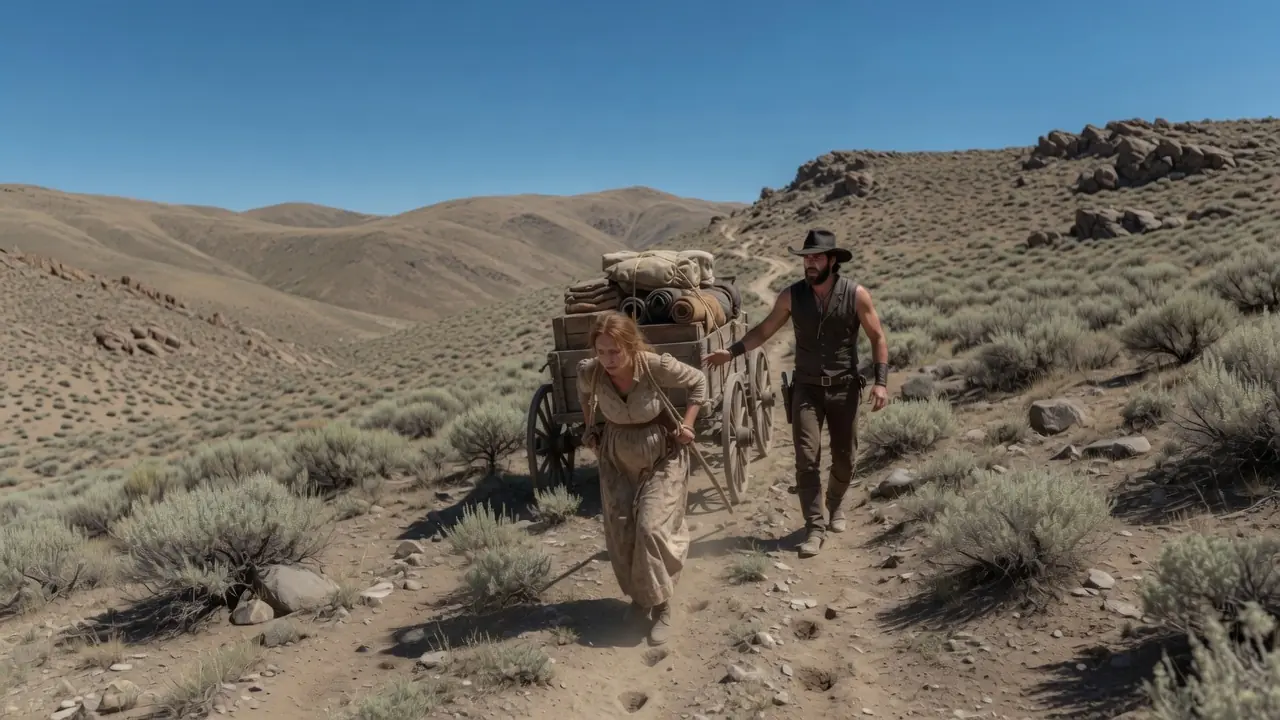
Its driver, a broad-shouldered mountain cowboy with years of hardship carved across his weathered face, slowed his team and made a decision that would forever change not only his own life but the destiny of everyone traveling that lonely pass. The cowboy was known throughout the northern Rockies as Elias Boone. At 39 years old, he had earned a reputation as a quiet man who preferred mountain trails to crowded towns. His dark chestnut horse, Ranger, carried him through places where few others dared to travel. Elias lived alone in a timber cabin overlooking Eagle Ridge, trapping through the winters, breaking wild horses in the spring and delivering supplies to isolated ranches during the summer.
Some believed he had once served as a scout for the cavalry, while others whispered that he had walked away from a painful past he never discussed. Whatever the truth, every sheriff from Montana Territory to Wyoming knew one thing about Elias Boone: he never abandoned innocent people. The woman struggling beside the damaged wagon was 26-year-old Abigail Mercer. Her pale blue dress was faded by weeks of travel, and dust covered nearly every inch of her clothing. Her auburn hair had slipped free from its braid beneath a worn bonnet, and exhaustion showed plainly in her tear-filled green eyes.
She rested one trembling hand against the child growing beneath her heart while trying to keep the overloaded wagon moving. Her husband, Daniel Mercer, had died from pneumonia the previous winter, leaving her with little more than a handful of savings and a letter promising land near the fertile valleys beyond Eagle Ridge. She had sold everything she owned to begin a new life, but the mountain trail seemed determined to bury those dreams beneath its unforgiving stones. Elias noticed more than the broken wheel. He recognized the fresh horse tracks cutting across the hillside above them, the disturbed rocks suggesting that men were hiding nearby, and the circling hawks that often followed violence before it happened.
Bullets shattered pine branches and struck the empty wagon Abigail had abandoned moments earlier. Five mounted outlaws charged from behind enormous granite boulders, believing they had cornered defenseless travelers. Their leader, Virgil Cain, wore a long black coat despite the summer heat, and his thick beard hid an old knife scar stretching from his jaw to his ear. Cain had spent years robbing prospectors, settlers, and supply caravans crossing Eagle Ridge. Survivors rarely escaped with their lives.
Instead of panicking, Elias snapped the wagon reins hard, urging his horses toward a narrow canyon entrance only experienced mountain men knew existed. The heavy freight wagon bounced violently over rough ground while bullets splintered the wooden rails behind them. Abigail wrapped both hands protectively around her unborn child as dust filled the air. Ranger raced alongside the wagon without hesitation, almost seeming to understand every movement his rider intended. The canyon narrowed until only one wagon could pass.
Elias stopped beside enormous fallen logs blocking most of the trail. Years earlier, a spring flood had left the timber balanced above the slope. One carefully placed rifle shot struck the supporting trunk. The entire pile thundered downward, filling the canyon with crashing wood and rolling stones. The avalanche trapped Cain's gang on the opposite side, forcing them to retreat rather than continue the chase.
It bought precious time, but not lasting safety. Late that afternoon, the travelers reached the isolated settlement of Red Pine Crossing, a rough frontier town built beside a mountain river. Smoke drifted from blacksmith forges. Children chased chickens through muddy streets. Freight wagons crowded the general store, and horses lined the hitching posts outside the weathered saloon.
Yet, beneath the appearance of ordinary life, fear lingered everywhere. Windows closed quickly whenever strangers appeared. Ranchers carried rifles even while buying flour. Nobody laughed for very long. Sheriff Thomas Grady explained the reason.
Virgil Cain had spent the past year terrorizing every settlement within 100 miles. Stagecoaches disappeared. Ranches were burned after refusing protection payments. Witnesses vanished before reaching court. The sheriff had only four deputies, and half the territory remained beyond their reach.
Abigail planned to continue west after resting one night, but fate intervened again. The town doctor examined her and warned that the difficult mountain journey had placed enormous strain upon her pregnancy. Traveling farther immediately could endanger both mother and child. She needed weeks of rest before attempting another wagon trail. Although Elias had intended to leave before sunrise, he quietly rented a small cabin beside the river for Abigail and paid the first month's rent using nearly every dollar he had earned delivering supplies.
When she tried to repay him with the little money remaining from her journey, he refused. The frontier had already taken enough from her. Over the following weeks, Abigail slowly regained her strength. She found work sewing clothes, repairing blankets, and teaching several children to read. Elias repaired fences for neighboring ranchers and helped the sheriff strengthen the town's defenses whenever outlaw sightings increased.
Their friendship grew through shared hardships rather than grand promises. Neither spoke often about loneliness, but both recognized it in each other's eyes. One afternoon, a respected Lakota elder named White Elk arrived peacefully to trade cured hides and medicinal herbs. He warned Sheriff Grady that Cain's gang had joined forces with several desperate rustlers fleeing federal marshals farther south. Together, they planned to seize Red Pine Crossing before winter, stealing livestock, supplies, and horses to survive the coming snow.
White Elk explained that violence would harm everyone living in the mountains, including his own people, who depended upon peaceful trade with frontier settlements. His warning united neighbors who had too often allowed fear to divide them. Elias organized ranchers, miners, hunters, blacksmiths, and farmers into volunteer patrols. Women prepared medical supplies and food while older children carried messages between lookout posts. Every able hand contributed.
The town finally discovered something stronger than fear: purpose. Days later, Cain launched his assault beneath a brilliant afternoon sky. Dust clouds rose across the valley as nearly 30 mounted outlaws charged toward Red Pine Crossing. Gunfire echoed through the hills while church bells rang continuously, warning every family to seek shelter. Elias anticipated Cain's approach.
Rather than defending the center of town alone, he positioned wagons into sturdy barricades across the main street, forcing the attackers into narrow lanes where they lost their advantage. Hunters hidden inside hay lofts picked careful shots that disabled horses rather than causing unnecessary bloodshed. Blacksmiths rolled heavy barrels downhill, blocking escape routes. Even elderly ranchers who could barely ride loaded spare ammunition for younger defenders. The battle raged beneath blazing daylight.
Smoke drifted between wooden storefronts while frightened horses galloped riderless through the streets. Cain eventually broke through the outer barricade and rode directly toward Abigail's cabin believing she remained an easy hostage. Instead, he found her standing beside several determined frontier women loading rifles for the defenders. She refused to flee despite her pregnancy, choosing courage over terror. Before Cain could reach her, Elias intercepted him near the town well.
The two men fought across muddy streets, through shattered wagon wheels, and beside frightened livestock scrambling for safety. Cain was larger, younger, and driven by desperation. Elias possessed experience, patience, and the determination of a man protecting innocent lives rather than stolen gold. Their struggle ended when Cain attempted to draw a hidden revolver after losing his rifle. Sheriff Grady witnessed the movement and fired a single precise shot that knocked the weapon from the outlaw's hand.
Deputies immediately surrounded the gang leader, ending months of terror without another innocent life being lost. With Cain captured and his followers surrendering one by one, peace gradually returned to Red Pine Crossing. The scars remained visible upon buildings and faces alike, yet hope slowly replaced constant fear. Several months later, during another bright afternoon, Abigail gave birth to a healthy baby girl. The townspeople celebrated together outside the little church where neighbors who had once barely spoken now gathered like family.
Abigail named her daughter Grace, believing the child represented every unexpected kindness that had carried them safely through impossible days. The abandoned land claim that Daniel Mercer had left behind proved richer than anyone expected. Fertile soil stretched across a peaceful valley watered by clear mountain streams. Elias helped build fences, raise a sturdy barn, and plant the first crops. As seasons passed, the once empty property transformed into one of the most successful ranches in the territory.
Travelers often stopped there for fresh water, warm meals, and honest directions before continuing through Eagle Ridge. Years later, children growing up in Red Pine Crossing loved hearing the story of the afternoon when one simple act of compassion changed countless lives. They never remembered the exact number of outlaws defeated or the amount of money Cain had stolen. Instead, they remembered the lonely mountain cowboy who refused to ride past someone in need.
They remembered that history often changes not because of famous generals or wealthy businessmen, but because ordinary people choose kindness when fear tells them to keep moving. Long after new railroads crossed the frontier and old wagon trails disappeared beneath fresh grass, travelers still paused near Eagle Ridge whenever they spotted an old wooden marker overlooking the mountain pass. It simply honored a cowboy who once stopped his wagon for a struggling widow on a dangerous afternoon. Few monuments have ever carried greater meaning because courage is remembered, compassion is never forgotten, and sometimes the smallest decision on the loneliest road becomes the beginning of an extraordinary legacy that echoes across generations.