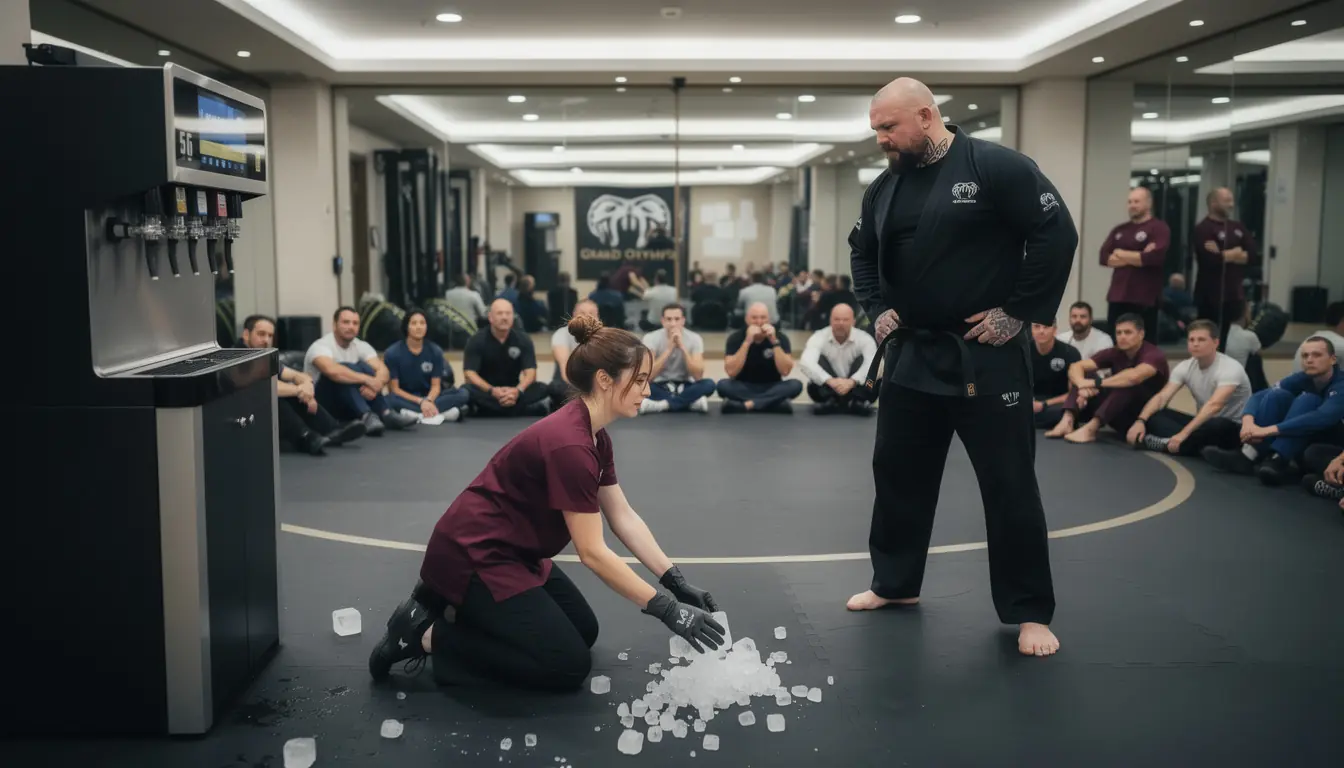
"Get off my mat, trash," he spat.But instead of crying, the cleaner's feet shifted. Her weight dropped. And in a fraction of a second, she assumed a fighting stance so elite the room went dead silent.The Grand Olympia Hotel in downtown Chicago was a towering monolith of glass, steel, and manufactured luxury. To the wealthy guests, it was a palace; to 34-year-old Saffron Howard, it was an invisible maze of service elevators, bleach-scented supply closets, and endless plush-carpeted hallways.Saffron pushed her heavy housekeeping cart down the corridor of the fourth floor, the wheels squeaking a rhythmic, lonely tune. She wore the standard uniform: a shapeless maroon tunic, loose black slacks, and rubber-soled shoes that offered no support. Her hair, a dull, fading brown, was pulled back into a tight, messy bun, deliberately covering the upper cartilage of her right ear. If anyone looked closely enough, they would notice the thickened, mangled tissue there—a classic cauliflower ear. But no one ever looked closely at the hotel cleaning staff. That was the point.It was the weekend of the Midwest Invitational Grappling Expo, and the hotel was swarming with martial artists. The lobby was packed with broad-shouldered men in tight T-shirts bearing the logos of various jiu-jitsu academies, mixed martial arts gyms, and supplement brands. They walked with the distinct rolling swagger of fighters, their conversations dominated by talk of weight cuts, heel hooks, and sparring sessions.For Saffron, the presence of these fighters was a suffocating ghost from a past she had buried three years ago.Saffron Howard didn't exist.She was Abigail Preston—a name whispered with a mixture of reverence and fear in the underground submission grappling circuits and professional MMA cages of Las Vegas and Miami. Abigail had been a prodigy, a woman who didn't just defeat her opponents, but dismantled them with a cold, terrifying, surgical precision. She was on the verge of signing the largest contract in the history of the women's bantamweight division.But then came the bout in Miami, funded by a ruthless, high-stakes gambling syndicate led by a man named Terrell Adams. Adams had ordered Abigail to take a dive in the third round against a heavily favored, heavily bet-upon local star. Abigail had nodded, stepped into the cage, and in the first 40 seconds of the first round, she had snapped her opponent's humerus in half with a devastating, inescapable armbar.It wasn't just a victory. It was a statement.The statement cost her everything. Within 24 hours, her apartment was torched; her coach was hospitalized with two broken legs. The message from Adams's syndicate was clear: she was next, and so was anyone she loved.Abigail Preston died that night. She fled, scrubbed her identity, cut ties with her family to keep them safe, and emerged in Chicago as Saffron Howard—a quiet, unremarkable woman who scrubbed toilets and changed bed linens for minimum wage."Hey, watch the cart, sweetheart."Saffron stopped, lowering her eyes to the carpet as a loud, booming voice echoed down the hall. Striding toward her was Darby Caulfield.