Get out of here now. Vanessa Whitmore’s voice cut across the main lobby of Whitmore Global like a blade. Every employee within earshot went still. She was standing over a janitor pointing at him the way someone points at something disposable.
Moments ago, she had walked straight into his bucket. Water soaked the hem of her designer dress. She didn’t hesitate. She assigned the blame, called security, and waited for the humiliation to land.
The janitor didn’t argue. He didn’t flinch. He simply looked at her with the kind of calm that didn’t belong to someone with nothing. Because he wasn’t.
Ryan Carter knew exactly what Vanessa Whitmore didn’t. That every floor she walked on, every office she commanded, every decision she made inside this building existed because of him. The lobby of Whitmore Global occupied the entire ground floor of a 40-story glass tower in the heart of downtown. On a normal morning, the space moved like a well-oiled machine: staff crossing in every direction, elevators opening and closing, the front desk fielding calls before the city had fully woken up.
Ryan Carter had worked inside this building for 11 days. He had mopped these floors, emptied the trash cans near the executive elevator bank, and refilled the soap dispensers in the third floor restrooms. Not one person had looked at him twice. That was exactly the point.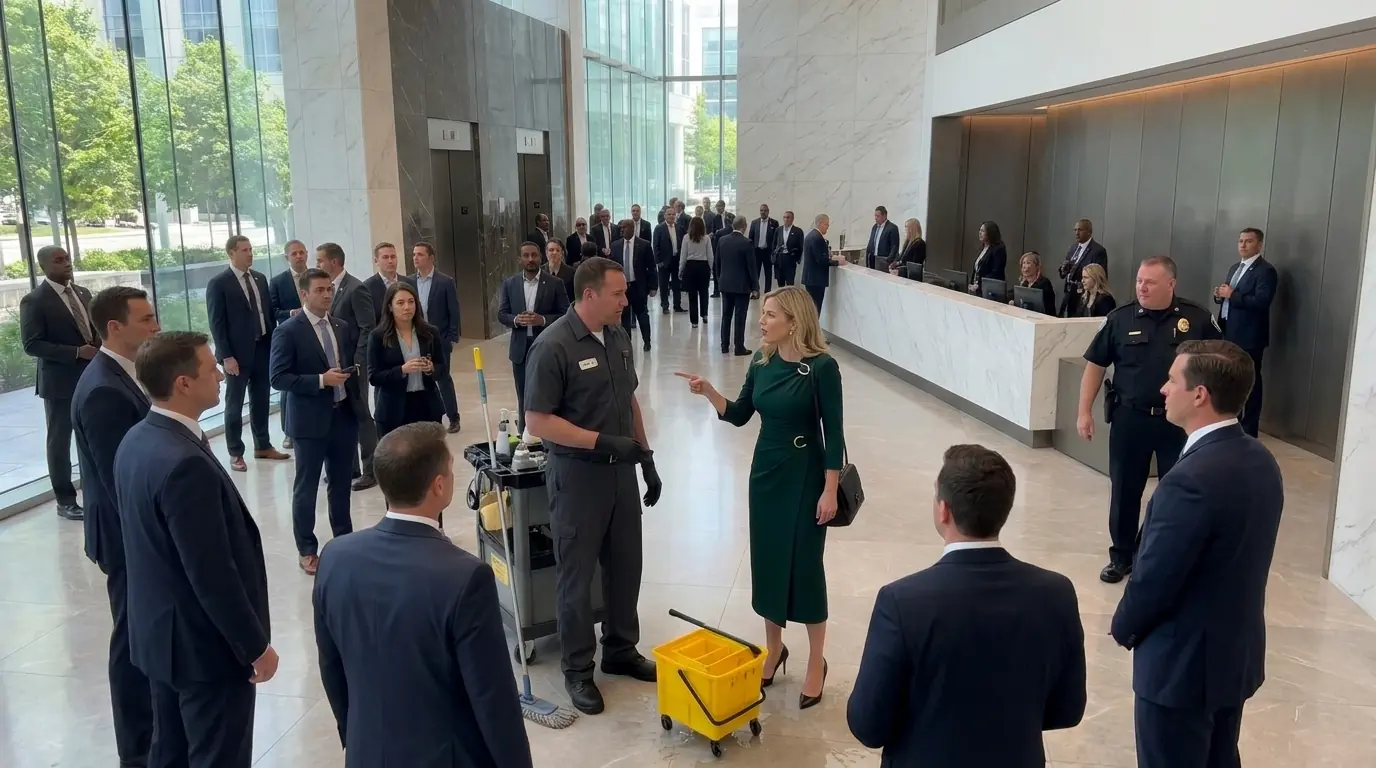
He had built this company from nothing. Whitmore Global had started as a midsize logistics firm operating out of a rented office space with 12 employees and a lease that ran month-to-month. Ryan had spent the better part of a decade restructuring it, acquiring smaller competitors, and expanding into financial services and commercial real estate. By the time the company went public, his name appeared nowhere in the press materials.
That was deliberate. He had always preferred operating from the background, holding his controlling stake through a private holding structure that kept his identity out of the public record. Vanessa Whitmore, polished, sharp, and magnetic in front of a camera, became the face the world associated with the company. Ryan had no objection to that arrangement.
What he had not anticipated was what that arrangement would eventually cost the people who worked here every day. The decision to go undercover had not been impulsive. For months, he had been receiving signals that something was wrong. Not in the financial reports, which looked clean on the surface, but in the patterns beneath them.
Turnover rates in the mid-level management tier had doubled over 18 months. A string of strong performers had quietly resigned without counteroffer. Exit interviews, where they existed, were vague to the point of uselessness. Ryan had raised the issue in a board call and been told the labor market was competitive.
He had not found that answer satisfying. So he created a temp worker profile through a third-party staffing agency, listed his skill set as general maintenance and showed up on a Monday morning with a gray uniform and a name badge that read Ryan C. What he found in those first 11 days was not a single dramatic incident. It was a texture, a way the building operated.
When the people at the top assumed they weren’t being watched, managers spoke to junior staff the way someone speaks to a vending machine. Requests came without context, and mistakes were addressed publicly, loudly, and without any apparent interest in what had actually gone wrong. Ryan had watched a young woman in accounts receivable get dressed down in a hallway for missing a deadline that based on what he overheard, had been moved up without notice. He had watched a facilities coordinator get talked over in three consecutive meetings until the man stopped showing up to them entirely.
None of it was illegal. All of it was the kind of slow erosion that doesn’t show up in any report until the people worth keeping have already left. On the morning of the 12th day, Ryan was working in the main lobby when Vanessa Whitmore came off the executive elevator 20 minutes ahead of her usual schedule. He had observed her routine enough to recognize the pace, quick-focused, the walk of someone who had already decided the next four things before her feet hit the ground floor.
She was in a conversation on her phone, one hand gesturing slightly as she spoke, her attention entirely on whatever was being said on the other end. She did not look down. The bucket was directly in her path, sitting where Ryan had placed it while he finished the section of floor near the front entrance. She walked into it cleanly.
No warning, no redirect, just the sharp sound of the impact and then water spreading fast across the polished marble in every direction. The phone call ended. Vanessa looked down at her dress, dark fabric, the kind that showed every drop and then looked up at Ryan. For a half second, nothing happened.
Vanessa’s voice was controlled, but loud enough to reach the edges of the room. She looked at Ryan the way someone looks at a problem they intend to remove. You leave equipment in the middle of a walkway and just stand there. Ryan said nothing.
He kept his expression neutral, which required less effort than it might have under different circumstances because he had spent years in rooms where the wrong reaction cost more than silence. Vanessa did not take the quiet as a sign to stop. She took it as permission to continue. She called over the head of lobby security, a broad-shouldered man named Dennis, who had always struck Ryan as someone who did his job and nothing more, and told him to have the janitor escorted out of the building immediately, not reassigned, not spoken to by a supervisor. Out.
She said the word like it cost her nothing. And then she straightened her bag on her shoulder and walked toward the executive corridor without looking back. Dennis crossed the lobby with the expression of someone following an instruction he had not written. He stopped a few feet from Ryan and spoke in a low voice.
I’ve got to ask you to come with me. He wasn’t unkind about it. He was just doing what he had been told. Ryan nodded. He left the mop where it was, walked with Dennis toward the side exit and stepped out onto the street without a word.
The door closed behind him. Through the glass, he could see the lobby gradually returning to motion, people finding their conversations again, the ambient noise of the building resuming as though a switch had been flipped, as though nothing had happened, as though a person had simply been removed, and the space had closed over the gap like water. He stood on the sidewalk for a moment and considered what he had just witnessed. not the spilled bucket.
That was incidental, a piece of bad timing with no real significance on its own. What stayed with him was the speed of it, the absence of any hesitation between the moment Vanessa realized she had an audience and the moment she decided what to do with it. The way no one in that lobby had moved or spoken or done anything other than watch. That wasn’t just the behavior of one person under pressure.
That was a room full of people who had already learned what happened when you pushed back. He pulled out the secondary phone he used for the undercover work and placed a call to the only person who knew what he was doing. His attorney, a precise and unhurried man named Gerald Foster, picked up on the second ring. I just got walked out of the building, Ryan said.
Gerald’s response was measured. Voluntarily or by force? Somewhere between the two. Lobby incident, Vanessa made a public example of it.
Ryan watched a cab cut across traffic three lanes over. I’m going back in tomorrow. I need you to have the staffing agency resubmit the profile under a variation on the name. Nothing that triggers a flag just enough distance from today.
Gerald was quiet for a moment. You could also just go in the front door as yourself. Not yet. Ryan put the phone back in his pocket and started walking. He wasn’t finished.
What he had seen in 11 days was enough to confirm that the culture problem was real and significant. What he had not yet confirmed was where it was coming from. Vanessa was the visible point of the behavior, but visibility and origin weren’t the same thing. He had built enough companies to know that the tone of a workplace rarely started at the top by accident.
Someone was setting the conditions. He needed to understand who. He spent that evening going back through the internal data he could access remotely. Not operational files, which would have required a system login that would surface his identity but the structural information available to him as controlling shareholder.
He was looking at patterns, not documents. Expense approvals routed around standard channels. A cluster of vendor contracts renewed without competitive bidding in the same quarter. A capital allocation decision that had bypassed the usual committee sign-off.
Each item on its own had an explanation. Together, they formed the outline of something that was not accidental. The name that appeared adjacent to several of those items wasn’t Vanessa Whitmore’s. It was Michael Reed, CFO, 1two years in corporate finance before joining Whitmore Global three years ago with a track record that looked impeccable from the outside.
And Ryan was beginning to suspect had been carefully constructed to look that way. Ryan had approved the hire. He had reviewed the credentials, spoken to two references, and moved on. He had not dug into the man’s history with the same scrutiny he would have applied in the early years of the company when every hire felt like a risk he was personally absorbing.
That had been a mistake. He did not reach a conclusion that night. He noted what he saw and set it aside. Conclusions required evidence and evidence required proximity.
He needed to get back inside the building and he needed to stay long enough to watch Michael Reed operate from a position where Reed had no reason to moderate his behavior. That meant going back in as the janitor. The next morning, Ryan returned to the building under a slightly adjusted profile. Same agency, different spelling on the last name, assigned to a different floor.
The temp pool turned over often enough that the adjustment drew no attention. He spent the day on floors 14 through 17, which housed the finance division, and three of the four senior executive assistants, who sat closest to the people Ryan most wanted to observe. He kept his head down, moved through the corridors at the pace that made him invisible, and listened. What he heard confirmed enough to keep him there for the next three weeks.
Michael Reed’s name came up the way a weather system comes up as something people worked around rather than engaged with directly. A junior analyst mentioned in a conversation that was clearly not meant to carry, that a departmental review had been quietly shelved after someone above had flagged it as redundant. An executive assistant referenced a meeting that had been kept off the official calendar. Small things. The kind of small things that meant someone was working very hard to control what left a paper trail and what didn’t.
Ryan cleaned the corridor outside the finance division for four days and said nothing to anyone. He watched Michael Reed move through the space with the confidence of someone who had never been seriously questioned. And he watched Vanessa Whitmore make decisions in public that she believed were entirely her own. The distance between those two realities was where the real story lived.
And Ryan was becoming certain that he was the only person in the building positioned to see both sides of it clearly. He had come in expecting to find a culture problem driven by leadership arrogance. What he was finding instead was something more deliberate, a system that had been designed to concentrate exposure at the top while concentrating control somewhere else entirely. Vanessa wasn’t running Whitmore Global so much as she was standing in front of it.
And the person standing behind her had been counting on no one ever looking past the face of the company long enough to notice the difference. Ryan picked up his mop, moved to the next section of hallway, and kept going. He wasn’t ready to surface. Not yet. He needed one more thing before he could move.
He needed to understand exactly what Michael Reed was planning and how far along the plan already was because whatever was being set in motion inside this building, Ryan had the distinct sense that it was not in the early stages. It had the feel of something already in motion, already angled toward a specific outcome, already running on a timeline that Ryan had not yet identified. That was the part that needed to change, and it needed to change before the timeline ran out. three weeks after returning to the building under the adjusted profile, Ryan had accumulated enough to understand the shape of what he was dealing with.
Not the full picture yet, but enough of the outline to know it was worse than anything he had walked in expecting to find. The abuse of authority inside Whitmore Global was not random. It followed a structure, and the structure had a source. Senior managers who reported directly to Michael Reed ran their teams with a particular style, not aggressive in the obvious sense, but corrosive in a way that was harder to name and easier to dismiss.
They assigned blame downward and absorbed credit upward. They created conditions where asking a question in a meeting felt like a personal risk. Ryan had watched a project coordinator named Sandra Hayes get publicly contradicted by her department head three times in a single meeting. Each correction delivered with the tone of someone who wanted the room to understand the hierarchy.
Sandra had stopped contributing by the third occurrence. By the following week, Ryan noticed she had stopped attending the meeting entirely. Two weeks after that, her name disappeared from the internal roster. She wasn’t the only one.
Over those same weeks, Ryan tracked at least six departures of people who, based on what he had observed and the work products he occasionally glimpsed, were among the more capable individuals in their departments. None of them made noise on their way out. That was perhaps the most telling detail, not that they left, but that they left quietly, as though they had already accepted that raising the issue would cost more than it would return. That kind of quiet didn’t come from nowhere.
It was learned. Vanessa Whitmore continued to move through all of this as though she were operating a different company. Ryan watched her closely during those weeks, not with the contempt he might have carried after the lobby incident, but with something closer to clinical curiosity. In public-facing settings, she was sharp and composed.
In internal meetings, she was decisive. She issued directives and followed up on them with the discipline of someone who genuinely believed she had full visibility into what was happening beneath her. But that belief Ryan was beginning to understand had been carefully maintained for her. The information that reached Vanessa’s desk had been filtered.
The reports that crossed her line of sight had been shaped. She was making real decisions, but she was making them inside a version of the company that Michael Reed had constructed around her. Ryan first understood the full scale of what Reed was doing on a Tuesday morning in the fourth week. He was cleaning the corridor outside the executive conference suite on the 32nd floor when a meeting ended earlier than scheduled, and several participants came through the door mid-conversation.
He kept his head down and continued working and no one gave him a second look. Two of the men speaking were mid-level finance directors who reported to Reed. They were discussing something that had been finalized in the meeting, a vendor agreement involving a commercial real estate asset held by the company. One of the men mentioned a number.
The number was large enough that Ryan committed it to memory without allowing any change in his expression. That evening, he cross-referenced what he had heard against the asset records he could access through his shareholder position. The vendor in the agreement did not appear in any previous Whitmore Global contract database. The company had been registered 14 months ago in a state with minimal disclosure requirements.
Its listed directors were names Ryan did not recognize. The valuation attached to the transaction was 40% above current market rate for a comparable asset. Ryan sat with that information for a long time, working through what it meant and what it was designed to do. This was not a mistake in judgment.
This was a structure. Someone had built a vehicle to extract value from the company through a transaction that would appear routine to anyone who wasn’t looking closely enough. And the person in the best position to be looking closely was the CFO who had designed the transaction himself. Ryan started documenting everything through a secure channel he had set up specifically for this purpose.
He used his secondary phone to photograph documents when the opportunity presented itself, recorded time and location for every relevant conversation he had overheard and cross-referenced each item against whatever external records he could verify. Gerald Foster, his attorney, received encrypted transfers of the material at the end of each day with instructions to hold everything until further notice. The picture that assembled itself over the following week was not subtle. Michael Reed had been running a parallel operation inside Whitmore Global for at least two years, diverting capital through inflated vendor contracts, routing transactions through entities he controlled, and keeping the scale of the losses hidden by distributing them across enough line items that no single figure would trigger an automatic flag.
The total, as Ryan estimated it, was somewhere between $60 million and $80 million already extracted with a much larger transaction in preparation. The larger transaction was the one that changed the timeline. Ryan overheard a fragment of a phone call through Reed’s office door, not fully closed, that referenced a board presentation scheduled within the week. The words Ryan caught were partial but sufficient: asset transfer, full authorization, final documentation.
He didn’t need the rest of the sentence. He understood what Reed was building toward. There was a transaction being prepared that would require Vanessa Whitmore’s signature, and once she signed it, the structure would be complete. She would have authorized the transfer of hundreds of millions of dollars in company assets to an entity she almost certainly didn’t know Reed controlled.
And when the damage was eventually discovered, every signature on every document would point to her. Ryan had three days, maybe four. He needed to move carefully, and he needed to move fast, and he needed to do both at the same time. The problem was that Michael Reed had apparently arrived at the same conclusion that someone inside the building was looking at things that weren’t meant to be seen.
Ryan didn’t know when the suspicion had started, but the first sign came on a Wednesday afternoon. He arrived on the 31st floor and found two of the regular security staff conducting what was described to the cleaning crew as a routine check of maintenance access logs. It wasn’t routine. Ryan recognized the difference between a procedural review and a targeted one.
He finished his shift without incident, but he knew the window had narrowed. The trap came the following morning. Ryan arrived at the building and was met in the service entrance by a facility supervisor he had never encountered before, a man named Craig, who held a tablet and spoke with the careful neutrality of someone reading from a prepared script. Craig informed him that a piece of equipment from the maintenance storage room had been reported missing and that based on access records, Ryan’s badge had been used in the relevant corridor during the relevant time frame.
Craig said it was likely a clerical error, but that until it was resolved, Ryan would need to surrender his building access card. Ryan handed over the card. He kept his voice level and his expression cooperative. He was not going to get what he needed by arguing with Craig, who was almost certainly acting on instructions from someone who had not explained the full situation to him.
The accusation was fabricated. He knew that with complete certainty, but the mechanism was effective. Without the access card, he couldn’t enter the building through any channel that didn’t immediately surface his real identity. His undercover profile, already thin, had now been formally compromised.
Two of the security team members who escorted him to the exit were the same men he had watched work this lobby for weeks. Neither of them looked at him the way they would look at someone they believed had actually stolen anything. They looked at him the way people look when they’re completing a task they weren’t given full context for. He was on the street again this time with no easy route back in.
He called Gerald from the corner. They made me, Ryan said. Reed flagged the access logs and had someone build a pretextual theft report. I’m out of the building on a fabricated basis and my temp profile is effectively burned.
Gerald’s voice was steady. What’s your evidence status? Enough to make a case. Not everything I wanted, but enough.
Ryan turned away from the building entrance and started walking. Reed is moving fast. He’s got a board presentation in the next 72 hours and a signature transaction waiting at the end of it. If Vanessa signs those documents, the extraction is complete and the liability falls entirely on her.
Gerald’s response came without hesitation, And she doesn’t know any of this. She has no idea. Ryan had been certain of that for weeks, but saying it out loud clarified something he had been processing quietly. Vanessa Whitmore was not the person he had believed she was when he walked out of this building the first time.
She was arrogant. Yes, she had humiliated him in that lobby without a second thought, had exercised her authority in a way that showed exactly how little she thought about the people beneath her. But arrogance was not the same as corruption. And the distinction mattered enormously here.
She was being used. The culture of fear and dismissal that Ryan had been watching all these weeks, the one he had assumed she was driving, had been engineered by someone else allowed to thrive because it kept people too unsettled to look carefully at anything, too focused on survival to ask the kind of questions that would have exposed what Reed was doing. Vanessa had been positioned at the center of something she didn’t understand and handed a title that made her the most logical person to hold responsible when it eventually collapsed. Ryan stopped walking.
He stood on the sidewalk outside a coffee shop two blocks from the tower and thought about that for a moment, about how completely the setup had been designed and how long it must have taken to build something this layered. Reed hadn’t just been stealing from the company. He had been constructing a story in which someone else would be blamed for it. Every loud public moment of Vanessa behaving badly, every instance of her exercising authority in a way that made enemies, every perception of her as someone who operated without accountability, all of it served Reed’s story.
When the fraud came to light, the narrative was already written. Nobody would look past her. The thought that followed was not warm, but it was honest. Ryan had nearly let it work.
He had walked into this building expecting to find a culture problem, and the culture problem was real, but it had been deliberately seated. He had spent weeks watching Vanessa as though she were the source. And in doing so, he had been looking exactly where Reed wanted him to look. He needed to move.
Now, the evidence he had was significant. the documentation of the vendor transactions, the fabricated company registration records, the financial data Gerald had been compiling, but it was not yet the kind of complete airtight package that would hold up to the scrutiny a case this large would require. Reed had already demonstrated he was willing to fabricate evidence. He had resources and access and the trust of the board.
Ryan had none of those things in his current position. He was on paper a temp maintenance worker who had been escorted off the premises on suspicion of theft. He called Gerald back. I need you to start preparing the full disclosure package for the board.
Everything: the vendor structures, the transaction history, the estimated figures, the timeline cross-referenced and sourced. He thought about the timeline again. I also need you to get me into that board meeting. Gerald was quiet for exactly the length of time it took to understand what Ryan was actually asking.
You want to walk into a board meeting that Michael Reed has called, as yourself with the board currently having no knowledge that you’ve been inside this building for the past month in a gray uniform. Yes, that’s going to be a significant moment. I know, Ryan said. Make sure we’re ready for it.
He ended the call and stood there for another moment, looking up at the glass tower that caught the morning light the same way it always had. Forty floors of something he had built, currently being taken apart from the inside by someone he had trusted, while the woman standing at the top of it had no idea the ground was being cut from under her feet. Ryan had come here to understand the truth of this company. He had found it.
Now he needed to decide what to do with the very small window of time he had left before that truth became irreversible. Gerald Foster had spent 30 years in corporate law and in that time he had walked into a significant number of rooms where the atmosphere was already hostile before anyone had said a word. He told Ryan this on the morning of the board meeting, not as reassurance but as a practical observation. The 38th floor conference room at Whitmore Global was going to be that kind of room.
Ryan needed to understand that going in. Ryan understood. He had spent the previous 48 hours with Gerald and two members of Gerald’s team assembling the disclosure package with the precision the situation required. Every transaction was documented. Every vendor entity was traced to its registration records, its listed directors, its connection to Michael Reed through three layers of corporate structure that had been designed to obscure that connection, but had not been designed to withstand the kind of scrutiny Gerald’s team applied.
The financial figures were conservative. Ryan had insisted on that because conservative figures that held up were more useful than aggressive ones that could be challenged. The total documented diversion across two years came to $73 million. The pending transaction, if completed, would have added an additional $240 million in asset transfers to entities Reed controlled.
Those numbers were now in a bound presentation that Gerald carried under his arm as they rode the elevator to the 38th floor. Ryan was dressed the way he dressed when he was being himself, dark suit, no tie, the particular kind of quiet that comes from someone who doesn’t need the room to recognize him immediately. He had not been in this building as Ryan Carter since before the undercover work began. The last time he had walked through the front entrance in this capacity, he had been just another face in the ownership structure that the public record didn’t document.
Today, that was going to change. The board meeting had been called by Michael Reed under the agenda item of a strategic asset restructuring proposal. Seven board members were present when Ryan and Gerald entered the room. Vanessa Whitmore was seated at the head of the table, a stack of folders in front of her, a pen already in her hand.
Reed was standing near the presentation screen at the far end of the room mid-sentence, in what appeared to be a preliminary explanation of the transaction, he stopped speaking when the door opened. The room went quiet in the way rooms go quiet when something enters that doesn’t fit the expected sequence of events. Ryan recognized two of the board members from previous interactions years ago. Neither of them showed immediate recognition.
Gerald placed a copy of the disclosure package on the table in front of each board member without speaking, moving around the room efficiently. His manner suggesting that this was a procedure and that procedures should be allowed to complete before anyone decided how to respond. Michael Reed spoke first. His voice was composed, but the composure had an edge that Ryan recognized as the sound of someone recalculating very quickly.
This meeting was not open to outside parties. I’m going to have to ask. Ryan spoke over him without raising his voice. My name is Ryan Carter.
I’m the founder of Whitmore Global and the controlling shareholder through Carter Holdings Group. I hold 53% of the voting equity in this company. He looked around the table as he said it, not to gauge reactions, but to make sure every person in the room had heard the statement clearly. I apologize for the abrupt entrance.
What I’m about to show this board couldn’t wait for a scheduled agenda item. The silence that followed had a different quality than the one that had preceded it. Vanessa Whitmore had not moved. She was looking at Ryan with an expression that hadn’t settled yet into anything recognizable.
Not anger, not confusion, something that was trying to process too many inputs at once and hadn’t landed on any of them. The pen was still in her hand. The folders were still in front of her. She had not yet picked up the disclosure package Gerald had placed at her seat.
One of the board members, a man named Arthur Webb, who had been on the board since the early years of the company, leaned forward and looked at the cover page of the package. He read it without speaking for a moment, then looked up at Ryan with the careful expression of someone who had been in enough rooms to know when the temperature had just changed permanently. Ryan walked them through it. He didn’t dramatize it and he didn’t editorialize.
He presented the documentation in sequence, starting with the vendor transaction that had been finalized three weeks earlier and working backward through the pattern of diversions that had preceded it. He named each entity, traced each registration and showed the board the ownership trail that connected every one of them to Michael Reed. He presented the estimated total of $73 million in confirmed historical diversions and the $240 million in pending transfers that were the subject of today’s meeting. The documents Vanessa had been prepared to sign before Ryan walked through the door.
He did not look at Reed while he spoke. He did not need to. The room’s attention had shifted in the way attention shifts. when a structure that was hidden becomes visible, not dramatically but completely the way a drawing changes the moment you see the image inside it and cannot unsee it afterward.
Reed made one attempt to interrupt about halfway through the presentation. He characterized the vendor relationships as legitimate third-party arrangements and suggested the documentation being presented had been obtained through improper means. Gerald responded to that point without heat, citing Ryan’s standing as controlling shareholder and his legal authority to conduct an internal investigation through whatever methodology he determined appropriate. Reed did not attempt a second interruption.
By the time Ryan finished, three of the seven board members had their phones out. Arthur Webb had already stepped to the side of the room and was speaking quietly into his. The nature of those calls was not difficult to interpret within the framework of what Gerald had presented. The board’s obligations were clear, and experienced board members understood those obligations without needing them explained.
Vanessa Whitmore had still not spoken. She had read through sections of the disclosure package during the presentation, turning pages with the focused attention of someone who needed to verify what they were hearing against what was written. At some point during the middle section she had set the pen down. It sat on the table in front of her next to the folders that contained the documents she would have signed this morning if this meeting had proceeded as Reed had planned.
Michael Reed was removed from the room by two of the building’s senior security staff 20 minutes after Ryan concluded his presentation. The request had come from Arthur Webb acting in his capacity as lead independent director pending formal notification of the relevant authorities. Reed left without making a scene which Ryan noted. People who had been building something for two years and watched it come apart in a single meeting sometimes made scenes and sometimes they simply recognized that the architecture had failed and that performance was no longer useful.
Reed appeared to belong to the second category. He straightened his jacket, gathered nothing from the table, and walked out between the two security staff members with the expression of someone storing whatever came next for a different room. The board members spent the following 30 minutes in a rapid sequence of procedural decisions, freezing the pending transaction, engaging external legal counsel, initiating contact with the appropriate financial regulatory authorities. Gerald guided that process with the efficiency of someone who had prepared for it, which he had.
Ryan stood to the side and let it proceed. This was the part that didn’t require him. What had required him was now done. After the board members had moved into a separate room with Gerald to begin the formal documentation process, Ryan and Vanessa were left alone in the conference room for the first time.
The presentation screen had gone dark. The disclosure packages were still spread across the table. Outside the floor-to-ceiling windows, the city continued in every direction without any awareness of what had just happened inside this room. Vanessa stood up.
She was composed in the way that people are composed when they are holding something together through conscious effort rather than ease. She looked at Ryan directly, the way she had looked at him in the lobby weeks earlier, but the geometry of that look had changed entirely. In the lobby, she had been looking down. Here she was looking across at someone she was trying to understand on terms she didn’t yet have full access to.
How long? Her voice was even. Five weeks inside the building, Ryan said. Longer on the outside looking at patterns in the data.
She absorbed that. The lobby, the morning with the bucket. It wasn’t a question exactly. It was the sound of someone placing a piece into a picture that was assembling itself in real time. Yes.
Vanessa looked at the table for a moment, then back at him. When she spoke again, her voice had lost the evenness, not in the direction of anger, but of something less defended. I humiliated you in front of the entire company. You did, Ryan said.
He wasn’t going to soften that because softening it would have required pretending it hadn’t happened. And it had happened. And it had mattered not primarily because of what it had done to him, but because of what it had told him about what this building had become. I didn’t know who you were.
I know that, Ryan said. That’s part of what I needed to understand. Whether what happened in that lobby was something you did because of who I appeared to be or something you would have done regardless. He let that sit for a moment, not as an accusation, but as a statement of what he had been observing.
The version I saw wasn’t an isolated incident. It was a pattern. People in this building had learned to absorb that kind of treatment because they understood the alternative was worse. Vanessa didn’t argue with that.
Whatever defenses she might have reached for in a different conversation, she didn’t reach for them here. She had just spent the last hour reading documentation that showed she had been positioned for an unknown period of time as the public face of a company being systematically hollowed out behind her. The ground was different under her feet than it had been this morning, and she was standing on it without pretending otherwise. I owe you an apology, she said.
Not just for the lobby, for what I allowed to happen here. She said it, looking at him directly. No qualification, no procedural framing. I told myself I was running this company.
I wasn’t paying attention to what that actually required. Ryan nodded. That exchange needed to stay between the two of them for now. But what had happened in that lobby five weeks ago had not happened between the two of them. It had happened in front of every person who worked on that floor.
And Vanessa understood that as well as he did. Two days later, Ryan called a companywide meeting in the main lobby. The same space, the same marble floor, the same elevator bank where the whole thing had started. The announcement framing was straightforward, a leadership address following recent organizational changes.
Most employees arrived expecting something procedural. What they got was different. Ryan spoke first. He introduced himself by name and by role founder, controlling shareholder, the person who had built this company before most of them had joined it.
He explained without excessive detail that he had spent five weeks working inside the building as a member of the maintenance staff. He said he had done it because he needed to understand what this place had become from the ground up and that what he had found had required a response. He did not turn it into a performance. He stated the facts and let them land.
Then Vanessa stepped forward. The lobby had the same quality of stillness it had held five weeks earlier when she had stood in this exact space and pointed at a man in a gray uniform and told security to remove him. Every person in the room who had been there that morning remembered it. She did not pretend otherwise.
five weeks ago, I stood in this lobby and publicly humiliated a member of our staff. Vanessa said her voice was steady and she did not look away from the room. I didn’t know who he was, and that is exactly the point. It should not have mattered who he was.
I treated a person as disposable because I was embarrassed and because I had an audience and I am standing here now to tell you directly that it was wrong. She looked across the assembled staff, the faces she recognized and the ones she didn’t, the people who had watched that morning and said nothing because they had learned that saying something cost too much. I am asking for the opportunity to earn back what that moment cost this company and I intend to do it by leading differently than I have been. The lobby didn’t erupt.
There was no dramatic response. people absorbed it the way people absorb something that is genuine quietly with the particular attention that comes when a room recognizes that what is being said is not managed or rehearsed. Ryan stood to the side and watched and what he saw in the faces of the staff was not forgiveness exactly, not yet, but something that looked like the first reasonable condition for it. In the weeks that followed, Ryan did what he had come here to do.
Not the undercover piece, which had been a means to an end, but the actual work of reorientation. He didn’t restructure the company from the outside through a series of directives issued from a holding company address. He came in as himself and sat in the rooms where the actual work happened. He met with the people who were still there and reached back to some of the ones who had left Sandra Hayes among them.
He didn’t reach out to reverse decisions that had already been made, but to understand what those departures had caused and what they said about what needed to change. Sandra agreed to a conversation. By the end of it, she had agreed to return. The management layer that had operated under Reed’s influence was addressed systematically, not through a single dramatic action, but through a structured review that Gerald’s team ran alongside an external HR consultancy.
Some people were let go. Others were moved into roles where the authority they had been misusing was no longer available to them. The process wasn’t gentle, but it was not punitive beyond what the facts required. Ryan had no interest in building a company that ran on fear in either direction. Vanessa remained.
That decision had not been automatic, and Ryan had not made it automatically. She was capable, genuinely, demonstrably capable, in ways that had been visible, even through the distorted picture Reed had constructed around her. What she had lacked was not intelligence or drive, but the kind of checked authority that comes from knowing someone is actually watching. Ryan gave her that.
He restructured the oversight framework so that the controlling shareholder position was no longer invisible, so that the layers between ownership and operation were fewer and more transparent, and so that the conditions Reed had exploited the gaps between what was visible and what was real could not quietly reassemble themselves. There was a morning about six weeks after the board meeting when Ryan walked through the main lobby of Whitmore Global on his way to the elevator. He was dressed as himself, badge on coffee in hand. The lobby was moving the way it always moved in the morning.
Staff crossing in every direction, the front desk fielding calls the ambient noise of a building starting its day. A young woman near the elevator bank dropped a folder and several documents scattered across the floor. Two people nearby stopped what they were doing and helped her collect them without being asked, without making anything of it, without looking around to see whether the gesture was being observed. Ryan noticed it.
He didn’t stop or make it into anything. He got on the elevator, pressed the button for 38, and looked straight ahead as the doors closed. It was a small thing. It was also exactly the thing he had come here to find.
Not the fraud, not the governance failure, not the specific misconduct of one man who had spent two years building a structure to enrich himself at everyone else’s expense. Those were problems with solutions, and the solutions were now in progress. What he had actually come looking for was evidence that this company could still be the thing he had built it to be: a place where people were treated as though their presence had value regardless of what they were carrying or what floor they were standing on. He had found that evidence in a lobby in a small unobserved moment between people who weren’t performing anything for anyone.
It was enough. It was, in fact, exactly