She was already walking away, head down, jaw locked. 32 steps toward the gate and she hadn't looked back once because looking back meant letting them see what Colonel Briggs's words had done to her face, and she refused to give him that. Then the handlers started shouting. Not at her, at the dais, because all 45 of them had stopped responding to every command, every whistle, every name being screamed across that field, and were moving in the same direction.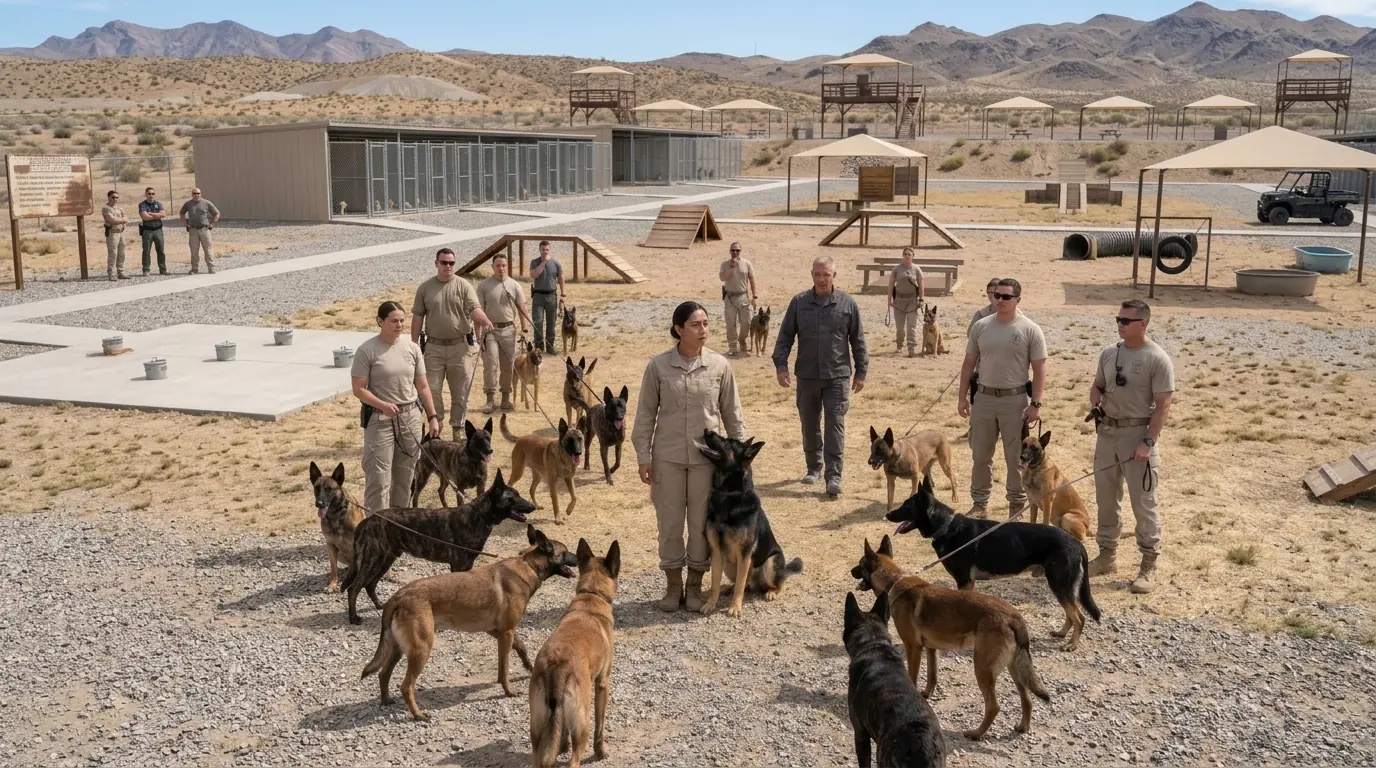
Toward her. Not running, not frantic, walking, deliberate, unified. Like they had made a decision that no human in that yard had been consulted on and didn't need to be. The morning Elena Cruz arrived at Desert Shadow K9 installation, the sun hadn't fully risen yet, but the base was already alive with noise, dogs barking, boots hitting gravel, handlers shouting commands in clipped military cadence. She stood at the main gate with a single duffel bag, her orders folded in her breast pocket, and the quiet certainty of someone who had learned long ago that first impressions rarely told the whole story.
The MP at the gate looked at her transfer papers, looked at her, looked at the papers again. "Lieutenant Cruz," he said like he was waiting for her to correct him. "That's right," she said. He let her through without another word, but she caught the look he exchanged with his partner, the kind of look that said this ought to be interesting. She'd seen that look her whole career.
The base briefing was conducted by a sergeant named Howell, mid-30s, career military, the kind of man who had decided somewhere around his second deployment that efficiency was a substitute for personality. "Desert Shadow runs 45 active K9 units," Howell said, not looking up from his clipboard. "Belgian Malinois, German Shepherds, Dutch Shepherds, all combat certified. These animals are not pets, Lieutenant. They are weapons with a heartbeat. You will address them accordingly."
"What's the average handler tenure?" Elena asked. Howell blinked. "Excuse me?" "The handlers. How long do they typically stay assigned before rotation?"
He stared at her for a moment like she'd asked something inappropriate. "18 months, standard cycle." "And the dogs?" Another pause. "The dogs stay." Elena nodded slowly.
"So the dogs outlast the handlers." "That is the nature of the program, yes." She didn't push further, but she filed it quietly, carefully, the way she filed everything. She met Colonel Briggs at 0800. He was standing in the center of the main training yard when she approached, arms folded across his chest, watching two handlers run their dogs through an obstacle sequence with the kind of detached scrutiny that belonged to a man who measured everything in metrics and results.
He heard her footsteps and didn't turn around. "Cruz," he said, flat like a verdict. "Sir." She stopped 3 ft behind him, regulation distance. Now he turned. He was a large man, not soft large, but the kind of large that came from decades of deliberate discipline.
His face had the look of someone who had made hard decisions so many times that the hardness had become structural, built right into the bones. He looked at her the way Colonel Briggs looked at everything, like he was calculating whether it was worth his time. Whatever he calculated, the answer wasn't favorable. "You're the transfer from Fort Detrick's behavioral unit," he said. "Yes, sir." "Trauma rehabilitation."
He said the words like they had a bad taste. "Dog therapy." "Behavioral reconditioning and trauma recovery, sir, for combat-returned K9 units exhibiting" "I know what it is." He cut her off without raising his voice. That was the thing about Briggs, he never needed volume. The dismissal was built into the tone.
"What I don't know is why command thought it was appropriate to send me a dog therapist when I run a combat unit?" Elena kept her expression even. "I was told you had three dogs removed from active rotation in the past 6 months. Behavioral incidents. I was assigned to assess and advise." "Assess and advise."
He repeated it slowly. "You know what those dogs needed, Lieutenant? Not advising. They needed to be worked harder. Push through it. That's how you fix a combat animal, you don't cuddle it back to health."
"With respect, sir, the research doesn't support that approach for trauma-related behavioral breakdown." The yard went quiet around them. Not dramatically, just the way yards go quiet when everyone within earshot realizes something is happening and decides very quickly to be somewhere else. Briggs looked at her for a long moment. "You have 1 week," he said finally. "Observe, stay out of the way, submit your report to command, and then go back to wherever they sent you from."
"Understood, sir." He turned back toward the field. "Dismissed." The first confrontation happened before lunch. Elena was observing a training run from the observation rail standard perimeter sweep simulation, two handlers, six dogs, when she noticed unit seven. Unit seven was a Belgian Malinois male, approximately 4 years old, designated Ranger.
He was running the drill, correctly hitting every mark, following every command. On paper, Ranger was performing perfectly. But Elena wasn't watching paper. She was watching the dog's ears, the way his back legs absorbed impact slightly differently on left turns, the way his head dropped 2 cm lower than it should when he moved through the tunnel segment. She leaned over the rail. "Handler, stop your dog."
The young corporal, barely 20, name tag reading Walsh, looked up at her with pure confusion. "Ma'am?" "Stop Ranger right now." Walsh hesitated just a fraction of a second, then called the dog in. Ranger came immediately, sat at his handler's left knee, and stared straight ahead like the professional he was. Elena came down from the rail and crouched in front of the dog.
She didn't reach for him immediately. She let him read her first, a full 10 seconds of stillness. Eye contact held at a respectful angle, body open and unhurried. Then she ran two fingers along Ranger's left rear hip. The dog didn't yelp. Combat dogs almost never yelped.
But his breathing changed, a single sharp intake, barely perceptible, controlled by an animal that had been trained to mask pain the same way soldiers are trained to mask fear. Elena stood up. "This dog has a soft tissue injury in his left hip flexor. He's been compensating for at least 3 days." Walsh stared. "He hasn't shown any" "He's been hiding it."
Elena said it matter-of-factly, not as an accusation. "That's what they do when they've been trained to push through. They hide it until they can't anymore, and then it becomes something worse." She looked at the young corporal directly. "When did he last have a full physical assessment?" Walsh's silence was the answer.
Elena pulled out her notepad. "I want a vet check on Ranger by end of day, and I'd like to review the assessment logs for all 45 units." Walsh looked like he wasn't sure if he had the authority to comply or refuse. "I should probably check with Sergeant Howell." "That's fine," Elena said. "Tell him Lieutenant Cruz requested it.
He can bring his concerns directly to me." She was already walking back toward the main building when she heard Walsh mutter something to the world under his breath. She didn't catch the words, but she caught the tone, uncertain, slightly odd, the voice of someone who had just watched something happen that he didn't have a category for. The logs were worse than she'd expected. She spent 3 hours that afternoon going through assessment records, injury reports, behavioral flags, veterinary recommendations.
The picture they painted was consistent and troubling. A high-performance unit operating on metrics alone, where dogs were evaluated almost entirely on task completion and speed, with behavioral and physiological nuance treated as secondary at best, irrelevant at worst. Two of the three dogs removed from rotation had flags in their records going back months, early indicators that a trained eye would have caught, but that had been buried under layers of performance data that told a simpler, more convenient story. The third dog's file stopped her cold.
The name in the record was Ghost. German Shepherd male, 6 years old, removed from active rotation 8 weeks ago following a behavioral incident during a live training exercise described in the report as unprovoked aggression toward handler. Elena read the incident report twice. Then she read the 18 months of records that preceded it. "Unprovoked," she said quietly to no one. Nothing in those records looked unprovoked to her.
What it looked like was an animal who had been sending signals for a year and a half, small signals easy to dismiss individually, until the signals ran out and the only language left was the one that finally got someone's attention. She set Ghost's file on top of the stack. Then she went to find where they were keeping him. The isolation kennel was at the far end of the compound, a separate structure, quieter, away from the main training areas.
There were four dogs housed there currently, Ghost among them. She found him in the third enclosure. He was lying in the far corner facing the wall. He didn't look up when she approached, which told her something. A dog with active aggression issues would have reacted to her footsteps. Ghost's stillness wasn't calm.
It was the specific heavy stillness of an animal that had stopped expecting anything. Elena sat down on floor outside the enclosure. Not close enough to be threatening. Not far enough to be dismissive. She didn't speak. She didn't make eye contact.
She just sat. 30 seconds passed. A minute. The dog did not move, still facing the wall. She'd done this before, sat on more concrete floors and more isolation kennels than she could count. She had spent countless hours waiting for an animal to decide whether she was worth the risk of trusting.
Some took 20 minutes. Some took 3 days. She had learned to be patient in a way that most people never needed to be because most people had never worked in the place she'd worked with the animals everyone else had already given up on. She was 4 minutes into the silence when Ghost moved. Not dramatically. Just a shift, the slow repositioning of a large body that had been holding itself rigid for too long.
He turned his head. Not toward her, just away from the wall. Elena stayed exactly where she was. Another 2 minutes. Then Ghost put his head on his paws and exhaled a long, slow breath that seemed to carry something with it. Not resignation.
Something older than that. Something that might under different circumstances have been called relief. Elena felt it move through her like a current. "There you are," she thought. She was still sitting there when Sergeant Howell found her. "Lieutenant."
His voice carried the particular brand of professional discomfort that comes from not knowing whether to be annoyed or confused. "What are you doing sitting?" he asked. "I can see that," she said without looking up. After a pause, he added, "You've been in here for 40 minutes." "Has it been that long?" It wasn't a question.
Howell was quiet for a moment. She could feel him trying to find the right footing. "Colonel Briggs would like a preliminary update on your observations whenever you're available." "I'll be available in 10 minutes." Another pause. "The dog isn't going to do anything, you know.
He's shut down. We've had handlers try to work with him." "He just lies there and faces the wall," Elena said. "Yes." "I know." She finally looked up at Howell.
"Ten minutes," he said, and left. Elena looked back at Ghost. The dog was watching her now. Not with suspicion. Not with the flat assessment of an animal deciding whether a threat was present. He was just watching.
The way you watch something you're not sure you believe in yet. "I know." she said softly. "Me, too." The meeting with Briggs lasted 11 minutes and accomplished very little, which Elena had expected. She laid out her preliminary findings. Ranger's injury, the pattern in the removed dog's records, the systemic gap between performance tracking and behavioral health monitoring.
She kept it precise, clinical, professional. Briggs listened with his arms folded and his expression arranged into something carefully neutral. "Your recommendation." he said when she finished. "Comprehensive behavioral assessment for all 45 units. Independent of handler reports. Standardized protocol, consistent evaluator."
"Meaning you." "Meaning a structured methodology that doesn't rely on the same individuals whose practices contributed to the problem." A muscle shifted in his jaw. "You're saying my handlers are the problem?" "I'm saying the system created conditions that made it very easy to miss things that should have been caught." She held his gaze.
"That's not a failure of character, Colonel. It's a structural issue. Those are fixable." Briggs was quiet for a moment. "Three dogs," he said finally. "Out of 45, that's a 6.7% incident rate.
In any other operational context, that's within acceptable variance." "Those aren't machines, sir. Variance has a different meaning when what's varying is a living thing." The quiet between them was the kind that had weight. "You have your week, Lieutenant." Briggs said.
"Use it." She was up before dawn the next morning. The training field was empty at 0430 or almost empty. Two handlers were running a pre-dawn drill with a pair of Malinois on the far perimeter. A maintenance crew was moving equipment near the obstacle course. The base had that particular quality of stillness that belonged to the early hours when the machinery of the day hadn't fully engaged yet and everything felt slightly more honest than it would later.
Elena walked the perimeter of the field alone, coffee in hand, studying the space. She was thinking about Ghost. Thinking about Ranger. Thinking about the 18 months of records she'd read and what they told her not just about those individual animals, but about the culture that had produced the records. She was so deep in thought that she almost missed it. Almost.
She stopped walking. 20 m to her right along the inner fence line, a handler was working with a shepherd she hadn't seen in yesterday's drills. The dog was going through a target identification sequence. Standard protocol, bite on command, release on command. The handler gave the release command. The dog didn't release.
The handler repeated it sharper this time, the authority cranked up two notches. The dog held. The handler reached for the dog's collar, a physical correction, and the dog turned his head toward him with a look that Elena recognized instantly and that the handler, to his clear surprise, did not. She was moving before she consciously decided to move. "Don't touch him." she said loud enough to carry across the distance.
The handler froze, looked at her. "Ma'am." "Step back from the dog." She kept walking toward them, keeping her own body language open and unhurried even though she was covering ground quickly. "Step back and turn sideways. Don't face him directly."
The handler, young, confused, and smart enough to hear the certainty in her voice, did what she said. The dog held the target for 1 more second. Then without a command from anyone, he released it. Set it down. Sat. Elena reached them and crouched down to the dog's level.
He looked at her with the alert, bright-eyed focus of an animal who had made a decision and was waiting to see what happened next. "Good boy." she said quietly. The handler stared. "How did you What's his name?" "Titan, ma'am." "How long has Titan been having trouble with the release commands?"
The handler's silence was a specific kind of silence, the kind produced by someone who has been pretending a problem doesn't exist and has just been caught. "2 weeks." he finally admitted. "Maybe 3." "And you didn't flag it?" "I thought" He stopped. Reconsidered.
"I thought I could work through it. If I reported it, they'd pull him from rotation." Elena looked at Titan. Titan looked at Elena with calm, clear eyes. "Titan is not broken," she said. "He's bored.
His task complexity has been the same for 6 months. He's a high-drive animal running low-stimulation routines. The behavioral issue you've been seeing is him communicating that." She stood up. "Increase the difficulty of his training sequences. Add variable commands.
Give him something to actually think about." The handler was looking at her like she'd just explained something in a language he'd been hearing for years without understanding. "That's it?" "That's it." She handed him back the target training sleeve. "Log it.
All of it. The release hesitation, the duration, what you observed this morning. Write it down exactly as it happened. Especially that part." She left him there with Titan and kept walking. Behind her, she heard the handler give a new command.
Heard Titan respond immediately, cleanly, the sharp precision of a dog who'd been given something worth doing. She didn't look back. But she smiled. By her third day, something was shifting. She couldn't have pointed to a single moment. It was more like a change in atmospheric pressure, gradual and cumulative.
Handlers who had initially avoided her began materializing near wherever she was working, ostensibly occupied with other things, but positioned just close enough to observe. Questions started appearing in sideways, indirect forms. Not "Can you help me with this?" but "I noticed you said something yesterday about and just hypothetically, if a dog was doing X, what would that mean?" She answered every question the same way she'd answered the first ones, directly, without condescension, as if the person asking was simply someone who hadn't had access to this particular information yet.
Because that's what she actually believed. Word traveled the way word always traveled in close communities, faster than anyone admitted and with more accuracy than anyone gave it credit for. By the end of day 3, she had four handlers openly seeking her out. Two more orbiting at a cautious distance. And one very pointed conversation with Sergeant Howell who appeared in the doorway of the assessment room where she was working and said with the air of a man whose certainty about something had recently developed a crack, "What exactly did you do in that program at Fort Detrick?"
Elena set down her pen. "Which part?" "The dogs they sent you." He paused. "The ones they were going to put down." She considered him for a moment.
"Who told you about that?" "Nobody told me anything." "I pulled your service record." He folded his arms, which she was beginning to recognize as his default posture for conversations he wasn't sure how to have. "It says you ran a 12-dog cohort. Animals flagged for euthanasia due to severe behavioral compromise.
Combat trauma, failed rehabilitation by standard protocols." Another pause. "And then it says all 12 were successfully returned to service." "Ten," she corrected. "10 returned to service. Two were retired into civilian placement.
They were done with military work and that was the right call. "That is still a 100% success rate on an impossible caseload."
"It depends on how you define success." Howell was quiet for a moment. "How do you define it?" Elena looked at him steadily. "Every single one of those animals deserved to be heard before a decision was made about their future. Whether the outcome was a return to service or retirement, the success was that we listened first." Howell uncrossed his arms. He didn't say anything else. But he stopped appearing in doorways to monitor her schedule after that, which she understood was its own form of statement. On the morning of day four, Colonel Briggs called a full unit assembly.
It was standard. He ran them weekly reviewing performance metrics, addressing operational updates, setting expectations for the coming cycle. Elena stood at the back of the formation and listened. Briggs was a precise, effective speaker. No wasted words, no sentiment. He communicated with the economy of a man who had spent his career understanding that clarity was a form of respect and ambiguity was a form of danger.
She could see why his people followed him. Could see the architecture of what he'd built. Here disciplined, high-performing, built to produce results in conditions where results were the only currency that mattered. She could also see exactly where the architecture had a fault line. After the assembly as handlers dispersed to their assigned areas, Briggs crossed the yard to where she was standing. He didn't slow down, just angled his path to pass close enough to speak without stopping.
"Your preliminary report," he said. "When end of day tomorrow," she said. He kept walking. "Make sure it says something useful." "It'll say what I observed." He stopped then, just for a moment, turned half toward her.
"That dog you have been working with in isolation, Ghost." "Yes, sir." "Don't get attached." He said it without cruelty, just fact. "Animals like that, once they go sideways, they don't come back." She met his eyes.
"I've heard that before." Something moved through his expression that she couldn't quite read. Not softening exactly, but a small, involuntary acknowledgement of something. "End of day tomorrow," he repeated. And he walked away. Elena watched him go.
"You're wrong about that," she thought. "I've heard that before, too." Day four was when Ghost stood up. She'd been coming to him every morning and every evening, same routine, sit outside the enclosure, no pressure, no agenda, just presence. He'd gone from ignoring her to watching her to by the third day positioning himself closer to the enclosure door when she arrived. On the morning of day four, she sat down in her usual spot and Ghost walked directly to the door.
Not aggressively, not frantically. He sat 3 in from the mesh level with her face and looked at her with an expression that was she didn't have a more clinical word for it searching. Like he was trying to figure out where he recognized her from. Her throat tightened. She pressed two fingers gently against the mesh. Ghost leaned his head forward and pressed his nose against her fingertips.
Behind her she heard a sharp intake of breath. She didn't turn around. She knew someone was there. She'd sensed them approaching 30 seconds ago, soft footsteps trying to be quiet. "He hasn't let anyone near that door in 8 weeks," said a voice. She turned then.
It was a young specialist she hadn't met, couldn't have been more than 22, dark circles under her eyes, a slightly hollowed look of someone who hadn't been sleeping. "You work with him?" Elena asked. "Worked," the specialist said. "Past tense. I was his handler before."
She stopped, started again. "Before the incident." Elena looked at the girl's face carefully. At the guilt that lived there, not fresh guilt, but the settled, structural kind. The kind that had taken up residence. "What's your name?"
Elena "Specialist Torres, ma'am." "What happened, Torres?" Elena said it gently. "The incident report version isn't the whole story. Tell me the real one." Torres' jaw worked for a moment.
Her eyes went to Ghost, who was still sitting at the door watching them both. "We were running a live exercise," she said finally. "High pressure. Colonel Briggs was observing." "And Ghost?" Elena prompted. "He stopped. In the middle of the sequence, he just stopped, sat down, and would not move." She swallowed. "I panicked. I pushed him." "Physically, because I needed him to perform and I was scared of I don't know. I was scared."
Her voice went thinner. "He turned on me. That's what the report says." "He turned on me." Elena waited. "He didn't attack me," Torres said quietly.
"He knocked me back. That's all. One push enough to create distance. Then he sat back down." She looked down at the floor. "But I reported it as aggression because I didn't know how to explain what actually happened and I was 18 months into my assignment and I was terrified of losing him."
She stopped. Elena looked at Ghost. Ghost looked back at Elena. In the language of everything she'd spent the last decade learning to read, the language of animals who communicated in the spaces between commands, in the weight of silences, in the small, specific grammar of bodies that don't lie, Ghost was the clearest sentence she'd ever read. "I was asking for help and nobody heard me." "Torres," she said.
"Ma'am." "Come sit down over here." Two hours later, Elena was back in the assessment room writing notes when her door opened without a knock and Sergeant Howell came in and she could tell from the way he was standing that something had changed. "Briggs wants you on the field," he said. "Full unit right now." She set down her pen.
"What happened?" "Nothing yet." He paused. "He's doing your evaluation." "My evaluation isn't scheduled until" "He moved it up." Howell's voice was neutral, but there was something underneath it.
"He's going to put you through a standard handling assessment in front of the full unit. All 45 dogs, all handlers assembled." She understood what he wasn't saying. A public assessment, a public result. Pass publicly or fail publicly. No private middle ground.
She stood up. "All right." Lieutenant Howell hesitated. She'd never seen him hesitate before. "He wants you to demonstrate command capability with a dog you haven't been assigned to. His choice."
Elena looked at him for a long moment. Then she picked up her jacket. "Let's go," she said. The field was assembled when she arrived. 45 dogs, 45 handlers, every sergeant, every specialist, every corporal assigned to Desert Shadow K9 installation, arranged in a loose formation around the central training area. Briggs stood in the center.
He looked at her as she approached and he didn't say a word until she was 5 ft away. "Lieutenant Cruz," he said, his voice carried easily across the assembled unit. "During your time at this installation, you've made several observations and recommendations regarding my K9 units and my handlers." He paused. "I believe it is appropriate for you to demonstrate the basis for those recommendations." He half turned and gestured to a handler at the edge of the formation, one she recognized, a staff sergeant named Miller, 11-year veteran, one of Briggs's most senior handlers.
Miller stepped forward with his dog, a massive German Shepherd, black saddled, lean muscled, with a particular quality of alertness that belonged to an animal at the very top of its training. The dog's name tag on the vest read Atlas. "You'll work with Atlas," Briggs said. "Standard command sequence. I'll call it." The handlers exchanged glances.
A few shifted weight from foot to foot. The air on that field had the particular texture of a moment that everyone present understood was going to matter. Elena looked at Atlas. Atlas looked at Elena. She didn't approach him immediately. She stood still for five full seconds, feeling the assembly around her, the weight of the evaluation, the silent pressure of 45 pairs of human eyes and 45 pairs of dog eyes who all converged on this exact moment.
Then she exhaled. And she walked toward Atlas with the same unhurried, open certainty she brought to every approach, not performing confidence, not manufacturing it, but locating the real thing in herself the way she always had, in the quiet underneath the noise. She stopped 2 ft from Atlas, crouched down to his level. Atlas' ears were forward, his gaze was clear and direct. She didn't reach for him, she just met his eyes and waited.
3 seconds. The whole field held its breath. Atlas' tail moved once, a single, controlled wag. Not excitement, recognition. The body language of an animal that had made an assessment and reached a conclusion. "Sit," Elena said.
Atlas sat. From somewhere at the edge of the formation, someone made a sound, not quite a word, just a breath of something that might have been surprise. Miller, Atlas' handler, was watching the dog with an expression that suggested he was running a fast internal calculation and not liking where it was coming out. "Down," Briggs called. "Down," Elena said. Atlas went down, immediately, cleanly.
Heel position. Move out 20 m north." Elena stood and began walking. Atlas fell into perfect heel position at her left knee as if he'd been doing it his entire life. She walked 20 m north, stopped. Atlas stopped.
She hadn't given him the command. He just stopped because she did. From 20 m away, she could see something changing on Briggs's face, not dramatically, not the kind of change that would show up in a photograph. But she'd been reading faces for a long time and she could see the small precise shift of a man encountering evidence that did not match his model of the world. He opened his mouth to call the next command and that's when it started.
One dog, then another, then six more and then in the space of approximately eight seconds, the time it took for a sound wave to travel the length of the training field and back all 45 dogs on Desert Shadow K9 installation were on their feet. Without a command from any handler. Without a signal from anyone. They were just standing and every single one of them was looking at Elena Cruz.
The silence that followed was the kind that doesn't happen by accident. It was the kind of silence that gets made built out of 45 dogs standing perfectly still. 45 handlers frozen with their mouths open and one Colonel who had spent 31 years in the United States Army and had never not once seen anything like what was happening in front of him right now. Nobody moved. Not the handlers, not the dogs, not Briggs.
Atlas was still at Elena's left knee, head up, ears forward, watching her face the way a dog watches a person it has decided to trust completely and without reservation. 20 m away the rest of the unit stood in various stages of alert, not aggressive, not fearful, not confused. Just oriented. All of them pointed at her like 45 compass needles finding the same north. Briggs took three steps forward.
His voice, when it came, was controlled but only just. What is this? Elena didn't answer immediately. She was doing something that looked from the outside like nothing at all, standing still, breathing steadily, her eyes moving slowly across the assembled dogs with the focused calm of someone reading a text they know well. Lieutenant? Briggs's voice dropped lower, which with him meant it got more dangerous, not less.
I asked you a question. I heard you, sir. She finally looked at him. I don't have an answer yet. You don't have He stopped himself, turned to Miller. Get Atlas back.
Miller stepped forward and gave the command. Atlas didn't move. Miller gave it again, sharper. Atlas stayed exactly where he was, pressed close to Elena's left side, tail low and still, the picture of a dog that had made a choice and wasn't interested in reconsidering it. A sound moved through the assembled handlers, not quite a murmur, not quite a gasp, something in between. The sound of 40 people simultaneously recalibrating.
"All handlers," Briggs said loudly, "recall your animals, now." Commands went out across the field in a cascade, hand signals, voice commands, whistle patterns, the kind of recall that these dogs had been conditioned to respond to through thousands of repetitions, through every weather condition and distraction level this desert installation could manufacture. Seven dogs returned to their handlers. Seven out of 45. The other 38 stayed where they were.
Some had moved not away but toward. They were tightening around Elena now, not chaotically, but in the organized purposeful way of animals that had agreed on something without needing to discuss it. Briggs stood in the middle of it and Elena watched the precise moment when his certainty, the deep structural certainty of a man who had built his professional life on the reliability of trained response, developed a fracture. It wasn't dramatic.
His face didn't change. His posture didn't change. But his eyes did. "How are they responding to you?" he demanded. "What are you doing?" "Nothing," she said.
And it was true. "That is not nothing, Lieutenant. Those animals do not behave this way. They are not capable of this kind of" He searched for the word and couldn't find one that fit. "This." "With respect, Colonel, they clearly are."
She said it quietly and without satisfaction because this wasn't a victory she wanted to claim. Something was happening here that she didn't fully understand yet and whatever it was, it wasn't simple. She looked down at Atlas, then out at the dogs surrounding her, then slowly because the thought was assembling itself from fragments she hadn't yet put together, she began to look at individual faces. And she started to count.
Howell found her in the records room 40 minutes later. She'd excused herself from the field or rather she'd told Briggs she needed an hour with the files and Briggs, who was still recalibrating, had let her go without the argument she'd expected. The dogs had eventually been returned to their kennels, most of them complying with recalls only after their handlers spent twice the normal effort and in a few cases physical redirection. The entire operation had taken 22 minutes longer than it should have.
22 minutes of public documented chaos in a unit that prided itself on control. Howell knocked once and came in without waiting for an answer, which she noted as a shift from his usual practice. "Talk to me," he said. She had three files open on the table in front of her and was cross-referencing dates with the focus of someone who had found a thread and was pulling it very carefully.
"Sit down, Sergeant." He sat. "When did this unit receive its last large batch of transfers?" She asked without looking up. "Dogs, not personnel. New animals coming in from other installations."
He thought about it. "14, 15 months ago, big rotation. We picked up 18 dogs from three different bases." "Which bases?" "Fort Detrick." He paused.
"Pendleton and Camp Shelby." Elena set down her pen. "Fort Detrick," she said. "Yeah, eight of the 18 came from Detrick. They'd been in some kind of behavioral program there, I think. They came in with extra documentation, medical history, behavioral records, the whole package.
Most of them integrated fine. Two of them were in the group that got pulled from rotation." Elena was very still. "Howell," she said, "I need you to pull the kennel assignment records for the 18 transfer dogs. All of them. I need to know which specific animals came from Fort Detrick."
He looked at her face and apparently saw something there that made him not ask the question he'd been about to ask. He stood up and left without another word. She sat alone in the silence and felt the pieces moving. Felt them the way you feel tectonic things moving, not with your hands, but somewhere deeper in the place that processes meaning before language has a chance to catch up.
Fort Detrick. 12 dogs, two years ago. The ones they'd said were unfixable. The ones she'd spent 14 months with before she was transferred and they were reassigned. "10 returned to service," she'd told Howell yesterday. "Two retired."
She pulled up the transfer manifest, ran her finger down the column of dog IDs. Her throat closed. She counted. Quietly, carefully checking each number against her memory, against the records she still had, the ones she'd kept in a personal file that she'd carried from posting to posting, the way other people carried photographs. When she finished counting, she put both hands flat on the table and breathed. Eight.
Eight of her dogs were here. Eight of the 12 she'd worked with at Fort Detrick, the ones they'd been going to destroy, the ones she'd fought for, sat with, rebuilt trust, with one excruciating inch at a time, eight of them had been transferred to Desert Shadow. She hadn't known. No one had told her. The transfers had happened after she'd left Detrick, after she'd been reassigned, after the program had been quietly folded into a broader initiative and the dogs had been redistributed across bases without any particular flag on their records to indicate where they'd come from or what they'd been through.
They hadn't told the receiving units either. She could see that in the files the Detrick dogs had arrived with their behavioral histories intact but with no narrative context, no explanation of why those histories looked the way they did. They'd just been slotted into the program as high-value animals with unusual documentation. Eight dogs. And on that field today, when 45 animals had simultaneously defied their handlers and moved toward her, she'd started counting faces, started looking at builds and markings and gates, the specific physical grammar of animals she'd known, the way you know people you've been through something real with.
She hadn't gotten to eight before Howell had interrupted her. But she'd gotten to five. Five she was certain of. Five who remembered. Howell came back in 12 minutes with the kennel assignment sheets. She took them and cross-referenced them against the transfer manifest and the personal records she pulled up on her phone, the photographs, the notes, the identifiers she'd documented obsessively during the Detrick program because she'd understood even then that documentation was the only armor those animals had against the institutional pressure to write them off as losses.
When she finished, she had a number. Not eight, 11. 11 of her 12 Fort Detrick dogs were currently housed at Desert Shadow K9 installation. "The 12?" Howell asked. He'd been reading over her shoulder for the last four minutes and had stopped pretending he wasn't.
"Retired," Elena said. "Civilian placement. She's living with a family in Oregon." She paused. "Her name was Birch. She was the first one who trusted me."
Howell was quiet for a moment. "So when they all" He stopped, started again. "On the field today, the ones who didn't come back when we called them." "The core group," Elena said. "The ones holding position closest to me. There were eleven of them."
The number landed in the room like something physical. "They knew you," Howell said, not a question. "They recognized me." She looked up from the files. "There's a difference. Knowing is intellectual.
Recognition is" She searched for the right word. "It's cellular. It lives in the body. These animals went through something extreme and then someone sat with them through it when everyone else had decided they weren't worth the effort. That doesn't go away, not for a dog. They don't have the mechanisms we have for rationalizing away what they feel.
They just carry it. Howell sat down heavily in the chair across from her. "Briggs is going to want to know all of this," he said. "I know." "He is not going to like it." "I know that, too."
He rubbed the back of his neck. "The fact that eleven of his combat dogs publicly defied handler commands because they recognized a handler from a previous assignment—that is not a story that makes this unit look good." "No," Elena said. "It is not." She began organizing the files. "But it is the true one." Briggs was waiting for her outside the records room.
Not pacing, not agitated, just standing the way he always stood with the particular stillness of a man who had trained himself to project certainty even when he didn't feel it. She stopped in front of him and met his eyes. "Brief me," he said. She briefed him. All of it. Fort Detrick, the rehabilitation program, the 12 dogs, the transfers.
She hadn't known about the 11 animals currently housed on his base who had been through something that created a specific and apparently durable bond with the person who had pulled them back from the edge. She laid it out in order, clinical and precise, because that was what this moment required. Not apology, not emotion. Facts. Briggs listened without interrupting. His expression did the thing it always did, stayed neutral on the surface while something moved underneath in the deeper layers.
When she finished, there was a silence. Then you're telling me that 11 of my 45 combat assets have a pre-existing bond with you that supersedes their current handler conditioning. I'm telling you that's what the evidence suggests. And the other 34, the ones who also didn't come back on recall? Elena hesitated for the first time. Pack behavior is part of it.
When a significant group of dogs in a shared environment respond to a stimulus, animals with high social integration tend to follow the lead of the group. But she paused. I think there's more to it than that. Explain. Dogs read humans better than we read ourselves, Colonel. They pick up signals we don't know we're sending, physiological, behavioral, micro-expression.
The 11 dogs who recognized me gave a signal. The others read that signal. She looked at him steadily. What they saw in me reflected in those 11 animals was safety. They moved toward it. Briggs was quiet for a long moment.
You're telling me my entire canine unit just publicly demonstrated that they trust a stranger more than their own handlers. No. She shook her head. I'm telling you that they demonstrated they can identify the quality of a relationship. That's not a failure of your handlers. That's evidence of extremely sophisticated social cognition in animals your program depends on.
He looked at her. She looked back. You're good at reframing things, he said. I'm good at seeing them accurately, she replied. Sometimes that looks the same. Something shifted in his face just slightly.
Not approval, not yet. But the specific expression of a man who has encountered an argument he can't immediately defeat and is honest enough to acknowledge it. I want a full written report, he said. Every dog from Detrick, their history, your assessment of their current status, recommendations. He paused. And I want it in terms I can give to command without explaining why my training field turned into a circus this afternoon.
I'll have it to you by morning. He started to turn away. Colonel. She stopped him. Ghost. He turned back slowly.
His incident report says unprovoked aggression. I've interviewed Torres. I've spent time with the dog. She kept her voice even. That designation needs to be reconsidered. If it stays on his record, he'll be euthanized when the review cycle comes up.
Briggs's expression didn't change. Torres filed an official report. Torres was scared and has made a mistake. She's acknowledged that. Elena held his gaze. Ghost was asking for help in the only way he had left.
That's not aggression. That's communication. And if I allow that distinction, Briggs said carefully, I'm acknowledging that one of my handlers misread a situation badly enough to put an animal on the euthanasia track. Yes. That has implications. Yes, she said again.
"It does." Another silence followed, longer this time. "The report," he said finally. "By morning." Then he walked away without answering her about Ghost. She watched him go and told herself that wasn't a no, but she wasn't sure she believed it. Torres found her at the isolation kennel that evening.
Elena had come to spend her nightly hour with Ghost same as every other night, and the specialist appeared in the doorway behind her like she'd been following at a careful distance and had finally decided to close the gap. I heard what you told him, Torres said, about Ghost. Elena glanced back at her. And I want to know if it's going to help. I don't know yet. Torres came and sat on the floor beside her.
Not exactly the same position, but close angled toward the enclosure. Ghost, who had been watching Elena, shifted his gaze to include Torres. His body language tightened slightly, then relaxed. One degree at a time, reading the air between them. I owe him something, Torres said quietly. I know that.
What do you want to do with that? Elena asked. I want to fix it. Saying so to me doesn't fix it. Writing a corrected account and submitting it to Briggs through the official channel, that fixes it. That's the only thing that does.
Torres was quiet. He'll know I lied, she said finally. He'll know you made a frightened mistake and then corrected it, Elena said. Those are not the same thing. Torres looked at Ghost. Ghost looked at Torres.
Elena watched them look at each other, watched the complicated, uncomfortable, necessary thing that happened when two creatures who had hurt each other were in the same space and neither of them ran. He doesn't hate you, Elena said. Torres' jaw tightened. How do you know? Because he's not facing the wall. Torres looked at Ghost again.
Ghost held her eyes for a moment, then glanced away, not dismissively, but in the way that dogs look away to signal the absence of threat. Torres made a sound that was halfway to a laugh and halfway to something else entirely. I'll write the report tonight, she said. Make it accurate, Elena said. Not favorable to you, not unfavorable, accurate. Yeah.
Torres stood up slowly. Yeah, I know. She left. Elena listened to her footsteps fade and then turned back to Ghost. Good boy, she said softly. Ghost pressed his nose against the mesh.
She was three-quarters through the written report when her door opened at 11:47 at night and Briggs walked in. Not Howell, not a messenger, Briggs himself in civilian clothes, the first time she'd seen him outside his uniform, which made him look slightly more like a human being and slightly less like a structural element of the institution. He sat down across from her without being invited. She set down her pen.
He didn't speak immediately. He put both hands on the table in front of him and looked at them, and she recognized the posture. It was the posture of a man assembling something difficult. I pulled the Fort Detrick program file tonight, he said finally. The full file, not the summary, the actual records. She waited.
12 dogs, he said, slated for behavioral euthanasia. Standard protocol when animals reach that designation, the resource expenditure of continued rehabilitation exceeds projected operational value. He looked up from his hands. That's the language in the policy document. I wrote part of that policy document. I know, Elena said.
14 months, he said. You spend 14 months on a 12-dog caseload that the program had officially closed out as a loss. The program closed it out, she said. I didn't. Why? The question landed simply, not rhetorically.
He actually wanted to know. She considered him for a moment. Because I was sitting with a dog named Birch in an isolation kennel at 2:00 in the morning and she put her head on my knee. And I thought if I walk away from this, who does she have? She held his gaze. That was the whole reason.
It wasn't complex. Briggs was quiet for a long time. The three dogs I pulled from rotation, he said. Two of them are from Fort Detrick. Yes. And Ghost.
Ghost is the one who got closest to the edge, Elena said carefully, because he waited the longest for someone to hear him. Briggs put his hands flat on the table, looked at them, looked up. If I authorize rehabilitation protocol for Ghost, full protocol, your methodology and it doesn't work, if he presents a safety risk to this unit, then I take full responsibility for the recommendation, Elena said. In writing, on record.
That's your career, Lieutenant. I know what it is. He looked at her for a long moment, the kind of look that doesn't have language attached to it, that operates at the level underneath words where decisions actually live. The other two, he said, the ones I pulled from rotation. Can you get them back? Yes, she said, without hesitation.
"I can get them back." Another silence followed. Then Briggs pushed his chair back and stood. "I will have Howell authorize your access first thing tomorrow," he said. "Full kennel access. All 45 units. Your protocol, your timeline." She felt something move through her.
Not triumph, nothing so simple as that. Something quieter. The specific feeling of a door opening that had been closed for a very long time. "And Ghost?" she asked. Briggs picked up his jacket from the back of the chair. ""The euthanasia flag gets suspended pending your assessment."" He paused at the door. "But Lieutenant, when you get him back—I mean actually back, operational and trustworthy..." He stopped. Something moved across his face that she didn't expect. Something that might in a different light have looked like regret.
"I want to know how you do it. What you actually do. Not the clinical language—the real version." He left before she could answer. She sat alone in the silence of the records room and looked at the report she'd been writing and for a moment she couldn't see it clearly because everything had just changed and her eyes needed a second to adjust. Then she picked up her pen.
She had a lot to write and she intended to make every word of it count. St- Down the hall in the isolation kennel, Ghost lay with his head on his paws in the dark. Not facing the wall, facing the door, waiting in the patient and absolute way of animals who have decided to believe in something for morning to come. Morning came fast and hard the way mornings do on a military base.
No easing in, no transition. Just the abrupt machinery of a world that doesn't wait for you to be ready. Elena had slept 3 hours. She knew because she'd checked the clock at 2:15 when she finally closed the report file and again at 5:12 when her eyes opened on their own the way they always did when something important was waiting. She dressed in the dark, drank coffee that tasted like it had been made the previous decade and was at the kennel block before the first handler rotation came on duty.
Ghost was already awake. He was sitting at the door of his enclosure, not lying down, not pacing. Sitting with the upright focused posture of an animal that had made a decision overnight and was prepared to act on it. When Elena came through the door his ears went forward and his tail moved. Once. Controlled but unmistakable.
She stopped in front of the enclosure and looked at him for a long moment. "Okay." She said quietly. "Let's do this." She keyed in the access code Hal had sent to her phone at 0530. Briggs had been as good as his word.
The authorization already processed before the sun finished rising. And the enclosure door swung open. Ghost didn't rush out. He stood up, walked through the doorway at a measured pace, and sat directly at her left side. Perfect heel position. Like he'd been doing it his whole life.
Like he'd been waiting 8 weeks to do it again. Elena put her hand on the top of his head. Not petting, just contact. Steady and present. "I know," she said.
"I'm sorry it took this long." Ghost leaned into her hand by exactly 1 inch. The precise dignified lean of a dog who had plenty of reasons not to trust and had decided to do it anyway. She felt it move through her like something being set back in place. The next six days were the most intense of her professional life. And that was saying something considerable.
Briggs had given her full access and she used every inch of it. She was in the kennels before 0600 and rarely left before 2100. Running assessments, adjusting protocols, sitting with dogs who needed time and pushing dogs who needed challenge and reading the specific individual language of 45 animals who had each developed their own particular way of telling the truth. The 11 Fort Detrick dogs responded to her with a speed that still caught her off guard even knowing the history behind it.
Rex, the big Dutch Shepherd she'd called reckless back at Detrick because of his early chaos and his later grace fell back into her rhythms within 20 minutes of their first session. Maverick, who'd arrived at Detrick as a biter with a trauma history that made the intake paperwork look like a horror novel, now sat beside her during assessment sessions with the calm authority of an elder statesman. Shadow, the one they'd almost lost twice in the early weeks, pressed herself against Elena's legs the first time they were alone together and stayed there without moving for 4 full minutes breathing. Just breathing.
Like she was confirming through the simple biological evidence of air moving in and out that this was real and not something she constructed out of want. Elena held herself together through all of it. Professionally, precisely. She took notes. She filled out assessment forms. She had clinical conversations with handlers about behavioral modification timelines and measurable performance benchmarks.
And at night alone in her quarters, she let herself feel the weight of what 11 animals had been carrying for 14 months without her. And she breathed through it the way she'd taught herself to breathe through the things that couldn't be fixed retroactively, only carried forward. On the third day Miller came to find her. Staff Sergeant Miller, Atlas's handler, the 11-year veteran, the man who had watched his dog refuse a recall command and go to a stranger on a training field in front of the entire unit.
He was not a man who appeared to find humility comfortable. But he came, which mattered more than the discomfort. "I want to understand what you did with Atlas," he said. No preamble, direct the way career soldiers would direct, the ones who decided that efficiency was more honest than ceremony. "What specifically?"
Elena asked. "The approach. You walked up to him and he just settled." Miller's jaw worked slightly. "I've been handling Atlas for 16 months. He performs perfectly.
He's never given me a problem. But what I saw on that field." He stopped. "That wasn't performance. That was something else." "It was preference."
Elena said. Miller looked like he'd been told something that didn't quite fit through the door of his understanding. "Preference?" "Atlas is a high trust animal. He needs to know the person beside him is paying complete attention not to the task, to him. When you work together, you execute the protocol correctly.
You're good at what you do." She paused. "But there's a difference between following a handler and choosing a partner." Miller was quiet. "You're telling me my dog doesn't trust me." He said finally.
"I'm telling you your dog respects you and would choose more if it were available." She kept her voice straight. "That's not an indictment of you. That's information. What you do with it is up to you." He stood there for a long moment turning something over internally that she couldn't see but could recognize the particular internal motion of a person encountering a truth that requires them to change.
"What do I do differently?" he asked. And that specific question asked without defensiveness, asked with nothing but the plain desire to be better was when Elena decided that Miller was going to be fine. "Stop running drills for a day," she said. "Just be with him. No commands, no objectives.
Walk the perimeter. Let him investigate what he wants to investigate. Pay attention to what he pays attention to." Miller looked deeply skeptical. "That's not protocol." "No."
She agreed. "It's not." He left without committing to anything. But the following morning she looked out across the east perimeter and saw Miller and Atlas walking slowly along the fence line. No lead tension, no command cadence. Miller's head turned toward whatever the dog was focused on.
She didn't say anything about it, but she added it to her notes. Ghost's first session with a command sequence happened on day four. She kept it short. Six commands, basic obedience. Nothing that would pressure him into the anxiety spiral that had been building for a year and a half before it finally broke open in that training exercise. She wanted him to remember that commands were a conversation, not a demand, that responding wasn't submission.
It was participation. He got all six right. Not tentatively. Not with the over-careful compliance of a buoy working around fear. Cleanly, confidently, the way he'd performed before everything went wrong. Walsh, who'd been hovering near the door pretending to organize equipment, made a sound under his breath.
Elena had started to notice that Walsh made a sound under his breath whenever something surprised him, which was increasingly often. "He looks like a different dog." Walsh said. "He's the same dog." Elena said. "He just has room to be himself again."
She took Ghost through the sequence twice more then ended the session early deliberately under what he could handle because she wanted to leave him wanting more. Wanting more was motivation. Motivation was the engine. She'd learned that at Fort Detrick on the worst nights when she'd needed to find a reason to come back the next day and the only reason available was that the dog would be sitting at the door waiting.
After the session she sat with Ghost in the empty assessment space and let him put his head in her lap, which he did without being invited and without apology. The complete unselfconscious trust of an animal that had decided the accounting was settled. She put her hand on his neck and felt him breathe. "You have no idea." She told him quietly. "How many times I thought about you.
All of you." Ghost's tail moved. The twist came on day five and it came from a direction she hadn't anticipated. She was in Howell's office going over the week's assessment summaries when his desk phone rang. He answered it, listened for 30 seconds, and then his face did something she hadn't seen it do before. It went carefully blank in the specific way that meant the person on the other end was someone whose reaction needed to be managed.
"Yes, sir," he said. "She's here now, actually." A pause. "Understood." He hung up and looked at her with the expression of a man who had just been handed something he didn't want to deliver. "That was command," he said.
She waited. "Specifically, it was General Harlow's office. There has been a complaint filed against your assessment protocol: unauthorized modification of handler-animal conditioning relationships and potential compromise of operational readiness." He laid it out flat, no editorial. The complaint came from within this installation. Elena felt the information land, let it settle.
"Who filed it?"
"I am not—" He stopped and reconsidered. "It was filed anonymously through the command feedback channel. But the specific language used..." He hesitated. "It sounds like someone with detailed knowledge of your daily movements." She thought about the handlers she'd worked with, the sessions she'd run, the conversations she'd had.
She ran through them quickly and landed with a particular cold clarity of an unwanted conclusion on the only person whose behavior had shifted from cautious observation to active distance in the past 2 days. Sergeant Caldwell, she said. Howell's silence confirmed it. Caldwell was a 12-year veteran handler of a Belgian Malinois named Strike, one of the unit's highest-decorated dogs. She'd had one session with him, brief, professional, entirely unremarkable.
He'd been polite, answered her questions, and then she'd noted in his assessment that Strike was showing early indicators of handler dependency that if unaddressed would likely develop into separation anxiety within 8 to 12 months. She'd framed it carefully, clinically. She'd offered specific intervention recommendations. She hadn't, she now realized, adequately considered what it felt like for a 12-year veteran to be told by a woman who'd been on base for 5 days that there was a structural problem in the relationship he'd spent over a year building with his dog.
What does General Harlow's office want? She asked. A full review of your assessment activities. Howell leaned back in his chair and a pause on any further protocol modifications pending that review. How long is the review? Estimated 10 to 14 days.
Elena sat with that. 10 to 14 days. Ghost's euthanasia flag suspension was tied to her assessment completion. The two dogs currently in active rehabilitation, Maverick and a shepherd named Duke, were mid-protocol, which meant stopping now would leave them in a worse position than if she'd never started. Does Briggs know? She asked.
"He will in about 15 minutes." Howell checked his watch. Harlow's office is calling him directly. She stood up. Then I need to talk to him first. She met Briggs in the corridor outside his office, moving toward her at a pace that suggested Harlow's office had called early.
They stopped 3 ft apart. You heard, he said. Howell told me. Caldwell. He said the name with the flat precision of a man identifying a problem he should have seen coming. He's not wrong to be concerned, Elena said carefully.
My methodology does disrupt existing conditioning patterns. That's not a side effect, it is the mechanism. I should have done a better job explaining that up front to the handlers who were likely to find it threatening. Briggs looked at her steadily. Are you defending the man who just filed a complaint designed to end your work here? I'm explaining the conditions that produced the complaint.
Those are different. She met his eyes. I'm also telling you that if you go to Harlow's office and argue this on my behalf, it's going to create a political problem for you that outlasts whatever I accomplish here. I'm aware of that. So you shouldn't do it. I didn't say I was going to.
He was quiet for a moment. "What I am going to do is submit my own assessment of your work to date as part of the review file, which means I need to be able to say with complete professional accuracy what you have achieved in five days." He held her eyes. She understood what he was asking. "Ghost is responding at a level I did not expect this fast," she said.
I would estimate full operational readiness within 3 weeks. Maverick and Duke are showing significant positive behavioral shift. Both could be returned to active rotation within 10 days if the protocol continues. She paused. And 11 dogs that your handlers couldn't fully reach are now operating at measurably higher responsiveness and stability. I have the assessment data to support all of it.
Give me the data, he said. All of it. By tonight. You'll have it. He started to move, then stopped. Caldwell, he said again.
Not a question this time. Something heavier in it. He loves his dog, Elena said simply. He just doesn't know yet that loving something well and holding it too tight are different things. Briggs looked at her for a moment with an expression she still couldn't fully decode, not quite admiration, not quite frustration, somewhere in the complicated territory between them. "Tonight," he said, and walked past her.
She was halfway through compiling the data package when Torres appeared in the doorway. The specialist looked like she hadn't slept well in several days, which made sense because she probably hadn't. But there was something different in her posture, a tentative straightness, the bearing of someone who had done something hard and was still adjusting to the weight of having done it. "I submitted the corrected report this morning," Torres said. Elena looked up from her work. "How did it go?"
"Howell read it, did not say much, and sent me to see Briggs." Torres leaned against the doorframe. "He asked me three questions: Was the original report inaccurate? Did I understand the potential consequences of the error? Was the corrected account complete and truthful?" She paused. "I said yes to all three."
"What did he do?"
"He told me I would have a formal counseling entry in my file and a 30-day review period."
She was quiet for a moment. And then he said, and I'm quoting exactly because I wasn't expecting it, he said, "The corrected report took more courage than the original one. Don't waste that." Elena felt something move through her chest. He's right. Torres nodded slowly.
"I went to see Ghost afterward." She looked down at her hands. "I just sat near his enclosure. I did not go in. I just sat." A pause. "He came to the door."
Elena didn't say anything. "He just..." Torres's voice went slightly thinner. "He just looked at me, and then he lay down close to the door. He did not come to me, but he did not go to the wall, either." She looked up. "Is that—" Torres began.
"That is exactly what it is," Elena said. Torres nodded again, blinked once quickly. "Okay." She straightened up. "I wanted you to know about the report."
"Thank you, Torres."
The specialist left. Elena sat for a moment without moving, holding all of it, the complaint, the review, the data she needed to compile, Torres and Ghost, and the small, unglamorous, essential work of people trying to be better than they'd been. Then she picked up her pen and got back to work. The data package was on Briggs's desk by 2045. She knocked, handed it over, and was turning to leave when he said, without looking up from the first page, Caldwell came to see me this afternoon.
She stopped. He wanted to withdraw the complaint. Briggs turned a page. I told him it was already in process and couldn't be withdrawn, but that his retraction would be included in the review file. He looked up. He said he'd been thinking about what you told him regarding Strike.
Elena waited. He wants to know, Briggs said, if you'll work with him. She was quiet for a moment. The room held a particular stillness of a late evening on a base that was winding down, distant footsteps, the far-off sound of a dog calling once and going quiet. Tell him to come find me tomorrow morning, she said. Early before the assessment schedule starts.
She paused at the door. And tell him to leave Strike's working lead in the kennel. Briggs looked at her. No lead? No lead, she confirmed. If he wants to understand what I'm doing, he starts by letting Strike choose to be next to him.
She left Briggs looking at the data package with the expression of a man who was revising something not his opinion of her, which had already been revising itself for days. Something larger. Something structural. She was almost to the end of the corridor when she heard him call after her. Lieutenant. She turned.
He was standing in his doorway, the report open in his hands, and when he spoke, his voice had lost the careful neutrality he usually maintained with surgical precision. "Page four," he said. "The section on Ghost."
"Yes, sir."
"You documented what you told me about him facing the door." He looked at the page for a moment. "You put it in a clinical report."
"It is a behavioral indicator," she said. "A significant one."
"It is also..." He stopped and started again with the specific difficulty of a man choosing honesty over comfort. "When I authorized the euthanasia flag on that dog, I read the incident report and made a decision in four minutes." He looked at her. "I did not read the eighteen months before it."
The corridor was very quiet. "No," Elena said gently. "You did not." She didn't say anything else. She didn't need to.
She turned and walked back toward the kennels, and behind her she heard Briggs's office door close, not with frustration, not with authority, but with the quiet deliberateness of a man who needed a moment alone with something he'd just understood. Ghost was at the door when she arrived. Of course he was. He'd been at the door every evening this week oriented toward the sound of her footsteps as she came down the hall.
She sat down in front of the enclosure, put her back against the wall, let her head rest back. Ghost lay down on his side of the mesh, close enough that she could feel his warmth through it, and put his chin on his paws. Outside, the desert dark was complete and enormous and indifferent. In here, it was just the two of them in the specific wordless language they'd built between them over 14 months in two years of distance, and the knowledge sitting steady in her chest like something finally settled, that whatever was coming next, they were going to face it from the same side.
The review from General Harlow's office arrived on a Tuesday and lasted exactly 48 hours. Elena knew it was coming, had known since the moment Howell told her about the complaint, but knowing a thing was coming and being ready for it were different animals entirely. She spent those two days in a particular kind of suspended motion, continuing her work because stopping would have been worse than useless, but carrying the awareness of the review like a stone in her chest that she couldn't set down. The reviewing officer was a major named Carver.
Late 40s, sharp-eyed, the particular brand of military efficiency that comes from a career spent evaluating things rather than doing them. He arrived with a second lieutenant and a tablet full of questions, and spent the first day observing without speaking, which Elena respected even when it unnerved her. On the second day, he pulled her into one of the conference rooms and placed his tablet on the table between them. "Your methodology," he said, "is not standard."
"No, sir," she agreed, "it isn't." "The complaint alleges that your assessment activities have disrupted established handler animal conditioning to a degree that constitutes an operational risk. The complaint is filed by a handler whose dog has early stage separation anxiety that developed under standard protocol," Elena said. "I'd be glad to show you the assessment data." Carver looked at her steadily. "I've read it."
He tapped the tablet. "I've also read your Fort Detrick file, all of it." She waited. "12 dogs, 14 months, 10 returned to full operational status." He set the tablet down. "The program director at Detrick wrote in his final evaluation that your results were" He glanced at his notes.
"Anomalous, reproducible, and not fully explainable within existing behavioral science frameworks." "Dr. Ellison was generous," Elena said. "He also wrote that he believed your methods should be studied and potentially standardized across canine programs." Carver leaned back slightly. "That evaluation was filed and then administratively buried." Elena went very still.
"I wasn't aware of that," she said. "No, you wouldn't have been." Carver's expression shifted, not dramatically, but she was good at reading the small movements. "Lieutenant, I'm going to tell you something that isn't in any document you'll officially receive from this review. The complaint against you was processed, it was reviewed, and there are people in command who would have been quite comfortable using it to close out your program here and reassign you somewhere your methodology wouldn't cause administrative friction."
Her jaw tightened. "And Howell and Colonel Briggs's response to the review inquiry was 17 pages long." Carver let that land for a moment. "17 pages of documented behavioral outcomes, performance metrics, handler feedback, and veterinary assessments in 48 hours." He looked at her with something that was almost but not quite a smile. "I've been in this branch for 22 years.
I have never received a 17-page character defense for a lieutenant who'd been on base for less than two weeks." The stone in Elena's chest shifted just slightly. "What does this mean for the review?" she asked carefully. "The complaint is noted in the record and closed as unsubstantiated." He stood up. "Continue your work, Lieutenant."
He left before she could respond. She sat alone in the conference room for a long moment, breathing through the release of pressure she hadn't fully realized she'd been holding. Then she thought about Briggs writing 17 pages, and she put her head in her hands for just a moment, not from distress, but from the specific disorienting gratitude that comes when someone does something for you that you didn't ask for and didn't expect and couldn't have manufactured yourself. She found Briggs in the training field that afternoon.
He was watching a handler drill with the same arms-folded assessing posture he always carried, and he didn't turn when she approached, which meant he'd heard her coming and was choosing the angle of this conversation deliberately. "The review is closed," she said. "I know," he said. "Carver briefed me." "17 pages," she said. He was quiet for a moment.
"The data supported 17 pages." "Colonel." She stepped around so she was in his line of sight because she needed him to hear this facing her. "And thank you." Briggs looked at her with an expression that moved through several stages quickly, discomfort, resistance, and then something that landed as plain acknowledgement. "You're doing important work," he said simply.
"Bureaucracy shouldn't stop important work." It wasn't effusive, it wasn't warm in the conventional sense, but from Briggs, it was the equivalent of a standing ovation, and they both knew it. "Caldwell," she said, shifting ground. "He came this morning with Strike." "How did it go?" "He left the lead in the kennel like I asked."
She paused. "Took Strike about 4 minutes to stop performing and just be a dog, and then Caldwell laughed. First time I've heard that man laugh in two weeks." She looked at Briggs steadily. "He's going to be one of the best handlers on this base in a year. He just needed to stop being afraid of his dog choosing him."
Briggs nodded slowly. "And Ghost?" "Ghost is ready for field assessment," she said. "I want to run him in a live environment, real terrain, real stimuli. See how he holds." Briggs looked at her sharply.
"That's faster than your initial timeline." "He's faster than I expected. He was always capable, he was just buried under everything that happened." She met his eyes. "I want Torres as his handler for the assessment." The silence that followed was the specific silence of a decision being made.
"Torres filed a corrected report," he said slowly. "She's under review." "She's under a 30-day observation period. That doesn't restrict field participation." Elena kept her voice level. "Ghost responds to her.
Not the way he did before, better. They've been doing supervised sessions for 3 days. The dynamic is different now that she's stopped pretending it isn't complicated." She paused. "They both need this." Briggs was quiet for a long time.
"Tomorrow," he said, "field assessment, Ghost and Torres. I'll observe." "I'd like to run it without observers if possible." He turned to look at her fully. "You want me to authorize a behavioral rehabilitation assessment on a flagged animal with a handler under corrective review and no senior oversight?" "Yes, sir."
"That's either very confident or very reckless." "Depends on what happens," she said. Something moved through his expression that might have been in a different kind of man amusement. "I'll observe from the north platform," he said. "You won't see me." "Fair enough," she said.
The field assessment happened at 0630 before the base had fully woken up. Elena set the parameters herself, a search and indication sequence, moderate terrain variation, one hidden target, enough to test responsiveness and stability without pushing into the high-pressure territory that had been Ghost's breaking point before. Torres stood at the start line with Ghost at her left, no lead, wearing the expression of someone who was terrified and doing it anyway. Ghost was vibrating with readiness, not anxiety, but the clean, purposeful energy of an animal who had been waiting for something real to do.
Elena stood 30 m back and said nothing. Torres looked at her once. Elena gave her a small nod. Torres looked down at Ghost. "Find it," she said. Ghost moved.
He moved the way he'd moved before everything went wrong, with precision and intelligence and the specific physical eloquence of a dog who was very good at something and knew it. He worked the terrain methodically, reading air currents, doubling back on anomalies, communicating through body language in a running conversation that Torres, to her credit, was reading in real time and responding to with adjustments Elena hadn't taught her, instinctive correct adjustments that came from actually watching the dog rather than executing a checklist. 4 minutes in, Ghost stopped. Head down, body rigid, the unambiguous indication of a trained detection animal.
Torres moved up to him, looked at the indicated location, marked it, and said quietly just two words, "Good boy." Ghost turned his head and looked at her. Not with the working focus he'd been running on for the past 4 minutes, with something else. With the specific expression Elena had learned to recognize over 14 months at Fort Detrick, the expression that meant this person sees me. "Good boy," Torres said again.
Her voice cracked slightly on the second word. Ghost pressed his shoulder against her leg, just once, just briefly. Then he straightened back up into working position, ready for the next command. Torres looked up and found Elena across the distance. She didn't say anything, she didn't need to. Elena looked up toward the north platform where she knew Briggs was standing, though she couldn't see him clearly.
She hoped he was watching. She suspected he was. The mission briefing happened 4 days later, and it arrived without warning. Elena was in the middle of a handler session when Howell appeared in the doorway of the training space with the particular expression that meant something had changed above their pay grade. "Colonel wants you," he said. "Command center, now."
She excused herself and followed him across the base at a pace that fell just short of running, which told her the urgency was real. When they walked into the command center, Briggs was already there with three people she didn't recognize. Two in uniform, one in the civilian business attire that meant either contractor or intelligence. "Shut the door," Briggs said. Howell did. "Sit down, Lieutenant."
She sat. Briggs placed a mission file on the table in front of her. She looked at the classification markings and felt something tighten in her stomach. "Six days ago," Briggs said, "a forward operating site in a classified training zone approximately 90 miles from this installation lost communication. Two personnel unaccounted for. Suspected hostile elements in the area.
A criminal organization that's been using the region for trafficking operations. Local law enforcement has been compromised." He paused. "Command has authorized a K9 assisted search and recovery operation. Small team, fast insertion, 48-hour window." Elena looked at the file without opening it.
"Why are you telling me?" "Because the terrain analysis indicates a high probability of concealed personnel, possibly instructors. And because the intelligence suggests the criminal element has posted lookouts with dogs of their own." He met her eyes. "We need our K9 units operating at their highest possible capacity. The team's assessment is that your work here has produced a measurable performance increase across the board."
"How many dogs?" she asked. "Six units." He paused. "I want you in the field as behavioral support, not handler, not combatant. You stay behind the line, advise on the animals, monitor for stress indicators that the handlers might miss under operational pressure." She looked at him steadily.
"You're asking me to go on a real mission." "I'm asking you to do what you do in a context where it actually matters," Briggs said. "You've had 2 weeks to tell me these dogs are better. I'm about to find out if you're right." The civilian, the intelligence contractor, leaned forward. "Lieutenant, your read on the animals in real time could be the difference between the team detecting a threat and walking into one.
We're not asking you to carry a weapon. We're asking you to do your job under pressure." Elena looked at the file, looked at Briggs. "Ghost," she said. Briggs's jaw tightened slightly. "Ghost is still technically on restricted status pending final assessment clearance.
Ghost is your best asset for confined space detection, and he's been fully operational for 5 days. You know that, and I know that." She kept her voice even. "Put him on the team. If something happens to that dog in the field, I'll take responsibility. Same as I said about the rehabilitation.
In writing, on record." She held his gaze. "You spent 17 pages defending my work to command. Let me show you it was worth defending." The room was quiet. The intelligence contractor looked at Briggs.
Briggs looked at Elena. "Torres goes as Ghost's handler," Elena said. "She's ready. He's ready. Separate them now, and you lose 2 weeks of work in one decision." Briggs stood up.
He walked to the window. Stood there for a long moment with his back to the room. When he turned around, his face had the look of a decision that had already been made, but was still finding its final shape. "Wheels up at 0400," he said. "Get your team briefed. Ghost is on the manifest."
He looked at Elena directly. "And you stay inside the operational perimeter at all times. That's non-negotiable." "Understood," she said. "You break that boundary, and I will personally pull you out of the field myself." "I understand, sir."
He nodded. "Dismissed." Yeah. She briefed Torres at 2100. The specialist sat across from her in the small prep room off the equipment bay and listened to the full operational picture without interrupting. When Elena finished, Torres was quiet for a moment.
"Then Ghost?" "Ghost," Elena confirmed. Torres closed her eyes for just a second. When she opened them, the fear was there. Elena could see it clearly, but it was sitting beside something else. Something steadier.
"He's never done a real mission," Torres said. "Not since not in a year and a half." "He was on four live operations before the incident," Elena said. "His performance record from those is in the file. He's good at this. He was always good at this."
"What if he shuts down out there in the middle of" "He won't." Elena said it with the quiet certainty that came from knowing, not predicting. "I've watched him work for 2 weeks. The shutdown was a response to a specific context, feeling unheard, feeling pushed past the edge of what he could communicate. That context doesn't exist anymore. What exists now is a dog who is ready, and a handler who is paying attention."
She looked at Torres directly. "He'll tell you what he needs. Your job is to listen. That's it." Torres nodded slowly. "And you'll be there?"
"Inside the perimeter, yes." "What if I freeze?" Torres started, then stopped. "What if it is real and loud and fast, and I freeze, and Ghost is reading me?" "Then Ghost will read your fear, and he will compensate for it," Elena said. "That's what he does.
That's what they all do. They fill the gap between what we feel and what we can manage. You won't be alone out there." She paused. "You've never been alone with him. You just didn't know that yet."
Torres looked at her for a long moment. "You actually believe that?" Torres said. Not a challenge, more like someone confirming something they needed to be true. "With everything I have," Elena said. The insertion was fast and dark and loud enough to make thought difficult, which Elena suspected was partly the point.
Sensory overload as a management tool, keeping the mind in the body rather than in the future. She was in the second vehicle with Howell and two handlers, Miller and a sergeant named Reyes. Ghost and Torres were in the lead vehicle with Briggs. The convoy moved in radio silence, GPS only through terrain that had the specific quality of somewhere that didn't want to be found. 20 minutes out, the lead vehicle stopped.
Briggs's voice came over the earpiece. "We've got a reading. Forward team, hold position." Elena was out of her vehicle before Howell finished saying her name. She moved to the lead vehicle and found Torres outside it, Ghost at her side, both of them focused on something in the dark ahead that the humans in the group couldn't see or smell or hear yet. Ghost's body language was crystalline.
She read it in under 2 seconds. Head forward, ears locked, breathing changed, the specific pattern of a dog that had identified a living presence and was categorizing it. "He's got something," Torres said quietly. Her voice was controlled, steady. "Someone ahead, not moving," Torres said. Elena looked at Briggs.
Briggs looked at Ghost. Ghost looked at Elena just for a second, just a flicker of eye contact, the quick check-in of a working dog confirming that the most trusted person in his orbit was aware of what he was telling them. "Trust him," Elena said. Briggs made a hand signal to the forward team. They adjusted their approach vector 40° right of the original line. 8 minutes later, they found the first missing personnel member in a concealed position exactly where Ghost's indication had pointed them.
Alive. Dehydrated, injured, but alive. The forward team secured the location. Howell radioed the confirmation. And in the controlled chaos of the next 4 minutes, medical assessment, perimeter establishment, radio traffic, the organized urgency of people who had trained for exactly this. Elena watched Torres drop to one knee beside Ghost and say something quietly into the space between them that Elena couldn't hear.
But she could see Ghost's response, the full body shift that meant received, understood, good. She turned away to give them the moment. And she found Briggs standing 3 ft behind her. His face in the dark was unreadable. "Second personnel member," he said quietly. "Still unaccounted for.
There's a structure 200 m northeast. Intel thinks that's where they are." "What's the risk?" "The criminal element has at least three people in the area, possibly armed. The structure has multiple entry points, and we have no interior layout." His voice was level.
"Forward team can breach, but without knowing where inside the personnel are located, the risk of injury during entry is significant." Elena looked at Ghost. Ghost looked back at her with the clear-eyed attentiveness of an animal who was working and was very, very good at it. "Let Ghost do a perimeter sweep of the structure first," she said. "He can indicate the location of a living presence through exterior walls if the conditions are right.
Gives the team a point of entry that minimizes risk." "He's never done that specific protocol in a live environment," Briggs said. "He's done it in training 40 times." "The environment is different. The skill is the same." She met Briggs's eyes.
"He won't miss. Not tonight." Briggs looked at Torres, at Ghost, at Elena. "3 minutes," he said. "Perimeter sweep. Then we go in."
Ghost worked the structure exterior with Torres twelve feet back on a long lead, enough slack to move freely while maintaining the thread between them. Elena stood at the operational boundary, every part of her attention on the dog. He made the first pass. Elena watched his body language shift at the northeast corner. Not a full indication, but the subtle change in the head carriage that meant he'd caught something and was confirming it.
Second pass. He slowed at the northeast corner. Head dropped. Third pass. He stopped, sat. His indication posture was perfect.
Textbook and personal at the same time—the form she'd watched him develop over months at Fort Detrick, the exact physical expression of a dog saying, Here. Exactly here. Someone is here. Torres looked at Elena across the distance. Elena looked at Briggs. Briggs looked at the northeast corner of the structure for exactly 2 seconds. Then he turned to the team leader and gave the hand signal. The breach team went in through the northeast entry point.
47 seconds later the radio crackled. "Second personnel secured. Minor injuries. We are coming out." The exhale that moved through the assembled team was quiet and collective and carried the specific quality of something dangerous that had just resolved in the right direction. Elena didn't exhale yet.
She was watching Ghost. Ghost was still sitting at his indication point watching the structure door waiting for the confirmation that was built into the training, the completion of the sequence, the closing of the loop. When the personnel emerged from the northeast door supported by two team members, Ghost's tail moved once, twice, then continuously the unguarded complete relief of a being whose work had meant something and who knew it. Torres went to him, dropped down, put both arms around his neck the way you hold on to something you almost lost.
"You did it," she said, her voice muffled in his fur. "You absolute ridiculous amazing dog, you did it." Ghost's tail kept going. Elena turned away because the moment was theirs and because she didn't trust her own face right now. She found Briggs standing exactly where he'd been standing before. He wasn't looking at the structure or the team or the emerging personnel.
He was looking at Ghost and Torres. And his expression was the expression of a man who had built his entire professional worldview on one understanding of how strength worked and had just watched something demonstrate quietly, precisely, without argument that he'd been missing half the picture. He didn't say anything. Elena didn't say anything either. Some things don't need language. Some things just need to be witnessed.
She stood beside him in the dark Nevada desert 47 miles from the base where he told her she didn't belong and she let the silence be what it was. Not empty, not uncomfortable, but full of something that was still finding its shape. Above them the stars were enormous and indifferent the way desert stars always were. Below them a dog who had been facing a wall 8 weeks ago sat in the dark and leaned against the handler who had wronged him and come back to make it right.
And all of it, all of it, meant exactly what Elena Cruz had spent her career believing it meant. That broken was not the same as done. That coming back was always possible if someone refused to stop believing in the return. The convoy rolled back into Desert Shadow at 0347 and the base was waiting for them. Not officially, no formation, no ceremony, no standing orders to assemble. But somehow the way news moves in close communities with the speed and accuracy of something alive, word had gotten back before the vehicles had.
Handlers stood in clusters outside the kennel block. Specialists leaned against the equipment bay wall. Even the night rotation MPs had drifted a few degrees out of position oriented toward the main gate without quite admitting they were watching for headlights. When the vehicles came through, nobody cheered. Military people rarely did. But the quality of the silence changed.
It went from waiting to something warmer, something that acknowledged without performing. Elena was the last one out of the second vehicle. She was tired in the specific clean way that follows something real, not the exhausted hollowness of wasted effort, but the deep fatigue of a body that had been used for exactly what it was built for. Torres came around from the lead vehicle with Ghost at her side.
Still no lead, still the easy matched stride they'd found together somewhere in the dark of the Nevada desert. And the handlers who saw them parted slightly instinctively, the way people make room for something that has earned its space. Walsh standing near the kennel entrance looked at Ghost and then at Torres and then said quietly but clearly enough to carry, "There he is." Not to anyone specifically, just to the air, just because it needed to be said.
Ghost looked at Walsh with the calm dignity of a dog who had done his work and knew it. And Walsh looked back with the expression of someone watching a thing come right that had been wrong for a long time. Briggs walked past Elena without stopping and said equally without stopping, "Debrief at 0800. Get some sleep." She almost laughed. She didn't, but it was close.
She didn't sleep. She tried to lay on the bunk in her quarters with her boots off and her eyes closed, but her mind was doing the thing it always did after high-pressure situations, running back through the sequence of events with the compulsive precision of a film editor looking for the cut that didn't land. Ghost's indication posture at the northeast corner. Torres's voice when she'd said, "You did it."
Briggs's face in the dark, the half-light hitting the specific topography of a man revising something foundational. At 5:30 she gave up and went to the kennels. Ghost was asleep, actually asleep on his side, legs loose, the complete physical surrender of an animal with nothing left to prove. She stood outside his enclosure and watched him breathe for a long moment. And the feeling that moved through her chest was one she didn't have a clean clinical category for.
Not pride, though it contained pride. Not relief, though relief was in there, too. It was more like gratitude, the structural kind, the kind that goes all the way down. She left him sleeping and went to find coffee. The debrief was supposed to last 45 minutes. It lasted 2 hours and 20.
Carver's office had sent a representative, the second lieutenant who'd been with him during the review, a young woman named Park who turned out to be considerably sharper than her quiet observation posture during the review had suggested. She asked precise questions and wrote down the answers with the focused attention of someone building something from the information, not just recording it. The operational team walked through the mission timeline in sequence. When they reached the point where Ghost's exterior indication had redirected the breach entry, Park looked up from her notes.
"The dog indicated the location of a living person through an exterior wall," she said. "In a live operational environment, Colonel." "First time in a real mission context since being cleared from restricted status." "Correct," Briggs said. "And the indication was accurate." "47 seconds from entry to confirmation, Colonel," Briggs said.
"Precise to within approximately 2 m." Park wrote something down, looked up again. "Colonel, the assessment I submitted to General Harlow's office recommended that Lieutenant Cruz's methodology be evaluated for broader program application." "Based on what you've just described," "Based on what I've described," Briggs said with the careful emphasis of a man who had decided something before he walked into this room, "I'm prepared to make a formal request to command that this installation be designated as a pilot site for behavioral integration protocol development."
He paused. "With Lieutenant Cruz as program lead." The room went quiet. Elena looked at Briggs. Briggs looked at Park. Park looked at her notes.
"That would be a significant departmental resource commitment." "It would also," Briggs said with the quiet finality of a man who had done the calculation and was done running it again, "prevent us from continuing to destroy perfectly viable assets because we lack the framework to understand what they're telling us." He said it without looking at Elena, but she felt it land precisely the way things land when they're aimed. After the debrief as people filtered out of the room, Howell fell into step beside her in the corridor.
"Program lead," he said. "I heard him," she said. "You're not surprised?" She thought about that honestly. "I'm surprised he moved this fast." Howell made a sound that was almost a laugh.
"Briggs doesn't do anything slowly once he's made up his mind. You should know that by now." He paused. "He also submitted a separate addendum to the review file this morning before the debrief." She looked at him. "He reclassified Ghost's incident report," Howell said.
"Officially. Changed the designation from unprovoked aggression to miscommunication event under stress conditions. Removed the euthanasia flag entirely." He kept his voice neutral, but she could hear what was underneath it. "It's permanent, on record. Ghost is fully cleared."
Elena stopped walking. She stood in the middle of the corridor and breathed through the information until it became real rather than just words. "He didn't tell me," she said. "No," Howell glanced at her sideways. "He's not really built for the part where he says the emotional thing directly, but he's apparently perfectly comfortable doing the emotional thing and letting someone else figure out what it meant." She started walking again.
"I need to go see Ghost." "Yeah," Howell said. "I figured." Ghost was awake by the time she got there, standing at the door of his enclosure, ears forward, tail moving in the measured way it moved when he was fully present and fully himself. She opened the enclosure. He came out and sat at her left side.
She crouched down to his level and looked directly into the clear, intelligent eyes that had been staring at a wall 8 weeks ago, at the easy posture of an animal that had come back from the far edge of what a living thing can endure and found on the other side of it something that looked surprisingly like peace. "Full clearance," she told him. "You're not restricted anymore. You're not flagged.
You're not a liability or a risk or a case study." She put both hands on the sides of his face. "You're just Ghost, and you're exactly where you're supposed to be." Ghost held her eyes, then he leaned forward and put his forehead against hers, a gesture so deliberate and specific that Walsh, who happened to be walking past at that moment, stopped completely and stood there with his mouth slightly open.
Elena didn't move, just held the contact. Breathing. After a moment, Walsh cleared his throat and said very quietly, "Sorry. I am just going to give you two some space." And walked away with the particular speed of someone removing themselves from something they felt they'd accidentally witnessed. She laughed.
Actually laughed, the real kind, the kind that comes up from somewhere you forgot you kept it. Ghost pulled back and looked at her with the alert, quizzical expression dogs get when humans make sounds they don't understand but have decided to tolerate. "You're going to be fine," she told him. "You know that, right?" He put his head in her lap. She took that as yes.
Caldwell found her that afternoon. He was standing outside the equipment room when she came around the corner, and from the look of him, he'd been working himself up to this for a while, that specific restless energy of someone who has something to say and has been rehearsing it long enough that the rehearsal has started to feel worse than the saying. "Lieutenant." He stopped her. "I need to."
He started and stopped. Tried again. "I filed that complaint because I was scared." "I know," she said. "Not of you," he clarified quickly, "of what you were saying about Strike." He looked at the ground briefly, then back up, making himself hold the eye contact.
"You said he was holding on too tight, that the dependency was going to break down. And I knew you were right the second you said it, and that was" He exhaled. "That was the problem. Because if you were right, it meant I'd been doing it wrong for 16 months, and I didn't know how to" He stopped again. "Caldwell," she said. "Yeah."
"Strike chose you every day for 16 months. He chose you. That's not nothing. That's not wrong." She kept her voice level and direct. "What I told you wasn't that you'd failed.
It was that you could go deeper than where you were. Those are not the same thing." He looked at her for a long moment. "Strike did the approach sequence without the lead yesterday," he said. "First time I've tried it without the lead. He stayed right beside me the whole time."
His voice shifted slightly. "He didn't have to. I wasn't holding him. He just stayed." "Yes," Elena said. "He did."
"Because he wanted to." "Because he wanted to," she confirmed. Caldwell nodded slowly, swallowed something. "I'm sorry for the complaint, for making it harder for you when you were" He gestured vaguely at the base around them, the insufficient gesture of someone trying to encompass something too large and "for what you're doing here." "Apologize to Strike," she said. "Take him somewhere quiet and just be with him for an hour.
No drills, no commands. Just you and him." Caldwell blinked. "That's yeah, okay." He paused. "Is that also how you I'm" "It's how I do everything," she said.
"Start with listening, build from there." He nodded once more, the nod of a man taking something seriously, and walked away toward the kennels. She watched him go and thought about the strange, specific mercy of second chances. How they didn't announce themselves, how they arrived sideways and asked whether you were willing to be a different version of yourself, and how the only answer that mattered was what you did next.
The twist she hadn't seen coming arrived at 1600 in the form of a phone call she took in Howell's office while he pointedly occupied himself with something at the other end of the room. The call came directly from General Harlow's office—not from a representative or an aide, but from a colonel named Webb, who had the particular vocal authority of someone who made decisions that moved through the system like weather. "Lieutenant Cruz," Webb said, "I'll be direct. The operation last night, combined with the review outcome and Colonel Briggs's program proposal, has generated significant interest at the departmental level."
"There are three other canine installations currently experiencing the kind of behavioral breakdown cascade that your installation was showing indicators of two weeks ago. Two of them have active euthanasia requests in the pipeline for dogs the program has classified as non-recoverable." Elena felt the cold clarity of the number. "How many dogs?" "14," Webb said, "across the three sites." She closed her eyes for exactly 1 second.
"What are you asking me?" she said. "We are asking you to consider whether the pilot program Colonel Briggs is proposing should be redesigned as a mobile consultancy model rather than a single-site program, which would mean—"
"Which would mean leaving Desert Shadow," she said. "Temporarily, potentially rotationally." Webb's voice was measured, diplomatic. "We understand this is a significant ask given that you're in the middle of active work here." She stood with the phone and the information and the 14 dogs she'd never met who were sitting in isolation kennels at three bases in different states facing walls and waiting for someone to come who understood what they were asking for.
14. She thought of Birch. Thought of Ghost. Thought of the specific quality of an animal's patience, the way they waited without cynicism, without the self-protective armor that humans build out of repeated disappointments, the way they kept facing the door even when the door had stopped opening for them. "I need to talk to Briggs first," she said. "Of course," Webb said.
"Take 24 hours." She found Briggs in his office, which was where he usually was when something complicated needed to be thought through in the presence of four walls and no interruptions. She sat down across from him and told him about the call without preamble because he was a man who deserved information delivered the way he delivered it, straight, complete, no softening. When she finished, he was quiet for long enough that she started to prepare for resistance.
Then he said, "14 dogs." "14 dogs," she confirmed. He leaned back in his chair, looked at the ceiling for a moment, came back down. "Torres can run Ghost's ongoing protocol. She doesn't need you anymore, not for the daily work. She knows what she's doing."
He paused. "Miller's got it. Caldwell's going to be fine. The 11 Detrick dogs are stable." He looked at her directly. "The work here is not finished, but the foundation is solid.
"The program proposal—" she started. "It stands regardless of where you're physically located," he said. "I'll build it. You consult remotely, come back for quarterly assessments, train the handlers here in the methodology, so it doesn't live only in your head." He held her gaze. "That's not a lesser version of what we proposed.
That might be the better version." She looked at him across the desk, this man who had told her to get out 3 weeks ago, who had spent 11 years building something on a model of strength she'd spent her career complicating, who had written 17 pages and cleared a dog's record without being asked, and was now sitting here dismantling his own proposal in real time because the mission had just gotten larger than his installation. "Why are you doing this?" she asked. Not suspiciously, genuinely.
Briggs looked at her for a long moment. "Because 14 dogs are sitting in kennels facing walls," he said. "And you're the person who knows how to turn them around." It was the plainest thing he'd ever said to her, the most undefended. She nodded slowly. "I'll call Webb back."
"Do that." He picked up a file from his desk, the signal that the personal portion of the conversation was complete. But just before she reached the door, he said, "Cruz." She turned. "When you get to those installations..." He did not look up from the file. "The first thing you do, before any assessment and before any meeting with the command structure..." He paused.
"You go to the isolation kennels. You find the dogs they have given up on. You sit down on the floor." She felt something move through her that had no clean name. "Yes, sir," she said quietly. "Good."
He turned the page. "Dismissed." She said goodbye to Ghost the morning she left. Torres was there, she'd asked to be, which Elena respected, standing a few feet back with the understanding of someone who knew when a moment belonged to other people. Ghost sat at Elena's feet and looked up at her with the clear, unhurried attention of a dog who was not afraid of what was happening because the last 2 weeks had rebuilt in him the foundational thing that the 18 months before had slowly dismantled, the belief that the people who mattered came back.
She crouched down, put her hand on his chest, felt his heartbeat steady and strong. "You did everything right," she told him. "Everything they told you was broken about you was never true. You were always exactly enough. You just needed someone to wait long enough to see it." Ghost put his paw on her knee, gentle, deliberate.
She had to breathe through that. "Torres is going to take good care of you," she said. "And I'm going to come back. That's a promise. You know what my promises mean." He did.
He'd watched her keep them 1 day at a time for 2 weeks straight. She stood up, looked at Torres. Torres had the eyes of someone holding themselves together with both hands. "We'll be okay," she said, and it was hard to tell if she was saying it to Elena or to herself or to Ghost or to all three of them at once. "I know," Elena said, "you already are."
She picked up her bag. She walked down the kennel corridor for the last time past the enclosures where 45 dogs watched her pass with the focused quiet awareness of animals who understood in the way that animals understood things that bypass language and went straight to the cellular level that something important was moving through their world. At the end of the corridor she stopped, turned back one more time. 45 dogs watching her.
Not with confusion, not with demand. With the specific patient trust of creatures who had learned or relearned or learned for the first time that the person coming down that hallway was someone who saw them clearly and had never flinched at what she saw. She stood there for one long breath. Then she walked out into the morning. Briggs was at the main gate when she got there, which she hadn't expected.
He was standing with his arms at his sides rather than folded across his chest, which from him was the equivalent of openness. She stopped in front of him. He looked at her duffel bag, at her face, at the gate behind her. "I was wrong," he said, just that. No qualifier, no context, no explanation of what specifically he meant. They both knew what he meant.
She held his eyes. "You were doing what you knew how to do," she said. "That's not the same thing." He considered that, accepted it in the way he accepted things quietly and completely without needing to make a production of it. He put out his hand. She shook it.
His grip was firm and brief and said everything it needed to without a single additional word. She walked through the gate. She didn't look back, not because she didn't want to, but because looking back was not what this moment required. What it required was forward motion, the kind that carried everything that had happened here inside it, not left behind. 14 dogs at three installations. 14 animals sitting in rooms.
The system had already started writing them off. Yet they waited with the inexhaustible patience of creatures who did not know how to stop hoping. They faced the door every morning not because they had reason to, but because facing the door was an act of faith so deep it lived below the level of decision. She was going to find every single one of them. She was going to sit on the floor.
And she was going to wait for as long as it took because that was what the work was. Not the dramatic moment of connection, not the field operation where everything came together cleanly under pressure, but the long unglamorous essential accumulation of showing up, of being present, of refusing to agree with the designation of broken just because the system had run out of patience before the animal had run out of trying. That was what she'd always known. That was what 45 dogs had stood up for on a training field in Nevada when a colonel told her she didn't belong.
She hadn't commanded them to stand. She hadn't trained them to respond to her. She hadn't done anything in that moment except be exactly who she was, the person who sat with them in the dark, who read what they were saying when no one else would listen, who stayed when leaving would have been easier. They hadn't stood for her. They stood because of what she represented, the proof walking and breathing and refusing to leave that compassion was not a liability in a world built on force.
That trust was not weakness. That patience was not passivity. That you could be the softest person in the room and still be the one that 45 trained combat animals chose without hesitation, without command, in front of every authority who had ever told you that you didn't belong. She belonged. She had always belonged. And somewhere behind her in a kennel block in the Nevada desert Ghost was facing the door.
Not waiting for her return, but understanding in the wordless and absolute way that dogs understand the things that matter, that the person who had saved him once had just gone on to save others. That was not abandonment. That was the mission continuing. And that all of it, every hard-won inch of it was enough.