What would you do if the man who ruled every acre for 20 miles laughed in your face and handed you a cottage he swore would break you by spring?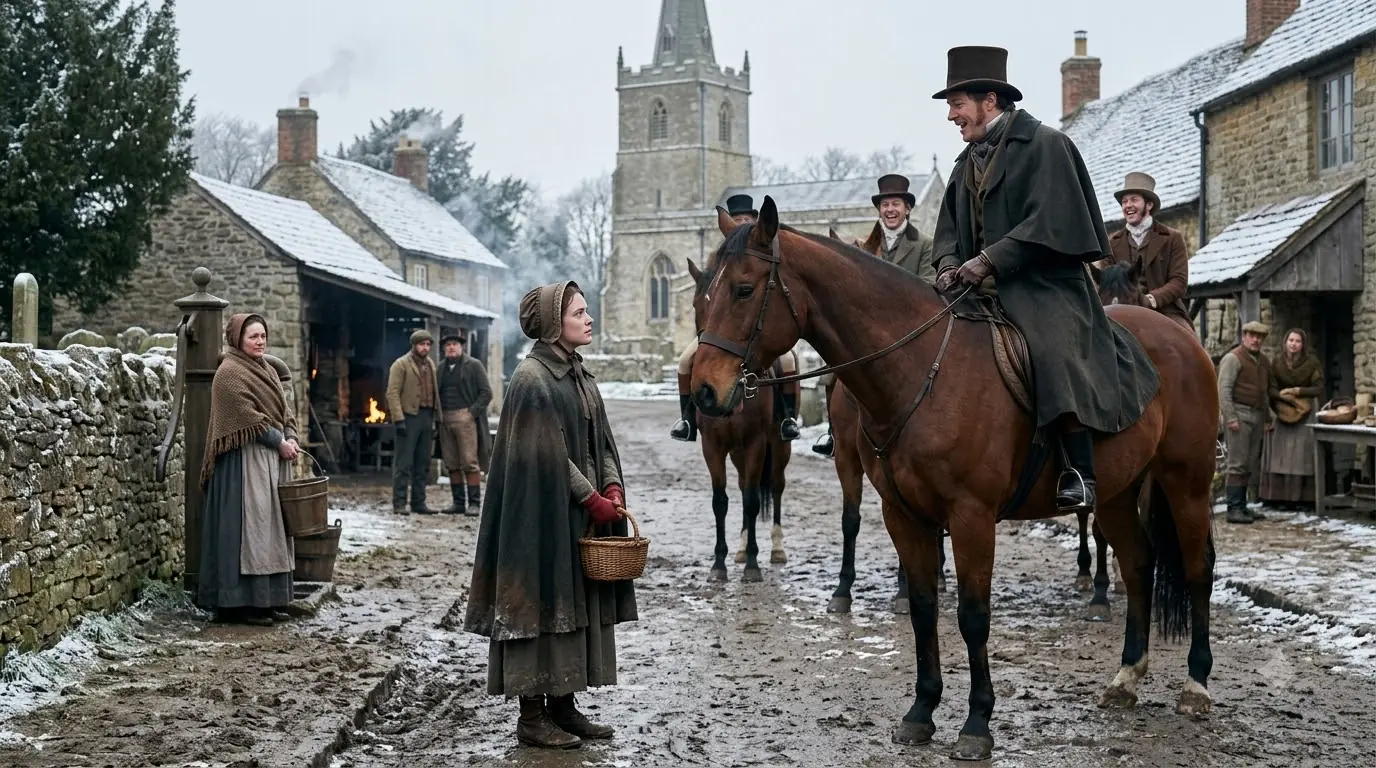
In the county of Merefield, in the cold tail of an 1847 winter, Mary Reed, one-and-twenty, was given the keys to a half-fallen keeper's cottage and a yard of neglected beehives the Duke of Merefield expected to sting her out before the first blossom. He thought it a fine joke. He thought her a small, quiet thing that would flee at the first swarm. But what the winter uncovered and what the spring proved after it turned the whole estate upon its axis.
The cart came into Merefield village in the gray hour before dusk, its wheels chattering against frozen ruts, and Mary Reed sat on the board with her hands folded flat in her lap, as if the folding of them were the only thing holding the rest of her together. Her wool cloak had gone thin at the shoulders. Her boots had been mended twice at the toe. In the wicker basket at her feet lay everything she still owned in the world: two dresses, her father's smoke bellows, a tin of dried chamomile, a wooden comb, and a small brass-cornered book she had not opened in 6 weeks.
Her father had been 3 months in the churchyard at Ashcombe. The bailiffs had taken the rest: bees, hives, honey house, cottage, the little orchard he had coaxed for 15 years—all of it swallowed to settle a debt she had not known he carried. She had walked out of that gate on a Tuesday morning with the basket in her hand and no place in the world to go. And it was only by the mercy of a distant cousin's letter and the Duke of Merefield's amusement that she had come here at all.
The village slid past her in slow smudges of slate and smoke. A woman drawing water at the pump paused to look. Two boys with a dog stopped their play. A man on the churchyard wall lowered his pipe and watched the cart go by with the unhurried curiosity of a place where nothing new happened between Christmas and Lent.
Mary kept her eyes forward. She had learned already that a bowed head invited neither pity nor question. And she wanted neither.
The driver, a broad man named Hollis, with a red nose and a kindness he tried to hide, cleared his throat as they crested the last rise. "Yonder," he murmured, nodding.
She looked. Below them, in a fold of the land where the hedgerows ran black against the last light, stood a low stone cottage with a sagging thatch. And beyond it, in a rough half-circle at the edge of a bare orchard, the pale humped shapes of a dozen or more straw skeps and box hives, half buried in bramble. Smoke did not rise from the chimney. No lamp burned in the window. The place had the settled look of something the world had already put down.
"That is the yard, then," Mary said.
"Aye," Hollis said. "That is the yard."
He did not add what everyone in Merefield already knew, which was that the last man to keep those bees had died there in the autumn of the year before. And that the Duke, in one of his loud humors at the Michaelmas rent dinner, had said before half the parish that he would give the cottage and the hives to the first fool who asked, and lay a wager the fool would not last till May.
Mary Reed had asked. The Duke had laughed until his eyes watered. And then he had signed the paper, because a duke who laughs before witnesses cannot easily un-laugh. And because he thought the sting of a hundred autumn bees would drive her back down the road within a fortnight.
She climbed down from the cart at the gate. Her boots sank into a rime of frozen mud. Hollis handed down the basket without meeting her eye. He had been paid to bring her only this far.
"There is wood in the lean-to, likely," he said. "If any is dry."
"Thank you."
"Miss Reed," he hesitated with the reins in his hand. "The Duke's steward will come round in a week to see if you are still here."
"I will be here."
He nodded once, the way a man nods at a thing he does not wish to argue with, and clucked the horse on.