The banker's pen stopped moving halfway through the signature line. He looked up at Alan Petroski across the desk, then down at the purchase agreement again.
$347,000 cash purchase. Hutchinson Implement Company: every building, every piece of inventory, every service bay, every parts bin, and the John Deere franchise itself.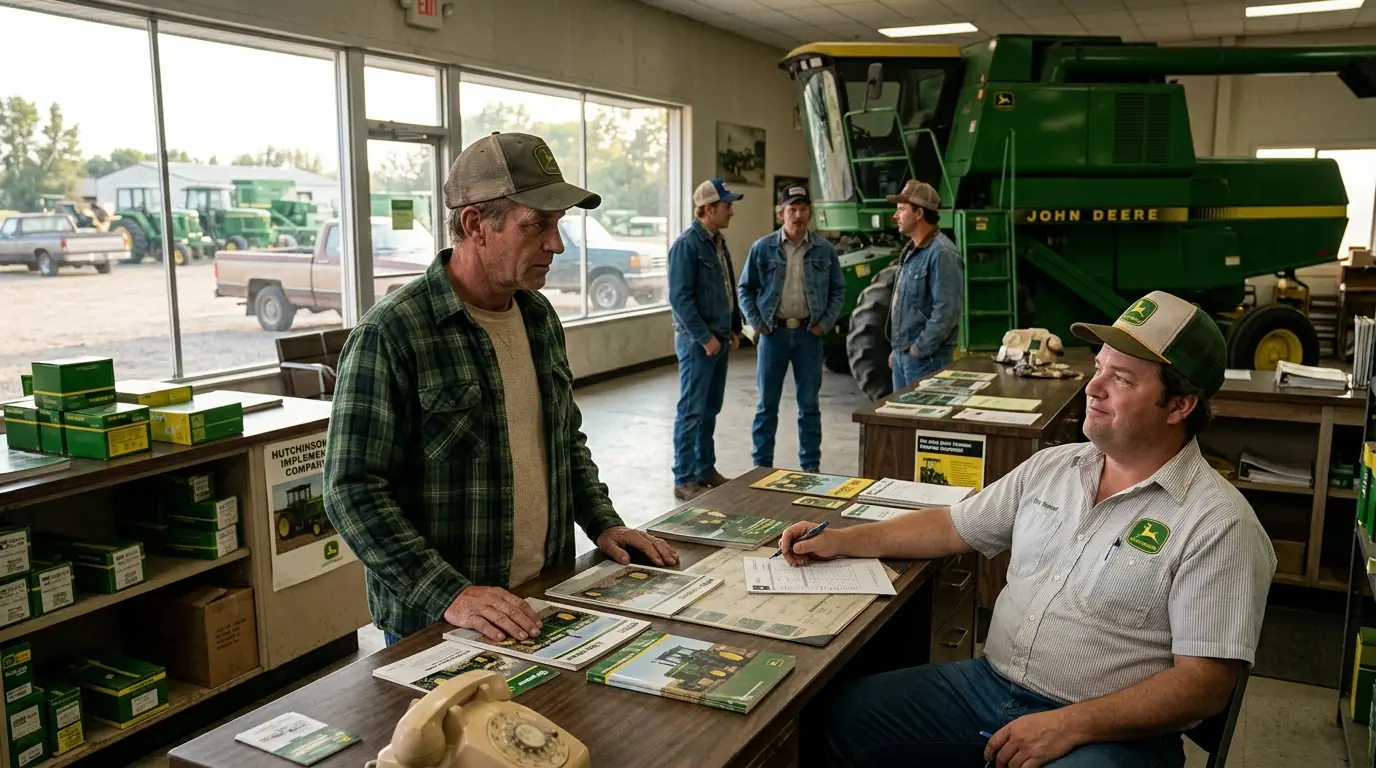
The buyer was a farmer from 10 miles outside town. The seller was the buyer's first cousin.
"Alan," the banker said quietly, "are you absolutely sure about this?"
Alan Petroski didn't answer right away. He was looking at the empty signature line where his cousin Rick's name would go. Rick Henning—the man who told him no 6 weeks earlier. The man who'd laughed at him in front of three other customers when Alan walked into the dealership and asked to order six new tractors for immediate delivery.
"I've never been more sure of anything in my life," Alan said.
The banker finished signing. It was October 14th, 1988. By the end of the day, Alan Petroski would own the only John Deere dealership in McLeod County, Minnesota, and his cousin Rick would be out of business.
This story is built on documented realities from 1988, a year when land prices had finally bottomed after seven years of collapse, when the farmers who survived were starting to see opportunities, and when agricultural equipment dealers were failing at rates that rivaled the farms themselves.
According to industry reports, over 200 John Deere dealerships closed or were consolidated between 1981 and 1989. The financial strategies, the equipment specifications, and the family tensions reflect what actually happened across the rural Midwest in the final years of the farm crisis.
Now, to where this really started—not in 1988, but 23 years earlier.
Alan Petroski and Rick Henning were born 3 months apart in 1952. Their mothers were sisters. Their fathers farmed adjoining sections in McLeod County: the Petroski place to the east, the Henning place to the west.
Growing up, the two boys were inseparable. They showed 4-H calves together, played on the same baseball team, learned to drive tractors on the same John Deere 4020. But they never really understood each other.
Rick was the one who always had the newest gear: newest baseball glove, newest shotgun. When he turned 16, his father bought him a three-year-old Chevy pickup. Rick wrecked it 6 months later and got a newer one.
When he graduated high school in 1970, his father sent him to the University of Minnesota—not to study agriculture, but to study business. Rick came back 2 years later with ideas about expansion, modernization, and leveraging opportunities.
Alan never went to college. He worked the home place with his father, saved every dollar he could, and married a school teacher named Janet in 1974. Janet kept teaching; her paycheck went straight into savings.
In 1976, Rick's father bought the John Deere dealership in Hutchinson. He was tired of farming, he said, tired of weather and markets and uncertainty. The dealership was steady income. Rick was 24 years old when his father handed him keys and told him it was his to run. Rick renamed it Hutchinson Implement Company and started ordering inventory like Deere was going to stop making tractors tomorrow.
That same year, Alan's father had a heart attack during harvest. He survived, but he couldn't farm anymore. Alan took over the family operation: 320 acres, all paid for, no debt. His father had made the last payment in 1968.
"You need to expand," Rick told him at Thanksgiving that year. "320 acres, Alan, that's nothing. You should be farming a thousand, two thousand. Land's cheap, interest rates are low, I can get you a deal on equipment."
Alan said no. He didn't need to expand; 320 was enough. Rick thought that was the most pathetic thing he'd ever heard.
The late '70s were good years for Rick. The dealership was selling tractors faster than Deere could ship them. Farmers were buying everything: new equipment, used equipment, parts, service. In 1978, Rick added a second building. In 1979, he added a third. He hired eight mechanics, three salesmen, and a full-time parts manager. He bought a new house in Hutchinson, a lake cabin near Brainerd, and a boat that cost more than most people's cars.
Alan was still farming 320, still driving a 1967 Ford pickup, still living in the farmhouse his grandfather had built in 1931. But he had no debt, and Janet was still teaching.
Then 1980 happened. Interest rates exploded. The prime rate hit 21.5% by December. Grain prices started falling. Land prices kept climbing for another year, but everyone could feel something breaking underneath.
Rick didn't slow down. He'd always operated on credit. That's how dealerships worked: you borrowed to buy inventory, sold the inventory, paid back the loan, borrowed again. The cycle worked as long as farmers kept buying.
In 1981, they stopped buying. Rick's inventory sat. The floor plan payments came due anyway. He borrowed more to cover them.
Alan watched all this from 10 miles away. He didn't expand. He didn't buy new equipment. In 1982, when land prices started dropping, he didn't sell. He just kept farming 320, kept his costs low, and watched the storm roll in.
By 1984, Rick's dealership was in trouble. Not failing yet, but stressed: too much inventory nobody wanted, too much credit extended to farmers who couldn't pay. The manufacturers were offering special financing to move equipment, but it was cutting margins to nothing. Rick's banker started asking questions.
At family gatherings, Rick stopped talking about expansion. He talked about how tough the equipment business had gotten, how farmers didn't appreciate quality anymore, how everyone wanted deals nobody could afford to give them. Alan mostly stayed quiet.
In 1985, Rick's banker made him consolidate loans, cut inventory, and let two mechanics go. Rick fought it, but he did it. The dealership survived, barely.
Alan's operation, meanwhile, was fine: 320 paid for, equipment old but functional, no debt except a small operating loan each spring that he paid off every fall, and Janet's teaching salary still covering their living expenses. They weren't getting rich, but they weren't drowning either.
Now, here's what happened in 1985 through 1987 in rural Minnesota: land values collapsed. According to USDA data, Minnesota farmland lost 40% of its peak value. Farmers who bought at the top or borrowed against inflated values were underwater. Foreclosures were constant.
But the flip side of that disaster was opportunity if you had cash.
Alan started buying land in 1986. Not much: 80 acres here, a quarter section there—land nobody else wanted because nobody else could get financing. He paid cash. Prices were so low he could afford it from 10 years of savings.
By 1988, Alan was farming 960 acres. All paid for. No debt.
Rick knew about this. The whole county knew. But Rick never asked Alan how he'd done it; pride wouldn't let him.
The drought of 1988 was severe. Across the Midwest, corn yields dropped by 40% in some areas. Soybeans weren't much better. But something else happened in 1988: prices rallied. The drought was bad enough that export buyers got nervous. Corn jumped to $3 a bushel; soybeans hit $9. If you had grain to sell, you made money that year.
Alan had grain. His land was paid for, so he could afford to store from the previous year. He sold at the peak. That fall, he cleared more profit than he'd made in the previous three years combined, and he decided he needed more equipment.
Alan walked into Hutchinson Implement on September 22nd, 1988. It was a Thursday morning. The dealership lot was half empty, not because they'd sold equipment, but because they didn't have much to sell.
Rick was in his office. Three other customers were looking at a used combine. Alan found Rick and told him what he wanted: six new tractors—two John Deere 4650s, three 4450s, one 4850—all with front-wheel assist, all with cab air conditioning, all to be delivered within 60 days so he could take advantage of year-end financing terms.
Rick stared at him. "Six tractors?"
"That's right."
"Alan, you farm 900 acres. Why do you need six tractors?"