Ten women stood shivering in the frontier mud, corsets tight, cheeks pinched pink. The trapper walked past the delicate ones, boots heavy on the boardwalk. He didn’t look at the fragile beauties. He pointed a scarred finger at the back of the line.
Give me the fat one. The mud in Oak Haven smelled like sulfur and horse urine. Hattie stood ankle-deep in it, the hem of her wool skirt heavy and dragging, soaking up the brown water like a sponge. Her back ached.
Her corset, laced three inches looser than what polite society dictated but still tight enough to bruise her lower ribs, felt like a cage of hot iron. She was sweating. It was November. The wind coming off the jagged eastern peaks carried the sharp bite of impending snow, but Hattie’s skin was slick beneath her heavy layers.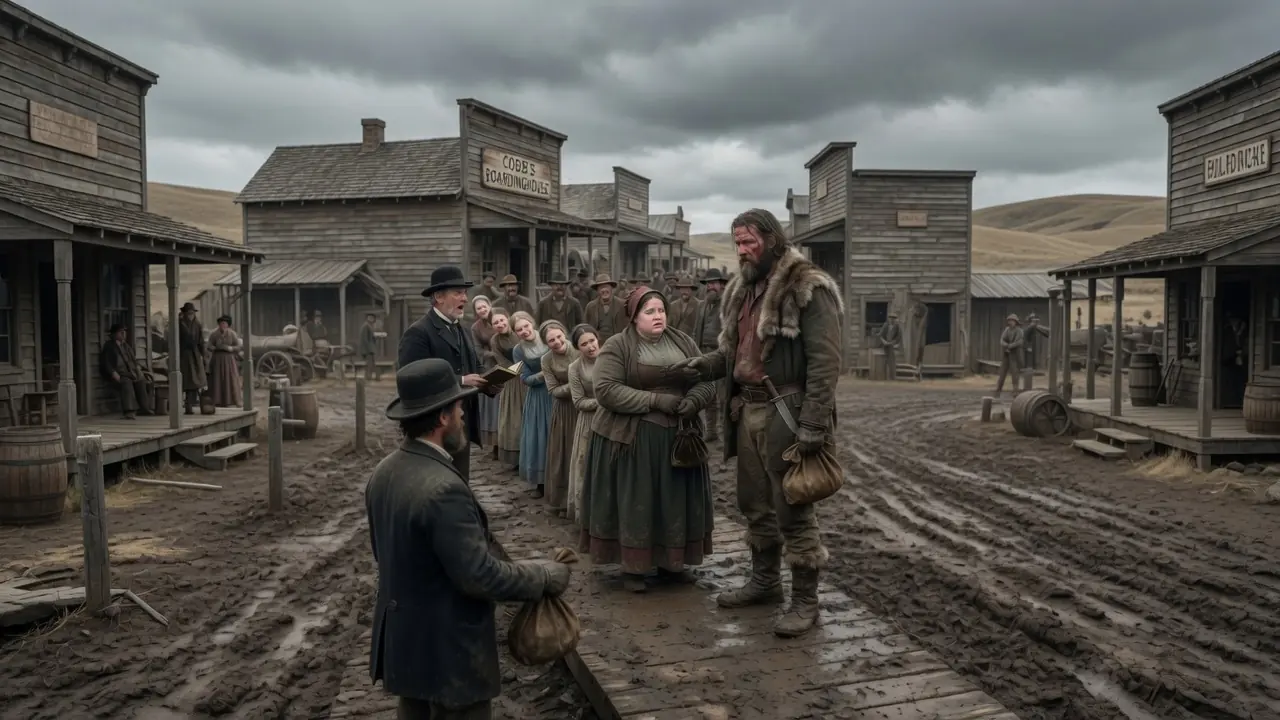
She was a big woman, substantial. Where the other nine women in the lineup trembled like wet sparrows, shivering in their thin cotton dresses and borrowed shawls, Hattie stood like a boulder. Her thighs rubbed together under her petticoats, chafed raw from the endless train ride, the jolting stagecoach, and now this miserable, humiliating parade. Mr. Cobb, the broker, paced in front of them, holding a leather-bound ledger.
He chewed on an unlit cigar, his breath a sour mix of coffee and rot. Stand straight, girls, Cobb muttered, tapping his pen against the paper. Miners are coming down from the ridge today, trappers, too. Got gold dust burning holes in their pockets and a long, cold winter ahead. Look lively.
Hattie didn’t look lively. She looked tired. At 28, she had buried her parents, sold the family’s bankrupt bakery in St. Louis, and faced the terrifying reality that a woman of her size, with no money and no prospects, was destined for the poorhouse. Mail-order bride. It was a desperate term for a desperate gamble.
She hadn’t expected romance. She had expected a roof, a stove, and perhaps a man who wouldn’t beat her. A commotion at the end of the muddy street drew Cobb’s attention. A man was walking toward the boardinghouse.
He didn’t walk so much as he consumed the ground beneath him. He was tall, broad across the shoulders, and wrapped in a coat made of mismatched, poorly cured furs. As he stepped onto the wooden boardwalk, the planks groaned. He carried the smell of the deep woods with him.
A sharp, pungent wave of pine pitch, wood smoke, and rancid bear fat. His hair was dark, threaded with premature gray, falling in greasy waves past his ears. A thick, untrimmed beard obscured his jaw. Hattie felt a sudden, heavy drop in her stomach.
This wasn’t a town merchant. This was a man who lived where the map turned blank. Judd Weaver, Cobb said, his tone shifting into something greasy and accommodating. Didn’t expect you down from the mountain before the freeze.
Judd stopped in front of the line. His eyes were a pale, washed-out blue, striking against the deep, wind-burned leather of his skin. He didn’t say a word to Cobb. He just stared at the women.
Next to Hattie, Lottie, a blonde girl barely 19 with a waist you could encircle with two hands, sucked in her breath and pushed her chest out trying to catch the trapper’s eye. Hattie just crossed her thick arms over her chest trying to ignore the damp cold seeping into her boots. She knew how this went. Men looked right past her.
His gaze moved past the frail, the pretty, the desperate. Then he stopped. He looked at Hattie. Really looked at her.
His eyes tracked the broad expanse of her shoulders, the thick curve of her hips barely contained by the heavy wool skirt, the fleshy roundness of her face flush with nervous heat. He didn’t look disgusted. He didn’t look amused. He looked at her the way a man inspects a heavy timber beam before trusting it to hold up a roof.
Hattie stiffened, her jaw setting into a hard line. Go on, she thought, a familiar cynicism bitter on her tongue. Make the joke. Make a comment about cattle.
Get it over with. Judd turned his head slightly toward Cobb. He didn’t point. He just nodded his chin in Hattie’s direction. Her.
Cobb blinked, pulling the cigar from his mouth. He looked at Hattie, then back at the mountain man. Her? Uh, Weaver, that’s Hattie.
She’s Well, she’s a sturdy worker, no doubt. But perhaps you’d prefer Lottie here. Younger, got a sweet disposition. I got 20 ounces of dust, Judd said.
His voice was like rocks grinding together at the bottom of a riverbed. Deep, unused to conversation. Give me the fat one. The silence on the boardwalk was absolute.
Someone down the line gasped. Lottie turned red. Hattie felt the blood drain from her face, only to rush back in a furious burning wave of humiliation and anger. The fat one.
It wasn’t a whisper behind her back. It wasn’t a polite euphemism like plump or robust. It was a blunt, ugly fact thrown out in the open air, heavy and undeniable. Hattie stepped forward.
The floorboards shrieked under her weight. She didn’t shrink. She looked up at Judd Weaver, meeting those washed-out blue eyes. I have a name, she said.
Her voice was steady, though her hands trembled slightly where she clutched her worn velvet reticule. Judd looked down at her. Up close, the smell of him was overwhelming. Iron, old blood, dirt, and raw humanity.
He noticed the tremor in her hands, then met her glare. Hattie, he repeated. It didn’t sound like an apology. It sounded like he was testing the weight of the word.
You got a coat, Hattie? I have what I’m wearing. He turned to Cobb and tossed a heavy leather pouch onto the broker’s ledger. It hit with a dull, solid thud. Contract now.
We lose the light in three hours. The wagon was a battered thing, hitched to two massive, ugly mules that looked as mean as the terrain they were built for. Hattie sat rigidly on the wooden bench. Every jolt of the iron-rimmed wheels over the rutted trail sent a shockwave up her spine.
She took up more than half the bench. Her hip pressed solidly against Judd’s thigh. She tried to pull herself inward, crossing her arms, tightening her shoulders, trying to minimize her footprint. It was a habit born of years apologizing for her size, but it was useless here.
There was nowhere to shrink to. Judd didn’t inch away. He sat with his legs planted wide, elbows resting loosely on his knees as he managed the reins. He didn’t seem bothered by the press of her flesh against his leg.
If anything, he leaned into it as the wagon swayed, using her solid weight to brace himself. They had been moving steadily uphill for two hours. The town of Oak Haven was gone, swallowed by the dense, towering pines. The temperature had plummeted.
The damp air had turned dry and biting, stinging Hattie’s cheeks and freezing the damp hem of her skirt into a stiff, icy ring around her ankles. She shivered. A violent, full-body tremor that rattled her teeth. Judd grunted. He reached behind the bench with one hand, blindly feeling around in the bed of the wagon. He dragged a massive, heavy hide forward and dropped it onto Hattie’s lap.
It was a buffalo robe. The underside was cured leather, supple and reeking of wood smoke and old dust. The top was thick, tangled brown wool. It must have weighed 20 pounds.
Wrap it, he said, not looking away from the mules. Hattie didn’t argue. She pulled the heavy hide up over her shoulders, burrowing into the rank animal warmth of it. The immediate relief was staggering.
The shivering subsided, replaced by a dull aching exhaustion. Where are we going? she asked. It was the first time either of them had spoken since leaving town. Cabin up the ridge.
Is it far? We’ll camp tonight. Make it by noon tomorrow. Hattie swallowed hard. Camp tonight.
Just the two of them in the sprawling terrifying emptiness of the woods. She looked at his hands on the reins. He was missing the top joint of his left thumb. A thick, raised scar ran across the back of his right hand, disappearing into his frayed canvas sleeve.
He was a violent man, or at least a man who lived a violent life. And she belonged to him. The paper in his saddlebag said so. By nightfall, the cold was absolute.
The woods were black, broken only by the eerie skeletal shapes of birch trees against the dark pines. Judd pulled the wagon into a small clearing sheltered by a massive rock outcropping. He didn’t ask her to help. He worked with a brutal, silent efficiency, unhitching the mules, hobbling them, striking a fire from a piece of flint and dry tinder he carried in a tin box.
Hattie sat on a stump near the growing flames, the buffalo robe still wrapped tightly around her. She felt useless, useless and large and in the way. Judd pulled a cast-iron skillet from the wagon along with a hunk of salted pork wrapped in waxed paper and a tin of beans. He sliced the pork with a hunting knife that looked sharp enough to split a hair.
The meat hit the hot iron with a violent sizzle. The smell hit Hattie’s stomach like a physical blow. She hadn’t eaten anything but a piece of stale bread in two days. Her stomach let out a loud, embarrassing groan.
Hattie clamped a hand over her abdomen, her face heating up. Judd didn’t look up. He stirred the beans into the fat. When it was bubbling and thick, he took a battered tin plate, scraped more than half the skillet onto it, and handed it to her along with a wooden spoon.
Hattie stared at the massive mound of food. In St. Louis, when she attended suppers, she would take tiny portions, chewing slowly, terrified that someone would see her eat a hearty meal and think, Well, no wonder she’s huge. She always ate later, in the dark, in the kitchen. She took the plate.
The heat warmed her numb fingers. She took a bite. The salt, the fat, the heavy starch of the beans, it was incredible. She tried to eat slowly, delicately, but she was starving.
Judd sat across the fire, eating straight from the skillet with his knife. He watched her. Hattie stopped chewing, suddenly hyper-aware of the grease on her lips, she lowered the spoon. What?
she snapped, the defensive wall slamming back into place. Am I eating your winter rations? Judd paused, the firelight catching the rough angles of his face. He chewed, swallowed, and wiped his mouth with the back of his hand.
You eat like you need it. Good. Hattie frowned, confused. Good skinny ones, he said, his voice dropping into that low, gravelly register. They peck at their food like birds.
Winter comes up here. The wind blows right through them. They get sick. They break. Ain’t no doctors for 60 miles.
He pointed the handle of his knife at her. You got insulation. You got meat on your bones. Means when the freeze sets in, you ain’t going to snap in half.
Hattie stared at him. The fire popped, sending a shower of orange sparks into the black sky. She searched his face for the mockery, for the cruel punchline she had braced herself for all her life. But there was none.
His eyes were flat, pragmatic. He was stating a fact about survival. Is that why you chose me? she asked, her voice quieter now, trembling slightly.
Because I’m fat? I chose you because you look like you got roots, Judd said simply. He set the skillet down. You look like you can hold your ground.
He stood up, grabbing an axe from the wagon to split more wood for the night. Hattie looked down at her plate. A strange, tight knot in her chest, one she hadn’t realized was there, began to loosen. She felt the heavy roll of stomach resting against her lap.
For 28 years, her body had been a source of shame, a failure of discipline, a target for disgust, but to the man splitting wood in the dark, it was an anchor. It was survival. She picked up the wooden spoon, scraped up a large bite of pork and beans, and ate it. She didn’t try to hide it.
She just ate. They reached the cabin just as the sky bruised purple. It sat tucked into the side of a granite ridge, a squat, ugly structure made of thick pine logs and daubed with dried mud. It didn’t look like a home.
It looked like a bunker built to withstand a siege. When Judd pushed the door open, the leather hinges shrieked. The air inside was dead, smelling of old ashes, mice, and stale tobacco. A single window, clouded with grease and dirt, let in the dying light.
Hattie stepped over the threshold. The floorboards were rough-hewn and uneven. In the corner sat a heavy cast-iron stove, rusted orange around the belly. A bed frame, built directly into the wall, was piled high with more animal skins.
There was a table, a single chair, and a washbasin. That was it. I’ll see to the mules, Judd said. The door clicked shut behind him.
Hattie stood in the center of the room. The silence of the mountain was total. It wasn’t the quiet of a sleeping city where a distant carriage or a barking dog reminded you that the world still turned. This was a heavy, suffocating silence.
It pressed against her eardrums. She set her reticule on the table. Her fingers were stiff. She didn’t weep.
She didn’t have the energy for it. Instead, she did the only thing she knew how to do when the world felt too large and her place in it too uncertain. She looked for work. She found a stiff bristle broom leaning near the stove. She swept.
She swept the dust, the dried mud, the dead pine needles. When Judd returned an hour later carrying her single battered trunk on one shoulder like it weighed nothing, the floor was clear. She had a fire going in the stove feeding it from a stack of split wood by the door. Judd dropped the trunk at the foot of the bed.
He looked at the floor, then at the fire. He didn’t offer a compliment, but he didn’t mock her either. He pulled off his heavy coat hanging it on a wooden peg. Underneath he wore a faded flannel shirt tight across his broad back.
Water barrels out back, he said. Takes a pickaxe to break the ice on top. I’ll haul it. I can haul water, Hattie said.
Her voice sounded too loud in the small room. Judd turned. He looked at her, his pale eyes tracking the sweat beating on her forehead, the soot smudged on her cheek. I know you can. Doesn’t mean you have to.
Night fell, bringing a cold so vicious it seemed to seep through the chinking in the logs. Hattie faced a new terrifying problem. The bed. She stood beside it, her hands nervously smoothing the coarse wool of her skirt. In St. Louis, her bed had been a massive reinforced thing.
When she stayed in boarding houses, the thin cots always groaned under her weight. Sometimes the slats snapped. The humiliation of a breaking bed was a fresh, raw scar in her memory. Judd was unlacing his boots.
He kicked them off and tossed a blanket onto the floor near the stove. Hattie frowned. What are you doing? Sleeping, he grunted, lying down and rolling his back to the fire. The contract?
Hattie started, her face burning. Mr. Cobb said— I know what Cobb said. Judd didn’t look back at her. I smell like mule and I snore. Bed’s yours.
Hattie stared at his broad back. Relief washed over her, hot and sudden, followed immediately by a sharp sting of rejection. He doesn’t want to share a bed with you. You take up too much room.
You’re too big. She turned away, unclasping her heavy skirt and letting it fall. She reached behind her back, her fingers finding the stiff, unforgiving laces of her corset. She yanked the knot loose.
The release of pressure was violently physical. She gasped as her ribs expanded, her lungs pulling in a full, deep breath for the first time in three days. The heavy flesh of her stomach and waist, bound tight for hours, spilled forward, finding its natural shape. She stripped down to her thick cotton chemise and climbed into the bed.
The ropes supporting the mattress groaned in protest. Hattie froze, squeezing her eyes shut, waiting for a comment from the floor. The cabin was silent. She shifted her weight.
The ropes creaked louder, a sharp whining sound. It holds, Judd’s voice came from the dark, gravelly and low. Built it myself. Oak pegs and ship rope.
You ain’t going to break it, Hattie. Go to sleep. Hattie lay there in the dark. She pressed her hand flat against her own stomach, feeling the soft, heavy curve of it under the chemise.
She listened to the wind howling against the logs. For the first time in her life, she felt the strange, terrifying sensation of being safe. Winter arrived not with a flurry, but with a hammer blow. For three weeks, the snow fell in a blinding, relentless sheet.
The world outside the cabin ceased to exist. They were trapped in a 10-by-10 box of heat, wood smoke, and the smell of each other. Hattie learned the rhythms of Judd Weaver. He wasn’t a talker.
He communicated in grunts, nods, and the occasional sharp gesture. But he watched. When she stood at the stove making biscuits from their dwindling flour supply, he watched the capable, steady movement of her thick arms. When she sat by the fire mending a tear in his coat, he watched the way the firelight caught the soft, round underside of her chin.
He didn’t make her feel small. He simply adjusted the space around her. When they passed each other in the cramped cabin, he didn’t flatten himself against the wall like she was an obstacle. He put a heavy hand on her waist to guide himself around her.
His touch was firm and grounded. It drove Hattie mad. She was waiting for the other shoe to drop. She was waiting for the joke, the cruelty, the exasperated sigh when she ate a second portion of stew.
It never came. On the 22nd day of the storm, the wind died down enough for Judd to check his traps on the lower ridge. He left at dawn. By mid-afternoon, the sky turned a bruised, ugly gray, and the snow started again, falling thick and wet.
Hattie paced the floor. She fed the stove until the iron belly glowed dull cherry red. By nightfall, panic had set into her chest like a cold stone. He was gone.
She was alone. Then the door smashed open. Judd stumbled in, bringing a swirl of violent white snow with him. He fell against the doorframe, his breath coming in ragged wet hitches.
Hattie rushed forward. He was covered in snow, his face the color of wet ash. His left arm hung completely useless at his side, the shoulder sloping at a grotesque, unnatural angle. Judd! She grabbed his good arm, pulling his heavy frame inside and slamming the door against the wind.
He collapsed onto the chair, groaning as the movement jarred his hanging arm. Ice, he gasped out, his teeth chattering uncontrollably. Slipped on the scree slope, grabbed a root, yanked the joint clean out. Hattie knelt beside him.
She touched his shoulder. Beneath the thick wool of his coat, the joint felt empty, the bone jutting sharply below the collarbone. I have to get your coat off, she said. Her hands were shaking, but her voice was steady.
She fetched her sewing shears and cut the heavy canvas and wool down the seam of the left sleeve, pulling it away from his ruined shoulder. He was sweating despite the freezing cold. The muscles in his neck were corded tight with agony. Needs resetting, Judd ground out, his eyes squeezed shut.
Ain’t going to go back on its own. Muscles are seizing. Tell me what to do. Judd opened his eyes.
They were hazy with pain, but focused squarely on her face. You got to pull it straight out, then up. It takes force, Hattie, a lot of force. A small woman couldn’t do it.
She’d just pull me off the chair. Hattie swallowed dryly. I’ll hurt you. You don’t do it, I lose the arm to rot, he rasped.
Put your boot against my ribs. Take my wrist. Lean back. Use your weight. Hattie stood up.
She looked at the massive, injured man. For a fraction of a second, the old voices hissed in her ears. Clumsy. Heavy. Cow. She pushed them down. She stepped close to him.
She placed her heavy, leather-soled boot squarely against his ribcage, right under his armpit. She grasped his thick wrist with both of her broad hands. Ready? she asked, her voice cracking. Pull.
Hattie didn’t just pull with her arms. She engaged her core, her thick thighs, the heavy, substantial mass of her body. She leaned back, putting every ounce of her 240 pounds against the leverage of his arm, Judd let out a raw animal scream. The resistance was incredible.
The muscles in his shoulder fought her, tight as steel cables. Hattie grunted, sweat stinging her eyes, her boots slipping slightly on the floorboards. She dug her heel in and pulled harder, shifting her center of gravity backward. There was a sickening wet thud.
The tension snapped. Hattie flew backward, landing hard on her backside against the floorboards. Judd slumped in the chair, panting wildly, his chin resting on his chest. His left shoulder was smooth and rounded again.
The bone was back in its socket. For a long moment, the only sound in the cabin was their ragged breathing, competing with the roar of the wind outside. Hattie scrambled up, her hands bruising from the grip. Judd?
Judd, are you He raised his good hand, waving her off while he caught his breath. Slowly, he rotated the left shoulder. He winced, a sharp hiss escaping his teeth, but the joint moved. God Almighty, he whispered.
He looked at her, sitting on the floor, her chemise soaked with sweat, her hair plastered to her neck. He slid off the chair, dropping to his knees on the rough floorboards in front of her. He reached out with his right hand. Hattie flinched instinctively, waiting to be pushed away, to be told to clean up, but his rough, calloused fingers didn’t shove her.
They landed squarely on the thick, soft curve of her waist. He didn’t pinch. He didn’t grab. He just rested his hand there, feeling the heat and the solid weight of her.
You’re a solid thing, Hattie, he murmured. The pain in his voice was fading, replaced by something heavier, darker. Hattie’s breath hitched. Don’t. Why?
Because it’s ugly, she whispered. The decades of shame finally breaking through her stoic shell. She looked down at her heavy thighs, her stomach pressing against the cotton of her shift. It’s ugly. Judd’s thumb moved, stroking a slow, deliberate line over the curve of her hip.
Ain’t nothing ugly about a woman who can anchor a man to the earth, he said. He leaned forward. He smelled of sweat, pine, and raw survival. He kissed her.
It wasn’t a delicate, polite peck. It was messy, their noses bumping, his beard scratching against her soft cheek. It was grounded. It was real.
Hattie didn’t shrink. She didn’t try to make herself small. For the first time, she reached out, wrapping her thick, capable arms around his neck, and let herself take up all the space she needed.