The hall was so quiet that even breathing felt like an interruption.
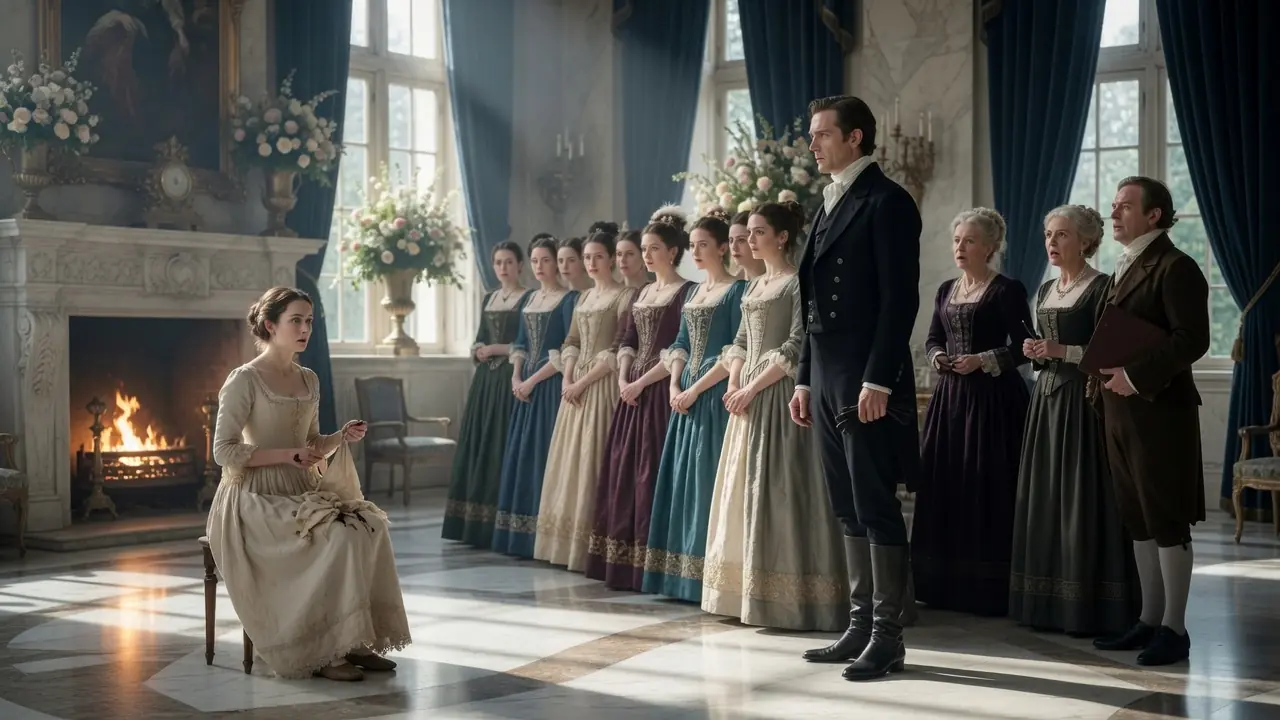
Ten women stood in a perfect line inside the grand receiving room of Ashvale Manor.
Each one of them had been chosen.
Each one had been dressed, powdered, and prepared by mothers who had not slept in three nights.
Their gowns were pressed.
Their smiles were practiced.
Their futures, they believed, were already decided.
Duke Calder Reinhardt walked in without announcement.
He did not look at the line right away.
He handed his gloves to the footman on his left, straightened the single silver button at his collar, and then turned slowly to face the women who had traveled from five different counties to stand before him.
His eyes moved, not quickly or impatiently.
He took his time, the way a man does when he is searching for something specific and already knows it is not where everyone expects it to be.
He passed the first woman, then the second.
The third gave a small curtsy, and he did not even pause.
By the seventh, the room had grown so tense that one of the chaperones near the back wall had pressed her handkerchief to her lips.
He stopped, but not in front of any of the ten women in the line.
He was looking past them, past the velvet drapes, past the flower arrangements that had cost a small fortune.
He was looking at the far corner of the room, where a young woman sat on a stool near the fireplace, her back slightly turned, her fingers holding a torn hem she had been quietly stitching before the duke walked in and forgot to leave.
She had not been introduced.
She was not on any list.
She was not wearing anything that marked her as a candidate.
Her dress was plain ivory, old at the cuffs, and slightly too short at the ankle.
Her hair was pinned, but not styled.
She had a small ink stain on her left thumb.
She did not look up immediately.
When she finally did, it was only because the silence had become too heavy to ignore.
She found the duke staring directly at her.
She looked behind herself to confirm he was not staring at the wall.
He was not.
His voice, when it came, was calm.
It was not loud.
It did not need to be.
“Give me the one they call useless.”
Nobody moved.
His secretary blinked.
The matchmaker dropped her pen.
The ten women in the line turned their heads in near unison toward the corner, then back at the duke, then back at the corner again.
The young woman with the ink stain slowly set down her needle.
“I beg your pardon?” the matchmaker finally said, her voice barely above a whisper.
“Your Grace, that is Miss Nora Vane. She is Lady Farrow’s niece. She was not presented. She is not a candidate. She is simply—”
“Bring her forward,” the duke said.
That was all.
And in that single moment, ten carefully arranged futures cracked open like porcelain dropped on stone.
Nobody in the receiving room of Ashvale Manor had expected the morning to go this way.
Lord Percival Dunn, the duke’s personal secretary, had prepared every detail of the selection with the kind of obsessive precision that had kept him employed for eleven years.
He had the names written in alphabetical order.
He had the family summaries bound in a leather folder.
He had even arranged the women by height to make the presentation more aesthetically pleasing, a decision he had spent twenty minutes debating with himself the night before.
None of that mattered now.
The duke had not looked at a single page of the folder.
He had not asked for names.
He had not requested family histories or dowry figures or the elaborate descriptions of temperament that Lady Farrow had personally submitted on behalf of each candidate, including a paragraph about one girl’s exceptional skill at watercolor painting, which Percival had thought was genuinely impressive.
The duke had pointed at the corner, and now Percival was standing very still, holding his leather folder against his chest like a shield, watching Miss Nora Vane rise slowly from her stool near the fireplace and look around the room with the expression of a person who suspects they may be the victim of a misunderstanding.
She was twenty-two.
Percival knew this because he had, out of habit, noted everyone present in the room when he first entered.
She was Lady Farrow’s niece on her late mother’s side, brought to Ashvale Manor not as a candidate but as an extra pair of hands.
Lady Farrow had three daughters in the selection.
Managing three nervous daughters required support.
Nora had been the support.
She mended things.
She fetched things.
She reminded people of appointments and smoothed over small disasters before they became large ones.
At the county assemblies back in Ketmore, where she was from, people generally treated her the way they treated useful furniture.
Present.
Appreciated in passing.
Never the subject of conversation.
She was not considered a beauty in any conventional sense.
Her features were soft rather than striking.
Her eyes were a warm brown that tended to look thoughtful when they should perhaps have looked delighted, and delighted when the situation called for solemnity.
She had a habit of tilting her head slightly when listening that made people feel heard whether they wanted to be or not.
She was also, at this precise moment, looking at Duke Calder Reinhardt with an expression that suggested she was about three seconds away from asking him if he had perhaps meant someone else.
The duke met her gaze and did not look away.
Lady Farrow moved first.
She was a tall woman with excellent posture and a voice like cut crystal, clear and capable of drawing blood.
She crossed the room in six quick strides and placed herself between Nora and the duke’s line of sight, which Percival felt was either extremely brave or extremely foolish, depending on how the next thirty seconds went.
“Your Grace,” Lady Farrow said, “I must respectfully clarify. My niece is here in a supporting capacity only. I have three daughters who were properly presented to your household through the correct channels.”
“Miss Clarissa Farrow is my eldest. She is accomplished, well-read, and has been praised by three separate music instructors for her talent at the pianoforte. Miss Delia Farrow has managed our household accounts since she was seventeen. Miss Tilda Farrow, my youngest, is considered by many in Ketmore to be among the loveliest young women of her generation.”
The duke let her finish.
He was polite in that particular way that powerful men sometimes are.
Not the kind of politeness that has anything to do with deference.
Everything to do with patience.
Then he said, “Where is Miss Vane from?”
Lady Farrow paused.
“Ketmore, Your Grace. As I said, she is my late sister’s daughter. She has no fortune, no establishment of her own, and no particular—”
“Ketmore,” the duke repeated, as though the name meant something to him.
Nora, who had been standing very still during this exchange, spoke then.
Her voice was quiet, but steady.
“Your Grace, I think Lady Farrow is right. I believe there may be some confusion. I was not presented. I am not on any list. I am here because my aunt needed help with her pins this morning, and the maid was busy.”
Several people in the room made small sounds, the kind of sounds that meant they were trying very hard not to react.
The duke looked at her.
“You repaired your aunt’s dress this morning?”
“Her brooch pin had come loose from the backing. It was a simple fix.”
“And the hem you were working on when I entered?”
“Miss Tilda’s, Your Grace. She caught it on a chair leg in the carriage.”
“So you came to Ashvale Manor to mend things?”
Nora’s chin lifted just slightly.
“I came to be useful.”
The duke was quiet for a moment.
Something moved behind his eyes, but Percival could not name what it was.
He had worked for this man for eleven years and had learned to read most of his silences.
This one he could not place.
“Clear the room,” the duke said.
That caused more immediate chaos than the first declaration had.
Lady Farrow inhaled sharply.
The matchmaker, a stout woman named Mrs. Corbett, who had been arranging noble marriages for thirty years and had never once been dismissed from a room mid-selection, pressed her hand to her chest.
The ten candidates stirred like a flock of birds, uncertain whether to land or fly.
“Your Grace,” Mrs. Corbett said, her voice carrying the weight of considerable professional indignation, “a private meeting with an unpresented young woman would be highly irregular. Without a chaperone present, it would be, frankly, scandalous.”
“Then stay,” the duke said to her. “Everyone else, leave.”
Mrs. Corbett blinked.
She had not expected to be the one he kept.
Lady Farrow looked at Nora with an expression that was equal parts fury and calculation.
Nora gave her aunt a small, helpless look that said she was as confused by this as anyone.
Lady Farrow pressed her lips together.
She gathered her three daughters with a single sweeping gesture and led them out of the room with the composure of a woman who intended to speak at length about this later in private.
The other families followed.
There were murmurs.
There were whispers sharp enough to cut.
Percival caught pieces of them as he moved toward the door.
“Not even a candidate.”
“Lady Farrow will be furious for a month.”
“Who is she? Does anyone actually know her?”
“The duke has lost his mind entirely.”
Percival lingered near the door until the duke gave him a single look, and then he too stepped out and pulled the heavy doors closed behind him.
Inside the receiving room, it was now just the duke, Mrs. Corbett seated rigidly in a chair near the window as though her spine had been replaced with iron, and Nora Vane standing in the middle of the floor with her hands folded in front of her and the faint ink stain still visible on her left thumb.
The fire crackled.
Outside, the first carriages were already being called around because several of the families had apparently decided that waiting for an unclear outcome was beneath their dignity.
Nora spoke first because the silence had gone on long enough, and she had never been good at pretending not to notice things.
“Your Grace, I would genuinely like to understand what is happening.”
“Sit down, Miss Vane.”
“I would rather stand, if it is all the same.”
He looked at her again, and for a moment, something that might have been amusement crossed his face, though it was gone before she could confirm it.
Duke Calder Reinhardt was thirty-one years old.
He had inherited the dukedom at twenty-three after his father died of a sudden fever that had taken three physicians completely by surprise.
He had spent the years since then managing an estate that was vast and complicated, a seat in the House of Lords that demanded regular attendance, and a reputation that had taken on its own momentum entirely separate from anything he actually did or said.
He was considered handsome by most people and intimidating by everyone.
He was not unkind, but he was direct in a way that unsettled people who preferred softness in their conversations.
He had been engaged once, briefly, at twenty-five, to a woman named Lady Petra Colen, who had broken the engagement herself six months in without ever fully explaining why.
Society had speculated.
Calder had not.
He had not seriously pursued marriage since.
His grandmother, the Dowager Duchess Heloise Reinhardt, had finally reached the end of her patience earlier that year and arranged this selection herself, calling in favors and issuing invitations with the cheerful aggression of a general preparing for battle.
She had expected him to cooperate.
He had agreed to attend.
That was all he had technically promised.
“Your name was mentioned to me once,” he said now, looking at Nora. “Seven months ago, at the Kettermere Autumn Assembly. Do you remember that evening?”
Nora was quiet for a moment, thinking.
“I was there,” she said carefully.
“There was a situation with a horse. One of the attendants had tethered three of the guests’ horses too close together, and they had become tangled and frightened. Most people stepped back. You went forward.”
She remembered.
The horses had been close to panicking.
The knots had been ridiculous.
She had simply done what needed doing because no one else was moving fast enough.
“A groom dealt with them,” she said.
“After you had already calmed the nearest one and untangled the leads. My man Silas was watching from the gate. He mentioned it in his report of the evening.”
He paused.
“He described you as the only person who moved toward the problem instead of away from it. He also mentioned that two separate guests thanked the groom afterward, and no one thanked you.”
Nora said nothing.
“He called you useful,” the duke said. “Which is how I came to know your name. And when I arrived today and looked at the room, I heard two women near the back of the line refer to you by a different description.”
“One of them said, ‘She is only Farrow’s useless niece. She is not worth worrying about.’ The other agreed.”
The fire popped.
Mrs. Corbett was so still she appeared to have briefly stopped breathing.
“I found that interesting,” the duke said. “That the person my man called useful was the same person those women called useless. I wanted to know which of them was right.”
Nora looked at him for a long moment.
“And is this the manner in which you intend to find out? By summoning me in front of everyone and clearing a room?”
“Would you have preferred I send a letter?”
“I would have preferred,” she said, “not to be the subject of a scene that will follow me for the rest of the season and possibly the rest of my life.”
He was quiet.
Then he said, “Fair.”
She had not expected him to say that.
“I apologize for the manner,” he said. “Not for the intent.”
Nora unfolded her hands and looked down at the ink stain on her thumb.
She rubbed at it absently.
It did not come off.
It never did.
Not until she scrubbed it properly with soap and water.
She had gotten it earlier that morning copying out a list of names for Mrs. Corbett, because Mrs. Corbett’s own handwriting was difficult to read and she had asked Nora to make a clean copy, which Nora had done because Nora did things that needed doing.
“What exactly do you want, Your Grace?” she asked.
He looked at her steadily.
“I want to speak with you again. Not here, not like this, but properly over the course of the next few days while the other selection candidates are still in residence.”
“You still intend to meet with the other women?”
“My grandmother arranged this selection. I will not insult her by abandoning it entirely.”
“But you want to speak with me separately.”
“Yes.”
Nora looked at the window.
Through it, she could see part of the gravel drive, and on the drive, she could see two carriages already loaded and preparing to depart.
In one of them, she was fairly certain, were Lady Barton’s daughters, who had traveled from two counties away specifically for this selection.
Lady Barton had spent money on new gowns for both of them.
She thought about her aunt.
Lady Farrow was going to be impossible for the rest of the week.
Her three cousins were going to be watching Nora with a mixture of resentment and bewilderment that would make every shared meal deeply uncomfortable.
Mrs. Corbett was going to tell this story to every hostess she knew within the fortnight.
“All right,” Nora said.
The duke raised an eyebrow, just slightly.
He had perhaps expected more resistance.
“I have conditions,” she added.
“Of course you do.”
“Whatever conversations we have, they are private and not announced. I will not be paraded or presented or pointed at again. If you decide that your interest was a mistake, you end it quietly, and I leave without any fuss.”
“Agreed.”
“And,” she said, “you do not tell my aunt about any of this until you have decided something definitive. She will make my life extremely complicated if she thinks there is something to hope for.”
He almost smiled.
It was the closest thing to a smile she had seen on his face.
“Agreed.”
Mrs. Corbett cleared her throat very pointedly from her chair near the window.
“Thank you, Mrs. Corbett,” the duke said without looking at her.
Mrs. Corbett stood, smoothed her skirts, and crossed to the door with the dignity of a woman who had survived thirty years of this industry and intended to survive thirty more.
She paused at the threshold.
“I will note,” she said to the air rather than to either of them, “that this is the most irregular selection I have ever conducted in my professional life.”
Then she walked out.
The doors fell closed again.
Nora and the duke were alone for approximately four seconds before Percival knocked and opened the door, clipboard in hand, expression carefully neutral.
“Your Grace,” Percival said, “Lady Dunmore has sent word that her daughter, Lady Fern, wishes it known she is withdrawing from the selection. Lady Vickers has submitted a written objection through her solicitor, which I suspect is a first. And your grandmother has arrived.”
Calder stood.
“Which is the most urgent problem?”
“Your grandmother,” Percival said without hesitation.
Nora turned back toward the fireplace and picked up her needle and thread from the stool where she had left them.
She had not finished Tilda’s hem.
The duke paused at the door.
“Miss Vane?”
She looked up.
“Tomorrow morning. The East Garden, before breakfast,” he said, the way he said most things, plainly and without decoration. “If you choose to come.”
He walked out.
Nora sat down on the stool and looked at the fire for a moment.
Then she picked up the hem and began stitching again.
But outside in the hallway, the sound of the Dowager Duchess Heloise Reinhardt’s arrival could be heard clearly through two closed doors.
Her voice was not loud.
It was simply the kind of voice that traveled.
“Calder,” the dowager was saying, in the tone of a woman who had raised a duke and intended to remind him of that fact. “I have just been told by Lady Farrow in the entrance hall, while removing my traveling coat, that you rejected ten presented candidates in favor of a girl with an ink stain on her hand who was there to fix a hem. Tell me this is not accurate.”
There was a pause.
“It is mostly accurate,” the duke’s voice said.
The dowager’s silence was somehow louder than her speaking.
Nora pressed her lips together and kept her eyes on the stitching.
The fire in the hearth shifted, throwing warm light across the plain ivory of her dress, across the careful, even stitches, across the ink that would not wash off her thumb.
Somewhere above her, in the beautiful, impossible rooms of Ashvale Manor, ten families were rearranging their plans.
A grandmother was drawing breath for what was sure to be a significant conversation.
A secretary was updating a list that no longer reflected any recognizable reality.
And a duke who had walked past ten prepared women to point at a corner was now standing somewhere down that long hallway, deciding, for reasons that had not yet been fully named, what he actually wanted.
Nora tied off her thread and snipped it.
She held up Tilda’s hem and checked it against the light.
The stitching was invisible.
It would hold.
She folded it neatly over her arm, stood up, and walked quietly out of the receiving room, down the side corridor that the staff used, and up to the room she shared with her cousin Tilda on the second floor.
Tilda was sitting on the bed when Nora entered.
She was seventeen and sharp-eyed, and had her mother’s forehead and her father’s mouth and a great deal more intelligence than people generally gave her credit for.
She looked at Nora with the focused intensity of someone who had been waiting.
“Tell me everything,” Tilda said.
“Your hem is fixed,” Nora said, and set it on the chair by the wardrobe.
“Nora.”
“I do not know anything yet,” Nora said honestly.
She sat down in the chair by the window and looked out at the garden below.
From here, she could see a portion of the East Garden, the part with the low stone wall and the climbing roses that had gone dormant for winter, with their bare stems curling upward against the pale stone.
“Mother is furious,” Tilda said.
“I know.”
“Clarissa is crying. Not sad crying, angry crying. There is a difference, and it is important.”
“I know that too.”
“Delia has not cried, but she has gone very quiet, which is worse.”
Tilda paused.
“I am not angry at you. I want you to know that.”
Nora looked at her cousin.
Tilda was the youngest and, in some ways, the most honest of the three.
She was also the one who had, on more than one occasion over the past three years, told Nora quietly and without cruelty that she deserved more than she was getting.
“Thank you,” Nora said.
“Do you like him?” Tilda asked.
Nora thought about the duke’s face when he had looked at the corner.
The way he had said bring her forward.
The particular quality of his voice when he said fair.
“Oh, I do not know him,” she said.
“That is not what I asked.”
Nora turned back to the window.
“I do not know,” she said.
Which was honest.
Which was the only thing she had at this exact moment to offer.
The East Garden was quiet in the pale light below.
She would decide in the morning whether to go.
The East Garden was cold at that hour.
Frost still clung to the stone wall when Nora arrived, her breath forming small clouds in the morning air.
She had woken before her cousins, dressed quickly in her warmest day dress, a deep green wool that had belonged to her mother and had been altered twice to fit her changing shape over the years.
She had told herself on the way down the stairs that she was simply going for a walk, that she happened to be walking in the direction of the East Garden, that this was not a decision so much as a direction.
Well, she was not very convincing, even to herself.
He was already there.
The duke stood near the low stone wall with a cup of something steaming in his hand, looking out at the bare rose stems with the expression of a man who had been awake for some time and was comfortable with that.
He had dressed simply, no formal coat, just dark trousers and a charcoal waistcoat over a white shirt.
And he looked more like a person than he had the day before in the receiving room.
Less like a title.
He turned when he heard her footsteps on the gravel path.
“You came,” he said.
“I told myself I was just taking a walk,” she said.
“And?”
“And I am clearly a poor liar.”
She stopped a few feet away from him and looked at the garden.
It was not beautiful in winter.
It was bare and still and a little stark.
But there was something honest about it, she thought.
Nothing performing.
Nothing pretending to be more than it was.
“How long have you been out here?”
“Since before the birds started.”
He offered her the cup.
She looked at it.
“That is your cup.”
“I have not drunk from it yet. I had it brought out and then forgot about it while I was thinking.”
She took it.
It was tea, nearly perfect temperature, which meant the timing of his thinking had been accidental rather than planned.
She drank a small amount and handed it back.
“What were you thinking about?” she asked.
“Yesterday,” he said. “Specifically the look on Mrs. Corbett’s face when I asked everyone to leave.”
Nora almost smiled.
“She is going to write about this in her professional memoirs.”
“She keeps memoirs?”
“Every matchmaker keeps memoirs. It is how they survive the occupation.”
She pulled her shawl tighter and looked at the stone wall.
“Your Grace, I want to ask you something directly.”
“All right.”
“Yesterday was dramatic and surprising, and I understand there was a logic to it, even if the execution was startling. But I need to understand what you are actually proposing. Not in the grand gesture version. In the plain version.”
He was quiet for a moment.
Then he said, “I want to spend the next few days speaking with you honestly. Not in a formal setting with a chaperone taking notes and a matchmaker hovering with a clipboard. Just talking. And at the end of those days, I want to know whether what I think I already know about you is real, or whether I have built something in my imagination that does not exist.”
“What do you think you know about me?”
He looked at her directly.
“That you are the kind of person who moves toward problems. That you do not require applause for it. That you are honest, even when honesty is inconvenient. And that you have been standing in other people’s shadows for long enough that you have started to believe the shadow is your natural size.”
Nora went very still.
The birds had started by now.
Small sounds in the bare branches of the trees along the garden wall.
The frost was beginning to soften in the growing light.
“That is a great deal to conclude from a horse incident and an ink stain,” she said, and her voice was careful.
“It is,” he agreed. “Which is why I want to find out if I am right.”
She looked at him for a moment.
His face was steady.
Not demanding.
Not performing.
Just waiting.
“I will give you three days,” she said. “After that, you will have enough to decide. And I will have enough to decide as well. Because this is not one-sided, Your Grace. I need to know things about you too.”
He raised an eyebrow.
“Such as?”
“Why Lady Petra Colen ended your engagement. What actually happened? Not the version society tells, which has at least four variations depending on who is telling it.”
Something shifted in his expression.
Not pain, exactly.
But a kind of careful stillness.
“You would ask me that directly?”
“I told you I was a poor liar. I am also a poor pretender. I do not want to spend three days dancing around the things that actually matter.”
He looked at her for a long moment.
“She ended it,” he said finally. “Because I was not present. Not physically. I attended every dinner, every event, every required occasion. But she said I was never actually there. Or that she felt she was engaged to a title and a set of obligations, and not to a person.”
He paused.
“She was not wrong.”
Nora said nothing.
She let the words settle where they landed.
“I have spent seven years since then trying to determine whether that is something that can be changed,” he said, “or whether it is simply what I am.”
“And have you decided?”
“Not yet,” he said. “But I am more interested in the question than I was before.”
The morning light had strengthened by now.
Inside the manor, they could both hear the distant sounds of the house waking.
Doors opening.
The clatter of breakfast being prepared.
Voices in the upper corridors.
Nora handed him back his now empty cup.
“Tomorrow morning,” she said.
“Tomorrow morning,” he agreed.
She turned to walk back up the path.
Then she stopped.
Without turning around, she said, “And for what it is worth, I do not think it is simply what you are. I think it is what you practiced because no one ever asked you to practice anything else.”
She walked back up toward the house.
Behind her, the duke stood holding the empty cup and looking at the place where she had been standing for a considerable while before he went back inside himself.
What neither of them saw was the figure standing at the upper window of the East Wing.
Lady Mirabelle Dunmore was twenty-four years old, the daughter of the Earl of Dunmore, and she had been considered the frontrunner of the entire selection by every person who had an opinion on the matter, which in social circles of this kind was everyone.
She was elegant.
She was well-connected.
She had red-gold hair and a speaking voice that music instructors had described as naturally musical.
And she had also already mentally chosen the furniture she intended to move when she became the Duchess of Ashvale.
She watched Nora walk back up the path toward the house.
She watched the duke stand by the stone wall for a long moment before following.
Then she turned from the window and sat down at the small writing desk in her room and picked up her pen.
She wrote two letters before breakfast.
The first went to her mother, Lady Dunmore, who was staying at a townhouse three miles away because the manor could not accommodate all the families of the candidates.
The second went to Lord Harwick Fenn, Lady Mirabelle’s cousin, who was also quietly and without announcement one of the most effective collectors of damaging information in three counties.
He knew things about people.
He found things out.
He had never once been thanked publicly for it, but he had been very well compensated privately.
The letter to Lord Harwick was short.
It said, “Find everything there is to find about Miss Nora of Ketmore. I want to know by Thursday.”
She sealed both letters and handed them to her personal maid, a quiet girl named Agnes, with instructions to have them dispatched before eight.
Then she went down to breakfast with a perfectly composed expression and complimented the Dowager Duchess Heloise on the quality of the eggs.
Breakfast at Ashvale Manor on the second morning of the selection was an exercise in sustained performance.
The dining room was large enough to seat twenty comfortably.
That morning, it held twelve, counting family members who had stayed as guests and the candidates who remained.
Four families had departed the day before, their withdrawals ranging from quietly dignified to loudly offended, depending on temperament.
Six candidates remained.
Lady Mirabelle Dunmore sat at the middle of the long table and smiled at everything.
This was, Nora had begun to understand, her primary strategy.
She smiled at the footman.
She smiled at the weather through the window.
She smiled at Nora in a way that felt like being handed a flower with thorns still on the stem.
“Miss Vane,” Lady Mirabelle said, reaching for the toast rack, “how are you finding Ashvale Manor? I imagine it must be quite different from what you are used to in Ketmore.”
The table shifted almost imperceptibly.
Several faces turned.
“It is a beautiful house,” Nora said simply.
“Of course it is,” Lady Mirabelle agreed warmly. “Though I imagine the scale must be somewhat overwhelming. Ketmore is a very modest county. My mother says the whole of it could fit inside one of the Dunmore estate’s east-facing fields.”
She laughed gently, as though this were a charming observation rather than a precise social cut.
Lady Farrow, seated beside Nora, said nothing.
This was notable because Lady Farrow was not generally a woman who said nothing.
She was saying nothing now because she was furious at Nora and was therefore not inclined to defend her.
Clarissa Farrow, the eldest, stirred her porridge with the focused energy of a woman channeling considerable emotion into a small domestic task.
Delia Farrow, the middle daughter, was reading a letter that had arrived with the morning post and appeared to find it more interesting than the conversation.
Tilda sat beside Nora and kicked her gently under the table, which was Tilda’s way of saying, I see what is happening, and I am with you.
Nora looked at Lady Mirabelle and said pleasantly, “I have always found that the size of a place has very little to do with how much happens in it. Some of the most interesting things I have ever seen have happened in very small rooms.”
Lady Mirabelle smiled again.
“How true.”
She did not look remotely troubled.
At the head of the table, the Dowager Duchess Heloise ate her breakfast with the focused attention of a woman storing information.
She was seventy-one, small in stature, white-haired, and possessed of the kind of social intelligence that had nothing to do with education and everything to do with a lifetime of watching people.
She had said very little since her arrival the day before.
She had also, as Nora had noticed, been watching very carefully.
The duke was not at breakfast.
Percival had delivered his apologies, citing an early meeting with his estate manager regarding the Northfield drainage situation, which Percival had described with the specific detail of someone who had been asked to make the excuse sound real.
Lord Cecil Barton arrived at breakfast late, which he did every morning, and took his usual seat at the far end of the table with the easy confidence of a man who considered punctuality optional.
He was thirty-five, the eldest son of the Barton family, and he had accompanied his younger sister, Lady Gwen, to the selection as her escort, since their father was unwell and their mother had stayed home to manage him.
He was charming in the specific way that required no particular effort, and good-looking in a conventional arrangement of features.
And Nora had decided over the past two days that he was approximately as deep as a decorative dish.
“Lively morning,” he said, surveying the table. “I passed three carriages on the drive yesterday. Half the candidates have fled already. Exciting stuff.”
He reached for the coffee.
“Miss Vane, you are the talk of the county, I understand.”
“Lord Barton,” Lady Dunmore’s voice came from across the table, sharp and bright. “Perhaps we might discuss something other than yesterday’s events.”
“Why? It is the most interesting thing that has happened all week.”
He looked at Nora with genuine curiosity rather than hostility.
“Did you actually not know he was going to do that?”
“I had no idea,” Nora said.
“Remarkable.”
He considered this.
“My sister Gwen would have fainted. Gwen, you would have fainted.”
Lady Gwen Barton, seated beside him, was nineteen and had the appearance of someone who spent a great deal of energy trying to look unbothered.
“I would not have fainted,” she said. “I would have sat down. There is a difference.”
This produced a small wave of genuine laughter around the table, which broke some of the tension, though not all of it.
Nora got through the rest of breakfast by keeping her eyes on her plate and her responses short.
When it was over, she excused herself and went to the library on the second floor, which she had discovered the day before was the one room in the manor where she was unlikely to be found by anyone who was looking for her.
She had been there approximately twenty minutes, reading without actually absorbing any of the words, when the door opened and the Dowager Duchess Heloise walked in.
Nora stood.
“Sit down,” the dowager said with a wave that suggested standing was unnecessary.
She moved through the library with the unhurried ease of someone who had been walking through this room for fifty years, which she had.
She settled into one of the two leather chairs near the window and looked at Nora with clear, sharp eyes.
“You did not come here expecting any of this,” the dowager said.
It was not a question.
“No,” Nora said.
“And you are not sure what to make of my grandson.”
“I am still deciding.”
The dowager made a small sound that might have been approval.
“Good. Anyone who was sure of Calder within twenty-four hours would concern me.”
She looked at her hands briefly.
“I arranged this selection because he needed to be pushed. He would not push himself. He is very good at managing things and very reluctant to want things. Do you understand the difference?”
“I think so.”
“Managing is safe,” the dowager said. “Wanting is not.”
She looked at Nora directly.
“He has not looked at a room that way in eleven years. Not since before his father died and the weight of all this fell on him. I do not know what he saw when he looked at that corner. But I know what he looked like when he saw it. And I know what I want for him.”
She paused.
“I am telling you this not to pressure you. I am telling you because you deserve to know the full picture.”
Nora looked at the older woman.
There was no performance in the dowager’s face.
No campaign.
Just a grandmother who had been watching her grandson manage and manage and manage for eight years and wanted something different for him.
“Lady Mirabelle wrote two letters this morning before breakfast,” the dowager said in a different tone entirely.
Nora blinked.
“How do you know that?”
“Because I have lived in this house for fifty years, and the staff tell me things.”
The dowager’s eyes held something sharp and unamused.
“One went to her mother. One went to Lord Harwick Fenn. If that name means nothing to you, it should. He is her cousin, and he is not a kind man when he is given a task.”
Nora felt something cold settle in her chest.
“I am not telling you this to frighten you,” the dowager said. “I am telling you because what is coming will be designed to make you look small and unworthy. And I want you to know in advance that it is coming so that when it arrives, you do not mistake it for truth.”
She stood, smoothed her skirts, and walked toward the door.
At the threshold, she paused.
“My grandson chose a corner over a lineup,” she said. “That tells you something about what he values. Make sure you know what you value too before this week is finished.”
She left.
The library was very quiet.
Nora put down the book she had never actually been reading and looked out the window at the East Garden below.
The frost from the morning had gone entirely.
The bare rose stems caught the winter light and held it.
She thought about Lord Harwick Fenn and two letters sent before eight in the morning.
And she thought about the duke standing by the stone wall with an empty cup, saying he was more interested in the question than he had been before.
She decided she was not going to be frightened off.
Then she went to find Tilda, because whatever was coming, she wanted at least one person in the house on her side who knew the full truth.
Tilda was in the upstairs sitting room pretending to embroider while actually watching the front drive through the window with great strategic interest.
When Nora sat down beside her and told her everything, including the dowager’s warning, Tilda set down her embroidery and looked at her with calm, serious eyes.
“Right,” Tilda said. “Then we need to be smarter than Mirabelle before Thursday.”
“We are not plotting anything,” Nora said.
“We are not plotting,” Tilda agreed. “We are preparing. There is a meaningful difference.”
Outside, the winter light shifted.
On the drive below, a rider on a dark horse turned in through the manor gates, moving at a pace that suggested his errand was urgent.
Tilda watched him with narrowed eyes.
“But who is that?”
Neither of them knew yet.
The rider’s name was Thomas Greave.
He was Lord Harwick Fenn’s personal messenger, and he had ridden hard from the town of Coldwick, twelve miles east, with a sealed document that he delivered directly into the hands of Lord Harwick, who had arrived at Ashvale Manor that same afternoon under the pretense of visiting his cousin, Lady Mirabelle, during the selection week.
Nobody had objected to his arrival.
He was a lord.
He had a reasonable excuse.
He smiled at everyone and made easy conversation over afternoon tea and left the impression of a man with nothing particular on his mind.
Nora saw him for the first time in the front sitting room when she came down with Tilda at four.
He was standing near the fireplace with a cup in his hand, talking to Lord Cecil Barton about hunting seasons.
But then he looked up when she entered with the specific quality of attention that meant he already knew who she was.
Lord Harwick Fenn was forty-one, lean with a pleasant face and pale eyes that did not match the pleasantness.
He had the kind of stillness that reminded Nora of certain animals she had observed as a child, the kind that moved very little and watched very much, and then moved suddenly and completely when the moment came.
“Miss Vane,” he said warmly, as though they were old acquaintances. “I have heard so much about you.”
“You have an advantage over me then,” she said. “I know very little about you.”
“That is often the case,” he said, smiling. “I am not a very interesting subject.”
Lord Cecil looked between them with a faint expression of someone who suspected there was a layer to this conversation he was not being included in.
“Harwick, you know Miss Vane?”
“We have only just met,” Lord Harwick said pleasantly. “But her name has come up in conversation.”
He looked at Nora again.
“I understand you are from Ketmore.”
“I am.”
“A quiet place. I passed through it once, two summers ago. I recall a rather unpleasant business involving a land dispute near the Vane family property. Something about the eastern boundary. Complicated stuff.”
He said it lightly, as though making idle conversation.
As though he had not just dropped a very specific piece of information in a very deliberate way.
Nora’s expression did not change.
“Land disputes are common in rural counties,” she said. “I imagine you encountered several in your travels.”
“Certainly,” he agreed. “Though most of them are resolved without much difficulty.”
He smiled again.
“This one, I recall, was not quite resolved.”
He let the sentence sit there.
Then he excused himself to refresh his cup and crossed the room to where Lady Mirabelle was standing.
Nora watched him go and kept her face entirely still.
Tilda was beside her in a moment, her voice low.
“What was that about?”
“Our land,” Nora said quietly. “There is a dispute about the boundary of the property my father left. It has been in legal uncertainty for two years. If it goes the wrong way, the eastern field is lost.”
“He knows about it.”
“He knows about it specifically,” Nora said. “Which means he has been busy since this morning.”
Tilda looked at Lord Harwick across the room with an expression that was not remotely seventeen.
“He is trying to find something to use against you.”
“He already has something. He is deciding how to use it.”
They moved to the far side of the room near the window.
Through the glass, the late afternoon light was going golden and thin, the kind of winter light that did not warm anything but made everything look briefly beautiful.
On the lawn outside, two groundsmen were clearing dead growth from the borders.
“The land dispute,” Tilda said. “How bad is it?”
“My father borrowed against the eastern field. The lender has been patient. If the boundary question is settled in the wrong direction, the field’s value drops significantly and the lender could call the debt.”
Nora kept her voice even.
“If that happened, my mother and I would lose the house.”
Tilda said nothing for a moment.
Then, “Does the duke know any of this?”
“No.”
“Mirabelle is going to make sure he finds out,” Tilda said. “In the worst possible framing. That you are a financial liability. That there is a scandal attached to your name. That choosing you would bring instability.”
Nora looked out at the lawn.
“I know.”
“So what do we do?”
Nora thought for a moment.
She thought about the dowager’s words that morning.
Know what you value.
She thought about the duke by the stone wall asking whether what he already believed about her was real or constructed.
She thought about the fact that if this came out through Lord Harwick’s version of events, it would look like concealment.
Like she had been hiding something damaging.
“I tell him first,” she said.
Tilda stared at her.
“You tell the duke about the debt and the land dispute yourself?”
“Before Harwick does. If he hears it from me, it is information. If he hears it from Harwick, it is ammunition.”
Tilda was quiet for a beat.
Then she said, “That is either very brave or very stupid.”
“It is what moves toward the problem instead of away from it,” Nora said.
And she said it without drama, just plainly, because it was simply true.
She went to find Percival.
He was in the small office off the main corridor, surrounded by updated schedules and what appeared to be a significant quantity of redirected correspondence.
He looked up when she knocked on the open door.
“Miss Vane,” he said, with the tone of a man who had been expecting additional complications all day and was receiving one now.
“I need ten minutes with the duke this evening,” she said. “Not tomorrow morning. Tonight. It is important.”
Percival looked at her for a moment.
He was a careful man who made careful assessments.
He had also, Nora suspected, been a Reinhardt secretary long enough to have strong instincts about what actually mattered.
“After dinner,” he said. “The study. I will let him know.”
“Thank you.”
She turned to go.
“Miss Vane,” Percival said.
She looked back.
“For what it is worth,” he said, with the careful neutrality of someone choosing each word deliberately, “the last time someone was honest with His Grace without calculating the effect first was a very long time ago.”
He paused.
“He generally responds well to it.”
She nodded and walked back down the corridor.
Dinner that evening was more populated than breakfast had been.
Lord Harwick had stayed, which meant Lady Mirabelle was considerably more animated than usual.
Her smiles were warmer and her conversation more pointed.
She had seated herself near the duke, who had appeared for dinner looking tired in the particular way of someone who had spent a full day dealing with things he would rather not have been dealing with.
He caught Nora’s eye once across the table, just briefly.
She held his gaze for a moment and then looked away.
Lady Mirabelle noticed.
Of course she did.
She turned to the duke with a fresh smile and said something about the Dunmore Winter Ball, and the duke turned toward her politely.
Lord Harwick, three seats down, watched Nora with those pale, quiet eyes and said nothing at all.
Lord Cecil was telling a story about a horse race to Lady Gwen, who was laughing more than the story probably warranted.
Mrs. Corbett was eating with the focused expression of a woman who was definitely composing her memoirs in real time.
Lady Farrow was speaking to the woman beside her about the merits of various London modistes.
Clarissa was sitting very straight and eating very little.
And Delia was watching everything with the cool intelligence she always turned on situations she did not trust.
It was Delia who caught Nora’s eye across the table, unexpectedly.
Delia, who had never once been warm to her, who had treated her for years as useful furniture in the family household, looked at her for a moment with something that was not warmth, exactly, but was something close to recognition.
Then Delia looked at Lord Harwick, then back at Nora, and very slightly, so slightly it might have been nothing, tipped her head in Lord Harwick’s direction with an expression that said, I see him watching you.
Nora gave the smallest possible nod.
I know.
And Delia turned back to her plate.
It was, Nora thought, possibly the most communication she and her middle cousin had ever had.
After dinner, when the company had moved to the drawing room for the evening, Percival appeared in the doorway and caught Nora’s eye and tilted his head almost imperceptibly toward the corridor.
She made her excuses quietly, which no one needed to hear since most people were engaged in their own conversations, and followed Percival out and down the corridor to the study.
The study was at the back of the manor, lined with books and maps and the accumulated documentation of an estate that had been managed by the same family for four generations.
The duke was already there, standing at the far side of the room near a large map of the Ashvale lands pinned to the wall, still in his dinner clothes.
He turned when she came in.
Percival closed the door behind her and stayed outside.
“Percival said it was important,” the duke said.
“It is,” she said.
She did not sit.
“I need to tell you something before someone else does, because if you hear it from someone else, it will be shaped in a way that is designed to damage how you see me. And I would rather you hear it plainly.”
He looked at her steadily.
“All right.”
She told him.
She told him about her father’s debts, about the loan against the eastern field, about the two-year-old boundary dispute, and the lender’s patience that had a limit.
She told him it clearly and without apology because it was not her failure.
It was her inheritance, and there was a difference.
She told him Lord Harwick Fenn had arrived that afternoon and had already referenced the dispute by name in casual conversation within three hours of his arrival.
She told him she believed Lady Mirabelle intended to use it to make her look like a liability.
She said all of it in under four minutes because she had planned what to say on the walk down the corridor and had kept it to the essential points and nothing else.
When she finished, the room was quiet.
The duke looked at her.
His expression had not shifted into pity or alarm or the particular careful blankness of a man recalculating.
He looked, if anything, more focused than before.
“The boundary dispute,” he said. “Who is the lender?”
She told him.
Something crossed his face then, brief and specific, but she did not know him well enough yet to read it.
“How long have you known about this?” he asked.
“The full extent of it? Eighteen months. My father passed away two years ago. It took some time for everything to become clear.”
“And you have been managing it?”
“Trying to,” she said honestly. “I am not certain I have managed it well, but I have tried.”
He was quiet for a moment.
Then he said something she had not expected.
“My father also left debt, not at this scale, but present. The estate I inherited was more complicated than anyone had allowed me to know in advance. I spent the first three years of my tenure doing nothing but untangling it.”
She looked at him.
“I am not saying this to make you feel better,” he said. “I am saying it because what you are describing is not a character failing. It is a circumstance, and I do not confuse those two things.”
He paused.
“Oh, and thank you for telling me directly.”
She breathed out slowly.
“Lord Harwick Fenn,” the duke said, and his voice had shifted into something considerably quieter and considerably less comfortable, “is going to find that the information he gathered this afternoon has a shorter shelf life than he expected.”
“You do not need to involve yourself,” she said. “I did not tell you this to ask for help. I told you so the version you heard first was the true one.”
“I understand that,” he said. “But I am involved.”
He said it simply.
Not as a declaration.
Just as a fact.
The fire in the study threw warm light across the maps on the wall, across the rows of ledgers, and the worn edges of the desk.
Nora stood in the middle of the room and felt something she did not quite have a name for.
Something that was not relief, exactly.
Or not gratitude, exactly.
But something in the space between them that felt like ground underfoot after a long time of not being sure where to step.
“Tomorrow morning,” he said. “East Garden.”
“East Garden,” she agreed.
She walked to the door, then stopped and turned back because there was one more thing, and she was a poor pretender.
“Your Grace,” she said, “for what it is worth, the thing Lady Petra said to you about not being present.”
She paused.
“You have been present every moment of the last two days. I want you to know that I have noticed.”
She opened the door and walked out.
In the study behind her, the duke stood for a long moment looking at the map of his estate, at the fields and boundaries and roads he knew better than anything, and he felt something shift in him that was not a decision yet, but was very close to one.
Down the corridor in the drawing room, Lord Harwick Fenn smiled at something Lady Mirabelle said and turned his cup in his hands and waited for Thursday with the patience of a man who believed he had already won.
He had not yet learned that the woman he had spent the day investigating was the same woman who had told the duke everything before dinner was even finished.
That miscalculation would matter.
It would matter very soon.
Thursday arrived with gray skies and the particular tension of a house that had been holding its breath for two days.
Lord Harwick Fenn came down to breakfast looking satisfied.
That was the first sign that something had moved.
Satisfaction was different from pleasant.
Pleasant was his default.
Satisfied meant he had received what he had been waiting for and had decided how to use it.
Nora saw it the moment she entered the dining room.
She said nothing.
She took her seat beside Tilda and poured her tea and let the morning proceed around her.
The second sign came thirty minutes later when Lady Mirabelle asked, in the sweetest possible voice, whether anyone had heard about the recent difficulties some families in Ketmore had been facing regarding land inheritance and unpaid obligations.
She addressed the question to the table generally, to no one specifically, in the way that people do when they want everyone to hear something without appearing to say it directly.
Lady Farrow’s fork paused above her plate for one full second.
Clarissa looked up.
Delia looked at Mirabelle, then at Nora, then back at her plate with an expression that had gone carefully flat.
Lord Cecil said, “Can’t say I follow county land news particularly. What is there, a story?”
“Only that some situations are more complicated than they appear,” Lady Mirabelle said warmly. “One feels for the families involved. It must be so difficult to maintain appearances when the ground beneath one is, shall we say, uncertain?”
The table was quiet in that particular way that meant everyone understood exactly what was happening and was deciding whether to participate or observe.
Lord Harwick smiled into his coffee.
Nora set down her cup.
She looked at Lady Mirabelle with a calm, level gaze.
“If you have something to say to me,” she said, quietly enough that it did not carry beyond the immediate circle, “I would prefer you said it plainly.”
The table went completely still.
Lady Mirabelle’s smile did not waver.
“I have nothing to say to you specifically, Miss Vane. I was speaking generally.”
“You were not,” Nora said, her same quiet voice, same level gaze. “But I understand why you would prefer to appear as though you were.”
Something flickered behind Lady Mirabelle’s eyes.
Not embarrassment.
Something sharper.
Lord Cecil made a small sound that was not quite a laugh, but wanted to be.
Lady Farrow put down her fork entirely and looked at her niece with an expression that Nora had never seen on her aunt’s face before.
It was not warmth.
It was something more surprising than warmth.
It was the look of a woman reassessing something she thought she had already settled.
Breakfast ended shortly after.
The company dispersed with the brittle energy of people who needed to process what they had just witnessed in private.
In the hallway, Lord Harwick fell into step beside Nora with the ease of a man who considered himself welcome everywhere.
“Miss Vane,” he said pleasantly, “you have a certain directness that I find admirable.”
“Thank you,” she said, and kept walking.
“It can be a liability, of course,” he continued, matching her pace. “Directness without resources to support it tends to look like recklessness. And reckless women in uncertain financial circumstances rarely end up in positions of strength.”
He paused.
“I say this helpfully.”
Nora stopped walking.
She turned and looked at him fully.
Lord Harwick was accustomed to people flinching slightly when he applied pressure.
It was the point of pressure.
The flinch.
The recalibration.
The backing down.
He had used this particular variety of quiet threat for twenty years across drawing rooms and corridors in four counties, and it had never once failed to produce the desired effect.
Nora did not flinch.
“Lord Harwick,” she said, “I know exactly what you found out and exactly what you intend to do with it. I know you sent a rider to Coldwick on Wednesday and received a document by four. I know the document concerns my family’s land.”
She kept her voice entirely even.
“I also know that the duke was informed of everything in that document before you sat down to dinner on Wednesday evening.”
“By me.”
Lord Harwick went very still.
“So whatever you are planning to deploy,” she said, “you should know that you are already two days late.”
She gave him a small, polite nod.
“Good morning.”
She walked away.
Behind her, Lord Harwick stood in the middle of the hallway and recalculated with the visible effort of a man whose tools had just been removed from his hands without warning.
Tilda, who had been walking four paces behind and had heard every word, caught up to Nora at the foot of the stairs and grabbed her arm.
“That,” Tilda said, in a voice of absolute conviction, “was magnificent.”
“It was necessary,” Nora said.
But she was gripping the stair rail quite firmly, and her hands were not entirely steady, and she did not pretend otherwise to Tilda.
“Your hands are shaking,” Tilda observed.
“Yes.”
“But you did not show him that.”
“No.”
Tilda looked at her with something close to fierce pride.
“Mother has been wrong about you for years,” she said. “I want you to know I have always known that.”
Nora looked at her youngest cousin and felt something warm move through the cold morning.
They went upstairs together.
What neither of them saw was Lord Harwick walking directly to Lady Mirabelle’s private sitting room and closing the door.
What neither of them heard was the conversation that followed, low and rapid and stripped of all pleasantness, in which two people who had expected easy victory rearranged their approach with the grim efficiency of people who did not accept defeat.
Lady Mirabelle said, “If the duke already knows, we cannot use the land dispute.”
“No,” Lord Harwick agreed.
“Then we use the other thing.”
Lord Harwick was quiet for a moment.
“That is a harder move.”
“I did not ask for easy,” Lady Mirabelle said. “I asked for something effective.”
The other thing had arrived in the same document as the land dispute information, in a single paragraph near the bottom of the page, denoted almost as an afterthought by the man in Coldwick who had done the digging.
It concerned a name.
Not Nora’s name.
Her father’s.
And what her father had done quietly and without public knowledge in the last year of his life.
The East Garden meeting on Thursday morning lasted longer than either of the previous ones.
The duke had arrived first again.
He was standing near the stone wall, but he had brought nothing with him this time.
No cup.
No papers.
Nothing to occupy his hands.
He was simply there in the pale morning air, waiting.
Nora came down the path at the same time as a groundsman named Old Robert, who had been tending the Ashvale gardens for thirty-four years and had seen enough to be unsurprised by anything.
He nodded to her as he passed with his barrow, as though young women coming to meet the duke at dawn was a completely ordinary feature of the garden’s daily life.
She stood beside Calder at the wall, not across from him this time.
Beside him.
“Lord Harwick knows that I told you,” she said.
“I expected that,” he said.
“He has not finished.”
She looked at the bare rose stems.
“There is something else. I do not know what it is yet, but I could see it in the way he spoke to Lady Mirabelle at breakfast. They shifted to a second position.”
The duke was quiet for a moment.
“You read the rooms very well.”
“I have had a lot of practice reading rooms where I was not the main subject,” she said.
She paused.
“When you are the extra person, the one who is there to be useful and not to be noticed, people stop performing for you. You see what is actually happening.”
He turned to look at her.
“Does it bother you? Having spent years being an extra person?”
She thought about it honestly rather than reaching for the comfortable answer.
“It used to,” she said. “When I was younger, it felt like a verdict. Like the room had looked at me and decided I was not worth its full attention.”
She paused.
“Now, I think it was training for something. I just did not know what until recently.”
He was looking at her with that steady, focused attention that she had noticed he gave to things he was genuinely interested in.
Not performing interest.
Actually having it.
“Calder,” she said.
And then stopped.
He went very still.
She had used his name, not his title.
His name.
She had not planned it.
It had simply come out because she had been thinking of him in her own mind for two days and the border had apparently dissolved when she was not watching.
“I am sorry,” she said immediately. “That was—”
“Do not apologize,” he said.
His voice was quiet and entirely certain.
“Say it again.”
She looked at him.
He was looking back at her, and there was nothing he could do about his expression.
Nothing arranged.
It was the face of someone who had been waiting without knowing they were waiting for something they could not have named.
“Calder,” she said again.
He breathed out slowly.
Like a man setting something down that had been heavy.
They stood at the stone wall in the winter garden for a moment that was not like the other moments.
The frost was on the ground and the birds were in the bare branches, and Old Robert had moved his barrow to the far end of the garden and was very carefully not looking in their direction.
“Whatever Harwick has,” Calder said, “I need you to tell me if it touches something real. Not because it changes anything. Because I want to be standing on the right ground when it lands.”
She nodded.
“I will tell you as soon as I know what it is.”
“How will you find out?”
“Delia,” she said. “My cousin. She is watching Harwick. She has been since Wednesday dinner. She does not like him.”
Calder raised an eyebrow slightly.
“I thought your family was not on your side in this.”
“My aunt is not. Clarissa is not. But Delia...”
She paused.
“Delia is complicated. She does not like me particularly, but she likes unfairness less. It is a different kind of loyalty, but it is real.”
He looked at her for a long moment.
“You are surrounded by people who underestimate you.”
“Yes,” she said simply. “I am counting on that.”
He almost smiled.
Not almost.
He did smile, just briefly.
And it changed his face entirely, opening something in it that made him look younger and less managed and genuinely, unreservedly human.
Nora felt that smile land somewhere in the middle of her chest and stay there.
She walked back up to the house with her hands folded in front of her and her expression entirely composed, and the absolute certain knowledge that she was in very serious trouble of a kind she had not prepared for.
Delia found her in the upstairs corridor at ten.
She appeared around a corner with the purposeful speed of someone who had been looking for her and pulled her into the small linen room beside the staircase and closed the door.
“Harwick was in the library this morning for forty minutes,” Delia said without preamble. “He had a letter with him. I saw him reading it through the window in the connecting room before he knew I was there. I could not see all of it, but I saw a name.”
Nora looked at her.
“Whose name?”
Delia hesitated for the first time, just briefly.
“Your father’s,” she said. “And beside it, the words trust account and the name of a bank in Edinburgh.”
The linen room was very small and very quiet.
“A trust account,” Nora repeated.
“I do not know what it means,” Delia said, “but Harwick wrote something down after he read it. And then he went to find Mirabelle.”
Nora’s mind was already moving.
Her father had been a quiet man.
Methodical.
Private with his finances to a fault.
She had spent eighteen months after his death trying to understand the full picture of what he had left behind.
She knew about the debt.
She knew about the eastern field.
She had gone through every letter, every ledger, every document she could find.
She had not known about any trust account in Edinburgh.
“Delia,” she said carefully, “why are you telling me this?”
Her cousin looked at her for a moment.
Delia was twenty-five, precise, practical, and had never wasted sentiment on things she considered impractical.
She was also, Nora now understood, someone who had been watching from her own version of a corner for a long time.
“Because Harwick was smiling when he wrote it down,” Delia said flatly. “And I have disliked that particular kind of smile since I was eight years old and first saw it on a man who used it right before he did something cruel.”
She paused.
“Also, because you did not deserve what Mirabelle did at breakfast. I do not particularly enjoy watching people be gutted over their eggs.”
It was, Nora thought, possibly the most feeling Delia Farrow had ever openly expressed.
“Thank you,” Nora said.
“Do not thank me. Just deal with it.”
Delia opened the linen room door, checked the corridor, and walked out.
Nora stood alone among the folded linens for a moment and thought about her father.
About the quiet way he had moved through the world.
Careful and private.
Never drawing attention.
About the debt and the field and the eighteen months of trying to understand what he had left.
And now a trust account in Edinburgh that she had not known existed.
It could be nothing.
Old paperwork.
A closed account.
Something already settled and forgotten.
But Harwick had smiled, written it down, and gone directly to Mirabelle.
She needed to get to that letter.
She came out of the linen room and walked quickly to the library.
Harwick was not there.
The room was empty, the fire banked low, the chairs undisturbed except for one near the window that had been moved slightly to a better reading angle.
She went to the writing table beside that chair.
There was nothing on its surface.
She checked the small drawer beneath the surface.
Empty.
She stood back and thought.
He would not have left it in a common room.
He would have taken it to his guest room or given it back to his own man for safekeeping.
She could not go to his guest room, but she knew someone who could find out what was in it without going anywhere near it.
She went to find Percival.
He was, as always, in the small office off the main corridor, surrounded by the day’s administrative reality.
He looked up when she knocked.
“Miss Vane,” he said.
“Percival,” she said.
The reason she used his name plainly was because she had noticed he responded better to directness than to formality.
“I need to know if there is a trust account held in my father’s name at any bank in Edinburgh. I need to know today.”
Percival looked at her carefully.
“That is a specific request.”
“Lord Harwick has information about it. I need to know what it contains before he uses it.”
Percival set down his pen.
He was quiet for a moment with the look of a man solving a problem rather than deciding whether to.
“I have a contact at the Edinburgh banking registry,” he said. “A professional relationship. Three hours, perhaps four.”
“Thank you.”
“Miss Vane.”
She stopped at the door.
“His Grace asked me this morning to ensure you had whatever you needed today.”
He said it carefully, with the precise neutrality of a man conveying a message without editorializing.
“Whatever you need. Those were his words.”
She looked at him for a moment.
Then she nodded and walked out.
The afternoon moved slowly, the way afternoons do when something is coming.
At luncheon, Lord Harwick was pleasant and said nothing pointed.
Lady Mirabelle smiled at the duke, and the duke was polite and gave nothing away.
Lord Cecil told another story.
Lady Gwen laughed.
Mrs. Corbett ate with the purposeful concentration of a woman who had stopped trying to control events and was now simply documenting them.
Lady Farrow watched Nora across the table with an expression that had been shifting since breakfast in a direction Nora could not yet name.
At three, Percival found Nora in the upstairs sitting room and placed a single folded note in her hand.
She opened it.
She read it.
She sat very still for thirty full seconds.
Then she stood up and went to find the duke.
She found him in the stables.
He was with his horse, a large gray animal named Flint, who had the temperament of someone who had seen everything and was impressed by none of it.
Calder was not riding.
He was simply standing beside him, the way he stood in gardens in the early morning, present, quiet, not requiring anything from the moment.
He turned when he heard her footsteps on the stable floor.
She handed him the note.
He read it.
His expression shifted once, sharply, and then settled back into stillness.
The note said, “Trust account, Edinburgh, held in the name of Edmund Vane, established fourteen years prior. Beneficiary named at account opening: Nora Vane, only daughter. Value at last recorded balance: considerable. Account sealed pending legal instruction. Instruction never given.”
Her father had opened an account for her when she was eight years old.
He had put money into it quietly, privately, over years without telling anyone.
Not her mother.
Not his solicitor.
Not Nora herself.
And then he died without giving the instruction to release it.
The account had been sitting in Edinburgh, sealed and silent for two years, while Nora had been trying to hold together the estate and manage the debt and stand in corners and stitch hems and believe she had nothing.
Calder looked up from the note.
He looked at her face.
“You did not know,” he said.
“I had no idea.”
Her voice was steady.
She had made it steady on the walk from the house to the stable, and she intended to keep it that way.
“He never told me. He was private about money. I think he was afraid that if he told me it existed, I would worry about it or ask questions about the rest of it, and he did not want me to carry the weight of the financial picture.”
She paused.
“He was protecting me the only way he knew how.”
Calder was quiet.
“The debt,” she said. “The eastern field, it can be resolved if the account is released. It resolves the lender question entirely. The boundary dispute becomes manageable.”
She pressed her lips together briefly.
“For two years, I have been managing a problem that had a solution I simply did not know existed.”
“Harwick found out about the account,” Calder said.
“Yes.”
“And he was going to use it.”
“He was going to present it as evidence of concealment,” she said. “That I had hidden assets. That I had been deliberately misleading about my financial situation to make myself a more sympathetic candidate. That I had been performing poverty to generate your interest.”
Calder’s jaw tightened just slightly.
“It is a clever construction,” she said. “Because it takes something that is actually true, that there is money I did not disclose, and reframes it as deliberate deception when it was simply ignorance.”
She looked at him directly.
“I want you to know that I genuinely did not know. Not because I expect you to believe me simply because I say it, but because it is true, and I will not stand here and let you have a false version of it.”
He crossed the stable floor and stood in front of her.
He was close enough that she had to look up slightly to hold his gaze, and she held it because she was not going to look away from this.
“Nora,” he said.
Her name in his voice.
Plain and direct and entirely certain.
“Yes,” she said.
“I know you did not know.”
He said it simply.
“I have spent four days watching how you operate. You move toward problems. You do not construct them. Everything about the way you have moved through this week is the opposite of strategy.”
He paused.
“Harwick’s version requires you to be a kind of person you are not. I do not need a document from Edinburgh to know that.”
She breathed in.
“I am going to speak to Harwick today,” he said. “And to Mirabelle.”
“Calder—”
“Not on your behalf,” he said.
And his voice was quiet and absolute.
“On mine. Because this is my house, and this selection is happening under my roof, and what they have been doing is something I will not permit to continue, regardless of where it touches.”
She looked at him for a moment.
“All right,” she said.
He took the note and folded it and put it in his pocket.
Then he looked at her with that open, unmanaged expression that she had first seen when he smiled in the garden and that had not stopped affecting her since.
“After I speak to them,” he said, “I need to speak to you tonight. Not the garden. Somewhere proper.”
He paused.
“There is something I want to say, and I would like to say it without frost on the ground.”
Her heart did something she chose not to examine closely.
“All right,” she said again.
She walked back to the house.
She passed Mrs. Corbett on the front steps, who looked at her with the expression of a woman who had been composing sentences for her memoirs all week and had just found the perfect ending.
Inside, in the entrance hall, Tilda was waiting.
“What Delia told me about the account,” Tilda said immediately. “Are you all right?”
“I think so.”
“Your father put it there for you?”
“Yes.”
Tilda looked at her for a moment with eyes that were not seventeen at all.
“He knew,” she said softly. “He knew you would need it. He just did not know how to tell you it was there.”
Nora stood in the entrance hall and let that settle.
Her father, private and quiet and protective in all the wrong directions and all the right ones simultaneously.
Her father, who had watched her move through the world taking care of things and had put money in a bank in Edinburgh and sealed it with her name and never found the moment to explain.
She pressed her hand briefly to her own chest, just for a second, and then let it drop.
“Where is Mirabelle?” she asked.
“Drawing room,” Tilda said, “with Harwick. They have been in there for twenty minutes.”
“And the duke?”
“Just passed through the hall two minutes ago heading in that direction.”
They looked at each other.
“We should not go near the drawing room,” Nora said.
“Absolutely not,” Tilda agreed.
They both moved toward the corridor that ran parallel to the drawing room wall, which happened to have a connecting door that happened to be very slightly ajar.
They stood on either side of it and listened.
Calder’s voice was already in the room.
It was the quietest Nora had ever heard it, which somehow made it the most serious.
He did not raise it.
He did not need to.
“Lord Harwick,” he was saying, “I want to be direct with you. The information you gathered regarding Miss Vane was gathered with the intention of damaging her standing in this house. I know this. I want you to know that I know it.”
A silence.
Lord Harwick’s voice, stripped now of pleasantness.
“Your Grace, I was acting in the interests of due diligence. A man in your position has every right to know the full financial picture of—”
“The full picture,” Calder said, “was given to me by Miss Vane herself on Wednesday evening, before you sat down to dinner.”
Another silence.
“Due diligence does not explain the framing you and Lady Mirabelle intended. It does not explain letters sent before breakfast or the performance at the dining table this morning.”
He paused.
“I am asking you to leave Ashvale Manor today.”
The drawing room went completely quiet.
Lady Mirabelle’s voice came then.
It had lost its warmth entirely, and what was underneath was harder and considerably more honest.
“You are making a mistake,” she said. “Whatever she has told you, whatever impression she has made, you are choosing instability over everything this selection was meant to accomplish. My family—”
“Lady Mirabelle,” Calder said. “I have the greatest respect for your family. I have none at all for the methods used in this room over the past two days. You are welcome to remain at Ashvale Manor through the end of the week as my grandmother’s guest. Lord Harwick will leave today.”
The connecting door shifted slightly in a draft, and Tilda grabbed Nora’s arm.
They both moved back from it quickly.
Tilda’s eyes were enormous.
Nora pressed her hand over her mouth for a moment.
Then they heard footsteps.
They walked very quickly and quietly back down the corridor and into the side parlor and sat down on the nearest available chairs and picked up the nearest available items.
Nora had a candlestick.
Tilda had a small decorative vase.
When Delia appeared in the parlor doorway thirty seconds later and took in the scene, her expression did not change.
She looked at the candlestick.
She looked at the vase.
She sat down across from them.
“He is leaving,” Delia said.
“We know,” Tilda said.
“Mother is going to be extremely conflicted,” Delia said. “She resents what Mirabelle did at breakfast. She also very much wanted one of us to be duchess.”
She looked at Nora.
“I think she is currently in her room deciding which of those feelings is stronger.”
Nora set down the candlestick.
“What happens tonight?” Delia asked.
“He needs to speak to me properly,” Nora said.
Delia looked at her for a moment with her clear, cool, practical eyes.
“Then wear something that is not ivory,” she said. “You have worn the same dress for three days.”
“I do not have anything else.”
Delia stood.
“I have a deep gold evening dress that I have never worn because Mother bought it and then decided it was too much for Ketmore.”
She looked at Nora briefly.
“It will need to be taken in at the waist. You have forty minutes.”
She walked out.
Tilda looked at Nora.
Nora looked at the door Delia had just walked through.
“The Farrow women,” Tilda said with the tone of someone documenting a personal revelation, “are deeply strange.”
“Yes,” Nora agreed. “But they are ours.”
She stood and followed Delia upstairs.
That evening, the drawing room after dinner was quieter than it had been all week.
Lord Harwick was gone.
His departure had been smooth and fast and explained to the general company as a prior commitment.
Nobody believed this.
Nobody said so.
Lady Mirabelle came to dinner.
She sat straight and said little and smiled at nothing.
Her eyes moved to Nora once, briefly, and what was in them was not the calculated warmth of earlier in the week.
It was something plainer.
Something that looked, surprisingly, almost like recognition.
Nora wore the deep gold dress.
Delia had taken it in with swift, precise stitching in under thirty minutes and had not mentioned it afterward.
The duke looked at her when she came into the dining room.
Just once.
Directly.
Then he looked at his plate, and the tips of his ears were slightly less composed than the rest of him.
And Tilda, seated beside Nora, made a tiny sound under her breath that she converted into a cough.
After dinner, Percival appeared in the doorway and nodded once.
Nora excused herself.
She walked down the corridor to the library, which was warm and fire-lit, and sat in one of the chairs and waited.
Calder came in two minutes later and closed the door.
He did not sit across from her.
He sat in the chair beside hers, close enough that the armrests nearly touched, and turned to face her.
The fire was the only sound.
“I told you on the first morning,” he said, “that I wanted to find out whether what I believed about you was real or whether I had constructed it.”
He paused.
“It is real. More real than I had calculated.”
She looked at him.
“I am not a man who does this easily,” he said. “You know that. I am not built for the kinds of declarations that come easily to other people. But I think you also know what I mean because I have not said anything this week that I did not mean.”
“I know that,” she said quietly.
“Then I want you to know,” he said, “that I am not interested in finishing this week and returning to what it was before. I am interested in you, Nora. Not as a candidate. Not as a selection outcome. As a person who walked into this house to fix a hem and made everything I thought I had already decided feel worth deciding again from the beginning.”
The fire moved in the hearth.
Outside, the wind had picked up, pressing against the old windows of Ashvale Manor, and the house held them in its warmth, as it had held four generations of Reinhardts through every season.
Nora looked at the man beside her.
At the careful, steady face that had been present, genuinely present, every single day.
At the ears that had betrayed him at dinner.
At the hands that were not entirely still in his lap.
“I came to this house,” she said, “believing I was the extra person, the useful one, the one who mends things and fetches things and makes other people’s situations easier.”
She paused.
“I did not come expecting to be looked at.”
“I know,” he said.
“And I want you to know,” she said, “that being looked at by you has been the most surprising thing that has ever happened to me, and I have not once wanted to step back from it, not even when it was frightening. And it has frequently been frightening.”
He reached out and took her hand.
Carefully.
Not demanding.
Just present.
She turned her hand and held his back.
They sat like that in the firelit library while the wind moved against the windows and the house settled around them, and nothing needed to be performed or arranged or managed.
And it was exactly, precisely, entirely enough.
Down the corridor, in the entrance hall, the Dowager Duchess Heloise Reinhardt stood with a small glass of sherry and the expression of a woman who had arranged something and was quietly, immovably pleased with the outcome.
Beside her, Percival stood with his clipboard held against his chest.
“Should I update the candidate list?” he asked.
The dowager took a small sip of her sherry.
“You may close it,” she said.
The morning after the library, everything felt different.
Not loudly different.
Not in the way that dramatic things announce themselves with noise and spectacle.
It was quieter than that.
The kind of difference that sits in the air before anyone has spoken.
That lives in the way a person carries themselves down a staircase.
In the particular quality of a glance across a breakfast table that says something has been decided.
And the decision was good.
Nora came down to breakfast in her own plain ivory dress because the gold one had been returned to Delia with genuine gratitude and could not be worn two days running regardless.
She sat in her usual seat beside Tilda.
She poured her tea.
She looked up and found Calder already looking at her from his end of the table.
And neither of them looked away quickly.
Tilda noticed.
Tilda noticed everything.
Under the table, she pressed her foot gently against Nora’s and said nothing at all, which was its own kind of language.
Lady Farrow noticed too.
She was a sharp woman, and she had been watching her niece with increasing attention since the morning of the breakfast confrontation with Lady Mirabelle.
Something had been shifting in her since then.
But slowly, and with the particular reluctance of a person who has held a fixed opinion for a long time and is finding it no longer fits the facts.
After breakfast, she asked Nora to walk with her in the front garden.
This had never happened before.
In the entirety of Nora’s life, Lady Farrow had never once asked her to walk anywhere privately.
They went out through the front entrance and onto the gravel path that curved around the formal boxwood borders.
The morning was cold but clear, the first genuinely bright sky of the week, and the light came in flat and white and made everything look very precise.
Lady Farrow walked for a full minute without speaking, which told Nora that whatever was coming had required preparation.
“I owe you an accounting,” Lady Farrow said finally.
Nora waited.
“Your mother was my sister,” Lady Farrow said. “My younger sister. She was clever and warm and considerably braver than I was, and I did not tell her that enough when she was alive.”
She paused.
“When she died and you came under my general care, I told myself I was doing right by you. I gave you a room and meals and brought you to the assemblies and the social occasions.”
She stopped walking.
“I did not give you standing. I let people call you extra. I let my daughters treat you as staff. I told myself it was an honest reflection of your circumstances and that I was not being unkind, merely accurate.”
The gravel path curved ahead of them.
A blackbird moved through the bare hedge.
“I was unkind,” Lady Farrow said. “I want you to know that I know that.”
Nora looked at her aunt.
At the straight back and the careful voice and the eyes that were her mother’s eyes, differently arranged.
“Why are you telling me now?” she asked.
“Because you stood up at that breakfast table and looked Lady Mirabelle in the eye and did not flinch,” Lady Farrow said. “And I realized I had spent years handing you reasons to flinch, and you had quietly, without any help from me, decided not to.”
She pressed her lips together.
“That is your mother in you. Not anything I gave you.”
They stood on the path in the cold, bright morning.
“I accept it,” Nora said simply.
Not warmly.
Not coldly.
Plainly, the way she did things.
Lady Farrow nodded once.
It was not a comfortable moment.
It was an honest one, which is harder and worth more.
They walked back to the house together in a silence that was not comfortable, but was no longer dishonest.
And that was something neither of them had managed before.
Inside, all of the house was moving with the particular energy of a day that was not standing still.
Percival had been in and out of the study three times before ten.
The Dowager Duchess Heloise had summoned her personal solicitor from the village, a small, neat man named Mr. Aldous Pritt, who arrived in a very clean coat and disappeared into the dowager’s private sitting room with a leather case under his arm.
Calder found Nora in the library at eleven.
He came in and closed the door and stood for a moment looking at her in that way he had, direct and without management.
And she set down her book and looked back at him with the ease of someone who had stopped being surprised by his attention and started simply receiving it.
“My grandmother has been busy this morning,” he said.
“I noticed Mr. Aldous Pritt arriving.”
“She is updating certain documents.”
He paused.
“She wants to meet with you this afternoon, formally. She asked me to tell you it is not an interrogation.”
“Is it an interrogation?”
“Probably slightly,” he said. “She is thorough. But she is also on your side, which makes it manageable.”
Nora almost smiled.
“I will survive it.”
He crossed the room and sat down in the chair beside hers and looked at her with an expression that was no longer almost a smile.
It was completely one.
Open and real and belonging to a person rather than a duke.
“I wrote to your mother this morning,” he said.
Nora went still.
“You wrote to my mother.”
“I introduced myself. I told her I had met her daughter at Ashvale Manor and that I intended to speak to her directly about my intentions as soon as the appropriate arrangements could be made.”
He looked at her steadily.
“I thought she should hear it from me before it came through other channels. Ketmore being the size it is.”
Nora thought of her mother, a quiet woman in a small house on the edge of a field that had been worrying them both for two years, opening a letter in the morning post with the seal of the Duke of Ashvale on the outside.
“She is going to sit down very suddenly,” Nora said.
“I anticipated that possibility.”
“Calder,” she said.
“I asked my man in Ketmore to ensure someone was with her when it arrived.”
Nora stared at him.
“You thought of that.”
“You told me she was alone in the house most mornings.”
She had mentioned it once in passing, on the second garden morning, in the middle of talking about something else entirely.
He had filed it and kept it and used it.
The precise, careful attention of it moved through her like warm light.
“Could I?” she said.
“Yes.”
“Ask me properly,” she said. “Not in a garden at dawn. Not in passing. Properly.”
He looked at her for a moment.
Then he stood.
He did not go down on one knee immediately.
Not yet.
That would come later, in the correct place and time with the correct witnesses.
But he stood in front of her and took both her hands and held them in his and looked at her with everything present.
Nothing managed.
Nothing held back.
“I want you to be my wife,” he said. “Not because the selection required an outcome. Not because my grandmother arranged a week and I had to choose someone. Because you walked into this house to mend a hem and you moved toward every problem and you told me true things and you said my name and I have not been the same since any of it.”
He paused.
“I want to spend the rest of my life being looked at the way you look at me. And I want to spend it looking at you.”
The library was warm and firelit, and Mr. Aldous Pritt was somewhere down the corridor with his leather case, and the dowager was updating her documents, and outside the winter sun was making the frost on the garden wall look briefly like something precious.
“Yes,” Nora said.
Plainly.
Certainly.
The way she did everything that mattered.
He raised her hands and pressed his lips to her knuckles.
And when he looked up, his face was the most unguarded she had ever seen it.
Open all the way through.
Nothing performing.
Nothing protecting.
She thought, not for the first time, about the man who had stood by the stone wall with an empty cup, saying he was more interested in the question than he had been before.
He had found his answer.
So had she.
The afternoon meeting with the Dowager Duchess Heloise took place in the private sitting room and lasted one hour and fourteen minutes, which Nora knew because she had quietly checked the mantel clock when she sat down and again when she stood to leave.
The dowager asked her about her father, about Ketmore, about the trust account in Edinburgh, about her views on estate management, on household governance, on the responsibilities that came with a title she had never in her life imagined carrying.
She asked her about her relationship with Lady Farrow, about her friendships, about what she considered her greatest weakness.
And then, without pause, what she considered her greatest strength.
Nora answered everything honestly, even the difficult answers.
Especially those.
At the end, the dowager looked at her for a long moment with those clear, sharp eyes.
“My grandson,” she said, “has been managing things since he was twenty-three years old. Managing them brilliantly. Managing them alone. The one thing he has never been able to manage is wanting something for himself without immediately converting it into a responsibility.”
She paused.
“You have made him want something, genuinely want it without the armor.”
She folded her hands in her lap.
“Do not let him put the armor back on. He will try. He is accustomed to it. Do not allow it.”
“I will not,” Nora said.
The dowager studied her face.
Then she nodded once, with the finality of a woman closing a question she had fully investigated.
“Welcome to this family, Miss Vane,” she said. “You will find it complicated, occasionally exhausting, and never boring.”
“That sounds entirely manageable,” Nora said.
The dowager’s eyes held something warm.
“Yes,” she said. “I believe it does to you.”
The announcement was made to the household that evening before dinner.
Calder stood in the drawing room with the assembled company around him and said it plainly because he did not perform things, and the plainness of it made it more real than any elaborate declaration could have.
Tilda made a sound that was not entirely ladylike and immediately covered it with both hands.
Then she reached over and gripped Nora’s arm with both of them and held on.
Delia sat very straight and looked at the middle distance with an expression that was not a smile but was definitely the architecture of one.
The bones of it present without the surface, yet committed.
Clarissa looked at her mother.
Lady Farrow looked at Nora.
What passed between them was complicated and layered and would take years to fully resolve, but it was not hostile.
Not anymore.
Lord Cecil Barton raised his glass immediately and with genuine enthusiasm.
“Well done, Reinhardt,” he said with the particular warmth of a man who is sincerely happy for people and does not bother to pretend otherwise. “Genuinely. Well done.”
Lady Gwen was crying in the pleasant way, the moved kind, dabbing at her eyes with her sleeve because she had no handkerchief, and Lord Cecil passed her his without comment.
Mrs. Corbett sat very upright in the far chair and looked at the scene before her with the expression of a woman who had spent thirty years arranging matches and had just witnessed the one that would anchor the final chapter of her memoirs.
She pressed her pen to her lips.
Then she wrote something down.
The wedding took place in the spring.
Not the distant, abstract spring of planning and postponement, but the real and immediate one, the April that came six weeks after the announcement, because Calder saw no reason to wait when the decision had been made, and Nora agreed that waiting was a thing people did when they were uncertain, and she was not uncertain.
The dowager was decisive and joyful and managed the arrangements with the same aggressive cheerfulness she had brought to the selection.
Mr. Aldous Pritt appeared and disappeared from Ashvale Manor so many times over the following weeks that he eventually took a room in the village and stopped commuting.
Nora’s mother, Mrs. Clara Vane, arrived at Ashvale Manor twelve days after receiving the letter and sat in the entrance hall with her coat still on for twenty minutes before anyone realized she had arrived, because she was too overwhelmed to stand up and announce herself.
Calder found her there on his way to the study and sat down beside her and talked to her quietly for half an hour about Ketmore and the east field and her husband’s trust account and what the resolution of all of it would look like.
And by the time Nora came looking for her mother, she found her sitting upright with her coat off, drinking tea with the Duke of Ashvale, looking like a woman who had arrived in a country she did not expect to recognize and found it felt like home.
The Edinburgh account was released.
The debt was cleared.
The eastern field boundary dispute was settled within three weeks, partly through legal resolution and partly because, as Percival noted dryly, land disputes tend to resolve with remarkable speed when one of the parties becomes engaged to a duke.
On the morning of the wedding, Tilda came to Nora’s room before anyone else and sat on the edge of the bed while Nora’s hair was being dressed and talked continuously about nothing in particular, which was her way of making sure Nora did not have space to be nervous.
And it worked.
Delia appeared at the door twenty minutes before the ceremony and said nothing.
She looked at Nora in the deep gold dress that had been properly altered now, taken in and let out and hemmed correctly, and then she straightened the small pearl button at Nora’s wrist that had come slightly loose and stepped back and gave a short, precise nod.
It was, Nora thought, the most Delia thing that had ever happened.
And she loved her cousin for it completely.
Lady Farrow stood in the corridor outside the chapel and watched her niece walk past and said, quietly enough that only Nora heard, “Your mother would have been proud.”
She did not embellish it.
She did not need to.
Nora looked at her aunt for a moment.
Then she touched her hand briefly, just once, and walked on.
The chapel at Ashvale Manor was old and stone and smelled of beeswax and cold air and the particular quality of centuries of important moments.
But the light came through the high windows in long, clean bars that fell across the stone floor and the wooden pews and the faces of the people assembled there.
Calder was standing at the front.
He turned when she came in.
He looked at her the way he had looked at the corner of a room seven weeks ago, with the focused, searching attention of a man who has found the specific thing he was looking for and is not looking anywhere else.
But this time there was nothing searching about it.
It was not looking for anything.
It was simply looking openly and without reservation at the person walking toward him.
Nora walked down the aisle of that old stone chapel in her mother’s altered gold dress, with the pearl button properly fastened at her wrist and the ink stain finally completely gone from her thumb.
And she felt, with every step, not the anxiety of a person stepping into something too large for them, but the settled certainty of a person arriving somewhere they had been moving toward for a long time without knowing it.
She reached him.
He took her hand.
The ceremony was not long.
The words were old and simple and had been said in that chapel many times before by people who meant them fully and people who meant them partially and people who were not entirely sure what they meant.
Calder and Nora said them to each other with the plain, direct honesty that was the only register either of them had ever really used.
The words landed differently for it.
Heavier.
Realer.
More permanent.
When it was done, he held her hand and looked at her, and the first thing he said, quietly enough that only she heard, was, “I was right.”
“About what?” she said.
“About the corner,” he said. “About what I saw.”
She looked at him for a moment.
At the face that was entirely present, entirely there.
Not managing anything.
Not protecting anything.
Just fully and completely the person inside it.
“So was I,” she said.
Outside the chapel, the April air was cool and bright, and the climbing roses on the East Garden wall had begun to bloom, small and pale and determined against the old stone.
The birds were loud in the trees.
The grounds of Ashvale Manor stretched out in every direction under a sky that had decided at last to be unreservedly generous with its light.
The Dowager Duchess Heloise stood on the chapel steps with her sherry replaced by champagne, and her expression replaced by something that required no performance at all.
Simply the open and unhurried happiness of a woman who had wanted something for the person she loved most and had lived to see it arrive.
Percival stood beside her with his clipboard held at his side for once, not against his chest, not in use, just held loosely in one hand, the way a man holds something he no longer needs urgently.
Tilda was laughing.
Lord Cecil was telling a story to Lady Gwen, who was laughing too.
Delia was standing slightly apart from the group with a glass of champagne and the expression of a woman who was privately and thoroughly satisfied with how events had concluded.
And Nora stood in the April light with her husband’s hand in hers and looked out at the garden where the roses were coming back.
She thought about corners.
About the people who are placed in them and told to stay.
About what happens when someone turns and looks at the corner, not with pity or obligation, but with the specific, undeniable recognition of someone who sees exactly what is there and wants it.
Plainly and completely.
She had spent years being useful in other people’s stories.
This one was hers.
She held onto his hand and let the light fall where it would.
And it fell on everything equally.
And it was warm.
And it was good.
And it was enough.
It was more than enough.
It was everything.