"Give my children milk. Mrs. Merton and I will work every frozen acre you own."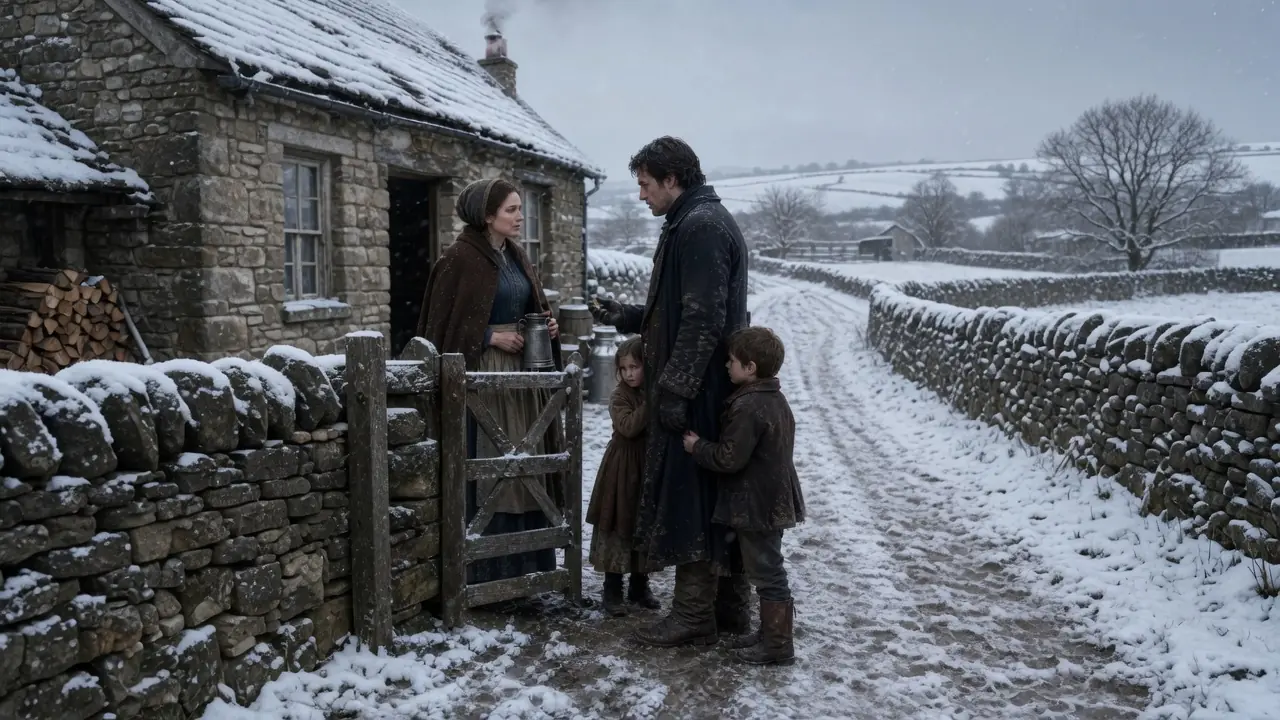
Florence stopped at the snow-whitened gate, a wicker basket crooked over her arm, as Benedict Vassell, Duke of Dunham, removed his battered hat. A little girl clung to one side of his torn greatcoat, a smaller boy to the other. Before Florence could ask why a duke had come without a servant, the girl swayed, and Florence saw the folded notice bearing her own name inside his coat. The wind off the Berkshire Downs drove ice across the yard. Behind Florence, smoke lifted from the low dairy cottage. Behind Benedict, the lane had vanished beneath the storm. She had known him before an elder brother's death made him a duke, before her own brief marriage ended in widowhood. The younger son who once argued with her at this gate had become a stern man in torn clothes, offering himself as a laborer to the widow whose tenancy his agent meant to end at Lady Day.
The girl's knees softened again. Florence set down her basket. She unhooked the small pewter measure from the gatepost, where she had left it after feeding a weak calf, and crossed to the milk can by the dairy door. The measure bore two worn initials: F.M. She filled it to the rim and held it to the child.
"Slowly," she said. "You will lose it if you drink too quickly."
The girl obeyed with solemn concentration. Warm milk left a pale line on her upper lip. The boy watched every swallow but did not ask for his turn. Benedict's face did not change. Only his hand tightened around the brim of his hat. When the girl had finished, Florence filled the measure again and gave it to the boy. He held it in both hands. His fingers were so cold that the pewter knocked against his teeth.
Benedict reached inside his waistcoat and drew out a heavy gold signet ring.
"Security," he said. His voice was low and stripped of ceremony. "For their keep."
Florence looked at the crest, then at the children.
"I cannot feed cattle with gold, Your Grace."
She closed his fingers over the ring.
"The south wall has lost six stones. The lower ditch is choked with frozen reeds. There are turnips to be hauled before the storehouse roof gives way. That will be your payment."
He glanced past her at the yard, measuring the work.
"Agreed."
There was no protest and no offended pride. He merely put the ring away. Florence lifted the gate latch. It stuck halfway, as it had every cold morning since November. Benedict reached for it, but she gave the iron a practiced upward twist and freed it herself.
"You may begin by learning which things here require strength," she said, "and which require sense."
For the first time, something moved behind his stern expression. Not amusement, perhaps, but recognition. He ushered the children through. The little girl paused beside Florence.
"I am Beatrice."
The boy pressed his face against his father's coat.
"And this is Thomas," Benedict said. "He has not spoken to strangers since his mother died."
Florence did not bend over him or offer pity.
"Then Thomas may speak when he has something worth the effort."
The boy looked at her. She led them toward the dairy stove while the storm erased their footprints behind them. Inside, the air smelled of warm milk, hay, and wood smoke. Florence settled the children on a bench near the iron stove and wrapped Thomas in the wool blanket she usually kept for night calvings. Benedict remained by the door until both children had stopped shivering. Only then did he remove his coat. The folded document in his inner pocket slipped farther into view. The wax had been broken. Across the top, in a clerk's careful hand, Florence read: Merton Tenancy Notice of Review.
He caught her glance.
"My carriage broke an axle on the upper ridge," he said. "The coachman and footmen went toward the village for horses. The snow came down before they returned."
Florence opened the stove door and added a split log.
"The upper ridge does not lead to my valley unless one leaves the post road."
Silence gathered between them. Benedict took the rough towel she offered.
"My cousin Lambert advised me to refuse your petition without reading it. He says a widow cannot maintain a dairy holding through another winter."
"And you came to discover whether I was as helpless as he hoped."
"I came to inspect the farm myself."
"Then your inspection begins before dawn," she said. "The red cow kicks if approached from the left. The barn latch must be lifted before it is pulled. And if you wake the children, you may settle them yourself."
His eyes held hers.
"Very well."
The storm closed the road before nightfall. Florence gave the children her bed and moved her own blankets to the small box room beside the kitchen. Benedict insisted upon sleeping in the detached bakehouse, though its hearth smoked and the wind found every crack in the stone.
"You will freeze there," she told him.
"My presence beneath your roof would be repeated in the village long after the weather is forgotten."
"I am a widow, not an unmarried gentlewoman requiring a chaperone at every door."
"You are a tenant whose renewal is being judged by men eager to call every independence improper."
That answer stopped her. He had seen the danger without pretending she was too delicate to name it. She gave him another blanket and the key to the bakehouse.
"The chimney draws better if the lower vent is left open."
He took both.
"Thank you."
"Do not thank me until morning."
He was in the barn before she was. Florence entered with a lantern and found the Duke of Dunham standing ankle-deep in straw, holding a pail in one hand while the red cow regarded him with open hostility.
"You approached from the left," Florence said.
"I gathered that."
A dark bruise had already begun on his thigh. She set down the lantern.
"A title teaches many things, I suppose. Not all of them useful."
"Today I intend to improve my education."
Florence showed him how to brace the pail and rest his forehead against the cow's flank. His hands were strong but untrained. Beatrice appeared at the barn door in Florence's sagging wool stockings. Thomas stood behind her with a wooden spoon held like a sword.
"Papa is milking a cow," Beatrice announced.
"Papa is being tolerated by a cow," Florence corrected.
The children laughed. Thomas made no sound, but his eyes brightened. That day, Benedict carried hay through deep drifts, rebuilt the south wall twice at Florence's insistence, and hauled turnips while Beatrice counted and Thomas carried one at a time. Florence worked beside them, forking hay and checking hooves. A duke's labor did not lessen her own. Near dusk, Benedict found her struggling with the gate hinge.
"Sense?" he asked.
"In summer."
She gave the iron its upward twist.
"In winter, it requires profanity, which I reserve for solitude."
He took the gate's weight while she drove a wedge beneath the sagging post. Together, they freed the hinge. It was the first task they completed without one directing the other. The following morning, the road remained buried. The next day, snow fell again. A parish coal cart forced its way down the lane on the third afternoon. Mr. Pike, the driver, stared from the ducal crest on the half-buried carriage to Benedict carrying a sack of meal across Florence's yard. His stare widened further when Beatrice ran after her father with a mitten in each hand. By evening, the village knew.
On the fifth day, a rider arrived with a sealed letter from Dunham Manor. Benedict read it beside the kitchen window. His face became still in the particular way Florence remembered from their youth, the stillness that came when anger had been forced into a narrow space.
"Lambert has heard where we are," he said. "He claims my continued stay will be used as proof that your petition was gained through improper influence. He proposes to remove the dairy from your management until the matter is settled."
Florence folded the drying cloth in her hands once, then again.
"He means to take the herd before Lady Day."
"Yes."
"And you intend to stop him?"
"I intend to send word that we are betrothed."
The cloth went still. Benedict continued in the same practical tone.
"A declared engagement would answer the charge of secret influence. It would also prevent Lambert from presenting your presence near the children as an impropriety."
Florence looked at him across the scrubbed table.
"You would protect my name by placing yours over it."
"It is the quickest defense."
"A lock is also a defense. It remains a lock."
His jaw tightened.
"I am not asking you to marry me."
"You are asking me to wear a promise you do not mean so that your family will consider me respectable."
"I am offering the only shield they cannot ignore."
"And I am telling you that a shield held too close may become a cage."
Beatrice and Thomas were in the next room arranging turnips by size. Florence kept her voice low. She would not let them hear adults making a bargain over another woman's life. Benedict's anger did not rise. Instead, he waited. That restraint mattered more than an apology would have. Florence went to the narrow desk where she kept her ledgers. She drew out a sheet of rough paper, dipped her pen, and wrote four terms:
The engagement ends at Florence Merton's word.
No servant or agent from Dunham Manor shall direct the dairy.
The Duke's labor continues in payment for his children's keep.
No promise shall be made to the children on Florence Merton's behalf.
She turned the paper toward him.
"If we are to lie," she said, "we will at least tell the truth about who governs my life."
Benedict read every line, took the pen, and signed. Then he added one sentence beneath his name:
No change to these terms shall be valid without Mrs. Merton's consent.
Florence read it twice.
"You have made your own authority inconvenient," she said.
"It has been too convenient for other men."
He removed his signet ring and set it upon the paper.
"Then keep the security until the arrangement ends."
Florence wrapped the ring inside the signed terms and placed both in her desk. She did not wear it. That evening, Beatrice drew a charcoal line beneath the measure's handle.
"One day, Papa worked for our milk," she explained.
"You will run out of room," Florence said.
"Then he must earn a larger cup."
Benedict, carrying wood, called her a severe creditor. Beatrice added another mark. The days formed a rhythm. Before sunrise, Florence and Benedict crossed the yard with separate lanterns. He broke ice from the troughs while she milked. Beatrice scattered feed for the hens. Thomas followed Florence from barn to dairy, solemnly carrying cloths or wooden spoons. At noon, they ate whatever could be spared. At dusk, they checked the gate, the roof, and the weak calf Florence had named Clover, because hope sometimes required insolence.
Benedict learned quickly. He stopped trying to overpower stubborn latches and watched how Florence handled them. He began setting the milk pails in the order she preferred, cleanest nearest the stove. When he noticed that the handle of her left pail cut into her fingers, he wrapped it with a strip of softened leather from his ruined boot. He did not present it to her. She found it ready before morning. Florence ran her thumb over the neat binding. Neighbors praised her fortitude because praise cost nothing. Benedict had given up part of his only sound boot.
That night, she left an extra warming brick by the bakehouse hearth. Neither mentioned the exchange. On the ninth morning, Florence poured the richest milk into the children's cups and a fair portion into Benedict's. She then turned toward the water crock and thinned her own. When she came back with the porridge, the cups had been changed. Benedict drank the watered milk without looking at her. Her cup sat warm and full beside her plate.
"You have interfered with the accounts again," she said.
"I have corrected an error."
"There was no error."
"You counted everyone except yourself."
Florence's fingers closed around the clay cup. The words were simple. They entered a place in her that grander kindnesses would have missed. She drank the milk. That afternoon, the weak calf failed to rise. Florence ordered heated bricks and more sacks. Benedict moved at once, holding the animal steady while Florence fed it warm milk from the pewter measure.
"Will she die?" Beatrice asked.
"She may," Florence said. "But not because we left her cold."
They stayed in the barn until after midnight. At last, Clover lifted her head and gave a weak, offended bleat. Thomas laughed aloud. The sound was rusty from disuse. Benedict turned toward his son, and for one breath, wonder, grief, and relief crossed his face without defense.
"Again," Florence told the calf, because she would not frighten the boy by making too much of him. "One more swallow."
Thomas came closer.
"I can hold it."
Those were the first words he spoke to her. Florence placed the measure in his hands and guided it beneath the calf's mouth. Benedict looked away, but not before she saw the brightness in his eyes. That was how he bore tenderness: by turning aside before anyone could witness what it had cost him. The storm returned two nights later. Near midnight, a violent gust tore a shutter from the upper loft. It struck the stone wall with a crack like a musket shot.
A scream came from the children's room. Florence dropped her mending and ran. Benedict reached the back door at the same moment, snow in his hair and his shirt hastily buttoned beneath his coat. Thomas thrashed in the narrow bed, eyes open but seeing nothing.
Benedict moved toward him.
"Thomas."
The boy recoiled until his shoulders struck the plaster wall. Benedict stopped. He did not seize his son. He did not command him to be calm. His hands lowered slowly. Then Thomas saw Florence. He scrambled from the bed and caught both fists in her skirts. Beatrice followed, clutching the pewter measure against her chest. Florence sank to the floor so the children did not have to cling upward.
"The shutter has broken," she said. Her voice stayed plain and steady. "The wood was rotten at the hinge. In the morning, Thomas will carry the nails. Beatrice will count them. Your father will climb the ladder because he is taller than I am, though not always wiser."
Beatrice gave a wet, startled breath that was almost a laugh. Florence continued, speaking of the morning. The south gate would need checking. Clover would be hungry. The hens would complain. The world beyond the dark still contained chores, and chores meant an hour after this one. Thomas's breathing slowed.
Benedict remained by the door. He watched Florence give his children no promises she could not keep, only the next morning, solid and near. When they slept again, Florence returned to the kitchen. She did not ask Benedict to speak. She filled the kettle, coaxed flame from the gray coals, and measured tea into the brown pot. He stood beside the hearth while she warmed two cups. For several minutes, the only sounds were the small crack of kindling and the wind pressing at the repaired shutters.
She handed him a cup. He held it without drinking. The baked clay warmed slowly against his palms, but the knuckles curved around it remained pale and cold.
"My wife died in January," he said.
He did not look at her.
"I was in London, disputing a boundary worth less than the horses used to reach it. By the time I returned, the fever had taken her. The children had been kept from the room. They thought she had vanished because they had displeased her."
Florence sat opposite him. She did not interrupt.
"For months, Beatrice asked every woman who entered the house whether she meant to stay. Thomas stopped asking. I dismissed a governess because they loved her and wept when she went to visit her sister. I refused every match Lambert proposed. I thought fewer attachments meant fewer losses."
At last, he looked at Florence.
"Tonight, they reached for you, and that frightened you."
"Yes."
The word came without rank or defense. Florence folded her hands around her own cup.
"You cannot spare them grief by teaching them never to trust happiness."
His gaze sharpened.
"And what has trust given you?"
The question struck too close. Florence could have turned away. Silence had protected her for years because silence allowed others to mistake endurance for peace.
"My husband left debts I did not know existed," she said. "Men who had praised his judgment came here to explain my own accounts to me. They called me brave when what they meant was that they did not intend to help."
Her voice tightened, but she kept it low.
"I do not need a man to save the dairy. I have saved it each morning before most men are awake. But I am tired of being admired for carrying what no one offers to lift. I am tired of every kindness arriving with a claim attached."
Benedict set down his cup. He lifted one hand toward her, then stopped before touching her. The choice remained hers. Florence looked at the calluses that had formed across his palm in her barn. Slowly, she leaned forward and rested her brow against his knuckles. One breath. No vow, no surrender of the farm, the future, or her name. Only the relief of not standing alone for the length of that breath.
Then she stepped back. Benedict lowered his hand.
"I will not attach a claim to it."
She believed he meant the touch. She feared he meant more. The next morning brought a letter from Dunham Manor. Lambert had summoned the principal members of the family to Candlemas. He intended to place Florence's tenancy before them as evidence that Benedict's judgment had been compromised. He also proposed sending the children to their great-aunt in Bath until a suitable household could be established at Dunham. The proposal had no legal force, but scandal did. A tenant widow accused of ensnaring a duke could lose customers before she lost her lease.
Florence read the letter once.
"Will they take us away?" Beatrice asked from the table.
Benedict knelt before her.
"No."
The certainty in his voice filled the room. Florence watched him. This was not the cold authority he used to end discussion. It was a promise made where it could wound him if broken. Three days before Candlemas, the thaw began. Snow slid from the roofs in heavy sheets. The lane turned to brown ruts between white banks, and the gate, swollen by wet, jammed before breakfast. Florence was carrying feed when she heard Thomas grunt with effort. He had both hands beneath the iron latch, his boots sliding in the mud.
"Strength will not mend it," she called.
He stopped. His face reddened, but he did not retreat behind the post. Florence set down the feed.
"What does it require?"
Thomas looked at the hinge. Then he placed one shoulder against the gate, lifted the latch, and twisted it upward as he had watched Florence do. The gate opened. He stared at it, startled by his own success.
"Sense," he said.
"Usually."
Beatrice ran through before it could close. Thomas remained by the post and held it for Florence. It was a small victory. No one praised him loudly. Benedict merely placed his hand upon the boy's shoulder as they passed. Thomas did not shrink from it. Lambert Vassell arrived before noon on a tall bay gelding, accompanied by two estate servants. He entered the dairy without removing his gloves. He was handsome in the polished manner of a man who had never carried anything heavier than another person's obligation. His gaze moved over Florence's plain gown, the children's bowls, and Benedict's mended coat hanging beside the stove. Then he saw the pewter measure on the shelf, marked with Beatrice's charcoal lines.
"How industrious," he said, picking it up. "Do you count His Grace's days by the cup, Mrs. Merton, or by the favor?"
"Put it down," Benedict said from the doorway.
Lambert turned the measure in his hand.
"The roads are open. The children return to the manor today. Mrs. Merton will be paid for provisions and removed from the holding until the review is complete."
"No," Florence said.
Lambert looked at her as one might look at a chair that had spoken. Benedict crossed the room.
"You no longer possess authority to suspend a tenant in my name."
"I possess the duty to prevent you from making the dukedom ridiculous." Lambert's smile thinned. "A false engagement to a dairy widow while laboring in her yard. If you persist, every drawing room in London will hear that she fed your children in order to purchase their father."
Benedict took one step closer. The room seemed to contract around him.
"You will apologize."
Lambert's color changed.
"To her?"
"To Mrs. Merton. Now."
The two estate servants lowered their eyes. Beatrice stopped breathing loudly. Thomas moved closer to Florence but did not hide behind her. Lambert set the measure down with a sharp click.
"I will not apologize for naming an ambition plain enough for anyone to see."
Benedict's hand closed at his side. For one instant, Florence thought he might strike him. The old Benedict would never have done it. The father who had crossed a storm with hungry children might. Then Benedict opened his hand.
"Leave my property," he said. "You are dismissed as my agent. The order will be in writing before sunset."
Lambert stared at him.
"And when she tires of playing mother?"
Florence stepped between the words and the children.
"You misunderstand me, Mr. Vassell." Her voice did not rise. "I have not asked to play anything."
She took the pewter measure from the table.
"The engagement ends today."
Benedict turned toward her.
"Florence."
"This is my term."
Pain crossed his face and disappeared. She went to the peg, took down her cloak, and gathered her ledger from the desk.
"I will stay at Mrs. Pike's keeper's cottage on the ridge until Candlemas. Your servants may feed the herd under my written direction. I will attend the review and speak for my tenancy myself."
"You need not leave," Benedict said.
"I do."
She met his eyes.
"Not because Lambert commanded it. Because the children must see that affection is not a rope adults pull from opposite ends."
Beatrice's mouth trembled. Florence knelt before her.
"I am not vanishing," she said. "Clover still needs feeding. Your father knows where the ridge cottage stands, and Candlemas is three mornings away."
"Will you come back?"
Florence could not promise what depended upon a choice she had not yet made.
"I will come to the manor and tell the truth."
Thomas held out the piece of charcoal he kept in his pocket.
"For the cup," he said.
Florence closed her fingers around it. She walked out with her ledger beneath her arm and the measure in her basket. She took no gold. Benedict did not attempt to stop her. That restraint hurt more than force would have because it proved he had heard every boundary she had drawn.
Mrs. Pike had lit the keeper's cottage hearth. From its single window, Florence saw Benedict return to the dairy between the children, one small hand in each of his. She turned away before longing made the choice for her. For two days, she sent instructions for the herd. Benedict's brief replies reported that Clover drank, the red cow kicked no one, and the gate remained sound.
The second note contained Beatrice's drawing of four figures beside a crooked cow. Beneath it, Thomas had written in uncertain letters: The gate needs sense. Florence kept the note by the hearth. At dawn on Candlemas, she dressed in her dark blue wool gown and brushed every trace of ash from the hem. She braided her hair plainly beneath her best bonnet.
In her basket, she placed the tenancy ledger, Benedict's signed terms, the charcoal, and the pewter measure. She did not go to Dunham Manor to ask for mercy. She went because her work deserved a witness, and because no man, not Lambert, not Benedict, not even her dead husband, would speak for her while she still possessed a voice. The manor's winter garden had been chosen for the gathering because Lambert believed glass, marble, and ancestral portraits would remind Florence of the distance between her station and theirs. It did.
Bare vines traced the winter garden's tall panes. Benedict's aunts, cousins, and two gray-haired trustees sat at a long table while servants stood against the walls. Florence entered alone. Conversation stopped.
Lady Agatha, Benedict's eldest aunt, raised a lace handkerchief toward her nose.
"The dairy appears to have accompanied her," she murmured.
Her sister looked at Florence's wicker basket.
"And she has brought the market with her."
One of the trustees examined Florence's wool gown before addressing Benedict.
"Surely the accounts of a dairy tenant may be inspected without admitting her to a family council."
Florence felt each word land exactly where it was meant to land: on the mud she had cleaned from her boots, on the hands no gloves could make delicate, on the name no ancestor had carved in marble. She set her basket on the table. Lambert stood at the head despite having been dismissed.
"Mrs. Merton has no place in a family discussion."
"Then you should not have made my name its subject," Florence said.
A younger cousin looked down to hide a smile. Lady Agatha did not. Benedict stood near the children in a dark coat and white neckcloth. His gaze found Florence's and held it. He did not come to take her arm. He did not place her behind him. He moved one chair away from the wall and left it open beside the table. A place, not a command.
Florence remained standing. Lambert began at once. He spoke of compromised judgment, village gossip, the dignity of the title, and a widow who had exceeded every proper limit of gratitude. Lady Agatha nodded when he described the false engagement as a humiliation. One trustee questioned whether a woman managing livestock could be expected to understand the long obligations of an estate lease. Lambert proposed that Florence's tenancy expire at Lady Day and that the children spend the remainder of winter with their great-aunt.
Florence listened until he finished. Then Benedict spoke.
"Lambert Vassell was dismissed as my agent three days ago. His authority over the estate ended when he used my children's grief to threaten a tenant."
Murmurs moved along the table. Benedict's voice remained controlled, but it carried to the glass roof.
"My children will not be removed from my house. Mrs. Merton's lease will not be decided by gossip. Any person who insults her in my presence will leave Dunham and will not be invited again."
His gaze moved from Lambert to Lady Agatha.
"That order includes my family."
The handkerchief lowered. Florence felt the force of what he had done. He had used rank as a barrier against cruelty, not as a chain around her. He had cleared a space in which she could speak. He stopped there.
Lambert laughed once.
"You see? She has taught him to threaten his own blood. What does she offer that no governess or respectable wife could provide?"
Florence opened her basket. First, she placed the signed engagement terms on the table.
"This arrangement ended at my word, as His Grace agreed it would."
Then she laid down the dairy ledger.
"These are the winter yields, feed costs, repairs, and sales for the Merton holding. The herd has lost no animal. The dairy has met every payment due. The south field can support two additional cows if the lease is renewed for seven years."
The elder trustee reached for the book. Florence kept her hand upon it.
"You may read it after I have finished."
His brows rose.
"Mrs. Merton, these are estate matters."
"They became my matters when your former agent attempted to remove me without examining them."
The man withdrew his hand. Lastly, she set down the pewter measure. Charcoal marks circled its worn handle.
"I fed two hungry children because they were hungry. Their father worked because he would not accept charity. The marks were made by his daughter, not as payment for a duke, but as proof that promises were being kept."
Lady Agatha glanced at Beatrice. Her expression shifted, though she said nothing. Lambert's mouth hardened.
"A touching performance."
"No."
Florence faced him.
"A performance would be pretending I do not know what you offered me in exchange for leaving the county."
She drew a folded letter from the ledger's back cover: the written proposal Lambert had sent to Mrs. Pike that morning, offering Florence a stipend if she abandoned both the tenancy and the engagement before Candlemas.
"I refused your money before I entered this house. I refuse it again before your witnesses."
The younger trustee took the letter. His expression changed as he read. Lady Agatha turned her chair slightly away from Lambert. Her sister placed the lace handkerchief in her lap. Along the wall, a footman lowered his gaze, not from Florence, but from the man who had tried to purchase her silence. The change in the room was small and absolute.
Lambert saw it too.
"You still expect to marry him?" he said.
Florence looked at Benedict. This was the question she had crossed the frozen grounds to answer. Not whether a duke would choose her, but whether she could choose a life beside him without becoming another possession entered in an estate book. She unwrapped Benedict's gold signet ring from the signed terms and placed it on the marble.
"I do not want security," she said. "I want the Merton lease in my own name. I want the dairy to remain under my direction. I will not become a replacement for the children's mother, a grateful tenant, or a respectable answer to a scandal."
Benedict did not flinch.
"The lease will bear your name," he said. "Your dairy will remain yours."
"And if I choose this family, it will not be because winter left me no road away."
"Then choose when every road is open."
He stepped forward and offered his hand. Florence looked at it. Beyond Benedict stood the portraits, the servants, and the titled women who had smelled the dairy upon her gown. She saw herself entering those rooms as the Duchess of Dunham while Florence Merton, the woman who knew every cow by temperament, every account by heart, and every turn of the frozen gate, was reduced to a name used only on old ledger pages.
A duchess might be respected. Florence Merton might disappear. Her fingers moved, almost drawing back into her skirts. Benedict saw it. He did not close the distance.
Before Florence could answer, Beatrice slid down from the settee. The girl walked to the table, picked up the pewter measure, and carried it to the open space between Florence and Benedict. She placed it carefully on the floor, neither at her father's feet nor Florence's.
"We want you to stay," she said.
Thomas joined her. The room was larger than any he had entered since his mother's death. Every face had turned toward him. His hand trembled once at his side. Then he looked at Florence. He did not hide behind her skirts.
"Clover needs you," he said. His voice was quiet, but it reached the table. "We do too."
Florence looked down at the measure. F.M. remained stamped upon its side. Marriage could alter how a household addressed her. It need not erase the woman who had opened the gate. She turned to the children.
"You may love your mother and still care for me. You may be angry when I leave a room. You may ask whether I am returning. But you must never be required to call fear by the name of love."
Beatrice nodded. Thomas stood straighter. Florence looked once more at Benedict's open hand.
"I will keep my farm."
"Yes."
"My accounts remain mine."
"Yes."
"I will not be managed by Lambert's successor."
"There will be no successor between you and me. Your lease will state it."
She placed her hand in his.
"I choose to begin," she said. "Nothing more may be claimed today."
His thumb rested lightly over her pulse. Relief crossed his face, but he did not turn her measured answer into a grander one.
"Then we begin."
Lambert turned toward the doors.
"One thing more," Benedict said.
Lambert stopped.
"Your rooms at Dunham will be cleared before nightfall. You will draw no further money, carriage, servant, or credit from any estate account. You will not enter Dunham land again without my written permission."
Lambert's face lost what remained of its color.
"You would cast out your own cousin for a tenant."
"No," Benedict said. "I cast out an agent who threatened my children and attempted to purchase an honest woman's silence."
No one at the table spoke for Lambert. He left without farewell. The doors closed behind him with a weight that sounded final. Lady Agatha remained still. Her fan rested closed across one gloved hand. She did not look at Florence when she tapped its ivory guard once against the table and inclined it toward the elder trustee.
The gesture was slight, almost impatient. The trustee understood. He rose and formally requested permission to examine Florence's ledger. Her Ladyship offered no praise. She withdrew no former insult. She merely ceased opposing the truth.
Florence allowed the trustee to take the book. By sunset, the seven-year lease had been approved in her name. The false engagement was not renewed.
Benedict courted her properly. He used the front door, endured Mrs. Pike's watchful tea, and brought no jewels. Instead, he brought a new gate hinge from Reading and asked where Florence wanted it fitted. She made him set it twice. When the snow melted, Beatrice kept the old charcoal marks. Thomas added one when Clover ran. Florence added one when Benedict came through rain to mend the storehouse roof.
Thomas began opening the gate each morning. Sometimes it still resisted him. He no longer mistook resistance for defeat. Benedict learned to ask before lifting a burden from Florence's hands. She learned that accepting help did not surrender command. On the morning of their wedding, Florence stood before the small clouded mirror in Mrs. Pike's cottage, wearing the same blue wool she had worn at Candlemas. The gown had been brushed, pressed, and altered at the sleeves, but it remained hers. No silk had been laid over the woman Benedict had chosen.
Beatrice stood on a stool behind her, attempting to pin the bonnet ribbons evenly. Thomas guarded the box containing the ring. Mrs. Pike declared that all three of them were making a simple task impossible. A knock sounded at the door. Benedict entered only after Mrs. Pike called permission. He wore a dark morning coat, his neckcloth precisely tied. But Florence saw the familiar calluses when he removed his gloves.
His gaze traveled over her blue gown, the practical shoes beneath it, and the hands resting at her waist. He did not tell her she looked transformed.
"You look like yourself," he said.
Florence had not known until then how greatly she needed those words. The clasp at her throat had twisted beneath the edge of her cloak. Benedict noticed, as he had once noticed the pail handle cutting her fingers.
"May I?"
Mrs. Pike moved toward the window and became suddenly occupied with the weather. The children watched from beside the stool. Benedict's eyes remained on Florence's reflection. Still, he waited. She nodded.
He set the clasp straight with careful fingers. His knuckles brushed the wool, not her skin. In the mirror, Florence saw no duchess replacing a dairy widow. She saw Benedict standing behind Florence Merton, asking before he entered even this smallest boundary.
"Better?" he asked.
"Yes."
He offered his arm. This time, she took it without fear. They married in early April at the small parish church. The congregation consisted of villagers, estate servants, two silent aunts, and the children, who scattered primroses with more enthusiasm than order. Benedict wore the signet ring he had offered at the gate. When the vicar asked for Florence's vow, she spoke it clearly enough for the laborers at the rear to hear.
After the service, Beatrice insisted upon counting every bell. Thomas held the gate for the villagers as they passed. Lady Agatha offered Florence no embrace, but she remained through the final hymn and inclined her head before entering her carriage. It was enough for one morning.
The wedding breakfast waited at the farmhouse. Fresh bread, winter apples, and the first pale butter of the season covered the table. Florence had scarcely removed her cloak when a farm boy ran in to announce that Clover had chosen that morning to calve. Mrs. Pike groaned. Beatrice cheered. Thomas seized the pewter measure. Florence looked at her new husband.
Benedict removed his coat.
"I believe," he said, "that this is one of the things requiring strength."
"And sense," Florence replied.
"Fortunately, I married for expert instruction."
They crossed the yard together, each carrying a pail. Across the fields, the church bells still rang their softened notes, following the newly married couple all the way to the barn. Months later, sunlight filled the farmhouse kitchen. The lease rested folded in Florence's desk, where useful things belonged. Beatrice marked the pewter measure with charcoal. She no longer counted labor. One line stood for Clover's calf, one for the repaired gate, one for the morning Thomas read aloud, and one for the day Florence moved two gowns to the manor but left her work apron in the dairy.
Thomas passed bread to Benedict. Benedict looked across the table at Florence.
"I read your petition before the carriage broke."
She paused with the milk jug in her hand.
"I suspected you had."
"At the bottom of the final page, you wrote that a title mattered less than whether a man kept a promise made at a gate."
Florence remembered the sentence. She had written it in anger, then failed to scratch it out.
"You said the same thing to me when we were young," he continued. "I had promised to return your father's book before the rain. I returned it late and found you waiting beneath the gate arch."
"You ruined the binding."
"I have regretted it for twenty years."
"No. You have regretted being caught."
A quiet smile touched his mouth. Florence understood then. He had not turned from the post road merely to inspect a dairy. He had remembered the measure by which one plainspoken girl had judged him before anyone bowed to his title. He had entered the storm to discover whether he could still meet it. She poured thick, unwatered milk into his cup. Then she filled her own.
Four hands reached across the table for bread. Outside, the new gate opened without sticking, and somewhere in the yard, Clover's calf called for its morning feed. A family, Florence thought, was not made by the name above a door. It was made by the people who kept returning to the same gate and learned to ask before entering.