Brenner Salvage Yard, Norfolk. Tuesday, just past noon. Margot Sterling crossed the gravel in heels and a white blazer. Beside her stood Anita Bell, deputy chief of staff at the mayor's office, and two Sterling engineers. Hollis Brenner climbed down from the crane in oil-stained coveralls. He did not remove his gloves. Margot looked at Bell, then at him.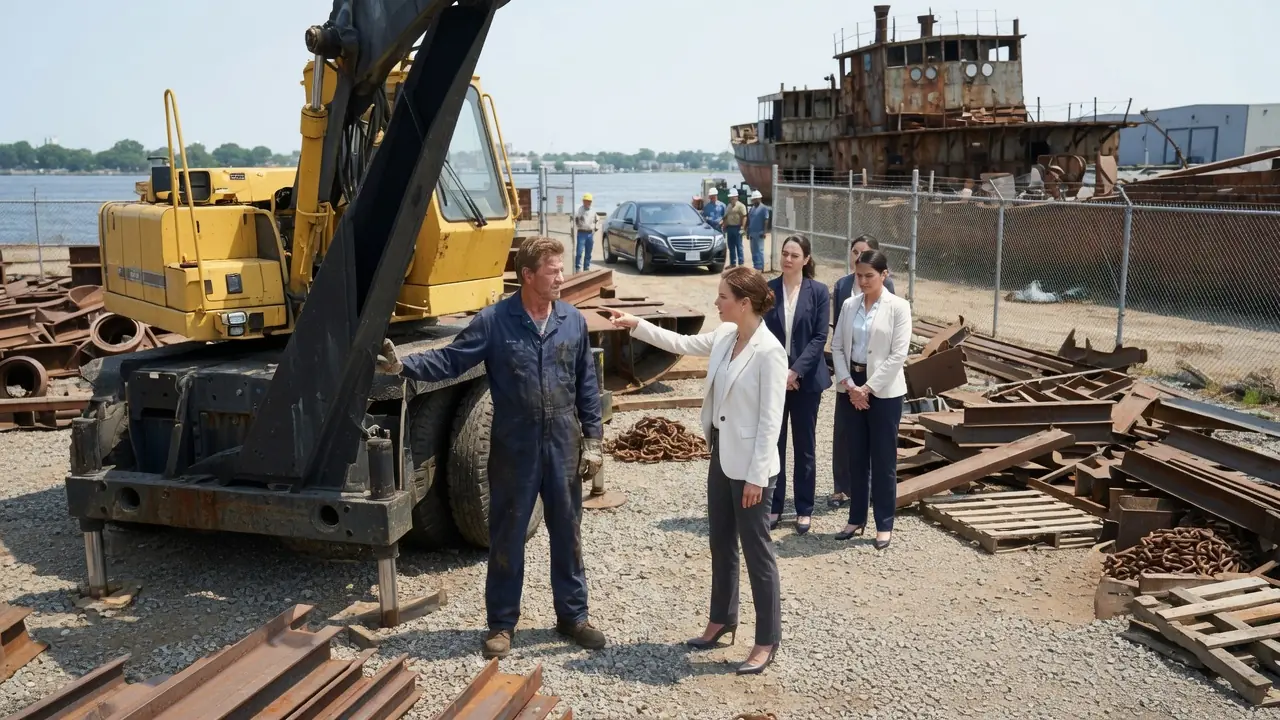
"Go back to your scrapyard, Mr. Brenner."
She turned, heels grinding rust. Bell did not follow at once. Hollis climbed back up. On Hampton Boulevard, a black navy staff car slowed at the gate. It did not stop. Not yet.
The yard quieted at 4:00. The crane went silent. The afternoon shift drove out one by one in pickups patched with primer. Hollis Brenner stayed behind to finish the Tuesday inventory on a clipboard, the way he finished it every Tuesday.
He marked each pulled section with a small clean check. He had been told three hours earlier to go back to his scrapyard. He had not answered. He had returned to the crane and finished the lift.
The words had stayed where she dropped them. He had walked past them on his way to the inventory shed and on his way back. They had not made him slower or faster than he already was. At 4:30, he locked the gate and drove the truck north to Willoughby Elementary.
The afternoon was warm. He pulled to the curb three minutes before the bell. Wren came out with her backpack bouncing and a folded paper in her fist. She climbed into the cab on her own.
"Miss Lynn read us a book about brown pelicans."
"Did she?"
"They dive. They eat. They don't waste anything."
"That sounds like a useful bird." She unfolded the drawing on her knees. The bird's beak was as long as its body. "Daddy, what is a scrapyard?"
He looked at her. She was tracing the outline of the wing with her finger.
"A place where things that broke get a second life."
"That's a good place."
"It can be." They stopped at the yard for ten minutes so he could sign a delivery slip. Wren wandered along the fence line and found a small piece of brass in the dust. She put it in her pocket. She did not see the white business card lying on the cinder block step by the office door. Hollis saw it. He bent down, picked it up, and put it in his shirt pocket without comment. At home in Willoughby Bay, he heated the casserole his uncle had left for him on Sunday. Bram Brenner came over at 6:00 with a paper bag of tomatoes from his back porch. Bram was 71 and the cancer in his lungs had taken most of his weight. But he came to dinner every Tuesday because he believed a girl Wren's age needed a third chair at the table. "How did the day go?" Bram asked.
"It went."
"That bad?"
Bram chewed slowly. He did not press.
"People do not usually like what they do not understand, son. You know that better than most."
Hollis did not answer.
He cut another piece of casserole for Wren and slid it onto her plate. Wren told Bram about the pelicans. Bram listened. After dinner, Wren brushed her teeth and asked for the pelican book from the library. Hollis read her two pages. She fell asleep on the third. He stood in the doorway for a minute looking at her in the half dark, the drawing on the nightstand under a stone she had brought home from the spit a year ago. When he came back to the kitchen, Bram was at the door with his coat on. They did not say good night. Bram tapped the doorframe twice on his way out. An old habit from the yard. Hollis listened to the truck pull away. He washed the dishes. He turned off the porch light. He sat at the kitchen table with his hands folded for a long time listening to the dishes soaking in the sink. The tick of the clock above the refrigerator and the slow breath of his daughter in the next room. He set the business card on the table. Sterling Maritime Solutions. Margot Sterling, Chief Executive Officer. He looked at it once and turned it face down. He went to bed at 10. He did not check his phone.
Margot Sterling drove south on Hampton Boulevard at 8:55 Wednesday morning with a folder in the passenger seat. Her father had taught her a long time ago that if you turn a man down you turn him down to his face. She had a formal audit to deliver in person. She had not slept.
She turned in through the open gate of Brenner Salvage Yard and parked beside Hollis's truck. He was at the south fence marking hull sections with white chalk. He looked up when her car door closed. He did not greet her.
He did not seem surprised. He went back to the chalk. She walked across the gravel with the folder in her hand.
"Mr. Brenner, I came to deliver the formal audit in person. Sterling Maritime will not be moving forward. I felt you deserved a face, not an email." He took the folder. He did not open it. He set it on the hood of his truck. "Thank you, Ms. Sterling."
That was all he said. She had expected anger or argument. She had not expected the simple acceptance of a man who had been carrying news worse than hers for longer than she had been a CEO.
At 9:07, a black navy staff car turned in from Hampton Boulevard and stopped on the gravel. Vice Admiral Cyrus Drake stepped out in service dress khaki, three stars on each shoulder. The driver's door opened and Senior Chief Daryl Halsey climbed out behind him. Drake crossed the yard at a measured pace.
He passed Margot without looking at her. He stopped three steps in front of Hollis Brenner and stood straight. "Captain Brenner, it has been four years." The yard noise had not stopped. The crane motor ran across the lot.
A gull called once over the river. The staff car ticked as it cooled on the gravel. Hollis pulled off his work gloves one finger at a time. He laid them on the hull section.
He did not salute. He stood the way a man stands when he is no longer required to.
"Sir."
Margot had not moved. The word captain was sitting in the air between them and she did not yet know what to do with it. Drake spoke loud enough for her to hear. "I came to ask you to do a job.
The Navy is preparing the sensitive system recovery on USS Halperin in Philadelphia. We need three civilian salvage partners with secret clearance and hull integrity experience. Yours is one of three yards on the East Coast that qualify. I came to ask you in person." Hollis listened without moving.
Drake turned then, for the first time, and looked at Margot Sterling. "Miss Sterling, Captain Brenner pulled your father out of 55-knot winds off Nantucket Shoals in 2014. He was a lieutenant then. He had the conn of a destroyer in seas that should have broken her. Twelve people came home.
Your father was one of them." Margot did not speak. Behind her eyes, the words from yesterday played again in her own voice. "Go back to your scrapyard, Mr. Brenner." Hollis turned back to Drake. "Sir, I appreciate the visit.
I am not coming back." Drake nodded. He did not argue. He reached into his breast pocket and took out a card. He placed it on the hood of Hollis's truck beside the manila folder Margot had set there minutes earlier.
"My door is open, Captain. It always will be." He turned and walked back toward the staff car. Halsey was already at the driver's door. Before he opened it, Halsey stopped beside Margot.
He spoke low, almost into the engine noise.
"Ma'am, what he carries, he does not tell people. Do not ask him about his wife." The door closed. The car rolled out of the yard and turned south. Margot stood on the gravel and did not move. The wind off the Elizabeth River carried gull cries and the smell of cut steel. She had not known he was a captain. She had not known he had been a lieutenant who had saved her father's life. She had not known he had a wife. Across the yard, Hollis put his gloves back on and went back to the hull. He did not look at her. He did not look at the card on the hood. He worked because work was what he did at 9:07 on a Wednesday in June.
At 9:42, she called her father from the parking lot of a gas station on Hampton Boulevard. She did not trust her voice in a building.
"Tell me about Nantucket."
Hugh Sterling was silent for a count, then began.
"It was March of 2014. The Atlantic tender lost main propulsion in a nor'easter off the shoals. We were drifting toward rocks. We were taking water through a cracked weld at the stern. We sent a mayday. The closest Navy asset was the destroyer Hawthorne. Captain Brenner was a lieutenant. He had the conn. He brought a destroyer into seas that should have broken her in 55-knot winds and held her bow to the wind for 40 minutes while his crew put a line on us. There was a chief at his shoulder who told me later it was the finest piece of ship handling that chief had seen in 26 years at sea. Twelve men came home. I am one of them. I would not be alive to build Sterling Maritime if he had stayed in the harbor that night. Margot, you owe him an apology. Not on paper. In person. With coffee in your hand and your head where it belongs."
She drove to the commissary on the base where her father had bought their household coffee for 30 years. The clerk recognized the name on her credit card. He brought down a tin from the back shelf. Navy blue label. The blend her father had carried home in plastic bags through the '90s. At 3:15, she returned to Brenner Salvage Yard. She did not call ahead. She filled a steel thermos in her car and walked across the gravel and set it on the hood of his truck. "My father said you would remember the brand."
Hollis looked at the thermos for a long time. He picked it up. He unscrewed the cap. He poured into two paper cups from the office shelf and held one out to her.
They sat on the cinder block step in front of the office. They drank the coffee. Bram Brenner walked past on his way to the gate. And when he saw Margot on the step, he nodded once.
It was the first time a man in that yard had acknowledged her. Wren came out of the office with a stone crab in her cupped hands. She knelt beside Margot to show it. Margot knelt back in her boots and her newer blazer and looked at the crab without touching it.
"Are you the lady from yesterday?"
"Yes."
"Daddy did not say anything bad about you."
Margot did not answer. She did not know what an answer would mean. Wren took the crab back to the spot under the office step where she had found it, set it down carefully, and watched it scuttle into the seam between two pieces of plywood. Then she went back inside.
Later that evening, after Margot had driven home and turned off her phone, Drexel Vance called her cell. She did not answer. He left a voicemail that was friendly and short. He invited Sterling Maritime to join the conversation on a project he was assembling. He called it the Elizabeth Riverside Renaissance. He said he would send the prospectus.
The prospectus arrived at midnight. She opened the PDF at her kitchen counter in her bathrobe with a glass of water in her hand. And the glass slipped a quarter inch when she saw what was in the center of the map, Brenner Salvage Yard. The full 8-acre parcel marked for rezoning to mixed-use residential. Anchor lot of a $42 million development. She did not call anyone. She did not sleep. By morning she had a list. She called Anita Bell at her office at 7:20.
"Anita, I need you to pull every land transfer in Hampton Roads for the last 36 months. Cross-reference Vance Waterfront Holdings and any LLCs that share registered agents."
There was a pause on the line.
"Margot, that is not a standard records request."
"You saw what I did on Tuesday. I am trying to undo it. Help me."
A longer pause.
"One favor. Use it well."
The records came in by encrypted email at 4:00 that afternoon. Margot laid them out on her kitchen table and worked until midnight with a yellow highlighter. She drew lines in red between each shell company and its registered agent. The agent's office was a strip mall storefront in Virginia Beach between a tax preparer and a dry cleaner.
The agent had filed 382 limited liability companies in the last 6 years. The same neat handwriting appeared on every form. By the time the coffee was cold, the pattern was on the paper. Vance Waterfront Holdings had acquired 14 contiguous parcels on the Elizabeth River through four shell limited liability companies.
Tidewater Real Holdings, Harbor View Group, East Norfolk Properties, Atlantic Coast Renewal. All four shared the same registered agent in Virginia Beach. The buying had begun 18 months earlier and had accelerated in the last six. Of the 14 lots, 13 were assembled.
The keystone, the one without which there was no waterfront access for the proposed condos, was Brenner Salvage Yard. Total estimated value after rezoning, $42 million. She drove to the yard the next morning. She did not bring coffee this time.
She brought the maps. She spread them on the hood of Hollis's truck the way she had spread the prospectus on her own kitchen counter. And Hollis stood beside her in his coveralls and looked. He did not seem surprised.
He nodded slowly. "Drexel Vance has been trying to take this yard since 2022. He just could not say why."
"Why does he want it?"
"Old story. I told it once. I will not tell it twice." He did not look up from the map. She did not push. Wren came out from behind the office with a white scallop shell. She held it out to Margot without explanation. Margot took it and put it in the pocket of her blazer. She did not know what else to do with it. Hollis watched his daughter hand something to this woman for the third time. He said nothing. That afternoon, Halsey came by with a foil-covered dish from his wife Marjorie, striped bass. For Bram. He set it inside the office, said hello to Wren, and on his way out he caught Hollis at the edge of the gravel. "Sir, there is something in my apartment safe you need to know. It is still there. When you are ready."
"Chief, I told you to burn it."
"With respect, sir, I did not, and I never will." Halsey climbed into his truck and pulled out of the yard. Hollis stood for a moment with his hand on the gatepost watching the dust settle. He did not call after Halsey. He did not need to. At her kitchen table that night, Margot took the scallop shell out of her pocket and set it next to the maps. She looked at the shell for a long time before she went to bed. She did not know exactly what she was doing. She knew only that she had begun to do it. Outside, on the water, a low fog was forming. By morning, it would lie across the salvage yard like a blanket. By morning, she would be back inside it.
Sterling Maritime Solutions and Brenner Salvage signed a memorandum of understanding eight days after Margot had told Hollis to go back to his scrapyard. The document was four pages. The first three were boilerplate. The fourth was a clause Margot had written herself in the early hours of a Saturday.
In the event of any third-party rezoning, eminent domain, or zoning variance action against the Brenner Salvage parcel, Sterling Maritime Solutions shall provide pro bono legal defense and full procedural representation without limit of time or expense until such action is resolved or withdrawn. Hollis read the page twice. He signed. "My daughter's name does not appear anywhere.
Not in a trust, not in the press, not in any filing."
"It does not." He set the pen down.
That weekend, on a Sunday afternoon that smelled of low tide and cut grass, Wren asked Margot to come with her to Willoughby Spit. Hollis stood by the truck at the parking pull-off and watched them walk down to the water. Margot had her boots in her hand. Wren had taken off her shoes a hundred yards back. "Do you like brown pelicans?"
"I do not know. I have never looked at one."
"Daddy says they are better than seagulls. Quieter."
Margot laughed. It was a small laugh, and it came out before she could stop it. Wren took her hand. The girl's fingers were sandy and cool.
They walked along the rack line until Wren stopped to pry a horseshoe crab shell out of the sea grape. The shell was the color of old paper. Wren held it up against the sun and turned it slowly so Margot could see the joints. A flock of brown pelicans crossed the channel low to the water, single file, the way they always crossed.
Wren counted them. Seven. Hollis stood at the truck with one hand on the bed rail and the other in his pocket. He watched.
He did not move. His mouth did not change, but the angle of his shoulders softened in a way only a man who had been holding them tight for 4 years would have noticed. He noticed. That night, after Wren was asleep and the dishes were washed, Hollis sat on the back step of his house in Willoughby Bay and looked out across the yard at the lights of the naval base.
The sound of a tug was on the water. He did not pray. He did not speak. He simply sat for a long time with his hands folded.
At 10:30, Margot's phone rang. The number was Marjorie Halsey's, called through her own phone, careful and roundabout. "Ma'am, Senior Chief Halsey, if you want to know why Drexel Vance wants that yard so badly, you need to read the 2021 Brenner audit. It is classified.
I have the unredacted raw logs in my apartment safe. Meet me at Cure Coffee on Granby Street tomorrow at 0700. Bring a manila envelope. Don't tell the captain." She did not say anything for a beat.
"I will be there." She set the phone face down on the counter. She did not turn it back over for an hour. She poured a glass of water she did not drink. She thought about the scallop shell on her windowsill, white as a piece of bone.
And she thought about Hollis at the truck on the spit. His hand on the bedrail, watching his daughter walk into the surf with a woman who was not her mother and not yet anything else. By sunrise, she would know what Drexel Vance wanted from Hollis Brenner. And she would know it was not the land.
Cure Coffee on Granby Street opened at 7:00 on weekdays. On the morning Margot drove in, the bell over the door rang into a half-empty room. Halsey was already at a corner table in jeans and a fleece with a paper cup in front of him and a kraft envelope on the chair beside him. She sat. He slid the envelope across.
"Read it here. Do not take it out of the building." Inside the envelope were two stacks. The first was photocopies of helicopter maintenance logs from HSC-9, the Tridents, dated through 2021. The second was a Navy report titled Atlantic Fleet MH-60 Maintenance Subcontractor Review, marked classified across the top of every page, dated December of 2021. The lead investigator was Commander Hollis Brenner. Margot read the first page, then the second, then the third. The report concluded that Vance Maritime Logistics, a subcontractor based in Chesapeake, had falsified 11 maintenance log entries across seven Atlantic Fleet helicopters between 2019 and 2021. One of those aircraft was an MH-60S Knighthawk, tail number 167840, which had gone down off the Virginia Capes in November 2021. Five crew members were lost.
The crash investigation had been conducted separately by the National Transportation Safety Board and a Navy Safety Investigation Board. Commander Brenner had been recused from that investigation because of his personal involvement. Margot turned the page. Among the five names of the lost crew, listed in alphabetical order, was Lieutenant Commander Eleanor Brenner, Nurse Corps.
Margot read the name twice. She read the rank. She read the corps. Nurse Corps. Eleanor had been a flight nurse, the kind of woman who flew toward people who were already broken to keep them alive. Margot put the report down. Her hand did not shake. Something behind her ribs did.
Halsey watched her. "He conducted the broader audit, ma'am, not the crash investigation. He could not touch the crash, but he could investigate the contractors. He chose what he could touch. Rear Admiral Drake, upper half at the time, signed the report and it was classified. Vance Maritime was debarred in December 2021. Lyle Vance died by suicide in January 2022. Hollis left the Navy in March 2022."
Margot closed the envelope. She drove to the yard with it on the passenger seat. Hollis was checking a generator behind the office. She held the envelope out.
"Halsey kept these."
He looked at the envelope. He took it. He looked at the first page. He set it down on the workbench without finishing. "I told them to burn it."
"Why did you not fight to publish it?"
He looked at her for a long count.
"Eleanor was not going to come back either way. Wren was four. She needed a father, not a man at hearings." The next words came out before Margot had planned them. They came out as a question because she did not yet have the right to make them a statement. "There is a public hearing on your parcel in eight days. When did you find out?"
"Fifty-two days ago."
"You did not tell me."
"I told you the day we met. I chose not to fight." She did not raise her voice. She did not have to. "You are going to fight now. And so am I." He looked at her. Then at the envelope on the workbench. Then back at her. He did not say yes. He did not say no. He picked up the envelope, walked into the office, and put it in the bottom drawer of his desk. On her way to the car, she called Anita Bell. "Anita, I need every Vance waterfront filing from the last 36 months in front of me before Friday. We are going to council."
The Norfolk City Council Chamber on the night of July 2nd was full to standing. The Norfolk Pilot had two reporters in the front row. A camera crew from WAVY had set up beside the second column. Anita Bell sat in the back in a navy suit with no notebook.
She had not announced she would be there. Hollis Brenner wore a gray collared shirt and dark slacks. No uniform. No ribbons.
He sat in the second row beside Margot Sterling. Drexel Vance spoke first. He had recused himself from the council vote in writing 3 weeks earlier. He spoke now as a private citizen.
He spoke about industrial blight. He spoke about environmental hazard. He spoke about a $42 million revitalization opportunity for the working families of East Norfolk. He did not look at Hollis when he said the word blight.
Margot Sterling rose when he sat down. She introduced herself as chief executive officer of Sterling Maritime Solutions, an active Navy contracting partner. She spoke into the microphone in a clean, even voice. She made three points.
First, Brenner Salvage Yard held current EPA Tier 3 metals certification and a Navy salvage Tier 2 operating license. There were two facilities on the East Coast that held both. The other was in Bath, Maine. The parcel under discussion was not blight.
It was a strategic asset. Second, she held up a one-page schematic. Vance Waterfront Holdings had assembled 14 contiguous parcels through four shell limited liability companies sharing a single registered agent in Virginia Beach. The acquisitions, the shell structure, and the rezoning timing suggested a possible conflict of interest involving a sitting council member who had only recused on paper.
Third, she moved to postpone the vote pending an ethics inquiry. A murmur went through the chamber. Drexel Vance leaned to his microphone. His voice was reasonable.
He had practiced it for many years. "Ms. Sterling defends a scrapyard owner. Why?" There was a beat of silence into which a great deal could have fallen. In the back of the chamber, a man in a civilian suit stood up.
He did not approach the microphone. He simply stood, hands clasped in front of him. The pilot reporter in the front row turned, recognized him, and wrote one line in her notebook. Vice Admiral Cyrus Drake, Vice Commander, United States Fleet Forces Command.
Anita Bell in the back did not stand. She did not have to. Drexel Vance lost his rhythm. He shifted the paper in front of him.
Hollis Brenner stood up. He did not approach the microphone for several seconds. When he spoke, he spoke from where he stood, with both hands on the back of the bench in front of him. "My wife flew helicopters into weather that would have grounded most pilots.
She did not die because she was unlucky. She died because someone falsified a logbook. I wrote the audit that proved it. The Navy chose to classify it.
I chose, at that time, not to fight that decision. I am choosing differently tonight." He looked toward Drexel Vance. "Mr. Vance, your brother Lyle made decisions that killed seven crew families. Mine was one of them.
I did not testify against him for revenge. I testified because the next family deserved better. I do not enjoy standing here. I am standing because the next family always deserves better." He paused.
He looked down at his hands on the bench in front of him. He looked up again. His voice did not break, but it dropped half a step. "My daughter still keeps a feather in her pocket because her mother told her the sky remembers people.
The sky should not have had to remember Eleanor. It should have brought her home." The chamber was very quiet.
The council voted to postpone the rezoning indefinitely and to open an ethics inquiry into Vance Waterfront Holdings. The Norfolk City Ethics Committee announced its investigation on a Friday. The Norfolk Pilot ran the shell company schematic on the front page above the fold the following Sunday. By Tuesday, Drexel Vance had resigned his council seat. The statement said "family reasons."
The next morning the yard was wet with river fog. Margot drove out at 6:30 and parked behind Hollis's truck. She did not know what she had come for. She came anyway.
He was in the office pouring coffee from an enamel pot into a beat-up metal cup the color of a tarnished spoon. He poured a second cup and held it out without looking up. She took it. The cup was warm.
The morning was cool. They stood at the office window and did not speak for a long minute. Outside, Wren came down the gravel path with something cupped in her palm. She pushed the office door open with her shoulder and walked straight to Margot.
She opened her hand, revealing a white gull feather, clean as paper.
"Daddy says these mean luck. Mama said they mean the sky remembers you."
She held it up to Margot until Margot took it from her. The room held very still. Bram Brenner watched from his folding chair in the corner. His oxygen tube looped over his ear.
He nodded. Slow. Once. Hollis stood at the coffee pot with the enamel cup still in his hand.
He did not look at his daughter. He looked at the floor. The angle of his shoulders moved one notch, the way it had moved at the truck on the spit. It was the first time in two years that Wren had said the word Mama in the open.
It was also the first time since the helicopter crash that the memory of her childhood kitchen had returned to the room where she stood. Margot put the feather in the inside pocket of her coat. She did not trust herself to put it anywhere else.
That afternoon Hollis's phone rang. Vice Admiral Drake was on the line from the vice commander's office at Fleet Forces. "Captain, I am calling to offer you a civilian advisor position with Eastern Surface Operations Recovery. You will not wear a uniform.
You will not deploy. You will share what you know on the work we have coming." Hollis listened. Then Drake continued, "Captain, I am calling to tell you something else. I was the officer who signed the classification of your audit in December of 2021.
I told myself it was protecting active programs. I was protecting my own decision-making. I was wrong. I am not asking you back because the Navy needs you.
I am asking because I owe you the chance to come back on your terms." Hollis was quiet for a long count. "Sir, I will think about it. Not for the Navy. For Halsey. He kept the file when I told him to burn it."
"Understood, Captain."
That afternoon, Bram was admitted to Sentara Norfolk General.
The doctor in soft tones said two to three weeks. Margot came to the hospital that night. She did not say much. She sat in the chair beside Bram's bed, and she sat for a long time.
She had brought a thermos of soup from a diner on Granby Street that Bram had liked when he was younger. He took two spoonfuls and laid the rest down. In a thin voice, he told her that her father had been a lieutenant on the USS Mason in the '70s when Bram had been a yard foreman on the same waterfront, and that the world had a way of folding itself back into the same shape twice if you waited long enough. Hollis watched her sit, and he did not say anything, either.
Hollis Brenner accepted the civilian adviser position with Eastern Surface Operations Recovery on August 1. He did not put on a uniform. He kept the yard. He drove to Fleet Forces twice a week.
The rest of the week he was in coveralls. Sterling Maritime Solutions and Brenner Salvage signed their full partnership agreement for the USS Halperin Sensitive System Recovery on the same day. The contract was 31 pages. The 32nd page was a rider Margot had written in pencil first and then in ink.
The Wren Eleanor Brenner Educational Trust, 4% of net annual profit in perpetuity, to be split between an educational fund for Wren Brenner and scholarships for five children of Norfolk Naval Station personnel each year. The trust documents listed the full middle name, Eleanor, for the first time in any legal filing in four years.
Hollis read the rider. He set the pen down. He did not pick it up for nearly a minute. Then he signed. "Eleanor would have signed this herself."
He said no more.
Bram Brenner died at Sentara Norfolk General twelve days later. It was a Sunday morning, quiet, the kind of dying that has had time to prepare itself. The funeral was held at St. Mary's on Chapel Street, East Norfolk. The church was small and full.
Halsey, Faye, and Marjorie were in the third pew with Kayla. Anita Bell came in late and stood at the back. Drake did not come. He sent a letter that Hollis read alone on the porch the next morning and did not show to anyone.
Hugh Sterling came down from Virginia Beach for the service. He stood in the back of the church beside his daughter. After the burial, in the parking lot behind the church, he walked over to Hollis and held out his hand. They shook for a long count.
"Captain."
"Sir."
That was all that was said. It was enough. Bram's will, simple and short, transferred Brenner Salvage Yard in full to Hollis Brenner. He inherited the office, the cranes, the eight acres along the Elizabeth River, the books in the desk, and the framed photograph on the wall of the office showing his father in 1978 standing on the deck of a tugboat with a wrench in his fist.
The following Friday, the Halsey family came to dinner at Hollis's house in Willoughby Bay. Marjorie brought a casserole. Kayla brought a deck of cards and a small stuffed dog. Margot brought nothing because she had been invited, not summoned.
Wren fell asleep on the sofa after dessert with the gull feather in her hand and the stuffed dog tucked against her chest. Halsey carried his daughter out to the truck and kissed the top of her head. Marjorie hugged Margot at the door for two seconds longer than a stranger would. Margot stayed to wash dishes.
Hollis dried. They did not speak much. The water ran. The light over the sink hummed away.
She washed a plate. He dried it and set it on the rack. She washed another. He dried it.
They moved through the pile in a rhythm that neither of them had practiced and neither of them had to think about when the last plate was done. She pulled the gull feather out of her coat pocket and set it on the windowsill above the sink. It dried in the steam. It was not a declaration. It was a kitchen.
Six weeks later, in the second week of September, the wind from the Chesapeake had begun to bring salt all the way to the inland streets. The leaves on the dogwoods in the front yards of Willoughby Bay had started to redden at their tips. The light at 4:00 in the afternoon was the long slow gold of a coast about to turn. Margot Sterling drove to Brenner Salvage Yard in a gray sweater and no boots.
Sneakers. She parked beside Hollis's truck and walked through the gate without calling ahead. By now, she did not need to. Hollis was at the dock at the back of the yard where the gravel ended and the planks began.
He had a length of frayed line in his hand. Wren stood at his hip in a denim jacket. He was teaching her how to tie a bowline. "The rabbit comes out of the hole, around the tree, and back down the hole." Wren tied it wrong on the first try.
He showed her again. She tied it right on the second try. She held it up for him with both hands, and her face was as proud as any face Margot had ever seen on a child. "There you go." He let her try a third time.
She tied it again, faster, surer, and held it up. Hollis took the rope, untied it, and handed it back. He nodded once. Wren tied it a fourth time, each loop a little tighter than the last.
He looked up then and saw Margot at the edge of the planking. He did not say anything. He held out his hand. She walked over.
The three of them went out to the end of the dock. Low tide, late afternoon. The river going gold and quiet. Wren ran ahead to look for shells in the exposed mud.
The water made the small slow sound that the Elizabeth River makes when it is not in a hurry. Hollis stood beside Margot. He did not turn to look at her. He looked across the water.
"You once told me to go back to my scrapyard."
"You did."
"And I came with you." He let the silence sit. It was the kind of silence that had room in it. After a while, he reached out and touched the back of her hand with the back of his. Just that. The lightest of contacts, the smallest of consents. Down at the mud line, Wren held up a clam shell as long as her forearm and shouted something neither of them caught.
In an office on Norfolk Naval Station that same afternoon, a male clerk delivered a manila envelope to the vice commander's outer office. The envelope had no return address. Inside was a single 5-by-7 photograph. Hollis Brenner, Wren Brenner, and Margot Sterling at the end of a wooden dock at low tide with the river behind them.
Vice Admiral Cyrus Drake took the photograph into his inner office. He looked at it for a long minute. He set it on the corner of his desk beside the older photograph of the commissioning of USS Sentinel in 2018. With Commander Hollis Brenner at the lectern in dress blues.
He stepped back. He looked at the two pictures together. He did not salute. He bowed his head.
One small movement. And then he went back to work. He had gone back to his scrapyard. She had been the one who came with him.
And for the first time since the sky took Eleanor, the silence in the yard was no longer empty.